On the Eve of Circle's Earnings Report, Wall Street Shows Major Divergence in CRCL Valuation

marsbitPublicado em 2026-08-04Última atualização em 2026-08-04

Resumo

On the eve of Circle (CRCL) releasing its quarterly earnings report, Wall Street analysts are deeply divided over the company's valuation. Morgan Stanley downgraded Circle from "Equal Weight" to "Underweight," slashing its price target from $106 to $38. Analyst James Faucette argues the market overestimates the growth potential of Circle's core USDC stablecoin, noting its circulation hasn't increased since Q3 2025 and new use cases beyond remittances and card spending are limited. He warns that slowing USDC growth could pressure the crucial "reserve income" and shift revenue toward lower-margin transaction fees. In stark contrast, TD Cowen initiated coverage with a "Buy" rating and an $82 price target. Analyst Bryan Bergin believes the market underestimates Circle's potential to evolve from a stablecoin issuer into a broader digital financial infrastructure platform. He forecasts a ~31% annual growth rate for USDC through 2030 and expects faster growth in fee-based revenue from services like payments, RWA tokenization, and its Arc network. A key external factor adding uncertainty is the stalled progress of the CLARITY Act in the US Senate, whose delay could dampen institutional adoption expectations for stablecoins. The core disagreement lies in whether Circle's future hinges on USDC circulation growth or a successful platform-based transformation. The upcoming earnings report is keenly awaited for insights into reserve income trends and the progress of newer business verti...

Original | Odaily Planet Daily (@OdailyChina)

Author | Azuma (@azuma_eth)
At 8:00 AM Beijing Time on August 5th, stablecoin issuer Circle (CRCL) will release its quarterly earnings report before the US stock market opens. However, on the eve of this report, Wall Street has already shown a clear divergence regarding Circle's future value.

On August 3rd, Morgan Stanley (hereafter referred to as "MS") downgraded Circle's rating from "Equal Weight" to "Underweight" and significantly lowered its price target from $106 to $38.

Simultaneously, TD Cowen initiated coverage of Circle for the first time, assigning a "Buy" rating with a price target of $82.

The two institutions have presented completely opposing rating judgments. The core divergence reflected behind this lies in how to define the current Circle — is it still a stablecoin issuer dependent on the growth of USDC's scale, or is it evolving into a technology company transitioning towards a digital financial infrastructure platform?

Institutional Divergence: MS Bearish on USDC Growth, TD Cowen Bets on Platform Transformation

The MS analyst issuing the "Underweight" rating is James Faucette. On TipRanks, Faucette holds a four-star rating (out of five). He is widely considered an above-average sell-side analyst. Although Faucette's average return rate over the past two years is only 3.1%, his success rate in judgment is as high as 60%.
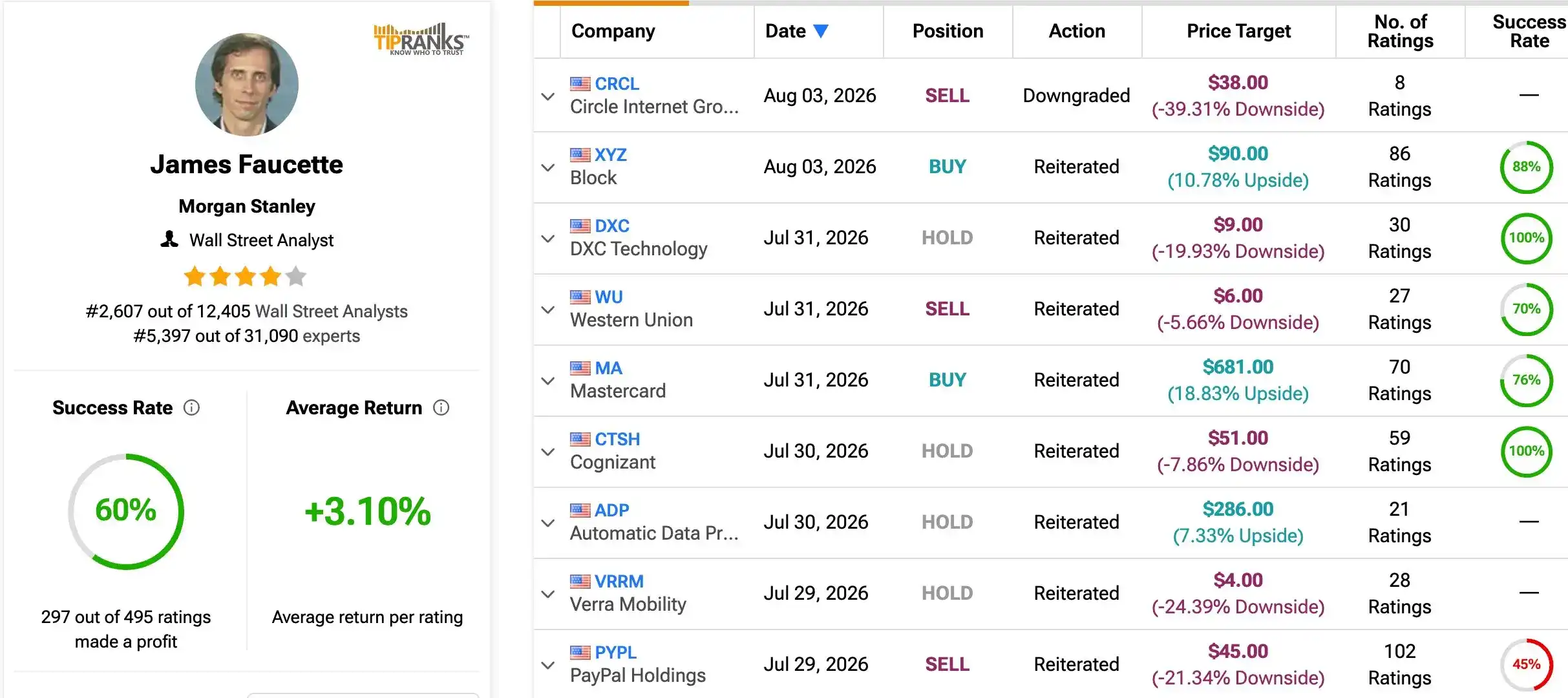
Faucette's bearish logic primarily revolves around Circle's current revenue model.

In his view, the market may have overestimated USDC's future growth potential, and the expansion speed of stablecoin use cases is also lower than previously expected — since Q3 2025, USDC's circulating supply has not actually grown. Currently, aside from remittances and stablecoin-linked card payments, no large-scale new use cases for USDC have emerged.

This suggests that Circle's most core revenue source, "Reserve Income," may face growth pressure. Currently, Circle's main revenue is highly dependent on investing USDC reserve assets in assets such as cash and short-term U.S. Treasury bills to earn interest income. Therefore, the growth of USDC's circulation is often seen as a key driver for the company's profit expansion.

Faucette believes that if USDC scale growth slows down, Circle's future revenue structure may gradually tilt towards transaction income, which has lower profit margins. Based on this judgment, he expects Circle's future earnings performance may fall short of market expectations and considers the current valuation to already reflect overly high growth expectations.

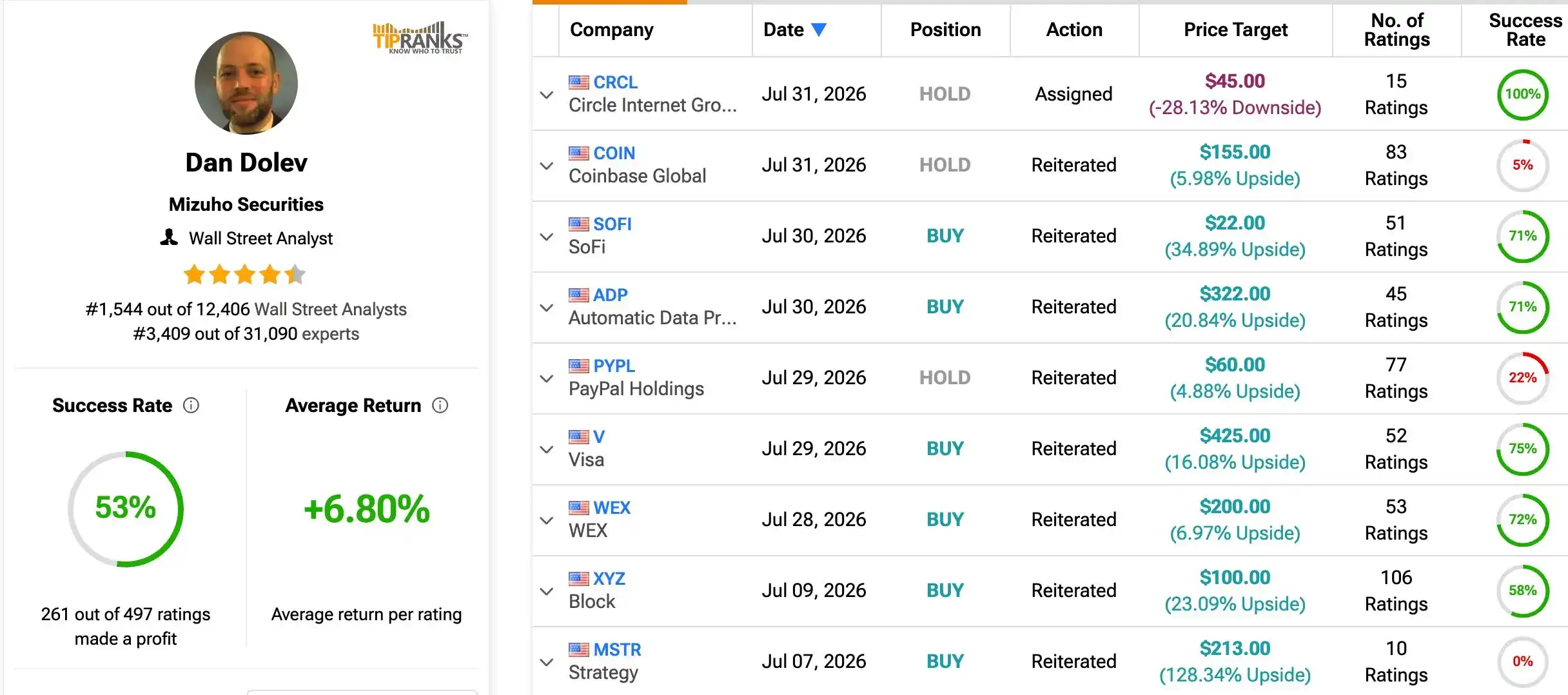
An analyst holding a similar bearish view to Faucette is Dan Dolev from Mizuho Securities. Dolev's rating on TipRanks is 4.5 stars, higher than Faucette's. This analyst assigned Circle a "Hold" rating last Friday but lowered his price target from $50 to $45.
As for TD Cowen, the analyst providing the "Buy" rating is Bryan C. Bergin. However, on TipRanks, Bergin's personal performance rating is only half a star, with a historical average return of -3.4% and a success rate of only 43%......
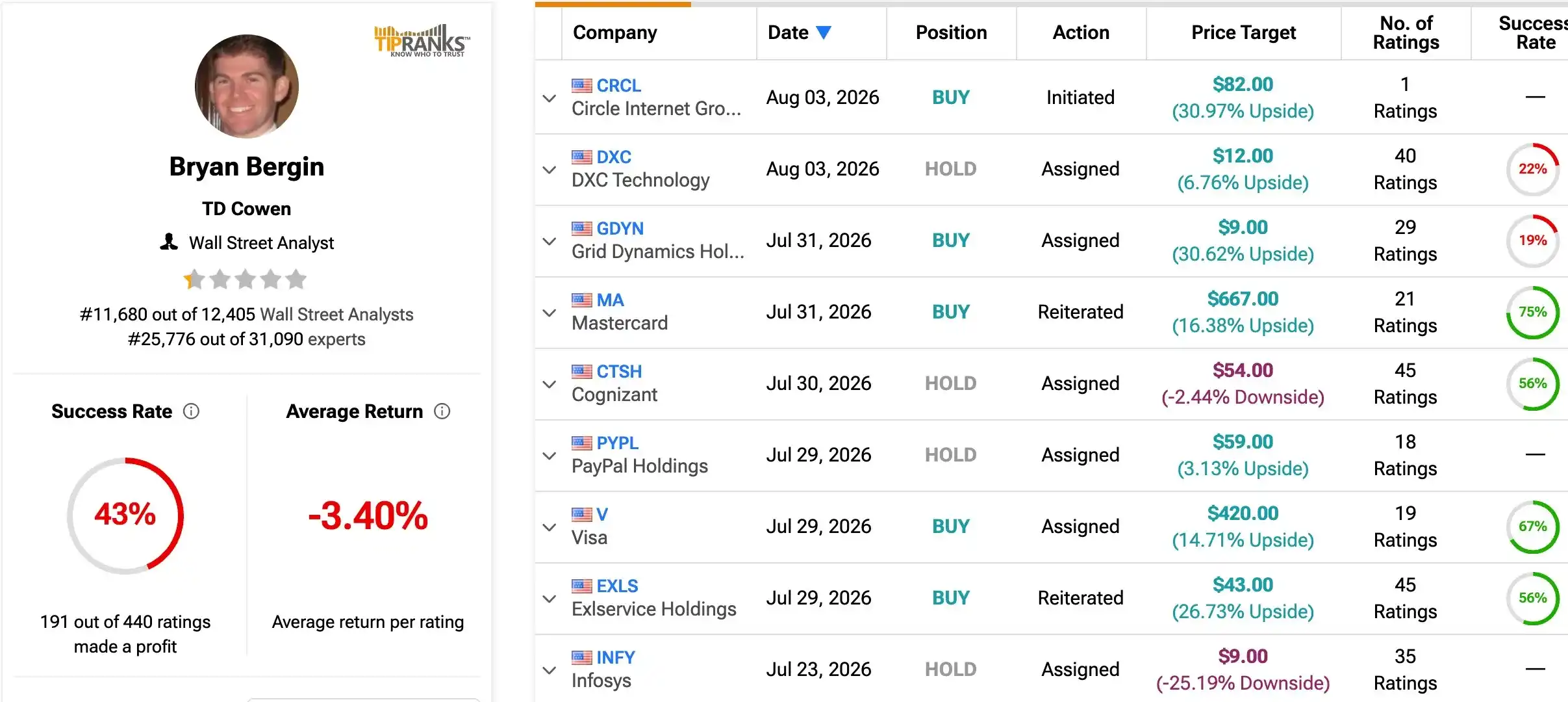
Bergin believes the market may currently be underestimating Circle's potential to transform from a stablecoin issuer into a broader financial infrastructure platform.

Within his analytical framework, Circle's future value does not solely depend on USDC's circulation scale, but rather on its ability to build a more comprehensive financial service ecosystem around stablecoins. This includes businesses such as payments, treasury management, real-world asset (RWA) tokenization, developer services, and blockchain infrastructure.

Bergin projects that by 2030, USDC's circulating supply could maintain a compound annual growth rate (CAGR) of approximately 31%. Simultaneously, fee-based revenue is expected to grow significantly faster than traditional reserve income. Furthermore, Circle's ongoing development of the Arc network is seen as a potential growth catalyst, which could further expand Circle's influence in the digital financial infrastructure space.

Another Recent Key Variable: CLARITY Act Progress

Apart from the company's own business model, regulatory progress is also a crucial factor currently influencing market expectations for Circle.

Previously, the market widely viewed the CLARITY Act as a key catalyst for further development in the stablecoin industry — if the bill is ultimately enacted, the issuance, trading, and related financial services of stablecoins would obtain a clearer regulatory framework, potentially reducing compliance uncertainty for institutional adoption of stablecoins.

However, as of now, the progress of the CLARITY Act has not been smooth. With only the final few working days left before the Senate's summer recess, market expectations for its short-term advancement have significantly declined.

  • Odaily Note: Refer to "So Close, Yet So Far: What's Stalling the Clarity Act?" and "What if the CLARITY Act Ultimately Fails?".

If the advancement of this bill continues to be delayed, the market may reassess the commercialization speed of the stablecoin industry and the growth expectations for Circle. Therefore, ahead of the earnings report, the uncertainty surrounding the CLARITY Act has also become a factor suppressing market sentiment towards CRCL.

Earnings Report Approaching, Market Awaits Circle's Answers

Ultimately, Wall Street's divergence regarding Circle stems not from short-term performance but from different judgments about the company's future positioning. Bearish analysts focus on whether Circle's traditional reserve income model can still support its current valuation if USDC growth slows. Bullish analysts are betting on Circle's ability to evolve into a digital financial infrastructure platform by leveraging its stablecoin business.

Therefore, in this earnings report, besides focusing on revenue and profit performance, the market will also closely observe the progress of reserve income (especially distribution agreements with Coinbase and other partners) as well as businesses like payments and RWA.

Following the release of tomorrow night's earnings report, Odaily Planet Daily will also provide an earnings analysis for everyone as soon as possible.


Perguntas relacionadas

QWhat are the two opposing Wall Street ratings for Circle (CRCL) just before its earnings report, and what are the respective target prices?

AMorgan Stanley ("Big Mo") downgraded Circle's rating from "Equal Weight" to "Underweight," slashing its target price from $106 to $38. In contrast, TD Cowen initiated coverage with a "Buy" rating and set a target price of $82.

QAccording to the article, what is the core disagreement among analysts regarding Circle's future?

AThe core disagreement is how to define Circle. One side (e.g., Morgan Stanley) sees it primarily as a stablecoin issuer whose growth depends on USDC circulation, while the other side (e.g., TD Cowen) views it as a tech company evolving into a broader digital financial infrastructure platform.

QWhat is the main reason cited by Morgan Stanley analyst James Faucette for his "Underweight" rating on Circle?

AJames Faucette's main concern is that the market has overestimated USDC's future growth potential and the speed of new use case development. He notes that USDC circulation has not grown since Q3 2025, and the lack of new large-scale applications could pressure its core "reserve revenue" model, potentially shifting revenue towards lower-margin transaction income.

QWhat potential catalyst for the stablecoin industry is facing uncertainty, and how might it affect Circle?

AThe potential catalyst is the CLARITY Act, which would provide a clearer regulatory framework for stablecoins. Its progress has been slower than expected, with low odds of passing before the Senate's summer recess. If further delayed, it could lead the market to reassess the pace of stablecoin commercialization and Circle's growth prospects.

QBesides revenue and profit, what specific business areas will the market be closely watching in Circle's upcoming earnings report?

AThe market will be closely monitoring the progress of "reserve revenue" (especially distribution agreements with partners like Coinbase), as well as newer business lines such as payments, real-world asset (RWA) tokenization, and its transformation into a financial infrastructure platform.

Leituras Relacionadas

Hong Kong Stock Market in July: Super IPOs Coexist with Wave of Breakings, Hard Tech Still the Main Theme

The Hong Kong IPO market in July presented a "two-tiered" scenario characterized by both a mega-IPO and a significant wave of new stock listings falling below their issue price ("breaking issue"). The highlight was Zhongji Innolight's (stock code: 03308.HK) listing on July 30, which raised approximately HK$53.41 billion. This marked the largest IPO on the Hong Kong exchange in nearly seven years since Alibaba's secondary listing. A prominent trend was the continued dominance of A+H listings, with companies like Luxshare (02475.HK) and others contributing significantly to the total monthly fundraising of around HK$116 billion. In stark contrast, the market saw a sharp rise in "broken issues." Out of 17 new listings for the month, 7 broke issue on their debut, with the rate climbing to 47% by month-end. Factors contributing to this included an intense concentration of listings (15 in one week), profit-taking by investors, and a market reassessment of valuations, particularly for companies with unclear commercial prospects. Despite the sell-off, hard tech remained the core theme, accounting for over 70% of July's listings. Key sectors were semiconductors and AI/autonomous driving. However, market enthusiasm became highly selective, with extreme over-subscription for certain niche players while others were heavily sold off. This signals a shift from speculative fervor towards a more value-driven assessment. Looking ahead, recent listing reforms by the Hong Kong Exchanges are expected to attract more tech firms. With a large pipeline of over 350 companies awaiting listing, including potential large offerings like SHEIN, the market is poised for continued activity. Analysts view July's correction not as a downturn but as a healthy valuation reset, emphasizing the need for investors to carefully discern company fundamentals.

marsbitHá 1h

Hong Kong Stock Market in July: Super IPOs Coexist with Wave of Breakings, Hard Tech Still the Main Theme

marsbitHá 1h

Wall Street Shows Sharp Divergence in CRCL Valuation on the Eve of Circle's Earnings Report

On the eve of its earnings report on August 5th, significant divergence emerged on Wall Street regarding the valuation of Circle (CRCL). Morgan Stanley downgraded Circle from "Equal Weight" to "Underweight," slashing its target price from $106 to $38. Analyst James Faucette argues that the market has overestimated the growth potential of USDC, noting stagnant circulation since Q3 2025 and a lack of major new use cases beyond remittances and card spending. He warns that slower USDC growth could pressure Circle's core "reserve income" and shift its revenue mix toward lower-margin transaction fees, making current valuations excessive. In contrast, TD Cowen initiated coverage with a "Buy" rating and an $82 target price. Analyst Bryan Bergin believes the market underestimates Circle's potential to evolve from a stablecoin issuer into a broader digital financial infrastructure platform. He focuses on future services like payments, asset management, RWA tokenization, and blockchain infrastructure, forecasting a ~31% CAGR for USDC circulation through 2030 and faster growth in fee-based revenues. A key external variable is the delayed progress of the CLARITY Act, whose uncertainty may pressure market sentiment by slowing regulatory clarity for stablecoins. Ultimately, the split centers on whether Circle's value hinges on USDC growth or its platform transformation. The upcoming earnings report will be scrutinized for details on reserve income, payment services, and RWA initiatives.

Odaily星球日报Há 1h

Wall Street Shows Sharp Divergence in CRCL Valuation on the Eve of Circle's Earnings Report

Odaily星球日报Há 1h

July Security Report: Total Losses Approximately $97 Million, Cross-Chain Bridge Attacks Concentrated with Over $35 Million

In July 2026, the cryptocurrency sector suffered total losses of approximately $97 million, with hacker attacks and contract vulnerabilities accounting for about $94 million. A significant trend was the shift in attack vectors from smart contract code to off-chain infrastructure, signature key leaks, and governance manipulation. Major incidents included: * **Ostium ($23.75M loss):** An attacker gained access to its off-chain price oracle signing system, manipulated BTC prices, and drained funds. * **AFX Trade Bridge ($24.15M loss):** The private validator key for its cross-chain bridge was compromised, allowing unauthorized withdrawals. * **BonkDAO ($20M loss):** An attacker acquired enough tokens to pass a malicious governance proposal and drain the treasury, exploiting low voting thresholds. * **Bonzo Lend ($9.05M loss):** A third-party oracle provider's signature verification was exploited to inject manipulated token prices. * **Verus Bridge ($7.55M loss):** A repeat attack exploiting the same unpatched bridge vulnerability. * **B2 Network ($3.86M loss):** An attacker seized the upgrade authority for a staking contract. Cross-chain bridges remained a prime target, with concentrated attacks causing over $35 million in losses. Phishing scams resulted in roughly $3 million in losses, employing sophisticated methods like fake mobile apps and physical counterfeit letters targeting Ledger users. Key takeaways are the acceleration of attacks on off-chain infrastructure, the persistent vulnerability of cross-chain bridges, and the rising prominence of governance-layer exploits. Recommendations include enhancing off-chain key management with multi-sig security, implementing stricter governance controls, and increasing user vigilance against phishing.

marsbitHá 1h

July Security Report: Total Losses Approximately $97 Million, Cross-Chain Bridge Attacks Concentrated with Over $35 Million

marsbitHá 1h

Trading

Spot
活动图片