After Missing the 20x, I've Found a 'Dumb' Method for AI Investing

marsbitPublicado em 2026-06-23Última atualização em 2026-06-23

Resumo

**Missing the 20x Opportunity: A Simple 'Dumb' Approach to AI Investing** The AI boom, driving NVIDIA's revenue from $60B to $216B in two years, creates immense investment pressure. However, like the internet bubble of 2000, the largest AI opportunities likely lie ahead, perhaps after a correction. Instead of rushing in now or waiting paralyzed for a crash, the author proposes a third way: building a "knowledge warehouse" by systematically mapping the AI industry to be ready when opportunities arise. The core of the strategy is understanding AI's four-layer value chain: 1. **Compute Infrastructure (The "Engine"):** This foundational layer, where all money eventually flows, includes: a) **Chip Design:** NVIDIA's dominance via its CUDA ecosystem, b) **Chip Manufacturing/Packaging/Memory:** TSMC's near-monopoly in advanced manufacturing and SK Hynix's lead in High Bandwidth Memory (HBM), c) **Optical Interconnects:** Essential for large-scale AI clusters (e.g., Lumentum, Coherent), d) **Cooling & Power:** Critical for high-density AI data centers (e.g., Vertiv), e) **Servers/Data Centers & Cloud Platforms:** The physical and virtual wholesale providers. 2. **Models & Tools (The "OS"):** The competitive layer of foundation models (OpenAI, Anthropic, Google, Meta, xAI), now generating real revenue. A key shift is the center of gravity moving from **Training** models to **Inference** (running models), which demands different chip characteristics and could challenge NVIDIA's mon...

Forty years ago, on October 22, 1978, Deng Xiaoping visited Japan for the first time. Traveling the 370-kilometer journey from Tokyo to Kyoto on the world's first high-speed railway—Japan's 'Hikari' Shinkansen—the Japanese accompanying personnel asked him for his impressions. He said: "It just feels like it urges one to run faster. So right now, we are just suited to ride such a train."

AI also has that effect of urging people to run faster.

Over the past two years, Nvidia's revenue has surged from $60 billion to $216 billion, and its stock price has increased tenfold. The wave of investment around AI has swept the globe—optical modules, data centers, cooling, robotics, AI applications—one wave after another. Every day there are new stories of price surges, and every day someone regrets not getting in earlier.

But while AI urges one to run, before running, one must first see the road clearly.

AI is the longest track our generation can encounter. The internet took ten years from 1995 to Google's IPO, and another eight years to Facebook's IPO. In between, it experienced the 2000 bubble burst, with the NASDAQ falling 78%. AI will likely follow a similar path—we might currently be in a position similar to 1998 or 1999. The truly biggest opportunities might only appear after the future bubble bursts, or perhaps they are hidden in some corner nobody is paying attention to today.

Currently, model capabilities are advancing at a rapid pace, capital is pouring in frantically, and valuations are pushed to uneasy heights. In this environment, there are two types of people:

The first type rush in to buy now—gambling that they've timed it right. They might make money, but are more likely to buy halfway up the mountain and then be shaken out by a correction.

The second type wait for the crash—but the problem is, when the crash really comes, will you dare to buy? Do you know what to buy? If you know nothing about this industry, you will only panic more in the face of panic.

I choose a third way: Don't rush to buy stocks now, but first build a position—build a 'knowledge position'.

Because no matter how AI develops, when the real opportunities appear, if we don't want to miss them—we must first become experts with a comprehensive understanding of the entire industry. So-called 'killer intuition' is nothing more than coming from a cognitive state of 'having a clear mental map'.

Starting today, I will begin doing something slow and 'dumb': systematically researching the AI industry from a holistic perspective, studying it bit by bit, understanding the entire AI industry chain from start to finish. Who is making money? Where does the money come from? Where does it flow? Who is irreplaceable? Who is feeding on leftovers?

So that when the day comes that the market gives us an opportunity—whether it's a crash, a correction, or some overlooked corner—I can make a judgment in seconds: 'Is this price worth acting on?'

Furthermore, in doing this, I will have two differentiators:

First, my investment foundation is solid. I have extensive experience and an extremely fast pace of evolution in investing. My return rate over the past three years, as my long-time followers are very clear, has reached a level few can match. Of course, the key isn't the return rate, as that might involve luck. The most important thing, and what is generally recognized, is my pace of evolution—I think this is even more crucial in the AI era. It's not about who is better, but about who evolves faster.

There's no need to dwell on the past. The future starts now. Let's 'wait and see'.

Second, I focus on one thing: how does this thing make money? My rapid evolution in recent years is mainly due to my focus: I only pay attention to the wealth opportunities behind phenomena. Most of the articles we see now teach you to use new Skills, new GitHub repos, pursuing trends and new things every day. These things are important, but from an investor's perspective, I care more about the wealth opportunities behind them.

When the iPhone 4 was released, did you, like others, marvel at the phone's design and performance, or did you research the investment opportunities behind it?

This article is the first in a series of research, aiming to do one main thing: light up the map. If systematically researching the entire AI industry chain is like playing a large open-world game—the first step isn't to rush to fight the Boss, but to first light up the map: which major regions, which key nodes, what is the main quest, what are the side quests. Once the map is clear, no matter what situation arises later, judgments can be made in seconds.

Chapter 1: Why View AI from a Holistic Perspective?

Nvidia's tenfold increase in two years is the most dazzling story in AI investing. But if you only see Nvidia, it's like only seeing one tree—you'll miss the structure of the entire forest beneath it.

Every major technological wave sees money spread outward along the industry chain, layer by layer. This has been repeatedly proven in history:

In the internet era, the first wave of money rushed into Cisco (network equipment), the second wave into Google, Amazon (platforms), the third wave into Facebook, Netflix (applications). In the mobile internet era, the first wave was Qualcomm (chips), the second wave was Apple (terminals), the third wave was WeChat, TikTok (super-apps).

AI is no exception. We can see a rough diffusion chain:

First Circle (2023-2024, already fully priced): GPU—Nvidia
Second Circle (2024-2025, currently being priced): Optical Interconnect, Power—LITE up 16x, Vertiv up 10x
Third Circle (2025-2026, not yet fully priced): Cooling, Storage, Specialized Foundry
Fourth Circle (2026+, awaiting catalyst): AI Applications, Energy Infrastructure, Robotics

For investors, the key insight is: The more foundational the infrastructure layer, the fewer players, the lower the substitutability, and the stronger the pricing power.

There might be thousands of companies competing in the 4th layer AI applications. This is why Nvidia earns $216 billion a year, while most AI application companies are still losing money.

But this also means that within the second, third, and even fourth circles of the infrastructure layer—those companies not yet labeled as 'AI concepts' by the market—may hide a wealth of opportunities. We need to first understand which players exist, what they do, and what they are worth.

Understanding this is significant because: When future market corrections, panic, or divergence occur, we will know where we should be looking.

The diffusion circles described above outline the sequence of market sentiment and capital flow—what money chases first, what later. But to truly understand the business logic of each segment, another map is needed: the hierarchical structure of the industry chain. Next, we will deconstruct it layer by layer, from the bottom up.

I divide the entire AI industry chain into a 4-layer structure, 4 main quest maps.

Chapter 2: Four-Layer Structure, Four Main Quest Maps

The four maps are: Computing Power Infrastructure, Model Layer, Middleware, Application Layer, plus one ultimate constraint: Power.

First Layer: Computing Power Infrastructure—The 'Engine' of AI

This layer is the physical foundation of the entire industry chain. All money—no matter which layer it flows in from—will ultimately settle here.

(1) Chip Design: The Arms King

Nvidia is the undisputed hegemon. In FY 2026 (ending January 2026), total revenue was $216 billion, with data centers contributing $193.7 billion—just two years ago it was less than $50 billion. This growth rate is unprecedented in semiconductor history.

What do these numbers mean? A specific example: training a cutting-edge large model costs hundreds of millions of dollars just for GPUs. And training is a one-time cost; after the model goes live, it needs to process hundreds of millions of user requests daily, each consuming computing power—this is the 'inference' cost. A model's lifetime inference cost can be more than ten times its training cost. This means as long as AI is being used, Nvidia continues to collect a 'tax'.

Nvidia's moat isn't just hardware. Its real barrier is CUDA—a software ecosystem with over 5 million developers. Like iOS for Apple, CUDA makes it hard for users to leave once they're in. AMD (MI300X) and Intel (Gaudi) are catching up, but the ecosystem gap is at least several years.

Another route is custom AI chips. Broadcom provides custom designs for Google's TPU, Amazon's Trainium, etc. The logic is simple: tech giants don't want to be 'choked' by one company forever. But at least for now, self-developed chips are supplements, not replacements.

Core Question: How long can Nvidia's monopoly last? Duan Yongping also said he doesn't understand—"Nvidia will definitely still be around in 10 years, but will it still hold its current market position?" This is a question worth trillions of dollars. And behind this, chip manufacturing involves a long industry chain, which has already boosted many companies. I will pay more attention to this.

(2) Chip Manufacturing, Packaging & Memory: The Armory

Chips designed need to be made. TSMC almost monopolizes the manufacturing of the world's most advanced AI chips. Nvidia, AMD, Broadcom, Apple's core chips are all fabricated by TSMC. In the 3nm, 2nm race, Samsung and Intel's foundry businesses lag far behind.

A more critical bottleneck is High-Bandwidth Memory (HBM). No matter how powerful an AI chip's computing power is, if data can't be 'fed' in, it's useless. SK Hynix leads the HBM field, with HBM3E being almost an exclusive supplier to Nvidia. Samsung and Micron are catching up, with a significant yield gap.

Advanced Packaging (CoWoS) is another capacity bottleneck—supply has been unable to meet demand for over a year.

Core Question: TSMC and SK Hynix's capacity is power. Whoever controls capacity controls the pace of the AI arms race.

(3) Optical Interconnect & Networking: The Nervous System

AI training clusters have expanded from thousands of GPUs to hundreds of thousands. How do chips communicate at high speed? Traditional copper cables hit a physical limit beyond 800Gbps—signal attenuation, power consumption surge, heat dissipation out of control. Optical interconnect is the only way out; this isn't something engineering optimization can solve, it's a hard constraint set by the fundamental laws of electromagnetics.

Key players: Lumentum (LITE, InP laser leader, 16x stock), Coherent (COHR, optical vertical integration), Tower Semiconductor (TSEM, silicon photonics foundry, I've previously written in-depth reports on this), Arista Networks (ANET, AI data center switches), Astera Labs (ALAB, connectivity chips).

Core Question: Optical interconnect is a second-circle opportunity—already being priced, but perhaps not fully priced yet. The key is distinguishing which companies still have room, and which are already priced in. I've recently written several reports related to this.

(4) Cooling & Power Supply: The City Sewer

Nvidia's latest GB200 cabinet power consumption is as high as 120 kilowatts. Putting tens of thousands of cards together generates astonishing heat. Liquid cooling has gone from 'optional' to 'essential'. Microsoft's two-phase immersion cooling technology has already reduced Azure server cooling energy consumption by 95%. Vertiv (VRT) is the leader in this field, with nVent (NVT), Modine (MOD) also growing rapidly.

Core Question: Not sexy, but indispensable. Typical third-circle—most people don't see it, but without it, AI data centers can't run. I will have related reports coming soon.

(5) Servers & Data Centers

Dell, Supermicro integrate chips, memory, networking, and cooling into AI servers. Equinix, Digital Realty provide physical facilities. CoreWeave (IPO expected 2025) is a representative of pure GPU cloud.

(6) Cloud Computing Platforms: Computing Power Wholesalers

AWS, Azure, GCP are the 'wholesalers' of computing power—the three clouds together account for about 65% global market share. Oracle became an unexpected winner with its AI cloud growth.

Second Layer: Models & Tools—The 'Operating System' of AI

This is the most watched, fastest-growing, but most uncertain layer in the AI industry chain.

Five strong contenders: OpenAI (GPT), Anthropic (Claude), Google (Gemini), Meta (Llama open-source), xAI (Grok). The revenue growth in this layer is staggering—Anthropic's ARR (Annualized Recurring Revenue) soared from $1 billion at the end of 2024 to $9 billion by the end of 2025, and surpassed $30 billion by April 2026.

Salesforce took 20 years to reach $30 billion in annual revenue; Anthropic did it in less than 3 years. OpenAI's current ARR is about $24 billion; the two combined exceed $50 billion. Model companies are no longer 'cash-burning stories', but real, gold-earning businesses.

But behind the revenue surge, there's a noteworthy structural change occurring: The focus of AI computing power is shifting from 'training' to 'inference'.

Over the past two years, AI's main computing power consumption was on training large models—pouring massive amounts of data to teach the model to understand the world. But once a model is trained, what follows is 'inference'—actually having the model answer questions and perform tasks.

Research by Deloitte shows that inference's computing power consumption had already surpassed training by the end of 2025, accounting for over 55% of AI cloud infrastructure spending. Some even point out, "In the past, 80% of computing power was spent on training and 20% on inference. In the future, this ratio will reverse."

What does this mean? The inference market may be far larger than the training market (projected to reach $255 billion by 2030), and inference's requirements for chips differ from training—it emphasizes cost efficiency and low latency more than extreme peak computing power. This could be a breakthrough point for challenging Nvidia's monopoly: AMD, Marvell (just received a $2 billion investment from Nvidia), and various self-developed chips are all targeting the inference market.

The most thought-provoking question in this layer is: Will AI models form an oligopoly, or will they be 'commoditized'?

Meta's Llama is free and open-source; DeepSeek created a competitive model at extremely low cost. GLM-5's current API packages are out of stock. Open-source is lowering the barrier to entry for the model layer. But 'commoditization' isn't that simple either—the capability gaps between models are narrowing but haven't disappeared.

Especially in deep usage scenarios, the experiential differences between models remain significant. Moreover, enterprises' API integrations, workflow customizations, and data accumulation create switching costs. The final landscape might be neither 'winner-takes-all' nor 'fully commoditized', but somewhere in between—a few major models occupy the primary market but maintain differentiated competition among themselves.

If profits in the model layer are compressed by open-source, real value will shift upward and downward. Upward to the infrastructure layer because everyone needs to run models, and computing power demand increases rather than decreases. Downward to the application layer because calling costs decrease, making AI applications easier to monetize. This process of profit redistribution might be one of the most important variables in the AI industry chain over the next few years.

Third Layer: Middleware & Platforms—The Glue Layer

The middle layer connecting models and applications. Representative companies: Scale AI (data labeling & AI evaluation, valuation $13.8 billion), LangChain (LLM application development framework), Hugging Face (model sharing platform, the GitHub of AI).

Most companies in this layer are not yet public and are relatively small. But once the AI application layer explodes, these 'glue' companies might experience explosive growth—just like Shopify and Stripe rose with the e-commerce boom. Worth continuous attention.

Fourth Layer: Vertical Applications—The Money Entry Point

Where AI directly creates value for end-users. Several directions:

Enterprise AI Platforms: Palantir sells AI operating systems to governments and enterprises. ServiceNow, Salesforce are grafting AI onto traditional SaaS.

Code Tools: GitHub Copilot is the de facto standard; Cursor is challenging it. The logic is clear—if AI can double programmer efficiency, every enterprise will pay.

Medical AI: Isomorphic Labs (under Alphabet, AlphaFold lineage) might be the most noteworthy long-term prospect, potentially IPO in 2027.

Robotics & Embodied AI: The direction with the largest long-term TAM (Total Addressable Market). Tesla Optimus, Figure AI, Unitree Robotics. But it's still very early.

Autonomous Driving: Waymo has the most mature commercialization; Tesla FSD is catching up with a vision-only approach.

The application layer is where a hundred flowers bloom and also the hardest layer to pick winners. But a noteworthy trend is: The global AI application market size is projected to exceed the upstream infrastructure market for the first time in 2026—money is shifting from 'building the city' to 'opening shops'. Meanwhile, AI Agents (autonomous agents) are becoming a new form of enterprise applications. By the end of 2026, over 40% of enterprise applications are expected to contain built-in AI Agent functionality, compared to less than 5% in 2025.

Cross-Cutting Dimension: Energy—The Ultimate Constraint of AI

All layers cannot avoid one question: Where does the electricity come from?

AI data center power consumption is growing exponentially. Microsoft has $80 billion in Azure orders that cannot be delivered due to insufficient power. This has sparked a wave of energy investment: Constellation Energy (nuclear), NuScale and Oklo (small modular reactors), GE Vernova (gas turbines).

AI will continue to expand; energy infrastructure is a derivative sector with extremely high certainty.

Chapter 4: Four Questions Beyond the Consensus

After drawing the map, the most valuable part isn't confirming consensus, but identifying what the market might be overlooking. Currently, I'm focusing on 4 questions, and subsequent research will start more from these angles.

Question 1: The shift from training to inference—whose fate will it change?

Over the past two years, the main demand for AI computing power was training large models. But now inference (making models actually work) has surpassed training to become a larger market. Inference has different chip requirements than training—more focused on cost-performance ratio than ultimate computing power.

This might open a window: Nvidia's monopoly in the training market is almost unshakeable, but the inference market is more fragmented. AMD, Marvell, Broadcom, and various self-developed chips all have opportunities. Meanwhile, the 'continuous consumption' nature of inference means computing power demand isn't a one-time event but grows continuously with AI application adoption—good news for the entire supply chain.

Question 2: Where is the return on the $600 billion investment?

In 2026, the capital expenditures of the five major tech giants will exceed $600 billion, but the revenue generated by AI applications is roughly a fraction of that figure. A similar input-output gap in history only occurred once—the telecom infrastructure boom in the late 1990s. The outcome then was bankruptcy for many fiber optic companies.

Of course, the key difference is: telecom companies back then relied on debt; today's tech giants rely on their own profits, with debt-to-asset ratios at historical lows. But if AI application monetization speed can't keep up, the capital expenditure growth rate will inevitably slow down—and this will ripple through the entire supply chain. Which companies' risks does this pose?

Question 3: What does the landscape of the second and third circles look like?

Nvidia is the first circle, already fully researched and priced. Optical interconnect and power supply are the second circle, being re-recognized by the market. What about the third circle? Cooling, specialized foundry, AI security, edge inference chips—which companies are in these segments? What are their business models? What is the competitive landscape? If these aren't clarified now, it will be too late when real opportunities appear. This is precisely what the subsequent layer-by-layer research aims to do.

Question 4: How does geopolitics affect the industry chain?

The U.S. export controls on AI chips to China are splitting the global AI industry chain in two. Nvidia's H20 is banned; China is building an independent AI infrastructure set. This means two parallel industry chains are both investing, potentially making the total volume larger than expected. But it also means some suppliers face the risk of 'choosing sides'.

Chapter 5: The Path Forward

The map is drawn; next is the main quest.

I will start from the first layer, delving into each segment one by one. Like clearing areas in a game—first do the main quest (the most core companies and logic of each layer), then the side quests (marginal but potentially surprising corners).

At each stop, clarify three things: What is the business model of this segment? What does the competitive landscape look like? What valuation level is it at? Once these three things are clear, no matter how the market changes in the future, we will have the basis for judgment.

Some Closing Remarks

While writing this industry chain overview, I remembered the LITE story.

I previously did an in-depth review of Lumentum (LITE) on my public account: 'How did others catch LITE's 20x in a year?' It's a textbook case: mid-2024, the market still viewed it as a 'telecom cycle stock', unwanted at $50 per share. But its essence was the 'nervous system' of AI data centers, with a 50-60% global share in InP lasers, the physical limits of copper cables, management expanding capacity counter-cyclically during losses, and book asset value higher than market cap.

All information was public, but I didn't have an industry chain map in my mind to recognize it.

Ultimately, all missed opportunities are not due to 'acting too slowly', but to 'researching too little'.

That's why I want to build a 'knowledge position'. AI is a sufficiently long track—long enough not to need anxiety about not getting on board now, but also not to do nothing and just wait. Understanding every layer, every segment of the industry chain is itself the best preparation. When the day comes that the market gives us an opportunity—whether in the ruins after a bubble burst, or at some suddenly appearing inflection point—with a map in hand, a judgment can be made in seconds.

'Killer intuition is not innate; it's earned through thousands of hours of research.'

Criptomoedas em alta

Perguntas relacionadas

QAccording to the author, what is the 'foolish but effective' approach to AI investment mentioned in the title?

AThe 'foolish but effective' approach is not to rush into buying stocks immediately, but to first build a 'knowledge warehouse'—to systematically research and understand the entire AI industry chain from the ground up, from the infrastructure layer to the application layer.

QThe article divides the AI industry chain into four layers. What are they, from the foundational layer upwards?

AThe four layers, from foundational to top, are: 1. Computing Infrastructure (the 'engine'), 2. Models & Tools (the 'operating system'), 3. Middleware & Platforms (the 'glue layer'), and 4. Vertical Applications (where value is created for end-users). Additionally, Energy is highlighted as a cross-cutting ultimate constraint.

QWhat key structural shift in the AI compute market is highlighted in the article, and what potential impact could it have on the industry landscape?

AThe key shift is the transition from 'training' to 'inference' as the primary driver of AI compute demand. Inference is projected to become a larger market than training. This could challenge NVIDIA's dominance, as inference chips prioritize cost efficiency and low latency over peak compute power, potentially opening opportunities for competitors like AMD, Marvell, and custom in-house chips from major companies.

QWhat are the 'four consensus-breaking questions' the author plans to focus on in future research?

A1. How will the shift from training to inference change the fate of different players? 2. Where will the return on the massive (over $600B) capital investment from tech giants come from? 3. What does the landscape of the 'second circle' and 'third circle' opportunities (like cooling, specialized manufacturing, AI security) look like? 4. How will geopolitics and export controls affect the global AI supply chain?

QUsing the example of Lumentum (LITE), what broader investment lesson does the author draw about missing major opportunities?

AThe lesson is that missing major opportunities like LITE's 20x rise is fundamentally not about 'acting too slowly,' but about 'researching too little.' The information was publicly available, but the lack of a comprehensive mental map of the AI industry chain prevented recognition of its crucial role in AI data centers (as a leader in InP lasers for optical interconnects). This underscores the value of building deep industry knowledge ('knowledge warehouse') before making investment decisions.

Leituras Relacionadas

Ethlabs Founded, Treasury Companies to Fund Ethereum Post-EF

Former Ethereum Foundation (EF) core researchers Ansgar Dietrichs, Barnabé Monnot, Caspar Schwarz-Schilling, Josh Rudolf, and Julian Ma announced the launch of Ethlabs, an independent non-profit R&D lab focused on Ethereum core protocol research and institutional-grade infrastructure. The initiative, backed by over 50 community participants including ETH treasury companies BitMine and Sharplink, Joseph Lubin, Hayden Adams, and Jesse Pollak, aims to make Ethereum the global economic settlement layer. This move comes amidst significant pressure on the EF, which has seen key departures and a strategic narrowing of its focus. A critical funding gap of approximately $30 million annually for core client development, following the expiration of the client incentive program, poses a near-term risk to the network's development. The context includes the evolution of ETH's value narrative. While mechanisms like EIP-1559 and the Merge previously supported the "ultrasound money" thesis, the success of L2 scaling via EIP-4844 has drastically reduced L1 fee revenue, leading to net ETH issuance and challenging that narrative. Ethlabs has listed ETH monetary economics as a primary research focus. Backing from corporate ETH treasuries like BitMine and Sharplink represents a strategic alignment, as these entities' asset values are directly tied to Ethereum's health and adoption. Their support is an investment rather than a pure donation. Ethereum's governance is shifting from a centralized EF model to a distributed network of specialized "manager nodes," including Ethlabs and a streamlined EF. While this promotes efficiency and reduces single-point failure risk, it introduces new challenges in coordination, priority alignment, and filling critical funding gaps across the decentralized ecosystem.

Foresight NewsHá 15m

Ethlabs Founded, Treasury Companies to Fund Ethereum Post-EF

Foresight NewsHá 15m

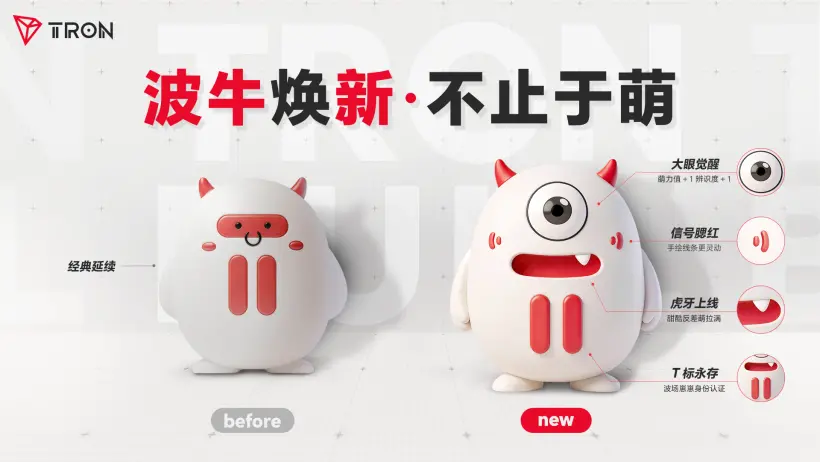
From Logo to Bo Niu: TRON Further Perfects Its Brand Visual Assets

On June 23rd, TRON completed a significant upgrade to its official mascot, Bo Niu. The revamped character features larger, brighter eyes, more expressive facial details, and a clearer "T" structural motif, while retaining its signature red-and-white color scheme and horned design. This refresh aims to enhance Bo Niu's approachability, emotional range, and versatility for use across social media, community interactions, offline events, and branded merchandise. The redesign focuses on creating a stronger first impression. A more open facial structure with distinct, expressive eyes and the addition of a mouth with a small fang make the character friendlier and more suitable for dynamic content like animations and emojis. Subtle brand elements are integrated, such as stylized cheek lines inspired by "signal" icons, referencing the "wave" in "TRON," and a "T" shape formed by its smile and chest markings. Bo Niu has also been given a more defined personality as "TRON's Chief Luck Officer," with traits like being playful and sweet. This persona provides a more accessible and emotionally resonant entry point to the TRON brand, contrasting with often technical Web3 narratives. This mascot upgrade is part of TRON's ongoing effort to build a comprehensive and extensible visual identity system, following its recent logo refresh. Bo Niu is positioned as a key asset to connect with users, foster community, and convey brand warmth in everyday contexts.

marsbitHá 19m

From Logo to Bo Niu: TRON Further Perfects Its Brand Visual Assets

marsbitHá 19m

TRON Refreshes the Bull Image, Creating a More Approachable Brand Character

TRON's official mascot "BONiu" (Wave Bull) has received a comprehensive visual upgrade. Retaining its core red-and-white color scheme, horned silhouette, and brand DNA, the refreshed character features larger, brighter eyes, more expressive facial details including a mouth with a small fang, and enhanced emotive capabilities. The redesign aims to strengthen the mascot's亲和力, emotional expressiveness, and adaptability across various scenarios. Key updates include a clearer facial structure for instant recognition, a simplified and more intuitive五官 design, and the integration of subtle brand language. The cheek blushes are now inspired by a "signal" icon, while the smile and chest lines form a stable "T" structure, creating a cohesive超级符号 for the brand. The character has also been equipped with a 12-phoneme lip-sync system to support future动画 and interactive content. Beyond its visual role, BONiu's persona has been enriched. Now titled "TRON's Chief Luck Officer," it carries playful personality tags like "foodie enthusiast" and "full-of-tricks," allowing it to engage with the community in a more approachable and relatable manner. This update provides a lower-barrier, emotionally warm entry point for users amidst the often technical and abstract narratives of Web3. This mascot revamp is part of TRON's ongoing effort to refine its visual asset system, following the earlier logo update. By evolving from a static visual into a dynamic, expressive brand角色, the new BONiu is positioned to become a key asset for connecting with users, building brand记忆, and conveying TRON's personality across社交传播, community互动,线下活动, and merchandise.

链捕手Há 35m

TRON Refreshes the Bull Image, Creating a More Approachable Brand Character

链捕手Há 35m

Trading

Spot
Futuros

Artigos em Destaque

O que é GROK AI

Grok AI: Revolucionar a Tecnologia Conversacional na Era Web3 Introdução No panorama em rápida evolução da inteligência artificial, a Grok AI destaca-se como um projeto notável que liga os domínios da tecnologia avançada e da interação com o utilizador. Desenvolvida pela xAI, uma empresa liderada pelo renomado empreendedor Elon Musk, a Grok AI procura redefinir a forma como interagimos com a inteligência artificial. À medida que o movimento Web3 continua a florescer, a Grok AI visa aproveitar o poder da IA conversacional para responder a consultas complexas, proporcionando aos utilizadores uma experiência que é não apenas informativa, mas também divertida. O que é a Grok AI? A Grok AI é um sofisticado chatbot de IA conversacional projetado para interagir com os utilizadores de forma dinâmica. Ao contrário de muitos sistemas de IA tradicionais, a Grok AI abraça uma gama mais ampla de perguntas, incluindo aquelas tipicamente consideradas inadequadas ou fora das respostas padrão. Os principais objetivos do projeto incluem: Raciocínio Fiável: A Grok AI enfatiza o raciocínio de senso comum para fornecer respostas lógicas com base na compreensão contextual. Supervisão Escalável: A integração de assistência de ferramentas garante que as interações dos utilizadores sejam monitorizadas e otimizadas para qualidade. Verificação Formal: A segurança é primordial; a Grok AI incorpora métodos de verificação formal para aumentar a fiabilidade das suas saídas. Compreensão de Longo Contexto: O modelo de IA destaca-se na retenção e recordação de um extenso histórico de conversas, facilitando discussões significativas e contextualizadas. Robustez Adversarial: Ao focar na melhoria das suas defesas contra entradas manipuladas ou maliciosas, a Grok AI visa manter a integridade das interações dos utilizadores. Em essência, a Grok AI não é apenas um dispositivo de recuperação de informações; é um parceiro conversacional imersivo que incentiva um diálogo dinâmico. Criador da Grok AI A mente por trás da Grok AI não é outra senão Elon Musk, um indivíduo sinónimo de inovação em vários campos, incluindo automóvel, viagens espaciais e tecnologia. Sob a égide da xAI, uma empresa focada em avançar a tecnologia de IA de maneiras benéficas, a visão de Musk visa reformular a compreensão das interações com a IA. A liderança e a ética fundacional são profundamente influenciadas pelo compromisso de Musk em ultrapassar os limites tecnológicos. Investidores da Grok AI Embora os detalhes específicos sobre os investidores que apoiam a Grok AI permaneçam limitados, é reconhecido publicamente que a xAI, a incubadora do projeto, é fundada e apoiada principalmente pelo próprio Elon Musk. As anteriores empreitadas e participações de Musk fornecem um forte apoio, reforçando ainda mais a credibilidade e o potencial de crescimento da Grok AI. No entanto, até agora, informações sobre fundações ou organizações de investimento adicionais que apoiam a Grok AI não estão prontamente acessíveis, marcando uma área para exploração futura potencial. Como Funciona a Grok AI? A mecânica operacional da Grok AI é tão inovadora quanto a sua estrutura conceptual. O projeto integra várias tecnologias de ponta que facilitam as suas funcionalidades únicas: Infraestrutura Robusta: A Grok AI é construída utilizando Kubernetes para orquestração de contêineres, Rust para desempenho e segurança, e JAX para computação numérica de alto desempenho. Este trio assegura que o chatbot opere de forma eficiente, escale eficazmente e sirva os utilizadores prontamente. Acesso a Conhecimento em Tempo Real: Uma das características distintivas da Grok AI é a sua capacidade de aceder a dados em tempo real através da plataforma X—anteriormente conhecida como Twitter. Esta capacidade concede à IA acesso às informações mais recentes, permitindo-lhe fornecer respostas e recomendações oportunas que outros modelos de IA poderiam perder. Dois Modos de Interação: A Grok AI oferece aos utilizadores a escolha entre “Modo Divertido” e “Modo Regular”. O Modo Divertido permite um estilo de interação mais lúdico e humorístico, enquanto o Modo Regular foca em fornecer respostas precisas e exatas. Esta versatilidade assegura uma experiência adaptada que atende a várias preferências dos utilizadores. Em essência, a Grok AI combina desempenho com envolvimento, criando uma experiência que é tanto enriquecedora quanto divertida. Cronologia da Grok AI A jornada da Grok AI é marcada por marcos fundamentais que refletem as suas fases de desenvolvimento e implementação: Desenvolvimento Inicial: A fase fundamental da Grok AI ocorreu ao longo de aproximadamente dois meses, durante os quais o treinamento inicial e o ajuste do modelo foram realizados. Lançamento Beta do Grok-2: Numa evolução significativa, o beta do Grok-2 foi anunciado. Este lançamento introduziu duas versões do chatbot—Grok-2 e Grok-2 mini—cada uma equipada com capacidades para conversar, programar e raciocinar. Acesso Público: Após o seu desenvolvimento beta, a Grok AI tornou-se disponível para os utilizadores da plataforma X. Aqueles com contas verificadas por um número de telefone e ativas há pelo menos sete dias podem aceder a uma versão limitada, tornando a tecnologia disponível para um público mais amplo. Esta cronologia encapsula o crescimento sistemático da Grok AI desde a sua concepção até ao envolvimento público, enfatizando o seu compromisso com a melhoria contínua e a interação com o utilizador. Principais Características da Grok AI A Grok AI abrange várias características principais que contribuem para a sua identidade inovadora: Integração de Conhecimento em Tempo Real: O acesso a informações atuais e relevantes diferencia a Grok AI de muitos modelos estáticos, permitindo uma experiência de utilizador envolvente e precisa. Estilos de Interação Versáteis: Ao oferecer modos de interação distintos, a Grok AI atende a várias preferências dos utilizadores, convidando à criatividade e personalização na conversa com a IA. Base Tecnológica Avançada: A utilização de Kubernetes, Rust e JAX fornece ao projeto uma estrutura sólida para garantir fiabilidade e desempenho ótimo. Consideração de Discurso Ético: A inclusão de uma função de geração de imagens demonstra o espírito inovador do projeto. No entanto, também levanta considerações éticas em torno dos direitos autorais e da representação respeitosa de figuras reconhecíveis—uma discussão em curso dentro da comunidade de IA. Conclusão Como uma entidade pioneira no domínio da IA conversacional, a Grok AI encapsula o potencial para experiências transformadoras do utilizador na era digital. Desenvolvida pela xAI e impulsionada pela abordagem visionária de Elon Musk, a Grok AI integra conhecimento em tempo real com capacidades avançadas de interação. Esforça-se por ultrapassar os limites do que a inteligência artificial pode alcançar, mantendo um foco nas considerações éticas e na segurança do utilizador. A Grok AI não apenas incorpora o avanço tecnológico, mas também representa um novo paradigma de conversas no panorama Web3, prometendo envolver os utilizadores com conhecimento hábil e interação lúdica. À medida que o projeto continua a evoluir, ele permanece como um testemunho do que a interseção da tecnologia, criatividade e interação humana pode alcançar.

485 Visualizações TotaisPublicado em {updateTime}Atualizado em 2024.12.26

O que é GROK AI

O que é ERC AI

Euruka Tech: Uma Visão Geral do $erc ai e as suas Ambições no Web3 Introdução No panorama em rápida evolução da tecnologia blockchain e das aplicações descentralizadas, novos projetos surgem frequentemente, cada um com objetivos e metodologias únicas. Um desses projetos é a Euruka Tech, que opera no vasto domínio das criptomoedas e do Web3. O foco principal da Euruka Tech, particularmente do seu token $erc ai, é apresentar soluções inovadoras concebidas para aproveitar as capacidades crescentes da tecnologia descentralizada. Este artigo tem como objetivo fornecer uma visão abrangente da Euruka Tech, uma exploração das suas metas, funcionalidade, a identidade do seu criador, potenciais investidores e a sua importância no contexto mais amplo do Web3. O que é a Euruka Tech, $erc ai? A Euruka Tech é caracterizada como um projeto que aproveita as ferramentas e funcionalidades oferecidas pelo ambiente Web3, focando na integração da inteligência artificial nas suas operações. Embora os detalhes específicos sobre a estrutura do projeto sejam um tanto elusivos, ele é concebido para melhorar o envolvimento dos utilizadores e automatizar processos no espaço cripto. O projeto visa criar um ecossistema descentralizado que não só facilita transações, mas também incorpora funcionalidades preditivas através da inteligência artificial, daí a designação do seu token, $erc ai. O objetivo é fornecer uma plataforma intuitiva que facilite interações mais inteligentes e um processamento eficiente de transações dentro da crescente esfera do Web3. Quem é o Criador da Euruka Tech, $erc ai? Neste momento, a informação sobre o criador ou a equipa fundadora da Euruka Tech permanece não especificada e algo opaca. Esta ausência de dados levanta preocupações, uma vez que o conhecimento sobre o histórico da equipa é frequentemente essencial para estabelecer credibilidade no setor blockchain. Portanto, categorizamos esta informação como desconhecida até que detalhes concretos sejam disponibilizados no domínio público. Quem são os Investidores da Euruka Tech, $erc ai? De forma semelhante, a identificação de investidores ou organizações de apoio para o projeto Euruka Tech não é prontamente fornecida através da pesquisa disponível. Um aspeto que é crucial para potenciais partes interessadas ou utilizadores que consideram envolver-se com a Euruka Tech é a garantia que vem de parcerias financeiras estabelecidas ou apoio de empresas de investimento respeitáveis. Sem divulgações sobre afiliações de investimento, é difícil tirar conclusões abrangentes sobre a segurança financeira ou a longevidade do projeto. Em linha com a informação encontrada, esta seção também se encontra no estado de desconhecido. Como funciona a Euruka Tech, $erc ai? Apesar da falta de especificações técnicas detalhadas para a Euruka Tech, é essencial considerar as suas ambições inovadoras. O projeto procura aproveitar o poder computacional da inteligência artificial para automatizar e melhorar a experiência do utilizador no ambiente das criptomoedas. Ao integrar IA com tecnologia blockchain, a Euruka Tech visa fornecer funcionalidades como negociações automatizadas, avaliações de risco e interfaces de utilizador personalizadas. A essência inovadora da Euruka Tech reside no seu objetivo de criar uma conexão fluida entre os utilizadores e as vastas possibilidades apresentadas pelas redes descentralizadas. Através da utilização de algoritmos de aprendizagem automática e IA, visa minimizar os desafios enfrentados por utilizadores de primeira viagem e agilizar as experiências transacionais dentro do quadro do Web3. Esta simbiose entre IA e blockchain sublinha a importância do token $erc ai, que se apresenta como uma ponte entre interfaces de utilizador tradicionais e as capacidades avançadas das tecnologias descentralizadas. Cronologia da Euruka Tech, $erc ai Infelizmente, devido à informação limitada disponível sobre a Euruka Tech, não conseguimos apresentar uma cronologia detalhada dos principais desenvolvimentos ou marcos na jornada do projeto. Esta cronologia, tipicamente inestimável para traçar a evolução de um projeto e compreender a sua trajetória de crescimento, não está atualmente disponível. À medida que informações sobre eventos notáveis, parcerias ou adições funcionais se tornem evidentes, atualizações certamente aumentarão a visibilidade da Euruka Tech na esfera cripto. Esclarecimento sobre Outros Projetos “Eureka” É importante abordar que múltiplos projetos e empresas partilham uma nomenclatura semelhante com “Eureka.” A pesquisa identificou iniciativas como um agente de IA da NVIDIA Research, que se concentra em ensinar robôs a realizar tarefas complexas utilizando métodos generativos, bem como a Eureka Labs e a Eureka AI, que melhoram a experiência do utilizador na educação e na análise de serviços ao cliente, respetivamente. No entanto, estes projetos são distintos da Euruka Tech e não devem ser confundidos com os seus objetivos ou funcionalidades. Conclusão A Euruka Tech, juntamente com o seu token $erc ai, representa um jogador promissor, mas atualmente obscuro, dentro do panorama do Web3. Embora os detalhes sobre o seu criador e investidores permaneçam não divulgados, a ambição central de combinar inteligência artificial com tecnologia blockchain destaca-se como um ponto focal de interesse. As abordagens únicas do projeto em promover o envolvimento do utilizador através da automação avançada podem diferenciá-lo à medida que o ecossistema Web3 avança. À medida que o mercado cripto continua a evoluir, as partes interessadas devem manter um olhar atento sobre os avanços em torno da Euruka Tech, uma vez que o desenvolvimento de inovações documentadas, parcerias ou um roteiro definido pode apresentar oportunidades significativas no futuro próximo. Neste momento, aguardamos por insights mais substanciais que possam desvendar o potencial da Euruka Tech e a sua posição no competitivo panorama cripto.

527 Visualizações TotaisPublicado em {updateTime}Atualizado em 2025.01.02

O que é ERC AI

O que é DUOLINGO AI

DUOLINGO AI: Integrar a Aprendizagem de Línguas com Inovação Web3 e IA Numa era em que a tecnologia transforma a educação, a integração da inteligência artificial (IA) e das redes blockchain anuncia uma nova fronteira para a aprendizagem de línguas. Apresentamos DUOLINGO AI e a sua criptomoeda associada, $DUOLINGO AI. Este projeto aspira a unir o poder educativo das principais plataformas de aprendizagem de línguas com os benefícios da tecnologia descentralizada Web3. Este artigo explora os principais aspectos do DUOLINGO AI, analisando os seus objetivos, estrutura tecnológica, desenvolvimento histórico e potencial futuro, mantendo a clareza entre o recurso educativo original e esta iniciativa independente de criptomoeda. Visão Geral do DUOLINGO AI No seu cerne, DUOLINGO AI procura estabelecer um ambiente descentralizado onde os alunos podem ganhar recompensas criptográficas por alcançar marcos educativos em proficiência linguística. Ao aplicar contratos inteligentes, o projeto visa automatizar processos de verificação de habilidades e alocação de tokens, aderindo aos princípios do Web3 que enfatizam a transparência e a propriedade do utilizador. O modelo diverge das abordagens tradicionais de aquisição de línguas ao apoiar-se fortemente numa estrutura de governança orientada pela comunidade, permitindo que os detentores de tokens sugiram melhorias ao conteúdo dos cursos e à distribuição de recompensas. Alguns dos objetivos notáveis do DUOLINGO AI incluem: Aprendizagem Gamificada: O projeto integra conquistas em blockchain e tokens não fungíveis (NFTs) para representar níveis de proficiência linguística, promovendo a motivação através de recompensas digitais envolventes. Criação de Conteúdo Descentralizada: Abre caminhos para educadores e entusiastas de línguas contribuírem com os seus cursos, facilitando um modelo de partilha de receitas que beneficia todos os colaboradores. Personalização Através de IA: Ao empregar modelos avançados de aprendizagem de máquina, o DUOLINGO AI personaliza as lições para se adaptar ao progresso de aprendizagem individual, semelhante às características adaptativas encontradas em plataformas estabelecidas. Criadores do Projeto e Governança A partir de abril de 2025, a equipa por trás do $DUOLINGO AI permanece pseudónima, uma prática frequente no panorama descentralizado das criptomoedas. Esta anonimidade visa promover o crescimento coletivo e o envolvimento das partes interessadas, em vez de se concentrar em desenvolvedores individuais. O contrato inteligente implementado na blockchain Solana indica o endereço da carteira do desenvolvedor, o que significa o compromisso com a transparência em relação às transações, apesar da identidade dos criadores ser desconhecida. De acordo com o seu roteiro, o DUOLINGO AI pretende evoluir para uma Organização Autónoma Descentralizada (DAO). Esta estrutura de governança permite que os detentores de tokens votem em questões críticas, como implementações de funcionalidades e alocação de tesouraria. Este modelo alinha-se com a ética de empoderamento comunitário encontrada em várias aplicações descentralizadas, enfatizando a importância da tomada de decisão coletiva. Investidores e Parcerias Estratégicas Atualmente, não existem investidores institucionais ou capitalistas de risco publicamente identificáveis ligados ao $DUOLINGO AI. Em vez disso, a liquidez do projeto origina-se principalmente de trocas descentralizadas (DEXs), marcando um contraste acentuado com as estratégias de financiamento das empresas tradicionais de tecnologia educacional. Este modelo de base indica uma abordagem orientada pela comunidade, refletindo o compromisso do projeto com a descentralização. No seu whitepaper, o DUOLINGO AI menciona a formação de colaborações com “plataformas de educação blockchain” não especificadas, com o objetivo de enriquecer a sua oferta de cursos. Embora parcerias específicas ainda não tenham sido divulgadas, estes esforços colaborativos sugerem uma estratégia para misturar inovação em blockchain com iniciativas educativas, expandindo o acesso e o envolvimento dos utilizadores em diversas vias de aprendizagem. Arquitetura Tecnológica Integração de IA O DUOLINGO AI incorpora dois componentes principais impulsionados por IA para melhorar as suas ofertas educativas: Motor de Aprendizagem Adaptativa: Este motor sofisticado aprende a partir das interações dos utilizadores, semelhante a modelos proprietários de grandes plataformas educativas. Ele ajusta dinamicamente a dificuldade das lições para abordar desafios específicos dos alunos, reforçando áreas fracas através de exercícios direcionados. Agentes Conversacionais: Ao empregar chatbots alimentados por GPT-4, o DUOLINGO AI oferece uma plataforma para os utilizadores se envolverem em conversas simuladas, promovendo uma experiência de aprendizagem de línguas mais interativa e prática. Infraestrutura Blockchain Construído na blockchain Solana, o $DUOLINGO AI utiliza uma estrutura tecnológica abrangente que inclui: Contratos Inteligentes de Verificação de Habilidades: Esta funcionalidade atribui automaticamente tokens aos utilizadores que passam com sucesso em testes de proficiência, reforçando a estrutura de incentivos para resultados de aprendizagem genuínos. Emblemas NFT: Estes tokens digitais significam vários marcos que os alunos alcançam, como completar uma seção do seu curso ou dominar habilidades específicas, permitindo-lhes negociar ou exibir as suas conquistas digitalmente. Governança DAO: Membros da comunidade com tokens podem participar na governança votando em propostas-chave, facilitando uma cultura participativa que incentiva a inovação nas ofertas de cursos e funcionalidades da plataforma. Cronologia Histórica 2022–2023: Conceituação O trabalho preliminar para o DUOLINGO AI começa com a criação de um whitepaper, destacando a sinergia entre os avanços em IA na aprendizagem de línguas e o potencial descentralizado da tecnologia blockchain. 2024: Lançamento Beta Um lançamento beta limitado introduz ofertas em línguas populares, recompensando os primeiros utilizadores com incentivos em tokens como parte da estratégia de envolvimento comunitário do projeto. 2025: Transição para DAO Em abril, ocorre um lançamento completo da mainnet com a circulação de tokens, promovendo discussões comunitárias sobre possíveis expansões para línguas asiáticas e outros desenvolvimentos de cursos. Desafios e Direções Futuras Obstáculos Técnicos Apesar dos seus objetivos ambiciosos, o DUOLINGO AI enfrenta desafios significativos. A escalabilidade continua a ser uma preocupação constante, particularmente no equilíbrio dos custos associados ao processamento de IA e à manutenção de uma rede descentralizada responsiva. Além disso, garantir a criação e moderação de conteúdo de qualidade num ambiente descentralizado apresenta complexidades na manutenção dos padrões educativos. Oportunidades Estratégicas Olhando para o futuro, o DUOLINGO AI tem o potencial de aproveitar parcerias de micro-certificação com instituições académicas, proporcionando validações verificadas em blockchain das habilidades linguísticas. Além disso, a expansão cross-chain poderia permitir que o projeto acedesse a bases de utilizadores mais amplas e a ecossistemas de blockchain adicionais, melhorando a sua interoperabilidade e alcance. Conclusão DUOLINGO AI representa uma fusão inovadora de inteligência artificial e tecnologia blockchain, apresentando uma alternativa focada na comunidade aos sistemas tradicionais de aprendizagem de línguas. Embora o seu desenvolvimento pseudónimo e o modelo económico emergente tragam certos riscos, o compromisso do projeto com a aprendizagem gamificada, educação personalizada e governança descentralizada ilumina um caminho a seguir para a tecnologia educativa no domínio do Web3. À medida que a IA continua a avançar e o ecossistema blockchain evolui, iniciativas como o DUOLINGO AI poderão redefinir a forma como os utilizadores interagem com a educação linguística, empoderando comunidades e recompensando o envolvimento através de mecanismos de aprendizagem inovadores.

458 Visualizações TotaisPublicado em {updateTime}Atualizado em 2025.04.11

O que é DUOLINGO AI

Discussões

Bem-vindo à Comunidade HTX. Aqui, pode manter-se informado sobre os mais recentes desenvolvimentos da plataforma e obter acesso a análises profissionais de mercado. As opiniões dos utilizadores sobre o preço de AI (AI) são apresentadas abaixo.

活动图片