Dalio's Key Long-Read: How to Position in the Current Market Environment?

marsbitPublicado em 2026-06-18Última atualização em 2026-06-18

Resumo

Ray Dalio's latest article provides a strategic framework for navigating the current investment landscape, characterized by a market heavily concentrated in AI and other revolutionary new technologies. He argues that investors should view their decisions like moves in a game (e.g., chess, poker), assessing the current "board" shaped by key forces: the AI-driven industry cycle, debt/money, politics, geopolitics, and nature. He warns that such technology-driven periods naturally involve high excitement, volatility, and uncertainty, with historical precedents showing most investors fail by concentrating bets on a few leading companies. The core choice is whether to (a) overweight the new tech sector, (b) match index weightings, or (c) diversify away from this concentration. Dalio strongly advocates for (c) – embracing diversification. He emphasizes that large, new tech companies face inherent risks: over/under-investment, external shocks, future disruption, and intense geopolitical competition (notably from China). His guiding principle is the "holy grail" of investing: a well-engineered portfolio of 15+ high-quality, uncorrelated, and risk-balanced bets. Mathematically, this significantly improves the risk-return ratio compared to any concentrated position. Given the current environment's high uncertainty and concentration, he believes no one can reliably predict outcomes to justify large, concentrated bets. Dalio also expresses a tactical view that future equity returns ap...

This article aims to explore: how you should play your hand in the current investment game.

Imagine you are playing bridge, poker, chess, or Go. When it’s your turn to make a move, there’s a computer beside you that assesses the situation and offers suggestions. In my view, investing is just like that—whether you use a computer's help or not, you should do this: based on the current state of the "board," ask yourself what the next move should be. In other words, you need to act based on the existing characteristics of the market and the various forces influencing it.

I have been playing this investment game for many years. At this stage, my goal is not only to share my own way of playing, but also to build a platform where everyone can explore their own way of investing, learn from and backtest past performance, and truly master the craft. I believe that for a given hand, there are right ways to play and wrong ways to play. Therefore, when faced with a situation like XYZ, you should ask yourself, "How should I bet in this situation?" and be able to give a good answer.

Now, I want to share with you my views on the current market characteristics, what I think should be done, and what I am actually doing.

How to Deal with the Current Environment

What are the most important environmental factors right now? How should one bet under these factors?

In my view (and likely the view of many), we are in an industry cycle driven by a significant new technology—primarily artificial intelligence—with only a handful of companies dominating the market trend. These companies command an extremely high proportion of the overall market capitalization and have a huge impact on the market and economy. All such periods share a common theme: immense excitement, uncertainty, and volatility emerge around the new tech industry, which transmits through the industry to the global stock market. Therefore, the volatility and uncertainty surrounding this industry are crucial.

Additionally, there is uncertainty stemming from other major drivers. I call them the "Five Big Forces":

  • The state of debt and money;

  • Political and social issues (which can significantly impact market factors like taxes);

  • How geopolitical factors (like wars) affect markets;

  • Acts of nature;

  • The development of new technologies.

I would feed these conditions into my investment system to consider how to bet in such an environment, while also thinking independently about the specific directions to bet on.

When thinking about how to deal with this environment, the most important question is: What choice do you really want to make?

  • (a) Overweight the new technology, overexpose to this emerging industry or its top few companies, relative to broad indices like the S&P 500;

  • (b) Keep exposure roughly aligned with index weights;

  • (c) Diversify away from this concentration.

Almost everyone wants to find the best investment and is willing to work hard for it. Right now, a new technology seems to be changing everything. However, history shows that at this stage of the cycle, most people fail because they put most of their chips on the stocks of a few leading tech companies. There is a logic to this, and it has always evolved this way in the past. Although this AI technology is indeed unique, there have been many equally "unique" new technologies in history that serve as analogies and references. People should study these cases; if they choose to ignore them, they must be able to explain well why this time is different.

The Risk is Undoubtedly High

All major new technology cases in the past have shown similar evolutionary trajectories due to the same logical reasons. High risk and great uncertainty are inherent characteristics of these new technology companies. Looking back at the performance of these companies in similar historical environments, even the most revolutionary and long-prospering ones like Microsoft and Apple suffered significant setbacks at similar stages of development. Moreover, in the early stages of these new tech companies, it was not easy to tell which would succeed and which would fail (e.g., IBM). If you look at all these cases, you'll see that major new technology companies have a naturally highly uncertain future.

For example, they either overinvest or underinvest. The reason: if they underinvest to win the competition, they are bound to fail; but they also cannot accurately foresee the future to judge if they are overinvesting. Both overinvestment and underinvestment are costly.

Furthermore, they cannot accurately foresee all changes, including external shocks like monetary tightening, wars, major tax adjustments, etc. Therefore, they all go through intense boom and bust cycles: first exciting investors, then frightening them and shaking out weak hands, eventually leading to exaggerated market swings. And just as these new technologies and companies disrupt their predecessors, most of them are eventually disrupted by newer technologies and companies in ways we couldn't have imagined beforehand. Therefore, we should also consider whether the current new technology and tech companies face the same risks. The impact of quantum computing is one known known risk. What about the risks not yet imagined?

What about risks from competitors? For example, China is producing and promoting AI technology, and Chinese policymakers have fundamentally different views on the economy and AI. We are in a new technology war, and world leaders believe they must win it. Their understanding of AI and its impact on the economy and human well-being will prompt them to offer this technology for free or at low cost because it has a huge productivity boost and raises living standards overall. In their view, the overall benefit of having more people use these new technologies outweighs profits. I believe they will compete internationally, as they have done with cars, solar panels, batteries, and many other products.

The current environment is reminiscent of many historical cases offering valuable lessons. I cannot help but think of how Britain defeated the Netherlands in key industries like shipbuilding at the end of the Dutch Empire and the beginning of the British Empire. AI stocks also face other risks, such as wealth taxes and other tax increases that could force large shareholders to sell massively; and rising anti-AI sentiment that could limit corporate space to advance the technology.

I could list more concerning things, but I could also list an equally long list of the great opportunities AI will create—and that's where I'm willing to place bets. I am not saying these risks will necessarily happen, nor that one shouldn't bet on AI companies. I am only saying that there is undoubtedly a high degree of concentration risk in the market, and people should be aware of how to deal with such an environment. Based on my study of all similar cases and their logical reasons, I am convinced the risk is high, and the best way to deal with this environment is: embrace diversification.

Embrace Diversification

You might be familiar with my mantra of "diversification." My "Holy Grail" of investing is to strive to hold 15 good, uncorrelated, risk-balanced bets. In other words:

A sufficiently diversified portfolio of high-quality bets will outperform a single concentrated bet. It has a higher risk-adjusted return and can be engineered to achieve better returns at the same risk level. The more market risk is concentrated in one area, the more one should diversify; especially when the market is driven by a revolutionary new technology, because the technology itself brings immense uncertainty.

This is not an opinion; it is a mathematical certainty. For example, assume an investment has a risk/return ratio of 0.3 (6% return, 18% standard deviation, a common assumption for stocks); then, if I hold 5, 10, or 15 uncorrelated investments, I can reduce the risk (as measured by standard deviation) to 8%, 6%, and 5% respectively while keeping the 6% return. Therefore, by holding 15 good, uncorrelated bets, my risk/return ratio improves from 0.3 to 1.29, a 4.3x improvement. If desired, you can add leverage on top of that to achieve higher returns at the same risk level. This is a fact.

I have strong confidence in this. It stems from my backtesting, my actual returns over more than 50 years of investing, and the probabilistic logic within it: well-diversified bets, adjusted to fit personal risk tolerance, will, in the long run, yield much better returns than the concentrated bets most investors tend to hold. Specifically, through good diversification, you can achieve a higher risk-adjusted return than any concentrated bet; adjusting it to the risk level you are willing to bear yields a higher return at that target risk than any other approach.

Because I share this method, it is no longer my not-so-secret investing way. However, I rarely encounter investors who truly think about investment strategy this way. That is, I rarely meet people who truly think from a portfolio construction perspective—considering how a well-structured, diversified basket of bets performs differently from simply holding the stock of one great transformative industry company. Most are just thinking about whether those stocks and that industry will perform well and how to bet on them. Those who think about portfolio construction versus those who don't can end up with vastly different performance results. Therefore, I will share my views on this more comprehensively on another occasion.

For all these reasons, in the current environment, when thinking about how to play your hand, you should ask yourself: How concentrated should I be before diversifying?

Expected Returns Look Low

The high risk is undeniable. Next, I'll put forward a view that might prove to be wrong: expected future returns look low. My judgment about expected future returns comes from valuation-related analytical work and the readings from my bubble indicators: the real return on stocks over the next 5 to 10 years seems to be between -5% and -10%, although these numbers carry great uncertainty. In my view, these stocks are long-duration assets with high risk because it's hard to reliably see far into the future; they also appear overvalued and have an unstable holder base.

A question raised by the research team:

In a recent meeting, a member of my research team asked me: Why do you think the market's allocation today is incorrect? How do you know that the lack of diversification in today's market isn't for a good reason? For example, some investors believe AI stocks have very high expected returns; or that index concentration naturally happens when an industry makes up such a high percentage of total market cap; or that when an industry is in a frenzy, many investors buy the stocks without making a wise and reliable calculation of future earnings and how they should be reflected in the stock price.

My response:

Prices rise for various reasons, and not all of them are good. Some investors consider prices and push them higher because they believe the price is still attractive relative to fundamentals; some investors hold these stocks for the long term because they recognize it's a great new technology and see price increases as confirmation these are good stocks; and other investors hold index exposure, passively giving them a large weight in these stocks.

In my view, you can agonize over these issues to decide what you want to do; or you can realize that you don't need to agonize over this problem at all because you don't have enough information to bet confidently. You can simply say, "I don't know enough to bet confidently." And then not bet.

What gets people into trouble is thinking they must form a view and believing their view has value; but more likely, they cannot form a reliable, bettable view.

To be clear, I am not suggesting avoiding bets. Besides, you can't avoid betting because you have to put your money in some portfolio or cash. Most people think cash is the safest investment, but in the long run it is almost certainly the worst. My advice is that even if you have no tactical view on which markets are good or bad, you should know how to make good bets through diversification. Specifically, by holding a balanced strategic asset allocation portfolio and sticking to it when you have no tactical view you can bet on. But that's for another discussion.

So, I believe: Knowing what you don't know and deciding when not to bet is just as important as knowing what you do know and deciding when to bet.

In short, I subscribe to the following principle: because it's usually hard to know enough to justify a concentrated bet as rational, the best practice is to hold only diversified bets you have enough confidence in and that are uncorrelated with each other—i.e., an engineered portfolio designed to match your desired risk level. This is my "Holy Grail."

At this moment, given the current environment, I don't think anyone can see clearly enough what will happen next in this technology-driven market to make large concentrated bets. For me, avoiding concentration and maintaining diversification is the best way to deal with this "unknown." I know this is different from what you read in textbooks. Textbooks basically assume markets are efficient, so you should "believe the market."

In summary, the current market is unusually concentrated around a revolutionary new technology. This fact should remind us: not to confuse excitement about the new technology with whether those tech stocks are attractive, nor to abandon caution by holding a high-risk, highly correlated concentrated bet. Especially when, through clever diversification, we can achieve equally attractive returns at a much lower level of risk.

Postscript:

I won't share my specific holdings or tactical views with you because I don't want to be your investment advisor. But soon, I will share some key perspectives behind these views with you, including my bubble indicators and the logic behind them.

(Note: The above translation was completed with the assistance of DeepSeek. The content is for reference only.)

Link to the original article

Criptomoedas em alta

Perguntas relacionadas

QAccording to Dalio, what are the 'five big forces' creating uncertainty in the current market environment?

AAccording to Dalio, the five big forces are: 1) The debt/money situation, 2) Political/social issues (which can significantly affect things like taxes), 3) Geopolitical factors (like wars), 4) Natural forces, and 5) New technologies developing.

QWhat is Dalio's central piece of investment advice for navigating the current AI-driven market, characterized by high concentration and uncertainty?

ADalio's central advice is to embrace diversification. He argues that a well-engineered, diversified portfolio of 15 or more high-quality, uncorrelated, and risk-balanced bets will provide a superior risk-adjusted return compared to a concentrated bet in a few leading tech/AI stocks.

QWhat is the key question investors should ask themselves when deciding how to 'play their hand' in the current market, as highlighted in the article?

AThe key question is: 'Before diversifying, how much concentration should I have?' This prompts investors to consciously decide their exposure level to the concentrated, high-flying tech sector relative to a diversified portfolio.

QWhy does Dalio believe that making large, concentrated bets on leading AI/tech companies at this stage is particularly risky?

ADalio believes it's risky because history shows that even the most revolutionary new tech companies experience major setbacks in similar early, euphoric phases. They face inherent uncertainties like over/under-investment, external shocks (monetary policy, wars), disruptive future technologies (e.g., quantum computing), and intense global competition (e.g., from China). Their future is highly unpredictable.

QWhat important principle does Dalio emphasize regarding when to make a bet versus when not to bet?

ADalio emphasizes that 'knowing what you don't know and deciding when not to bet is as important as knowing what you do know and deciding when to bet.' He suggests that often, investors lack sufficient information to make a confident, concentrated bet, and the rational choice is to acknowledge that and rely on strategic diversification instead.

Leituras Relacionadas

Gate Research Institute: Analysis of Chart Patterns and Breakout Trading Strategies

Gate Research Institute: Chart Pattern Analysis and Breakout Trading Strategies Chart patterns are crucial tools in technical analysis for observing market supply and demand shifts, trend continuations, and reversals. This analysis involves a comprehensive evaluation of trend, volume, support/resistance, time cycles, and breakout validity, not just rote pattern recognition. Patterns are broadly categorized into reversal patterns (e.g., Double Tops/Bottoms, Head and Shoulders) and continuation patterns (e.g., Flags, Triangles, Rectangles). An effective breakout, key for trading, requires clear support/resistance, prolonged consolidation, a prevailing trend backdrop, and volume confirmation. However, breakouts are not guaranteed, as false breakouts are common. Risk must be managed through position sizing, stop-loss orders, pullback confirmations, and profit-taking in stages. Key pattern types discussed include: * **Rectangle Patterns:** Indicate market indecision within parallel support and resistance, with breakouts projecting a move equal to the pattern's width. * **Flag & Pennant Patterns:** Short-term continuation patterns following sharp price moves ("flagpoles"). * **Triangle Patterns:** Symmetrical, Ascending (bullish bias), and Descending (bearish bias) triangles, representing consolidation before a directional move. * **Head and Shoulders Patterns:** Major reversal patterns signaling trend exhaustion. The article details breakout trading strategies, defining valid breakouts by price closing beyond a key level with increased volume and minimal immediate re-entry into the prior range. It contrasts range trading with breakout trading and outlines entry methods (immediate entry, pullback entry, scaling in), stop-loss placement (based on pattern failure), and profit-taking techniques (target-based, structure-based, trend-following). It further classifies breakout outcomes: 1. **Valid Breakouts:** Strong, sustained moves in the breakout direction. 2. **Pullback Breakouts:** Price breaks out, retests the breakout level as support/resistance, then resumes the trend—offering a lower-risk entry. 3. **False Breakouts:** Price briefly breaches a level but quickly reverses back into the prior range, a common risk managed by strict stop-losses. Key validation tools for breakouts include volume analysis, the principle of support/resistance role reversal, and momentum indicators like ATR, Moving Averages, Bollinger Bands, and RSI. In conclusion, while chart patterns and breakout analysis provide a structured framework, their effectiveness relies on multiple confirming factors—trend context, volume, and proper risk management. They should be integrated into a broader trading system rather than used as standalone signals.

marsbitHá 10m

Gate Research Institute: Analysis of Chart Patterns and Breakout Trading Strategies

marsbitHá 10m

Joseph Chalom: Ethereum is Becoming the "Settlement Layer of Trust" for Global Finance

In a speech titled "The Industrialization of Trust," Sharplink CEO Joseph Chalom (former BlackRock digital assets head) discussed the future transformation of global finance. Drawing from 20 years at BlackRock, where he led the launch of Bitcoin/ETH ETFs and tokenized funds, Chalom highlighted the immense hidden costs of establishing trust in traditional finance—estimated at over $9.3 trillion annually in the US alone due to fragmented systems, multi-day settlements, and countless reconciliations. He argued that Ethereum is emerging as the global financial "settlement layer for trust," with its robust, decentralized infrastructure securing over $300 billion in on-chain assets and most stablecoins and tokenized assets. The future, he stated, will be driven by three accelerating pillars: stablecoins (evolving beyond crypto gateways to become efficient cross-border payment rails), tokenized assets (enabling 24/7 trading and reshaping capital markets), and DeFi (providing automated, accessible financial services). A potential game-changer, Chalom added, is the fourth pillar: "Agentic Finance," where AI agents autonomously execute programmable financial transactions via smart contracts and stablecoins. He envisions individuals soon having AI-powered "CFOs in their pockets" to optimize idle capital and manage tokenized portfolios. This shift, facilitated by Ethereum's trustless settlement, could multiply on-chain transaction volume 1000x within a year, moving finance toward a seamless, digitized future.

marsbitHá 10m

Joseph Chalom: Ethereum is Becoming the "Settlement Layer of Trust" for Global Finance

marsbitHá 10m

STRC Severely Unpegged, What Risks Is the Market Pricing In?

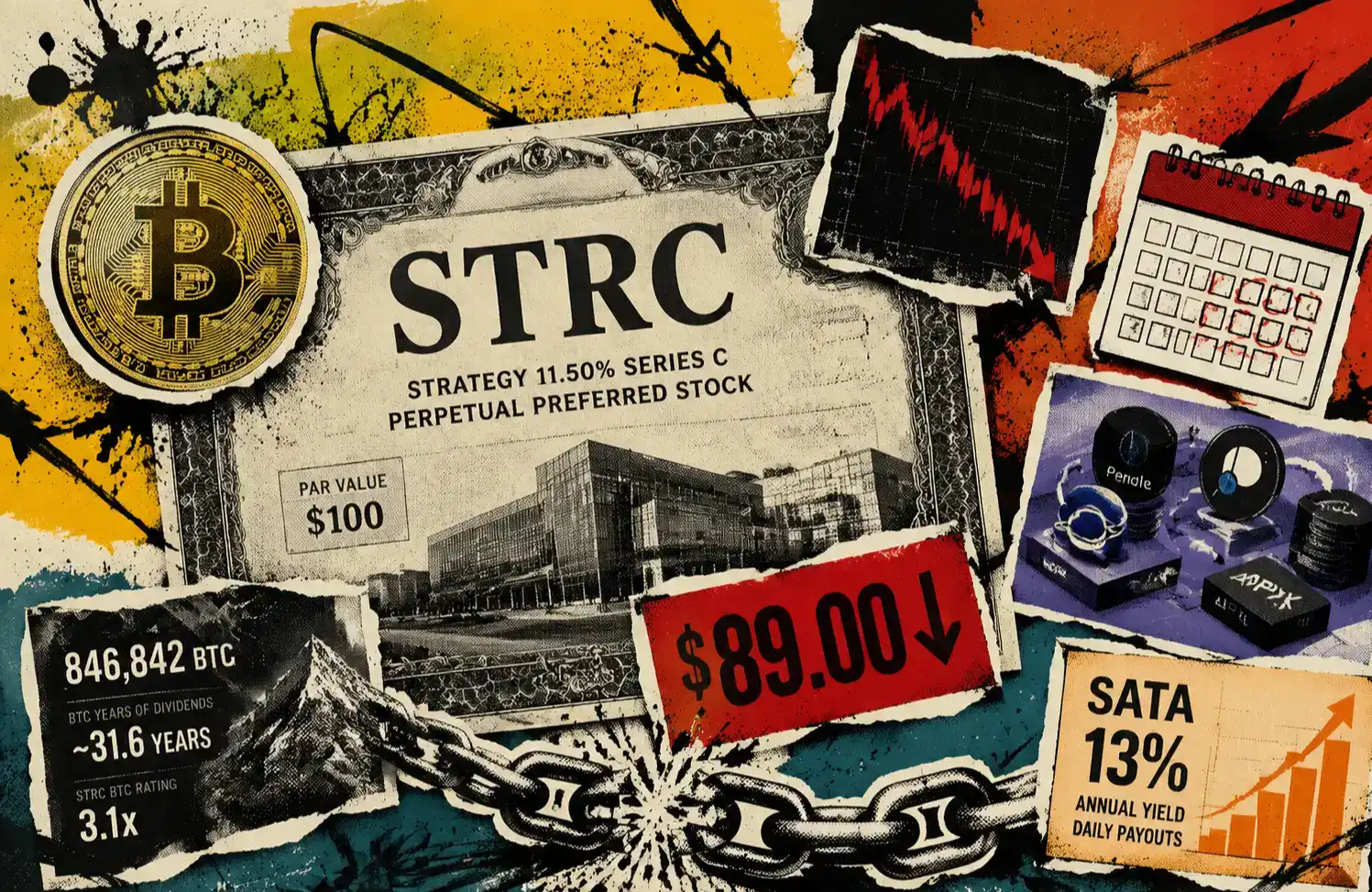
The article analyzes the recent significant de-pegging of Strategy's perpetual preferred stock, STRC, whose price fell to approximately $89, far below its $100 face value. This discount has pushed its simple yield to around 12.9%, creating a paradox. The stock was designed as a high-yield instrument trading near par, and Strategy maintains an 11.5% annual dividend, even recently switching to semi-monthly payments to support the price. The author explores several reasons why the high yield hasn't attracted enough buying pressure to restore the par value. A key factor is potential reverse deleveraging from carry trades, where leveraged investors may be forced to sell due to margin calls as the price falls, creating a self-reinforcing downward spiral. Additionally, the tokenization and integration of STRC into DeFi protocols (like Apyx, Saturn, Pendle) have introduced faster, more transparent, and potentially more volatile price adjustment mechanisms through leverage and yield-splitting products. The emergence of a competing product, Strive's SATA, offering a 13% yield with daily dividends, has also changed the yield benchmark, challenging STRC's unique high-yield narrative. Furthermore, the market is questioning the distinction between Strategy's substantial Bitcoin reserves, which provide long-term balance sheet coverage, and the certainty of stable near-term cash flow for dividends. Ultimately, the price dip represents a stress test for this type of BTC-backed, high-yield financing tool. The future path of STRC depends on whether Strategy acts to reinforce the $100 peg (e.g., by adjusting dividends), whether DeFi-related leverage unwinds further, and how investors ultimately price the risks of leverage, competition, and cash flow uncertainty against the offered yield.

marsbitHá 22m

STRC Severely Unpegged, What Risks Is the Market Pricing In?

marsbitHá 22m

LIT Token Hits Six-Month High: How Long Can the Buyback Flywheel Keep Burning Fuel?

The LIT token of decentralized perpetual exchange Lighter surged to a six-month high above $1.90 on June 18th, with a market cap of $425 million. After a price correction earlier this year, the recent rebound is attributed to its core "buyback flywheel" mechanism. All protocol fee revenue is used for programmatic, hourly market buybacks of LIT. Since its TGE in December 2025, approximately 15 million LIT (6% of circulating supply) has been repurchased for around $21 million. Additional price support comes from the LLP (Lighter Liquidity Pool), where providers must stake LIT worth 10% of their deposited USDC, locking significant token supply. However, challenges persist. Trading volume has declined amidst a sluggish market, with total volume at $1.68 trillion, significantly lower than leading competitor Hyperliquid's $4.37 trillion. While Lighter focuses on perpetual contracts, RWA, and Pre-IPO markets, Hyperliquid has expanded into prediction markets and boasts a U.S. spot ETF, attracting institutional investment and influencer endorsements like from Arthur Hayes. In contrast, LIT currently lacks similar high-profile backing. With 75% of LIT's total 1 billion supply still locked (team and investor tokens begin a 3-year linear unlock in December 2026), there is no immediate unlock selling pressure. The token's future performance hinges on sustaining trading volume growth, successful product iteration, and executing its transparent buyback strategy against a dominant competitor.

Foresight NewsHá 41m

LIT Token Hits Six-Month High: How Long Can the Buyback Flywheel Keep Burning Fuel?

Foresight NewsHá 41m

Trading

Spot
Futuros

Artigos em Destaque

O que é $S$

Compreender o SPERO: Uma Visão Abrangente Introdução ao SPERO À medida que o panorama da inovação continua a evoluir, o surgimento de tecnologias web3 e projetos de criptomoeda desempenha um papel fundamental na formação do futuro digital. Um projeto que tem atraído atenção neste campo dinâmico é o SPERO, denotado como SPERO,$$s$. Este artigo tem como objetivo reunir e apresentar informações detalhadas sobre o SPERO, para ajudar entusiastas e investidores a compreender as suas bases, objetivos e inovações nos domínios web3 e cripto. O que é o SPERO,$$s$? O SPERO,$$s$ é um projeto único dentro do espaço cripto que procura aproveitar os princípios da descentralização e da tecnologia blockchain para criar um ecossistema que promove o envolvimento, a utilidade e a inclusão financeira. O projeto é concebido para facilitar interações peer-to-peer de novas maneiras, proporcionando aos utilizadores soluções e serviços financeiros inovadores. No seu núcleo, o SPERO,$$s$ visa capacitar indivíduos ao fornecer ferramentas e plataformas que melhoram a experiência do utilizador no espaço das criptomoedas. Isso inclui a possibilidade de métodos de transação mais flexíveis, a promoção de iniciativas impulsionadas pela comunidade e a criação de caminhos para oportunidades financeiras através de aplicações descentralizadas (dApps). A visão subjacente do SPERO,$$s$ gira em torno da inclusão, visando fechar lacunas dentro das finanças tradicionais enquanto aproveita os benefícios da tecnologia blockchain. Quem é o Criador do SPERO,$$s$? A identidade do criador do SPERO,$$s$ permanece algo obscura, uma vez que existem recursos publicamente disponíveis limitados que fornecem informações detalhadas sobre o(s) seu(s) fundador(es). Esta falta de transparência pode resultar do compromisso do projeto com a descentralização—uma ética que muitos projetos web3 partilham, priorizando contribuições coletivas em vez de reconhecimento individual. Ao centrar as discussões em torno da comunidade e dos seus objetivos coletivos, o SPERO,$$s$ incorpora a essência do empoderamento sem destacar indivíduos específicos. Assim, compreender a ética e a missão do SPERO é mais importante do que identificar um criador singular. Quem são os Investidores do SPERO,$$s$? O SPERO,$$s$ é apoiado por uma diversidade de investidores que vão desde capitalistas de risco a investidores-anjo dedicados a promover a inovação no setor cripto. O foco desses investidores geralmente alinha-se com a missão do SPERO—priorizando projetos que prometem avanço tecnológico social, inclusão financeira e governança descentralizada. Essas fundações de investidores estão tipicamente interessadas em projetos que não apenas oferecem produtos inovadores, mas que também contribuem positivamente para a comunidade blockchain e os seus ecossistemas. O apoio desses investidores reforça o SPERO,$$s$ como um concorrente notável no domínio em rápida evolução dos projetos cripto. Como Funciona o SPERO,$$s$? O SPERO,$$s$ emprega uma estrutura multifacetada que o distingue de projetos de criptomoeda convencionais. Aqui estão algumas das características-chave que sublinham a sua singularidade e inovação: Governança Descentralizada: O SPERO,$$s$ integra modelos de governança descentralizada, capacitando os utilizadores a participar ativamente nos processos de tomada de decisão sobre o futuro do projeto. Esta abordagem promove um sentido de propriedade e responsabilidade entre os membros da comunidade. Utilidade do Token: O SPERO,$$s$ utiliza o seu próprio token de criptomoeda, concebido para servir várias funções dentro do ecossistema. Esses tokens permitem transações, recompensas e a facilitação de serviços oferecidos na plataforma, melhorando o envolvimento e a utilidade gerais. Arquitetura em Camadas: A arquitetura técnica do SPERO,$$s$ suporta modularidade e escalabilidade, permitindo a integração contínua de funcionalidades e aplicações adicionais à medida que o projeto evolui. Esta adaptabilidade é fundamental para manter a relevância no panorama cripto em constante mudança. Envolvimento da Comunidade: O projeto enfatiza iniciativas impulsionadas pela comunidade, empregando mecanismos que incentivam a colaboração e o feedback. Ao nutrir uma comunidade forte, o SPERO,$$s$ pode melhor atender às necessidades dos utilizadores e adaptar-se às tendências do mercado. Foco na Inclusão: Ao oferecer taxas de transação baixas e interfaces amigáveis, o SPERO,$$s$ visa atrair uma base de utilizadores diversificada, incluindo indivíduos que anteriormente podem não ter participado no espaço cripto. Este compromisso com a inclusão alinha-se com a sua missão abrangente de empoderamento através da acessibilidade. Cronologia do SPERO,$$s$ Compreender a história de um projeto fornece insights cruciais sobre a sua trajetória de desenvolvimento e marcos. Abaixo está uma cronologia sugerida que mapeia eventos significativos na evolução do SPERO,$$s$: Fase de Conceituação e Ideação: As ideias iniciais que formam a base do SPERO,$$s$ foram concebidas, alinhando-se de perto com os princípios de descentralização e foco na comunidade dentro da indústria blockchain. Lançamento do Whitepaper do Projeto: Após a fase conceitual, um whitepaper abrangente detalhando a visão, os objetivos e a infraestrutura tecnológica do SPERO,$$s$ foi lançado para atrair o interesse e o feedback da comunidade. Construção da Comunidade e Primeiros Envolvimentos: Esforços ativos de divulgação foram feitos para construir uma comunidade de primeiros adotantes e investidores potenciais, facilitando discussões em torno dos objetivos do projeto e angariando apoio. Evento de Geração de Tokens: O SPERO,$$s$ realizou um evento de geração de tokens (TGE) para distribuir os seus tokens nativos a apoiantes iniciais e estabelecer liquidez inicial dentro do ecossistema. Lançamento da dApp Inicial: A primeira aplicação descentralizada (dApp) associada ao SPERO,$$s$ foi lançada, permitindo que os utilizadores interagissem com as funcionalidades principais da plataforma. Desenvolvimento Contínuo e Parcerias: Atualizações e melhorias contínuas nas ofertas do projeto, incluindo parcerias estratégicas com outros players no espaço blockchain, moldaram o SPERO,$$s$ em um jogador competitivo e em evolução no mercado cripto. Conclusão O SPERO,$$s$ é um testemunho do potencial do web3 e das criptomoedas para revolucionar os sistemas financeiros e capacitar indivíduos. Com um compromisso com a governança descentralizada, o envolvimento da comunidade e funcionalidades inovadoras, abre caminho para um panorama financeiro mais inclusivo. Como em qualquer investimento no espaço cripto em rápida evolução, potenciais investidores e utilizadores são incentivados a pesquisar minuciosamente e a envolver-se de forma ponderada com os desenvolvimentos em curso dentro do SPERO,$$s$. O projeto demonstra o espírito inovador da indústria cripto, convidando a uma exploração mais aprofundada das suas inúmeras possibilidades. Embora a jornada do SPERO,$$s$ ainda esteja a desenrolar-se, os seus princípios fundamentais podem, de facto, influenciar o futuro de como interagimos com a tecnologia, as finanças e uns com os outros em ecossistemas digitais interconectados.

69 Visualizações TotaisPublicado em {updateTime}Atualizado em 2024.12.17

O que é $S$

O que é AGENT S

Agent S: O Futuro da Interação Autónoma no Web3 Introdução No panorama em constante evolução do Web3 e das criptomoedas, as inovações estão constantemente a redefinir a forma como os indivíduos interagem com plataformas digitais. Um projeto pioneiro, o Agent S, promete revolucionar a interação humano-computador através do seu framework aberto e agente. Ao abrir caminho para interações autónomas, o Agent S visa simplificar tarefas complexas, oferecendo aplicações transformadoras em inteligência artificial (IA). Esta exploração detalhada irá aprofundar-se nas complexidades do projeto, nas suas características únicas e nas implicações para o domínio das criptomoedas. O que é o Agent S? O Agent S é um framework aberto e agente, especificamente concebido para abordar três desafios fundamentais na automação de tarefas computacionais: Aquisição de Conhecimento Específico de Domínio: O framework aprende inteligentemente a partir de várias fontes de conhecimento externas e experiências internas. Esta abordagem dupla capacita-o a construir um rico repositório de conhecimento específico de domínio, melhorando o seu desempenho na execução de tarefas. Planeamento ao Longo de Longos Horizontes de Tarefas: O Agent S emprega planeamento hierárquico aumentado por experiência, uma abordagem estratégica que facilita a decomposição e execução eficientes de tarefas intrincadas. Esta característica melhora significativamente a sua capacidade de gerir múltiplas subtarefas de forma eficiente e eficaz. Gestão de Interfaces Dinâmicas e Não Uniformes: O projeto introduz a Interface Agente-Computador (ACI), uma solução inovadora que melhora a interação entre agentes e utilizadores. Utilizando Modelos de Linguagem Multimodais de Grande Escala (MLLMs), o Agent S pode navegar e manipular diversas interfaces gráficas de utilizador de forma fluida. Através destas características pioneiras, o Agent S fornece um framework robusto que aborda as complexidades envolvidas na automação da interação humana com máquinas, preparando o terreno para uma infinidade de aplicações em IA e além. Quem é o Criador do Agent S? Embora o conceito de Agent S seja fundamentalmente inovador, informações específicas sobre o seu criador permanecem elusivas. O criador é atualmente desconhecido, o que destaca ou o estágio nascente do projeto ou a escolha estratégica de manter os membros fundadores em anonimato. Independentemente da anonimidade, o foco permanece nas capacidades e no potencial do framework. Quem são os Investidores do Agent S? Como o Agent S é relativamente novo no ecossistema criptográfico, informações detalhadas sobre os seus investidores e financiadores não estão explicitamente documentadas. A falta de informações disponíveis publicamente sobre as fundações de investimento ou organizações que apoiam o projeto levanta questões sobre a sua estrutura de financiamento e roteiro de desenvolvimento. Compreender o apoio é crucial para avaliar a sustentabilidade do projeto e o seu impacto potencial no mercado. Como Funciona o Agent S? No núcleo do Agent S reside uma tecnologia de ponta que lhe permite funcionar eficazmente em diversos ambientes. O seu modelo operacional é construído em torno de várias características-chave: Interação Humano-Computador Semelhante: O framework oferece planeamento avançado em IA, esforçando-se para tornar as interações com computadores mais intuitivas. Ao imitar o comportamento humano na execução de tarefas, promete elevar as experiências dos utilizadores. Memória Narrativa: Utilizada para aproveitar experiências de alto nível, o Agent S utiliza memória narrativa para acompanhar os históricos de tarefas, melhorando assim os seus processos de tomada de decisão. Memória Episódica: Esta característica fornece aos utilizadores orientações passo a passo, permitindo que o framework ofereça suporte contextual à medida que as tarefas se desenrolam. Suporte para OpenACI: Com a capacidade de funcionar localmente, o Agent S permite que os utilizadores mantenham o controlo sobre as suas interações e fluxos de trabalho, alinhando-se com a ética descentralizada do Web3. Fácil Integração com APIs Externas: A sua versatilidade e compatibilidade com várias plataformas de IA garantem que o Agent S possa integrar-se perfeitamente em ecossistemas tecnológicos existentes, tornando-o uma escolha apelativa para desenvolvedores e organizações. Estas funcionalidades contribuem coletivamente para a posição única do Agent S no espaço cripto, à medida que automatiza tarefas complexas e em múltiplos passos com mínima intervenção humana. À medida que o projeto evolui, as suas potenciais aplicações no Web3 podem redefinir a forma como as interações digitais se desenrolam. Cronologia do Agent S O desenvolvimento e os marcos do Agent S podem ser encapsulados numa cronologia que destaca os seus eventos significativos: 27 de Setembro de 2024: O conceito de Agent S foi lançado num artigo de pesquisa abrangente intitulado “Um Framework Agente Aberto que Usa Computadores como um Humano”, mostrando a base para o projeto. 10 de Outubro de 2024: O artigo de pesquisa foi disponibilizado publicamente no arXiv, oferecendo uma exploração aprofundada do framework e da sua avaliação de desempenho com base no benchmark OSWorld. 12 de Outubro de 2024: Uma apresentação em vídeo foi lançada, proporcionando uma visão visual das capacidades e características do Agent S, envolvendo ainda mais potenciais utilizadores e investidores. Estes marcos na cronologia não apenas ilustram o progresso do Agent S, mas também indicam o seu compromisso com a transparência e o envolvimento da comunidade. Pontos-Chave Sobre o Agent S À medida que o framework Agent S continua a evoluir, várias características-chave destacam-se, sublinhando a sua natureza inovadora e potencial: Framework Inovador: Concebido para proporcionar um uso intuitivo de computadores semelhante à interação humana, o Agent S traz uma abordagem nova à automação de tarefas. Interação Autónoma: A capacidade de interagir autonomamente com computadores através de GUI significa um avanço em direção a soluções computacionais mais inteligentes e eficientes. Automação de Tarefas Complexas: Com a sua metodologia robusta, pode automatizar tarefas complexas e em múltiplos passos, tornando os processos mais rápidos e menos propensos a erros. Melhoria Contínua: Os mecanismos de aprendizagem permitem que o Agent S melhore a partir de experiências passadas, aprimorando continuamente o seu desempenho e eficácia. Versatilidade: A sua adaptabilidade em diferentes ambientes operacionais, como OSWorld e WindowsAgentArena, garante que pode servir uma ampla gama de aplicações. À medida que o Agent S se posiciona no panorama do Web3 e das criptomoedas, o seu potencial para melhorar as capacidades de interação e automatizar processos significa um avanço significativo nas tecnologias de IA. Através do seu framework inovador, o Agent S exemplifica o futuro das interações digitais, prometendo uma experiência mais fluida e eficiente para os utilizadores em diversas indústrias. Conclusão O Agent S representa um ousado avanço na união da IA e do Web3, com a capacidade de redefinir a forma como interagimos com a tecnologia. Embora ainda esteja nas suas fases iniciais, as possibilidades para a sua aplicação são vastas e cativantes. Através do seu framework abrangente que aborda desafios críticos, o Agent S visa trazer interações autónomas para o primeiro plano da experiência digital. À medida que avançamos mais profundamente nos domínios das criptomoedas e da descentralização, projetos como o Agent S desempenharão, sem dúvida, um papel crucial na formação do futuro da tecnologia e da colaboração humano-computador.

679 Visualizações TotaisPublicado em {updateTime}Atualizado em 2025.01.14

O que é AGENT S

Como comprar S

Bem-vindo à HTX.com!Tornámos a compra de Sonic (S) simples e conveniente.Segue o nosso guia passo a passo para iniciar a tua jornada no mundo das criptos.Passo 1: cria a tua conta HTXUtiliza o teu e-mail ou número de telefone para te inscreveres numa conta gratuita na HTX.Desfruta de um processo de inscrição sem complicações e desbloqueia todas as funcionalidades.Obter a minha contaPasso 2: vai para Comprar Cripto e escolhe o teu método de pagamentoCartão de crédito/débito: usa o teu visa ou mastercard para comprar Sonic (S) instantaneamente.Saldo: usa os fundos da tua conta HTX para transacionar sem problemas.Terceiros: adicionamos métodos de pagamento populares, como Google Pay e Apple Pay, para aumentar a conveniência.P2P: transaciona diretamente com outros utilizadores na HTX.Mercado de balcão (OTC): oferecemos serviços personalizados e taxas de câmbio competitivas para os traders.Passo 3: armazena teu Sonic (S)Depois de comprar o teu Sonic (S), armazena-o na tua conta HTX.Alternativamente, podes enviá-lo para outro lugar através de transferência blockchain ou usá-lo para transacionar outras criptomoedas.Passo 4: transaciona Sonic (S)Transaciona facilmente Sonic (S) no mercado à vista da HTX.Acede simplesmente à tua conta, seleciona o teu par de trading, executa as tuas transações e monitoriza em tempo real.Oferecemos uma experiência de fácil utilização tanto para principiantes como para traders experientes.

1.3k Visualizações TotaisPublicado em {updateTime}Atualizado em 2026.06.02

Como comprar S

Discussões

Bem-vindo à Comunidade HTX. Aqui, pode manter-se informado sobre os mais recentes desenvolvimentos da plataforma e obter acesso a análises profissionais de mercado. As opiniões dos utilizadores sobre o preço de S (S) são apresentadas abaixo.

活动图片