How Much Longer Can Ethereum's Last Major Buyer Hold On?

链捕手Publicado em 2026-06-11Última atualização em 2026-06-11

Resumo

"The article analyzes the precarious position of Bitmine, currently the largest and most aggressive marginal buyer of Ethereum (ETH). Despite holding a massive position of approximately 5.66 million ETH (nearing its 5% supply target) and generating staking income, the company faces over $10 billion in unrealized losses due to a high average purchase price. With ETH prices depressed, its equity has plummeted nearly 90%. To sustain its buying spree, Bitmine recently issued $274 million in perpetual preferred shares with a 9.5% annual dividend. The core dilemma is whether staking yields (3-4%) can long-term support these high dividend obligations without significant ETH price appreciation. The article warns that once Bitmine achieves its 5% goal and potentially stops buying, the ETH market risks losing its key support pillar. Other institutional buyers, like ETH ETFs, have shown net outflows, while potential new demand from stablecoin legislation or RWA tokenization remains slow to materialize. The conclusion questions who will provide the next wave of sustained buying pressure to support ETH's price, highlighting a critical uncertainty for the asset's near-term trajectory."

As the crypto market continues to fall, BTC and ETH have once fallen to around $60,000 and $1,500, with both Strategy and Bitmine experiencing floating losses exceeding $10 billion. Just at the end of May, Strategy sold 32 BTC, breaking its long-standing narrative of not selling coins, marking the pressure testing phase for the model of financing purchases with debt.

Against this backdrop, Bitmine grandly announced the issuance of its Series A Perpetual Preferred Shares with a 9.5% annualized yield, raising approximately $274 million net. As of press time, Bitmine increased its holdings by 127,000 ETH last week and accumulated purchases of 125,000 ETH over the past three days. Its total holdings now stand at about 5.66 million ETH, less than 400,000 ETH away from its 5% target.

As the most persistent and aggressive marginal buyer of ETH in the current market, Bitmine continues to increase its holdings despite facing over ten billion dollars in unrealized losses. Now, even it needs to rely on preferred shares to replenish its flywheel. Once the financing market experiences changes and its coin-hoarding machine is forced to slow down, who will be left to support the price of Ethereum?

Reaching 5% Before Year-End, Then What?

Bitmine began accumulating ETH in the second half of last year, planning to complete its "5% Alchemy" plan within 5 years. Data shows that Bitmine raised $19.2 billion through 50 equity offerings between July 2025 and June 2026, with all funds used to purchase ETH.

As of press time, Bitmine's Ethereum holdings have reached approximately 5.66 million ETH, less than 400,000 ETH away from its 5% target, achieving over 90% of the plan's progress within a year.
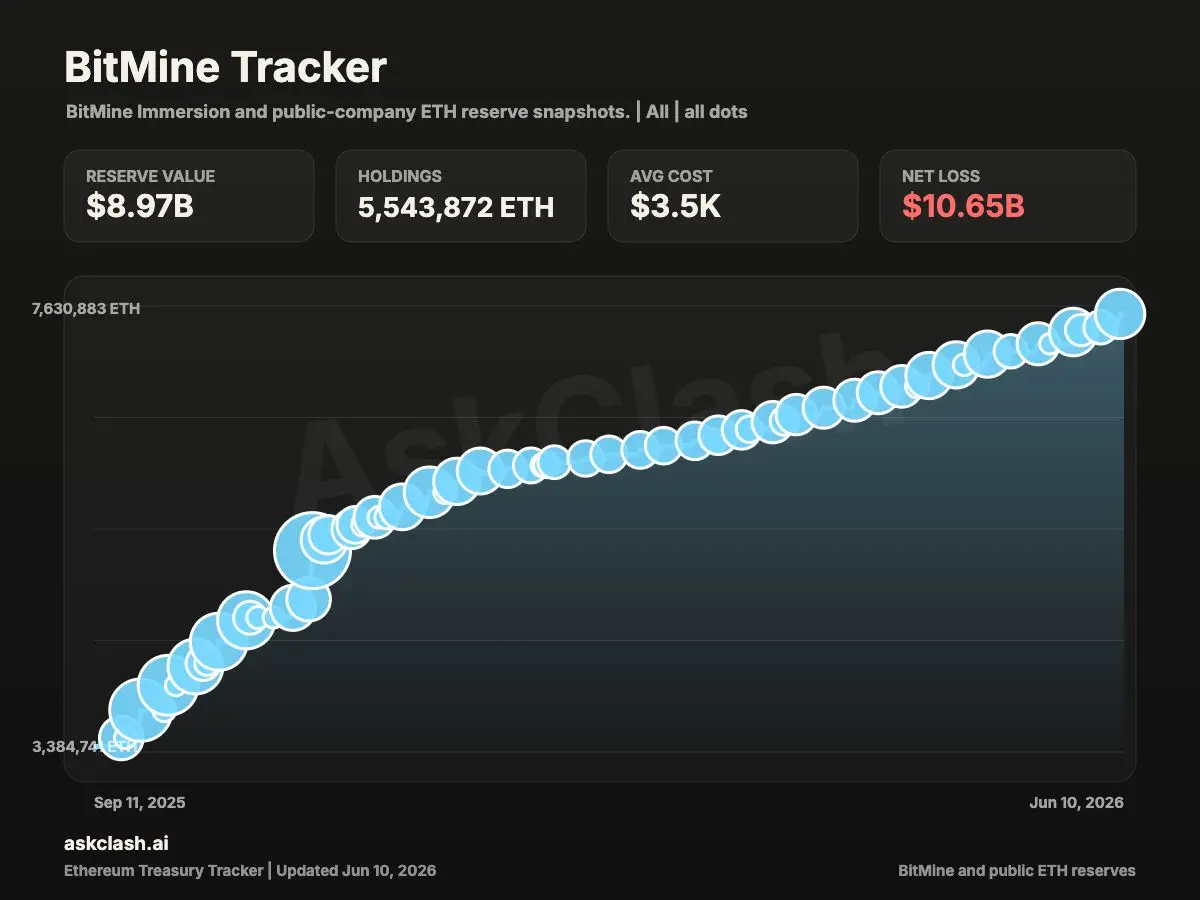
Among these, about 4.719 million ETH have been staked, accounting for over 85% of total holdings, with expected annualized staking returns ranging from $230 million to $296 million. This staking system is supported by the company's self-built MAVAN validator node network, considered the most critical structural design differentiating Bitmine from Strategy.

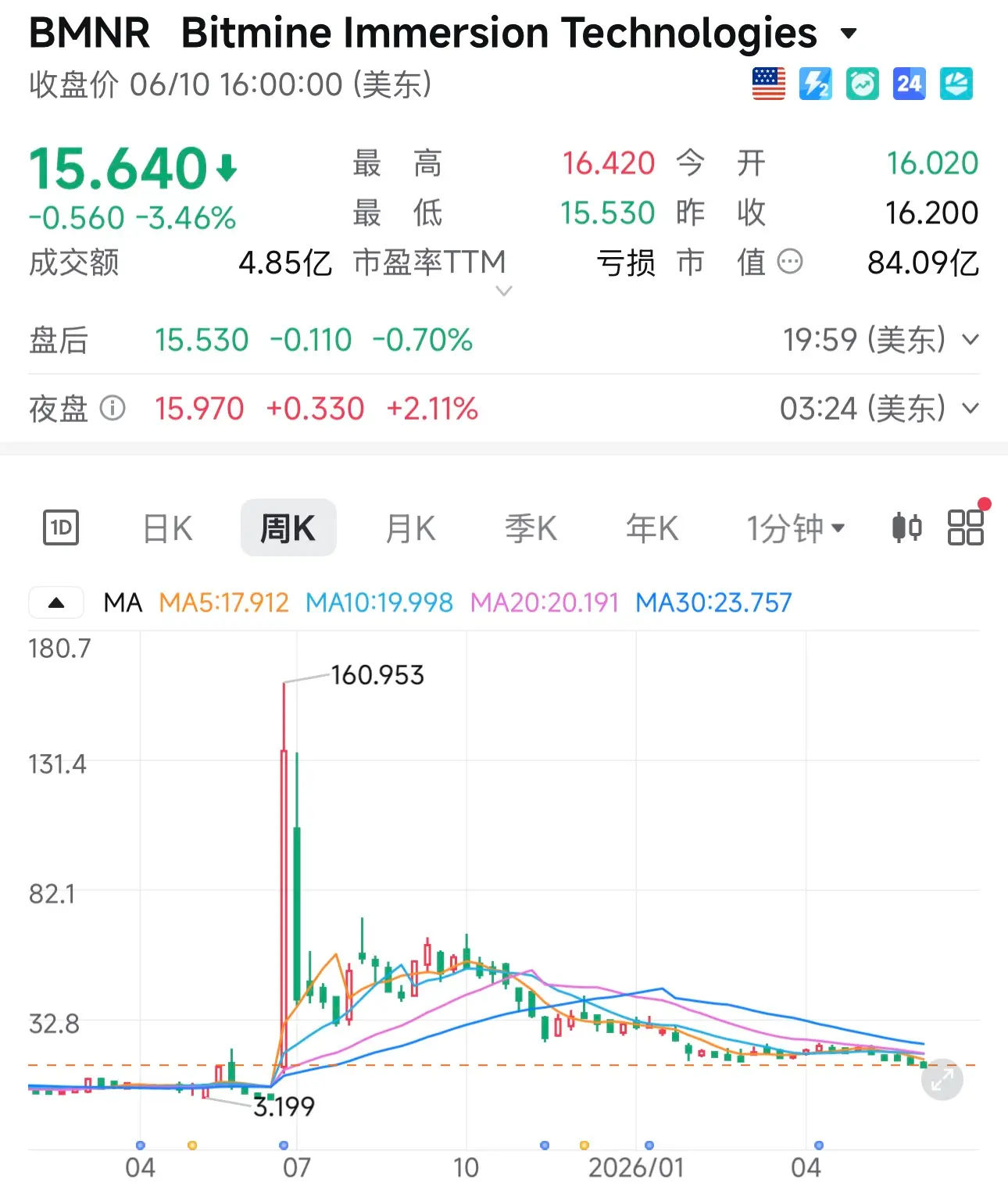
However, the cost of aggressive accumulation is also evident. With current ETH prices around $1,650, the company's average holding cost is as high as about $3,500. Its ETH treasury is valued at only about $9.3 billion, resulting in an overall company loss of $10.5 billion, a drawdown exceeding 50%. The company's stock price has plummeted nearly 90% from its peak.
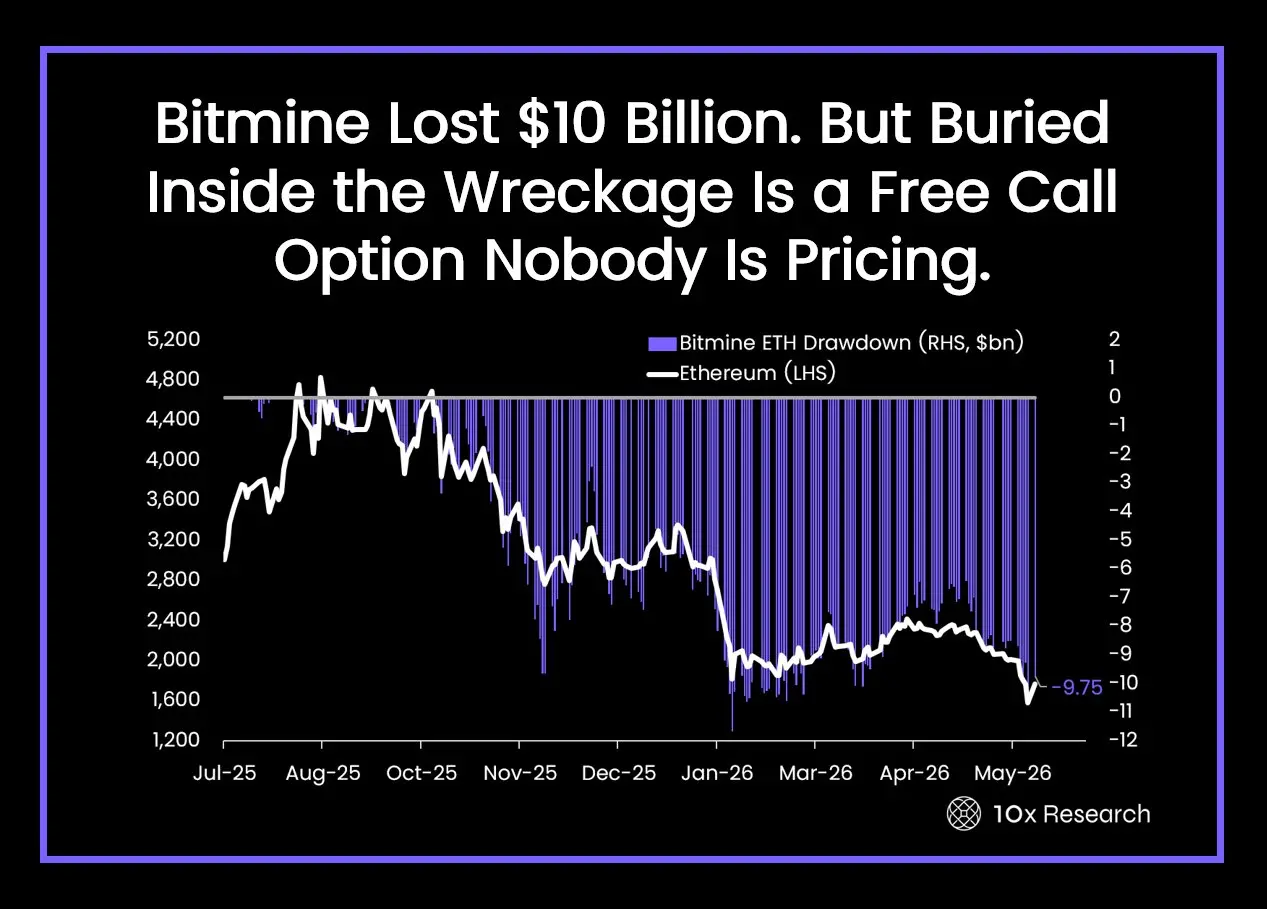
10x Research points out that Bitmine's investors face two layers of losses: the floating loss from ETH's price drop is the first layer. The second layer is the approximately $4.6 billion premium investors paid for BMNR stock relative to the underlying ETH net asset value. Combined, these layers amplify the actual loss magnitude for shareholders.
Facing massive unrealized losses, Tom Lee characterizes this round of decline as superficial. He believes the existing financial system harbors a large amount of fake trading, whereas Ethereum has never had fraudulent transactions, with lower operating costs. On-chain transaction volume and daily active addresses have both hit record highs. The price correction is led by macro factors and leverage unwinding, with fundamentals undamaged. The longer-term bet is that AI agent systems will rely on blockchains to operate, ETH supply is continuously contracting, and Ethereum is the most direct beneficiary.

Tom Lee recently revealed that Bitmine is expected to complete its 5% target before the end of 2026, at which point it may no longer need to continue increasing holdings. He also mentioned the company may be formally included in the Russell 1000 index by the end of June, which, based on market cap calculations at the time, would bring at least $2.15 billion in passive fund buying pressure for BMNR.

How Can 3% Staking Returns Support 9.5% Dividends?

On June 5th, Bitmine completed pricing for its Series A Perpetual Preferred Shares: 3.5 million shares, issued at $80 per share, with a par value of $100, raising approximately $274 million net. The dividend yield is 9.5%, paid weekly in cash, and dividends continue to accrue even if undeclared by the board. Annualized dividend obligation is about $33.25 million based on par value.

Bitmine holds an early redemption right: it can redeem at 110% of par value within 18 months of issuance, at 105% between 18 months and 3 years, and at 100% after 3 years, with accrued but unpaid dividends also paid upon redemption.

At first glance, the math isn't hard. By the end of May, Bitmine had cumulatively staked 4.7 million ETH, with expected annualized staking returns of about $230 million to $296 million, which is 8 to 9 times the annualized dividend obligation.

However, the prediction exceeding $200 million is based on the assumption that the recent 4.7 million ETH are fully staked. According to the prospectus, for the six months ended February 28, 2026, the company's staking income was $11.18 million, annualized to about $22 million.

It's noteworthy that staking rewards are denominated in ETH, not USD. If ETH continues to fall, the company's staking income will shrink accordingly.

Here lies a fundamental difference between Bitmine and Strategy. BTC has no native yield; Strategy's STRC can only pay dividends through BTC price appreciation or selling coins, as detailed by ChainCatcher in the article "Strategy Cashes Out $2.5 Million as Bitcoin Market Cap Evaporates $80 Billion".

ETH's staking mechanism offers Tom Lee a different path: even if the price stays flat, staking rewards still generate income without touching the principal holdings. This is the real pressure-resistant advantage of the Bitmine model in the current bear market.

But this path may not be sustainable. Crypto KOL chenmo points out that in the early stages with low issuance, covering dividends with staking returns is manageable. However, as preferred share issuance scale continues to expand, the 3-4% staking yield is destined to be unable to cover the 9.5% annual interest. At that point, only a rise in ETH can maintain this logic.

Analyst Yuyue also noted that Strategy's model is already under pressure in the current market. Following up with preferred share issuance now, even if it's a short-term positive, may be interpreted by the market as a worse signal.

According to CointelegraphMT research, two details in the prospectus for this issuance are worth noting. The auditor was changed to KPMG on April 27th, with simultaneous disclosure of material weaknesses in internal controls. The audit is not yet complete, and financial data may be subject to restatement.

Additionally, the board has complete discretionary power over dividend payments. The only enforcement mechanism for preferred shareholders is the right to nominate two directors after 18 consecutive months without receiving dividends.

If Bitmine Stops Buying After 5%, Where Will ETH's Price Go?

On-chain analyst Yu Jin stated that at the current buying pace, the target could be reached as early as next month. So, will they continue buying after reaching it? If they stop, and this market's last staunch bull disappears, what will support ETH?

Bitmine has been the most consistent and aggressive marginal buyer in the ETH market over the past year. Other potential buying forces are scattered and weak. ETH spot ETFs saw a net outflow of $173 million overall last week. Although they briefly turned positive on June 8th after 17 consecutive days of outflows, the strength was far less than the previous outflow scale.

Meanwhile, Goldman Sachs reduced its ETH ETF holdings by about 70% in Q1 2026, and Harvard University's endowment fund completely liquidated its approximately $87 million ETHA holdings, selling all after holding for just one quarter. Details on institutional fund movements can be found in "Harvard and Other Institutions Liquidate, Six Core Talents Depart in One Month, What's Wrong with Ethereum?".

Furthermore, stablecoin legislation and institutional incremental demand brought by RWA tokenization are slow variables, difficult to fill a gap of Bitmine's scale in the short term.

Without an overall reversal in the crypto market, it can be foreseen that the treasury flywheel will become difficult to sustain. The transmission would be: ETH price continues to fall, BMNR stock price is under pressure, the premium relative to net assets narrows, the window for additional fundraising shrinks, the buying pace slows, and ETH further loses marginal support. This cycle doesn't even require Bitmine to actively sell a single ETH; the disappearance of buying power alone is sufficient.
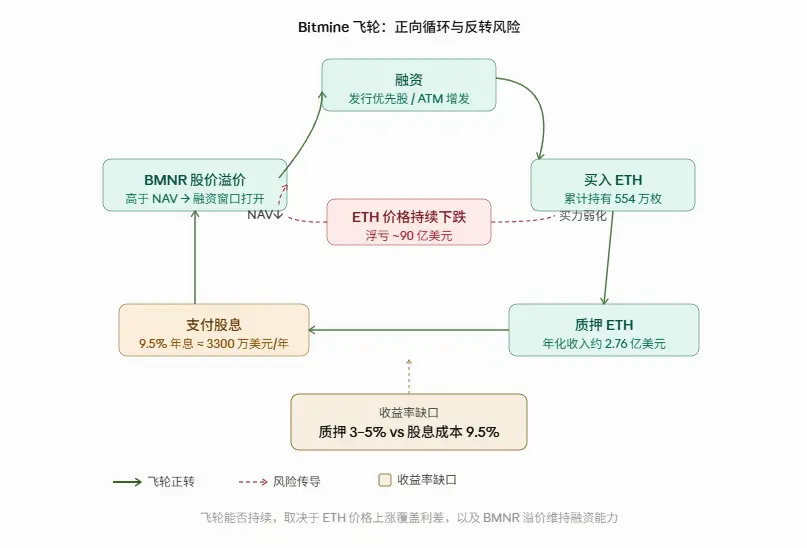
Image Source: AI Generated

In a pessimistic scenario, if the financing market's acceptance of preferred shares declines, BMNR continues to hit new lows, and buying slows significantly, ETH may explore the next key consensus level (around $1,000). DWF Labs co-founder Andrei Grachev believes Strategy and Bitmine have a great chance to create the largest market crash in cryptocurrency history. This is a tail risk judgment, not a baseline expectation.

In the baseline scenario, Bitmine maintains buying, staking returns provide a buffer, preferred shares are smoothly absorbed, and ETH consolidates and bottoms out in the $1,500 to $2,000 range. Despite Bitmine's heavy losses and ETH's difficulty recovering in the short term, a 10x Research report mentions that when a stock falls deep enough, the underlying asset becomes almost irrelevant. What investors are buying is essentially a pure option—a free call option on ETH's future rebound, which is not yet fully priced in by the market.

In an optimistic scenario, formal inclusion in the Russell 1000 brings passive funds, and the landing of stablecoin legislation like the GENIUS Act clears obstacles for institutional entry. Standard Chartered maintains its year-end 2026 ETH target price of $4,000, believing recent price declines do not reflect the continuous improvement in Ethereum's network fundamentals. It likens the current situation to Amazon's stage after the 2001 bubble burst—price temporarily disconnected from network value, but infrastructure building never stopped. The bank expects the ETH/BTC exchange rate to recover to about 0.08 by the end of this decade, with a target price of $40,000 by the end of 2030.

Conclusion

Ultimately, how long this financing can sustain Bitmine's flywheel comes down to the price of ETH. However, Bitmine's coin-buying itself is a crucial part of price support.

So the core question is: after Bitmine completes its 5% target and gradually fades out, who will take up the baton? Traditional institutions are withdrawing, ETF funds flow in and out, and real incremental demand from stablecoins and RWA has yet to materialize on a large scale.

Perhaps Ethereum is not short on narratives, but when the liquidity turning point will appear and where the new marginal buyers will come from are key questions determining ETH's price trend going forward.

Perguntas relacionadas

QWhat is Bitmine's primary strategy and goal in the Ethereum market, and what is its current progress?

ABitmine's strategy is to aggressively accumulate Ethereum (ETH) with the goal of holding 5% of the total ETH supply. They finance this through equity offerings. Currently, Bitmine holds approximately 5.66 million ETH, which is over 90% of their 5% target, requiring less than 400,000 ETH more to complete.

QWhat significant financial challenge is Bitmine currently facing, and how is it attempting to address it?

ABitmine is facing over $10.5 billion in unrealized losses due to ETH's price falling well below its average acquisition cost of around $3,500. To address this and continue its buying strategy, Bitmine recently issued perpetual preferred shares with a 9.5% annual dividend, raising approximately $274 million.

QWhat is a key structural difference between Bitmine and a company like Strategy, and what advantage does it provide in a bear market?

AA key difference is that Bitmine stakes its ETH holdings (over 85%), generating an estimated annual yield of $230-$296 million. Unlike Bitcoin held by Strategy, this provides a native yield stream that can help cover obligations without needing to sell the underlying asset or rely solely on price appreciation, offering an advantage in a bear market.

QWhat are the potential scenarios for ETH's price if Bitmine stops being a major buyer after reaching its 5% goal?

AIf Bitmine stops buying, several scenarios are outlined: 1) Pessimistic: If buying halts and financing dries up, ETH could fall towards $1,000. 2) Base case: ETH trades between $1,500-$2,000. 3) Optimistic: Factors like inclusion in the Russell 1000 index, positive legislation, and strong network fundamentals could lead to a significant price recovery, with targets like $4,000 by 2026 or even $40,000 by 2030 mentioned.

QWhat is the core dilemma or 'flywheel' problem highlighted for Bitmine's business model?

AThe core dilemma is a potential negative feedback loop: If ETH price falls, Bitmine's stock (BMNR) price suffers, making it harder to raise new funds through equity. This slows or stops their buying, which in turn removes a major source of buying pressure for ETH, potentially causing further price declines. This cycle can occur even without Bitmine actively selling any ETH.

Leituras Relacionadas

Raising Interest Rates Is Not a Tech Killer, EPS Is: A Strategy for Discarding the Weak and Retaining the Strong After the AI Theme's Sharp Decline

**Summary: Rising Interest Rates Are Not the Killer of Tech; EPS Is: The "Keep the Strong, Ditch the Weak" Strategy After the AI Theme Plunge** The author argues that the sharp sell-off in tech and AI-related stocks, triggered by a strong US jobs report that heightened Fed rate hike fears, represents a "pullback to pick up passengers" rather than a "car crash." The true end of a tech bull market is not determined by an extra 25 basis point hike, but by industry overcapacity and the disproval of earnings per share (EPS) expectations. Historical analysis shows that during past rate hike cycles, the Nasdaq-100 often outperformed, provided EPS growth remained strong. The current phase is seen as a shift from a "broad narrative-driven rally" to a "focused verification stage" for AI. The investment strategy should be to "keep the strong, ditch the weak." * **Retain exposure** to high-conviction AI infrastructure leaders with clear order visibility, stable margins, strong cash flow, and upward EPS revisions (e.g., AI servers, advanced packaging, optical modules, key cloud suppliers). * **Reduce exposure** to high-beta, narrative-driven stocks with unclear profit paths (e.g., some quantum computing, space, or speculative chip stocks), especially on rebounds. Valuation concerns should focus on whether earnings can catch up to high multiples, not on high P/E alone. Crowded positioning signals a concentration into quality assets, not necessarily a market top. The upcoming Q2 earnings season will be a key validation point. The core principle is to hold stocks with proven EPS, while using macro events (CPI data, central bank meetings) to manage timing and risk.

marsbitHá 3h

Raising Interest Rates Is Not a Tech Killer, EPS Is: A Strategy for Discarding the Weak and Retaining the Strong After the AI Theme's Sharp Decline

marsbitHá 3h

The Largest IPO in History Ignites Heated Debate: Is SpaceX Worth $1.77 Trillion?

SpaceX's potential IPO is priced at $135 per share, aiming to raise $75 billion and valuing the company at approximately $1.77 trillion, which would make it the largest IPO in history. This valuation has sparked intense debate among investors. Bullish analysts, including major underwriters Goldman Sachs and Morgan Stanley, argue the valuation is justified by SpaceX's long-term potential. They see it not just as a rocket company but as a future leader in space infrastructure, with key growth drivers being Starlink satellite internet, low-cost rocket launches, and future AI-related ventures. They project revenues reaching hundreds of billions to trillions of dollars by 2030-2040. ARK Invest's model suggests a 2030 enterprise value could reach $2.5 trillion. Bearish analysts from independent research firms like Morningstar, PitchBook, and New Constructs contend the IPO price is excessively high, already pricing in unrealistic future growth. Using DCF and sum-of-the-parts models, they estimate fair value between $780 billion and $1.7 trillion, significantly below the IPO target. They highlight risks such as the speculative nature of AI projections, over-dependence on Elon Musk, high growth expectations, and corporate governance concerns. Trefis set a target price of just $79 per share. While both sides acknowledge SpaceX's unique position in commercial space, the core disagreement centers on whether the $135 share price offers a reasonable margin of safety or is overly optimistic. Despite the valuation controversy, reported strong demand for the IPO indicates significant market interest.

marsbitHá 4h

The Largest IPO in History Ignites Heated Debate: Is SpaceX Worth $1.77 Trillion?

marsbitHá 4h

Trading

Spot
Futuros

Artigos em Destaque

O que é BITCOIN

Compreender o HarryPotterObamaSonic10Inu (ERC-20) e a Sua Posição no Espaço Cripto Nos últimos anos, o mercado de criptomoedas assistiu a um aumento na popularidade das moedas meme, cativando não apenas os traders, mas também aqueles que procuram envolvimento comunitário e valor de entretenimento. Entre estes tokens únicos está o HarryPotterObamaSonic10Inu (ERC-20), um projeto intrigante que mistura referências culturais no tecido das criptomoedas. Este artigo explora os principais aspetos do HarryPotterObamaSonic10Inu, examinando os seus mecanismos, a sua ética orientada pela comunidade e o seu envolvimento com o vasto panorama cripto. O que é o HarryPotterObamaSonic10Inu (ERC-20)? Como o nome sugere, o HarryPotterObamaSonic10Inu é uma moeda meme construída na blockchain Ethereum, classificada sob o padrão ERC-20. Ao contrário das criptomoedas tradicionais, que podem enfatizar a utilidade prática ou o potencial de investimento, este token prospera no valor de entretenimento e na força da sua comunidade. O projeto visa promover um ambiente onde utilizadores envolvidos possam reunir-se, partilhar ideias e participar em atividades inspiradas por diversos fenómenos culturais. Uma característica notável do HarryPotterObamaSonic10Inu é a zero taxa sobre transações. Este elemento atraente visa encorajar a negociação e o envolvimento da comunidade, isento de encargos adicionais que podem desencorajar os traders de pequena escala. A oferta total da moeda está fixada em mil milhões de tokens, uma cifra que marca a sua intenção de manter uma circulação substancial dentro da comunidade. Criador do HarryPotterObamaSonic10Inu (ERC-20) As origens do HarryPotterObamaSonic10Inu estão um pouco envoltas em mistério; os detalhes sobre o criador permanecem desconhecidos. O desenvolvimento deste token carece de uma equipa identificável ou de um plano explícito, o que não é raro no setor das moedas meme. Em vez disso, o projeto surgiu de forma orgânica, com o seu progresso a depender fortemente do entusiasmo e da participação da sua comunidade. Investidores do HarryPotterObamaSonic10Inu (ERC-20) No que diz respeito a investimentos externos e apoios, o HarryPotterObamaSonic10Inu também permanece ambíguo. O token não lista quaisquer fundações de investimento conhecidas ou apoio organizacional significativo. Em vez disso, o “sangue vital” do projeto é a sua comunidade de base, que informa o seu crescimento e sustentabilidade através da ação coletiva e do envolvimento no espaço cripto. Como Funciona o HarryPotterObamaSonic10Inu (ERC-20)? Como uma moeda meme, o HarryPotterObamaSonic10Inu opera principalmente fora dos quadros tradicionais que muitas vezes governam o valor dos ativos. Existem vários aspetos distintivos que definem como o projeto funciona: Transações Sem Taxas: Sem taxas sobre transações, os utilizadores podem comprar e vender o token livremente, sem a preocupação de custos ocultos. Envolvimento da Comunidade: O projeto prospera na interação da comunidade, aproveitando plataformas de redes sociais para criar entusiasmo e facilitar a participação. Discussões, partilha de conteúdo e envolvimento são elementos cruciais que ajudam a expandir o seu alcance e a fomentar a lealdade entre os apoiantes. Sem Utilidade Prática: Deve ser notado que o HarryPotterObamaSonic10Inu não oferece utilidade concreta dentro do ecossistema financeiro. Em vez disso, é classificado como um token principalmente para entretenimento e atividades comunitárias. Referência Cultural: O token incorpora de forma inteligente elementos da cultura popular para atrair interesse, conectando-se tanto com entusiastas de memes como com seguidores de criptomoedas. HarryPotterObamaSonic10Inu exemplifica como as moedas meme operam de forma diferente de projetos de criptomoedas mais tradicionais, entrando no mercado como construções sociais inovadoras em vez de ativos utilitários. Linha do Tempo do HarryPotterObamaSonic10Inu (ERC-20) A história do HarryPotterObamaSonic10Inu é marcada por vários marcos notáveis: Criação: O token surgiu de um meme viral, capturando a imaginação de muitos entusiastas de criptomoedas. Datas específicas de criação não estão disponíveis, sublinhando a sua ascensão orgânica. Listagem em Exchanges: O HarryPotterObamaSonic10Inu conseguiu entrar em várias exchanges, permitindo um acesso e negociação mais fáceis pela comunidade. Iniciativas de Envolvimento da Comunidade: Atividades contínuas direcionadas a melhorar a interação comunitária, incluindo concursos, campanhas em redes sociais e geração de conteúdo por fãs e defensores. Planos de Expansão Futura: O roteiro do projeto inclui o lançamento de uma coleção de NFTs, mercadorias e um site de eCommerce relacionado aos seus temas culturais, envolvendo ainda mais a comunidade e tentando adicionar mais dimensões ao seu ecossistema. Pontos-Chave sobre o HarryPotterObamaSonic10Inu (ERC-20) Natureza Orientada pela Comunidade: O projeto prioriza a contribuição coletiva e a criatividade, assegurando que o envolvimento dos utilizadores está na vanguarda do seu desenvolvimento. Classificação como Moeda Meme: Representa o epítome da criptomoeda baseada em entretenimento, destacando-se dos veículos de investimento tradicionais. Sem Afiliação Direta com o Bitcoin: Apesar da semelhança no nome do ticker, o HarryPotterObamaSonic10Inu é distinto e não tem qualquer relação com o Bitcoin ou outras criptomoedas estabelecidas. Foco na Colaboração: O HarryPotterObamaSonic10Inu é projetado para criar um espaço de colaboração e partilha de histórias entre os seus detentores, proporcionando uma via para a criatividade e o fortalecimento da comunidade. Perspectivas Futuras: A ambição de expandir além da sua premissa inicial para NFTs e mercadorias delineia um caminho para o projeto potencialmente entrar em avenidas mais mainstream dentro da cultura digital. À medida que as moedas meme continuam a capturar a imaginação da comunidade cripto, HarryPotterObamaSonic10Inu (ERC-20) destaca-se devido aos seus laços culturais e abordagem centrada na comunidade. Embora possa não se encaixar no molde típico de um token orientado para utilidade, a sua essência reside na alegria e camaradagem fomentadas entre os seus apoiantes, destacando a natureza em evolução das criptomoedas em uma era cada vez mais digital. À medida que o projeto continua a desenvolver-se, será importante observar como as dinâmicas comunitárias influenciam a sua trajetória no panorama em constante mudança da tecnologia blockchain.

1.7k Visualizações TotaisPublicado em {updateTime}Atualizado em 2024.12.03

O que é BITCOIN

Como comprar BTC

Bem-vindo à HTX.com!Tornámos a compra de Bitcoin (BTC) simples e conveniente.Segue o nosso guia passo a passo para iniciar a tua jornada no mundo das criptos.Passo 1: cria a tua conta HTXUtiliza o teu e-mail ou número de telefone para te inscreveres numa conta gratuita na HTX.Desfruta de um processo de inscrição sem complicações e desbloqueia todas as funcionalidades.Obter a minha contaPasso 2: vai para Comprar Cripto e escolhe o teu método de pagamentoCartão de crédito/débito: usa o teu visa ou mastercard para comprar Bitcoin (BTC) instantaneamente.Saldo: usa os fundos da tua conta HTX para transacionar sem problemas.Terceiros: adicionamos métodos de pagamento populares, como Google Pay e Apple Pay, para aumentar a conveniência.P2P: transaciona diretamente com outros utilizadores na HTX.Mercado de balcão (OTC): oferecemos serviços personalizados e taxas de câmbio competitivas para os traders.Passo 3: armazena teu Bitcoin (BTC)Depois de comprar o teu Bitcoin (BTC), armazena-o na tua conta HTX.Alternativamente, podes enviá-lo para outro lugar através de transferência blockchain ou usá-lo para transacionar outras criptomoedas.Passo 4: transaciona Bitcoin (BTC)Transaciona facilmente Bitcoin (BTC) no mercado à vista da HTX.Acede simplesmente à tua conta, seleciona o teu par de trading, executa as tuas transações e monitoriza em tempo real.Oferecemos uma experiência de fácil utilização tanto para principiantes como para traders experientes.

4.1k Visualizações TotaisPublicado em {updateTime}Atualizado em 2026.06.02

Como comprar BTC

O que é $BITCOIN

OURO DIGITAL ($BITCOIN): Uma Análise Abrangente Introdução ao OURO DIGITAL ($BITCOIN) OURO DIGITAL ($BITCOIN) é um projeto baseado em blockchain que opera na rede Solana, com o objetivo de combinar as características dos metais preciosos tradicionais com a inovação das tecnologias descentralizadas. Embora partilhe um nome com o Bitcoin, frequentemente referido como “ouro digital” devido à sua percepção como uma reserva de valor, o OURO DIGITAL é um token separado projetado para criar um ecossistema único dentro da paisagem Web3. O seu objetivo é posicionar-se como um ativo digital alternativo viável, embora os detalhes sobre as suas aplicações e funcionalidades ainda estejam em desenvolvimento. O que é o OURO DIGITAL ($BITCOIN)? OURO DIGITAL ($BITCOIN) é um token de criptomoeda explicitamente projetado para uso na blockchain Solana. Em contraste com o Bitcoin, que fornece um papel amplamente reconhecido como armazenamento de valor, este token parece focar em aplicações e características mais amplas. Aspectos notáveis incluem: Infraestrutura Blockchain: O token é construído na blockchain Solana, conhecida pela sua capacidade de lidar com transações de alta velocidade e baixo custo. Dinâmicas de Oferta: O OURO DIGITAL tem um fornecimento máximo limitado a 100 quatrilhões de tokens (100P $BITCOIN), embora os detalhes sobre o seu fornecimento circulante ainda não tenham sido divulgados. Utilidade: Embora as funcionalidades precisas não estejam explicitamente delineadas, existem indicações de que o token poderia ser utilizado para várias aplicações, potencialmente envolvendo aplicações descentralizadas (dApps) ou estratégias de tokenização de ativos. Quem é o Criador do OURO DIGITAL ($BITCOIN)? Neste momento, a identidade dos criadores e da equipa de desenvolvimento por trás do OURO DIGITAL ($BITCOIN) permanece desconhecida. Esta situação é típica entre muitos projetos inovadores no espaço da blockchain, particularmente aqueles alinhados com finanças descentralizadas e fenómenos de moedas meme. Embora tal anonimato possa fomentar uma cultura orientada pela comunidade, intensifica as preocupações sobre governança e responsabilidade. Quem são os Investidores do OURO DIGITAL ($BITCOIN)? As informações disponíveis indicam que o OURO DIGITAL ($BITCOIN) não tem apoiantes institucionais conhecidos ou investimentos proeminentes de capital de risco. O projeto parece operar num modelo peer-to-peer focado no apoio e adoção da comunidade, em vez de rotas de financiamento tradicionais. A sua atividade e liquidez estão principalmente situadas em exchanges descentralizadas (DEXs), como a PumpSwap, em vez de plataformas de negociação centralizadas estabelecidas, destacando ainda mais a sua abordagem de base. Como Funciona o OURO DIGITAL ($BITCOIN) A mecânica operacional do OURO DIGITAL ($BITCOIN) pode ser elaborada com base no seu design de blockchain e nas características da rede: Mecanismo de Consenso: Ao aproveitar o exclusivo proof-of-history (PoH) da Solana combinado com um modelo de proof-of-stake (PoS), o projeto assegura uma validação eficiente das transações, contribuindo para o alto desempenho da rede. Tokenomics: Embora mecanismos deflacionários específicos não tenham sido extensivamente detalhados, o vasto fornecimento máximo de tokens implica que pode atender a microtransações ou casos de uso de nicho que ainda estão por definir. Interoperabilidade: Existe o potencial para integração com o ecossistema mais amplo da Solana, incluindo várias plataformas de finanças descentralizadas (DeFi). No entanto, os detalhes sobre integrações específicas permanecem não especificados. Cronologia de Eventos Chave Aqui está uma cronologia que destaca marcos significativos relacionados ao OURO DIGITAL ($BITCOIN): 2023: O lançamento inicial do token ocorre na blockchain Solana, marcado pelo seu endereço de contrato. 2024: O OURO DIGITAL ganha visibilidade ao tornar-se disponível para negociação em exchanges descentralizadas como a PumpSwap, permitindo que os utilizadores o negociem contra SOL. 2025: O projeto testemunha atividade de negociação esporádica e potencial interesse em envolvimentos liderados pela comunidade, embora não tenham sido documentadas parcerias ou avanços técnicos notáveis até ao momento. Análise Crítica Forças Escalabilidade: A infraestrutura subjacente da Solana suporta altos volumes de transações, o que pode aumentar a utilidade do $BITCOIN em vários cenários de transação. Acessibilidade: O potencial preço de negociação baixo por token pode atrair investidores de retalho, facilitando uma participação mais ampla devido a oportunidades de propriedade fracionada. Riscos Falta de Transparência: A ausência de apoiantes, desenvolvedores ou um processo de auditoria publicamente conhecidos pode gerar ceticismo em relação à sustentabilidade e confiabilidade do projeto. Volatilidade do Mercado: A atividade de negociação depende fortemente do comportamento especulativo, o que pode resultar em volatilidade significativa dos preços e incerteza para os investidores. Conclusão O OURO DIGITAL ($BITCOIN) surge como um projeto intrigante, mas ambíguo, dentro do ecossistema em rápida evolução da Solana. Embora tente aproveitar a narrativa do “ouro digital”, a sua divergência do papel estabelecido do Bitcoin como reserva de valor sublinha a necessidade de uma diferenciação mais clara da sua utilidade pretendida e estrutura de governança. A aceitação e adoção futuras dependerão provavelmente da abordagem da atual opacidade e da definição mais explícita das suas estratégias operacionais e económicas. Nota: Este relatório abrange informações sintetizadas disponíveis até outubro de 2023, e desenvolvimentos podem ter ocorrido além do período de pesquisa.

92 Visualizações TotaisPublicado em {updateTime}Atualizado em 2025.05.13

O que é $BITCOIN

Discussões

Bem-vindo à Comunidade HTX. Aqui, pode manter-se informado sobre os mais recentes desenvolvimentos da plataforma e obter acesso a análises profissionais de mercado. As opiniões dos utilizadores sobre o preço de BTC (BTC) são apresentadas abaixo.

活动图片