Visa Brings Stablecoins To $1.7 Trillion Platform In BVNK Partnership

bitcoinistPublicado em 2026-01-15Última atualização em 2026-01-15

Resumo

Visa has partnered with stablecoin infrastructure provider BVNK to integrate stablecoin payments into its Visa Direct platform, a $1.7 trillion real-time global payout system. This collaboration aims to modernize money movement by reducing friction and providing faster, more efficient payment options, including during non-banking hours. Initially targeting markets with strong digital payment demand, the service will include stablecoin pre-funding and payouts. The partnership follows an investment by Visa Ventures in BVNK in May 2025. Both companies emphasize the transformative potential of stablecoins as a core payments infrastructure. This move comes as stablecoin adoption grows, with total transaction volume reaching a record $33 trillion in 2025, led by USDC and USDT.

Visa has partnered with BVNK to bring stablecoin payments to the Visa Direct platform, expanding its digital payments infrastructure.

BVNK Will Power Visa Direct’s Stablecoin Infrastructure

As announced in a Wednesday press release, BVNK and Visa have formed a strategic partnership to enable stablecoin payments on the latter’s Visa Direct platform. Based in the US, Visa is the second-largest card payment organization globally, behind only China’s UnionPay. In fact, when excluding China, the firm is the single largest, making up for 50% of total card payments.

Lately, Visa has been exploring digital asset payments, particularly those involving stablecoins, in a bid to modernize money movement. In 2025, the payments giant ran multiple stablecoin pilots related to Visa Direct, its $1.7 trillion real-time global payouts platform.

Now, it seems Visa has taken the next step by partnering with BVNK, a stablecoin infrastructure provider processing over $30 billion in payments annually. Mark Nelsen, Visa’s head of product, commercial, and money movement, said:

Stablecoins are an exciting opportunity for global payments, with enormous potential to reduce friction and expand access to faster, more efficient payment options – including during weekends, holidays and when banks are closed.

Starting with markets with strong demand for digital payments, BVNK will power a few different Visa Direct services, including stablecoin pre-funding and payouts. Visa’s new deal with BVNK hasn’t come out of the blue. Back in May 2025, Visa Ventures made an investment in the digital asset payments rail company. Jesse Hemson-Struthers, BVNK CEO, noted:

Visa and BVNK both believe in the transformational potential of stablecoin technology, not just as a payment method, but as a powerful layer of payments infrastructure.

Following the initial rollout, a broader global expansion of the service is planned, but so far, it’s unconfirmed which markets will be included, only that Visa will decide it based on “customer needs.” Stablecoins have witnessed growing adoption during the past year, as multiple countries have pushed on with legislation related to the sector. Among the most notable developments was the signing of the GENIUS Act by US President Donald Trump.

According to a report from Bloomberg, total stablecoin transaction volume rose 72% to $33 trillion in 2025, a new record.
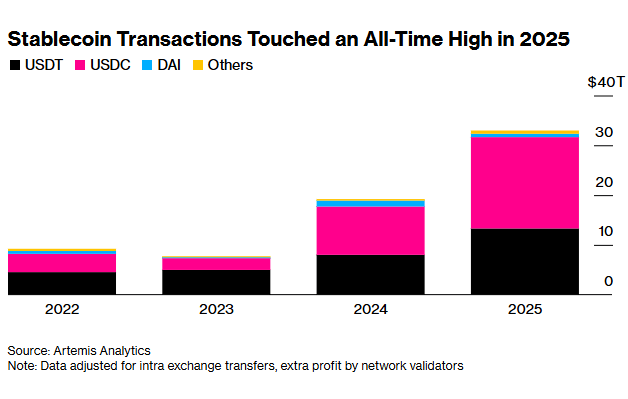
The breakdown of transactions across the major fiat-tied tokens | Source: Bloomberg

Tether’s USDT is the largest fiat-tied cryptocurrency based on market cap, with a valuation that’s more than double Circle’s USDC, but the latter still dominated in transactions during 2025. USDC made up for $18.3 trillion of the total volume, while USDT accounted for $13.3 trillion.

Together, the two tokens covered an extreme majority of the total volume last year, suggesting that activity related to other dollar-pegged tokens and non-USD stablecoins remained low.

Bitcoin Price

At the time of writing, Bitcoin is trading around $95,000, up more than 3% over the past week.

Looks like the price of the coin has surged over the past day | Source: BTCUSDT on TradingView


Perguntas relacionadas

QWhat is the main purpose of the partnership between Visa and BVNK?

AThe partnership aims to enable stablecoin payments on Visa's $1.7 trillion Visa Direct platform, expanding its digital payments infrastructure.

QHow much payment volume does BVNK process annually according to the article?

ABVNK processes over $30 billion in payments annually.

QWhich two stablecoins dominated transaction volume in 2025, and what were their respective volumes?

AUSDC dominated with $18.3 trillion in transaction volume, while USDT accounted for $13.3 trillion in 2025.

QWhat significant development in US stablecoin legislation is mentioned in the article?

AThe signing of the GENIUS Act by US President Donald Trump was mentioned as a significant development in stablecoin legislation.

QWhat was Bitcoin's approximate price and weekly performance at the time of writing?

ABitcoin was trading around $95,000, up more than 3% over the past week.

Leituras Relacionadas

In-depth Analysis of AI and Crypto: The Era of Symbiosis between Algorithms and Ledgers

By 2026, the integration of artificial intelligence and cryptocurrency has advanced from proof-of-concept to a new stage of "system-level integration". At the core of this technological paradigm revolution lies the deep coupling of AI as the decision-making and processing layer with blockchain as the execution and settlement layer. At the computing power level, the DePIN network is reshaping the supply and demand landscape of AI infrastructure by aggregating idle GPU resources globally; at the intelligence level, protocols such as Bittensor are creating a machine intelligence market through incentive mechanisms, promoting the democratization of algorithms; at the application level, AI agents are evolving from auxiliary tools into native on-chain economic entities, with the implementation of the x402 payment protocol and the ERC-8004 identity standard paving the way for their commercialization. Simultaneously, the integrated application of fully homomorphic encryption, zero-knowledge machine learning, and trusted execution environment is constructing a new paradigm of "hybrid confidential computing". Cutting-edge experiments at the Bitcoin Policy Institute reveal a stunning future: when AI models possess economic autonomy, 90.8% of them choose digital native currencies, with 48.3% choosing Bitcoin as their preferred store of value. This transformation is reshaping the logic of global financial infrastructure—future currencies will flow like information, banks will be integrated into the underlying internet infrastructure, and assets will become routable data packets.

HTX LearnHá 19m

In-depth Analysis of AI and Crypto: The Era of Symbiosis between Algorithms and Ledgers

HTX LearnHá 19m

a16z Crypto Operating Partner: Wall Street Is Undergoing Its Biggest Infrastructure Upgrade in 30 Years

Wall Street is undergoing its largest infrastructure upgrade in 30 years by migrating to on-chain systems, moving beyond mere blockchain exploration. This shift is driven by the promise of significantly faster capital movement, similar to the electronic trading revolution of the 1990s which reduced costs, expanded participation, and increased market size. Tokenization—digital representations of real-world assets like Treasuries and stocks on blockchain—enables 24/7 markets, instant settlement, fractional ownership, and global accessibility. Major institutions are already adopting this: DTCC plans to tokenize U.S. Treasuries by 2026, NYSE is launching a platform for on-chain stock trading, and Tradeweb has executed real-time blockchain-based Treasury trades. The current financial system’s inefficiencies—high fees, slow settlement, and intermediary dependencies—create opportunities for disruption. Smart contracts and atomic settlement eliminate these frictions, turning existing profit margins into avenues for innovation. Regulatory clarity, such as the CLARITY Act, is further accelerating this transition. Established institutions are not competitors but potential customers for new infrastructure products. Founders have a window to build the next generation of financial services atop this emerging regulated, institutional-grade framework. The outcome will be a larger, more liquid, and accessible global market.

marsbitHá 34m

a16z Crypto Operating Partner: Wall Street Is Undergoing Its Biggest Infrastructure Upgrade in 30 Years

marsbitHá 34m

Trading

Spot
Futuros
活动图片