2026 Mid-Year Report On-Chain RWA: Tokenized Stock Market Cap Doubles in a Year, But 90% of Rights Are Hollow Shells

marsbitPublicado em 2026-08-01Última atualização em 2026-08-01

Resumo

The 2026 Mid-Year Report on On-Chain RWA highlights a significant growth in tokenized stock market capitalization, which nearly doubled from $951 million in March to $1.89 billion by July. However, the report reveals a fundamental contradiction in this "layer 2.5" ecosystem: products with the strongest legal foundation (like regulated U.S. infrastructure) lack liquidity and distribution, while freely tradable offshored wrapper products often lack substantive ownership rights. The increase is driven largely by a few products (SECZ, FGRS, STRCx) and platforms (Ondo, xStocks, Securitize collectively hold over 85% share). While distributed value across networks like Ethereum, Solana, and BNB Chain has grown, the market remains fragmented. Products referencing the same underlying asset (e.g., Apple stock) are distinct legal liabilities with different intermediaries and jurisdictional rules, offering varying degrees of legal claim. The report cautions that headline numbers are misleading, as they reflect changes in distributed token value—driven by issuance, conversions, and price movements—not pure investor inflows. True "canonical shares" with legal ownership, wide wallet distribution, institutional liquidity, and independent on-chain price discovery do not yet exist at scale. Tokenized treasuries show stronger product-market fit, and ETFs may be easier to scale than single stocks. The core takeaway is a trade-off: legal certainty versus liquidity and composability.

Author: insights4vc

Translation: Deep Chao TechFlow

Deep Chao Introduction: The headline figure for the scale of on-chain tokenized assets looks good, but behind it lies a fundamental contradiction—products that can be freely circulated often lack real ownership rights, while products with genuine legal effect lack liquidity. This report uses specific data to dissect just how much of this "$1.89 billion market" is real money, serving as a necessary dose of sobriety for any investor considering deploying capital in on-chain securities.

The stock market hasn't moved on-chain. What has truly emerged is a set of more credible infrastructure layers—for distributing securities, recording ownership claims, and settling trades through blockchain-based systems.

Data from RWA.xyz shows that the value of distributed tokenized stocks grew from $951 million in March 2026 to $1.89 billion in July, almost doubling. However, this growth primarily came from a handful of products and platforms.

The most significant progress has come from regulated market infrastructure, notably Nasdaq's Same CUSIP Settlement model and the planned commercial rollout by DTC. Liquidity, investor distribution, and independent on-chain price discovery remain very limited. Tokenized treasuries continue to demonstrate stronger product-market fit, and equity ETFs may be easier to scale than single stocks.

Therefore, this market is best understood as a fragmented "Layer 2.5" system: products with the most robust legal foundations often have the weakest liquidity and distribution capabilities; while the most actively traded wrapped products typically have the thinnest ownership rights.

This report is an update to insights4vc's March 2026 analysis "The State of On-Chain Real Assets," focusing on what has substantively changed since its release.

The State of On-Chain Real Assets

What Has Substantively Changed Since March

The March report distinguished between two types of assets: those recorded on a blockchain, and those transferable to external wallets. This distinction remains important today. Under RWA.xyz's framework, a "represented asset" stays within the issuer's or platform's own environment; a "distributed asset" can be transferred externally, though transfers may still be limited to approved or whitelisted wallets.

But transferability alone is no longer sufficient to gauge a product's maturity.

Since March, offshore products have become more accessible for cross-chain movement and use in decentralized markets. Ondo expanded to Ethereum, BNB Chain, and Solana, introduced decentralized routing, and added continuous minting and redemption features for some products. xStocks also broadened its distribution channels and collateral integrations.

Meanwhile, regulated US infrastructure has taken a different path: the focus is not on unrestricted portability, but on legal certainty, controlled wallets, compliant custody, transfer agent records, and integration with DTC.
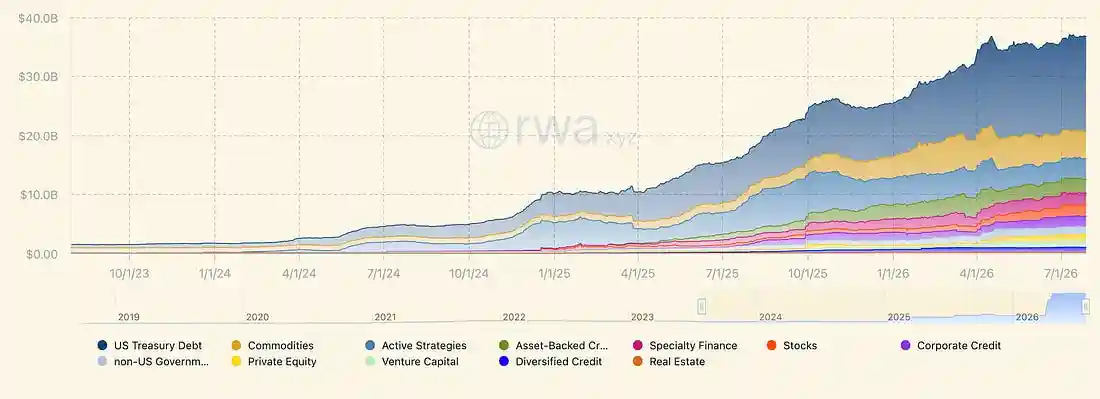
Chart: Market Cap Evolution of Various RWA Asset Types (2019–2026) (Including Tokenized Stocks, Treasuries, etc.)

These two paths solve different problems: offshore wrapped products improve accessibility and composability; regulated infrastructure strengthens the link between the token and the legal ownership claim.

A "canonical share" is the authorized form of the underlying security issued, whose transfer is recognized in the official ownership system. It is fundamentally different from third-party instruments that merely track a stock's price or performance.

Currently, no product achieves all four elements at scale: canonical ownership, broad wallet distribution, institutional liquidity, and independent on-chain price discovery.
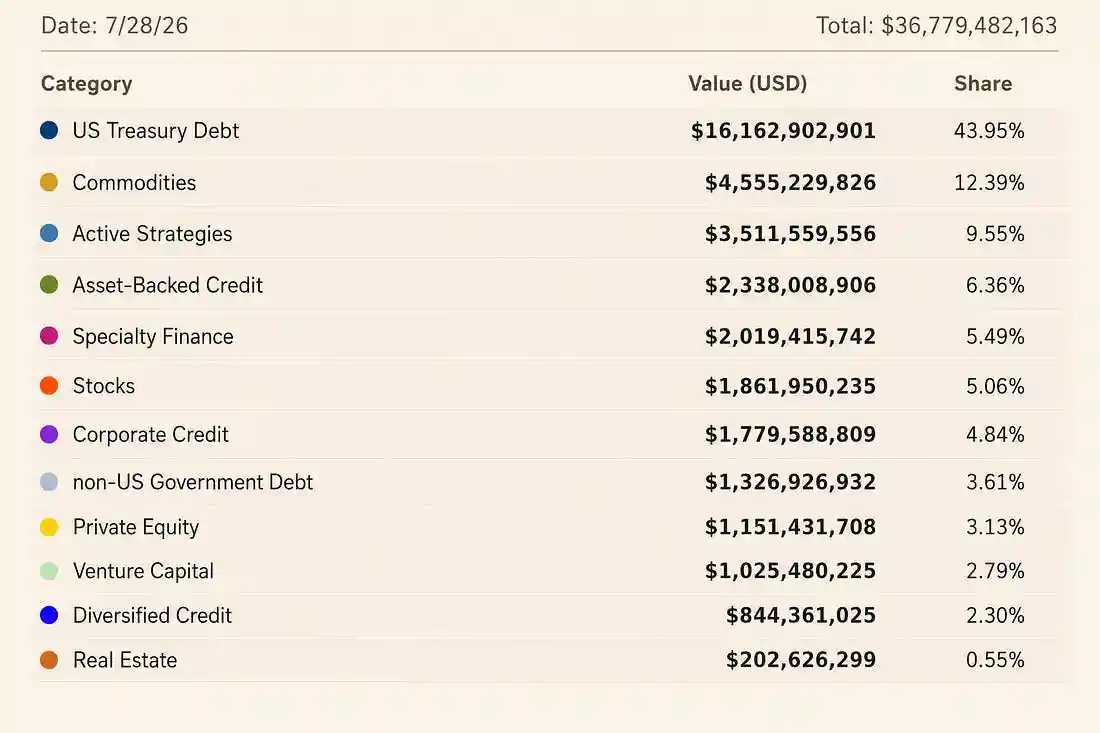
Chart: On-Chain Real Assets Summary Statistics (As of July 28, Total ~$36.78 Billion, US Treasuries Account for 43.95%)

Broader RWA total figures also require careful interpretation. Data reported by RWA.xyz on July 29: distributed value $36.81 billion, represented value $218.27 billion. The apparent $124.33 billion decrease in represented value should not be interpreted as capital outflow or a redemption wave. Between the two observation dates, numerous datasets were added, removed, reclassified, or revalued.

These numbers describe the value of interests covered by the platform's methodology at a specific point in time, not a measure of investor fund flows.

The tokenized stock series is more instructive, as the same "bridged token value" methodology can be applied across both periods. Even so, the reported 98.5% increase cannot be clearly decomposed into new issuance, price appreciation, and classification changes.

FGRS provides a useful example. Figure completed a fundraising offering 4.375 million blockchain shares at $32 per share, but subsequently reported value fluctuates with market prices. Without daily mint, burn, and net asset value data for each product, it's impossible to reliably reconstruct the net market-wide issuance.

Why the $1.888 Billion Headline Number Is Misleading

RWA.xyz uses "Bridged Token Value" to measure tokenized stocks, calculated as: Bridged circulating supply multiplied by Net Asset Value.

Circulating supply excludes balances identified as treasury holdings or pre-minted inventory. The bridged figure also removes tokens locked in known bridge contracts to avoid double-counting when an asset is locked on one network and issued on another.

This is a valid measure of distributed value, but it differs from free float. Free float refers to the portion of securities genuinely available for public trading after excluding restricted, strategic, and concentrated holdings.

The timing of the data also matters. The provided asset-level export shows a distributed total value of $1.8879 billion on July 27, consistent with the ~$1.888 billion shown on the dashboard. A snapshot across platforms and networks on July 29 sums to approximately $1.872 billion.

The difference is $15.8 million, or 0.84%, consistent with price and token supply changes between the two observation dates. Therefore, this report's growth calculations for specific instruments use July 27 data, while platform and network market share uses the July 29 snapshot, and the two datasets are not mixed in the same calculation.
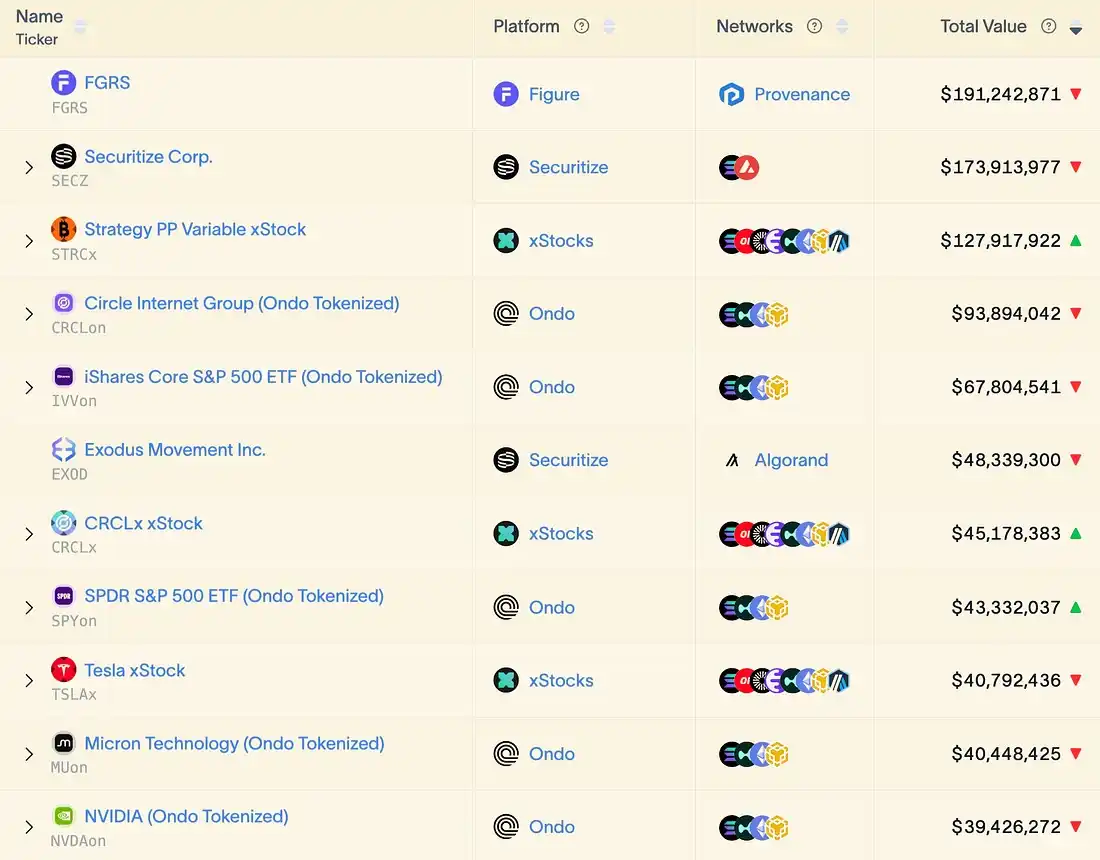
Chart: Tokenized Stock Details (10 Underlyings, Classified by Issuing Platform & Network, FGRS highest at ~$191 million)

Three named instruments contributed roughly half the increment: SECZ added $169 million post-listing, FGRS added $162.9 million, STRCx added $126.6 million. Together they contributed $458.6 million, 49% of the total $936.8 million increase. Long-tail products collectively contributed another $150.5 million, 16.1% of the increment.

These figures reflect changes in distributed value, not investor subscriptions.

SECZ is affected by both the number of represented shares and Securitize's NYSE stock price. FGRS reflects a combination of issuance, conversion activity, and market price changes. STRCx depends on the circulating supply and value of receipts tied to Strategy Floating Rate Preferred Stock.

Calling the above three increases "tokenized stock capital inflows" would merge several economically distinct events into a single, potentially misleading number.

Concentration is more evident at the platform level. In the July 29 snapshot, Ondo and xStocks together accounted for 72.7% of distributed value. Adding Securitize raises the top three platforms' share to 85.1%.
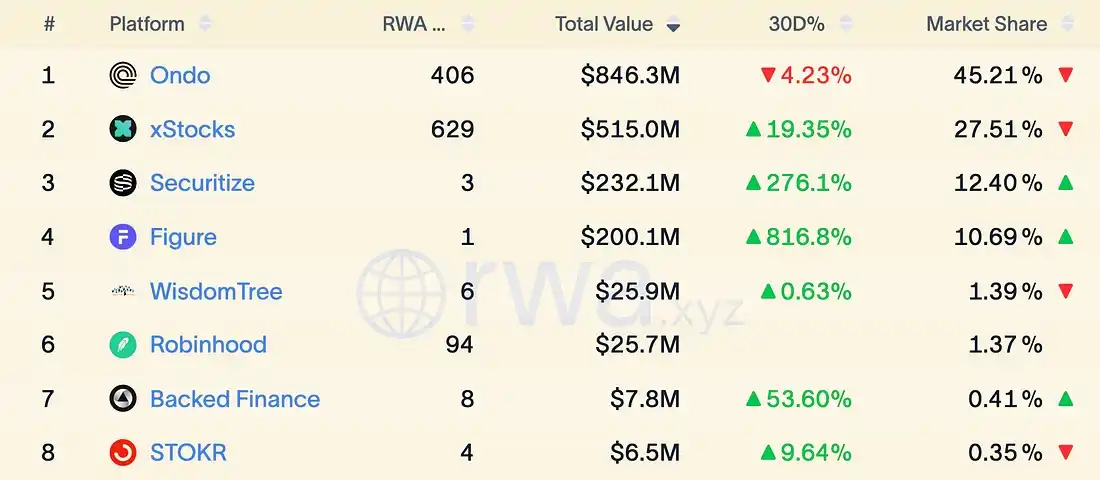
Chart: RWA.xyz Platform Rankings — Ondo (45.21%), xStocks (27.51%), Securitize (12.40%) are Top Three

Distribution across blockchain networks is more decentralized, but this doesn't eliminate underlying common dependencies. Ethereum leads with a 36.2% value share, followed by Solana (19.6%) and BNB Chain (15.8%). Provenance and Avalanche are primarily driven by Figure and Securitize, respectively.

Products issued on different networks may still rely on the same wrapping issuer, broker, custodian, transfer agent, or reference price provider.
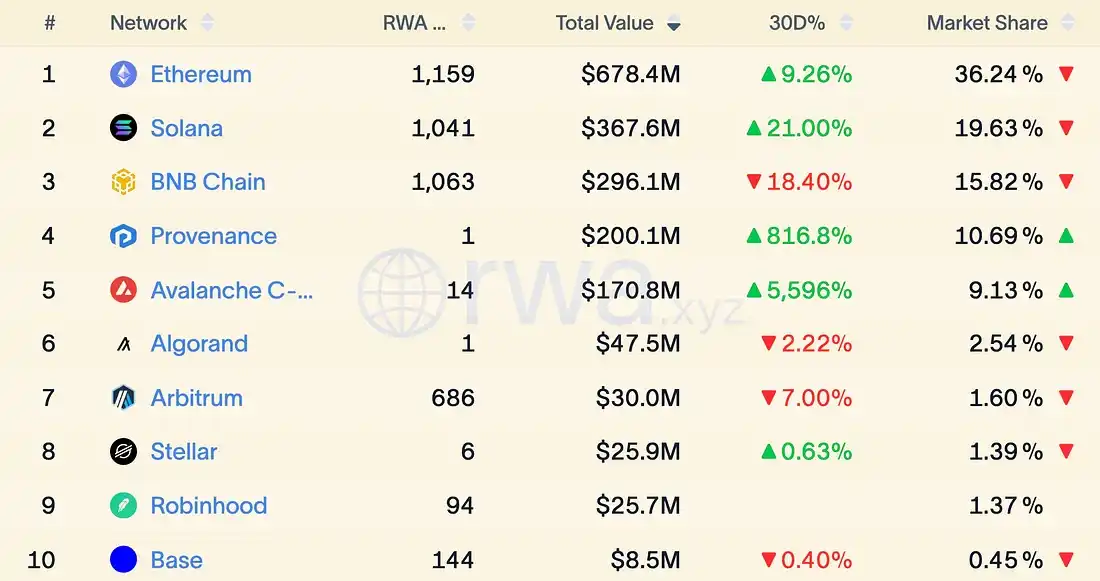
Chart: RWA.xyz Network Rankings — Ethereum (36.24%), Solana (19.63%), BNB Chain (15.82%) are Top Three

This market has broadened in scope but remains legally fragmented. Multiple tokens can simultaneously reference Apple stock or the S&P 500 ETF, but each is a separate legal liability, subject to different jurisdictions, and reliant on different intermediaries.

Bridge adjustments prevent double-counting the same token on different networks, but they cannot—and should not—consolidate products that reference similar assets but offer substantively different legal rights.


Criptomoedas em alta

Perguntas relacionadas

QAccording to the article, what is the core contradiction within the current tokenized stock market?

AThe core contradiction is that products with free tradability often lack genuine legal ownership rights, while products with solid legal ownership rights suffer from poor liquidity.

QWhat were the two main categories of assets defined in the March 2026 report, and why does the article say transferability alone is no longer sufficient to judge a product's maturity?

AThe two categories were 'represented assets' (recorded but kept within the issuer's environment) and 'distributed assets' (transferable to external wallets). The article states transferability alone is insufficient because the market has evolved into two distinct paths: offshore products focus on accessibility/composability, while regulated US infrastructure focuses on legal certainty, controlled wallets, and integration with traditional systems like the DTC.

QWhich three specific tokenized stock instruments contributed nearly half of the reported growth in distributed value from March to July 2026?

AThe three instruments were SECZ (which added ~$169M), FGRS (~$162.9M), and STRCx (~$126.6M). Together, they contributed about 49% of the total $936.8M increase in distributed value.

QHow concentrated is the tokenized stock market at the platform level as of late July 2026, based on the data presented?

AThe market is highly concentrated. The top three platforms—Ondo, xStocks, and Securitize—collectively accounted for 85.1% of the total distributed value as of July 29th.

QWhat are the four key elements that, according to the article, no tokenized stock product has managed to achieve at scale simultaneously?

AThe four elements are: 1) Canonical ownership (legal recognition), 2) Broad wallet distribution, 3) Institutional liquidity, and 4) Independent on-chain price discovery.

Leituras Relacionadas

UNI Doubles in Two Months Against the Trend: A 5-Year-Overdue Value Realization

Amidst a generally stagnant crypto market in June and July, UNI, the governance token of Uniswap, saw a significant surge, nearly doubling in price from around $2.3 to $4.6. This rally represents a delayed but significant value reassessment, triggered by the practical implementation of its long-debated "fee switch" mechanism. The key turning point was the on-chain execution of the UNIfication proposal in December 2025. It activated a protocol fee on select pools, directed Unichain sequencer revenue (net of costs) to a communal treasury, executed a one-time burn of 100 million UNI, and established a system where all protocol revenue flows into a "TokenJar" contract. This treasury has a single exit: purchasing and permanently burning UNI via a "Firepit" contract. Initially, the market reacted tepidly as the generated revenue and corresponding burn rate were modest. The narrative shifted dramatically in July 2025 with two major developments. First, the launch of Robinhood Chain, tailored for tokenized stocks, rapidly became a primary source of volume and fees for Uniswap, at one point contributing nearly half of its weekly fees. Second, governance votes successfully expanded the fee mechanism to v4 pools and initiated a temperature check for fees on Robinhood Chain. The activation of v4 fees caused the protocol's daily revenue earmarked for UNI burns to nearly triple. The core of UNI's recent price action is the transition from a pure governance token to a cash-flow asset with a permanent, protocol-funded buyer. Its effectiveness is amplified by UNI's mature and widely distributed supply, with no major impending unlocks to dilute the impact of the buybacks. The sustainability of this rally now hinges on whether the transaction volume, particularly on Robinhood Chain, persists after its initial gas subsidies expire, determining if this is a genuine value realization or a subsidy-fueled spike.

marsbitHá 6m

UNI Doubles in Two Months Against the Trend: A 5-Year-Overdue Value Realization

marsbitHá 6m

Breaking: Google Earth Urgently Pulls Back Nano Banana 2 Image Generation Feature!

Google Earth's newly launched "Create image" feature, powered by the Nano Banana 2 AI image generation model, was abruptly withdrawn shortly after its release due to being "played" by users. The feature allowed users to generate and overlay AI-created visuals directly onto real-world satellite and 3D maps in Google Earth. The tool enabled creative applications like historical recreations (e.g., visualizing ancient Pompeii), generating informational graphics for landmarks, and envisioning architectural projects or futuristic cityscapes on real terrain. It operated under "geospatial grounding," meaning the AI respected the underlying geography, topography, and perspective of the chosen map view. The model also integrated with Gemini to retrieve relevant factual information. However, upon release, users quickly tested its limits. A prominent example involved reimagining Philadelphia's historic Independence Hall as a post-apocalyptic ruin overrun by "happy" zombies, evil clowns, and giant alien mechs. This highlighted both the feature's playful potential and its risks regarding the generation of inappropriate or misleading content on realistic maps, leading to its swift temporary removal. Google stated it would re-release the feature after implementing "enhanced guardrails." Analysts note this move strategically leverages Google's vast proprietary geospatial data, positioning its AI not just for artistic generation but for spatially accurate world visualization—a unique advantage in the competitive AI image generation landscape.

marsbitHá 1h

Breaking: Google Earth Urgently Pulls Back Nano Banana 2 Image Generation Feature!

marsbitHá 1h

Altman Admits: Overestimated AI Snatching Jobs! Huang Renxun: The Unemployment Narrative Is Completely Backwards

Sam Altman has revised his earlier predictions about AI rapidly replacing jobs, admitting he overestimated the speed at which AI would eliminate entry-level white-collar roles. Speaking on the "Invest Like the Best" podcast, he stated that people do not truly want an AI CEO, as accountability and human connection remain critical. He found that individuals prefer interacting with people who can be held responsible for decisions. Similarly, NVIDIA's Jensen Huang argued that the narrative of AI destroying jobs is misguided. He distinguishes between tasks and jobs, noting that while AI can automate specific tasks, entire jobs—encompassing communication, judgment, coordination, and accountability—are not eliminated. He cited examples like radiologists and software engineers, where demand for these roles has increased as AI handles repetitive tasks, allowing for business expansion and the creation of more positions. Data from a University of Maryland and LinkUp study supports this, showing that U.S. job postings for new graduates have actually risen, countering the fear of vanishing entry-level roles. However, a significant shift is occurring: the traditional entry-level tasks that help newcomers gain experience are being automated, making initial career access more challenging. The key insight is that as AI takes over standardized tasks, the enduring value of human work shifts toward areas of responsibility, trust-building, and final decision-making—aspects that AI cannot replicate. The real "moat" for professionals lies in these irreplaceable human elements.

marsbitHá 1h

Altman Admits: Overestimated AI Snatching Jobs! Huang Renxun: The Unemployment Narrative Is Completely Backwards

marsbitHá 1h

Weekly Editor's Picks (0725-0731)

Weekly Editor's Picks (0725-0731) provides a curated selection of deep analysis, filtering out market noise. Key themes from this week include: **Macro & Policy:** The Federal Reserve's upcoming meeting is marked by high uncertainty, balancing cooling inflation data against persistent price pressures. Meanwhile, the U.S. crypto regulatory Clarity Act faces critical political hurdles, with its 2026 passage probability seen as low. **Investing & Crypto:** Analysis suggests long-term crypto success depends on conviction through volatile cycles, focusing on assets like Bitcoin and core smart contract platforms. A trend noted is the increasing similarity between global equity markets (especially tech) and crypto, driven by narrative and leverage. Several major crypto protocols show strong revenue growth, but this isn't always translating to token price appreciation due to sell pressure and structural factors. **AI & Semiconductors:** Nvidia's rising credit default swap rates signal market concern over AI infrastructure financing risks. The storage sector experienced volatility as markets began pricing in potential 2027 oversupply. Despite a record profitable quarter, SK Hynix's results were deemed "below expectations," reflecting heightened investor demands for future growth visibility. **Markets & DeFi:** TradeXYZ demonstrated remarkable accuracy in pre-market pricing for a major A股 listing. The token ONDO saw gains, linked to its growing role in the on-chain tokenized stock ecosystem. **Ethereum:** Post-Pectra upgrade, a major structural shift is underway as Lido begins migrating millions of ETH to new validator architectures designed for capital efficiency. **Also Highlighted:** Butian's bullish stock market move; OpenAI's Altman promising major advances; Samsung and SK Hynix securing large AI chip deals; Apple reaching a $5T market cap; and ongoing discussions around exchange security following Poolin's bankruptcy case.

marsbitHá 2h

Weekly Editor's Picks (0725-0731)

marsbitHá 2h

Trading

Spot

Artigos em Destaque

Como comprar CAP

Bem-vindo à HTX.com!Tornámos a compra de Cap (CAP) simples e conveniente.Segue o nosso guia passo a passo para iniciar a tua jornada no mundo das criptos.Passo 1: cria a tua conta HTXUtiliza o teu e-mail ou número de telefone para te inscreveres numa conta gratuita na HTX.Desfruta de um processo de inscrição sem complicações e desbloqueia todas as funcionalidades.Obter a minha contaPasso 2: vai para Comprar Cripto e escolhe o teu método de pagamentoCartão de crédito/débito: usa o teu visa ou mastercard para comprar Cap (CAP) instantaneamente.Saldo: usa os fundos da tua conta HTX para transacionar sem problemas.Terceiros: adicionamos métodos de pagamento populares, como Google Pay e Apple Pay, para aumentar a conveniência.P2P: transaciona diretamente com outros utilizadores na HTX.Mercado de balcão (OTC): oferecemos serviços personalizados e taxas de câmbio competitivas para os traders.Passo 3: armazena teu Cap (CAP)Depois de comprar o teu Cap (CAP), armazena-o na tua conta HTX.Alternativamente, podes enviá-lo para outro lugar através de transferência blockchain ou usá-lo para transacionar outras criptomoedas.Passo 4: transaciona Cap (CAP)Transaciona facilmente Cap (CAP) no mercado à vista da HTX.Acede simplesmente à tua conta, seleciona o teu par de trading, executa as tuas transações e monitoriza em tempo real.Oferecemos uma experiência de fácil utilização tanto para principiantes como para traders experientes.

169 Visualizações TotaisPublicado em {updateTime}Atualizado em 2026.06.26

Como comprar CAP

Discussões

Bem-vindo à Comunidade HTX. Aqui, pode manter-se informado sobre os mais recentes desenvolvimentos da plataforma e obter acesso a análises profissionais de mercado. As opiniões dos utilizadores sobre o preço de CAP (CAP) são apresentadas abaixo.

活动图片