Behind the Coinbase Acquisition of USDH: Hyperliquid’s Interest-Driven Choice

Odaily星球日报Publicado em 2026-05-15Última atualização em 2026-05-15

Resumo

The article discusses the transition of the Hyperliquid ecosystem's native stablecoin, USDH, following its acquisition by Coinbase. Last September, USDH, issued by Native Markets, was a focal point in the ecosystem. Recently, Coinbase announced it will become the official USDC treasury deployer on Hyperliquid. Native Markets granted Coinbase the rights to purchase the USDH brand assets, leading to the gradual phase-out of USDH. Users can convert USDH to USDC or fiat without fees during this period. USDC is now Hyperliquid's official stablecoin. The move is framed as a three-way win: * **Coinbase & Circle:** Deepen ties with Hyperliquid's on-chain economy. Both companies are staking HYPE tokens. Circle had already invested in HYPE previously. * **Hyperliquid:** Becomes the primary beneficiary, set to receive the vast majority (estimated ~90%) of the reserve yield income from the ~$5.16 billion in USDC on its platform. This could translate to significant daily HYPE buybacks. The alliance with Coinbase may also offer regulatory advantages in the US. * **Native Markets:** While exiting the stablecoin business, the team reportedly received economic compensation from Coinbase for the USDH brand assets, framing it as a successful conclusion to USDH's role. However, the article notes criticism from some Hyperliquid community members. They view the shift as a step back for decentralization and argue that the original USDH issuer vote was driven by internal interests rather th...

Original|Odaily Planet Daily(@OdailyChina)

Author|Wenser(@wenser 2010)
In September of last year, the battle over the Hyperliquid native stablecoin USDH once became a focal point in the industry; now, this once highly anticipated stablecoin has suddenly welcomed its own "exit moment."

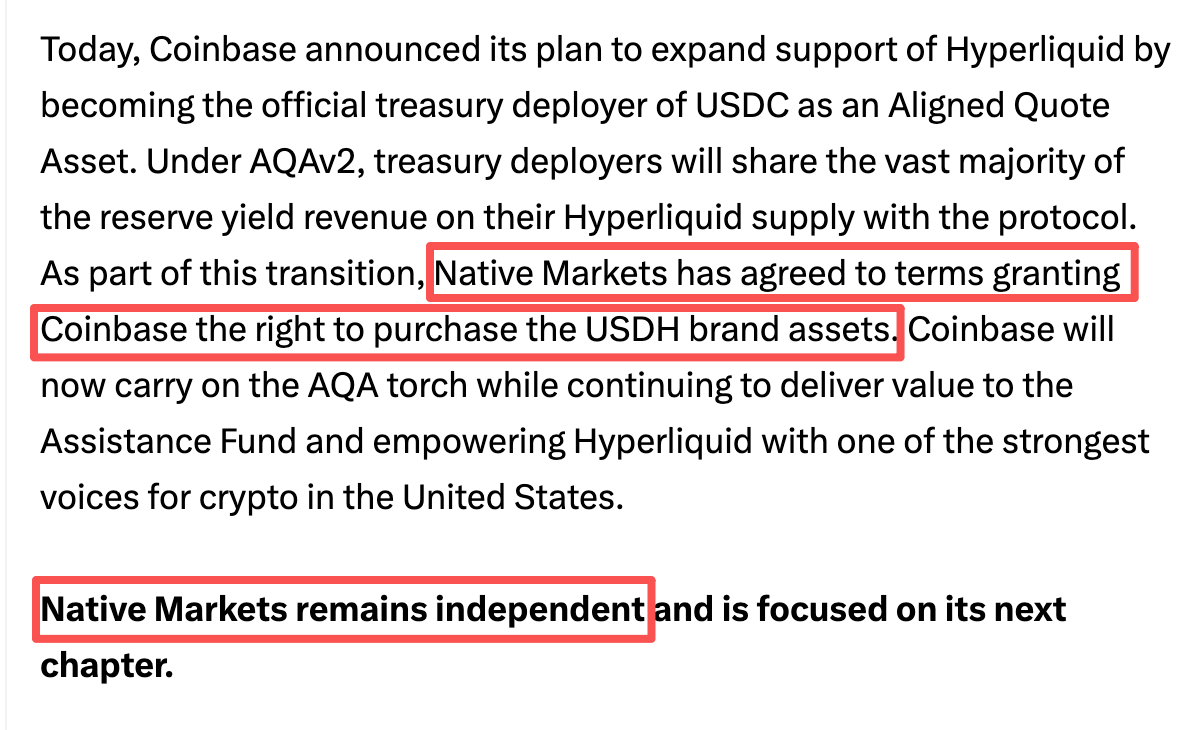
Last night, Coinbase announced it would become the official treasury deployer for USDC on Hyperliquid, while Native Markets, the issuer of the Hyperliquid native stablecoin USDH, granted Coinbase the right to purchase USDH brand assets. Subsequently, the USDH market will be gradually phased out, during which users can still convert USDH to USDC or fiat currency without transaction fees.

From this point on, the once-famous USDH has become an asset absorbed by Coinbase, while USDC is officially established as the official stablecoin and quote asset of Hyperliquid. Odaily Planet Daily will briefly analyze the details and subsequent impacts of this event in this article.

USDH Exits, USDC Rises: The Economic Calculations Behind $50 Billion

This grand play of the "Hyperliquid Ecosystem Stablecoin Battle" ultimately concluded with a win-win-win outcome for the three parties: Coinbase & Circle, Hyperliquid, and Native Markets, the USDH issuer.

Coinbase further deepened its integration with the Hyperliquid ecosystem through this move; Hyperliquid secured the majority of the revenue from USDC stablecoin reserves within its ecosystem; Native Markets, as the ultimate beneficiary of USDH, received its reward in the form of "selling the USDH brand assets."

Coinbase & Circle: Binding to Hyperliquid's On-Chain Economy, Continuously Increasing Investment in HYPE

Currently, the scale of USDC on Hyperliquid is approximately $5.164 billion, a year-on-year increase of 2 times.

As the official partner and revenue-sharing party for USDC, Coinbase's action undoubtedly aims to deeply integrate with the Hyperliquid ecosystem.

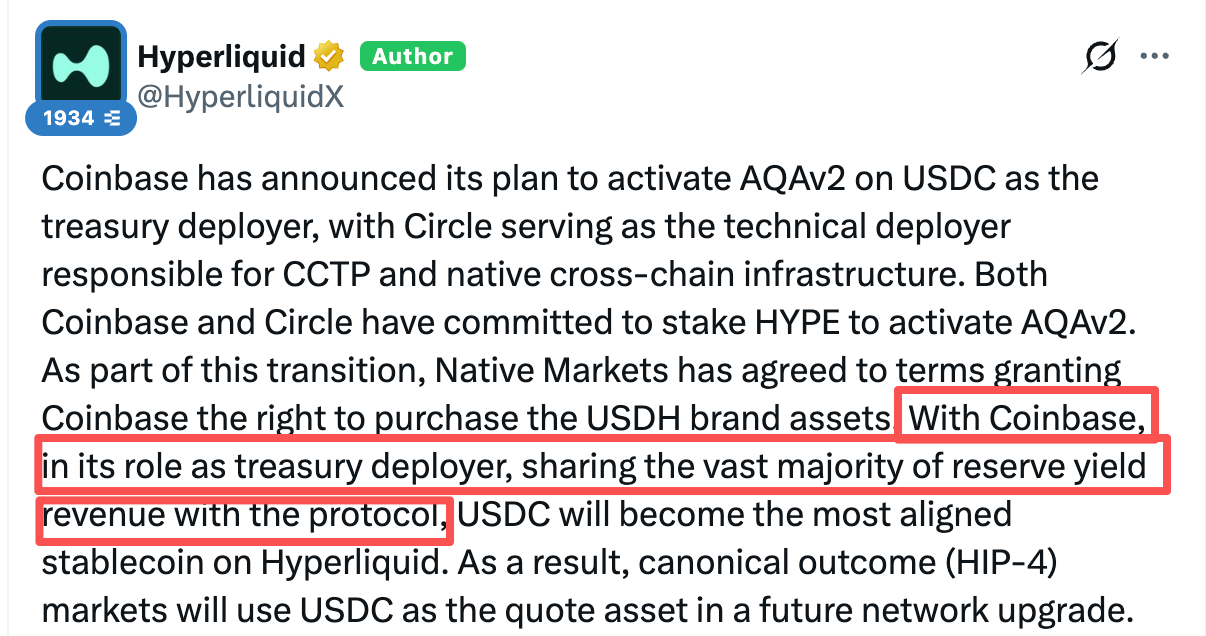
Additionally, according to official Hyperliquid announcement information, both Coinbase (funds deployer) and Circle (responsible for CCTP and native cross-chain infrastructure technical deployment) have committed to staking HYPE to activate AQAv2 (Aligned Quote Asset v2).

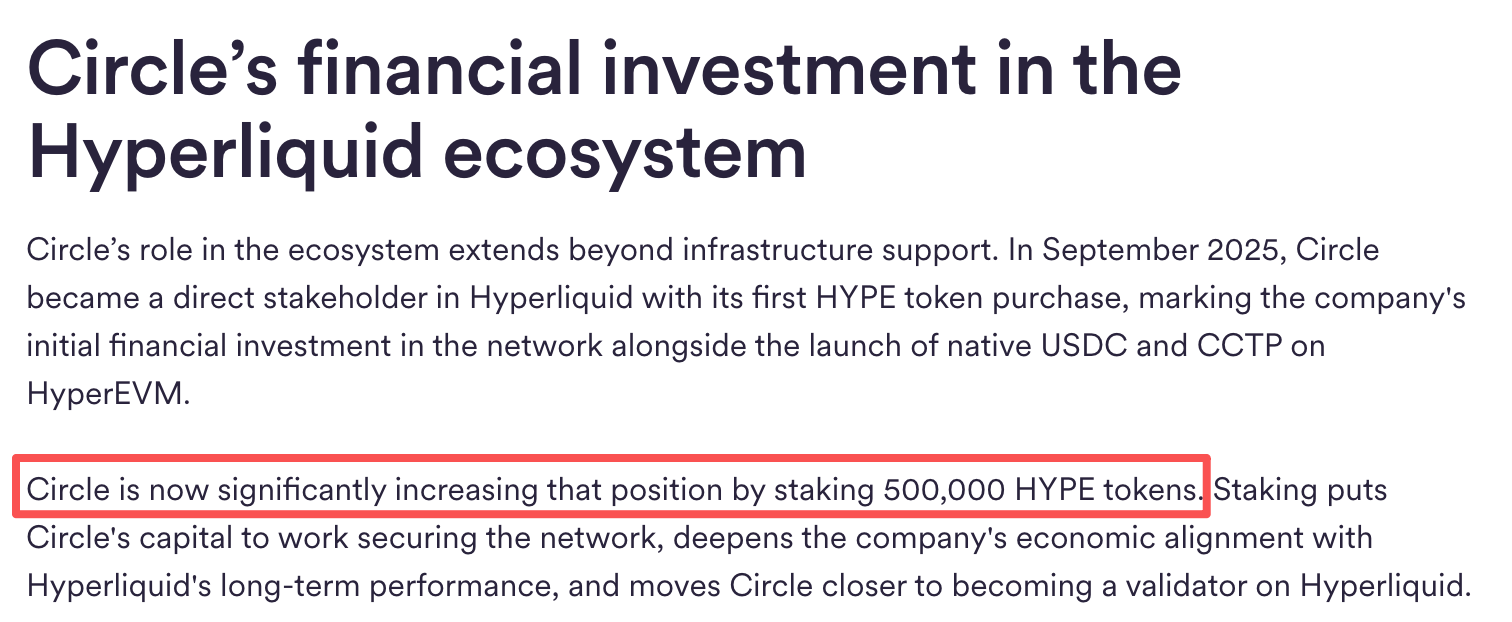
It is worth mentioning that in September last year, Circle had already purchased HYPE tokens, and its current HYPE token staking scale has increased to around 500,000.
Hyperliquid: Secures the Lion's Share of USDC Reserve Revenue, Enjoys the Convenience of Being a Coinbase Ally

As for the biggest winner of this cooperation, it is undoubtedly Hyperliquid as the foundational ecosystem.

According to the official announcement, Coinbase will subsequently share the majority (vast majority) of reserve revenue income with the Hyperliquid protocol. Although the specific split ratio has not been disclosed, if based on the previous USDH revenue-sharing mechanism, Hyperliquid will actually receive approximately 90% of the reserve revenue.

According to calculations by Hyperliquid community members, based on a scale of $4.7 billion and a 3.8% interest income rate, this revenue corresponds to approximately $160 million; in other words, it corresponds to a daily HYPE token buyback of about $440,000.

Furthermore, with the CLARITY Act passing the vote in the U.S. Senate Banking Committee, the deep integration between Hyperliquid and Coinbase also means that HYPE and Hyperliquid have gained a certain level of support in terms of U.S. regulation.
Native Markets: USDH's Historical Mission Accomplished

As the issuer of the Hyperliquid native stablecoin USDH, Native Markets might seem like the biggest loser in this "absorption event," but judging from its official statement, its ending can also be considered a "successful retirement."

On one hand, USDH provided a model and template for the revenue sharing of USDC between Coinbase and the Hyperliquid protocol; on the other hand, Coinbase likely directly acquired the USDH-related brand assets. The USDH stablecoin issued by the Native Markets team was essentially "acquired by Coinbase," thus providing the team with a certain economic return.

Subsequently, Native Markets also stated it would remain independent and seek developments in other areas.
After USDH's Exit, In a Win-Win-Win Situation, Only USDH Users Get Hurt

Of course, Native Markets' exit has not been met with universal "praise." Hyperliquid community users have also expressed disapproval of its so-called "sitting at the negotiation table" narrative.

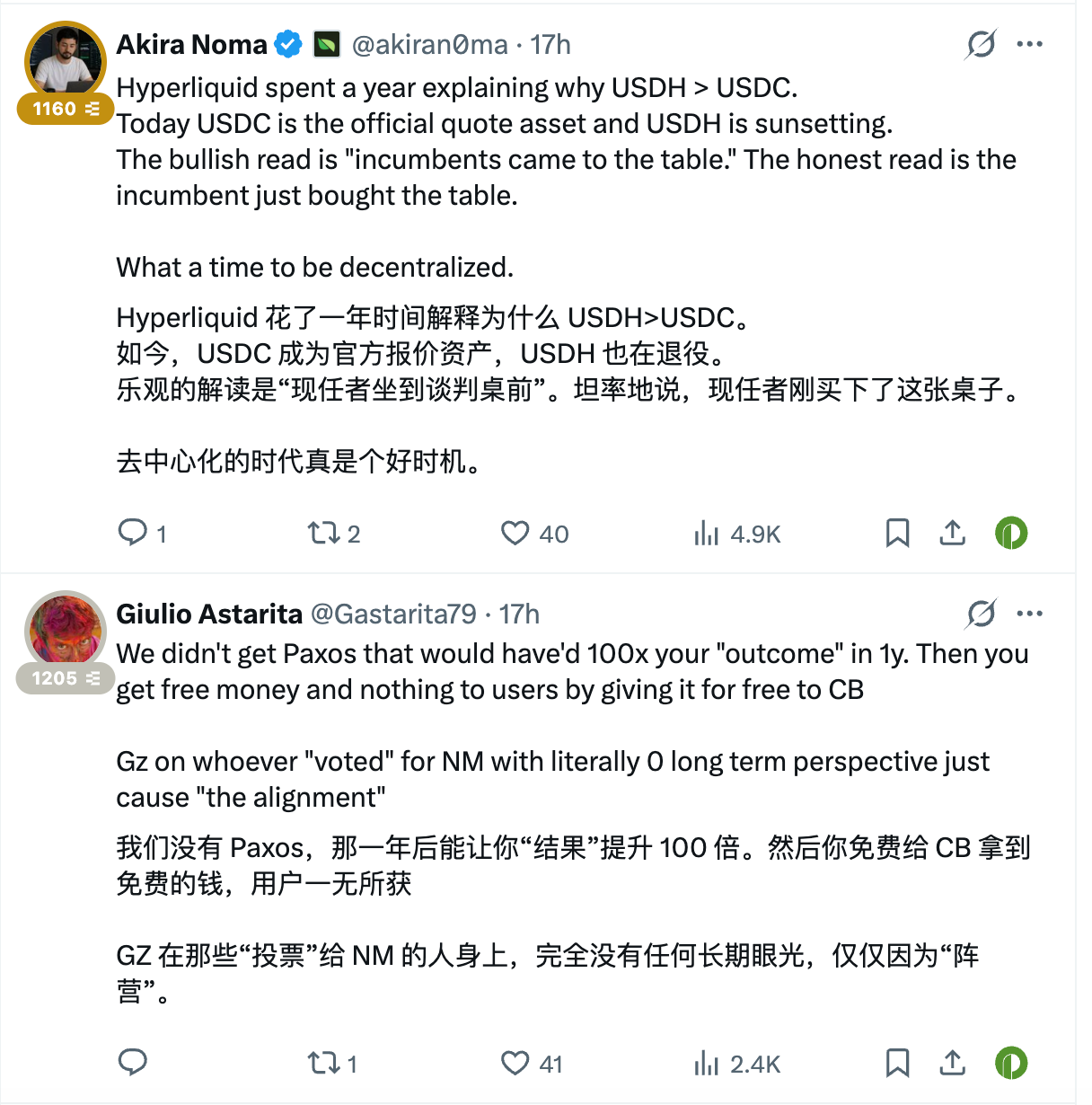
Some believe that the exit of USDH signifies a complete regression of the decentralization era;

Others point out that during the original USDH stablecoin issuer vote, Paxos should have been chosen, as they at least considered users and stablecoin growth. Those who voted for Native Markets were merely aligning with factions and internal interests. Ultimately, users gained nothing. These remarks have garnered considerable agreement and support.
Thus, the drama from a year ago, filled with "dominant pursuit," "resistance against giants," has finally come to an end.

However, looking back now at the scene of Hyperliquid "shaking hands and making peace" with Coinbase and Circle is somewhat poignant and slightly ironic.

In the end, everything was merely about the distribution of interests, not the once-loudly proclaimed slogans of "for the community" or "for Hyperliquid."

Recommended Reading

Hyperliquid Stablecoin USDH Becomes the "Industry's Favorite," Giants Trigger Chaotic Battle for Distribution Rights

USDH Vote in Progress: "Prearranged Script," "Dominant Pursuit," "Stepping Down Bravely" Take Turns on Stage


Perguntas relacionadas

QWhat major announcement did Coinbase make regarding Hyperliquid, and what does it mean for USDH?

ACoinbase announced it will become the official USDC treasury deployer on Hyperliquid. Additionally, USDH issuer Native Markets granted Coinbase the right to purchase the USDH brand assets. This means the USDH market will gradually be shut down, and USDH will effectively be 'acquired' by Coinbase, while USDC is established as Hyperliquid's official stablecoin and quote asset.

QAccording to the article, why is Hyperliquid considered the biggest winner in this arrangement?

AHyperliquid is considered the biggest winner because it will receive the vast majority (estimated around 90%) of the revenue generated from the USDC reserves on its platform. This represents significant, ongoing income. Furthermore, the deep partnership with Coinbase provides regulatory support and convenience for the Hyperliquid ecosystem in the US market.

QWhat benefit does the article state that Coinbase and Circle gain from this partnership with Hyperliquid?

ACoinbase and Circle gain a deeper economic and strategic bond with the Hyperliquid ecosystem. Coinbase strengthens its role as a major stablecoin infrastructure provider. Both companies have also committed to staking HYPE tokens to support the platform's AQAv2 (Aligned Quote Asset) mechanism, with Circle having already increased its HYPE stake significantly.

QHow is the outcome for Native Markets, the issuer of USDH, described in the article?

AThe outcome for Native Markets is described as achieving a 'graceful exit' or 'mission accomplished.' While they are stepping away from USDH, they are reportedly receiving financial compensation from Coinbase for the sale of the USDH brand assets. The team will remain independent to pursue other ventures, having paved the way for the USDC revenue-sharing model.

QWhat is one of the main criticisms from the Hyperliquid community regarding the shutdown of USDH?

AOne major criticism from the community is that the shutdown of USDH represents a step back for decentralization. Some users also expressed disappointment, arguing that the initial vote for the USDH issuer was driven by internal interests and 'bandwagoning' rather than choosing an issuer (like Paxos) that would prioritize users and the stablecoin's growth, leaving end-users with nothing.

Leituras Relacionadas

a16z Crypto: A Guide to the CLARITY Act for Crypto Entrepreneurs

The CLARITY Act, a bipartisan crypto market structure bill, has advanced through the Senate Banking Committee, marking a potential historic shift in U.S. digital asset regulation. For years, a lack of clear rules has stifled innovation, pushed development overseas, and exposed consumers to risk. This bill aims to establish a comprehensive framework, providing long-needed regulatory clarity for blockchain networks and digital assets. It builds upon previous legislative efforts like FIT21 and the House version of CLARITY, which gained strong bipartisan support. CLARITY is crucial because it recognizes that blockchain networks are fundamentally different from traditional companies. Networks operate through decentralized, shared rules rather than centralized control. Applying corporate legal frameworks to networks forces them into a centralized model, concentrating power and value. In contrast, decentralized blockchain networks can function as user-owned public infrastructure, distributing value more equitably among participants. The bill seeks to enable the safe launch of networks in the U.S., clarify regulatory jurisdiction between the SEC and CFTC, oversee crypto exchanges, and enhance consumer protections. Its passage would align U.S. law with the nature of decentralized technology, allowing builders to operate transparently and fund projects domestically without structural compromises due to regulatory uncertainty. Similar to the positive impact seen after the stablecoin-focused GENIUS Act, CLARITY could unlock a new wave of innovation, helping the U.S. reclaim leadership in the crypto space while combating fraud and abuse.

链捕手Há 14m

a16z Crypto: A Guide to the CLARITY Act for Crypto Entrepreneurs

链捕手Há 14m

muShanghai Discusses Consumer AI: After Continuous Iteration of Large Models, Product Competition Moves Towards Scenarios and Experience

The roundtable discussion "Innovative Practices and Path Exploration of the AI Consumption Ecosystem" at muShanghai AI Week, featuring experts from model platforms, cultural apps, the open-source ecosystem, and music creation, delved into the practical paths for consumer AI products. A key consensus emerged: while AI model advancements lower prototyping barriers, the real challenge for enduring products lies beyond raw technology. True differentiation comes from deep scene understanding, data organization, user education, delivering emotional value, and building open ecosystems. The competition is shifting from "who has the stronger model" to "who best understands the specific user and scenario." Participants highlighted that application-layer barriers, such as accumulated contextual data and cultural localization (e.g., FateTell's translation of Eastern metaphysics for global users), are not easily erased by model updates. They cautioned that AI simplifies prototyping but not the core entrepreneurial hurdles: user acquisition, community building, and commercialization. The discussion emphasized that value must return to human needs—like emotional comfort (FateTell) or preserving the creative *process* in music-making, as highlighted by musician-developer Gao Jiafeng, rather than just outputting a final product. With the rise of AI Agents, user education is evolving from manual documentation reading to more guided, interactive learning within the product experience itself. Looking ahead 3-5 years, panelists foresee AI moving into the physical world via hardware and robotics, enabling more personalized services and addressing growing needs for companionship amidst technological anxiety. The future points towards "technology democratization," where AI assists diverse lifestyles, and cultural forms may be recombined, with emotional connection becoming paramount. Ultimately, as models continue to evolve, the products that endure will be those that meet genuine human needs, foster understanding, and build meaningful connections.

marsbitHá 1h

muShanghai Discusses Consumer AI: After Continuous Iteration of Large Models, Product Competition Moves Towards Scenarios and Experience

marsbitHá 1h

Trading

Spot
Futuros
活动图片