Chip Design: The 'Cash Flow Restructuring' and 'Capability Leap Window' of 'Institutional Rents'

marsbitPublicado em 2026-08-10Última atualização em 2026-08-10

Resumo

Chip Design: The "Cash Flow Reconstruction" and "Capability Leap Window" of Institutional Rents The first half of 2026 saw extreme divergence in China's chip design sector. While companies like Jiangbolong and GigaDevice reported massive profit surges, others like StarPower saw sharp declines. This disparity stems not from market cycles, but from a fundamental "institutional rent" transfer—profits were systematically shifted from downstream manufacturers (the payers) to upstream design firms (the recipients) due to supply constraints and policy-driven "domestic substitution" mandates. For decades, China's chip design industry was trapped in a vicious cycle: no revenue without customers, no R&D without revenue, and no competitive products without sustained R&D, leading to perpetual cash flow crises. Crucially, this institutional rent, though distorting short-term competition, has inadvertently broken this deadlock. It has created a "cash flow reconstruction," funneling steady, policy-backed income to design houses for the first time. This generates a critical "capability leap window"—a structural, long-term opportunity (potentially lasting over five years due to prolonged chip shortages and tightening export controls) for companies to invest rents into long-cycle R&D (e.g., automotive-grade, AI chips) rather than short-term speculation. Policy is also evolving from simple procurement subsidies to "ecosystem binding," forcing adoption and integration of domestic chips. Conv...

By | Ban Dai Jun

The 2026 interim report season reveals an extreme contrast in China's chip design industry:

Longsys saw a net profit increase of 74394%, GigaDevice grew by 1099%, and Cambricon achieved multi-billion-level profitability for two consecutive quarters. In the same field, StarPower's profits plummeted by 70%, CETC Chip turned from profit to loss, and HGTECH's net profit plunged by 800%.

If you analyze these companies as manufacturing, you would conclude 'high inventory risk, price hikes unsustainable.' If analyzed as financial institutions, you'd get 'balance sheet arbitrage.'

Both conclusions are wrong.

Because they overlook a more fundamental fact: The profits of the chip design industry in 2026H1 were not 'created'; they were 'institutionally transferred.'

But this article's purpose is not to expose darkness. It is to prove: It is precisely this much-criticized 'institutional transfer' mechanism that has accomplished something China's chip industry failed to do in the past twenty years—it has given chip design companies, for the first time, positive operating cash flow and an irreversible 'window for capability leap.'


I. The Distribution of Institutional Rents: Verified Hard Data

First, look at data from authoritative institutions.

TrendForce data shows that in Q1 2026, global contract prices for mainstream DRAM rose 90%–95% quarter-on-quarter, and NAND Flash prices rose 55%–60%, marking historic highs. The upward trend continued in Q2, with mainstream DRAM contract prices up 58%–63% and NAND Flash up 70%–75% quarter-on-quarter.

However, monitoring data from the Digital Economy Laboratory of the University of International Business and Economics shows that from January to March 2026, China's memory chip exports reached $19.14 billion, a year-on-year increase of 205.5%, while export volume grew only about 4%.

Volume up 4%, price up 205%—this is not demand expansion; it's a violent price redistribution under supply constraints.

Data from the China Passenger Car Association shows that from January to May 2026, the profit margin of China's auto industry was 3.4%, lower than the downstream industrial average of 6.1%, and has been declining over the past three years (4.3% in 2024, 4.1% in 2025, 3.2% in Q1 2026). He Xiaopeng, CEO of XPeng Motors, stated bluntly that most of the money saved by automakers through technological innovation was given back to partners in businesses like memory chips and lithium carbonate.

GigaDevice's 6.9 billion yuan profit and Longsys's 10.2 billion yuan profit are essentially an institutional transfer of profits from downstream sectors. They didn't 'create' value; the system (capacity squeeze + policy compliance) forced downstream sectors to 'cede' profits to upstream ones.

Cambricon is similar. On May 22, 2026, Li Chao, Deputy Director of the Policy Research Office of the National Development and Reform Commission, clearly stated that they would 'guide domestic large models to intensify efforts to adapt to domestic computing power chips.' In April 2026, State Council Decree No. 834, the 'Regulations on Promoting the Security and Stability of Industrial and Supply Chains,' took effect. Internet giants buy Cambricon chips not because they perform better than NVIDIA's, but because 'domestic substitution' is a political task.

Customers are not buying chips; they are buying 'compliance credentials.'

This creates a unique pricing mechanism: Chip price = Physical cost + Institutional rent. Institutional rent has no upper limit—it depends on the intensity of policy pressure, not on marginal improvements in technical performance.

The entire industry is split into two classes:

Class One: The Institutional Rent Recipients (Cambricon, GigaDevice, Longsys, Biwin Storage, Hygon)

Class Two: The Institutional Rent Payers (StarPower, CETC Chip, HGTECH, TOWED, Giantec)

This is not cyclical divergence; it is class differentiation. Unidirectional flow, zero-sum game, time mismatch.


II. The Fact Everyone Overlooks: Cash Flow Restructuring

Up to this point, the analytical framework aligns with the pessimistic view. But next, the same framework leads to a completely different conclusion.

What has been the biggest fatal flaw of China's chip design industry over the past twenty years?

It's not technological backwardness; it's the perpetual breakage of cash flow.

Always worrying about the next round of financing, never waiting for products to become profitable, forever forced into short-cycle R&D like 'product in 18 months, IPO in 3 years.' Without positive operating cash flow, there is no capital for long-cycle technological gambles; without long-cycle technological gambles, there's no catching up to NVIDIA, Qualcomm, Texas Instruments.

Although institutional rents distort short-term competition, they objectively accomplish an 'institutional cash flow restructuring'—systematically transferring the profit pool from downstream manufacturing to the upstream design segment through two valves: capacity scarcity and policy compliance.

This is not market-driven value creation, but it achieves something venture capital and subsidies failed to do in the past twenty years: giving chip design companies positive operating cash flow for the first time.

Look at a set of data drowned in the profit noise:

Cambricon, GigaDevice, Hygon, and Montage Technology all disclosed significant increases in R&D investment in their 2026 interim reports, with R&D directions shifting from 'mature process substitution' to 'automotive-grade/industrial-grade/AI computing power iteration.' The Siyuan 690 chip is already in mass production, with FP16 computing power exceeding 700 TFLOPS; GigaDevice's automotive-grade MCUs and industrial-grade NOR Flash are moving from concept to mass production.

This money doesn't come from venture capital or government subsidies; it comes from the cash flow restructuring enabled by institutional rents.

The key distinction: Whether restructuring is poison or antidote doesn't depend on the restructuring itself, but on how companies spend this money.

Spending it on hoarding capacity, buying equity, expanding government relations teams—that's the Dutch Disease, a slow suicide.

Investing it in 10-year-cycle technology—that's strategic depth, a capability leap after cash flow restructuring.


III. The Capability Leap Window: Why This Time Is Different

Some might say: 'There has been policy support and domestic substitution before. Why is this time different?'

Because previous transfusions were 'intermittent,' while this cash flow restructuring is 'structural and long-cycle.'

SK Hynix CEO Kwak Noh-Jung clearly stated: 'The memory chip shortage phenomenon may last beyond 2030.' TrendForce has revised its 2026 global memory market size forecast upward from $551.6 billion to $889.3 billion, a 61% increase.

This means: The window period for institutional rents is not one or two years, but five years or more. Long enough for a company to complete a full cycle from 'proof of concept' to 'product iteration' to 'ecosystem lock-in.'

More importantly, policies are shifting from 'procurement subsidies' to 'ecosystem binding.'

On May 22, 2026, the NDRC didn't simply say 'support domestic chips,' but explicitly stated it would 'guide domestic large models to intensify efforts to adapt to domestic computing power chips.' This is not a procurement subsidy; it's mandatory ecosystem binding—turning domestic chips from 'being procured' to 'being used,' from 'compliance credentials' to 'part of the technological ecosystem.'

In June 2026, the US further tightened AI chip export controls to China, even restricting sales of the H20. Nine domestic AI chips received National Security Level I certification. The greater the external pressure, the longer the window period for institutional rents, and the more time available for the capability leap.

This is not 'policy protecting backward capacity'; it's 'policy using non-market means to forcibly solve a problem the market couldn't solve'—the chicken-and-egg deadlock in the chip industry chain.

No customers, no revenue; no revenue, no R&D; no R&D, no products; no products, no customers.

Institutional rents break this deadlock: First, use forced procurement to create customers; then, use customer revenue to feed R&D; finally, use R&D results to lock in genuine market-driven customers.


IV. The 'Market-Driven Clearing' of the Payer Side: The Necessary Pain

StarPower's profits plummeted 70%, TOWED's revenue and profit both declined, HGTECH plunged 800%.

The market calls this a 'predicament.' But from another angle, it's 'market-driven clearing.'

The problem with China's power semiconductor, analog chip, and military communication chip industries over the past decade has been: Too much policy protection, too little market competition. Although StarPower's technology is among the top three globally, it has lived in the greenhouse of 'domestic substitution'—downstream automakers forced to procure, ineffective price transmission masked by subsidies, low R&D efficiency hidden by order growth.

The 2026H1 institutional rent distribution shattered that greenhouse. Payer-side companies without the protection of policy rents were thrown into real, fierce market competition for the first time—costs must be cut, prices must be transmitted, efficiency must be improved.

More crucially is the downstream feedback effect. After automaker profits were compressed to the extreme of 3.4%, they began extending olive branches to upstream chip companies—not just procurement, but equity binding, joint R&D, co-construction of capacity. Similar to the Toyota-Denso, Volkswagen-Infineon models.

StarPower's predicament objectively constitutes bargaining chips for upgrading from 'supplier' to 'ecosystem partner.' Of course, the cost of this 'market-driven clearing' is real: capacity contraction, order volatility, supply chain pressure. Industrial restructuring is never painless, but the pain itself is a signal—it proves the old model has reached its end, and a new model is being forced into existence.


V. The True Light: Independent Growth 'Beyond Institutional Rents'

In all the preceding analysis, one type of company was overlooked: Their growth does not entirely rely on institutional rents but is based on genuine technological barriers and market-driven demand.

Montage Technology is typical. In the first half, net profit attributable to shareholders grew 63.9%–81.2%, and non-GAAP net profit grew 14.5%–32.9%. Although the non-GAAP growth rate is lower than the GAAP figure, it is positive, real, stemming from market demand for DDR5 interface chips—AI server memory upgrades are part of a real technological iteration cycle, not policy-mandated procurement.

Fudan Microelectronics is similar. Non-GAAP net profit grew 92%–147%. Demand for automotive-grade MCUs and FPGAs is independent of the consumer electronics cycle; domestic substitution in automotive electronics is a market-driven choice (automakers actively diversifying for supply chain security), not policy coercion.

The existence of these companies demonstrates the boundaries of the 'institutional rents' framework: Rents are indeed corroding some companies, but they are also shielding another group of companies, allowing them to complete the independent growth of market-driven capabilities. When rents recede, the former will be exposed, while the latter will become protagonists of the new cycle.

This is the true light—not the reflection of rents, but the faint glimmer of independent technological growth.


VI. The Second Half of 2026: Three Strangulation Mechanisms and Three Leap Signals

Based on the above analysis, the chip design industry faces three strangulation mechanisms in the second half of 2026, alongside the emergence of three leap signals:
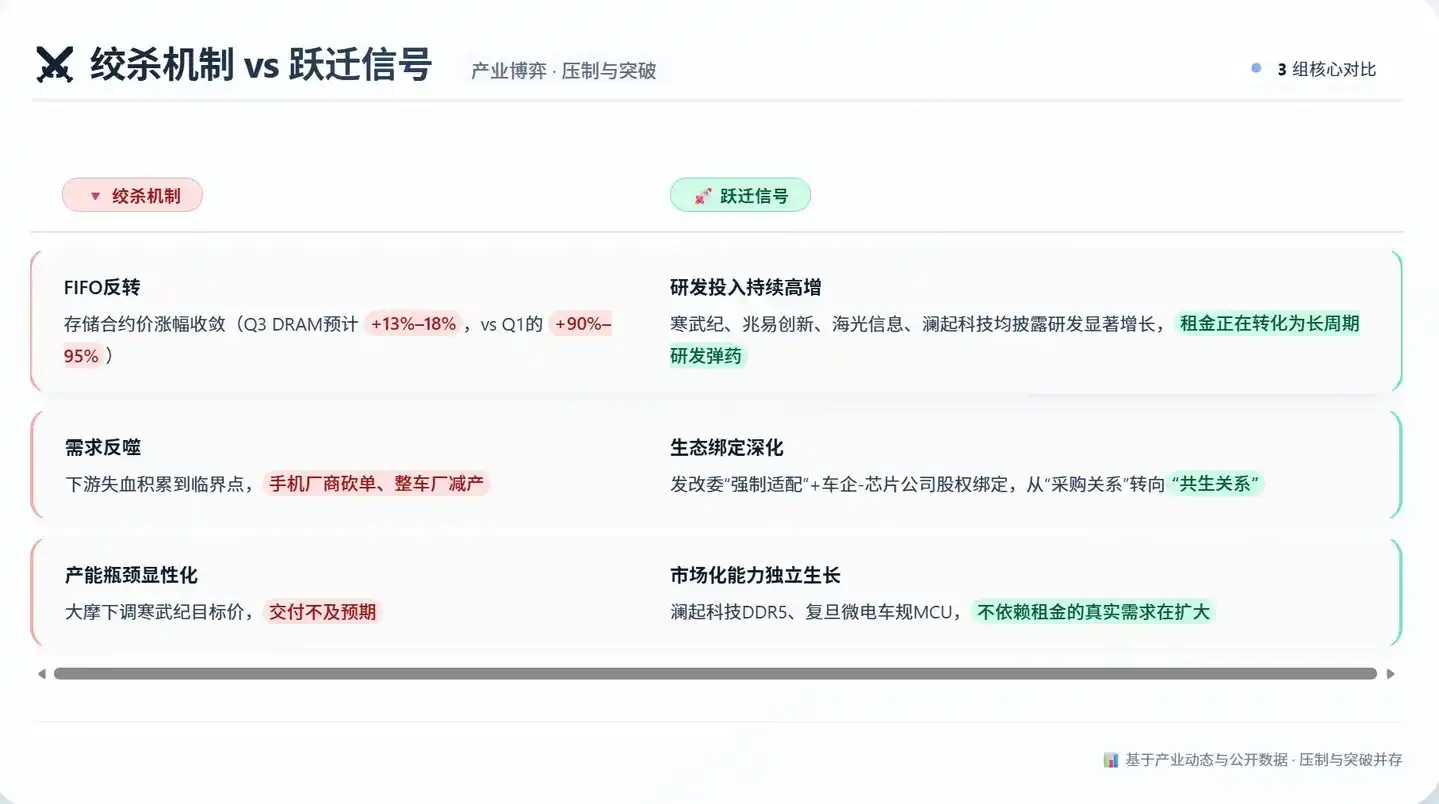
Strangulation and leap are two sides of the same coin. Strangulation weeds out companies that 'only know how to collect rents,' while leap rewards those that 'transform rents into capabilities.'


VII. Conclusion: Planting Flowers in the Abyss

The extreme divergence in China's chip design industry in 2026H1 is indeed the result of 'institutional rent distribution.' Profits were not 'created'; they were 'institutionally transferred'—from downstream payers to upstream recipients. This transfer is unidirectional, zero-sum, and time-mismatched.

But the core judgment of this article is: Institutional rents are not the end point; they represent a 'capability leap window' following 'cash flow restructuring.'

The biggest dilemma for China's chip industry over the past twenty years has been the 'short-cycle R&D trap caused by cash flow breakage.' Although institutional rents distort short-term competition, they objectively break the chicken-and-egg deadlock—first using forced procurement to create customers, then using customer revenue to feed R&D, finally using R&D results to lock in genuine market-driven customers.

SK Hynix says memory shortages may last until 2030, US export controls are tightening, domestic substitution policies are upgrading— this window period is long enough for companies with real capability to complete the leap, transforming from 'rent collectors' into 'technology definers.'

The strangulation mechanisms of the second half (FIFO reversal, demand backlash, capacity bottlenecks) will still activate, and the cast of the divergence will change. But the new selection criteria will no longer be 'who collects the most rent,' but rather 'who has transformed rent into irreplaceable technological barriers.'

The essence of investing in chip design is not betting on the persistence of institutional rents, but identifying companies that are transforming 'cash flow restructuring' into 'independent viability.'

The moment the feast is most sumptuous is often also when the signal to leave is clearest. But this time, it's not just the old paradigm leaving—on the ruins of the old paradigm, new species with genuine market-driven viability are quietly sprouting under the cover of rents.

There is light at the bottom of the abyss. That light is not the reflection of rents; it's the faint glimmer of independent technological growth.


Criptomoedas em alta

Perguntas relacionadas

QAccording to the article, what is the fundamental nature of the profits reported by Chinese chip design companies in the first half of 2026?

AThe article argues that the profits were not 'created' but were 'institutionally transferred' from downstream industries. This transfer is driven by supply constraints and policy compliance (e.g.,国产替代/domestic substitution mandates), creating a 'systematic cash flow restructuring' that moves profit pools from downstream manufacturing (the payment end) to upstream chip design (the collection end).

QWhat critical problem has historically plagued the Chinese chip design industry for the past two decades, and how has the 'institutional rent' mechanism addressed it?

AThe fundamental problem has been perpetual cash flow rupture. Companies were stuck in a short-cycle R&D trap, constantly fundraising without generating positive operating cash flow, preventing long-term technological bets. The 'institutional rent' mechanism, while distorting competition, has objectively broken this deadlock. It provides a structural, long-term cash flow infusion, allowing companies for the first time to have positive operating cash flow to fund longer-term R&D cycles.

QWhy does the article claim the current situation is different from previous periods of policy support or domestic substitution?

AThe article states that previous support was 'intermittent,' whereas the current cash flow restructuring is 'structural and long-cycle.' Key factors include: a projected shortage of memory chips potentially lasting until 2030+, providing a window of 5+ years; and a policy shift from simple 'procurement subsidies' to 'ecosystem强制绑定/forced binding,' integrating domestic chips into the technology ecosystem rather than just using them as compliance tokens.

QHow does the article interpret the profit decline of companies like StarPower (斯达半导), which are classified as the 'institutional rent payment end'?

AThe article frames this not merely as a 'predicament' but as a necessary 'market-based clearance' or '出清.' These companies, previously protected in a 'greenhouse' of domestic substitution policies, are now exposed to real market competition. This painful process forces efficiency gains, cost reductions, and may create negotiation leverage for them to upgrade from mere suppliers to true 'ecosystem partners' with downstream customers.

QWhat is the article's final assessment regarding the role of 'institutional rent' and the future of the industry?

AThe article concludes that institutional rent is not an end but a 'cash flow restructuring' that opens a 'window for capability leap.' The ultimate test is not the persistence of the rent but whether companies can transform this cash flow into 'non-substitutable technological barriers' and 'independent market-based survival capabilities.' The real opportunity lies in identifying companies using the rent as a shield to achieve 'independent growth of technology'—the true 'glimmer of light' at the bottom of the abyss.

Leituras Relacionadas

When 'Odysseus' Encounters the Algorithm

Christopher Nolan's "Odyssey," a $250 million IMAX epic, premiered in July 2026, quickly grossing over $1 billion and setting box office and critical records. The film's production was defined by its physical scale: shooting across six countries with practical effects, custom-built IMAX cameras, and extensive use of film. Concurrently, the AI-generated film "Odysseus: The Fall," created by the independent studio Fountain0 for just $50,000, demonstrated the technical feasibility of AI in long-form filmmaking. This stark 5,000x cost difference highlights a broader industry conflict between traditional, experience-driven production and algorithmic efficiency. While the AI film achieved technical success, it revealed current limitations, such as unstable long shots, inconsistent characters, and a lack of nuanced emotional performance. More importantly, its infinite, low-cost nature lacks the scarcity and immersive "event" status that fuels the theatrical premium for films like Nolan's. The market strongly favored the traditional model's brand security, physical assets, and premium theatrical experience. The analysis suggests AI will not replace auteurs like Nolan but will significantly disrupt mid-tier productions and technical, labor-intensive roles (e.g., pre-visualization, VFX). This could erode the career pathways for future directors. Paradoxically, as AI content proliferates, the perceived value of "handcrafted," physically-shot cinema may rise, akin to artisanal goods. The core tension is framed as the irreconcilable conflict between algorithmic "efficiency logic" and cinematic "experience logic." Ultimately, the enduring human preference may be for the unique, difficult journey of traditional storytelling over the predictable, algorithmically smooth path.

marsbitHá 10m

When 'Odysseus' Encounters the Algorithm

marsbitHá 10m

Wall Street 'Conspiracy Theory': Did Powell Deliberately Push Up Long-Term U.S. Treasury Yields?

Bank of America refutes market speculation that Federal Reserve Chair Warsh deliberately pushed up long-term U.S. Treasury yields via press conferences to tighten financial conditions. Their report argues such action contradicts the Fed's established policy framework and would lack FOMC support. According to the report, some market participants interpreted the post-July FOMC meeting rise in long-end yields and inflation breakevens as a deliberate strategy by Warsh to combat inflation by tightening financial conditions. Analysts Mark Cabana and Aditya Bhave directly reject this, stating the FOMC's core policy tool remains the federal funds rate, as outlined in its long-term strategy statements. They emphasize Warsh cannot unilaterally alter the Fed's operational approach, which would require full FOMC consensus—a high bar. The analysis highlights the Fed's precise control over overnight rates versus its limited, indirect influence on long-term yields, which operate through policy expectations and the hard-to-manage term premium channel. The recent sharp move in long-end rates serves as a reminder of the risks of operating outside the Fed's direct control. The report concludes the FOMC is unlikely to abandon its proven, controllable tools for unverified methods, dismissing the "four-dimensional chess" theory of long-rate manipulation as market overinterpretation.

marsbitHá 14m

Wall Street 'Conspiracy Theory': Did Powell Deliberately Push Up Long-Term U.S. Treasury Yields?

marsbitHá 14m

Third Quarter Beijing Office Market: Investment and Owner-occupier Acquisition Demand to Recover in Parallel

Third Quarter Beijing Office Market: Investment and Owner-Occupier Acquisition Demand to Recover in Parallel Structural shifts in the domestic economy are reshaping office leasing demand. While expansion in high-tech sectors like AI, semiconductors, and new energy will drive demand, traditional industries may downsize to cut costs. Rents are expected to continue declining due to new supply and landlords' concessions, but prime submarkets attracting high-tech tenants will see slower rental declines and faster absorption. Tenants increasingly favor submarkets with strong industry clusters and supportive policies. The adoption of AI may also lead some firms to reduce their office footprint as they optimize workforce efficiency. The investment sales market is showing signs of recovery. Investor-buyers are becoming more active, targeting properties with stable rental income in key tech hubs. Simultaneously, owner-occupier demand is emerging from high-tech firms seeking headquarters. They prefer buildings in relevant industry locations with good renovation potential. Market Strategy for Q3 2026: * For Tenants: Those for whom office image is critical should consider prime buildings in the CBD. Leverage strong brand positions to negotiate favorable terms, including landlord contributions to fit-out costs. * For Landlords: Transition to service providers by offering industry-specific support like financing connections. Proactively engage expiring tenants with renewal incentives and dedicated account management. * For Buyers: Investor-buyers should target stable, well-occupied assets in submarkets like Zhongguancun. Owner-occupiers from high-tech sectors can seek value in properties with good locational fit but financially pressured sellers, carefully assessing renovation costs. Q2 2026 Market Snapshot: The average effective rent for Beijing Grade A offices fell 2.7% QoQ to RMB 197/sqm/month, with vacancy at a high 16.3%. High-tech sectors drove major leases in submarkets like Zhongguancun and Wangjing-Jiuxianqiao. Total investment sales volume reached RMB 14.2 billion, boosted by investor interest in tech areas and owner-occupier acquisitions by high-tech firms. The average sales price rose 24% QoQ to RMB 38,312/sqm, partly due to premium prices paid for owner-occupier purchases in key financial submarkets.

marsbitHá 14m

Third Quarter Beijing Office Market: Investment and Owner-occupier Acquisition Demand to Recover in Parallel

marsbitHá 14m

BofA Research Report Insights: Bull & Bear Indicator Rises to 9.7, Liquidity Backstop and Midterm Elections Form Market's Core Contradiction

Bank of America's Bull & Bear indicator rose to 9.7 in early August, its highest since 2021 and nearing a "sell" signal. Weekly flows showed $52.9B into cash, $32.9B into equities, and $23.1B into bonds. The report highlights a core market contradiction: clear policy intent to backstop financial conditions (evidenced by recent coordinated FX intervention, termed a "poor man's LTCM event") versus extreme bullish sentiment, widening credit spreads for AI mega-cap firms, and rising political uncertainty ahead of the midterm elections. Fund flows were mixed: while equity inflows are on a record annualized pace, the tech sector saw its first outflow in six weeks. Bank of America's strategy advises a "summer retreat or rotation"—exiting risk assets or rotating into defensive sectors (consumer staples), duration assets (REITs, small caps, biotech), and the USD to hedge against potential financial tightening. The midterm election is identified as the key macro variable for H2 2026, acting as a referendum on populist fiscal policies. A Republican-held Senate is viewed as market-positive. The report also notes that AI capital expenditure momentum requires the Mag 7 index to recover above 50 to counter threats from cheap Chinese computing. Near-term market direction may hinge on July payroll data, influencing the Fed's Jackson Hole stance. Overall, while liquidity backstops provide downside protection, the extreme Bull & Bear reading suggests limited upside.

marsbitHá 17m

BofA Research Report Insights: Bull & Bear Indicator Rises to 9.7, Liquidity Backstop and Midterm Elections Form Market's Core Contradiction

marsbitHá 17m

Trading

Spot

Artigos em Destaque

Como comprar FLOW

Bem-vindo à HTX.com!Tornámos a compra de Flow (FLOW) simples e conveniente.Segue o nosso guia passo a passo para iniciar a tua jornada no mundo das criptos.Passo 1: cria a tua conta HTXUtiliza o teu e-mail ou número de telefone para te inscreveres numa conta gratuita na HTX.Desfruta de um processo de inscrição sem complicações e desbloqueia todas as funcionalidades.Obter a minha contaPasso 2: vai para Comprar Cripto e escolhe o teu método de pagamentoCartão de crédito/débito: usa o teu visa ou mastercard para comprar Flow (FLOW) instantaneamente.Saldo: usa os fundos da tua conta HTX para transacionar sem problemas.Terceiros: adicionamos métodos de pagamento populares, como Google Pay e Apple Pay, para aumentar a conveniência.P2P: transaciona diretamente com outros utilizadores na HTX.Mercado de balcão (OTC): oferecemos serviços personalizados e taxas de câmbio competitivas para os traders.Passo 3: armazena teu Flow (FLOW)Depois de comprar o teu Flow (FLOW), armazena-o na tua conta HTX.Alternativamente, podes enviá-lo para outro lugar através de transferência blockchain ou usá-lo para transacionar outras criptomoedas.Passo 4: transaciona Flow (FLOW)Transaciona facilmente Flow (FLOW) no mercado à vista da HTX.Acede simplesmente à tua conta, seleciona o teu par de trading, executa as tuas transações e monitoriza em tempo real.Oferecemos uma experiência de fácil utilização tanto para principiantes como para traders experientes.

386 Visualizações TotaisPublicado em {updateTime}Atualizado em 2026.06.02

Como comprar FLOW

Discussões

Bem-vindo à Comunidade HTX. Aqui, pode manter-se informado sobre os mais recentes desenvolvimentos da plataforma e obter acesso a análises profissionais de mercado. As opiniões dos utilizadores sobre o preço de FLOW (FLOW) são apresentadas abaixo.

活动图片