Pledging ETH Earned a Steady $46 Million, So Why is BitMine Still Deep in the Red?

marsbitPublicado em 2026-07-16Última atualização em 2026-07-16

Resumo

BitMine reported a significant surge in revenue for Q3 FY2026, driven by its Ethereum staking and validation business which generated $45.7 million. However, the company posted a net loss of $83.6 million, primarily due to a $92.1 million loss from Ethereum derivatives and options trading. This loss, stemming largely from expired contracts and exercised positions, completely offset the gains from staking. To fund its aggressive accumulation of Ethereum, BitMine has heavily relied on equity financing, significantly diluting existing shareholders. In the first nine months of the fiscal year, it issued over 340 million shares to raise approximately $11.87 billion, using most of it to purchase Ethereum. As of May 31, the company held 5.42 million ETH with an average cost of $19.05 billion, resulting in an unrealized loss of roughly $8.2 billion due to market depreciation. While staking provides a stable cash flow that covers core operational costs, the company faces rising expenses from long-term service agreements and high management fees. Additionally, BitMine remains highly dependent on continuous access to capital markets for funding its operations and expansion. The company's long-term viability hinges on its staking income consistently covering these costs and future losses, its ability to secure ongoing equity financing, and a substantial recovery in the price of Ethereum.

Original Author: Oluwapelumi Adejumo

Original Compilation: Chopper

BitMine has aggressively built up its Ethereum holdings, aiming to turn them into a stable source of cash flow. In the last quarter, its staking business generated nearly $46 million in revenue.

However, a $92.1 million loss on derivative options completely offset the staking gains. Coupled with persistently rising asset management costs and aggressive share issuances, the profit potential for existing shareholders was significantly compressed.

The Q3 FY2026 financial report, for the period ending May 31, shows company revenue skyrocketed to $46.5 million from $2.1 million in the same period last year. Of this, 98% ($45.7 million) came from staking and node validation services. BitMine is accelerating its shift away from Bitcoin mining operations to fully embrace an Ethereum treasury model.

Behind the substantial revenue growth, the company recorded a net loss of $83.6 million this quarter, a dramatic increase compared to a modest loss of $623,000 in the same quarter last year.

Huge Options Loss Erases All Ethereum Staking Gains

The core factor dragging down this quarter's performance was the company's Ethereum derivatives options trading strategy. BitMine incurred a total loss of $92.1 million on Ethereum-related derivatives this quarter, roughly double the total revenue from its staking business in the same period. Of this, $78.6 million came from net losses on expired option contracts, and $14 million from losses on exercised positions. A mere $534,000 gain from open contracts only slightly offset part of the loss.

The company engaged in no derivative trading during the same period last year, marking a qualitative leap in the risk exposure of its asset management operations. For the first nine months of this fiscal year, cumulative derivative losses reached $133.3 million, consisting of $79.3 million in losses from exercises, $54.5 million in losses from expired contracts, and only $515,000 in profit from open contracts. During the same period, the staking and validation businesses generated only $56.9 million combined—derivative losses were over twice the staking income.

BitMine stated that its options strategy primarily involves selling put options as part of an overall portfolio management plan. While selling put options can generate premium income and allow for asset accumulation during price dips, significant losses occur when market moves against the position and contracts are exercised under unfavorable conditions. This substantial loss clearly demonstrates that the attempt to boost returns using options has currently completely negated the stable income created by node staking operations.

Simultaneously, the company's administrative and general expenses surged from $744,000 a year ago to $37.3 million. Management explained the increase was mainly due to digital asset custody and management service fees, increased salaries, and increased cash and stock-based compensation for directors.

Before adjustments for crypto asset valuation changes, staking revenue was sufficient to cover this quarter's cost of sales and administrative expenses. Even after excluding several non-cash items, the company's own adjusted non-GAAP net loss still reached $70.8 million. This report indicates that the node validation business has generated considerable stable cash flow, but the overall portfolio trading strategy continues to consume staking profits.

Continued Issuance of BMNR Stock to Hoard Ethereum, Shareholder Equity Heavily Diluted

The funds for BitMine's large-scale Ethereum hoarding come almost entirely from public market issuances of common stock, with the cost fully borne by existing shareholders. In the nine months ended May 31, the company sold a cumulative 340.7 million shares of BMNR common stock through its at-the-market offering program, raising $11.87 billion net of issuance costs. Over the same period, it spent $11.69 billion purchasing Ethereum.

Shareholder equity has been significantly diluted. The number of outstanding common shares increased by 149% over nine months, from 232.4 million shares as of August 31, 2025, to 579.7 million shares by the end of May 2026. The issuance continued after the quarter-end, with total shares reaching 603.2 million as of July 9.

Relying on equity financing, BitMine held a cumulative 5.42 million Ethereum as of May 31, with a comprehensive carrying cost of $19.05 billion. At the time of writing, the holding had increased to 5.7 million Ethereum.
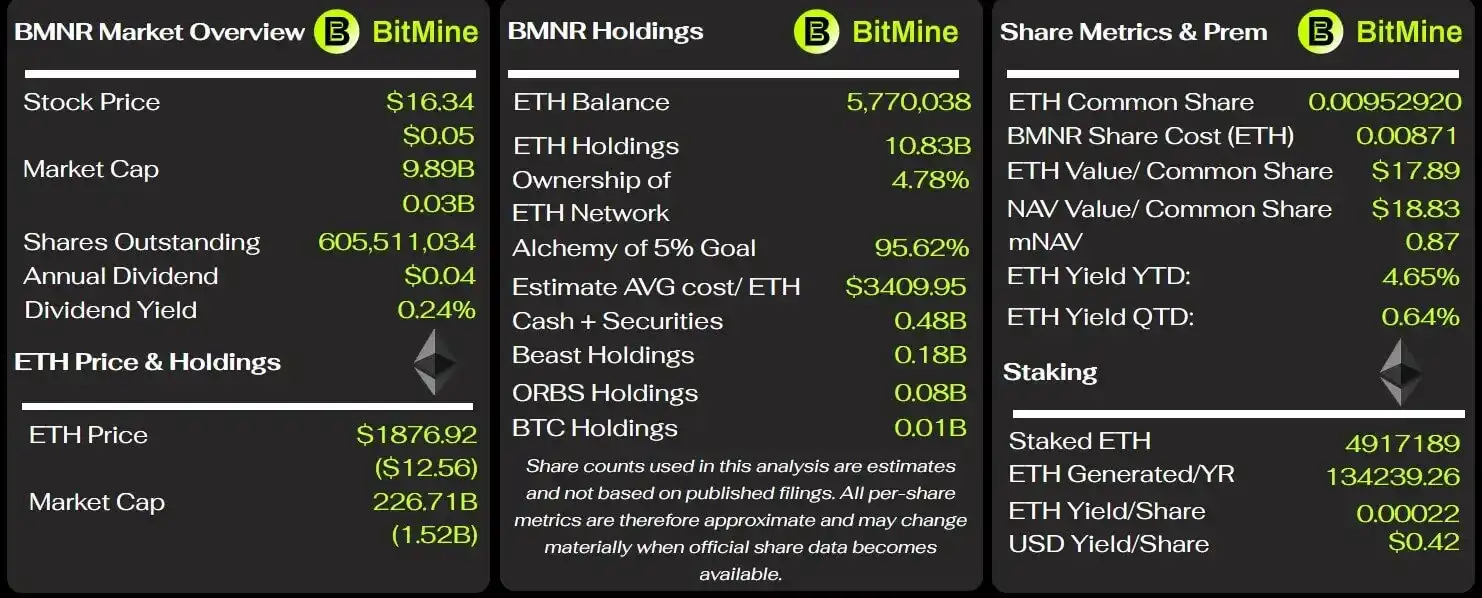
BitMine's Key Metrics, Source: BitMine Tracker

The market value of this Ethereum holding was only $10.86 billion at the end of May, representing a paper loss of approximately $8.2 billion, or a 43% unrealized loss.

This holding impairment is the primary source of the company's $9.04 billion unrealized loss on digital assets for the first nine months of this fiscal year, during which the company's cumulative net loss was $9.1 billion. The massive paper loss vividly illustrates that BitMine's share issuances to buy Ethereum at high prices place all the risk on shareholders.

A shareholder meeting in January this year approved increasing the company's authorized common share ceiling from 500 million shares to 50 billion shares. This authorization does not obligate the company to issue all shares but gives management ample room to continue issuing stock for purchasing digital assets and other investments.

BitMine notes that its ability to expand its Ethereum holdings is highly dependent on continued access to financing channels. A decline in Ethereum's price, weakness in the company's stock price, or waning investor appetite for its offerings could raise future financing costs or even limit the company's ability to issue securities on favorable terms.

The viability of this business model depends not only on staking annualized returns and future Ethereum price appreciation but also on shareholders accepting significant equity dilution and the company's portfolio carrying billions in paper losses for years, while continuously providing capital for its coin hoarding.

Long-Term Service Contracts Increase Staking Operational Costs, Squeezing Profit Margins

BitMine relies on its staking business to hedge portfolio price volatility, but the accompanying long-term cooperation agreements generate fixed fees and profit-sharing, continuously squeezing overall profits. The company has a ten-year consulting agreement with third-party service provider Ethereum Tower, incurring an expense of $12.8 million this quarter, accounting for roughly 28% of total staking revenue for the period. Cumulative expenses for this agreement totaled $37.5 million for the first nine months; the company estimates annual costs in the range of $40-50 million, calculated on a tiered basis according to the total value of custodial digital assets.

This agreement can only be terminated under a few specific conditions. If BitMine terminates the agreement without cause, it must pay Ethereum Tower 85% of all estimated service fees for the remaining contract term.

Additionally, following the acquisition of node operator Pier Two, BitMine entered a separate ten-year managed services agreement. This agreement grants Ethereum Tower a 2% equity stake in the MAVAN platform, with monthly revenue sharing based on the proportion of native staking rewards generated by the platform. As of May 31, the company had not yet recognized any expenses related to this agreement, so the sharing cost has not yet impacted the staking business profit statement.

BitMine states that the vast majority of its Ethereum is staked through MAVAN, and in the long run, staking rewards are sufficient to cover asset custody costs. At an operational level for this quarter alone, staking revenue did cover sales and administrative expenses excluding crypto asset valuation changes. However, when factoring in the decade-long fixed consulting fee, future profit-sharing, and various asset management expenses, relying solely on staking income cannot fully measure the business's true profitability.

BitMine Has No Debt, but Reliance on Capital Markets Deepens

As of the end of May, BitMine's balance sheet showed extremely low leverage, with $340.3 million in cash, working capital of $433.1 million, and no traditional debt. The company's total assets stood at $11.63 billion, with total liabilities at only $30.1 million, the vast majority of assets being digital assets like Ethereum. On paper, the company faces no immediate solvency crisis, but operating activities used $287.6 million in cash during the first nine months. The company attributes this cash burn mainly to legal, consulting, and investment banking fees related to the expansion of its Ethereum holdings and fundraising.

After the quarter ended, BitMine issued another 3.5 million shares of its 9.5% annualized perpetual preferred stock, BMNP, raising $273.8 million. This issuance provides short-term liquidity but adds a new rigid annual dividend expense of $32.25 million for the preferred shares. While these securities are equity, not debt, they rank senior to common stock for distributions, and the high dividends continuously consume company cash flow.

Management believes existing cash, anticipated operating cash flow, and its at-the-market offering facility are sufficient to fund operations for at least the next 12 months. This assessment assumes capital markets remain open for financing. Should Ethereum prices remain depressed long-term, the company's stock price weaken, or investor appetite wane, the company's financing costs would rise, limiting operational flexibility.

In summary, BitMine's latest financial report paints a picture of conflicting realities: On one hand, the company has built a mature staking business generating tens of millions per quarter, capable of covering core operating expenses. On the other hand, massive options losses completely devour staking profits, long-term contracts persistently increase management costs, Ethereum hoarding expansion relies entirely on stock issuance, and the total share count has more than doubled.

Therefore, BitMine's long-term economic viability depends on whether staking revenue can stably cover various asset management costs and options losses, whether the company can maintain consistent access to equity financing, and whether the Ethereum price can stage a significant recovery.

Criptomoedas em alta

Perguntas relacionadas

QAccording to the article, why did BitMine experience a significant net loss of $83.6 million in Q3 of fiscal year 2026 despite its staking revenue reaching nearly $46 million?

ABitMine's significant net loss was primarily caused by massive losses of $92.1 million from its Ethereum derivatives and options trading strategies, which completely offset the gains from its staking business. Additionally, rising administrative and management expenses contributed to the overall loss.

QHow is BitMine funding its massive accumulation of Ethereum holdings, and what impact does this have on existing shareholders?

ABitMine is funding its Ethereum purchases almost entirely by issuing new common stock (BMNR) in public markets. This has led to significant dilution of existing shareholders' equity, with the number of outstanding shares increasing by 149% over nine months.

QWhat are the key factors identified in the article that are compressing the profit margin of BitMine's staking operations?

AThe profit margin of BitMine's staking operations is compressed by long-term service contracts with fixed fees and future revenue sharing (e.g., the 10-year agreement with Ethereum Tower), high management and administrative expenses, and massive losses from its options trading strategies.

QDespite having no traditional debt, why is BitMine described as being increasingly dependent on capital markets?

ABitMine is dependent on capital markets because its business model relies on continuously issuing new securities (common stock and preferred stock) to fund Ethereum purchases and cover operational cash outflows. Its ability to maintain this model depends on favorable market conditions and sustained investor appetite for its stock.

QWhat was the unrealized loss on BitMine's Ethereum holdings as of May 31, and what contributed to this situation?

AAs of May 31, BitMine's Ethereum holdings had an unrealized loss of approximately $8.2 billion, representing a 43% loss. This situation resulted from the company aggressively buying Ethereum at high prices using funds raised from stock issuance, just before or during a market downturn where Ethereum's price fell.

Leituras Relacionadas

Gold Rush Handbook | Rialto Teams Up with Robinhood Crypto, Targeting Order Routing Rights

**Summary** Rialto is positioning itself as an on-chain spot exchange focused on order routing and execution quality for a range of assets, including cryptocurrencies and tokenized stocks/ETFs. It operates primarily on the Robinhood Chain network. Its core mechanism revolves around **propAMMs** – on-chain market makers that use proprietary inventory and pricing logic, referencing external markets (like underlying stock exchanges for tokenized equities) rather than relying solely on automated market maker (AMM) formulas. For each user order, Rialto's aggregator solicits real-time quotes from multiple liquidity sources, including its own propAMM (Rivo Altus) and traditional DEX pools. It then selects and atomically executes the path offering the best net output after costs, potentially splitting orders across sources. Rialto's key competitive claim is turning **order routing control into a service for better execution**. Instead of users manually finding the best liquidity, the system automatically compares and routes to the optimal source(s) for each trade. It has launched a partner program for integrations and its swap API is already used by several protocols. Challenges ahead include expanding the asset base on Robinhood Chain, ensuring Rivo Altus's price competitiveness, attracting diverse external liquidity, and consistently delivering superior net execution compared to manual routing. Success in these areas would see Rialto competing for the crucial "order routing right" in the emerging on-chain market for tokenized real-world assets.

Foresight NewsHá 17m

Gold Rush Handbook | Rialto Teams Up with Robinhood Crypto, Targeting Order Routing Rights

Foresight NewsHá 17m

Bitwise: RWA and Prediction Markets Continue to Gain Momentum, Crypto is Bottoming Out

Bitwise's Q2 2026 report highlights a challenging crypto market. The Bitwise 10 Crypto Index fell 15.4%, and spot Bitcoin ETFs saw a record $4.9 billion in quarterly outflows as Bitcoin dropped below $60,000. Overall sentiment is described as one of the worst in eight years. Despite the downturn, key sectors show resilience and growth. Real-World Asset (RWA) tokenization reached a record $33 billion, up 45% year-to-date. Prediction markets also hit new highs, with open interest at $1.8 billion and quarterly volume hitting $43 billion, driven partly by political events. Crypto equities outperformed, with the Bitwise Crypto Innovators 30 Index rising 30.6%, largely fueled by AI-related Bitcoin miners. These stocks exhibited low correlation with other major asset classes. Major DeFi protocols like Aave demonstrated strong revenue generation, with the top ten crypto applications collectively earning $5.9 billion over the past year. The report notes that while prices and on-chain activity are down from peaks, fundamental metrics like stablecoin supply (~$300B) and Ethereum transaction activity are significantly higher than at the 2022 bear market bottom. Key Q3 factors include the fate of the CLARITY Act, final rules for the GENIUS stablecoin act, and policy signals from the new Fed Chair. The conclusion is that the industry is building a stronger foundation—with greater adoption, institutional involvement, and real utility—even at depressed prices, setting the stage for the next cycle.

Odaily星球日报Há 43m

Bitwise: RWA and Prediction Markets Continue to Gain Momentum, Crypto is Bottoming Out

Odaily星球日报Há 43m

Bitcoin Shifts to Building a Bottom, with Selling Pressure from Long-Term Holders Significantly Easing

Bitcoin is transitioning into a basing phase, with significant selling pressure from long-term holders showing signs of easing. The market is testing overhead resistance, with Bitcoin responding more positively to favorable macro data like soft inflation reports than major equity indices. Its correlation with stocks is weakening while its inverse relationship with the US dollar strengthens, indicating a shift in primary drivers towards liquidity factors rather than risk sentiment. On-chain analysis reveals that long-term holder profit-taking has largely dried up, and the wave of capitulation selling from this cohort has peaked and begun to recede. Buyers successfully absorbed selling pressure at the June lows. Bitcoin currently trades between the network's average realized price (a support floor) and the short-term holder cost basis near $69k, which will be a key resistance level. A breakout above this level is needed to signal a more sustained recovery. In derivatives markets, traders are unwinding bearish bets, with put/call ratios falling and crash protection premiums declining. However, this futures and options positioning adjustment has not been accompanied by significant spot buying. US spot ETF outflows have slowed but not reversed. Volatility has compressed to low levels. In summary, the foundations for a bottom are forming: long-term holder selling is subsiding, demand absorbed the recent low, and the market is reacting to positive catalysts. However, confirmation is still lacking, requiring a spot-driven breakout and hold above the short-term holder cost basis around $69k.

Foresight NewsHá 51m

Bitcoin Shifts to Building a Bottom, with Selling Pressure from Long-Term Holders Significantly Easing

Foresight NewsHá 51m

Trading

Spot

Artigos em Destaque

O que é ETH 2.0

ETH 2.0: Uma Nova Era para o Ethereum Introdução ETH 2.0, amplamente conhecido como Ethereum 2.0, marca uma atualização monumental à blockchain do Ethereum. Esta transição não é meramente uma mudança estética; visa melhorar fundamentalmente a escalabilidade, segurança e sustentabilidade da rede. Com uma mudança do mecanismo de consenso em Proof of Work (PoW), intensivo em energia, para um Proof of Stake (PoS) mais eficiente, o ETH 2.0 promete uma abordagem transformadora ao ecossistema blockchain. O que é ETH 2.0? ETH 2.0 é um conjunto de atualizações distintas e interconectadas focadas na otimização das capacidades e desempenho do Ethereum. Esta reformulação foi projetada para abordar desafios críticos que o mecanismo atual do Ethereum enfrentou, particularmente em relação à velocidade das transações e à congestão da rede. Objetivos do ETH 2.0 Os principais objetivos do ETH 2.0 giram em torno da melhoria de três aspectos centrais: Escalabilidade: Com o objetivo de melhorar significativamente o número de transações que a rede pode manejar por segundo, o ETH 2.0 procura ultrapassar a limitação atual de aproximadamente 15 transações por segundo, alcançando potencialmente milhares. Segurança: Medidas de segurança melhoradas são integrais ao ETH 2.0, especialmente através da resistência aprimorada contra ciberataques e da preservação do ethos descentralizado do Ethereum. Sustentabilidade: O novo mecanismo PoS foi projetado não apenas para melhorar a eficiência, mas também para reduzir drasticamente o consumo de energia, alinhando a estrutura operacional do Ethereum com considerações ambientais. Quem é o Criador do ETH 2.0? A criação do ETH 2.0 pode ser atribuída à Ethereum Foundation. Esta organização sem fins lucrativos, que desempenha um papel crucial no apoio ao desenvolvimento do Ethereum, é liderada pelo co-fundador notável Vitalik Buterin. A sua visão de um Ethereum mais escalável e sustentável tem sido a força motriz por trás desta atualização, envolvendo contribuições de uma comunidade global de desenvolvedores e entusiastas dedicados a melhorar o protocolo. Quem são os Investidores do ETH 2.0? Embora os detalhes sobre os investidores do ETH 2.0 não tenham sido tornados públicos, é sabido que a Ethereum Foundation recebe apoio de várias organizações e indivíduos no espaço da blockchain e tecnologia. Esses parceiros incluem firmas de capital de risco, empresas de tecnologia e organizações filantrópicas que compartilham um interesse mútuo em apoiar o desenvolvimento de tecnologias descentralizadas e infraestrutura de blockchain. Como Funciona o ETH 2.0? ETH 2.0 é notável por introduzir uma série de características chave que o diferenciam do seu predecessor. Proof of Stake (PoS) A transição para um mecanismo de consenso PoS é uma das mudanças de destaque do ETH 2.0. Ao contrário do PoW, que depende da mineração intensiva em energia para a verificação de transações, o PoS permite que os utilizadores validem transações e criem novos blocos de acordo com a quantidade de ETH que apostam na rede. Isso leva a uma maior eficiência energética, reduzindo o consumo em aproximadamente 99,95%, tornando o Ethereum 2.0 uma alternativa consideravelmente mais ecológica. Shard Chains As shard chains são outra inovação crítica do ETH 2.0. Estas cadeias menores operam em paralelo com a cadeia principal do Ethereum, permitindo que várias transações sejam processadas simultaneamente. Esta abordagem melhora a capacidade geral da rede, abordando preocupações de escalabilidade que têm atormentado o Ethereum. Beacon Chain No coração do ETH 2.0 está a Beacon Chain, que coordena a rede e gere o protocolo PoS. Ela atua como uma espécie de organizador: supervisiona os validadores, garante que as shards permaneçam conectadas à rede e monitora a saúde geral do ecossistema blockchain. Linha do Tempo do ETH 2.0 A jornada do ETH 2.0 tem sido marcada por vários marcos chave que traçam a evolução desta atualização significativa: Dezembro de 2020: O lançamento da Beacon Chain marcou a introdução do PoS, preparando o caminho para a migração para o ETH 2.0. Setembro de 2022: A conclusão de “The Merge” representa um momento crucial em que a rede Ethereum fez a transição com sucesso de um quadro PoW para um PoS, anunciando uma nova era para o Ethereum. 2023: O lançamento esperado das shard chains visa melhorar ainda mais a escalabilidade da rede Ethereum, solidificando o ETH 2.0 como uma plataforma robusta para aplicações e serviços descentralizados. Características Chave e Benefícios Escalabilidade Melhorada Uma das vantagens mais significativas do ETH 2.0 é a sua escalabilidade melhorada. A combinação de PoS e shard chains permite que a rede expanda a sua capacidade, permitindo que acomode um volume de transações muito maior em comparação com o sistema legado. Eficiência Energética A implementação do PoS representa um enorme passo em direção à eficiência energética na tecnologia blockchain. Ao reduzir drasticamente o consumo de energia, o ETH 2.0 não só reduz os custos operacionais, mas também se alinha mais estreitamente com os objetivos globais de sustentabilidade. Segurança Aprimorada Os mecanismos atualizados do ETH 2.0 contribuem para uma segurança melhorada em toda a rede. O uso do PoS, juntamente com medidas de controle inovadoras estabelecidas através das shard chains e da Beacon Chain, assegura um maior grau de proteção contra potenciais ameaças. Custos Mais Baixos para os Utilizadores À medida que a escalabilidade melhora, os efeitos sobre os custos de transação também serão evidentes. Aumentada a capacidade e reduzida a congestão, espera-se que isso se traduza em taxas mais baixas para os utilizadores, tornando o Ethereum mais acessível para transações do dia a dia. Conclusão ETH 2.0 marca uma evolução significativa no ecossistema da blockchain do Ethereum. Ao abordar questões fundamentais como a escalabilidade, o consumo de energia, a eficiência das transações e a segurança geral, a importância desta atualização não pode ser subestimada. A transição para o Proof of Stake, a introdução das shard chains e o trabalho fundamental da Beacon Chain são indicativos de um futuro em que o Ethereum pode atender à crescente demanda do mercado descentralizado. Em uma indústria movida pela inovação e progresso, o ETH 2.0 representa um testemunho das capacidades da tecnologia blockchain em pavimentar o caminho para uma economia digital mais sustentável e eficiente.

125 Visualizações TotaisPublicado em {updateTime}Atualizado em 2024.12.03

O que é ETH 2.0

O que é ETH 3.0

ETH3.0 e $eth 3.0: Uma Análise Profunda do Futuro do Ethereum Introdução No ambiente em rápida evolução da criptomoeda e da tecnologia blockchain, o ETH3.0, frequentemente denotado como $eth 3.0, emergiu como um tema de considerável interesse e especulação. O termo abrange dois conceitos principais que merecem esclarecimento: Ethereum 3.0: Esta representa uma potencial atualização futura destinada a aumentar as capacidades da atual blockchain do Ethereum, focando especialmente na melhoria da escalabilidade e desempenho. ETH3.0 Meme Token: Este distinto projeto de criptomoeda procura aproveitar a blockchain do Ethereum na criação de um ecossistema centrado em memes, promovendo o envolvimento na comunidade de criptomoedas. Compreender esses aspectos do ETH3.0 é essencial não apenas para entusiastas de criptomoedas, mas também para aqueles que observam as tendências tecnológicas mais amplas no espaço digital. O que é ETH3.0? Ethereum 3.0 Ethereum 3.0 é promovido como uma atualização proposta para a rede Ethereum já estabelecida, que tem sido a espinha dorsal de muitas aplicações descentralizadas (dApps) e contratos inteligentes desde a sua criação. As melhorias vislumbradas concentram-se principalmente na escalabilidade—integrando tecnologias avançadas como sharding e provas de conhecimento zero (zk-proofs). Essas inovações tecnológicas visam facilitar um número sem precedentes de transações por segundo (TPS), potencialmente alcançando milhões, abordando assim uma das limitações mais significativas enfrentadas pela tecnologia blockchain atual. A melhoria não é meramente técnica, mas também estratégica; visa preparar a rede Ethereum para uma adoção generalizada e utilidade em um futuro marcado por uma maior demanda por soluções descentralizadas. ETH3.0 Meme Token Em contraste com o Ethereum 3.0, o ETH3.0 Meme Token aventura-se por um domínio mais leve e divertido, combinando a cultura dos memes da internet com a dinâmica das criptomoedas. Este projeto permite que os usuários comprem, vendam e negociem memes na blockchain do Ethereum, proporcionando uma plataforma que fomenta o envolvimento da comunidade através da criatividade e interesses compartilhados. O ETH3.0 Meme Token visa demonstrar como a tecnologia blockchain pode interseccionar com a cultura digital, criando casos de uso que são tanto divertidos quanto financeiramente viáveis. Quem é o Criador do ETH3.0? Ethereum 3.0 A iniciativa em direção ao Ethereum 3.0 é impulsionada principalmente por um consórcio de desenvolvedores e pesquisadores dentro da comunidade Ethereum, notavelmente incluindo Justin Drake. Conhecido por suas percepções e contribuições para a evolução do Ethereum, Drake tem sido uma figura proeminente nas discussões sobre a transição do Ethereum para uma nova camada de consenso, referida como “Beam Chain”. Esta abordagem colaborativa ao desenvolvimento significa que o Ethereum 3.0 não é fruto de um único criador, mas sim uma manifestação da engenhosidade coletiva focada no avanço da tecnologia blockchain. ETH3.0 Meme Token Os detalhes sobre o criador do ETH3.0 Meme Token são atualmente indetectáveis. A natureza dos tokens de meme frequentemente leva a uma estrutura mais descentralizada e impulsionada pela comunidade, o que poderia explicar a falta de atribuição específica. Isso alinha-se com a ethos da comunidade de criptomoedas mais ampla, onde a inovação geralmente surge de esforços colaborativos em vez de esforços individuais. Quem são os Investidores do ETH3.0? Ethereum 3.0 O apoio ao Ethereum 3.0 provém principalmente da Fundação Ethereum, juntamente com uma comunidade entusiástica de desenvolvedores e investidores. Esta associação fundacional proporciona um grau significativo de legitimidade e melhora as perspectivas de uma implementação bem-sucedida, uma vez que aproveita a confiança e credibilidade construída ao longo de anos de operações de rede. Em um clima em rápida mudança no mundo das criptomoedas, o apoio da comunidade desempenha um papel crucial no impulso ao desenvolvimento e adoção, posicionando o Ethereum 3.0 como um sério candidato a futuros avanços na blockchain. ETH3.0 Meme Token Embora as fontes atualmente disponíveis não forneçam informações explícitas sobre as fundações ou organizações de investimento que apoiam o ETH3.0 Meme Token, é indicativo do modelo típico de financiamento para tokens de meme, que frequentemente depende de apoio base e engajamento da comunidade. Os investidores em tais projetos costumam consistir em indivíduos motivados pelo potencial de inovação impulsionada pela comunidade e pelo espírito de cooperação encontrado dentro da comunidade cripto. Como Funciona o ETH3.0? Ethereum 3.0 As características distintivas do Ethereum 3.0 residem em sua proposta de implementação de sharding e tecnologia zk-proof. Sharding é um método de partição da blockchain em partes menores e gerenciáveis ou “shards”, que podem processar transações simultaneamente em vez de sequencialmente. Esta descentralização do processamento ajuda a prevenir congestionamentos e garante que a rede permaneça responsiva mesmo sob carga pesada. A tecnologia de prova de conhecimento zero (zk-proof) contribui com outra camada de sofisticação ao permitir a validação de transações sem revelar os dados subjacentes envolvidos. Este aspecto não apenas melhora a privacidade, mas também aumenta a eficiência geral da rede. Há também conversas sobre a incorporação de uma Máquina Virtual Ethereum de conhecimento zero (zkEVM) nesta atualização, amplificando ainda mais as capacidades e utilidade da rede. ETH3.0 Meme Token O ETH3.0 Meme Token distingue-se ao capitalizar sobre a popularidade da cultura dos memes. Estabelece um mercado para que os usuários participem da negociação de memes, não apenas para entretenimento, mas também para potencial ganho econômico. Ao integrar recursos como staking, provisão de liquidez e mecanismos de governança, o projeto fomenta um ambiente que incentiva a interação e participação da comunidade. Ao oferecer uma mistura única de entretenimento e oportunidade econômica, o ETH3.0 Meme Token visa atrair um público diversificado, variando de entusiastas de criptomoedas a conhecedores casuais de memes. Cronologia do ETH3.0 Ethereum 3.0 11 de novembro de 2024: Justin Drake sugere a próxima atualização do ETH 3.0, centrada nas melhorias de escalabilidade. Este anúncio sinaliza o início de discussões formais sobre a futura arquitetura do Ethereum. 12 de novembro de 2024: A proposta antecipada para Ethereum 3.0 deve ser revelada no Devcon em Bangkok, preparando o cenário para um feedback mais amplo da comunidade e potenciais próximos passos no desenvolvimento. ETH3.0 Meme Token 21 de março de 2024: O ETH3.0 Meme Token é oficialmente listado no CoinMarketCap, marcando sua entrada no domínio público das criptomoedas e aumentando a visibilidade de seu ecossistema baseado em memes. Pontos Chave Em conclusão, Ethereum 3.0 representa uma evolução significativa dentro da rede Ethereum, focando em superar limitações quanto à escalabilidade e desempenho através de tecnologias avançadas. As atualizações propostas refletem uma abordagem proativa às futuras demandas e usabilidade. Por outro lado, o ETH3.0 Meme Token encapsula a essência da cultura impulsionada pela comunidade no espaço das criptomoedas, aproveitando a cultura dos memes para criar plataformas envolventes que incentivam a criatividade e participação dos usuários. Compreender os distintos propósitos e funcionalidades do ETH3.0 e $eth 3.0 é fundamental para qualquer pessoa interessada nos desenvolvimentos contínuos dentro do espaço cripto. Com ambas as iniciativas a pavimentar caminhos únicos, elas sublinham coletivamente a natureza dinâmica e multifacetada da inovação em blockchain.

129 Visualizações TotaisPublicado em {updateTime}Atualizado em 2024.12.03

O que é ETH 3.0

Como comprar ETH

Bem-vindo à HTX.com!Tornámos a compra de Ethereum (ETH) simples e conveniente.Segue o nosso guia passo a passo para iniciar a tua jornada no mundo das criptos.Passo 1: cria a tua conta HTXUtiliza o teu e-mail ou número de telefone para te inscreveres numa conta gratuita na HTX.Desfruta de um processo de inscrição sem complicações e desbloqueia todas as funcionalidades.Obter a minha contaPasso 2: vai para Comprar Cripto e escolhe o teu método de pagamentoCartão de crédito/débito: usa o teu visa ou mastercard para comprar Ethereum (ETH) instantaneamente.Saldo: usa os fundos da tua conta HTX para transacionar sem problemas.Terceiros: adicionamos métodos de pagamento populares, como Google Pay e Apple Pay, para aumentar a conveniência.P2P: transaciona diretamente com outros utilizadores na HTX.Mercado de balcão (OTC): oferecemos serviços personalizados e taxas de câmbio competitivas para os traders.Passo 3: armazena teu Ethereum (ETH)Depois de comprar o teu Ethereum (ETH), armazena-o na tua conta HTX.Alternativamente, podes enviá-lo para outro lugar através de transferência blockchain ou usá-lo para transacionar outras criptomoedas.Passo 4: transaciona Ethereum (ETH)Transaciona facilmente Ethereum (ETH) no mercado à vista da HTX.Acede simplesmente à tua conta, seleciona o teu par de trading, executa as tuas transações e monitoriza em tempo real.Oferecemos uma experiência de fácil utilização tanto para principiantes como para traders experientes.

3.3k Visualizações TotaisPublicado em {updateTime}Atualizado em 2026.06.02

Como comprar ETH

Discussões

Bem-vindo à Comunidade HTX. Aqui, pode manter-se informado sobre os mais recentes desenvolvimentos da plataforma e obter acesso a análises profissionais de mercado. As opiniões dos utilizadores sobre o preço de ETH (ETH) são apresentadas abaixo.

活动图片