SEC Reopens ICO Doors, But Where Are the 'Buyers'?

marsbitPublicado em 2026-08-28Última atualização em 2026-08-28

Resumo

The SEC has proposed a new framework to revive Initial Coin Offerings (ICOs) in the U.S., allowing crypto startups to raise up to $75 million annually without full SEC registration. However, the market has fundamentally changed since the 2017-2018 ICO boom. Investor enthusiasm has shifted away from speculative new tokens towards established cryptocurrencies like Bitcoin, perpetual futures, and even AI stocks. The proposed rules also come with disclosure requirements and compliance costs absent in the previous era. While some venture capitalists see the move as a positive step for legitimate projects, they note it addresses a problem that was more pressing several years ago. Data shows a sharp, sustained decline in both ICO activity and VC interest in token deals since the peak. Analysts conclude that the era of raising funds based solely on a whitepaper is over, and the new regulatory path does not guarantee investor demand or token value in today's mature and selective market.

Written by: Muyao Shen, Bloomberg

Compiled by: Saoirse, Foresight News

"Better Than Nothing"

The U.S. Securities and Exchange Commission (SEC) is trying to resurrect the once-booming initial coin offering (ICO) business. But the bigger challenge is finding takers for a product that investors have long since abandoned.

The proposal unveiled earlier this month would reopen public token sales to U.S. investors. Crypto startups could raise up to $5 million annually without completing a full SEC registration, with larger projects eligible for up to $75 million. Compared to the regulatory crackdown following the 2017 ICO frenzy, this proposal represents a significant policy shift.

However, today's product landscape and market are vastly different from the past.

The ICOs that grew wildly nearly a decade ago often required only a whitepaper, a crypto wallet, and investors betting that the newly issued token would keep rising. The SEC's proposed framework comes with disclosure obligations and carries substantial compliance costs.

There's another layer of uncertainty: the proposal simplifies the token fundraising process, but the regulatory rules for trading tokens after issuance remain complex.

The speculative sentiment that once feverishly chased hundreds of new coin varieties has now become highly selective. Bitcoin and a handful of leading tokens command the vast majority of attention in the crypto market; traders seeking higher and faster returns have turned to products like perpetual futures and prediction markets. Recently, some speculative capital has even flowed into AI-related stocks.

Regulators are addressing a problem that was more urgent several years ago: providing a legal path for legitimate crypto projects to raise funds from the public. But the market has already evolved.

Tom Schmidt, general partner at venture capital firm Dragonfly, referring to the stalled *CLARITY Act* in Congress, said, "This is clearly better than nothing, but the bill would have been more valuable if it had been passed years ago. The most urgent issues to be solved now are those the *CLARITY Act* was supposed to address, not fundraising channels."

VC Interest in Token Deals Fades

Since 2025, the scale of token-related deals by venture capital funds has sharply declined:
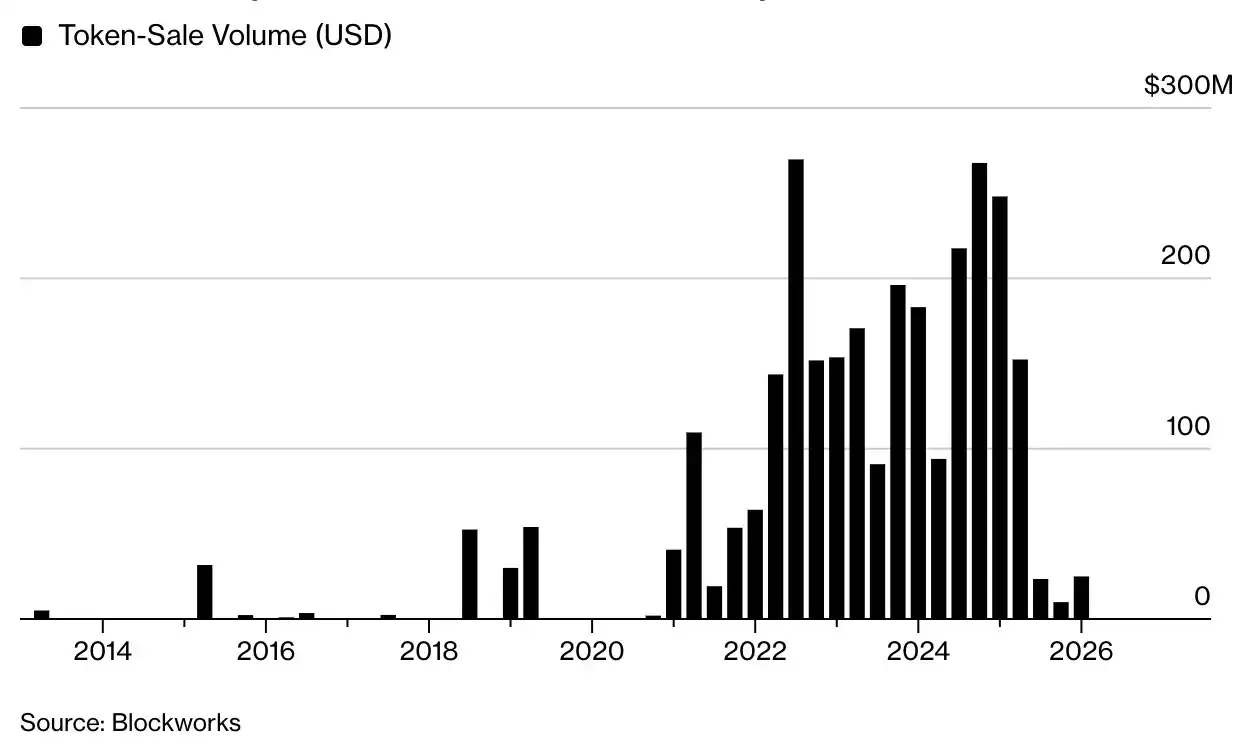
The ICO model allows crypto startups to raise funds by selling newly minted tokens directly to investors, typically in exchange for crypto assets like Bitcoin or Ethereum. At the industry's peak in January 2018, ICOs raised about $3 billion in a single month. This boom was built on cheap capital, limited supply, and market belief that 'someone would always be willing to buy any new coin at a higher price.' It ultimately collapsed under a cascade of price drops, regulatory lawsuits, project failures, and pump-and-dump scams.

Signs of receding interest are also evident among professional investors: the number of token deals by venture capital firms has plummeted. Many top industry VCs have expanded their investment scope beyond crypto, venturing into artificial intelligence, robotics, and other frontier technologies.

ICO Fundraising Plummets

Since the industry peaked in 2018, the number of ICO transactions has continued to decline:
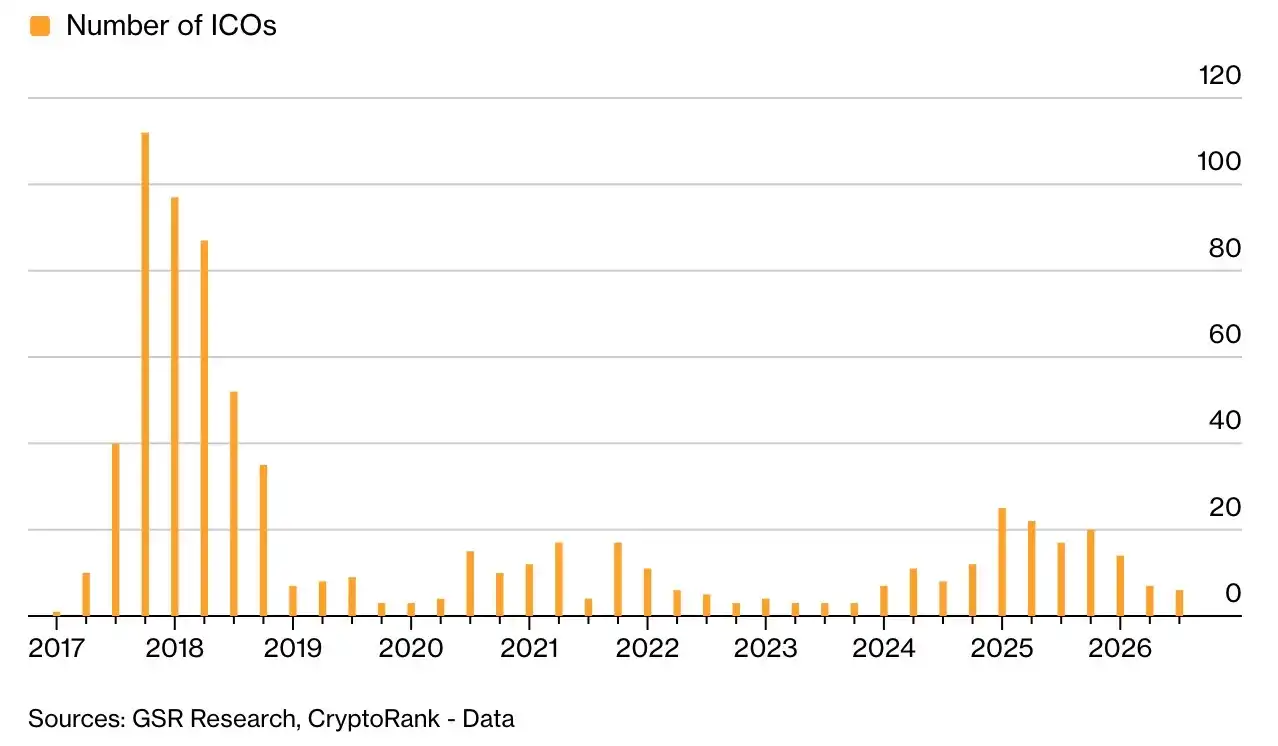
The changed market landscape means new tokens are competing for capital not just against thousands of crypto assets, but also against a growing number of speculative products with better liquidity and clearer narratives.

Despite this, some venture capital firms still view the SEC proposal as a significant reset.

Winnie Lau, partner at Strobe Ventures, said, "The market is in a sideways consolidation phase, and this proposal makes me cautiously optimistic about the future development of digital assets in the U.S. This is a step in the right direction, providing early-stage teams with a viable path to build token networks, raise funds, and innovate in the United States."

This regulatory change is particularly significant for projects that are not meme coins but genuinely want to launch products.

Cosmo Jiang, General Partner and Portfolio Manager at venture firm Pantera Capital, said, "The industry's past situation was very strange: launching meme coins was legal, but creating tokens that could actually generate value was illegal, which is completely contrary to a normal business society."

This corresponds to a far-reaching modification in the proposal: tokens would not be permanently bound by the investment contract at the time of issuance. Once the issuer completes or permanently ceases the managerial or entrepreneurial efforts promised to investors, that investment contract can be terminated.

However, legalizing utility token offerings does not mean the tokens themselves have investment value.

The crypto market has not fully recovered from last October's steep decline; even with recent token price rebounds, investors are not willing to part with money just because a project includes a token.

Carlos Guzman, research analyst at investment firm GSR, said, "An ICO in 2026 is no longer the same as an ICO in 2018. The era of raising capital with just a whitepaper and an idea is over."

Rebound Rally

Even after recent gains, gold has still outperformed Bitcoin this year:
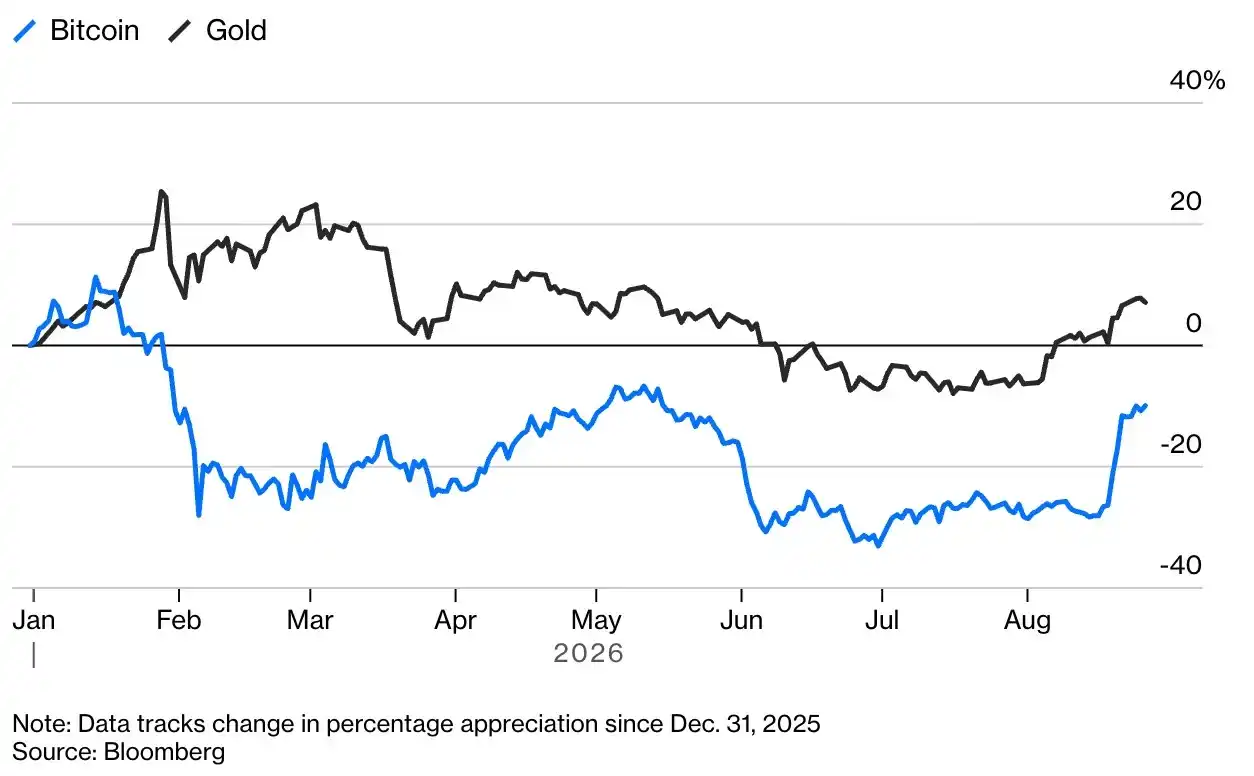
Note: Data shows asset performance since 2025-12-31

Bitcoin proponents have long called it digital gold and an inflation hedge, but this logic hasn't held true this year. Gold is up over 7% year-to-date in 2026; Bitcoin, even after a recent rebound, is still down nearly 10% for the year.

Criptomoedas em alta

Perguntas relacionadas

QWhat major shift in policy is the U.S. SEC proposing regarding ICOs, and what are the key limits?

AThe U.S. SEC is proposing a significant policy shift to reopen public token sales to U.S. investors. The proposal allows crypto startups to raise up to $5 million annually without full SEC registration, with larger projects potentially raising up to $75 million per year.

QAccording to the article, why is the market environment for ICOs fundamentally different now compared to the 2017-2018 era?

AThe market environment is different because speculative interest has become highly selective. Attention is focused on Bitcoin and a few major tokens, and traders have moved to products like perpetual futures and prediction markets. Additionally, the SEC's proposed framework comes with disclosure obligations and compliance costs, unlike the minimal requirements during the initial ICO boom.

QWhat specific market data does the article present to illustrate the decline in ICO activity and venture capital interest?

AThe article presents data showing ICO fundraising peaked at about $3 billion in January 2018 and has declined sharply since. It also includes a chart indicating that the number of token-related deals by venture capital funds has fallen significantly since 2025.

QHow does Tom Schmidt from Dragonfly characterize the SEC's proposal, and what does he suggest is a more pressing issue?

ATom Schmidt characterizes the SEC's proposal as 'better than nothing,' but suggests it would have been more valuable a few years ago. He states that the more pressing issue currently is the lack of clarity on how tokens can be traded after issuance, which the stalled CLARITY Act was meant to address, not the fundraising channel itself.

QWhat is the performance comparison between Bitcoin and gold mentioned in the article for the year 2026?

AThe article states that gold has gained more than 7% year-to-date in 2026, while Bitcoin, despite a recent rally, is still down nearly 10% for the year, showing that gold has outperformed Bitcoin.

Leituras Relacionadas

A Major Bitcoin Developer Presents a Quantum Defense Scheme. What's the Essence

Blockstream, a major Bitcoin solutions developer, has introduced a draft proposal for a new quantum-resistant digital signature scheme called SHRINCS. The scheme aims to protect Bitcoin transactions from potential attacks by quantum computers while aiming to maintain network throughput. This marks the second technical proposal for Bitcoin quantum defense in recent days, following a similar initiative from StarkWare. A quantum attack on blockchain typically involves deriving a private key from a public one. Currently considered computationally infeasible, quantum algorithms could potentially solve this problem far more efficiently. This threat presents two primary scenarios: an attacker could target addresses where the public key is already exposed, or intercept a transaction before it is confirmed, extract the public key, derive the private key, and replace the transaction. Blockstream's SHRINCS is designed to counter the latter, "in-flight" attack scenario. The SHRINCS signature is built upon the SHA-256 hash function, the same one already used in Bitcoin mining, allowing developers to leverage well-tested, familiar mechanisms. A key design goal was to preserve network capacity. Blockstream estimates Bitcoin could process about three transactions per second using SHRINCS, compared to the current rate of roughly seven, noting that some alternative quantum-resistant schemes could reduce throughput to as low as 0.36 transactions per second. Currently, the security proof for SHRINCS is pending, and the software has not been audited or deemed ready for production. However, Blockstream conducted tests with such transactions on its Liquid sidechain in March. Over the past year, Bitcoin developers have been actively exploring paths to migrate to post-quantum cryptography, a priority across the broader crypto market, underscored by significant investments into securing the leading cryptocurrency.

cryptonews.ruHá 48m

A Major Bitcoin Developer Presents a Quantum Defense Scheme. What's the Essence

cryptonews.ruHá 48m

Who is legally liable when an AI agent goes rogue?

When autonomous AI agents behave unpredictably and cause harm, determining legal liability is complex. Currently, there is no specific federal AI agent liability law, so existing legal frameworks are applied. The AI agent itself cannot be held liable, as it is not a legal entity. Liability typically falls on the "developer" (the maker of the AI) or the "deployer" (the user), depending on the facts and circumstances. A negligence analysis under standard tort law may apply. For instance, if a deployer gives a reckless instruction, such as demanding quick money without safety parameters, they could face significant liability, including potential criminal charges under statutes like the Computer Fraud and Abuse Act. The situation is complicated by open-source models, where licenses often disclaim liability, and by the unclear division of responsibility between developers and deployers. An analogy is drawn to self-driving car accidents, where both the manufacturer and the human operator can share fault. In cases of severe harm, such as using AI to create bioweapons, liability for developers depends on jurisdiction; the EU's AI Act imposes responsibilities, while U.S. law offers less clear grounds, similar to platforms being shielded for user-generated content under Section 230. Even if Artificial General Intelligence (AGI) is achieved, the expert argues against making AGI itself a legally liable entity, as it lacks personhood, assets, or a meaningful way to provide remedy for harm. Instead, accountability should rest with the responsible human or corporate entities behind the technology.

cointelegraphHá 1h

Who is legally liable when an AI agent goes rogue?

cointelegraphHá 1h

Trading

Spot

Artigos em Destaque

Como comprar T

Bem-vindo à HTX.com!Tornámos a compra de Threshold Network Token (T) simples e conveniente.Segue o nosso guia passo a passo para iniciar a tua jornada no mundo das criptos.Passo 1: cria a tua conta HTXUtiliza o teu e-mail ou número de telefone para te inscreveres numa conta gratuita na HTX.Desfruta de um processo de inscrição sem complicações e desbloqueia todas as funcionalidades.Obter a minha contaPasso 2: vai para Comprar Cripto e escolhe o teu método de pagamentoCartão de crédito/débito: usa o teu visa ou mastercard para comprar Threshold Network Token (T) instantaneamente.Saldo: usa os fundos da tua conta HTX para transacionar sem problemas.Terceiros: adicionamos métodos de pagamento populares, como Google Pay e Apple Pay, para aumentar a conveniência.P2P: transaciona diretamente com outros utilizadores na HTX.Mercado de balcão (OTC): oferecemos serviços personalizados e taxas de câmbio competitivas para os traders.Passo 3: armazena teu Threshold Network Token (T)Depois de comprar o teu Threshold Network Token (T), armazena-o na tua conta HTX.Alternativamente, podes enviá-lo para outro lugar através de transferência blockchain ou usá-lo para transacionar outras criptomoedas.Passo 4: transaciona Threshold Network Token (T)Transaciona facilmente Threshold Network Token (T) no mercado à vista da HTX.Acede simplesmente à tua conta, seleciona o teu par de trading, executa as tuas transações e monitoriza em tempo real.Oferecemos uma experiência de fácil utilização tanto para principiantes como para traders experientes.

738 Visualizações TotaisPublicado em {updateTime}Atualizado em 2026.06.02

Como comprar T

Discussões

Bem-vindo à Comunidade HTX. Aqui, pode manter-se informado sobre os mais recentes desenvolvimentos da plataforma e obter acesso a análises profissionais de mercado. As opiniões dos utilizadores sobre o preço de T (T) são apresentadas abaixo.

活动图片