When Faith Becomes a Cage: The Sunk Cost Trap in the Crypto Era

深潮Publicado em 2025-12-12Última atualização em 2025-12-12

Resumo

In the crypto era, the "sunk cost trap" describes how past investments—whether in skills, relationships, or digital assets—can become psychological prisons that prevent people from moving on, even when they know their current path is no longer beneficial. The author reflects on personal experiences in poker and crypto, noting how early beliefs in Bitcoin and smart contracts have now materialized (e.g., Bitcoin ETFs, institutional adoption), yet many remain stuck due to emotional or financial commitments. The article categorizes crypto believers into four camps: Bitcoin-only (Green), crypto-but-not-Bitcoin (Red), both (Brown), and neither (White), each split into (a) those who still see upside and (b) those who don’t. Only true believers (e.g., Red (a)) should fully commit time and resources; others should diversify or plan exits. As crypto becomes mainstream (e.g., Robinhood using Arbitrum), opportunities may lie elsewhere (e.g., equities, AI). The key is to avoid mistaking sunk costs for future potential and to cultivate skills beyond crypto for a softer landing. Freedom requires courage to walk away from the "cave" of past investments.

Written by: Evanss6

Compiled by: AididiaoJP, Foresight News

At any point in the past, this might have been good advice when talking about cryptocurrency: hoard Bitcoin, or at least mainstream coins, do some staking, try new products with rewards, trade contracts without getting liquidated—chances are you would have made money. Behind this are two core beliefs: Bitcoin will become a more mainstream non-sovereign store of value, and smart contracts will become the infrastructure of finance.
I won’t go into detail about how these judgments have been validated, because we need to talk about this "cage." Just two facts:

Bitcoin ETFs have seen inflows of $49 billion, Ethereum ETFs have seen inflows of $4.3 billion, and more altcoin ETFs are just getting started. Michael Saylor himself has bought over $40 billion, and many companies are gradually buying in.

Robinhood just announced that it will use Arbitrum's tech stack to build an EVM chain as the backend financial infrastructure for its platform, and will also list the most popular product in cryptocurrency: perpetual contracts.
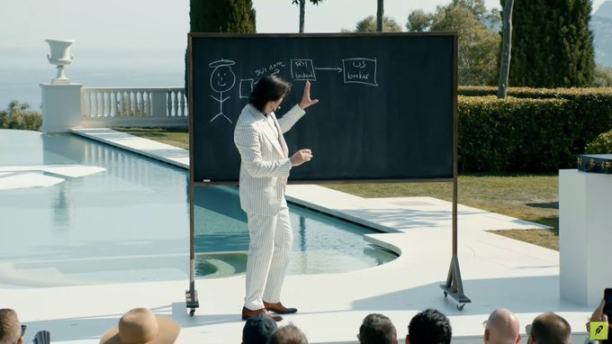
Cryptocurrency is increasingly resembling traditional finance. It’s being bought by the previous generation in brokerage accounts, promoted by Larry Fink, and used by companies like Robinhood. What many of us imagined a decade ago is coming true.

So what exactly is the "sunk cost cage"?

Simply put, it’s sticking with something because of past investments. This can appear in many places: your skills, investments you still hold, your relationships, a job you’re afraid to quit, or spending all your time on cryptocurrency.

  • "I don’t want to leave her because our past is too deep."

  • "I don’t want to change careers because I’ve spent too much time on this."

  • "I don’t want to sell Ethereum because I bought it early, and it’s been good to me."

These are all sunk cost fallacies. Not realizing you’re thinking this way is a form of self-sabotage, making you continue doing things you know deep down are no longer beneficial.

The sunk cost cage is the modern version of Plato’s allegory of the cave.
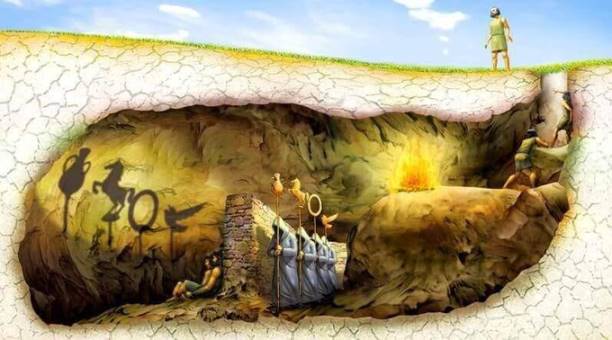
The prisoners only know the shadows on the wall, unaware of where the shadows come from or that there’s a larger world outside.

In Plato’s allegory, the prisoners stay in the cave because they mistake the shadows for reality, unaware that there is a "more real" world outside. In the modern version, we stay not out of ignorance but because we’ve invested too much in the shadows. That job that no longer fits, the career you no longer believe in, the identity built on long hours and silent endurance—these are the costs paid. The more time, education, and reputation you’ve invested, the harder it is to leave. The illusion is no longer just external; it’s internalized as responsibility, logic, and "the reasonable thing to do."

But freedom isn’t cheap. Escaping the sunk cost cage means admitting that what you’ve built may no longer serve you. Past efforts cannot justify staying. Like the prisoner turning toward the light, this requires not only courage but also betraying the part of yourself that is overly loyal to your self-investment. The hardest part isn’t seeing the truth but saying goodbye to the self that stayed too long, believed too deeply, and paid the price for the cage.

My Experience

I stayed in the cage for a long time myself.

As a teenager, I fell in love with poker. In the back row of high school classes, I was always calculating bankroll expectations in my notebook, not listening to lectures or taking notes. Within two years, I went from micro-stakes ($0.01/$0.02) to high-stakes tables. Over time, I enjoyed playing less and less, seeing it only as a way to make money, always thinking, "I’ll quit in a couple of years."

But a decade passed, and nothing changed. I was still playing, still winning, but always felt the money wasn’t enough to "do something else." Worse, I didn’t even know what else I could do, and I saw clearly: poker is a declining game, and I had to work harder and harder to keep up. But I told myself I should continue because I’d spent so much time getting good, it paid better than other options, I had no other viable path, and no time to think—staying a consistent winner in high-stakes online games was exhausting enough: studying strategy, finding good games, avoiding cheaters and shady platforms...
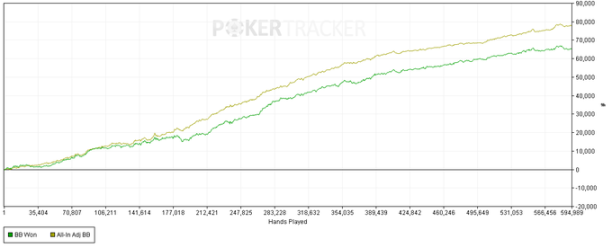
Honestly, this "can’t easily switch careers because it makes money" is a luxurious problem. But as it became harder to find better games, I knew the days were numbered.

First Encounter with Cryptocurrency

I encountered cryptocurrency early through my previous career. In 2012, I first read about Bitcoin on a poker forum called TwoPlusTwo. Back then, the Bitcoin sub-section had been open for over a year.

The first reply was hilarious: "This thing is worth 70 cents now? A currency no one uses can reach this price, lol." The second reply said you could actually exchange it for dollars or buy pizza—this was the early use case of what later became a $2 trillion asset. Scrolling down a few more replies:
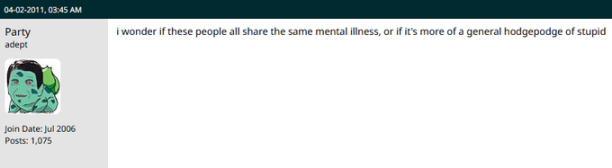
"Really missed an era." Anyway, I noticed it because some poker sites started using it. At the time, I thought its $2 billion market cap was outrageous. If it was for black/gray markets, maybe it was worth that; if it could go mainstream, its value would multiply endlessly.

By 2016-17, as my investments became substantial, I spent more and more time on cryptocurrency (especially ICOs). This diversion of time was my first step out of the cage. But it wasn’t until the rise of DeFi in 2020, when it actually became profitable, that I fully jumped in.

Back then, I knew nothing about trading and had to learn on the go. I studied economics and math in college, but my only real skill was poker. Fortunately, poker is excellent training for trading: it gives you ruthless real-time feedback on decisions, forces you to manage risk, price correctly, develop overall strategy, and builds emotional resilience and soft skills to endure bad runs—all essential for independent trading.

In the end, I’m grateful and lucky that I spent a lot of time from 2013-2019 exploring these curiosities, which put me in the best position when opportunity arose. If I’d focused more on poker those years, I might have played better, but following my intuition to create a transition/exit plan was truly fortunate.

How does this "cage" apply today?

In recent years, financial nihilism has become increasingly evident in the crypto space. More and more people no longer believe in the ideals that drew them in initially. The goal has become "making money," going all-in, grinding hard, and "exiting" once you’ve made enough.
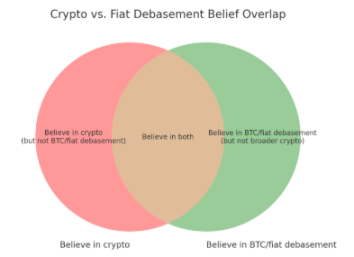
Roughly, there are four camps:

  • Green Camp (believe in Bitcoin, not other cryptocurrencies)

  • Red Camp (believe in cryptocurrency, not Bitcoin)

  • Brown Camp (believe in both)

  • White Camp (believe in neither)

Add two scenarios to each camp, and it becomes eight types:

  • (a) Believe there is still upside, worth the risk

  • (b) Believe the upside has been taken by early buyers

I think only those in 2(a) should devote all their time to cryptocurrency. If you’re in 1(b), 2(b), 3(b), or 4(b), you’re better off starting to diversify your time and make an exit plan. If you’re in 1(a) or 4(a), just hold Bitcoin and don’t pay much attention to anything else. 3(a) can hold some Bitcoin and other assets, splitting time and energy between crypto and non-crypto. If you’ve seen my account and posts, you can probably tell that I, who was mostly in 2(a) from 2015-2023, am now somewhat oscillating between 1(a), 3(a), and 3(b).

Let’s talk about the Red Camp. It’s been painful here the past few years.
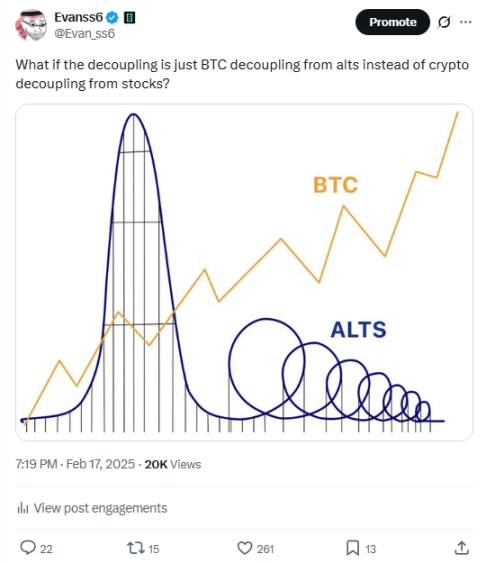
We’ve basically been in a situation where Bitcoin dominance keeps rising, even as the crypto system overall becomes more adopted. Even if you accurately predicted that Ethereum ETFs would see over $4 billion in net inflows, predicted that giants like Robinhood would use its technology, predicted that Trump would win, reform the SEC, end OCP2.0, and create a pro-crypto environment. From the day the ETFs launched, your Ethereum investment is still down. And today, Ethereum is around $2,600—2015 investors are up 2,000 to 8,600 times.

So the Answer

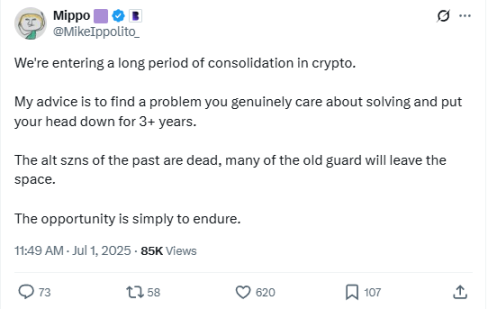
I doubt whether "enduring," as Mippo said in the tweet at the beginning of this article, is really the right path or the biggest opportunity. Everything you dreamed of has either already happened or is on its way. In 2017, if Robinhood announced building on Ethereum, the price would have jumped 10% immediately, but now it’s different. The move now is to buy HOOD stock. I believe there are still opportunities in crypto, but the trend of opportunities being captured by non-crypto assets (stocks) or insiders (teams/private investors—look at Celestia Finance) isn’t friendly to dreamers. If you really want to "endure," you need to invest early in these projects or build them yourself. So Mippo isn’t wrong; solving real problems in crypto is still an opportunity. But don’t assume that just because crypto technology is being adopted, current coin prices will necessarily rise (especially compared to other assets you could invest in).

Unless you’re a true Red Camp diehard 2(a), "enduring" is choosing to stay in the cave watching shadows on the wall while people outside are working on AI and robots.

You’d better ask yourself honestly: Which camp are you in? Do you even like cryptocurrency? Regardless, try to develop some skills that are useful elsewhere, so if it doesn’t work out, you have a fallback. At the very least, you won’t be unhappy spending all your time on something you’re already tired of. And if you’re wrong, you have a soft landing place.

The door of the sunk cost cage isn’t locked; what traps you is your own thoughts. All you need to do is open the door from time to time and walk out. Life is beautiful, and the world is full of possibilities.

Perguntas relacionadas

QWhat is the 'sunk cost trap' in the context of the crypto era, as described in the article?

AThe 'sunk cost trap' refers to the tendency to persist with an endeavor, such as investing in or working within the cryptocurrency space, primarily because of the significant time, money, or effort already invested in the past, even when it may no longer be the best or most beneficial path forward.

QAccording to the author, what are the two core beliefs that underpinned the common crypto advice of 'HODLing' Bitcoin or major altcoins?

AThe two core beliefs were that Bitcoin would become a more mainstream non-sovereign store of value and that smart contracts would become the foundational infrastructure for finance.

QHow does the author relate the 'sunk cost trap' to Plato's Allegory of the Cave?

AThe author describes the 'sunk cost trap' as a modern version of the allegory. In the original, prisoners stay in the cave because they mistake shadows for reality. In the modern version, people stay (e.g., in a job or investment) not out of ignorance, but because they have invested too much in the 'shadows'—the past efforts, time, and identity built around that pursuit, making it difficult to leave.

QBased on the author's framework, which group of people should dedicate all their time to cryptocurrency?

AAccording to the author's framework, only those in group 2(a)—people who believe in crypto (but not Bitcoin) AND believe there is still significant upside potential and it's worth the risk—should put all their time into cryptocurrency.

QWhat advice does the author give to someone who might be in a 'sunk cost cage' within crypto?

AThe author advises individuals to honestly assess which of the four camps (Green, Red, Brown, White) and two sub-categories (a or b) they fall into. They should consider developing skills transferable outside of crypto to have a 'soft landing' and an exit plan. The key is to recognize that the cage door isn't locked and that one can choose to walk away from a path that is no longer fulfilling or beneficial.

Leituras Relacionadas

In-Depth Research Report on U.S. Crypto Equity Market in 2026 — Opportunities, Risks, and Portfolio Allocation Framework

Since the U.S. Securities and Exchange Commission (SEC) historically approved spot Bitcoin ETFs in January 2024, the U.S. crypto investment landscape has undergone a profound maturation process. In 2026, investors can participate in the crypto market through four primary channels: spot ETFs, crypto-related public equities (including miners and treasury companies), leveraged and inverse ETFs, and blockchain-themed funds. As of March 30, 2026, U.S. spot Bitcoin ETFs collectively held approximately 1.29 million BTC, representing roughly $86.9 billion in assets under management (AUM), while spot Ethereum ETFs reached approximately $18 billion in AUM. Notably, the rise of the Ethereum treasury company model is reshaping the logic of institutional participation. Exemplified by Bitmine Immersion Technologies (BMNR), these firms generate native on-chain yield annually through ETH staking, creating a fundamentally different business resilience model compared with traditional Bitcoin treasury companies. On the regulatory front, the 2025 GENIUS Act established the first federal stablecoin framework in the United States. The U.S. Strategic Bitcoin Reserve has been officially established, banks have been authorized to provide crypto custody services, and major compliance bottlenecks have been definitively removed. Nevertheless, the high volatility of leveraged ETFs, the balance-sheet risks embedded in treasury-company financing structures, and the slashing risk of staked assets continue to pose investment obstacles that cannot be overlooked. For investors seeking exposure to this sector, building a tiered portfolio comprising core holdings, sector beta exposure, and high-risk tactical position may be the most viable path of participation.

HTX LearnHá 13m

In-Depth Research Report on U.S. Crypto Equity Market in 2026  — Opportunities, Risks, and Portfolio Allocation Framework

HTX LearnHá 13m

Viewpoint: After Surviving the Death Cycle, Why Has Privacy Pioneer Zcash Returned to the Mainstream Spotlight?

Zcash, the pioneering privacy-focused cryptocurrency built with zero-knowledge proof (ZK) technology, is re-emerging as a major narrative. Having survived a "death cycle" and proven its resilient community, Zcash is now positioned at a unique convergence of factors driving renewed institutional and retail interest. Key catalysts include the increasing institutionalization of crypto (e.g., BlackRock's ETF), which creates a "Trojan horse" for privacy adoption through Zcash's transparent mode. The rise of AI-powered on-chain surveillance makes financial privacy a critical necessity, not just for niche users but for mainstream wealth preservation against overreach. ZK technology has finally matured to enable practical, user-friendly private transactions, a core advantage over older "obfuscation" methods like Monero's ring signatures. Zcash’s narrative as "private Bitcoin"—a fork with the same 2100M cap and PoW—is simple and powerful. It competes in the store-of-value arena, offering cryptographic privacy as a fundamental human right. Its development roadmap is robust, featuring a soon-to-be-complete quantum resistance upgrade for its shielded pool, faster block times, and improved wallet support (e.g., from Ledger). With backing from major funds and a growing developer ecosystem, Zcash is seen as leading the crucial reintegration of privacy into the crypto landscape, fulfilling the original cypherpunk vision.

marsbitHá 21m

Viewpoint: After Surviving the Death Cycle, Why Has Privacy Pioneer Zcash Returned to the Mainstream Spotlight?

marsbitHá 21m

Conversation with Glassnode Analyst: Bitcoin Bull Market Has Restarted, Current Market Still in 'Sell on Rally' Phase

Bitcoin analyst Checkmate believes the cryptocurrency market is now in a bull phase following a likely capitulation event in June, with an 80% probability the $60,000 low marked the bottom. However, he expects a prolonged consolidation period, similar to past cycles. Key resistance levels are identified at $78,000 (short-term cost basis), $85,000 (a critical supply zone and 200-day moving average), and $95,000. Sustained price appreciation requires consistent capital inflows, with institutions expected to enter more aggressively if Bitcoin surpasses $100,000. The discussion extends to macroeconomics, where rising global bond yields signal a loss of trust in government fiscal management. Checkmate argues this reflects a broader monetary regime change, where Bitcoin and gold will serve as primary stores of value outside the traditional system, while fiat currencies like the USD act as mediums of exchange. Finally, Checkmate criticizes proposed Australian capital gains tax reforms, calling them a "wealth grab." The plan to replace a 50% discount for assets held over a year with inflation indexing based on low CPI rates would drastically increase effective tax rates, punishing savers and investors trying to overcome the country's severe housing affordability crisis. He urges public opposition to prevent such policies from spreading globally.

marsbitHá 1h

Conversation with Glassnode Analyst: Bitcoin Bull Market Has Restarted, Current Market Still in 'Sell on Rally' Phase

marsbitHá 1h

Trading

Spot
Futuros

Artigos em Destaque

Como comprar HPP

Bem-vindo à HTX.com!Tornámos a compra de House Party Protocol (HPP) simples e conveniente.Segue o nosso guia passo a passo para iniciar a tua jornada no mundo das criptos.Passo 1: cria a tua conta HTXUtiliza o teu e-mail ou número de telefone para te inscreveres numa conta gratuita na HTX.Desfruta de um processo de inscrição sem complicações e desbloqueia todas as funcionalidades.Obter a minha contaPasso 2: vai para Comprar Cripto e escolhe o teu método de pagamentoCartão de crédito/débito: usa o teu visa ou mastercard para comprar House Party Protocol (HPP) instantaneamente.Saldo: usa os fundos da tua conta HTX para transacionar sem problemas.Terceiros: adicionamos métodos de pagamento populares, como Google Pay e Apple Pay, para aumentar a conveniência.P2P: transaciona diretamente com outros utilizadores na HTX.Mercado de balcão (OTC): oferecemos serviços personalizados e taxas de câmbio competitivas para os traders.Passo 3: armazena teu House Party Protocol (HPP)Depois de comprar o teu House Party Protocol (HPP), armazena-o na tua conta HTX.Alternativamente, podes enviá-lo para outro lugar através de transferência blockchain ou usá-lo para transacionar outras criptomoedas.Passo 4: transaciona House Party Protocol (HPP)Transaciona facilmente House Party Protocol (HPP) no mercado à vista da HTX.Acede simplesmente à tua conta, seleciona o teu par de trading, executa as tuas transações e monitoriza em tempo real.Oferecemos uma experiência de fácil utilização tanto para principiantes como para traders experientes.

180 Visualizações TotaisPublicado em {updateTime}Atualizado em 2026.04.29

Como comprar HPP

O que é GENIUS

I. Introdução ao Projeto1. O Que É Genius?Genius (GENIUS) é posicionado como o “terminal definitivo em cadeia”, uma plataforma de negociação descentralizada focada na privacidade e na velocidade. Ao integrar tecnologia de privacidade de topo, visa construir uma infraestrutura de negociação em privacidade de próxima geração em redes como a BNB Chain, permitindo que os utilizadores interajam em cadeia com uma experiência fluida comparável às trocas centralizadas.2. Como Funciona o Genius?A arquitetura técnica central do Genius está estruturada da seguinte forma:(1) Invisível na cadeia: Os utilizadores não precisam de lidar manualmente com aprovações em múltiplas etapas para operações cross-chain, embrulhamento de ativos ou gestão complexa de gás.(2) Negociação sem Assinatura: Através de integrações como a Turnkey, o Genius permite negociações instantâneas sem confirmações pop-up ou autorizações por transação.(3) Agregador de Agregadores: O Genius é alimentado por uma pilha de agregação de classe mundial integrada com mais de 150 DEXs, reivindicando uma eficiência de citação superior em comparação com produtos concorrentes.(4) Gestão de Contas: A plataforma adota uma arquitetura não custodial e utiliza o Turnkey e o Lit Protocol para gestão de chaves, permitindo que os utilizadores acedam às suas contas de forma segura através de chaves de acesso.3. Quem Criou o Genius?De acordo com os seus Termos de Serviço oficiais, o Genius foi desenvolvido pela Shuttle Labs, Inc. Com base na conta oficial do projeto no X, Ryan Myher é um dos principais colaboradores que impulsionam a iteração do produto, incluindo desenvolvimentos como a implementação do protocolo Ghost, bem como um maior envolvimento da comunidade.O fundador da Binance, CZ, juntou-se oficialmente ao projeto como conselheiro, com o objetivo de ajudar a equipa a construir uma experiência de negociação em cadeia mais rápida e que preserve a privacidade.Além disso, o projeto recebeu um forte apoio da YZi Labs, que investiu no Genius e trabalha ao lado da Genius Foundation, responsável pela manutenção do núcleo do Genius Bridge Protocol (GBP).4. Tokenomics do GeniusGENIUS é o token nativo do ecossistema Genius. Até ao momento, o projeto não lançou um documento completo de tokenomics.Com base nas últimas divulgações oficiais, o Genius incorpora um mecanismo deflacionário, e 4,6% do fornecimento total de tokens já foi queimado durante a fase inicial de lançamento.Sistema de Pontos Genius (GP):(1) Trade-to-Earn: A plataforma estabeleceu um pool de recompensas de 200 milhões de Pontos Genius, e os utilizadores ganham GP por cada negociação executada através do terminal.(2) Níveis e Distintivos: O Genius apresenta um sistema de distintivos baseado em progressão que varia de Smart a God, com níveis mais altos a desbloquear benefícios e vantagens adicionais.(3) Rendimento Nativo: Os utilizadores que detêm ativos designados como usdGG no painel podem ganhar rendimento nativo diretamente sem passar por staking complexo.(4) Incentivos de Referência: Os referenciadores podem ganhar reembolsos de taxas superiores a 45% pagos em USDC, juntamente com GP adicionais.5. Cronograma & Principais MarcosMarço de 2020: A conta oficial do projeto no X foi criada, marcando o início da sua fase de preparação inicial.13 de janeiro de 2026: O Genius anunciou um investimento de vários milhões de dólares da YZi Labs e simultaneamente confirmou CZ como conselheiro para acelerar a construção da sua infraestrutura de negociação em privacidade.18 de abril de 2026: O projeto anunciou que o protocolo de privacidade Ghost seria lançado em breve.29 de abril de 2026: O protocolo Ghost abriu oficialmente para os seus primeiros 50 testadores, marcando o início de uma nova era para a negociação em privacidade na BNB Chain. Ao mesmo tempo, a equipa confirmou que 4,6% dos tokens foram queimados.​II. Informação sobre o Token1) Informação BásicaNome do token: GENIUS (Genius)III. Links RelacionadosWebsite:https://www.tradegenius.com/homeExploradores:https://bscscan.com/address/0x1f12b85aac097e43aa1555b2881e98a51090e9a6Sociais:https://x.com/GeniusTerminalNota: A introdução ao projeto provém dos materiais publicados ou fornecidos pela equipa oficial do projeto, que é apenas para referência e não constitui aconselhamento de investimento. A HTX não se responsabiliza por quaisquer perdas diretas ou indiretas resultantes.

308 Visualizações TotaisPublicado em {updateTime}Atualizado em 2026.05.12

O que é GENIUS

Como comprar GENIUS

Bem-vindo à HTX.com!Tornámos a compra de Genius (GENIUS) simples e conveniente.Segue o nosso guia passo a passo para iniciar a tua jornada no mundo das criptos.Passo 1: cria a tua conta HTXUtiliza o teu e-mail ou número de telefone para te inscreveres numa conta gratuita na HTX.Desfruta de um processo de inscrição sem complicações e desbloqueia todas as funcionalidades.Obter a minha contaPasso 2: vai para Comprar Cripto e escolhe o teu método de pagamentoCartão de crédito/débito: usa o teu visa ou mastercard para comprar Genius (GENIUS) instantaneamente.Saldo: usa os fundos da tua conta HTX para transacionar sem problemas.Terceiros: adicionamos métodos de pagamento populares, como Google Pay e Apple Pay, para aumentar a conveniência.P2P: transaciona diretamente com outros utilizadores na HTX.Mercado de balcão (OTC): oferecemos serviços personalizados e taxas de câmbio competitivas para os traders.Passo 3: armazena teu Genius (GENIUS)Depois de comprar o teu Genius (GENIUS), armazena-o na tua conta HTX.Alternativamente, podes enviá-lo para outro lugar através de transferência blockchain ou usá-lo para transacionar outras criptomoedas.Passo 4: transaciona Genius (GENIUS)Transaciona facilmente Genius (GENIUS) no mercado à vista da HTX.Acede simplesmente à tua conta, seleciona o teu par de trading, executa as tuas transações e monitoriza em tempo real.Oferecemos uma experiência de fácil utilização tanto para principiantes como para traders experientes.

178 Visualizações TotaisPublicado em {updateTime}Atualizado em 2026.05.12

Como comprar GENIUS

Discussões

Bem-vindo à Comunidade HTX. Aqui, pode manter-se informado sobre os mais recentes desenvolvimentos da plataforma e obter acesso a análises profissionais de mercado. As opiniões dos utilizadores sobre o preço de A (A) são apresentadas abaixo.

活动图片