Strategy's Preferred Stock STRC Unpegs by 11%, Can Its Perpetual Motion Machine Keep Spinning?

marsbitPublicado em 2026-06-20Última atualização em 2026-06-20

Resumo

The preferred stock STRC issued by Strategy (MicroStrategy) has depegged over 11% from its $100 target par value, raising questions about the sustainability of the company's capital flywheel strategy. STRC, a perpetual preferred stock designed to trade around $100, serves as a key engine for Strategy's expansion, allowing it to raise fiat currency via at-the-market offerings to buy Bitcoin without diluting common shareholder equity. Its depegging, despite dividend rate hikes, suggests market concerns extend beyond yield to the core stability of Strategy's model. Analysts point to potential leveraged unwinding and, more critically, worries about Strategy's liquidity. While the company cites its massive Bitcoin holdings as covering decades of dividends, a recent small BTC sale—a first—has shaken confidence in its "never sell" narrative. If STRC remains discounted, impairing Strategy's fundraising ability, fears may grow that the company could be forced to sell Bitcoin to meet obligations, potentially turning a major market buyer into a seller and exerting significant downward pressure on Bitcoin's price.

Author | Azuma, Odaily Planet Daily

Strategy's preferred stock, STRC, is experiencing sustained "unpegging."

U.S. stock market data shows that since May 15th, STRC has gradually deviated from its target par value of $100. Recently, the discount has intensified significantly, hitting a low of $83.26 during Thursday's session and closing at $88.59, representing an unpegging of over 11% from the target par value.

For an ordinary stock, an 11% decline might not be a big deal. But for STRC, its persistent deviation from the $100 target par value signals a severe challenge to the product's core design objective.

This is because, in Strategy's original design, STRC was created as an income-oriented security intended to trade around a $100 par value, not a highly volatile speculative asset. The widening gap between market price and target par value is leading more investors to re-examine the logic behind this product.

More importantly, as Strategy continues to expand its Bitcoin reserves, STRC has gradually grown into the company's most crucial financing channel. In a sense, the market pricing of STRC reflects not only investor sentiment towards a preferred stock but also market confidence in Strategy's entire capital operation model.

STRC: The Engine of Strategy's Capital Flywheel

To understand the severity of this unpegging, we must first clarify STRC's product structure and its unique anchoring mechanism.

STRC is an innovative financial derivative instrument launched by Strategy in 2025. Unlike Strategy's common stock, MSTR, STRC is positioned as a perpetual preferred stock with a fixed target par value ($100) and relatively stable dividend income, resembling a fixed-income security.

  • Odaily Note: Strategy founder Michael Saylor recently revealed that STRC was designed with the assistance of AI.

Within Strategy's balance sheet expansion cycle, STRC is not just an ordinary financing tool but the most powerful engine of its current capital flywheel.

Before STRC, Strategy primarily relied on issuing convertible notes and direct common stock offerings to raise funds for Bitcoin purchases. However, both models had limitations—convertible notes were constrained by maturity dates and debt leverage caps, while frequent common stock offerings diluted existing shareholders' equity.

STRC's emergence perfectly addressed this pain point. Its core utility in Strategy's strategy is primarily manifested in two dimensions:

  • Unlimited "At-the-Market" (ATM) Offering Program: As long as STRC's market price remains at or above $100, Strategy can continuously issue new STRC shares in the secondary market through the ATM mechanism, raising fiat currency.
  • Purchasing Power with Zero Equity Dilution: As a perpetual preferred stock, STRC has no legal maturity or principal repayment pressure and lacks the voting rights and residual asset claims of common stock. This means Strategy can create billions in fiat purchasing power out of thin air, channeling it entirely into Bitcoin accumulation, without diluting MSTR shareholder equity or increasing rigid debt interest expenses.

Through the "issue more STRC ➡️ raise fiat ➡️ buy BTC ➡️ increase company net assets ➡️ boost STRC trust" loop, Strategy successfully constructed what seemed like an infinitely cycleable capital flywheel.

However, a key prerequisite for this flywheel's smooth operation is that STRC must trade near its $100 par value. Once the market price falls significantly below $100, based on ATM fundraising terms and market arbitrage logic, Strategy will effectively be unable to absorb funds from the market through the discounted preferred shares, and its entire capital magic trick will factually grind to a halt.

At the design stage, to ensure STRC's secondary market price would consistently adhere to the $100 target par value, Strategy introduced a "monthly dynamic dividend rate adjustment" mechanism. Simply put, when STRC's market price is below $100, Strategy can increase the dividend rate to enhance the product's attractiveness; when the price is above $100, it can lower the dividend rate — in theory, through continuous dividend rate adjustments, STRC should be able to trade long-term around $100.

But now, even though Strategy has raised the dividend to a high of 11.5% and switched the payout frequency from monthly to bi-weekly, STRC's "unpegged" state hasn't been effectively corrected... Why is that?

Unpegging Reasons: Confidence, Confidence, and Still Confidence

The ineffectiveness of dividend corrections means the market is pricing in risks that go beyond STRC's yield itself. From current market discussions, risk concerns are primarily focused on two levels.

First, surface-level technical factors. Some market participants believe the recent decline largely stems from concentrated stampeding due to arbitrage capital deleveraging.

Over the past year, STRC traded consistently around $100, attracting significant yield-seeking arbitrage capital. Such funds often use leverage to amplify returns, capturing both dividend income and price convergence arbitrage. However, as STRC broke below $100 and continued to weaken, some leveraged accounts hit risk control limits, forcing them to sell holdings; price declines then triggered more leveraged capital to unwind, creating a chain reaction. In this process, selling pressure intensified, causing STRC's decline to far exceed what normal supply-demand changes would warrant.

Yet, explaining the current market performance solely through leverage-driven stampeding seems insufficient. For many investors, a deeper concern lies in Strategy's liquidity reserve situation.

Earlier this month, J.P. Morgan released a research report pointing out that Strategy has an annual dividend obligation of approximately $1.7 billion. Based on current cash reserve levels, its cash on hand is only sufficient to cover about 6.3 months of preferred stock dividend payments. This sparked market worries about Strategy's promised future liquidity coverage capability.

In response, Strategy offered a starkly different explanation. The company officially posted on X, emphasizing that if its massive Bitcoin reserves are taken into account, they are sufficient to cover 32 years of dividend payments.
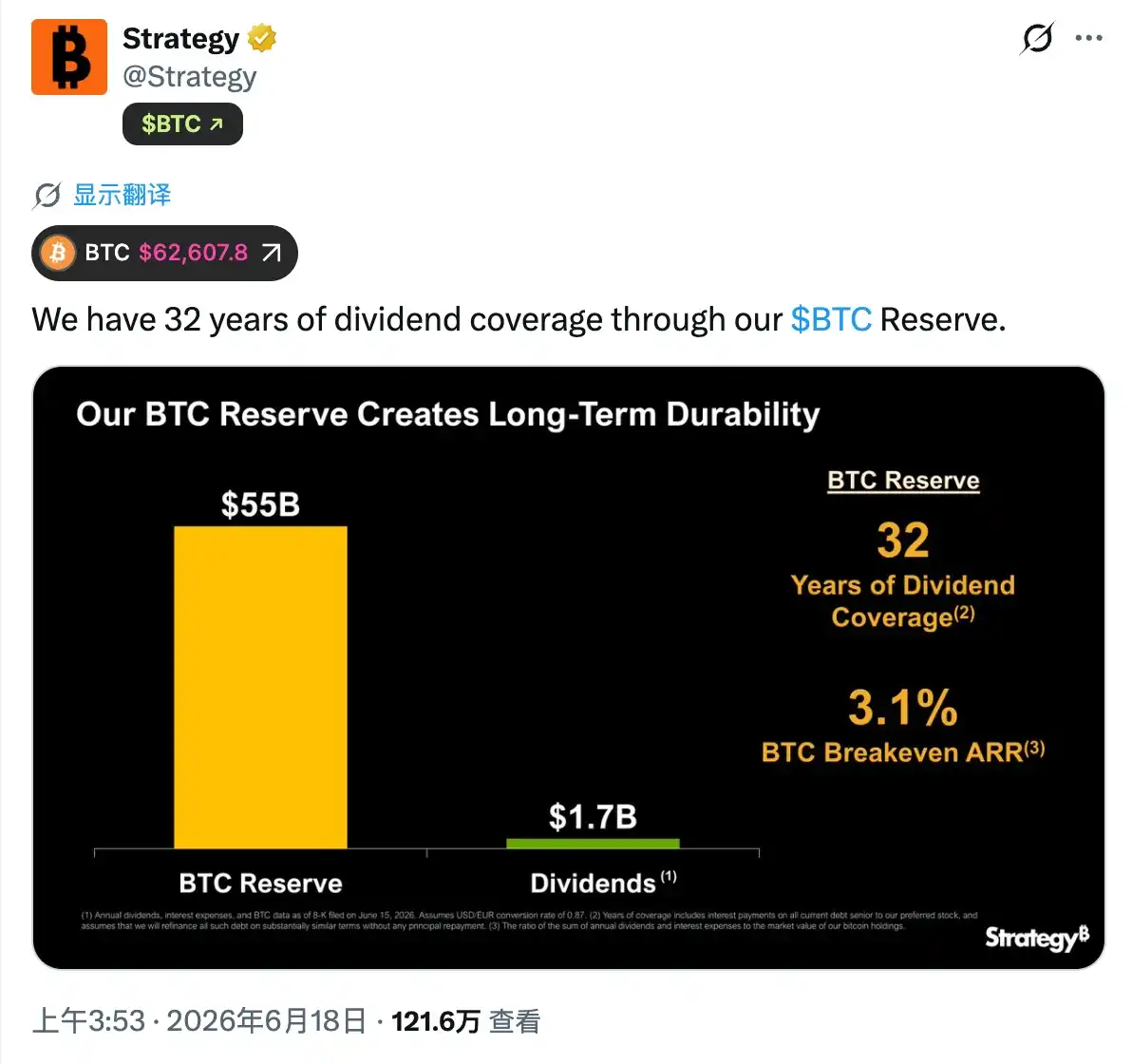
The issue, however, is that these two statements are based on different premises. J.P. Morgan focuses on Strategy's cash position, while Strategy's calculation implies a crucial assumption—if necessary, the company can obtain funds by selling Bitcoin.

This touches on the market's most sensitive nerve. Early this month, Strategy sold a portion of its Bitcoin holdings for the first time. Although the sale involved only 32 Bitcoins and was packaged by the company as "active market desensitization testing," with mention of "buying back more later," it still caused significant market shock. The reason is that over the past few years, Strategy and its founder Michael Saylor have consistently promoted a core narrative to the market—Bitcoin is a long-term strategic reserve asset, and the company will source operational funds through capital market financing, not by selling Bitcoin.

Therefore, when the market witnessed Strategy selling Bitcoin for the first time, it inevitably raised greater concerns—if financing conditions tighten in the future, will Strategy need to rely further on selling Bitcoin to meet dividend obligations? If the answer is not an absolute no, then investors must reassess the risk profile of related securities.

From this perspective, the persistent "unpegging" of STRC reflects the market re-evaluating the robustness of Strategy's entire capital structure.

Strategy's Buying Power Could Turn into Selling Pressure

For Strategy, the biggest impact of STRC's sustained unpegging is the weakening of its financing function.

Over the past few years, Strategy's ability to continuously expand its Bitcoin reserves hinged on a core logic: raising funds from capital markets by issuing stocks, convertible notes, and preferred shares, then using those funds to increase Bitcoin holdings. STRC is precisely Strategy's most important financing tool. When it trades persistently below its $100 target par value, it means the market is demanding higher risk compensation, and Strategy's financing ability consequently faces a temporary shutdown.

Going forward, STRC's re-pegging status may become a crucial indicator for the market to observe Strategy's risk profile. If STRC remains discounted for an extended period, leading to persistently constrained financing ability, while Strategy's cash reserves continue to deplete, market fears about Strategy potentially needing to sell more Bitcoin to meet dividend payments will inevitably intensify.

Once this expectation strengthens, its impact will extend beyond STRC itself. As one of the most significant marginal buyers in the Bitcoin market over recent years, Strategy's financing ability and accumulation pace have profoundly influenced market supply-demand expectations. If Strategy's buying power turns into selling pressure, it could exert unimaginable downward pressure on Bitcoin.


Criptomoedas em alta

Perguntas relacionadas

QWhat is the core issue with Strategy's preferred stock STRC, and why is it significant?

AStrategy's preferred stock STRC has experienced a significant 'de-pegging' from its target par value of $100, with its price falling more than 11% below this level. This is significant because STRC is not meant to be a high-volatility speculative asset but a yield-oriented security designed to trade around $100. Its sustained discount threatens the core mechanism of Strategy's capital model, as it undermines the company's primary ability to raise funds through at-the-market (ATM) offerings of STRC, which are only viable when the stock trades at or above $100.

QHow did STRC function as the 'engine' of Strategy's capital flywheel, and what was the critical prerequisite for its operation?

ASTRC functioned as the engine by enabling Strategy to raise fiat currency through continuous at-the-market (ATM) share offerings without diluting the equity of common shareholders (MSTR holders) or incurring fixed debt obligations. The capital flywheel worked as follows: issue more STRC -> raise fiat -> buy Bitcoin -> increase the company's net assets -> boost confidence in STRC. The critical prerequisite for this flywheel to operate smoothly was that STRC's market price had to remain stable around its $100 target par value to facilitate new ATM issuances.

QAccording to the article, what are the two main reasons given for STRC's continued de-pegging despite high dividend adjustments?

AThe two main reasons are: 1) Technical factors involving a deleveraging cascade, where leveraged arbitrage funds were forced to sell their STRC holdings as the price fell below $100, creating a self-reinforcing cycle of selling pressure. 2) A deeper, fundamental loss of market confidence related to concerns about Strategy's liquidity. Investors are worried that if financing becomes tight, Strategy might need to sell its Bitcoin reserves to cover dividend payments, contradicting its long-standing 'hodl' narrative and increasing the perceived risk of STRC.

QWhat was the discrepancy between JPMorgan's analysis and Strategy's own statement regarding the company's ability to cover its dividend obligations?

AJPMorgan's analysis focused on Strategy's cash reserves, concluding they were only sufficient to cover about 6.3 months of preferred stock dividend payments. In contrast, Strategy's official statement argued that if its massive Bitcoin reserves were factored in, the company had enough assets to cover 32 years of dividend payments. The core discrepancy lies in the underlying assumption: JPMorgan considered immediate cash liquidity, while Strategy's calculation assumed the company could and would sell Bitcoin if necessary to generate funds for dividends.

QWhat broader market implication does the article suggest if STRC remains de-pegged and Strategy's financing ability weakens?

AThe article suggests that if STRC remains de-pegged, weakening Strategy's ability to raise new capital, market concerns will intensify that Strategy may be forced to sell portions of its Bitcoin holdings to meet its cash obligations (like dividend payments). As Strategy has been one of the most significant marginal buyers in the Bitcoin market, a shift from being a consistent buyer to a potential seller could create substantial downward pressure on the price of Bitcoin itself, impacting the broader market.

Leituras Relacionadas

Two Legends Lost in Three Days: Is Google's AI Talent Dam Cracking?

In three days, Google lost two AI legends. On June 18, Noam Shazeer, co-author of the seminal "Attention is All You Need" paper and Gemini co-lead, left for OpenAI. Just 48 hours later, John Jumper, 2024 Nobel laureate and AlphaFold lead, departed DeepMind for Anthropic. This follows Andrej Karpathy joining Anthropic in May. These moves highlight a structural trend: top AI talent is concentrating at mission-driven, pre-IPO firms like OpenAI and Anthropic, while Google becomes a primary source. The exodus stems from a core mission mismatch. Google's ad-centric model often subordinates AI research to product and revenue goals, creating friction for pioneers like Shazeer, who returned in 2024 only to leave again. In contrast, OpenAI and Anthropic offer singular focus on pushing AI boundaries, whether towards AGI or safety-aligned models, which deeply appeals to top researchers like Jumper. Financial incentives amplify the pull. With both OpenAI and Anthropic nearing IPO, employees stand to gain immensely from equity, an upside Google's mature stock cannot match. Furthermore, the 2023 merger of Google Brain and DeepMind, intended to consolidate strength, has instead created cultural tension and slowed the path from research to product, as evidenced by Gemini's pace. This talent redistribution is reshaping the AI landscape. While Google retains vast data and compute resources, its true crisis is the quiet, continuous loss of the people who define the field's future. The real moat in AI is not infrastructure, but the concentration of brilliant minds—a battle Google is currently losing.

marsbitHá 1h

Two Legends Lost in Three Days: Is Google's AI Talent Dam Cracking?

marsbitHá 1h

Behind the AI Report Card, Lies a Chinese 'Exam Setter'

Beyond the familiar performance charts like MMLU-Pro and MMMU, which major AI models strive to ace, stands a key "examiner": Chinese-Canadian researcher Wenhu Chen. An assistant professor at the University of Waterloo and founder of TIGERLab, Chen addresses the crucial need for more rigorous AI evaluation. As models like GPT-4 began scoring near-perfect results on older benchmarks like MMLU, it became difficult to distinguish their true capabilities. In response, Chen introduced MMLU-Pro in 2024, featuring harder, more reasoning-focused questions with more answer choices, successfully reintroducing meaningful performance gaps. His work extends to multi-modal evaluation with MMMU and its enhanced version, MMMU-Pro. These benchmarks test a model's ability to understand and reason with complex information from images, charts, and text across diverse academic subjects, exposing the significant challenges even top models face in genuine comprehension. Chen's background in complex QA, table reasoning, and his experience at Google DeepMind on projects like Gemini inform his approach. He understands that effective benchmarks must anticipate how models might "cheat" by memorizing data or avoiding visual analysis. His lab also actively researches video understanding and generation models (e.g., UniVideo, Vamba), ensuring his evaluation work is grounded in practical model-building challenges. Now at Meta's Super Intelligence Lab, Chen continues his focus on multi-modal data and evaluation, representing the deep yet often unseen contributions of Chinese talent in shaping the fundamental tools of the AI industry.

marsbitHá 1h

Behind the AI Report Card, Lies a Chinese 'Exam Setter'

marsbitHá 1h

Alliance Co-founder's Letter to Entrepreneurs: Written at the Moment Cursor Sold for $600 Billion

Alliance Co-founder's Letter to Entrepreneurs: On Cursor's $60 Billion Sale Many aspiring founders see massive exits like Cursor's $60B sale and wonder why they can't achieve the same, often concluding opportunities are exhausted. But great companies aren't built in obvious, crowded spaces. Cursor, like Stripe, Figma, and Shopify before it, started with a non-consensus belief about the future. Before ChatGPT, they believed AI would transform knowledge work. They focused on a genuinely exciting domain, became their own customer, and obsessed over power users. Their journey involved years of "glass-chewing" effort before the market was ready. The pattern is consistent: identify a long-term technological shift, find a missed entry point, and execute for years before the trend becomes obvious. First-generation products (PayPal, Adobe, Amazon) prove a market exists. Second-generation winners (Stripe, Figma, Shopify) rebuild that market around new insights, technology, or changing customer behaviors. Founders must identify their phase in the cycle. Early entrants like Coinbase or Cursor focus on making new technology usable for power users. Later entrants find the "yin" to the established "yang"—the blind spots incumbents miss as they grow distant from individual users. The key is deep market immersion. Use every product in your space. Talk to users. Build an audience. Stop looking for ideas and start *seeing* them everywhere. Then, choose one. The idea must offer a 10x improvement or solve a "hair-on-fire" pain point—something severe enough that users are already crafting workarounds. When building, avoid feature bloat. Ask: why would someone switch? Great startups rarely force new behaviors; they improve familiar workflows with drastically lower friction (e.g., Cursor forked VS Code instead of creating a new editor). Distribution is the underestimated moat. Before product-market fit, achieve distribution-market fit. How do customers discover new tools? Founders like those at Airbnb, Stripe, and Cursor did unscalable, manual work to recruit early users. The final, unteachable ingredient is resilience. Cursor built for years pre-market, faced rejection, and persisted. So did Airbnb, Nvidia, and Rain (which launched post-FTX collapse). The lesson isn't that these founders were smarter, but that they stayed in the game long enough for their insights to compound. Framework: Spot technological cycles. Cultivate unique insight. Obsess over your market. Talk to customers. Find a hair-on-fire problem. Build the simplest wedge. Win your distribution channel. Above all, don't quit when it gets hard. Most people won't do these things consistently. The few who do build the next generation of great companies. Go build.

marsbitHá 1h

Alliance Co-founder's Letter to Entrepreneurs: Written at the Moment Cursor Sold for $600 Billion

marsbitHá 1h

Weekly Editor's Picks (0613-0619)

Weekly Editor's Picks (0613-0619): Market Insights & Analysis This weekly digest curates in-depth analysis often lost in the information flow, focusing on key insights across macro trends, investment, and technology. **Macro & Geopolitics:** With the Strait of Hormuz reopening and military conflict shifting to negotiation, markets are pivoting from "war shock" to "supply restoration." Trades include shorting crude risk premiums, longing airlines/tourism, Asian energy importers, and bond duration, while shorting inflation expectations. LNG, fertilizer, and chemical chains are also being repriced. **Investment & VC:** Ray Dalio advises against betting on concentrated AI giants dominating indices, advocating for diversified portfolios of high-quality, low-correlation assets instead. Analysis covers the 4-year crypto cycle, predicting the core surviving product by 2029 will be asset trading markets. Current BTC metrics suggest a potential bottoming zone, presenting a patient accumulation window. SpaceX's high-profile IPO at a $2.1T valuation faces scrutiny over fundamentals, with key watchpoints being its likely inclusion in the Nasdaq index and Q2 earnings. Concerns are raised about potential "gamma squeeze" and systemic risks if its narrative-driven valuation gets amplified by passive index funds. Robinhood (HOOD) is noted for breaking its high correlation with crypto, bolstered by its stock trading and new underwriting business. **Web3 & AI:** A warning highlights ~$1.8T in off-balance-sheet AI infrastructure commitments (purchase commitments, leases) as a potential systemic risk if AI monetization lags. AI models are being used for World Cup predictions, adding a new layer for betting markets. A cost breakdown of a $20 AI subscription reveals the supply chain from model companies to cloud, GPUs, and power. **Prediction Markets:** The emergence of prediction market "concept stocks" is noted, with Robinhood developing its own platform, Rothera, signaling a shift from market competition to a "channel war" for user access. **CeFi & DeFi:** The SpaceX IPO tested perpetual contract mechanisms for pre-IPO assets, highlighting challenges in handling corporate actions like stock splits on-chain. The de-pegging of STRC (Strategy's preferred share) to ~$89 reflects market concerns over MicroStrategy's capital structure and BTC-backed leverage model. BlackRock's covered-call Bitcoin ETF (BITA) offers yield but caps upside, appealing to yield-seeking institutions. **Ethereum:** An opinion piece argues Ethereum's core strength is its vast developer community and composability, solidifying its role as the default operating system for the financial internet. **Weekly Hot Topics:** Include the US-Iran deal reopening the Strait of Hormuz, Fed's hawkish hold, Anthropic restricting model access, SpaceX acquiring Cursor, and a humorous stock surge for "Liuliumei" due to its "LLM" ticker.

marsbitHá 1h

Weekly Editor's Picks (0613-0619)

marsbitHá 1h

Alliance's Co-Founder's Letter to Entrepreneurs: Written on the Occasion of Cursor's $60 Billion Sale

In this letter to entrepreneurs, Alliance reflects on the success of Cursor's $60 billion sale to Elon Musk, using it as a case study to counter the misconception that opportunities in crowded fields like AI or crypto are exhausted. The piece argues that great companies like Cursor, Stripe, Figma, and Shopify are not built by geniuses with perfect ideas, but by founders who start with a non-consensus belief about the future and build for years before that future becomes obvious to everyone. They identify long-term shifts, find overlooked entry points, and execute relentlessly. The framework for success involves: 1. **Identifying your place in the technology cycle**: Early-stage opportunities focus on making new tech usable for power users (e.g., Coinbase, Cursor). Later-stage opportunities involve finding the "yin" to an existing "yang"—the blind spots of first-generation players (e.g., Stripe vs. PayPal, Figma vs. Adobe). 2. **Cultivating unique insights**: Immerse yourself deeply in the market. Use every product, talk to users, and build an audience. Insights will emerge naturally from deep engagement. 3. **Finding a "hair-on-fire" problem**: Look for a 10x improvement or a severe, urgent pain point. The strongest signal is people already building clumsy workarounds. 4. **Building a focused MVP**: Don't just add features because you can. Ask why users would abandon their current tool for yours. The best startups rarely force new behaviors; they improve familiar workflows with drastically lower friction. 5. **Winning a distribution channel**: Distribution is often the moat. Before product-market fit, achieve channel-market fit. Find where your customers are and build an engine to reach them, even through unscalable, manual efforts initially. 6. **Persistence**: The final, unteachable ingredient is resilience. Success stories like Cursor, Airbnb, and Nvidia involved years of grinding, rejection, and perseverance when the path forward seemed unclear. The conclusion is that there is no secret. Most people fail to consistently execute these steps over the long term. The few who do build the companies that define the next era. The world is yours to create.

链捕手Há 1h

Alliance's Co-Founder's Letter to Entrepreneurs: Written on the Occasion of Cursor's $60 Billion Sale

链捕手Há 1h

Trading

Spot
Futuros

Artigos em Destaque

O que é $S$

Compreender o SPERO: Uma Visão Abrangente Introdução ao SPERO À medida que o panorama da inovação continua a evoluir, o surgimento de tecnologias web3 e projetos de criptomoeda desempenha um papel fundamental na formação do futuro digital. Um projeto que tem atraído atenção neste campo dinâmico é o SPERO, denotado como SPERO,$$s$. Este artigo tem como objetivo reunir e apresentar informações detalhadas sobre o SPERO, para ajudar entusiastas e investidores a compreender as suas bases, objetivos e inovações nos domínios web3 e cripto. O que é o SPERO,$$s$? O SPERO,$$s$ é um projeto único dentro do espaço cripto que procura aproveitar os princípios da descentralização e da tecnologia blockchain para criar um ecossistema que promove o envolvimento, a utilidade e a inclusão financeira. O projeto é concebido para facilitar interações peer-to-peer de novas maneiras, proporcionando aos utilizadores soluções e serviços financeiros inovadores. No seu núcleo, o SPERO,$$s$ visa capacitar indivíduos ao fornecer ferramentas e plataformas que melhoram a experiência do utilizador no espaço das criptomoedas. Isso inclui a possibilidade de métodos de transação mais flexíveis, a promoção de iniciativas impulsionadas pela comunidade e a criação de caminhos para oportunidades financeiras através de aplicações descentralizadas (dApps). A visão subjacente do SPERO,$$s$ gira em torno da inclusão, visando fechar lacunas dentro das finanças tradicionais enquanto aproveita os benefícios da tecnologia blockchain. Quem é o Criador do SPERO,$$s$? A identidade do criador do SPERO,$$s$ permanece algo obscura, uma vez que existem recursos publicamente disponíveis limitados que fornecem informações detalhadas sobre o(s) seu(s) fundador(es). Esta falta de transparência pode resultar do compromisso do projeto com a descentralização—uma ética que muitos projetos web3 partilham, priorizando contribuições coletivas em vez de reconhecimento individual. Ao centrar as discussões em torno da comunidade e dos seus objetivos coletivos, o SPERO,$$s$ incorpora a essência do empoderamento sem destacar indivíduos específicos. Assim, compreender a ética e a missão do SPERO é mais importante do que identificar um criador singular. Quem são os Investidores do SPERO,$$s$? O SPERO,$$s$ é apoiado por uma diversidade de investidores que vão desde capitalistas de risco a investidores-anjo dedicados a promover a inovação no setor cripto. O foco desses investidores geralmente alinha-se com a missão do SPERO—priorizando projetos que prometem avanço tecnológico social, inclusão financeira e governança descentralizada. Essas fundações de investidores estão tipicamente interessadas em projetos que não apenas oferecem produtos inovadores, mas que também contribuem positivamente para a comunidade blockchain e os seus ecossistemas. O apoio desses investidores reforça o SPERO,$$s$ como um concorrente notável no domínio em rápida evolução dos projetos cripto. Como Funciona o SPERO,$$s$? O SPERO,$$s$ emprega uma estrutura multifacetada que o distingue de projetos de criptomoeda convencionais. Aqui estão algumas das características-chave que sublinham a sua singularidade e inovação: Governança Descentralizada: O SPERO,$$s$ integra modelos de governança descentralizada, capacitando os utilizadores a participar ativamente nos processos de tomada de decisão sobre o futuro do projeto. Esta abordagem promove um sentido de propriedade e responsabilidade entre os membros da comunidade. Utilidade do Token: O SPERO,$$s$ utiliza o seu próprio token de criptomoeda, concebido para servir várias funções dentro do ecossistema. Esses tokens permitem transações, recompensas e a facilitação de serviços oferecidos na plataforma, melhorando o envolvimento e a utilidade gerais. Arquitetura em Camadas: A arquitetura técnica do SPERO,$$s$ suporta modularidade e escalabilidade, permitindo a integração contínua de funcionalidades e aplicações adicionais à medida que o projeto evolui. Esta adaptabilidade é fundamental para manter a relevância no panorama cripto em constante mudança. Envolvimento da Comunidade: O projeto enfatiza iniciativas impulsionadas pela comunidade, empregando mecanismos que incentivam a colaboração e o feedback. Ao nutrir uma comunidade forte, o SPERO,$$s$ pode melhor atender às necessidades dos utilizadores e adaptar-se às tendências do mercado. Foco na Inclusão: Ao oferecer taxas de transação baixas e interfaces amigáveis, o SPERO,$$s$ visa atrair uma base de utilizadores diversificada, incluindo indivíduos que anteriormente podem não ter participado no espaço cripto. Este compromisso com a inclusão alinha-se com a sua missão abrangente de empoderamento através da acessibilidade. Cronologia do SPERO,$$s$ Compreender a história de um projeto fornece insights cruciais sobre a sua trajetória de desenvolvimento e marcos. Abaixo está uma cronologia sugerida que mapeia eventos significativos na evolução do SPERO,$$s$: Fase de Conceituação e Ideação: As ideias iniciais que formam a base do SPERO,$$s$ foram concebidas, alinhando-se de perto com os princípios de descentralização e foco na comunidade dentro da indústria blockchain. Lançamento do Whitepaper do Projeto: Após a fase conceitual, um whitepaper abrangente detalhando a visão, os objetivos e a infraestrutura tecnológica do SPERO,$$s$ foi lançado para atrair o interesse e o feedback da comunidade. Construção da Comunidade e Primeiros Envolvimentos: Esforços ativos de divulgação foram feitos para construir uma comunidade de primeiros adotantes e investidores potenciais, facilitando discussões em torno dos objetivos do projeto e angariando apoio. Evento de Geração de Tokens: O SPERO,$$s$ realizou um evento de geração de tokens (TGE) para distribuir os seus tokens nativos a apoiantes iniciais e estabelecer liquidez inicial dentro do ecossistema. Lançamento da dApp Inicial: A primeira aplicação descentralizada (dApp) associada ao SPERO,$$s$ foi lançada, permitindo que os utilizadores interagissem com as funcionalidades principais da plataforma. Desenvolvimento Contínuo e Parcerias: Atualizações e melhorias contínuas nas ofertas do projeto, incluindo parcerias estratégicas com outros players no espaço blockchain, moldaram o SPERO,$$s$ em um jogador competitivo e em evolução no mercado cripto. Conclusão O SPERO,$$s$ é um testemunho do potencial do web3 e das criptomoedas para revolucionar os sistemas financeiros e capacitar indivíduos. Com um compromisso com a governança descentralizada, o envolvimento da comunidade e funcionalidades inovadoras, abre caminho para um panorama financeiro mais inclusivo. Como em qualquer investimento no espaço cripto em rápida evolução, potenciais investidores e utilizadores são incentivados a pesquisar minuciosamente e a envolver-se de forma ponderada com os desenvolvimentos em curso dentro do SPERO,$$s$. O projeto demonstra o espírito inovador da indústria cripto, convidando a uma exploração mais aprofundada das suas inúmeras possibilidades. Embora a jornada do SPERO,$$s$ ainda esteja a desenrolar-se, os seus princípios fundamentais podem, de facto, influenciar o futuro de como interagimos com a tecnologia, as finanças e uns com os outros em ecossistemas digitais interconectados.

70 Visualizações TotaisPublicado em {updateTime}Atualizado em 2024.12.17

O que é $S$

O que é AGENT S

Agent S: O Futuro da Interação Autónoma no Web3 Introdução No panorama em constante evolução do Web3 e das criptomoedas, as inovações estão constantemente a redefinir a forma como os indivíduos interagem com plataformas digitais. Um projeto pioneiro, o Agent S, promete revolucionar a interação humano-computador através do seu framework aberto e agente. Ao abrir caminho para interações autónomas, o Agent S visa simplificar tarefas complexas, oferecendo aplicações transformadoras em inteligência artificial (IA). Esta exploração detalhada irá aprofundar-se nas complexidades do projeto, nas suas características únicas e nas implicações para o domínio das criptomoedas. O que é o Agent S? O Agent S é um framework aberto e agente, especificamente concebido para abordar três desafios fundamentais na automação de tarefas computacionais: Aquisição de Conhecimento Específico de Domínio: O framework aprende inteligentemente a partir de várias fontes de conhecimento externas e experiências internas. Esta abordagem dupla capacita-o a construir um rico repositório de conhecimento específico de domínio, melhorando o seu desempenho na execução de tarefas. Planeamento ao Longo de Longos Horizontes de Tarefas: O Agent S emprega planeamento hierárquico aumentado por experiência, uma abordagem estratégica que facilita a decomposição e execução eficientes de tarefas intrincadas. Esta característica melhora significativamente a sua capacidade de gerir múltiplas subtarefas de forma eficiente e eficaz. Gestão de Interfaces Dinâmicas e Não Uniformes: O projeto introduz a Interface Agente-Computador (ACI), uma solução inovadora que melhora a interação entre agentes e utilizadores. Utilizando Modelos de Linguagem Multimodais de Grande Escala (MLLMs), o Agent S pode navegar e manipular diversas interfaces gráficas de utilizador de forma fluida. Através destas características pioneiras, o Agent S fornece um framework robusto que aborda as complexidades envolvidas na automação da interação humana com máquinas, preparando o terreno para uma infinidade de aplicações em IA e além. Quem é o Criador do Agent S? Embora o conceito de Agent S seja fundamentalmente inovador, informações específicas sobre o seu criador permanecem elusivas. O criador é atualmente desconhecido, o que destaca ou o estágio nascente do projeto ou a escolha estratégica de manter os membros fundadores em anonimato. Independentemente da anonimidade, o foco permanece nas capacidades e no potencial do framework. Quem são os Investidores do Agent S? Como o Agent S é relativamente novo no ecossistema criptográfico, informações detalhadas sobre os seus investidores e financiadores não estão explicitamente documentadas. A falta de informações disponíveis publicamente sobre as fundações de investimento ou organizações que apoiam o projeto levanta questões sobre a sua estrutura de financiamento e roteiro de desenvolvimento. Compreender o apoio é crucial para avaliar a sustentabilidade do projeto e o seu impacto potencial no mercado. Como Funciona o Agent S? No núcleo do Agent S reside uma tecnologia de ponta que lhe permite funcionar eficazmente em diversos ambientes. O seu modelo operacional é construído em torno de várias características-chave: Interação Humano-Computador Semelhante: O framework oferece planeamento avançado em IA, esforçando-se para tornar as interações com computadores mais intuitivas. Ao imitar o comportamento humano na execução de tarefas, promete elevar as experiências dos utilizadores. Memória Narrativa: Utilizada para aproveitar experiências de alto nível, o Agent S utiliza memória narrativa para acompanhar os históricos de tarefas, melhorando assim os seus processos de tomada de decisão. Memória Episódica: Esta característica fornece aos utilizadores orientações passo a passo, permitindo que o framework ofereça suporte contextual à medida que as tarefas se desenrolam. Suporte para OpenACI: Com a capacidade de funcionar localmente, o Agent S permite que os utilizadores mantenham o controlo sobre as suas interações e fluxos de trabalho, alinhando-se com a ética descentralizada do Web3. Fácil Integração com APIs Externas: A sua versatilidade e compatibilidade com várias plataformas de IA garantem que o Agent S possa integrar-se perfeitamente em ecossistemas tecnológicos existentes, tornando-o uma escolha apelativa para desenvolvedores e organizações. Estas funcionalidades contribuem coletivamente para a posição única do Agent S no espaço cripto, à medida que automatiza tarefas complexas e em múltiplos passos com mínima intervenção humana. À medida que o projeto evolui, as suas potenciais aplicações no Web3 podem redefinir a forma como as interações digitais se desenrolam. Cronologia do Agent S O desenvolvimento e os marcos do Agent S podem ser encapsulados numa cronologia que destaca os seus eventos significativos: 27 de Setembro de 2024: O conceito de Agent S foi lançado num artigo de pesquisa abrangente intitulado “Um Framework Agente Aberto que Usa Computadores como um Humano”, mostrando a base para o projeto. 10 de Outubro de 2024: O artigo de pesquisa foi disponibilizado publicamente no arXiv, oferecendo uma exploração aprofundada do framework e da sua avaliação de desempenho com base no benchmark OSWorld. 12 de Outubro de 2024: Uma apresentação em vídeo foi lançada, proporcionando uma visão visual das capacidades e características do Agent S, envolvendo ainda mais potenciais utilizadores e investidores. Estes marcos na cronologia não apenas ilustram o progresso do Agent S, mas também indicam o seu compromisso com a transparência e o envolvimento da comunidade. Pontos-Chave Sobre o Agent S À medida que o framework Agent S continua a evoluir, várias características-chave destacam-se, sublinhando a sua natureza inovadora e potencial: Framework Inovador: Concebido para proporcionar um uso intuitivo de computadores semelhante à interação humana, o Agent S traz uma abordagem nova à automação de tarefas. Interação Autónoma: A capacidade de interagir autonomamente com computadores através de GUI significa um avanço em direção a soluções computacionais mais inteligentes e eficientes. Automação de Tarefas Complexas: Com a sua metodologia robusta, pode automatizar tarefas complexas e em múltiplos passos, tornando os processos mais rápidos e menos propensos a erros. Melhoria Contínua: Os mecanismos de aprendizagem permitem que o Agent S melhore a partir de experiências passadas, aprimorando continuamente o seu desempenho e eficácia. Versatilidade: A sua adaptabilidade em diferentes ambientes operacionais, como OSWorld e WindowsAgentArena, garante que pode servir uma ampla gama de aplicações. À medida que o Agent S se posiciona no panorama do Web3 e das criptomoedas, o seu potencial para melhorar as capacidades de interação e automatizar processos significa um avanço significativo nas tecnologias de IA. Através do seu framework inovador, o Agent S exemplifica o futuro das interações digitais, prometendo uma experiência mais fluida e eficiente para os utilizadores em diversas indústrias. Conclusão O Agent S representa um ousado avanço na união da IA e do Web3, com a capacidade de redefinir a forma como interagimos com a tecnologia. Embora ainda esteja nas suas fases iniciais, as possibilidades para a sua aplicação são vastas e cativantes. Através do seu framework abrangente que aborda desafios críticos, o Agent S visa trazer interações autónomas para o primeiro plano da experiência digital. À medida que avançamos mais profundamente nos domínios das criptomoedas e da descentralização, projetos como o Agent S desempenharão, sem dúvida, um papel crucial na formação do futuro da tecnologia e da colaboração humano-computador.

681 Visualizações TotaisPublicado em {updateTime}Atualizado em 2025.01.14

O que é AGENT S

Como comprar S

Bem-vindo à HTX.com!Tornámos a compra de Sonic (S) simples e conveniente.Segue o nosso guia passo a passo para iniciar a tua jornada no mundo das criptos.Passo 1: cria a tua conta HTXUtiliza o teu e-mail ou número de telefone para te inscreveres numa conta gratuita na HTX.Desfruta de um processo de inscrição sem complicações e desbloqueia todas as funcionalidades.Obter a minha contaPasso 2: vai para Comprar Cripto e escolhe o teu método de pagamentoCartão de crédito/débito: usa o teu visa ou mastercard para comprar Sonic (S) instantaneamente.Saldo: usa os fundos da tua conta HTX para transacionar sem problemas.Terceiros: adicionamos métodos de pagamento populares, como Google Pay e Apple Pay, para aumentar a conveniência.P2P: transaciona diretamente com outros utilizadores na HTX.Mercado de balcão (OTC): oferecemos serviços personalizados e taxas de câmbio competitivas para os traders.Passo 3: armazena teu Sonic (S)Depois de comprar o teu Sonic (S), armazena-o na tua conta HTX.Alternativamente, podes enviá-lo para outro lugar através de transferência blockchain ou usá-lo para transacionar outras criptomoedas.Passo 4: transaciona Sonic (S)Transaciona facilmente Sonic (S) no mercado à vista da HTX.Acede simplesmente à tua conta, seleciona o teu par de trading, executa as tuas transações e monitoriza em tempo real.Oferecemos uma experiência de fácil utilização tanto para principiantes como para traders experientes.

1.3k Visualizações TotaisPublicado em {updateTime}Atualizado em 2026.06.02

Como comprar S

Discussões

Bem-vindo à Comunidade HTX. Aqui, pode manter-se informado sobre os mais recentes desenvolvimentos da plataforma e obter acesso a análises profissionais de mercado. As opiniões dos utilizadores sobre o preço de S (S) são apresentadas abaixo.

活动图片