The First SEC-Compliant Tokenized Stock Launches in the US: Ondo Brings S&P 500 ETF and Micron On-Chain

marsbitPublicado em 2026-07-03Última atualização em 2026-07-03

Resumo

On July 2nd, Ondo Finance announced the tokenization of BlackRock's S&P 500 ETF (IVV) and Micron Technology stock on Ethereum. This marks the first practical implementation in the US of the SEC's proposed "third-party custody model" from January. The underlying securities remain within the traditional custodial system, with token holders able to exercise voting rights via Broadridge. Ondo aims to prove that mainstream assets can be compliantly brought on-chain. Unlike synthetic models (like Robinhood's OpenAI-linked tokens), this custody-backed model grants token holders equivalent shareholder rights and protections. While a significant regulatory milestone involving traditional finance infrastructure like Broadridge, the products are currently unavailable to US investors. Furthermore, the SEC's supportive stance is only a staff statement, not a formal rule, leaving some regulatory uncertainty. The direct impact on Ondo's token price was limited, with broader significance contingent on future US investor access and expansion to more assets.

Author: Claude, Deep Tide TechFlow

Deep Tide Introduction: On July 2nd, Ondo Finance announced the tokenization of BlackRock's S&P 500 ETF (IVV) and Micron stock, becoming the first practical implementation of the "third-party custody model" proposed by the SEC in January of this year. The underlying stocks remain within the traditional custody system, and token holders can exercise voting rights through Broadridge. However, the products are not yet available to US investors, and the SEC staff statement does not constitute formal rules.
Tokenized stocks in the US finally have a version that received a regulatory nod.

According to CoinDesk, Ondo Finance announced on July 2nd the issuance of tokenized versions of BlackRock's S&P 500 ETF (IVV) and Micron Technology (MU) stock on Ethereum. This is the first production deployment of the "third-party custody model" since the SEC issued a staff statement on tokenized securities in January, and also marks the first time a US-listed security has been tokenized by a third party without leaving the country or circumventing through an offshore structure.

In a statement, Ondo CEO Ian De Bode said, "Today's milestone demonstrates that we can tokenize securities in a way that meets both market and regulatory requirements, serving US and global investors, and laying the groundwork for more US investors to participate in on-chain investments."

The First Batch of Assets Chosen Are Two of the Most Mainstream

The two assets chosen for tokenization are not obscure. IVV is BlackRock's flagship ETF tracking the S&P 500, while Micron is a star stock in the current memory chip cycle. By using a broad-based ETF and a hot tech stock to validate the new model, Ondo's intent is clear: first prove that "mainstream assets can also be brought on-chain in a compliant manner."

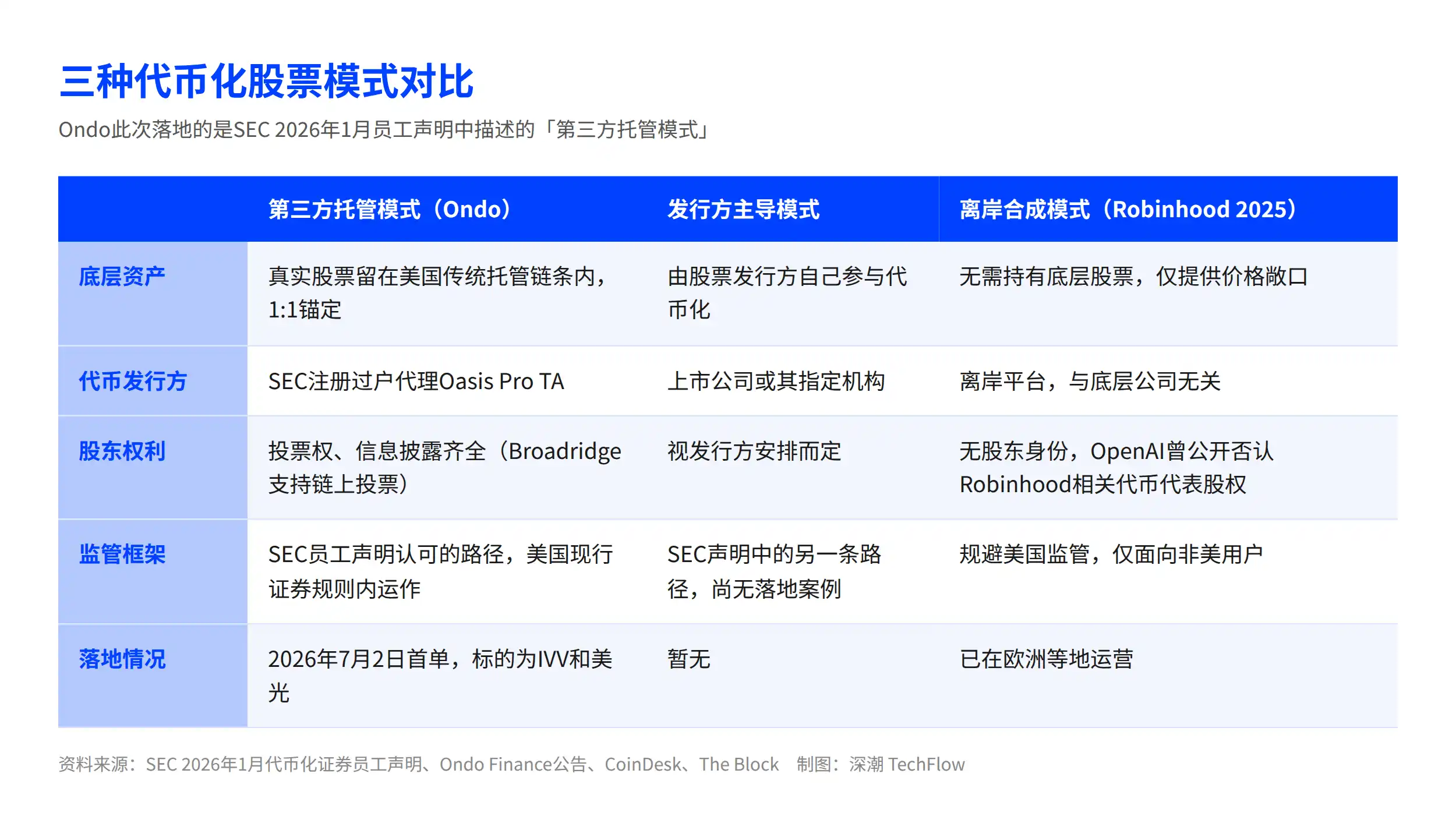
In terms of the specific structure, the underlying IVV and Micron shares remain within the US traditional custody chain, held by regulated custodians. Oasis Pro TA, an SEC-registered transfer agent acquired by Ondo last year, mints corresponding tokens on Ethereum at a 1:1 ratio. Transfer restrictions are enforced jointly by participating broker-dealers, transfer agents, and custodians.

According to Ondo, its overseas Global Markets platform has already tokenized over $1 billion worth of stocks and ETFs, covering more than 430 securities, ranking first in the industry by total value of tokenized securities. This is the company's first extension of its business into the domestic US framework.

Fundamentally Different from the OpenAI-Contradicted Robinhood Model

For the average investor, the real question worth asking about this launch is whether the purchased tokenized stock counts as equity.

Last year, this issue caused controversy. After Robinhood launched tokenized products in Europe linked to OpenAI shares, OpenAI publicly stated it had not authorized the products and warned that the tokens did not represent equity in the company. Those products belonged to a "synthetic model," where the issuer had no relationship with the underlying company, and investors only gained price exposure without shareholder status.

The SEC's staff statement in January offered another path. Under the third-party custody model, a regulated intermediary holds the real stock and issues on-chain tokens representing the holder's rights. According to The Block, Ondo's product is built precisely around this framework, where token holders receive the same shareholder rights and protections as investors in traditional brokerage accounts, including issuer notifications and on-chain proxy voting.

Put in portfolio terms, this difference means that tokens under the custody model have real shares, voting rights, and information disclosure backing them, while the synthetic model only offers a price shadow.
Wall Street Veteran Infrastructure Player Broadridge Steps In to Handle Voting

Another signal from this launch is the deep involvement of traditional financial infrastructure.

Broadridge (NYSE ticker BR) is an infrastructure giant in the US shareholder communication and proxy voting space, with a large portion of shareholder voting for US-listed companies running on its ProxyVote.com platform. In this partnership, Broadridge is responsible for providing proxy voting, regulatory disclosure, and shareholder communication services to Ondo's token holders, who can participate in voting directly on-chain.

In a statement, Doug DeSchutter, President of Broadridge's Investor Communication Solutions business, said, "By providing proxy voting, issuer communications, and regulatory disclosure for Ondo's token holders, we are delivering on our promise to provide complete, trusted governance capabilities to both investors and issuers, regardless of the structure in which assets are held."

The tokenization space has seen frequent moves recently. Robinhood launched its own public blockchain and expanded tokenized stocks beyond Europe on July 1st; the DTCC (Depository Trust & Clearing Corporation) announced in May that it would bring tokenized assets to the Stellar chain; Nasdaq received SEC approval in March to trade tokenized securities; and the NYSE has also announced related plans. According to a Citigroup report cited by CoinDesk in June, the market size for tokenized securities could reach $5.5 trillion by 2030.

Not Open to US Investors Yet; Two Risk Points to Note First

For interested readers, two points require a dose of cold water first.

First, according to CoinDesk, the product is not yet available to US investors. Ondo's current move is more about validating the architecture's feasibility; the actual timeline for opening to US retail investors is undetermined.

Second, the SEC's January statement is a staff statement, representing only the thinking direction of regulatory personnel and does not carry the force of formally adopted rules by the Commission. In other words, the compliance status of this model remains subject to potential modification by subsequent formal rules.

For ONDO token holders, as of the time of writing, ONDO is trading at around $0.33, up about 4% in 24 hours. The direct impact of the news on the token price is limited. The mid-term logic depends on when US investors can actually buy these products and whether the custody model can expand from two assets to the more than 430 securities on Ondo's overseas platform. Until these two milestones are reached, the significance of this launch lies primarily on the regulatory front, rather than the revenue front.

Perguntas relacionadas

QWhat is the core significance of Ondo Finance's recent tokenization of BlackRock's S&P 500 ETF and Micron stock according to the article?

AThe article states that this is the first production deployment of the 'third-party custody model' outlined in the SEC's January staff statement. It represents the first instance of US-listed securities being tokenized by a third party without leaving the US regulatory perimeter or using offshore structures, marking a regulatory-approved version of tokenized stocks in the US.

QHow does the 'third-party custody model' used by Ondo differ fundamentally from the 'synthetic model' used by Robinhood for its OpenAI-linked product?

AIn Ondo's third-party custody model, the underlying real stocks (like IVV and Micron) are held with regulated custodians within the traditional system, and the tokens represent direct ownership rights, including voting and receiving issuer communications. In Robinhood's synthetic model, there is no direct relationship with the underlying company; the tokens only provide price exposure without conferring any shareholder rights or ownership.

QWhich major traditional financial infrastructure company is involved in providing proxy voting services for Ondo's token holders, and what is its role?

ABroadridge (NYSE: BR), a major US shareholder communications and proxy voting infrastructure firm, is involved. It is responsible for providing proxy voting, regulatory disclosures, and shareholder communications services to Ondo's token holders, allowing them to vote directly on-chain.

QWhat are the two main limitations or risks mentioned regarding Ondo's newly launched tokenized products for potential investors?

A1. The products are currently not available to US investors. 2. The SEC's January guidance is a staff statement, not a formally adopted rule by the Commission, meaning the regulatory status of this model could potentially be changed by future official rules.

QBeyond Ondo, what are some other recent significant developments in the tokenization of securities mentioned in the article?

AThe article mentions several: Robinhood launched its own blockchain and expanded tokenized stocks beyond Europe; DTCC announced plans to bring tokenized assets to the Stellar blockchain; Nasdaq received SEC approval in March to trade tokenized securities; and the NYSE has also announced related plans. A Citigroup report estimates the tokenized securities market could reach $5.5 trillion by 2030.

Leituras Relacionadas

Countdown to the CLARITY Act: 25 Days Left—What Will Happen to the Crypto Market if It Fails to Pass Before the August Recess?

"The CLARITY Act, a key US crypto market structure bill, faces a tight deadline with only 25 working days left before the Senate's August 10 recess. The bill aims to clarify SEC/CFTC jurisdiction and establish a non-security path for decentralized tokens. Despite passing the House in 2025 and a Senate committee in May 2026, final negotiations have stalled over ethics and law enforcement provisions, jeopardizing the 60 Senate votes needed. If the bill fails to pass before the recess, its chances in 2026 drop significantly, with prediction markets giving only a 40% probability. Analyst Galaxy Digital has lowered its 2026 passage odds to 50%. Failure would likely lead to continued 'slow bleeding' in crypto markets, as seen in June's record $4.5 billion net outflow from US Bitcoin ETFs. XRP, which stands to gain permanent commodity status from the bill, could lose its 'regulatory premium.' Bitcoin and Ethereum, already classified as commodities via a joint agency interpretation, would face less direct impact but broader regulatory uncertainty would persist, delaying institutional capital and DeFi innovation. The path forward includes: 1) Passage before August (a major catalyst), 2) Delay to 2027 (extending market uncertainty), or 3) Failure, requiring the bill to be reintroduced in the next Congress. While delay is a setback, the bill's progress indicates the US is closer than ever to resolving crypto regulatory ambiguity."

marsbitHá 2m

Countdown to the CLARITY Act: 25 Days Left—What Will Happen to the Crypto Market if It Fails to Pass Before the August Recess?

marsbitHá 2m

In the First Half of the Year, Half of VC Money Flowed to AI, with These 30 Companies Alone Raising Over 170 Billion Yuan

First Half of 2026: VC Investment in AI Explodes, with 30 Top Companies Raising Over 170 Billion RMB In the first half of 2026, China's AI sector saw a massive surge in venture capital, with total equity financing exceeding 300 billion RMB—already surpassing the entire 2025 total. Key trends include: * **Massive Funding Scale:** The AI track recorded 1,203 financing events totaling over 300 billion RMB. Investment peaked in June, partly driven by DeepSeek's landmark 51-billion-RMB Series A round. * **Geographic Concentration:** Beijing, Hangzhou, Shanghai, and Shenzhen dominated, accounting for 74% of deals and 86% of total funding. Beijing led with 95.5 billion RMB, while Hangzhou surged to second place due to DeepSeek's round. * **Sector Focus:** * **Large Models** were the top draw, securing over half of all funds (nearly 1.6 trillion RMB). * **AI Infrastructure** (compute, chips) and **Embodied AI** (e.g., robotics) were other major investment areas, with the latter being the most active in number of deals. * **AIGC Applications** attracted significant capital (59.6 billion RMB), indicating strong belief in near-term commercialization. * **Investment Stage Logic:** Capital followed a clear strategy: heavy bets on growth-stage companies (A/B rounds), major funding for mature leaders, and widespread, smaller-scale seeding of early-stage innovators. * **Notable Early-Stage Trends:** World models (seen as the "OS" for embodied AI) attracted the most early capital. Angel/seed rounds reached unprecedented sizes ("inflation"), and investment shifted from foundational large models to downstream applications like robotics and physical AGI. * **Top Companies:** The 20 largest mid/late-stage deals raised 1.565 trillion RMB. Leaders include the "Big Three" large model firms (DeepSeek, StepFun, Kimi), seven leading humanoid robot companies ("Seven Samurai"), and top AIGC application players. * **Outlook:** Full-year 2026 funding is projected to exceed 6 trillion RMB. However, consolidation is expected in the large model sector, with the window for pure-play general AI startups closing. Survival will depend on finding niche verticals or securing strategic backing.

marsbitHá 7m

In the First Half of the Year, Half of VC Money Flowed to AI, with These 30 Companies Alone Raising Over 170 Billion Yuan

marsbitHá 7m

Airwallex Invests in Metal: How Stablecoins Reconnect with the Real Financial System?

Airwallex Invests in Metal: How Stablecoins Connect Back to the Real Financial System? Airwallex, a global financial platform for businesses, has completed a $3.2 billion Series H funding round at an $11 billion valuation. Concurrently, it co-led the seed round for Metal, a "tokenized financial products infrastructure" project, becoming its first design partner. This move signals Airwallex's strategic shift beyond traditional cross-border payments. It aims to leverage its decade of experience in licenses, local payment networks, and API infrastructure to address a new challenge: facilitating the entry of stablecoins, tokenized assets, and AI agents into enterprise financial systems. This involves handling critical functions like authorization, compliance, currency exchange, fiat on/off-ramps, and final settlement. Metal positions itself not merely as another stablecoin payment solution but as a compliant settlement layer (Layer 1 blockchain) designed for regulated financial institutions. It targets a broader scope of tokenized financial products, including stablecoins, tokenized deposits, and securities. The core challenge it addresses is connecting efficient on-chain assets with the complex realities of corporate finance, such as multi-currency bank accounts, securities, compliance checks, and local regulations. Airwallex's investment, alongside its founder-backed fund Capital49, provides Metal with crucial real-world infrastructure: access to local payment networks covering 200+ countries and 90+ currencies. This partnership aims to bridge the gap between on-chain efficiency and off-chain, institution-ready settlement. The announcement aligns with Airwallex's broader product direction, which includes an AI-native financial platform (T:0) and a wallet infrastructure for AI agent commerce (Airi). The combined vision is an integrated infrastructure that can handle the speed and cost benefits of on-chain assets while seamlessly managing compliance, authorization, and fiat connectivity required for global business operations and the emerging AI agent economy.

Foresight NewsHá 36m

Airwallex Invests in Metal: How Stablecoins Reconnect with the Real Financial System?

Foresight NewsHá 36m

Trading

Spot
活动图片