In the First Half of the Year, Half of VC Money Flowed to AI, with These 30 Companies Alone Raising Over 170 Billion Yuan

marsbitPublicado em 2026-07-03Última atualização em 2026-07-03

Resumo

First Half of 2026: VC Investment in AI Explodes, with 30 Top Companies Raising Over 170 Billion RMB In the first half of 2026, China's AI sector saw a massive surge in venture capital, with total equity financing exceeding 300 billion RMB—already surpassing the entire 2025 total. Key trends include: * **Massive Funding Scale:** The AI track recorded 1,203 financing events totaling over 300 billion RMB. Investment peaked in June, partly driven by DeepSeek's landmark 51-billion-RMB Series A round. * **Geographic Concentration:** Beijing, Hangzhou, Shanghai, and Shenzhen dominated, accounting for 74% of deals and 86% of total funding. Beijing led with 95.5 billion RMB, while Hangzhou surged to second place due to DeepSeek's round. * **Sector Focus:** * **Large Models** were the top draw, securing over half of all funds (nearly 1.6 trillion RMB). * **AI Infrastructure** (compute, chips) and **Embodied AI** (e.g., robotics) were other major investment areas, with the latter being the most active in number of deals. * **AIGC Applications** attracted significant capital (59.6 billion RMB), indicating strong belief in near-term commercialization. * **Investment Stage Logic:** Capital followed a clear strategy: heavy bets on growth-stage companies (A/B rounds), major funding for mature leaders, and widespread, smaller-scale seeding of early-stage innovators. * **Notable Early-Stage Trends:** World models (seen as the "OS" for embodied AI) attracted the m...

Part I: AI Sector Races Forward in H1, Funding Skyrockets

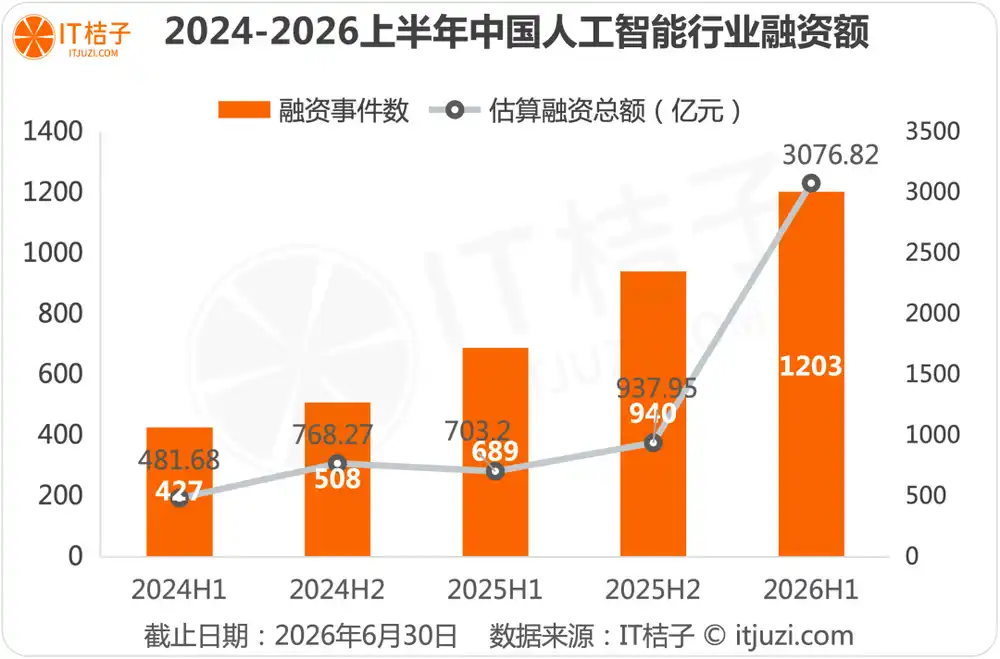
From January to June 2026, data from ITJuzi shows that equity financing in China's AI sector exhibited the core characteristics of "high total volume growth and a significant surge in funding amounts." Capital continues to increase its investment intensity in AI, with the funding scale for just six months already far exceeding the full-year level of 2025.
Data Statement:

1. Data filtering criteria: entries labeled "Artificial Intelligence" in the ITJuzi database's "Event Library," excluding non-AI industry entries.

2. Statistics scope limited to equity financing events in the primary market, excluding company listings (IPOs), post-IPO refinancing, M&A transactions, etc.

ITJuzi data shows that in the first half of 2026, there were 1,203 financing events in the AI sector, with total funding exceeding 300 billion yuan, far surpassing the full year of 2025. This reflects a sustained enhancement of capital's investment confidence in the AI sector. The AI industry has fully transitioned from the technology verification phase into the explosive period of large-scale implementation.

The funding pace in the AI sector during H1 2026 remained high from March onwards. Domestic AI funding scale consistently stayed above 40 billion yuan in March, April, and May. June saw explosive growth, with single-month total funding exceeding 100 billion yuan, primarily driven by the completion of DeepSeek's 51 billion yuan first-round financing, continuously pushing the overall funding scale of the sector higher.

The geographical pattern of AI sector financing in H1 2026 showed a landscape of "absolute leadership by Beijing, Hangzhou, Shanghai, and Shenzhen, significant agglomeration effects in the Yangtze River Delta region, and accelerated follow-up by new first-tier cities," highlighting prominent features of industrial cluster development.
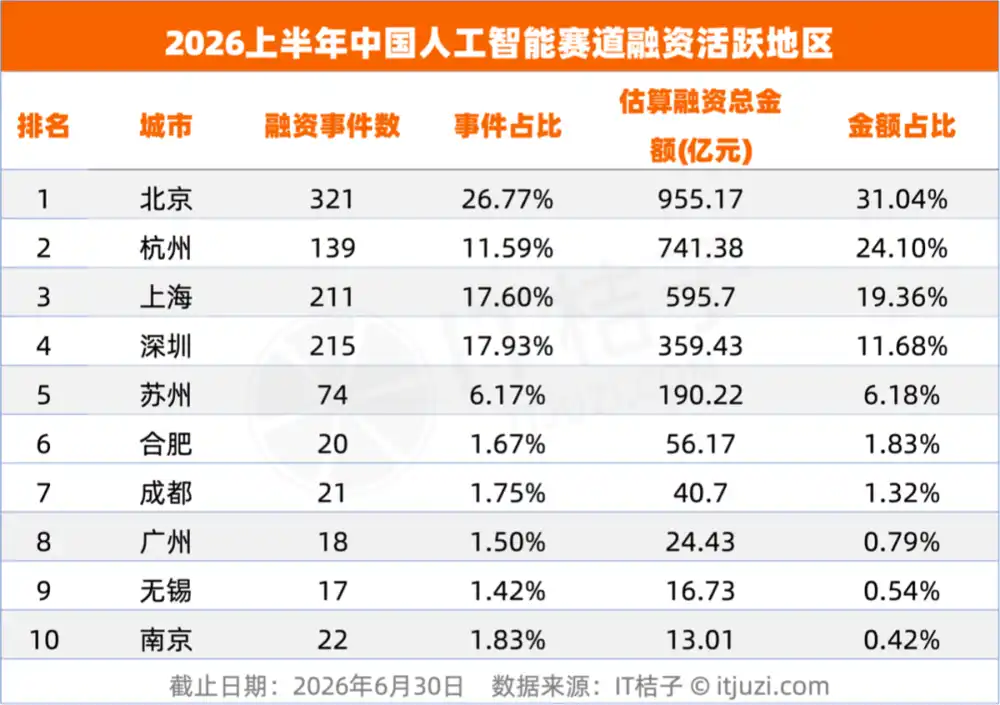
In the AI financing landscape of the first half of the year, Beijing, Shanghai, Hangzhou, and Shenzhen absolutely led the way, contributing 73.89% of the total financing transaction count and monopolizing 86% of the funding scale, becoming the absolute core of China's AI financing.

Among them, Beijing, with 321 financing events and total financing of 95.517 billion yuan, ranked first nationally, serving as the absolute core of domestic AI sector financing. Hangzhou, benefiting from the rise of Deepseek and its first-round subscription exceeding 50 billion yuan, saw its funding amount surpass Shanghai and Shenzhen to rank second nationally, becoming the absolute leader among new first-tier cities.

Shanghai had 211 AI financing events with total financing of 59.570 billion yuan in H1, while Shenzhen had 215 events with total financing of 35.943 billion yuan. Although their financing volumes were similar, Shanghai's AI companies demonstrated stronger overall capital attraction ability, reflecting higher valuation midpoints for Shanghai AI companies and larger bets per deal by institutions.

Suzhou, with 19.022 billion yuan, ranked 5th nationally, becoming the third pillar in the Yangtze River Delta. Momenta's cornerstone round of 2.9 billion HKD and Pre-IPO round of 1 billion USD contributed approximately 9.7 billion yuan, accounting for over half of Suzhou's H1 AI financing amount.

In addition to Yangtze River Delta cities like Hangzhou, Shanghai, Suzhou, Wuxi, and Nanjing, new first-tier cities such as Hefei, Chengdu, Guangzhou, Xi'an, and Wuhan also saw AI projects securing financing. Some cities achieved zero breakthroughs in financing events, reflecting the continuous expansion of the AI industry's radiation scope and second-tier cities accelerating their AI sector layout through policy support and industrial spillover absorption.

Part II: Funding Scale Across AI Sub-sectors

Since the artificial intelligence industry covers a wide range, relying solely on a conceptual term cannot reveal its full picture. Therefore, we conducted a broader statistical analysis of sub-fields.
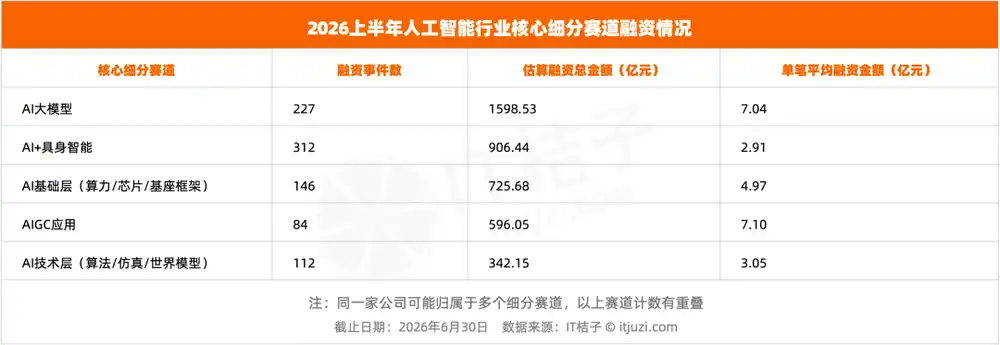
From the distribution characteristics of sub-sectors: In terms of total funding distribution, large models dominate overwhelmingly, taking over half of the total sector funds.

The large model sub-sector, with 159.853 billion yuan in total financing, became the absolute core technical foundation of the AI sector. Top projects frequently secured single rounds of tens of billions in financing, showing the strongest Matthew effect for capital. It is the first most heavily invested sub-sector in the primary market.

Additionally, in H1 2026, the AI infrastructure layer (including computing power, AI chips, training frameworks) raised a total of 72.568 billion yuan. These are capital-intensive sub-sectors with frequent large-scale financing. The AI technology layer, leaning towards simulation and spatial algorithms, had lower numbers of financing events and amounts compared to the infrastructure layer, often financing in sync with large model and embodied intelligence companies.

These two major sub-sectors together accounted for 258 events and combined financing of 106.783 billion yuan, constituting 18.00% of the total summarized funds. They represent the core investment direction for the AI industry's technical foundation, apart from large models.

The AI+Embodied Intelligence sub-sector is the second growth driver, with total financing reaching 90.644 billion yuan. It is the core hardware carrier sub-sector for AI technology implementation, with 312 financing events, making it the sub-sector with the highest number of financing events and the highest project activity level.

The AIGC application sub-sector raised a total of 59.605 billion yuan in six months, representing the most mature sub-sector for AI technology commercialization, with the highest capital recognition of its commercial value.

In terms of financing event distribution, the AI+Embodied Intelligence sub-sector had 312 financing events, accounting for 26.02% of all sector events. It is the most densely populated sub-sector with projects, covering all stages from early startups to growth-stage leaders, showing the strongest industry innovation vitality.

From the perspective of single-project financing capability, large models and AIGC are most prominent. The top three sub-sectors with the highest average financing amount per event are: AIGC (710 million yuan), Large Models (704 million yuan), both far exceeding the sector average. This reflects that capital is willing to offer extremely high valuation premiums and large-scale financial support for top projects in these three sub-sectors, which are the core targets of capital's heavy investment.

Part III: Capital's Core Betting Rhythm

&

In-depth Analysis Matching Different AI Companies' Financing Development Stages

Capital allocation in the AI sector in H1 2026 presented a clear rhythm: "heavy investment in growth stage, anchor in maturity stage, early-stage incubation." The financing scale, number of events, and capital preferences differed significantly across these three investment stages.
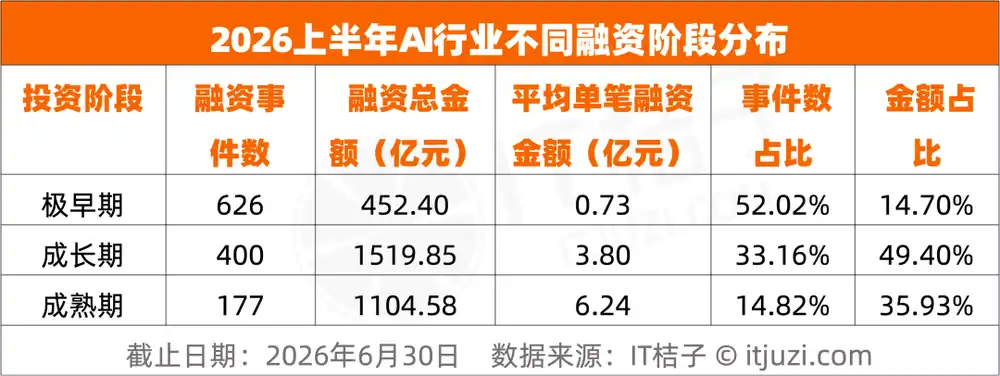
The core betting logic of capital can be clearly seen from the key data:

Companies in the ultra-early stage (Seed, Angel, Pre-A rounds) are the core source of technological innovation in the AI sector. They contributed 626 events, over half of the total, but the average financing amount per event was only 73 million yuan. The core logic of early-stage investment is "casting a wide net, early positioning, betting on the future"—locking in early-stage projects with innovative potential through small, high-frequency investments.

Growth-stage AI companies (Series A, A+, B, B+ rounds) were the core battlefield for capital deployment in the AI sector in H1 2026. Companies at this stage have completed technology validation and possess initial product implementation capabilities and commercialization potential. Together, they contributed 49.40% of the total financing amount, with an average financing amount per event of 380 million yuan.

Mature-stage AI companies are the anchor of the sector. Although they accounted for only 177 events, they contributed over 100 billion yuan in total financing, with the highest average financing amount per event reaching 624 million yuan. These mature-stage companies, which have formed industry leadership positions and possess stable profitability capabilities, often receive larger financial support.

To penetrate beyond the surface information of "funding amounts," we will break down the analysis into two stages—early stage and mid-to-late stage—and conduct an in-depth analysis of the companies with the highest financing amounts to answer a core question: What exactly is every penny of capital betting on?

1. Early Stage: The Source of Innovation and Incubation Pool for the Sector

According to ITJuzi statistics, the top 10 early-stage companies collectively secured 16.589 billion yuan, accounting for 36.7% of the total ultra-early stage financing. Who are the companies that can secure large-scale, even over 1 billion yuan, financing in the early stage?
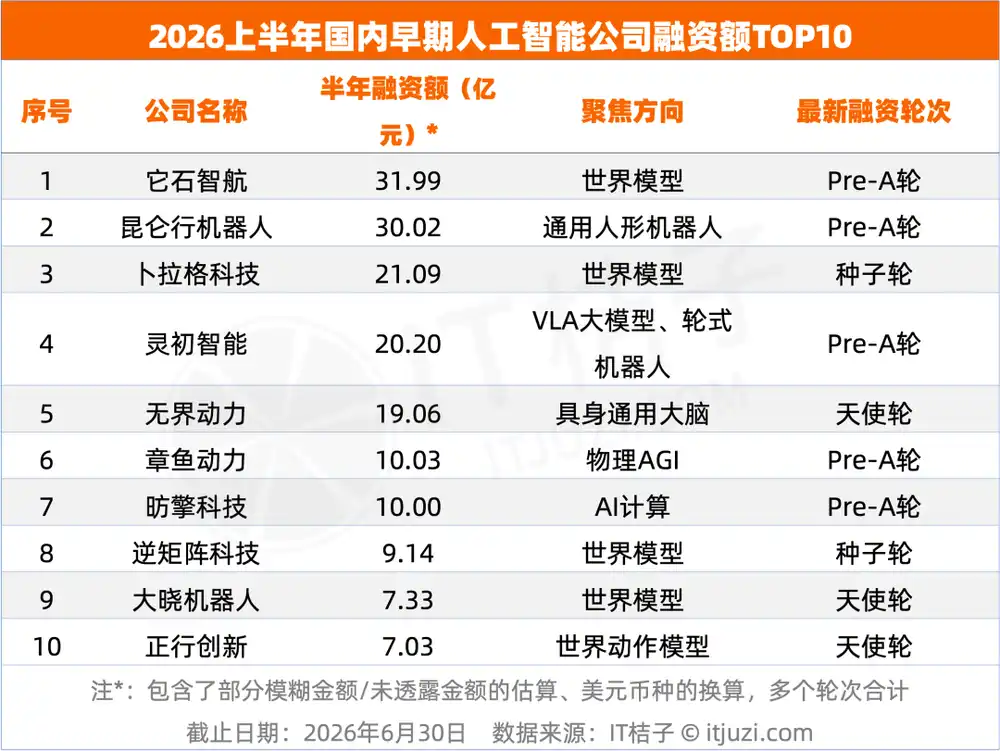
Four Key Insights from the Early-Stage TOP10

Insight One: World Models become the "First Consensus" for early-stage investment.

Six companies in the world model direction collectively raised 9.7 billion yuan (58%). World models are seen as the "operating system" for embodied intelligence—whoever masters the world model masters the robot's ability to understand the physical world. The logic of early-stage VCs is to position themselves at the operating system level, which holds greater strategic value than competing at the application level.

Insight Two: Significant "Inflation" in Angel round financing amounts.

Four companies among the TOP10 completed financing exceeding 700 million yuan in their Seed or Angel rounds (Brag 2.1B, Wujie Power 1.9B, Inverse Matrix 900M, Daxiao 700M), which was unimaginable before 2024. This phenomenon indicates that the premium for founding teams' academic/industry backgrounds in the AI sector is extremely high. Top VCs are moving towards earlier stages to compete for scarce top-tier teams.

Insight Three: The spillover effect of the talent ecosystem from major companies is becoming evident.

Daxiao Robot, founded in 2025, is an embodied intelligence company incubated by SenseTime, launching the first domestically open-source and commercially applied "Kaiwu" World Model 3.0. Daxiao Robot's inclusion on the list represents a trend—AI talent and technology from major companies are diffusing outward through incubation/entrepreneurship, forming a "major company ecosystem" for startups.

Insight Four: None of the early-stage TOP10 are pure large model companies.

This is an extremely important signal—the early window for the large model sub-sector has essentially closed. Capital judges that the competitive landscape for foundational large models has preliminarily taken shape, and new early-stage large model projects are unlikely to receive support from top VCs. Capital is shifting towards the "downstream of large models"—world models, embodied brains, physical AGI.

2. Growth/Maturity Stage: Core Targets of Capital's Heavy Investment

Large-scale financing occurs frequently in both the growth and maturity stages, so they are considered together. According to ITJuzi statistics, the TOP20 companies collectively raised 156.5 billion yuan, accounting for over half of the total sector financing. So, who can attract concentrated capital bets?
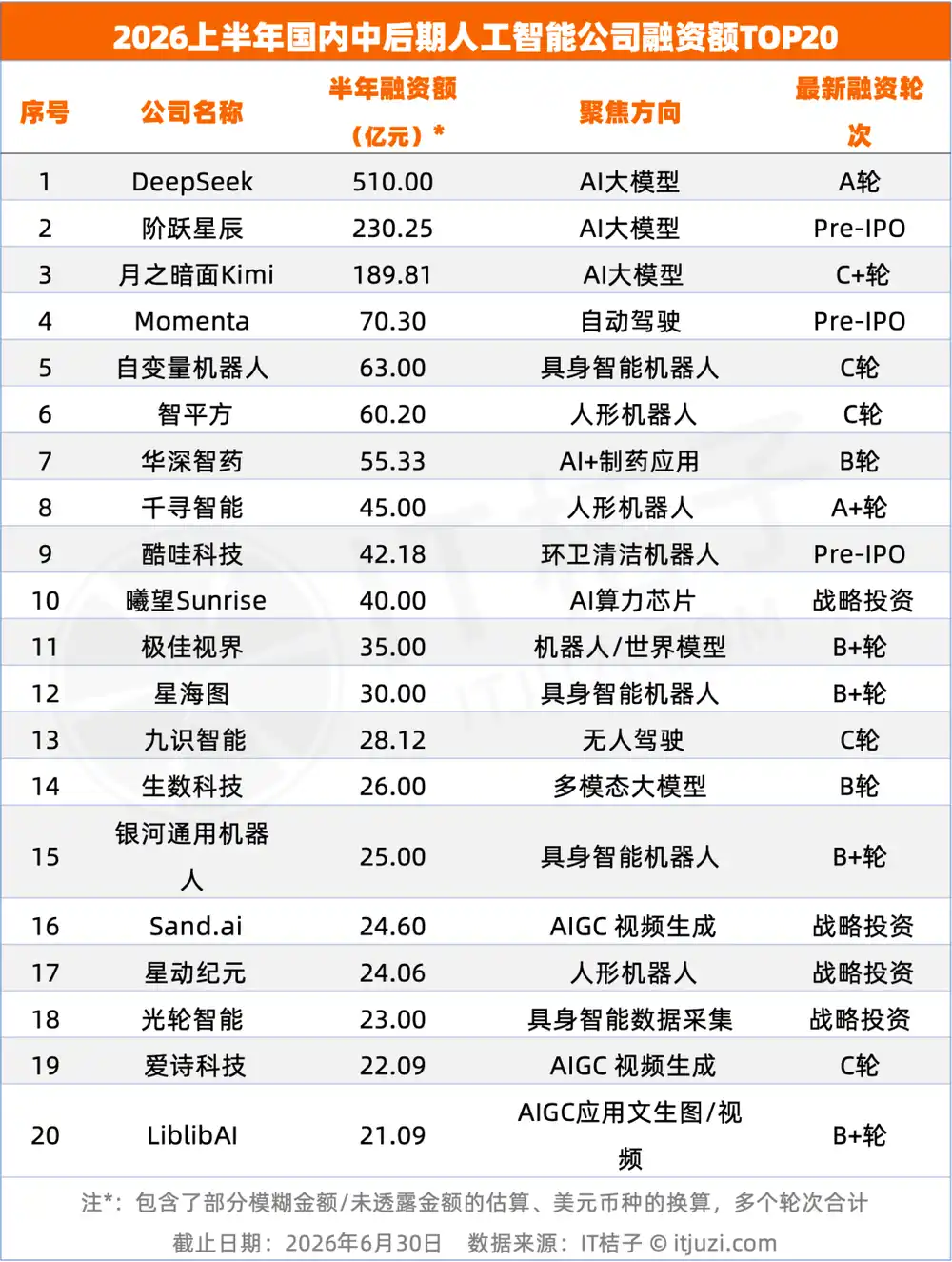
Based on their focus areas, we categorize the TOP20 AI companies in mid-to-late stages into five major camps for analysis:

Camp One: The Big Three Large Models (Collectively 93.006 billion yuan, 59.4% of TOP20)

Deepseek, StepFun, and Kimi took the top three spots, each securing over 10 billion yuan in financing. Among them, DeepSeek obtained 51 billion yuan with just one Series A round, making it the largest financing event in the AI sector in H1 2026.

However, the financing logic of the big three differs significantly. DeepSeek's single 51 billion yuan round was completed at Series A, indicating extremely high valuation elasticity and capital trust. StepFun's intensive financing (four rounds in six months) reflects capital needs in the Pre-IPO冲刺冲刺 sprint stage, with a considerable portion of its 23 billion yuan likely allocated for final resource preparation before listing. Kimi's 18.9 billion yuan was completed in two relatively balanced rounds.

Camp Two: The "Seven Samurai" of Humanoid Robots (Collectively 28.226 billion yuan, 18.0% of TOP20)

Humanoid robots are the second major area, with the industry on the eve of large-scale implementation. Seven embodied intelligence companies—Independent Variable Robotics, ZhiPingFang, Qianxun Intelligence, Jijia Vision, Xinghai Tu, Galaxy General Robot, and Xingdong Jiyuan—each secured large-scale financing exceeding 2 billion yuan.

Moreover, their financing stages collectively entered Series B to strategic investment, indicating capital is no longer betting on technical routes but on who can achieve mass production first. Additionally, Independent Variable Robotics completed four rounds totaling 6.3 billion yuan in six months—an unusually intensive financing pace in the robotics sector—suggesting funds are rapidly concentrating towards it.

Camp Three: The "Three Musketeers" of AIGC Applications (Collectively 6.778 billion yuan, 4.3% of TOP20)

In the AIGC application sub-sector, ShengShu Technology, Sand.ai and LiblibAI, and Aishi Technology focus on the core scenario of multimodal video/image generation and have preliminarily achieved scaled commercialization of AIGC technology.

Compared to 2024 when most AIGC companies were in Angel/Series A stages, H1 2026 shows the AIGC sub-sector has clearly entered the commercialization verification phase. Notably, the financing amounts of the three companies are highly similar, without a clear "winner-takes-all" pattern—this reflects that the AIGC application layer is still in a "dividing the pie" rather than a "determining the winner" phase.

Camp Four: Autonomous Driving & Others (Collectively 25.893 billion yuan, 16.6% of TOP20)

Both Momenta and Kuwa Technology are in the Pre-IPO stage, reflecting that the autonomous driving sub-sector is entering an exit window. Huashen Zhiyao's 5.533 billion yuan represents the largest single financing in the AI drug discovery sub-sector, indicating that AI's commercial prospects in pharmaceutical R&D have been validated by capital's heavy investment. Sunrise's 4 billion yuan strategic investment represents the financing capability of AI chips under the logic of domestic substitution.

Part IV: Outlook for the Second Half of the Year

Looking at the AI industry from the midpoint of 2026, we predict the annual financing scale is highly likely to exceed 600 billion yuan, but the pace in the second half will be "high front, low back."

The H1 financing total of 307.682 billion yuan has already set a high base. According to seasonal patterns, financing is typically more active in H2, making it highly probable that the full year will exceed 600 billion yuan.

Additionally, the large model sub-sector will face its first round of "elimination matches."

In H1, the big three large models took 93 billion yuan. Furthermore, Zhipu and Minimax have entered the secondary market. The funding window for the remaining 200+ model companies is rapidly narrowing. We anticipate that the first cases of layoffs/transitions/M&A among large model startups will emerge in H2.

Companies that can survive will either have found clear differentiated scenarios (e.g., vertical models for AI drug discovery, AI programming, etc.) or secured strategic investments from industry giants. The window for pure "general-purpose large model" entrepreneurship has closed.

This article is from WeChat Official Account: ITJuzi , Author: Wu Meimei

Criptomoedas em alta

Perguntas relacionadas

QWhat was the total AI financing amount and the number of deals in the first half of 2026 according to the article?

AIn the first half of 2026, the total AI financing amount exceeded 300 billion yuan across 1,203 deals.

QWhich city ranked first in AI financing amount in China during H1 2026, and what was its total?

ABeijing ranked first with a total financing amount of 95.517 billion yuan across 321 deals.

QWhich AI sub-sector received the largest share of financing in H1 2026, and what was its total?

AThe Large Model sub-sector received the largest share, with a total financing amount of 159.853 billion yuan, accounting for over half of the total AI financing.

QWhat were the three main investment stages in AI during H1 2026, and which stage attracted the highest total amount?

AThe three main stages were Early-stage (seed/angel), Growth-stage (Series A/B), and Mature-stage. The Mature-stage attracted the highest total financing amount, over 100 billion yuan, despite having fewer deals.

QWhich company had the single largest financing round in H1 2026, and how much was it?

ADeepSeek had the single largest financing round, raising 51 billion yuan in its Series A funding.

Leituras Relacionadas

How Far Are We from the End of the Crypto Bear Market?

How Much Longer Until the Crypto Bear Market Ends? A persistent negative Coinbase Bitcoin Premium Index, reaching a record 46 consecutive days of negative values, underscores the ongoing crypto bear market. The downturn accelerated in late May/early June when MicroStrategy (referred to as "Strategy" in the text), a major BTC holder, sold a small amount of Bitcoin (32 BTC), shattering market confidence and triggering sharp declines in BTC, ETH, and SOL. This was compounded by sustained net outflows from US spot Bitcoin ETFs. June saw Bitcoin briefly fall below $60,000, its worst weekly performance since 2022, breaking below the critical 200-week moving average—a signal some analysts consider confirmation of a bear market. While some institutional analyses in mid-June suggested the bottom might be near (e.g., around $53,600 based on realized price, or a potential end during the 2026 World Cup summer), further price drops quickly disproved these optimistic forecasts. Key bear market indicators include: the severe de-pegging of MicroStrategy's preferred shares (STRC) from their $100 NAV, which later recovered partly due to company stabilization plans; a record number of BTC (over 10.83 million) and a significant portion of long-term ETH holders now in unrealized loss; and Bitcoin's price trading below its 200-week moving average. Predictions for the bear market's end vary. Some, like investor Yilihua, suggest July-August 2026 could present a final buying opportunity. Others, like miner Jiang Zhu'o'er, predict a bottom between $42,000-$44,000 in October-December 2026, based on the historical lag between MicroStrategy's mNAV ratio bottom and Bitcoin's price bottom. Technical indicators like the BTC 4-year average price index dipped briefly below 1, and the Coinbase Premium Index remains negative, suggesting a need for a price rebound to around $77,000 for a return to positive territory. In the absence of major external catalysts, the consensus leans toward the bear market persisting for another 2-3 months, with late September to early October 2026 being a potential turning point window.

Odaily星球日报Há 27m

How Far Are We from the End of the Crypto Bear Market?

Odaily星球日报Há 27m

Solana Ecosystem Shows Signs of Recovery: On-Chain Governance Upgrade, Tokenized Stocks and Meme Coins Heat Up

Solana Ecosystem Shows Signs of Revival: Governance Upgrades, Tokenized Stocks, and Memecoins Heat Up While the broader crypto market faces a downturn, Solana has shown relative strength with its price rising nearly 15% recently. This resilience is attributed to warming ecosystem activity, particularly in tokenized stocks and memecoins, coupled with a major upgrade to its on-chain governance. In the Real World Assets (RWA) sector, Solana now leads all public chains in both the number of unique holder wallets and the quantity of RWA assets. Its tokenized stock weekly trading volume has surged to a record $1.42 billion, capturing about 96% of the market share, largely driven by the Backpack exchange. Simultaneously, the Solana memecoin sector has reignited, fueled by the rapid ascent of the ANSEM token following endorsements from a prominent crypto influencer. This has boosted activity across platforms like Pump.fun and increased fee revenue for several Solana-based exchanges. A key development is the launch of Solana Governance Proposals (SGP), a new on-chain mechanism. It allows validators with at least 100,000 SOL delegated to submit proposals for community vote, enhancing decentralized decision-making. SGP will operate alongside the existing technical proposal process (SIMD), focusing on broader ecosystem governance. Despite these positive signals in specific areas, overall on-chain activity and transaction volumes still lag behind previous bull market peaks, indicating the recovery remains partial rather than ecosystem-wide.

marsbitHá 50m

Solana Ecosystem Shows Signs of Recovery: On-Chain Governance Upgrade, Tokenized Stocks and Meme Coins Heat Up

marsbitHá 50m

While Semiconductor Stocks Plunge, Anthropic Plans to Develop a 2nm Chip

Anthropic, the AI company behind Claude, is exploring the development of its own custom AI chip, according to a report from The Information. The company is in early discussions with Samsung Electronics to manufacture the chip using Samsung's most advanced 2-nanometer process and packaging technology. While the project is still in preliminary stages, including defining chip specifications, and could be abandoned, it marks a strategic step for Anthropic. The move comes as the company seeks greater control over its computing costs and hardware optimization, particularly for inference tasks to run its models more efficiently and cheaply. Samsung's potential involvement follows its participation as a strategic investor in Anthropic's recent $65 billion funding round. For Samsung, partnering with a major AI lab represents a significant opportunity for its foundry business to compete with market leader TSMC in advanced semiconductor manufacturing. Anthropic's CEO, Dario Amodei, has previously highlighted the immense financial challenge of securing enough computing power for anticipated growth, making cost-effective inference a critical focus. The company would join other tech giants like Google, Amazon, Microsoft, Meta, and OpenAI in pursuing custom AI silicon. However, analysts note this trend creates deeper interdependencies rather than independence, as US AI labs become more tightly woven into Asian semiconductor supply chains. Despite this move, Anthropic remains heavily reliant on a multi-cloud, multi-vendor strategy for its immediate computing needs. It has secured massive, long-term commitments for capacity from Amazon Web Services (Trainium chips), Google (TPUs), and even leased a large GPU cluster from xAI. For now, Nvidia continues to dominate the AI chip market, with its share reportedly growing to 74%.

链捕手Há 52m

While Semiconductor Stocks Plunge, Anthropic Plans to Develop a 2nm Chip

链捕手Há 52m

Korean Companies Following Strategy in Accumulating Cryptocurrency: From Bull Market to Delisting?

Title: Korean DAT Companies Following "Strategy" Bitcoin Hoarding Model Face Delisting Amid Bear Market Summary: Several Korean KOSDAQ-listed companies, known as Digital Asset Trusts (DATs), are at risk of being delisted due to a combination of stricter regulatory thresholds and a downturn in crypto markets. These firms, inspired by models like Strategy and Japan's Metaplanet, raised capital to buy Bitcoin, relying on a cycle of rising crypto prices to boost their stock value. However, recent reforms in Korea have raised the minimum market capitalization required to stay listed from 150 billion won to 200 billion won (approx. $1.3M), with a further increase to 300 billion won set for next January. The new rules also close loopholes like reverse stock splits used to artificially inflate share prices. The situation is exacerbated by a significant drop in Bitcoin's price from its 2025 peak and a weak KOSDAQ market. While the main KOSPI index has surged nearly 95% year-to-date, KOSDAQ has fallen about 10%, draining liquidity from smaller companies. Many DATs now hover near or below the new market cap thresholds and must also book substantial valuation losses on their Bitcoin holdings. Analysts suggest that without a sustained recovery in both crypto prices and broader market interest in KOSDAQ stocks, these companies have limited options to avoid delisting, marking a precarious moment for Korea's crypto-linked public companies.

marsbitHá 1h

Korean Companies Following Strategy in Accumulating Cryptocurrency: From Bull Market to Delisting?

marsbitHá 1h

Trading

Spot

Artigos em Destaque

O que é GROK AI

Grok AI: Revolucionar a Tecnologia Conversacional na Era Web3 Introdução No panorama em rápida evolução da inteligência artificial, a Grok AI destaca-se como um projeto notável que liga os domínios da tecnologia avançada e da interação com o utilizador. Desenvolvida pela xAI, uma empresa liderada pelo renomado empreendedor Elon Musk, a Grok AI procura redefinir a forma como interagimos com a inteligência artificial. À medida que o movimento Web3 continua a florescer, a Grok AI visa aproveitar o poder da IA conversacional para responder a consultas complexas, proporcionando aos utilizadores uma experiência que é não apenas informativa, mas também divertida. O que é a Grok AI? A Grok AI é um sofisticado chatbot de IA conversacional projetado para interagir com os utilizadores de forma dinâmica. Ao contrário de muitos sistemas de IA tradicionais, a Grok AI abraça uma gama mais ampla de perguntas, incluindo aquelas tipicamente consideradas inadequadas ou fora das respostas padrão. Os principais objetivos do projeto incluem: Raciocínio Fiável: A Grok AI enfatiza o raciocínio de senso comum para fornecer respostas lógicas com base na compreensão contextual. Supervisão Escalável: A integração de assistência de ferramentas garante que as interações dos utilizadores sejam monitorizadas e otimizadas para qualidade. Verificação Formal: A segurança é primordial; a Grok AI incorpora métodos de verificação formal para aumentar a fiabilidade das suas saídas. Compreensão de Longo Contexto: O modelo de IA destaca-se na retenção e recordação de um extenso histórico de conversas, facilitando discussões significativas e contextualizadas. Robustez Adversarial: Ao focar na melhoria das suas defesas contra entradas manipuladas ou maliciosas, a Grok AI visa manter a integridade das interações dos utilizadores. Em essência, a Grok AI não é apenas um dispositivo de recuperação de informações; é um parceiro conversacional imersivo que incentiva um diálogo dinâmico. Criador da Grok AI A mente por trás da Grok AI não é outra senão Elon Musk, um indivíduo sinónimo de inovação em vários campos, incluindo automóvel, viagens espaciais e tecnologia. Sob a égide da xAI, uma empresa focada em avançar a tecnologia de IA de maneiras benéficas, a visão de Musk visa reformular a compreensão das interações com a IA. A liderança e a ética fundacional são profundamente influenciadas pelo compromisso de Musk em ultrapassar os limites tecnológicos. Investidores da Grok AI Embora os detalhes específicos sobre os investidores que apoiam a Grok AI permaneçam limitados, é reconhecido publicamente que a xAI, a incubadora do projeto, é fundada e apoiada principalmente pelo próprio Elon Musk. As anteriores empreitadas e participações de Musk fornecem um forte apoio, reforçando ainda mais a credibilidade e o potencial de crescimento da Grok AI. No entanto, até agora, informações sobre fundações ou organizações de investimento adicionais que apoiam a Grok AI não estão prontamente acessíveis, marcando uma área para exploração futura potencial. Como Funciona a Grok AI? A mecânica operacional da Grok AI é tão inovadora quanto a sua estrutura conceptual. O projeto integra várias tecnologias de ponta que facilitam as suas funcionalidades únicas: Infraestrutura Robusta: A Grok AI é construída utilizando Kubernetes para orquestração de contêineres, Rust para desempenho e segurança, e JAX para computação numérica de alto desempenho. Este trio assegura que o chatbot opere de forma eficiente, escale eficazmente e sirva os utilizadores prontamente. Acesso a Conhecimento em Tempo Real: Uma das características distintivas da Grok AI é a sua capacidade de aceder a dados em tempo real através da plataforma X—anteriormente conhecida como Twitter. Esta capacidade concede à IA acesso às informações mais recentes, permitindo-lhe fornecer respostas e recomendações oportunas que outros modelos de IA poderiam perder. Dois Modos de Interação: A Grok AI oferece aos utilizadores a escolha entre “Modo Divertido” e “Modo Regular”. O Modo Divertido permite um estilo de interação mais lúdico e humorístico, enquanto o Modo Regular foca em fornecer respostas precisas e exatas. Esta versatilidade assegura uma experiência adaptada que atende a várias preferências dos utilizadores. Em essência, a Grok AI combina desempenho com envolvimento, criando uma experiência que é tanto enriquecedora quanto divertida. Cronologia da Grok AI A jornada da Grok AI é marcada por marcos fundamentais que refletem as suas fases de desenvolvimento e implementação: Desenvolvimento Inicial: A fase fundamental da Grok AI ocorreu ao longo de aproximadamente dois meses, durante os quais o treinamento inicial e o ajuste do modelo foram realizados. Lançamento Beta do Grok-2: Numa evolução significativa, o beta do Grok-2 foi anunciado. Este lançamento introduziu duas versões do chatbot—Grok-2 e Grok-2 mini—cada uma equipada com capacidades para conversar, programar e raciocinar. Acesso Público: Após o seu desenvolvimento beta, a Grok AI tornou-se disponível para os utilizadores da plataforma X. Aqueles com contas verificadas por um número de telefone e ativas há pelo menos sete dias podem aceder a uma versão limitada, tornando a tecnologia disponível para um público mais amplo. Esta cronologia encapsula o crescimento sistemático da Grok AI desde a sua concepção até ao envolvimento público, enfatizando o seu compromisso com a melhoria contínua e a interação com o utilizador. Principais Características da Grok AI A Grok AI abrange várias características principais que contribuem para a sua identidade inovadora: Integração de Conhecimento em Tempo Real: O acesso a informações atuais e relevantes diferencia a Grok AI de muitos modelos estáticos, permitindo uma experiência de utilizador envolvente e precisa. Estilos de Interação Versáteis: Ao oferecer modos de interação distintos, a Grok AI atende a várias preferências dos utilizadores, convidando à criatividade e personalização na conversa com a IA. Base Tecnológica Avançada: A utilização de Kubernetes, Rust e JAX fornece ao projeto uma estrutura sólida para garantir fiabilidade e desempenho ótimo. Consideração de Discurso Ético: A inclusão de uma função de geração de imagens demonstra o espírito inovador do projeto. No entanto, também levanta considerações éticas em torno dos direitos autorais e da representação respeitosa de figuras reconhecíveis—uma discussão em curso dentro da comunidade de IA. Conclusão Como uma entidade pioneira no domínio da IA conversacional, a Grok AI encapsula o potencial para experiências transformadoras do utilizador na era digital. Desenvolvida pela xAI e impulsionada pela abordagem visionária de Elon Musk, a Grok AI integra conhecimento em tempo real com capacidades avançadas de interação. Esforça-se por ultrapassar os limites do que a inteligência artificial pode alcançar, mantendo um foco nas considerações éticas e na segurança do utilizador. A Grok AI não apenas incorpora o avanço tecnológico, mas também representa um novo paradigma de conversas no panorama Web3, prometendo envolver os utilizadores com conhecimento hábil e interação lúdica. À medida que o projeto continua a evoluir, ele permanece como um testemunho do que a interseção da tecnologia, criatividade e interação humana pode alcançar.

490 Visualizações TotaisPublicado em {updateTime}Atualizado em 2024.12.26

O que é GROK AI

O que é ERC AI

Euruka Tech: Uma Visão Geral do $erc ai e as suas Ambições no Web3 Introdução No panorama em rápida evolução da tecnologia blockchain e das aplicações descentralizadas, novos projetos surgem frequentemente, cada um com objetivos e metodologias únicas. Um desses projetos é a Euruka Tech, que opera no vasto domínio das criptomoedas e do Web3. O foco principal da Euruka Tech, particularmente do seu token $erc ai, é apresentar soluções inovadoras concebidas para aproveitar as capacidades crescentes da tecnologia descentralizada. Este artigo tem como objetivo fornecer uma visão abrangente da Euruka Tech, uma exploração das suas metas, funcionalidade, a identidade do seu criador, potenciais investidores e a sua importância no contexto mais amplo do Web3. O que é a Euruka Tech, $erc ai? A Euruka Tech é caracterizada como um projeto que aproveita as ferramentas e funcionalidades oferecidas pelo ambiente Web3, focando na integração da inteligência artificial nas suas operações. Embora os detalhes específicos sobre a estrutura do projeto sejam um tanto elusivos, ele é concebido para melhorar o envolvimento dos utilizadores e automatizar processos no espaço cripto. O projeto visa criar um ecossistema descentralizado que não só facilita transações, mas também incorpora funcionalidades preditivas através da inteligência artificial, daí a designação do seu token, $erc ai. O objetivo é fornecer uma plataforma intuitiva que facilite interações mais inteligentes e um processamento eficiente de transações dentro da crescente esfera do Web3. Quem é o Criador da Euruka Tech, $erc ai? Neste momento, a informação sobre o criador ou a equipa fundadora da Euruka Tech permanece não especificada e algo opaca. Esta ausência de dados levanta preocupações, uma vez que o conhecimento sobre o histórico da equipa é frequentemente essencial para estabelecer credibilidade no setor blockchain. Portanto, categorizamos esta informação como desconhecida até que detalhes concretos sejam disponibilizados no domínio público. Quem são os Investidores da Euruka Tech, $erc ai? De forma semelhante, a identificação de investidores ou organizações de apoio para o projeto Euruka Tech não é prontamente fornecida através da pesquisa disponível. Um aspeto que é crucial para potenciais partes interessadas ou utilizadores que consideram envolver-se com a Euruka Tech é a garantia que vem de parcerias financeiras estabelecidas ou apoio de empresas de investimento respeitáveis. Sem divulgações sobre afiliações de investimento, é difícil tirar conclusões abrangentes sobre a segurança financeira ou a longevidade do projeto. Em linha com a informação encontrada, esta seção também se encontra no estado de desconhecido. Como funciona a Euruka Tech, $erc ai? Apesar da falta de especificações técnicas detalhadas para a Euruka Tech, é essencial considerar as suas ambições inovadoras. O projeto procura aproveitar o poder computacional da inteligência artificial para automatizar e melhorar a experiência do utilizador no ambiente das criptomoedas. Ao integrar IA com tecnologia blockchain, a Euruka Tech visa fornecer funcionalidades como negociações automatizadas, avaliações de risco e interfaces de utilizador personalizadas. A essência inovadora da Euruka Tech reside no seu objetivo de criar uma conexão fluida entre os utilizadores e as vastas possibilidades apresentadas pelas redes descentralizadas. Através da utilização de algoritmos de aprendizagem automática e IA, visa minimizar os desafios enfrentados por utilizadores de primeira viagem e agilizar as experiências transacionais dentro do quadro do Web3. Esta simbiose entre IA e blockchain sublinha a importância do token $erc ai, que se apresenta como uma ponte entre interfaces de utilizador tradicionais e as capacidades avançadas das tecnologias descentralizadas. Cronologia da Euruka Tech, $erc ai Infelizmente, devido à informação limitada disponível sobre a Euruka Tech, não conseguimos apresentar uma cronologia detalhada dos principais desenvolvimentos ou marcos na jornada do projeto. Esta cronologia, tipicamente inestimável para traçar a evolução de um projeto e compreender a sua trajetória de crescimento, não está atualmente disponível. À medida que informações sobre eventos notáveis, parcerias ou adições funcionais se tornem evidentes, atualizações certamente aumentarão a visibilidade da Euruka Tech na esfera cripto. Esclarecimento sobre Outros Projetos “Eureka” É importante abordar que múltiplos projetos e empresas partilham uma nomenclatura semelhante com “Eureka.” A pesquisa identificou iniciativas como um agente de IA da NVIDIA Research, que se concentra em ensinar robôs a realizar tarefas complexas utilizando métodos generativos, bem como a Eureka Labs e a Eureka AI, que melhoram a experiência do utilizador na educação e na análise de serviços ao cliente, respetivamente. No entanto, estes projetos são distintos da Euruka Tech e não devem ser confundidos com os seus objetivos ou funcionalidades. Conclusão A Euruka Tech, juntamente com o seu token $erc ai, representa um jogador promissor, mas atualmente obscuro, dentro do panorama do Web3. Embora os detalhes sobre o seu criador e investidores permaneçam não divulgados, a ambição central de combinar inteligência artificial com tecnologia blockchain destaca-se como um ponto focal de interesse. As abordagens únicas do projeto em promover o envolvimento do utilizador através da automação avançada podem diferenciá-lo à medida que o ecossistema Web3 avança. À medida que o mercado cripto continua a evoluir, as partes interessadas devem manter um olhar atento sobre os avanços em torno da Euruka Tech, uma vez que o desenvolvimento de inovações documentadas, parcerias ou um roteiro definido pode apresentar oportunidades significativas no futuro próximo. Neste momento, aguardamos por insights mais substanciais que possam desvendar o potencial da Euruka Tech e a sua posição no competitivo panorama cripto.

532 Visualizações TotaisPublicado em {updateTime}Atualizado em 2025.01.02

O que é ERC AI

O que é DUOLINGO AI

DUOLINGO AI: Integrar a Aprendizagem de Línguas com Inovação Web3 e IA Numa era em que a tecnologia transforma a educação, a integração da inteligência artificial (IA) e das redes blockchain anuncia uma nova fronteira para a aprendizagem de línguas. Apresentamos DUOLINGO AI e a sua criptomoeda associada, $DUOLINGO AI. Este projeto aspira a unir o poder educativo das principais plataformas de aprendizagem de línguas com os benefícios da tecnologia descentralizada Web3. Este artigo explora os principais aspectos do DUOLINGO AI, analisando os seus objetivos, estrutura tecnológica, desenvolvimento histórico e potencial futuro, mantendo a clareza entre o recurso educativo original e esta iniciativa independente de criptomoeda. Visão Geral do DUOLINGO AI No seu cerne, DUOLINGO AI procura estabelecer um ambiente descentralizado onde os alunos podem ganhar recompensas criptográficas por alcançar marcos educativos em proficiência linguística. Ao aplicar contratos inteligentes, o projeto visa automatizar processos de verificação de habilidades e alocação de tokens, aderindo aos princípios do Web3 que enfatizam a transparência e a propriedade do utilizador. O modelo diverge das abordagens tradicionais de aquisição de línguas ao apoiar-se fortemente numa estrutura de governança orientada pela comunidade, permitindo que os detentores de tokens sugiram melhorias ao conteúdo dos cursos e à distribuição de recompensas. Alguns dos objetivos notáveis do DUOLINGO AI incluem: Aprendizagem Gamificada: O projeto integra conquistas em blockchain e tokens não fungíveis (NFTs) para representar níveis de proficiência linguística, promovendo a motivação através de recompensas digitais envolventes. Criação de Conteúdo Descentralizada: Abre caminhos para educadores e entusiastas de línguas contribuírem com os seus cursos, facilitando um modelo de partilha de receitas que beneficia todos os colaboradores. Personalização Através de IA: Ao empregar modelos avançados de aprendizagem de máquina, o DUOLINGO AI personaliza as lições para se adaptar ao progresso de aprendizagem individual, semelhante às características adaptativas encontradas em plataformas estabelecidas. Criadores do Projeto e Governança A partir de abril de 2025, a equipa por trás do $DUOLINGO AI permanece pseudónima, uma prática frequente no panorama descentralizado das criptomoedas. Esta anonimidade visa promover o crescimento coletivo e o envolvimento das partes interessadas, em vez de se concentrar em desenvolvedores individuais. O contrato inteligente implementado na blockchain Solana indica o endereço da carteira do desenvolvedor, o que significa o compromisso com a transparência em relação às transações, apesar da identidade dos criadores ser desconhecida. De acordo com o seu roteiro, o DUOLINGO AI pretende evoluir para uma Organização Autónoma Descentralizada (DAO). Esta estrutura de governança permite que os detentores de tokens votem em questões críticas, como implementações de funcionalidades e alocação de tesouraria. Este modelo alinha-se com a ética de empoderamento comunitário encontrada em várias aplicações descentralizadas, enfatizando a importância da tomada de decisão coletiva. Investidores e Parcerias Estratégicas Atualmente, não existem investidores institucionais ou capitalistas de risco publicamente identificáveis ligados ao $DUOLINGO AI. Em vez disso, a liquidez do projeto origina-se principalmente de trocas descentralizadas (DEXs), marcando um contraste acentuado com as estratégias de financiamento das empresas tradicionais de tecnologia educacional. Este modelo de base indica uma abordagem orientada pela comunidade, refletindo o compromisso do projeto com a descentralização. No seu whitepaper, o DUOLINGO AI menciona a formação de colaborações com “plataformas de educação blockchain” não especificadas, com o objetivo de enriquecer a sua oferta de cursos. Embora parcerias específicas ainda não tenham sido divulgadas, estes esforços colaborativos sugerem uma estratégia para misturar inovação em blockchain com iniciativas educativas, expandindo o acesso e o envolvimento dos utilizadores em diversas vias de aprendizagem. Arquitetura Tecnológica Integração de IA O DUOLINGO AI incorpora dois componentes principais impulsionados por IA para melhorar as suas ofertas educativas: Motor de Aprendizagem Adaptativa: Este motor sofisticado aprende a partir das interações dos utilizadores, semelhante a modelos proprietários de grandes plataformas educativas. Ele ajusta dinamicamente a dificuldade das lições para abordar desafios específicos dos alunos, reforçando áreas fracas através de exercícios direcionados. Agentes Conversacionais: Ao empregar chatbots alimentados por GPT-4, o DUOLINGO AI oferece uma plataforma para os utilizadores se envolverem em conversas simuladas, promovendo uma experiência de aprendizagem de línguas mais interativa e prática. Infraestrutura Blockchain Construído na blockchain Solana, o $DUOLINGO AI utiliza uma estrutura tecnológica abrangente que inclui: Contratos Inteligentes de Verificação de Habilidades: Esta funcionalidade atribui automaticamente tokens aos utilizadores que passam com sucesso em testes de proficiência, reforçando a estrutura de incentivos para resultados de aprendizagem genuínos. Emblemas NFT: Estes tokens digitais significam vários marcos que os alunos alcançam, como completar uma seção do seu curso ou dominar habilidades específicas, permitindo-lhes negociar ou exibir as suas conquistas digitalmente. Governança DAO: Membros da comunidade com tokens podem participar na governança votando em propostas-chave, facilitando uma cultura participativa que incentiva a inovação nas ofertas de cursos e funcionalidades da plataforma. Cronologia Histórica 2022–2023: Conceituação O trabalho preliminar para o DUOLINGO AI começa com a criação de um whitepaper, destacando a sinergia entre os avanços em IA na aprendizagem de línguas e o potencial descentralizado da tecnologia blockchain. 2024: Lançamento Beta Um lançamento beta limitado introduz ofertas em línguas populares, recompensando os primeiros utilizadores com incentivos em tokens como parte da estratégia de envolvimento comunitário do projeto. 2025: Transição para DAO Em abril, ocorre um lançamento completo da mainnet com a circulação de tokens, promovendo discussões comunitárias sobre possíveis expansões para línguas asiáticas e outros desenvolvimentos de cursos. Desafios e Direções Futuras Obstáculos Técnicos Apesar dos seus objetivos ambiciosos, o DUOLINGO AI enfrenta desafios significativos. A escalabilidade continua a ser uma preocupação constante, particularmente no equilíbrio dos custos associados ao processamento de IA e à manutenção de uma rede descentralizada responsiva. Além disso, garantir a criação e moderação de conteúdo de qualidade num ambiente descentralizado apresenta complexidades na manutenção dos padrões educativos. Oportunidades Estratégicas Olhando para o futuro, o DUOLINGO AI tem o potencial de aproveitar parcerias de micro-certificação com instituições académicas, proporcionando validações verificadas em blockchain das habilidades linguísticas. Além disso, a expansão cross-chain poderia permitir que o projeto acedesse a bases de utilizadores mais amplas e a ecossistemas de blockchain adicionais, melhorando a sua interoperabilidade e alcance. Conclusão DUOLINGO AI representa uma fusão inovadora de inteligência artificial e tecnologia blockchain, apresentando uma alternativa focada na comunidade aos sistemas tradicionais de aprendizagem de línguas. Embora o seu desenvolvimento pseudónimo e o modelo económico emergente tragam certos riscos, o compromisso do projeto com a aprendizagem gamificada, educação personalizada e governança descentralizada ilumina um caminho a seguir para a tecnologia educativa no domínio do Web3. À medida que a IA continua a avançar e o ecossistema blockchain evolui, iniciativas como o DUOLINGO AI poderão redefinir a forma como os utilizadores interagem com a educação linguística, empoderando comunidades e recompensando o envolvimento através de mecanismos de aprendizagem inovadores.

463 Visualizações TotaisPublicado em {updateTime}Atualizado em 2025.04.11

O que é DUOLINGO AI

Discussões

Bem-vindo à Comunidade HTX. Aqui, pode manter-se informado sobre os mais recentes desenvolvimentos da plataforma e obter acesso a análises profissionais de mercado. As opiniões dos utilizadores sobre o preço de AI (AI) são apresentadas abaixo.

活动图片