ChatGPT Loses Half Its Market: From Monopoly to Shared Market in Three and a Half Years

marsbitPublicado em 2026-06-18Última atualização em 2026-06-18

Resumo

In a landmark shift three and a half years after its debut, ChatGPT's global market share in the AI assistant market has fallen below 50% for the first time, dropping to 46.4% as of May 2026. This signals the end of its initial dominance, with the market now diversifying among competitors like Gemini (27.7%) and Claude (10.3%). The report from Sensor Tower indicates the AI assistant landscape has matured from a phase of awe and experimentation into one of product comparison, ecosystem integration, and monetization. Users are increasingly pragmatic, readily switching between assistants based on specific use cases, brand trust, and value propositions. The industry is moving past the "free lunch" era, with users demonstrating a willingness to pay for premium features, driving significant in-app expenditure. Major players are adopting varied monetization strategies: Claude boasts a high subscription conversion rate, while ChatGPT is increasingly testing ads and shopping integrations to complement its subscription revenue. However, this growth comes with immense costs, as exemplified by OpenAI's soaring cash burn for model training and infrastructure. While ChatGPT remains the largest single player, its declining share symbolizes a broader normalization of AI. The technology is no longer a novelty but an integral, scrutinized part of daily digital life, judged on practical utility, price, and seamless integration. The battle has shifted from proving AI's potential to competing i...

It has been three and a half years since ChatGPT made its debut. At that time, many people realized for the first time that a dialog box could become the next-generation internet gateway. Today, it has long been the fastest application in human history to reach 1 billion monthly active users. Yet, at the same time, it has reached a symbolic turning point:

ChatGPT's global market share has fallen below 50% for the first time.

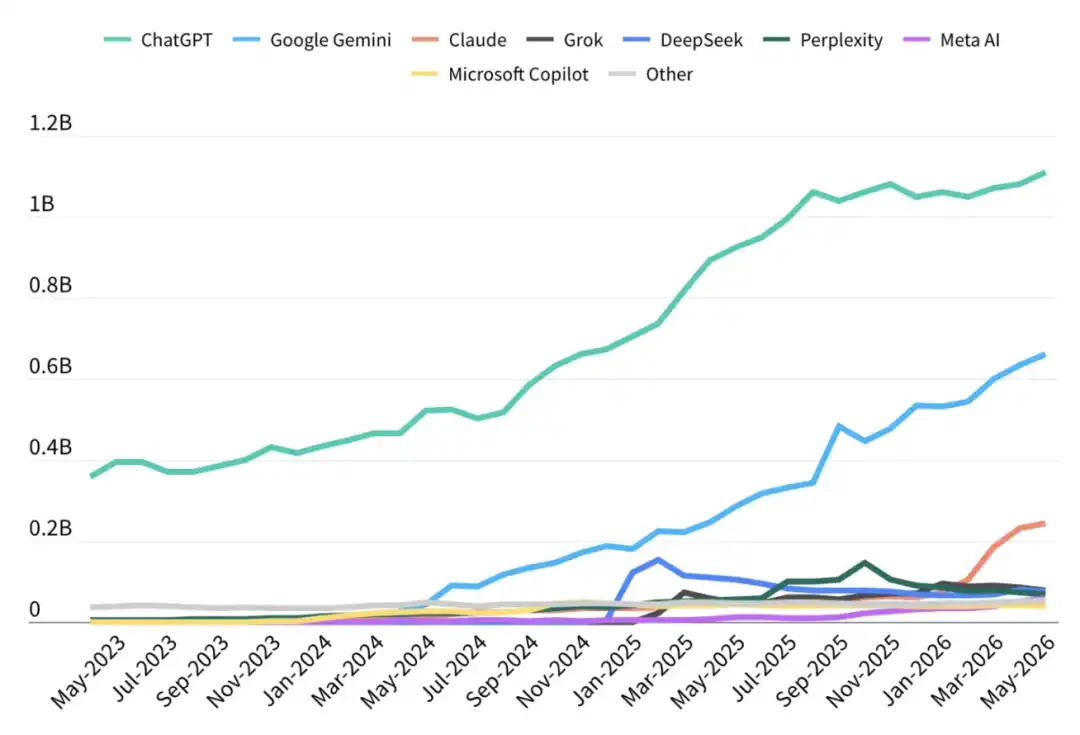
According to data analytics firm Sensor Tower's "State of AI 2026 Report," as of the end of May this year, ChatGPT's share of the global AI assistant market dropped to 46.4%. Before January this year, that figure was still above 50%. ChatGPT remains the world's largest AI assistant. But leading no longer equals monopolizing.

The AI assistant boom ignited by OpenAI has moved from awe, trial, and admiration into the stages of product comparison, ecosystem integration, paid conversion, and commercial realization.

Loyalty Is a False Proposition, Users Are All 'Heartbreakers'

In 2023, having a ChatGPT account still carried a certain identity of being an AI pioneer.

By 2026, AI assistants have increasingly become internet infrastructure, much like search, email, and office suites. The most noteworthy change in the Sensor Tower report is not just that ChatGPT still ranks first.

More importantly, users are becoming more willing to migrate. As long as another assistant is more convenient in a specific scenario, users will immediately allocate time to another product.

The main competitors pulling ChatGPT's share below 50% are Gemini and Claude.

As of the end of May, Gemini's global share reached 27.7%, and Claude reached 10.3%. Products like Grok, Perplexity, DeepSeek, and Meta AI each still hold less than 5%, but they are also constantly squeezing the remaining market.
Gemini's growth is easy to understand. It's backed by Google's complete ecosystem. Search, Gmail, Docs, Calendar, and Android are all natural entry points. When AI is embedded into tools users rely on daily, many average users have no need to specifically open another webpage to summon ChatGPT.

Especially after the release of Gemini 3.0, Google also achieved its first truly significant victory, officially securing a seat at the AI table and entering the mainstream user's view.

Claude's path is more like a victory for a productivity tool.

It lacks a distribution system like Google's, but has built a strong reputation in scenarios like writing, coding, long-text processing, and complex task collaboration. Sensor Tower states that Claude is approaching ChatGPT's user retention levels. For power users, AI assistants have shed their toy-like attributes and are genuinely beginning to impact work efficiency.
A more subtle change is that when users evaluate AI products, they no longer look solely at model capability. As AI assistants gradually take on more personalized interaction characteristics, users are also starting to discuss work, emotions, judgments, and decisions with them. Brand trust, value orientation, and institutional relationships can all become part of the user's choice.

A hint of public controversy can trigger a massive wave of uninstalls. OpenAI CEO Sam Altman has likely gained a deep understanding of this over the past year.

AI companies once believed that as long as the model was stronger, users would stay. The reality in 2026 is far more complex. Capability, ecosystem, price, use case, and brand trust are now collectively determining whether an assistant will be used consistently.

The Free Lunch Is Over, AI Apps Start Talking Money

Beyond market share, another set of data from the Sensor Tower report better illustrates the stage change in the industry: AI applications are still growing, but the growth logic has changed.

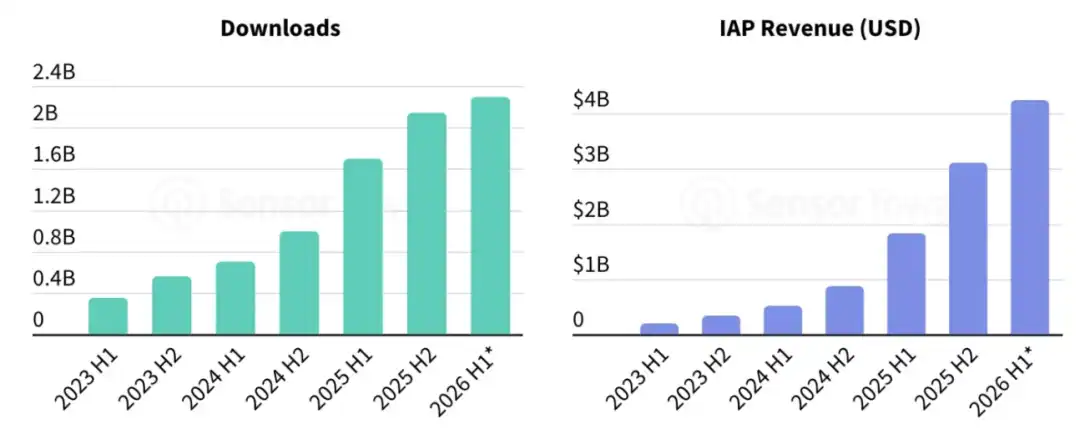
Sensor Tower estimates that in the first half of 2026, global AI app downloads will approach 2.3 billion, with in-app spending exceeding $4.2 billion. In comparison, AI app in-app spending was $1.83 billion in the first half of 2025.

Users are still downloading AI apps and are also willing to pay for AI.

However, the growth rates for both downloads and spending have slowed. Meanwhile, the industry has moved from a period of rapid expansion into a more realistic phase of competition.

Vendors can no longer just talk about user growth; they must also prove they can turn traffic into revenue. Regional differences are also emerging. Asia remains the market with the highest AI app downloads, but in Q1 2026, downloads declined for the first time by 3.3%, mainly affected by markets like India.
In contrast, North America and Europe are stronger in terms of in-app consumption. For AI companies, what truly determines the business model is often the ability to pay; install base only solves part of the problem. The trend in the US market is more pronounced. Users are starting to use AI assistants for productivity tasks and are more willing to pay for premium features.

Claude performs notably well here. Sensor Tower states that Anthropic has 13% of its users subscribing to a paid plan, a conversion rate ranking among the highest in the industry. This 13% subscription conversion rate explains why Claude can continue to expand its presence amidst competition from giants.

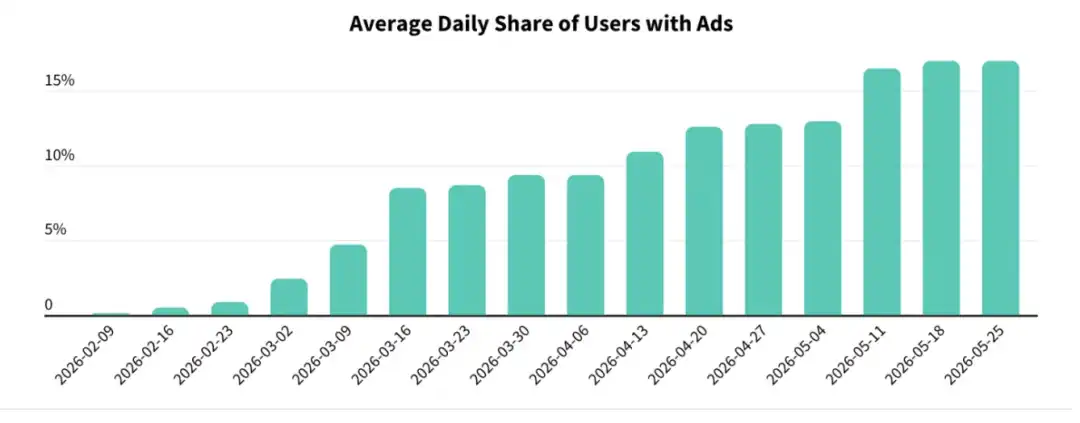
As long as AI can help users save time, complete code, organize documents, and handle complex tasks, monthly subscription fees ranging from twenty to even two hundred dollars are actually within an acceptable range. ChatGPT's commercialization path is more diverse and also more controversial. Sensor Tower states that OpenAI began testing ads in ChatGPT starting in February this year, gradually expanding the scale of ad displays and the proportion of users covered.

By May, an average of 17% of users were seeing ads daily. Software and shopping are currently the largest advertiser categories, followed by media & entertainment, and food & beverage.
From subscriptions to ads, ChatGPT is moving towards a more typical internet business model. Early users were familiar with a clean dialog box, an entry point imbued with the imagination of Artificial General Intelligence (AGI).

Unfortunately, even the smartest AI on this planet ultimately cannot escape the fate of becoming a shopping guide.

For OpenAI, ads and shopping have become necessary experiments to advance. Now, this entry point is also starting to carry ads, shopping guides, recommendations, and transaction conversions.

Model inference, training, and computing power expenses are extremely costly; relying solely on subscription revenue can hardly cover long-term investments. Advertising and shopping are becoming the next pieces of the puzzle for ChatGPT's commercialization.

As AI begins to penetrate core scenarios like shopping, office work, and search, the imagination of AI becoming a unified super-gateway is also encountering increasingly realistic platform boundaries. Sensor Tower estimates that in the first half of 2026, global AI app usage time will grow from 17.2 billion hours in the same period last year to approximately 36 billion hours.

Among them, the top three AI assistants account for 89% of the total usage time of AI assistant apps.

New players still have opportunities, but these opportunities exist more in fragmented scenarios, such as AI companions, AI content generation, and vertical industry tools. The main battlefield for general assistants is already mostly occupied by ChatGPT, Gemini, and Claude.

Stepping Down from the Altar, AI Goes Mainstream

ChatGPT's share decline occurs at a somewhat paradoxical time: OpenAI's revenue is still growing rapidly, its user base is still expanding, and its capital reserves far exceed those of most startups. According to a report by The Information, based on documents OpenAI disclosed to shareholders, OpenAI consumed $3.7 billion in cash in the first quarter, more than half of its $5.7 billion revenue.

Both cash burn and revenue tripled compared to the same period last year.

This is also a common challenge facing the current AI industry. Users and revenue continue to grow, yet massive capital investment is required to sustain model training, inference services, and infrastructure construction.
Furthermore, OpenAI expects cash burn could reach $25 billion in 2026, further rising to $57 billion in 2027. Even though OpenAI has confidentially submitted its IPO filing documents, the listing time may still be adjusted based on market conditions.

In other words, as one of the world's strongest AI brands, OpenAI still needs to answer a question: when models become increasingly expensive, competition grows fiercer, and users become more prone to migrate, how high can ChatGPT's business model's profit margin ultimately be.

Nevertheless, even as ChatGPT's share falls below 50%, it remains the world's largest AI assistant and is still the name most frequently mentioned when discussing AI. But this milestone is symbolic. The AI assistant market has moved beyond the era defined by a single product. In the past, ChatGPT was responsible for convincing the public that AI could change the internet.

Now, Gemini, Claude, Grok, DeepSeek, and various vertical AI assistants are collectively dividing up user time, usage scenarios, and commercial revenue.
User demands are also subtly changing.

By now, you likely no longer find satisfaction in just having AI write a poem or tell a silly joke. Instead, you start demanding it write code with fewer errors, process documents more accurately, collaborate in office work more conveniently, and offer more reasonable subscription prices, etc.

When a technology no longer elicits repeated amazement but instead begins to be criticized, compared, and replaced, it has truly started to enter mainstream life.

ChatGPT has lost half of its market dominance, but AI has truly begun to win over the world.

It's just that in this new world, there are no eternal kings, only us, forever ready to migrate for better tools.

Criptomoedas em alta

Perguntas relacionadas

QAccording to the article, what is the current global market share of ChatGPT and what has caused its decline?

AAccording to the article, as of May, ChatGPT's global market share has dropped to 46.4%. The decline is attributed to increased competition from other AI assistants like Gemini (27.7%) and Claude (10.3%). Users are now more willing to migrate to other products if they offer a better fit for specific scenarios, and factors like ecosystem integration, productivity features, brand trust, and price are becoming key decision points.

QWhat does the article suggest about user loyalty in the AI assistant market?

AThe article suggests that user loyalty is a 'false proposition' and that users are fickle ('渣男'). Users are willing to switch between AI assistants based on which product performs better in specific use cases, such as writing, coding, or integration with existing tools like Google's ecosystem.

QHow is the business model for AI applications evolving, according to the Sensor Tower report cited in the article?

AThe business model is shifting from focusing solely on user growth to monetization. The 'free lunch' is ending. Methods include subscription fees (e.g., Claude's 13% paid user conversion rate) and advertising (e.g., ChatGPT testing ads shown to 17% of daily users by May). The report notes that while downloads are still growing, the pace has slowed, and the ability to convert traffic into revenue is now critical.

QWhat financial challenge does OpenAI face despite its growth, as mentioned in the article?

ADespite rapid revenue growth, OpenAI faces the significant financial challenge of massive cash burn to sustain model training, inference services, and infrastructure. The article states that in Q1, OpenAI burned $3.7 billion in cash, over half of its $5.7 billion revenue. It is projected that cash burn could reach $25 billion in 2026 and $57 billion in 2027, raising questions about the long-term profitability of its business model.

QWhat does the symbolic decline of ChatGPT's market share below 50% represent for the AI industry?

AThe symbolic decline represents the end of a single product defining the AI assistant market. The industry has moved past the initial phase of awe and experimentation into a stage of practical comparison, ecosystem competition, and commercial diversification. While ChatGPT popularized AI, the market is now being shared by multiple players like Gemini, Claude, and others, indicating that AI technology is maturing and becoming integrated into everyday life.

Leituras Relacionadas

NVIDIA CPU Advances, China's RISC-V Responds: Semiconductor Deep Dive - Part Four

NVIDIA is set to launch its new Vera AI data center CPU in China as early as August, with high pricing. While this move offers a new option, it highlights China's continued dependence on foreign-controlled Arm architecture. In response, the Chinese semiconductor industry is increasingly turning to RISC-V as a strategic alternative for achieving high-performance computing autonomy. The article explores the concept of the "impossible triangle" in CPU development—balancing prosperity, control, and autonomy—and posits that RISC-V's open-source, modular nature offers a unique path to achieving all three. While RISC-V is already dominant in embedded systems, the focus is now shifting to data centers and AI workloads. China has become a global hotspot for RISC-V development, driven by AI-driven compute demand, supply chain concerns from export controls, cost benefits of open-source, and strong policy support. Multiple Chinese companies have reportedly crossed the key performance threshold of 15 SPECint per GHz, a benchmark for entering the high-performance CPU club. Progress extends beyond single-core benchmarks. Companies are developing complete computing subsystems, including commercial-grade coherent network-on-chip (NoC) technology and server processors with up to 40 cores that strictly adhere to the RVA23 standard to ensure software compatibility. Real-world applications are emerging in areas like video transcoding and edge AI. However, significant challenges remain. The RISC-V ecosystem faces fragmentation, immature toolchains and verification processes, and gaps in single-core performance and energy efficiency compared to mature x86 and Arm architectures. The formidable software moat, epitomized by NVIDIA's CUDA, is a long-term hurdle. In conclusion, while RISC-V cannot immediately replace offerings like NVIDIA's Vera, it represents a viable long-term path for China to develop a self-sufficient, high-performance CPU ecosystem. The journey is acknowledged to be long and arduous, requiring sustained effort to overcome technical and ecosystem challenges.

marsbitHá 28m

NVIDIA CPU Advances, China's RISC-V Responds: Semiconductor Deep Dive - Part Four

marsbitHá 28m

My Coding Betting Dashboard is Profiting, but Polymarket is Truly Not a Good Place for 'Arbitrage'

The author built a custom monitoring dashboard for Polymarket, a prediction market platform, and tested it with $1,600, achieving over 30% returns. However, the core argument is that Polymarket is not a good venue for traditional arbitrage. The dashboard has two main sections: a "Portfolio Dashboard" for tracking active positions with key metrics like total capital, P&L, and a risk-control module using a tier system (T1, T2, T3), and an "Opportunity Watchlist" for monitoring markets. The article details a critical structural trap in binary markets: a bet with a high perceived probability of success still carries a 100% loss risk if wrong. The author's T1/T2/T3 system is designed to manage this by limiting position sizes based on conviction and time horizon, emphasizing that high confidence should not equal high concentration. A key insight is the danger of "pseudo-diversification"—betting on different markets driven by the same underlying variable. The author concludes that Polymarket offers few true low-risk, arbitrage opportunities. It is instead a high-risk environment where wins can create a false sense of mastery, leading to large losses. The platform is better viewed as a training ground for honing judgment through disciplined, framework-driven betting rather than a reliable income source. The tools help transform intuition into structured, rule-based decisions to mitigate the risk of catastrophic errors.

marsbitHá 3h

My Coding Betting Dashboard is Profiting, but Polymarket is Truly Not a Good Place for 'Arbitrage'

marsbitHá 3h

WeChat AI Card Hands-On Guide: Has the AI Shopping Era Arrived?

**"WeChat AI Card" Practical Test Guide: Has the Era of AI Shopping Arrived?** WeChat has officially launched the "AI Exclusive Card," a feature integrated into its Workbuddy AI assistant. This card is designed to handle payments for AI-initiated purchases. Our hands-on test reveals it's not yet a tool for fully autonomous AI shopping, but rather a controlled payment layer for AI agents. The AI Card functions as an isolated sub-wallet within WeChat Pay. Users must bind the card and transfer funds into it from their main wallet. Crucially, every transaction requires explicit user confirmation via smartphone scan; AI cannot spend autonomously. Currently accessible through the Workbuddy agent, the card targets specific digital consumption scenarios: purchasing paid content (reports, data), calling paid APIs/tools, and subscribing to services. Its design prioritizes security and control by separating funds and mandating approval for each payment. We tested a real-world scenario: ordering bubble tea via Workbuddy using a "Meituan Life Assistant" skill. The process encountered multiple hurdles: high "skill" usage costs (exceeding daily free credits), and most importantly, while a payment was successfully initiated, the AI purchased an incorrect product (a mismatched group-buy coupon instead of the desired drink). This highlights the current limitation: the **AI Card only solves the payment step**. The broader challenge lies in the **AI agent's execution chain**—accurately understanding intent, navigating third-party platforms, selecting the right product, and ensuring proper fulfillment. The payment succeeded, but the purchase failed to meet the user's need. In conclusion, the WeChat AI Exclusive Card is a cautious, early-step experiment in AI commerce. It provides a secure, user-controlled payment method for agent interactions but is not yet capable of reliable, end-to-end complex purchases. For now, it's best used for low-value, low-risk digital services with careful user verification at each step. The vision of AI handling complete shopping tasks remains a work in progress.

marsbitHá 6h

WeChat AI Card Hands-On Guide: Has the AI Shopping Era Arrived?

marsbitHá 6h

Deconstructing Notion's Growth: From a Note-taking Tool to 100 Million Users—How Notion Built a Triple Growth Flywheel Through Product, Templates, and Community

Notion's growth from a niche note-taking tool to a platform with 100 million users is powered by three interconnected flywheels: Product-Led Growth (PLG), a Template Economy, and Community-Driven Growth. First, Notion's PLG strategy relies on a highly flexible, "plastic" product that users can adapt to countless personal and team workflows. Its freemium model lowers the barrier to entry, while features like page sharing and collaboration drive organic, usage-based viral growth as users naturally invite others. Second, the Template Economy solves the "blank page" problem. Templates, created by both Notion and its community, transform abstract product capabilities into concrete, copyable solutions for specific scenarios (e.g., project management, content calendars). This dramatically lowers activation costs for new users and fuels SEO-driven discovery. Third, a vibrant Community acts as a distributed growth engine. Users and official Ambassadors create tutorials, share use cases, and host local events. This community not only educates users but also fosters a sense of identity around pursuing "better ways of working," strengthening loyalty and enabling global, low-cost expansion. Together, these flywheels create a self-reinforcing ecosystem: a great product attracts users who create templates and community content, which in turn attracts more users and deepens engagement. This system allowed Notion to scale from individuals to teams and enterprises through a bottom-up adoption path. Looking ahead, AI integration promises to accelerate these flywheels further by making templates smarter and the platform a potential AI-native work operating system. Ultimately, Notion's defensible advantage is not just its features, but this deeply entrenched network of user assets, creators, and community trust.

marsbitHá 6h

Deconstructing Notion's Growth: From a Note-taking Tool to 100 Million Users—How Notion Built a Triple Growth Flywheel Through Product, Templates, and Community

marsbitHá 6h

Trading

Spot
Futuros

Artigos em Destaque

O que é DOGE M

Doge Matrix ($doge m): A Nova Raça de Criptomoeda Orientada pela Comunidade Introdução No panorama em constante evolução das criptomoedas, novos projetos surgem constantemente, cada um visando captar o interesse de investidores e entusiastas. Um dos mais recentes entrantes neste domínio é o Doge Matrix, representado pelo símbolo de ticker $doge m. Este projeto atraiu atenção graças às suas raízes na popular cultura de memes em torno do Dogecoin, estabelecendo o seu lugar dentro do espaço web3. Este artigo visa fornecer uma análise abrangente do Doge Matrix, cobrindo a sua visão geral, criador, investidores, funcionalidade, cronologia e aspetos notáveis. O que é o Doge Matrix ($doge m)? O Doge Matrix é um projeto de criptomoeda orientado pela comunidade que aparentemente se baseia no apelo generalizado do Dogecoin, uma moeda digital conhecida pelo seu mascote Shiba Inu e pelas suas origens em memes. Embora os objetivos gerais do Doge Matrix não estejam extensivamente definidos, caracteriza-se por um compromisso em aproveitar o envolvimento e o apoio da comunidade. Ao contrário das criptomoedas tradicionais que muitas vezes enfatizam a utilidade ou o valor intrínseco através de tecnologias subjacentes, o Doge Matrix posiciona-se dentro de um espaço que abraça o fenómeno cultural das criptomoedas, apelando particularmente àqueles que se identificam com a ética dos ativos baseados em memes. Aproveitando as forças da comunidade Dogecoin, o Doge Matrix opera como parte de um ecossistema mais amplo, convidando à participação e ao envolvimento de utilizadores que partilham um interesse pela criptomoeda e pelo espaço digital. Quem é o Criador do Doge Matrix ($doge m)? A identidade do criador do Doge Matrix permanece desconhecida. Esta falta de transparência não é uma ocorrência incomum no espaço das criptomoedas, onde alguns projetos são lançados sem revelar as identidades dos seus fundadores. A ausência de informação sobre a equipa fundadora pode levantar questões entre potenciais investidores sobre a responsabilidade e a direção do projeto. Quem são os Investidores do Doge Matrix ($doge m)? Atualmente, não há informações disponíveis publicamente que detalhem os investidores ou as fundações de investimento que apoiam o Doge Matrix. O projeto parece depender principalmente do apoio da comunidade em vez de investimento institucional. Este modelo alinha-se com a natureza orientada pela comunidade da iniciativa, promovendo um ambiente onde a direção do projeto é moldada pelos seus participantes em vez de ser ditada por um pequeno grupo de financiadores. Como Funciona o Doge Matrix ($doge m)? Os detalhes sobre os mecanismos operacionais do Doge Matrix são um tanto vagos, refletindo uma tendência mais ampla de projetos no espaço das moedas meme, onde funcionalidades inovadoras nem sempre são claramente articuladas. No entanto, o Doge Matrix parece ser projetado para aproveitar o ecossistema existente de criptomoedas, incentivando a participação dos utilizadores enquanto se liga às referências culturais familiares associadas ao Dogecoin. As suas características potencialmente únicas derivam das interações da comunidade em vez de avanços tecnológicos, enfatizando experiências partilhadas e colaboração entre os detentores de tokens. Embora as inovações exatas não tenham sido explicitamente delineadas, o projeto parece criar um espaço onde os membros da comunidade podem interagir, partilhar ideias e impulsionar o potencial do projeto para a frente. Cronologia do Doge Matrix ($doge m) Refletir sobre a cronologia do projeto revela eventos notáveis que definiram a sua jornada até agora: 25 de Novembro de 2024: O Doge Matrix alcançou o seu valor máximo histórico, marcando um marco significativo na sua história inicial. 1 de Janeiro de 2025: Por outro lado, o Doge Matrix atingiu o seu valor mínimo histórico, ilustrando a volatilidade frequentemente associada às criptomoedas, especialmente nas fases iniciais do ciclo de vida de um projeto. Em Curso: O projeto continua a ser ativamente negociado e apoiado pela sua comunidade, embora marcos ou objetivos futuros específicos ainda não tenham sido divulgados. Pontos Chave Sobre o Doge Matrix ($doge m) Foco na Comunidade No coração do Doge Matrix está um compromisso com o envolvimento da comunidade. O projeto prospera na premissa de colaboração e objetivos partilhados entre os seus membros, enfatizando a importância do esforço coletivo. Ao contrário de projetos centralizados que muitas vezes têm uma estrutura de liderança definida, o Doge Matrix apresenta atualmente uma abordagem mais fluida à governança, onde a voz de cada membro da comunidade importa. Volatilidade O mercado de criptomoedas é notório pela sua volatilidade, e o Doge Matrix não é exceção. A sua história de preços reflete flutuações significativas entre valores altos e baixos, o que é típico de muitas novas criptomoedas, mas sublinha os riscos associados ao investimento em tokens emergentes. Falta de Informação Detalhada Uma das características mais marcantes do Doge Matrix é a escassez de informação detalhada sobre os seus fundamentos tecnológicos e mecanismos operacionais. Esta ambiguidade exige que potenciais investidores realizem uma diligência prévia minuciosa antes de se envolverem com o projeto. Conclusão Em resumo, o Doge Matrix ($doge m) ilustra uma nova onda de projetos de criptomoeda que dependem fortemente do envolvimento da comunidade e da relevância cultural. Embora falte em certos pormenores—como liderança clara, objetivos definidos e funcionalidade detalhada—o projeto conseguiu gerar interesse dentro da comunidade cripto, aproveitando o apelo estabelecido da cultura de memes. Como em qualquer investimento no espaço das criptomoedas, compreender os riscos inerentes e realizar uma pesquisa abrangente é essencial para potenciais participantes. O Doge Matrix serve como um lembrete da natureza dinâmica, por vezes imprevisível, da indústria cripto, marcada por uma evolução constante e entusiasmo por iniciativas orientadas pela comunidade.

479 Visualizações TotaisPublicado em {updateTime}Atualizado em 2025.02.03

O que é DOGE M

O que é $M

Compreender o Mantis ($M): Uma Nova Era na Interoperabilidade entre Cadeias No panorama em constante evolução do Web3 e das criptomoedas, novos projetos esforçam-se por oferecer soluções inovadoras destinadas a melhorar a experiência do utilizador e expandir as possibilidades funcionais dentro do ecossistema financeiro descentralizado. Um desses projetos que está a ganhar atenção é o Mantis ($M), um protocolo pioneiro fundado nos princípios da interoperabilidade entre cadeias e liquidações baseadas em intenções. Este artigo explora os aspetos essenciais do Mantis, incluindo a sua funcionalidade central, criadores, apoio ao investimento, características inovadoras e marcos críticos. O que é o Mantis ($M)? O Mantis é descrito como um protocolo de liquidação de intenções multi-domínio que simplifica as interações entre cadeias, permitindo que os utilizadores executem transações financeiras complexas em várias plataformas de blockchain de forma contínua. O protocolo opera através de três camadas principais: Expressão de Intenção: Os utilizadores podem articular os seus objetivos de transação utilizando linguagem natural facilitada pelo DISE LLM, um modelo avançado de linguagem de IA. Por exemplo, um utilizador pode expressar o desejo de trocar Ethereum (ETH) por Solana (SOL) com uma tolerância de slippage específica de 1%. Execução: Esta camada utiliza uma rede de solucionadores que competem para satisfazer as intenções dos utilizadores. As transações são executadas utilizando mecanismos como Coincidência de Vontades (CoWs) e Leilões de Fluxo de Ordens (OFAs), que garantem que as exigências dos utilizadores sejam atendidas de forma otimizada. Liquidação: Aproveitando o protocolo de Comunicação Inter-Blockchain (IBC), o Mantis permite transações atómicas entre cadeias, permitindo que os utilizadores operem em várias cadeias suportadas, incluindo Ethereum, Solana e Cosmos. O Mantis é projetado para introduzir geração de rendimento nativa para ativos inativos, utilizando provas criptográficas para manter a integridade das transações ao longo de todo o processo. Criadores e Equipa de Desenvolvimento O Mantis foi concebido pela Composable Foundation, uma organização orientada para a pesquisa notável pela sua ênfase em soluções de interoperabilidade de blockchain. Esta fundação colabora com instituições académicas de prestígio, incluindo a Universidade de Harvard e a Universidade de Lisboa, contribuindo para extensos esforços de pesquisa e desenvolvimento que informam a arquitetura e funcionalidade do Mantis. O compromisso da Composable Foundation em fomentar a inovação no espaço da blockchain posiciona o Mantis como uma solução robusta para a crescente demanda por interoperabilidade entre várias redes de blockchain. Investidores e Apoio Embora detalhes específicos sobre investidores individuais não tenham sido divulgados publicamente, o Mantis conta com um apoio substancial de várias entidades, incluindo: Subsídios de ecossistemas de cadeias habilitadas para IBC, que apoiam o crescimento e integração do protocolo dentro dos ecossistemas de finanças descentralizadas. Parcerias estratégicas com fornecedores de infraestrutura que melhoram as capacidades de rede do Mantis e as estratégias de implementação. Financiamento através do tesouro da Composable Foundation, garantindo apoio financeiro sustentado para o desenvolvimento contínuo e custos operacionais. Esses esforços colaborativos refletem um consenso entre as partes interessadas sobre a importância de melhorar a funcionalidade entre cadeias e o potencial utilitário das inovações infraestruturais do Mantis. Inovações Chave O Mantis distingue-se através de várias inovações pioneiras que melhoram a sua funcionalidade e utilidade: Intenções Agnósticas em Relação à Cadeia: Os utilizadores podem iniciar transações a partir de qualquer cadeia suportada enquanto liquidam em outra. Esta flexibilidade empodera os utilizadores, promovendo uma maior interação entre diferentes plataformas. Interface Potenciada por IA: A integração do DISE LLM permite que os utilizadores realizem operações DeFi complexas utilizando linguagem natural, simplificando assim as interações e tornando a tecnologia blockchain acessível a um público mais amplo. Captura de MEV Inter-Domínio: O Mantis cria um mercado interno para valor máximo extraível (MEV) através de competições entre solucionadores. Esta abordagem inovadora permite uma maior eficiência e extração de valor em transações complexas. Camada de Liquidação Modular: O protocolo suporta vários métodos de verificação, incluindo provas de conhecimento nulo e rollups otimistas, proporcionando uma estrutura versátil que pode adaptar-se a tecnologias de blockchain emergentes. Cronologia Histórica O desenvolvimento do Mantis é marcado por vários marcos críticos que traçam a sua trajetória e crescimento: | Ano | Marco | |————|————————————————————————| | 2022 | Desenvolvimento do conceito inicial dentro da divisão de pesquisa da Composable Foundation. | | Q3 2024 | Lançamento da testnet com capacidades de ponte entre Solana e Ethereum. | | Q1 2025 | Evento de Geração de Token (TGE) antecipado juntamente com o lançamento da mainnet. | | Q2 2025 | Integração esperada do DISE LLM e expansão das capacidades entre cadeias. | | 2025 H2 | Apoio planeado para mais de 15 cadeias através de mais atualizações do IBC. | Esta cronologia delineia a evolução do Mantis, desde discussões conceituais até à implementação ativa e fases de crescimento futuro. Estratégia de Crescimento do Ecossistema A estratégia do Mantis para o crescimento do ecossistema inclui várias iniciativas destinadas a incentivar a participação dos utilizadores e o envolvimento dos desenvolvedores: Sistema de Créditos: Os utilizadores podem ganhar créditos do protocolo ao fornecer liquidez e participar em programas de referência. Esses créditos são resgatáveis por incentivos no futuro, promovendo uma comunidade de utilizadores robusta. Kit de Desenvolvimento de Software Modular (SDK): Este kit de ferramentas capacita os desenvolvedores a criar aplicações baseadas em modelos orientados por intenções utilizando a infraestrutura do Mantis, promovendo assim a inovação dentro do seu ecossistema. Modelo de Governança: À medida que o protocolo amadurece, os detentores de tokens $M terão voz na governança do protocolo, permitindo-lhes votar em atualizações e alterações propostas, aumentando assim o envolvimento da comunidade e a descentralização. O Mantis representa um avanço significativo no domínio da arquitetura entre cadeias. Ao integrar de forma contínua algoritmos avançados de IA com uma estrutura de liquidação robusta, o Mantis procura abordar os problemas de fragmentação dentro de ecossistemas multi-cadeia. A sua abordagem inovadora prioriza a melhoria das experiências dos utilizadores, enquanto adere aos princípios fundamentais de descentralização e segurança, estabelecendo um novo padrão para a futura interoperabilidade das tecnologias blockchain. À medida que o Mantis continua a sua jornada de crescimento e implementação, promete ser um projeto a observar de perto no competitivo panorama do Web3 e das finanças descentralizadas. Com o seu foco em ultrapassar fronteiras e elevar o envolvimento dos utilizadores, o Mantis está posicionado para ser uma parte integral dos desenvolvimentos futuros no espaço das criptomoedas.

79 Visualizações TotaisPublicado em {updateTime}Atualizado em 2025.03.18

O que é $M

Como comprar M

Bem-vindo à HTX.com!Tornámos a compra de MemeCore (M) simples e conveniente.Segue o nosso guia passo a passo para iniciar a tua jornada no mundo das criptos.Passo 1: cria a tua conta HTXUtiliza o teu e-mail ou número de telefone para te inscreveres numa conta gratuita na HTX.Desfruta de um processo de inscrição sem complicações e desbloqueia todas as funcionalidades.Obter a minha contaPasso 2: vai para Comprar Cripto e escolhe o teu método de pagamentoCartão de crédito/débito: usa o teu visa ou mastercard para comprar MemeCore (M) instantaneamente.Saldo: usa os fundos da tua conta HTX para transacionar sem problemas.Terceiros: adicionamos métodos de pagamento populares, como Google Pay e Apple Pay, para aumentar a conveniência.P2P: transaciona diretamente com outros utilizadores na HTX.Mercado de balcão (OTC): oferecemos serviços personalizados e taxas de câmbio competitivas para os traders.Passo 3: armazena teu MemeCore (M)Depois de comprar o teu MemeCore (M), armazena-o na tua conta HTX.Alternativamente, podes enviá-lo para outro lugar através de transferência blockchain ou usá-lo para transacionar outras criptomoedas.Passo 4: transaciona MemeCore (M)Transaciona facilmente MemeCore (M) no mercado à vista da HTX.Acede simplesmente à tua conta, seleciona o teu par de trading, executa as tuas transações e monitoriza em tempo real.Oferecemos uma experiência de fácil utilização tanto para principiantes como para traders experientes.

604 Visualizações TotaisPublicado em {updateTime}Atualizado em 2026.06.02

Como comprar M

Discussões

Bem-vindo à Comunidade HTX. Aqui, pode manter-se informado sobre os mais recentes desenvolvimentos da plataforma e obter acesso a análises profissionais de mercado. As opiniões dos utilizadores sobre o preço de M (M) são apresentadas abaixo.

活动图片