Stratosphere, Pudgy Penguins and Streamex Host Founders Table VIP Dinner During ETHConf 2026 and NYC Tech Week

TheNewsCryptoPublicado em 2026-06-18Última atualização em 2026-06-18

Resumo

During ETHConf 2026 and NYC Tech Week, Stratosphere, Pudgy Penguins, and Streamex co-hosted an exclusive Founders Table VIP Dinner in New York City. The June 9th event assembled a select group of founders, C-level executives, investors, and institutional leaders from firms such as Citi, BitGo, Delphi Digital, and Pyth Network for private, agenda-free networking. The dinner aimed to foster natural conversations among key figures across digital assets, tech, AI, and traditional finance. Stratosphere contributed its extensive network, Pudgy Penguins added its strong consumer brand community, and Streamex provided expertise in tokenized commodities and institutional markets. Stratosphere CEO Hassan Shaikh highlighted the importance of such gatherings for discussing market trends, particularly commodity tokenization. The Founders Table series, which runs alongside major industry conferences, is designed to build high-quality, relationship-driven connections that are difficult to achieve on standard conference floors. Stratosphere positions itself as an ecosystem growth partner for leading tech and finance brands.

New York, United States, June 18th, 2026, Chainwire

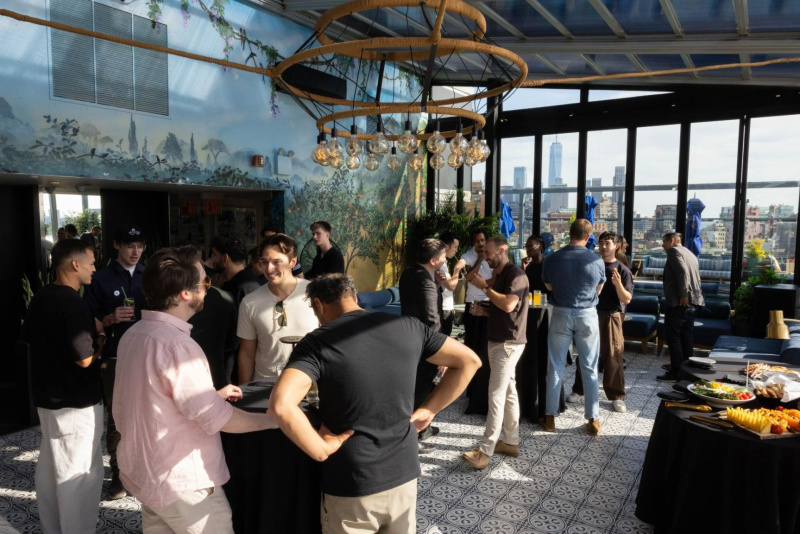
Stratosphere, Pudgy Penguins and Streamex hosted a private Founders Table VIP Dinner in New York City during ETHConf 2026 and NYC Tech Week, bringing together leaders across digital assets, tech, AI, traditional finance and institutional capital.

The invite-only dinner took place on June 9th and gathered a curated room of founders, operators, funds, C-level executives and institutional leaders for an intimate evening of dinner and conversation.

Guests in attendance included leaders from Citi, BitMine, BitGo, Mirae Asset Securities USA, Experian, Pyth Network, Space and Time, MegaETH, B3, Stable, Antler, Delphi Digital, Fun, Linera, Vanta Trading, Streamex, PolyData, Horizen Labs, World Foundation, Zipcode, OpenLedger, Onyx, Definitive, Notalone Ventures and more.

The Founders Table format is intentionally simple: a selected guest list, a private room and no stage agenda. The goal is to bring the right people together in a setting where conversations can happen naturally.

The dinner was hosted by Stratosphere with Pudgy Penguins and Streamex. Stratosphere brought its network across founders, operators, investors and institutional teams. Pudgy Penguins added one of the strongest consumer brands and communities in digital assets. Streamex brought the institutional and real-world asset side of the conversation, with its focus on tokenized gold and commodity markets.

The Stratosphere team and its CEO, Hassan Shaikh, have continued to build Founders Table into a private dinner series around major industry conferences. After previous editions during Digital Asset Summit and Consensus, the New York dinner continued the same idea: high-quality rooms, selected attendance and conversations that are hard to recreate on a conference floor.

For Stratosphere, the dinner reinforces the company’s position as an ecosystem partner for leading brands across tech, finance and digital assets. Established projects work with Stratosphere to deepen cultural relevance, strengthen market narratives and connect with founders, investors, institutions and operators across the industry.

“I’m optimistic about the next phase of digital assets, especially around the tokenization of commodities,” said Hassan Shaikh, CEO of Stratosphere. “These dinners give us a way to bring funds, institutions, and founders into the same room to talk about where the market is heading.”

The Founders Table series is expected to continue around major global conferences throughout the year, with future editions focused on bringing together founders, capital, institutions and leading brands in private, relationship-driven rooms.

For those interested in attending or getting involved in future Founders Table editions, reach out to the Stratosphere team.

About Stratosphere

Stratosphere is an ecosystem partner and growth consultancy for industry leaders in tech and finance, building the narratives, ecosystem partnerships, and distribution flywheels that create sustainable, repeatable growth.

Website: www.stratosphere.vip

X: @StratosphereVIP

Contact

Yaroslav Provada
max@movimentum.io

Perguntas relacionadas

QWhat was the purpose of the Founders Table VIP Dinner hosted by Stratosphere, Pudgy Penguins, and Streamex?

AThe purpose was to bring together leaders across digital assets, tech, AI, traditional finance, and institutional capital for an intimate evening of dinner and conversation, facilitating natural discussions in a private setting without a stage agenda.

QWho were some of the notable companies and organizations whose leaders attended the dinner?

AGuests included leaders from Citi, BitMine, BitGo, Mirae Asset Securities USA, Experian, Pyth Network, Space and Time, MegaETH, Delphi Digital, Horizen Labs, and more.

QAccording to Stratosphere CEO Hassan Shaikh, what is one area of digital assets he is optimistic about?

AHassan Shaikh is optimistic about the next phase of digital assets, especially around the tokenization of commodities.

QHow does the Founders Table dinner series benefit the projects that work with Stratosphere?

AIt helps established projects deepen cultural relevance, strengthen market narratives, and connect with founders, investors, institutions, and operators across the tech, finance, and digital assets industry.

QWhere can someone interested in future Founders Table events get more information?

AThey should reach out to the Stratosphere team via their website (www.stratosphere.vip) or their X account (@StratosphereVIP).

Leituras Relacionadas

Coin-Equity Barometer | Strategy Sells 1,638 BTC for $105 Million; Michael Saylor Reiterates He Has Not Sold Any Bitcoin, Strategy's Trading Activity Unrelated to Personal Holdings (August 4th)

**Summary: Cryptocurrency & Stock Market Update (August 4th)** Global stock markets remain under pressure, with Korean markets facing liquidity outflows and US tech stocks showing mixed results during earnings season. Major US cloud providers (Microsoft, Amazon, Google) saw gains, reinforcing their pivotal role amid computing, energy, and storage demands. In crypto-related stocks, Coinbase and Strategy traded lower post-earnings, while Robinhood demonstrated strong long-term potential despite short-term declines. Key BTC Treasury Corporate Activity: * Global publicly listed companies (excluding miners) were net sellers of Bitcoin, with a weekly net outflow reaching $101 million. * **Strategy** sold 1,638 BTC for approximately $105 million, reducing its holdings to 842,138 BTC. Concurrently, it repurchased $81.2 million of its preferred stock. * Michael Saylor clarified he has **never sold any of his personal Bitcoin holdings**, stressing that Strategy's corporate treasury management is separate from his personal long-term investment philosophy. * Several other companies, including Strive, OrangeBTC, and Capital B, reported new Bitcoin purchases last week. * Hyperscale Data sold 100 BTC to establish a Bitcoin-backed credit facility for AI infrastructure funding. ETH Treasury Corporate Activity: * **Bitmine** significantly increased its Ethereum position, adding 10,399 ETH last week for a total holding of ~5.79 million ETH. * The company continues active staking, recently staking 28.8k ETH via Coinbase Prime and an additional 150.1k ETH directly, with roughly 87% of its total ETH now staked. Other Developments: * Nasdaq-listed **Solmate** partnered with Kraken Institutional for SOL staking and validator infrastructure support. * The total BTC held by tracked public companies (excluding miners) stands at 1,138,643 BTC, valued at ~$72.42 billion (5.7% of circulating supply). *(Note: Content is for informational purposes only and not investment advice.)*

marsbitMesmo agora

Coin-Equity Barometer | Strategy Sells 1,638 BTC for $105 Million; Michael Saylor Reiterates He Has Not Sold Any Bitcoin, Strategy's Trading Activity Unrelated to Personal Holdings (August 4th)

marsbitMesmo agora

Analog Chips Are Picking Up

The analog chip market is showing signs of recovery, as evidenced by strong Q2 2026 earnings and guidance from major players like TI, STMicroelectronics, NXP, and onsemi. Revenue growth, improved order backlogs, and declining inventory levels across the supply chain indicate the start of a new upward cycle. Industrial markets led the recovery, followed by data centers and a notable pickup in automotive demand in Q2. The rebound is broad-based but uneven, with specific product areas like automotive analog, power management, and AI server power chains seeing tighter supply and pricing power, while consumer-focused and general-purpose segments remain competitive. A critical turning point is the normalization of inventory. After a prolonged multi-level destocking phase from OEMs to end customers, channel inventories have returned to healthy levels (e.g., NXP at 11 weeks). This has triggered restocking, particularly in automotive, and is now being supplemented by genuine end-demand from new system designs. AI is emerging as a key growth driver, creating new demand in two areas: 1) high-power data center infrastructure (power conversion, thermal management, signal integrity for GPUs, and optical modules) and 2) "Physical AI" in automotive, robotics, and industrial equipment (sensors, motor drivers, power management). This provides a growth vector less dependent on traditional consumer cycles. While some price increase notices have been issued, the revenue impact in Q3 is expected to be minimal, with volume driving growth. The recovery's sustainability will depend on the strength of underlying end-demand now taking over from inventory replenishment.

marsbitHá 5m

Analog Chips Are Picking Up

marsbitHá 5m

From 'Speculative Asset' to 'Next-Generation Financial Backbone': Is Crypto Evolving into a New TradFi World?

From "Speculative Asset" to "Next-Generation Financial Infrastructure": Is Crypto Evolving a New TradFi World? The crypto industry has long been dominated by the question: "What's the next asset to rise?" However, since 2026, a confluence of developments across different sectors suggests a fundamental shift. Crypto's capabilities in issuance, custody, trading, payment, and settlement are evolving beyond serving crypto assets themselves and are beginning to serve broader financial activities and the machine economy. A new layer of infrastructure is emerging beneath the speculative market. This transformation is driven by several key components reaching maturity and beginning to interconnect: 1. **Stablecoins as Programmable Money Interfaces:** Evolving from a tool for crypto trading, stablecoins are becoming a programmable form of money that applications can directly integrate and call like an API, facilitating global, 24/7 payments and settlements. 2. **RWA (Real-World Assets) as Programmable Objects:** Tokenization is moving beyond simple asset mapping. Initiatives like DTCC and Nasdaq are working to connect tokenized securities with real-world ownership, custody, and legal rights, allowing blockchain to host parts of traditional asset lifecycles. 3. **Prediction Markets for Price Discovery:** These markets aggregate dispersed information into real-time probability prices for future events, providing a price discovery layer that traditional finance often lacks. 4. **AI Agents as Economic Actors:** AI agents capable of autonomous decision-making are becoming new economic participants. Their need for frequent, low-value, automated payments is a natural fit for stablecoins and low-cost blockchains. Together, these elements form the early layers of a potential next-generation financial infrastructure: asset issuance/mapping, 24/7 payment/settlement, continuous trading/price discovery, and identity/permission management. The regulatory conversation is also shifting from whether crypto should exist to defining rules for its operation. However, the journey from a functional system to a reliable, widely-trusted infrastructure is long. Critical challenges remain, including establishing legal finality for on-chain actions, defining liability boundaries for AI agents, overcoming liquidity fragmentation, ensuring privacy for institutional use, and building the complex credit and risk management frameworks inherent to traditional finance. In summary, while speculation remains, crypto is undeniably building foundational capabilities beneath it. The most significant trend of 2026 is not a single breakout sector, but the convergence of previously independent pieces—programmable assets and money, continuous markets, autonomous software agents, and clearer regulation—into a more coherent system for real-world financial activity.

marsbitHá 10m

From 'Speculative Asset' to 'Next-Generation Financial Backbone': Is Crypto Evolving into a New TradFi World?

marsbitHá 10m

NEAR Co-Founder Proposes Creation of Protocol Sovereign Fund

NEAR co-founder Ilya Polosukhin has proposed creating a sovereign protocol fund to support ecosystem development through targeted funding. The fund aims to improve the project's sustainability, moving away from the current model where most L1 blockchains, including NEAR, pay for network security via token inflation, diluting non-staking holders. Inspired by sovereign wealth funds in countries like Singapore and Norway, the NEAR fund would use protocol revenue and treasury assets to generate yield, covering security costs and other public goods, ultimately aiming to lower inflation and potentially transition to a fixed token supply model. The initial phase would involve allocating around 30 million NEAR (approximately $50 million) to the fund. It would use protocol revenue to buy back NEAR and invest in yield-generating protocols. Profits would fund ecosystem initiatives like validator support and MPC provider payments. Unlike traditional sovereign funds holding fiat assets, this fund would primarily hold NEAR tokens, introducing additional risk that Polosukhin believes can be mitigated through diversified yield strategies. Token holders could participate in the fund's returns via the existing House of Stake delegation mechanism. The launch is planned to be gradual, with checkpoints to verify the model's effectiveness before allocating more capital. Polosukhin has opened the proposal for a two-week community discussion, emphasizing that final parameters will be determined by stakeholders, including validators and token holders.

cryptonews.ruHá 13m

NEAR Co-Founder Proposes Creation of Protocol Sovereign Fund

cryptonews.ruHá 13m

Trading

Spot
活动图片