China's No.1, Closing in on OpenAI, Mysterious "Sweeping Monk" Rises to Top Seven Globally

marsbitPublicado em 2026-06-30Última atualização em 2026-06-30

Resumo

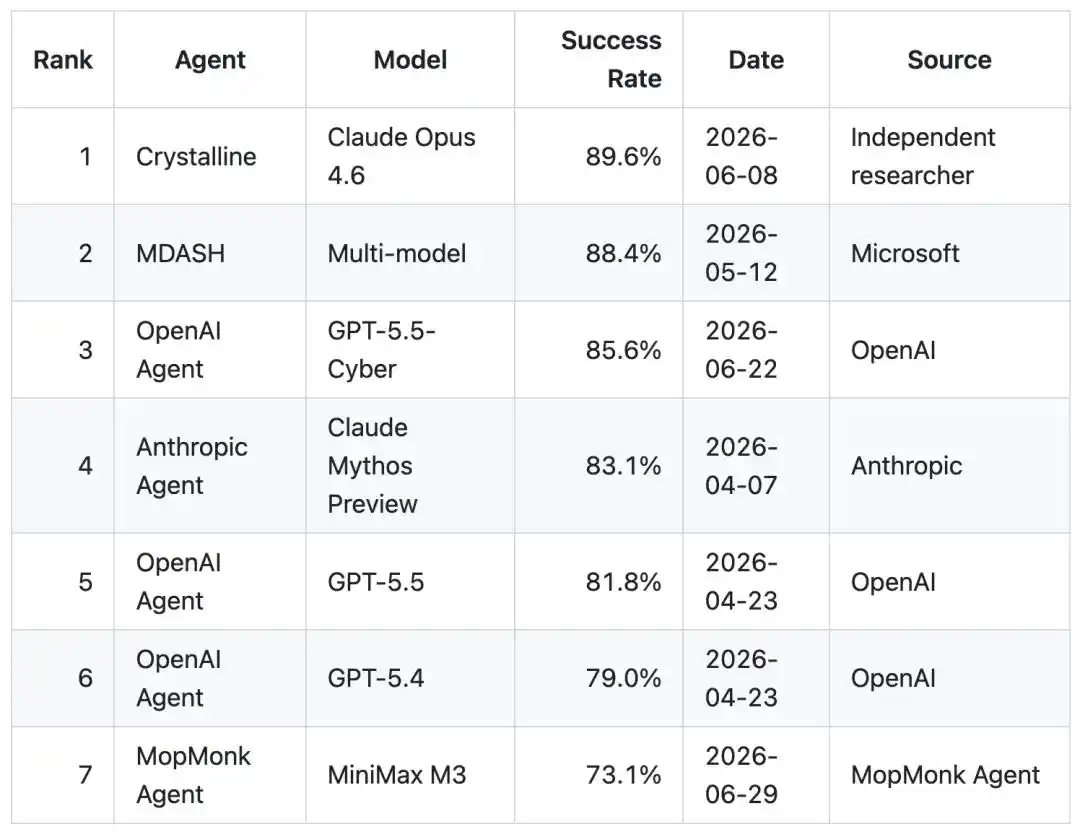
A mysterious Chinese AI project named "MopMonk" (meaning "Sweeping Monk") has achieved a top-ranking result on the globally recognized CyberGym cybersecurity benchmark. With a 73.1% success rate, it ranks seventh worldwide and first among Chinese entries, performing closely behind OpenAI. The significance lies in the benchmark itself. CyberGym, created by UC Berkeley, is considered a premier "Olympics" for AI security. It tests models on over 1500 real-world software vulnerabilities, requiring them to not just identify but actually generate working exploits (PoCs) in a complex, offline environment. This moves beyond simple knowledge to testing an AI's practical "execution" capabilities. MopMonk's approach is notable. It uses the open-source MiniMax M3 model from Shanghai as its powerful reasoning "brain," leveraging its strong coding skills and long context window. However, the key to its performance is a custom-built, multi-agent security framework—its "Harness." This system uses structured "vulnerability memory" to efficiently guide the search for exploits, allowing multiple agents to explore in parallel while sharing lessons learned from failures. This engineering layer effectively translates the model's intelligence into actionable, iterative testing steps. The project remains highly secretive, with no official website or team information, embodying the "dark horse" spirit of its literary namesake. Its success highlights a potential industry shift: beyond simply scalin...

It's insane! A mysterious Chinese AI "Sweeping Monk" without even an official website, stormed into the CyberGym global top seven with a 73.1% win rate, hot on OpenAI's heels. The whole internet is going crazy trying to figure out, whose master is this?

These past few days, on a leaderboard where global AI giants are fiercely competing, a name no one has ever heard of suddenly appeared.

It's called MopMonk (Sweeping Monk).

No grand launch event, no official blog post, no cheerleading on social media.

It just emerged out of thin air and charged straight into the CyberGym global top ten.

With a 73.1% success rate, it closely trailed OpenAI by a narrow margin, setting a new record for the highest historical score by a Chinese team on this leaderboard.
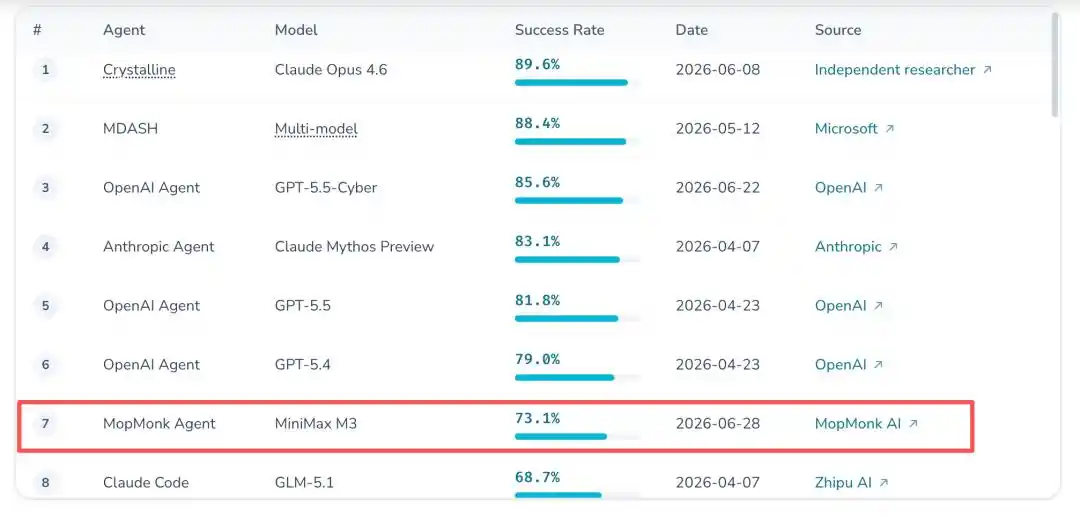
The most surreal part of the whole thing is that, to this day, no one knows its true identity.

Just how significant is the CyberGym leaderboard?

How explosive is MopMonk's achievement this time? Look at the arena it stepped onto.

CyberGym, meticulously crafted by a UC Berkeley team, had its core paper accepted at the ICLR 2026 top conference.
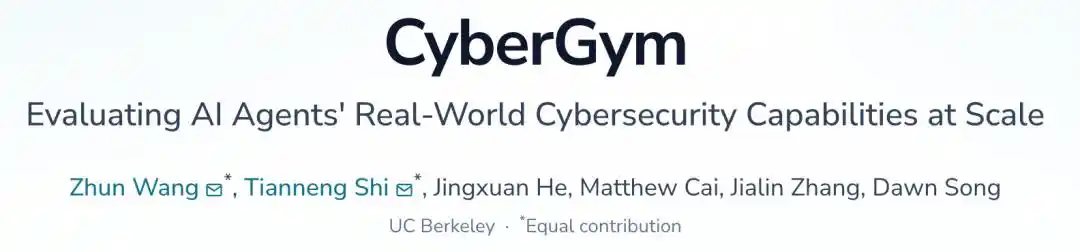
Portal: https://arxiv.org/pdf/2506.02548

As one of the most authoritative public benchmarks in AI cybersecurity capability assessment, this place is essentially a "battleground of the gods" for large models—

Even top-tier heavyweights like GPT-5.5-Cyber and Claude Mythos have been in close combat on this leaderboard.

The entire benchmark focuses on "live-fire exercises":

1507 vulnerability instances, 188 major open-source projects. All test questions are sourced from real historical vulnerabilities accumulated in Google's OSS-Fuzz.
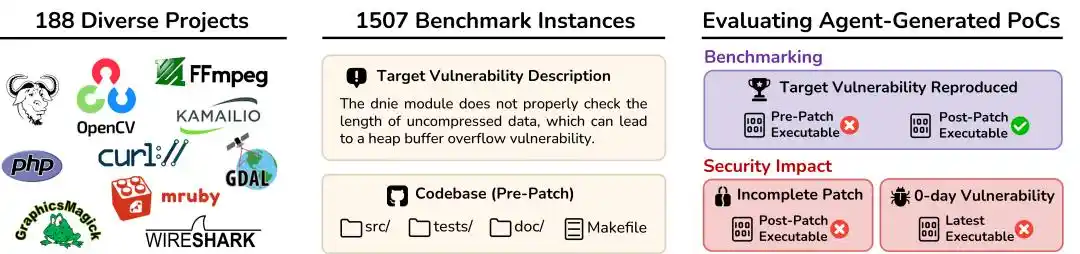
From an evaluation dimension perspective, this represents a breakthrough across scales.

Its scale is a full 7.5 times that of the previous largest public benchmark (NYU CTF, ~200 questions), and it leaves predecessors like CVE-Bench an order of magnitude behind.

Even more daunting is the difficulty. CyberGym doesn't offer multiple-choice questions.

It requires AI to perform deep reasoning within real-world projects involving thousands of files and millions of lines of code.

Precisely because it is large enough, real enough, and difficult enough, CyberGym has "differentiating power"—

It can slice out, bit by bit, the genuine capability gaps between different models and different Agent frameworks.

No wonder the security community directly crowned it the "Olympics of AI security."

This is also why almost all major global players are present: Microsoft, OpenAI, Anthropic, Google, Meta, Zhipu AI......
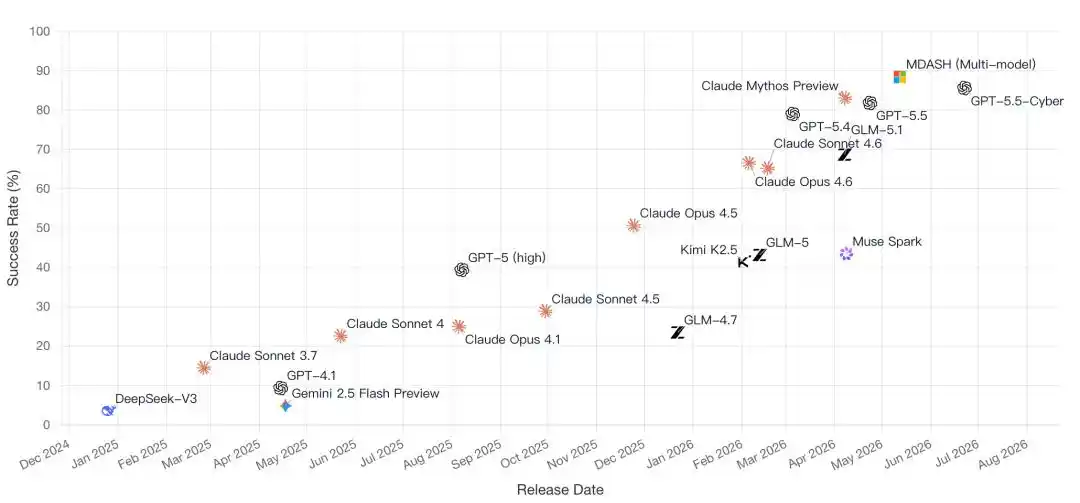
The CyberGym leaderboard itself is witnessing a crucial shift in AI competition:

From comparing who has more parameters, to comparing whose Agent can actually get the job done.

A mysterious Eastern codename suddenly appears among Silicon Valley AI giants

Who would have thought that on this very arena where "hard skills" speak the loudest, a "ghost player" would emerge as a dark horse?

Piercing through the fog, we currently only have three pieces of known information:

Mysterious Codename: MopMonk (Sweeping Monk)

Base Model: MiniMax M3

Leaderboard Record: Broke into CyberGym global top seven, China's number one

Normally, a team achieving such results should have already flooded the scene with technical reports and press conferences.

Yet, on this leaderboard teeming with masters, MopMonk is precisely that ultimate "outsider": It only tossed out a technical report, with its team, company, and location remaining complete unknowns.

This collision of "top-tier capability, information nakedness" itself is filled with a dramatic flair reminiscent of Eastern martial arts novels.

Those familiar with Jin Yong understand the weight carried by the three characters "Sweeping Monk" in "Demi-Gods and Semi-Devils"—

That old monk who swept floors for decades in the Shaolin Library, whose name no one remembered, yet with one move subdued the two great masters, Xiao Yuanshan and Murong Bo.

The most inconspicuous character, harboring the deepest skills.

Daring to challenge the arena under the banner of "Sweeping Monk," this team clearly has extremely cold confidence in its own strength!

A more crucial clue is hidden in its technical foundation—the base chosen by MopMonk is MiniMax M3.

As an open-source base originating from Shanghai, M3 can be called an all-round warrior, directly integrating three core capabilities: cutting-edge programming ability, a 1M ultra-long context window, and native multimodality.

On one side, an "Eastern cultural symbol" full of flavor; on the other, a technological base bearing a purely domestic label.

Placing these two clues on the table narrows the circle considerably. All the traces are frantically hinting at the same conclusion:

This is most likely a Chinese team.

The Deciding Factor Lies in the Harness

Putting aside the identity mystery, as those who have been long tracking AI technology, we want to figure out one question even more:

Why did MopMonk win?

To answer this, we must first return to CyberGym's hardest core—it doesn't test "whether you know," but "whether you can do."

Judging whether a piece of code has a vulnerability isn't too difficult for today's large models.

But CyberGym tests the next step, the deadliest step: generating an input that can trigger the vulnerability, i.e., a PoC.

It must trigger on the "vulnerable version," fail on the "patched version," and pass the execution verification in the benchmark environment.

This hurdle is far more tricky than imagined.

The trigger conditions for a vulnerability are often scattered among code paths, parsing logic, build environments, test harnesses, and input formats, requiring piece-by-piece assembly.

Even more troublesome, even if the PoC crashes the program locally, it might not count. As long as it doesn't satisfy the differential judgment of "triggers on vulnerable version, does not trigger on patched version," it's all wasted effort.
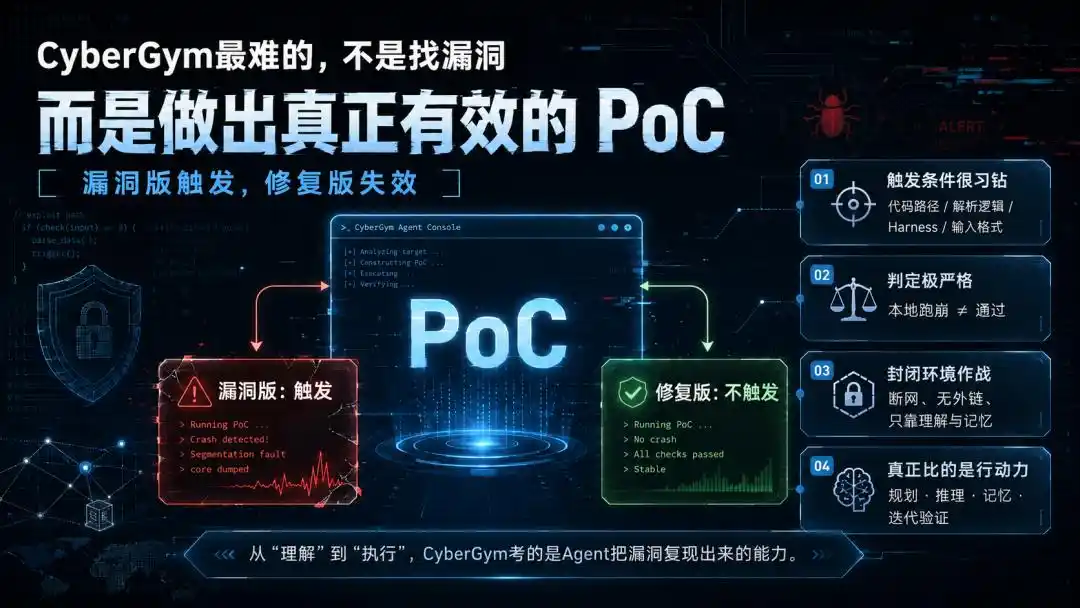
This step pulls the task completely from "understanding" into "execution." And a very specific kind of execution—

The entire exam takes place in a closed, offline environment.

No external search for help, no "outside resources" whatsoever. The AI can rely only on its understanding of the codebase before it and the memories it has accumulated step by step.

To "reproduce" a vulnerability under such conditions depends on a whole set of interlocking abilities:

Tool-calling planning: When to read files, when to run tests, when to go back and revise the plan;

Multi-round reasoning: The last attempt didn't trigger, what exactly was the problem, how to adjust next time;

Memory management: Structurally storing read code, tried inputs, and encountered pitfalls, rather than rereading everything from scratch each round;

Iterative verification: Repeatedly approaching that critical point until the vulnerability is truly reproduced.

In other words, the core of CyberGym competition is the Agent's "execution capability"; the model's "intelligence" is just the entry ticket.

And the key link that transforms "smartness" into "execution capability" is today's most underestimated term in the entire Agent field—Harness.

Harness is the "coordination layer" between the model and external tools, the execution environment.

It is responsible for tool orchestration, context state management, collection and re-feeding of execution feedback.
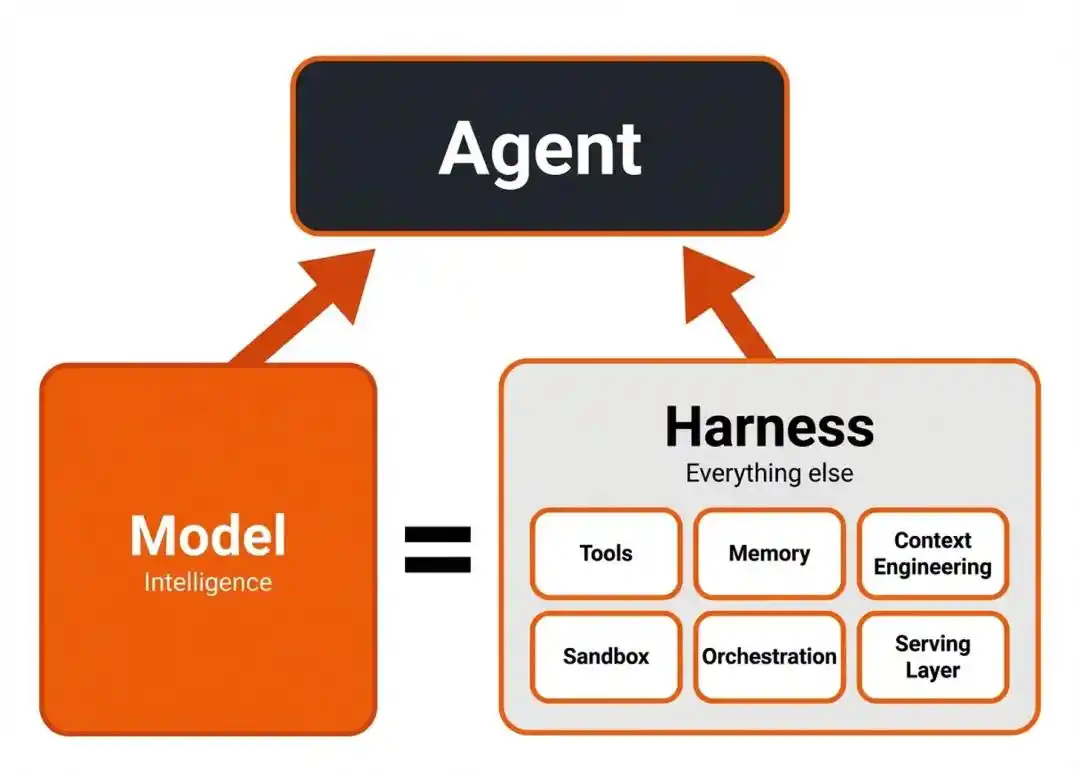
Simply put, the model is the brain, responsible for thinking "where the vulnerability might be, how to dig next."

The Harness is the limbs plus nervous system, responsible for turning the brain's thoughts into a series of real actions—

Which file to open, which command to run, how to adjust after getting an error, how to change the approach after a failed round.

On tasks like CyberGym, which require running dozens or hundreds of rounds and repeatedly trial-and-error within millions of lines of code, the quality of the Harness directly determines how much of the model's intelligence can be converted into combat effectiveness.

A smart model + a mediocre Harness often results in "can think of it, but can't do it";

A capable model + a strong Harness tailored for vulnerability mining is what can potentially achieve results in such long-range tasks.

An Agent "Tailor-Made" for Vulnerability Mining

Now, through the GitHub technical report, MopMonk's technical outline has become clear:

A security multi-Agent system newly designed specifically for vulnerability mining, powered by the thinking base MiniMax M3.
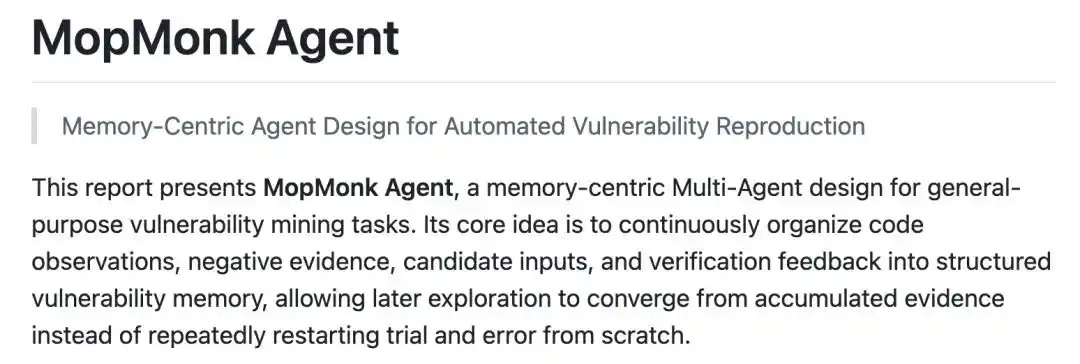
GitHub Address: https://github.com/MopMonkAI/MopMonkAgent

As mentioned, M3 is a rare open-source model today that integrates top-tier coding capability, a million-token context window, and native multimodality within a single architecture.

A glance at its benchmarks makes it clear: SWE-Bench Pro achieved 59.0%, Terminal-Bench 2.1 reached 66.0%, MCP Atlas scored 74.2%—
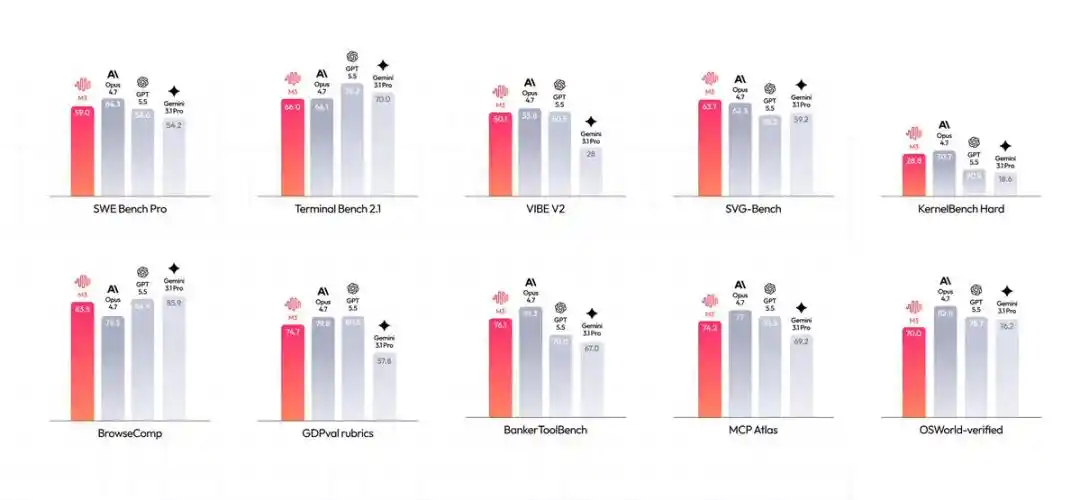
These impressive numbers precisely meet the most hardcore capability needs for Agent deployment in real-world scenarios.

Not only that, it can also autonomously iterate and self-correct over tasks lasting more than ten hours.

In other words, M3 plays the role of a "super brain" combining top-tier code parsing ability, ultra-long memory, and proficient tool-calling skills.

For tasks like CyberGym that often require swallowing an entire codebase and running dozens of rounds, a 1M context window is almost a necessity.

What MopMonk's security Agent framework does is amplify M3's brainpower into execution capability for vulnerability mining.

Its "core techniques," as seen from the technical details publicly available on GitHub, revolve around three key moves—

First move, structured "Vulnerability Memory."

It's not simply stacking chat history, nor is it dumping the ultra-long context wholesale into the model. Instead, it organizes a continuously updatable "Task Fact Memory" around the most critical types of objects in vulnerability mining:

Vulnerability target, code paths, input formats, candidate PoCs, failure evidence, verification status, and "Next Step Constraint" memory.

The last category especially shows skill: It doesn't generate vague abstract plans but directly extracts hard constraints that the next experiment must satisfy from the current evidence.

For example, "This time must cover that branch," "Which field to adjust," "Which type of failure cause to exclude."

This memory design transforms vulnerability mining from "repeated trial-and-error from scratch" into "an evidence-based convergence process."

Each code read, each execution result, each failed submission is converted into reusable constraints for the next PoC generation.
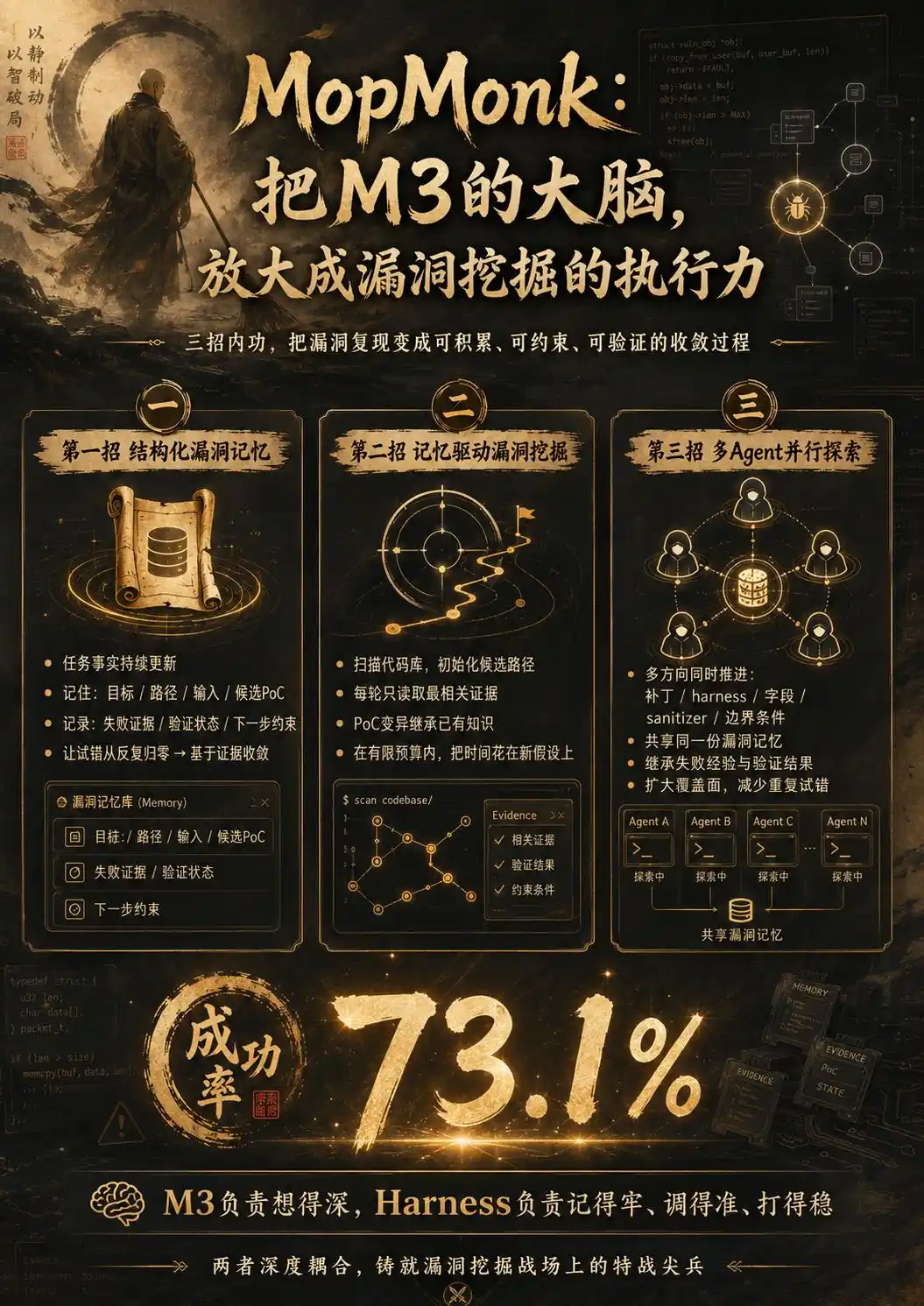
Second move, Memory-driven "Vulnerability Mining."

In vulnerability mining tasks, the system first initializes the vulnerability memory by scanning the codebase and using candidate trigger paths and directory information as planning starting points.

Then, it advances step by step, attempting to converge on the specific code location that triggers the crash.

Afterward, each exploration attempt reads the current memory, tests a specific hypothesis, and writes the results back into memory.

Thus, the model doesn't have to reread the entire task from the beginning each round. Instead, it precisely retrieves the most relevant piece of evidence from this structured memory—

This drastically reduces the burden of long context while allowing each mutation of a candidate PoC to inherit the previously accumulated knowledge of code paths and input formats, making the search increasingly accurate.

Within strict exploration budgets, time is therefore spent as much as possible on "new hypotheses," dramatically increasing the density of effective trials.

Third move, "Multi-Agent Parallel Exploration" under Shared Memory.

Multiple exploration attempts share the same vulnerability memory. They can advance simultaneously from multiple directions such as patch clues, harness entry points, file format fields, sanitizer types, boundary conditions, etc., inheriting each other's failure experiences and verification results.

This expands coverage while avoiding repetitive, ineffective exploration.

From this, it's evident that MopMonk has rewritten vulnerability reproduction from an open-ended trial-and-error process into a "accumulable, constrainable, verifiable" memory update process.

Combining all three moves, relying entirely on "internal skills" that precipitate, refine, and reuse bit by bit within the task, it forcefully dispatches a powerful open-source base into a special forces soldier on the vulnerability mining battlefield.

Ultimately, it achieved a 73.1% success rate.
The base is responsible for "thinking deeply," the Harness is responsible for "remembering solidly, tuning accurately, striking steadily."

The deep coupling of both ultimately forged that eye-catching breakthrough achievement on the leaderboard.

A Judgment More Valuable Than "Stacking Parameters"

The real inspiration of this matter lies in—

In recent years, the industry's inertia has been "stacking parameters": the larger the parameters, the stronger the model, the higher the leaderboard ranking.

But real-world attack/defense tasks like CyberGym offer another answer: increasingly, the deciding factor is the Agent's execution capability, the engineering depth of the Harness layer.

According to the GitHub technical report, the value of this approach lies in three points:

Powerful base model capabilities provide the foundation for the search;

Structured vulnerability memory provides the mechanism for convergence;

Multi-agent exploration with shared memory improves cost-effectiveness within limited budgets.

The base determines the upper limit of capability, while this memory-centric Harness determines how much of that capability can be actualized.

More critically is its compounding nature:

Model bases will be swapped generation after generation; using M3 today, possibly newer open-source models tomorrow.

But a Harness repeatedly tempered on real battlefields, accumulating attack/defense experience, is an asset that can compound continuously, transcending base model iterations.

In short, the long-term value of the MopMonk Harness might be greater than "stacking another doubling of parameters."

This is precisely the fundamental reason the industry is starting to seriously examine this mysterious "Sweeping Monk":

What people want to see isn't just its score, but that it demonstrates a path to maximizing open-source base models.

So, who exactly is the "Sweeping Monk"?

After circling around, we return to that initial, most tantalizing question.

MopMonk, who are you?!

Piecing the clues together: an Eastern martial arts-flavored codename + a base from Shanghai's MiniMax + a body of "internal skills" in the security field.

Almost all arrows point to the same judgment: This is an AI security company from China, most likely based in Shanghai.

Some, considering the two-way adaptation between the base model and the Agent, blindly speculate that its background is inseparable from the native AI large model team.

Various versions of guesses are circulating wildly, but no one has been able to produce hard evidence so far.

Who do you think MopMonk is? The master of which house? The comment section awaits your inside scoop.

This article is from the WeChat public account "New Zhiyuan", author: ASI Apocalypse

Criptomoedas em alta

Perguntas relacionadas

QWhat is MopMonk's rank on the CyberGym leaderboard, and what is its success rate?

AMopMonk (Sweeping Monk) is ranked seventh globally and first among Chinese teams on the CyberGym leaderboard, achieving a success rate of 73.1%.

QWhat is the key focus of the CyberGym benchmark that makes it particularly challenging?

ACyberGym focuses on evaluating an AI's practical 'execution' capability, specifically the ability to generate a working Proof-of-Concept (PoC) that can trigger a historical vulnerability in a real codebase, rather than just identifying vulnerabilities.

QWhat base model does MopMonk's Agent system utilize?

AMopMonk's Agent system utilizes MiniMax M3 as its foundational base model.

QWhat is a 'Harness' in the context of AI Agents, and why is it crucial for tasks like CyberGym?

AA Harness is the 'coordination layer' between the AI model and the external execution environment. It manages tool orchestration, context state, and feedback loops. It's crucial for converting a model's analytical intelligence into actionable, multi-step execution capability required in complex, long-running tasks like vulnerability exploitation in CyberGym.

QAccording to the article, what are the three core techniques of MopMonk's architecture for vulnerability mining?

AThe three core techniques of MopMonk's architecture are: 1. Structured 'vulnerability memory' that organizes key information about the exploit task. 2. Memory-driven 'vulnerability exploitation' that guides the search using accumulated constraints. 3. 'Multi-agent parallel exploration' with shared memory, allowing multiple agents to investigate different hypotheses while learning from each other's results.

Leituras Relacionadas

Earning Six Figures and Still Struggling to Rent in San Francisco

A couple in San Francisco with a combined tech income over $360,000 struggled for months to find a one-bedroom apartment under $5,000 per month. Their story highlights how the AI wealth boom, driven by upcoming IPOs from companies like OpenAI and Anthropic, is dramatically escalating the city's cost of living. Even six-figure salaries are becoming insufficient for a comfortable lifestyle. The article details the financial reality for tech workers earning around $180,000 annually. After taxes, retirement contributions, and healthcare, take-home pay is roughly $7,000 per month. With average rents exceeding $3,800 and one-bedrooms often costing $4,500-$5,200, discretionary income shrinks to $1,500-$2,500. This contrasts sharply with reported median total compensations of $640,000 at OpenAI and $420,000 at Anthropic. The AI gold rush is identified as the primary driver. The scale of potential wealth from these IPOs, far surpassing previous tech booms, is flooding the housing market. Data shows San Francisco's average rent is now the highest in the U.S., with vacancy rates in desirable neighborhoods plummeting to around 3%. The overall cost of living is 65.6% above the national average. The piece features multiple professionals, including a 25-year-old with a $250,000 salary, facing housing instability, fierce competition for rentals, and a persistent, low-grade financial anxiety despite high earnings. It concludes that the rapid concentration of AI wealth is redefining what constitutes a "high salary" in San Francisco, pushing out mid-tier tech talent and creating a stark divide between those in the AI sector and everyone else.

marsbitHá 50m

Earning Six Figures and Still Struggling to Rent in San Francisco

marsbitHá 50m

Rate Hikes to Save STRC, Selling Bitcoin to Preserve Credit: Strategy Picks Its Two Most Expensive Paths

Over the past six weeks, Strategy has faced a significant crisis of confidence, with its core securities MSTR and STRC experiencing sharp price declines. The situation escalated as the company utilized dollar reserves intended for dividends and interest payments to repurchase debt, and then sold a small amount of Bitcoin for the first time since 2022—an action that contradicted its "never sell" narrative and signaled potential liquidity strain. In response, Strategy introduced a Digital Credit capital framework. This formalized a series of measures to manage the pressure down its capital structure: ordinary shareholders have already borne costs through equity dilution from an $11.5 billion ATM offering; new rules enforce a hard dollar reserve covering at least 12 months of expected dividend and interest payments; the STRC dividend rate was increased from 11.5% to 12%; and, most notably, Bitcoin was officially integrated into the capital toolkit, with board authorization to sell up to $1.25 billion worth if needed to support obligations and repurchase programs. The market reacted with a mix of relief and skepticism. While the announcement triggered a sharp single-day rally in both MSTR and STRC, the preferred shares still trade at a significant discount. Supporters view the framework as pragmatic crisis management that provides a price floor and clearer rules. Critics argue that institutionalizing Bitcoin sales undermines the core investment thesis and, with Bitcoin's price below the company's average cost basis, amounts to selling assets at a loss to maintain its financial structure. The broader context shows institutional Bitcoin buying drying up, highlighting that Strategy's challenges and new framework are now a key indicator for overall market risk sentiment. Ultimately, the framework buys time, but STRC's return to par value depends on market belief in the company's ability to cover dividends without further dilution or substantial Bitcoin sales—a task that would be easier if Bitcoin's price recovers.

链捕手Há 56m

Rate Hikes to Save STRC, Selling Bitcoin to Preserve Credit: Strategy Picks Its Two Most Expensive Paths

链捕手Há 56m

Has Bitcoin Bottomed? Unpacking 12 Key Data Indicators

Author: BitalkNews **Title: Has Bitcoin Bottomed? Analyzing 12 Key Data Indicators** The current Bitcoin price is around $59,600, representing a maximum drawdown of approximately 53% from the 2025 high. The market is in a deep correction phase. Multiple indicators suggest valuations are nearing historical lows, but a confirmed bottom requires more time. **Summary of Key Indicators:** 1. **Fear & Greed Index:** At 16, indicating "Extreme Fear," similar to levels seen during the 2022 FTX collapse. 2. **Rainbow Chart:** BTC has fallen into the "Bitcoin is dead" zone, only the second such occurrence historically. 3. **MVRV Ratio:** Currently around 1.13, near the lower historical band, pointing to a bottoming valuation area (approx. $53,200-$53,400). 4. **Realized Price:** The aggregate cost basis is ~$53,400; the current price is only about 12% above it but hasn't broken below yet. 5. **UTXO Profit/Loss Ratio:** Has dropped to its lowest level this cycle, signaling a potential "capitulation" event often seen near cycle bottoms. 6. **Long-Term Holder SOPR:** For holders >155 days, it's at 0.662, now negative, indicating seasoned investors are selling at a loss. 7. & 8. **Miner Health:** ~20% of miners are unprofitable, and actual miner revenue is below theoretical levels, indicating ongoing miner stress. 9. **ETF Flows:** U.S. spot BTC ETFs have seen sustained net outflows, including a 13-day streak with over $1.7B in weekly outflows. 10. **Strategy Risk:** Strategy's stock premium has significantly contracted, pressuring the traditional "borrow-to-buy" model. 11. **Bear Duration & Drawdown:** The correction has lasted >265 days with a ~52.5% drawdown, shorter in depth but lengthy in duration. 12. **Market Expectations (Polymarket):** Betting markets suggest an ~80% probability of BTC falling below $55,000 and a notable chance below $50,000. **Conclusion:** Bitcoin is in a deep correction with potential bottom formation. Valuation metrics are in historically low ranges, and on-chain capitulation signals are accumulating. However, a complete shakeout isn't finished—the realized price hasn't been breached, and ETF demand hasn't reversed. The area below $60,000 holds long-term appeal, but patience is advised. Key signals to watch for include a return to ETF inflows, a recovery in the Long-Term Holder SOPR, and easing miner pressure.

marsbitHá 1h

Has Bitcoin Bottomed? Unpacking 12 Key Data Indicators

marsbitHá 1h

Valuation Inversion Emerges, Bitcoin Treasury Companies Face Trust Crisis

"Valuation Inversion Emerges, Sparking Trust Crisis for Bitcoin Treasury Firms" The investment thesis for corporate Bitcoin treasury stocks has fundamentally shifted. Investors are no longer rewarding companies simply for accumulating more Bitcoin. Instead, the focus is now on net Bitcoin per share, with intense scrutiny on whether new financings truly benefit existing shareholders or merely dilute their stake. Key indicators highlight the new reality. Metaplanet's market capitalization has fallen below the total value of its Bitcoin holdings, indicating a valuation discount. While MicroStrategy maintains a premium, its core metric—Bitcoin per diluted share for common shareholders—has been declining due to dilution from financing activities, primarily through its STRAT permanent preferred shares. This marks a transition from a pure "asset accumulation" phase to an "equity attribution" phase. Investors now deduct costs like preferred dividends and debt to calculate the actual Bitcoin claim for common equity. The widespread adoption of spot Bitcoin ETFs has removed the scarcity value these stocks once held, forcing them to justify their structure with superior leverage, dividends, or capital efficiency. European entrants like France's Capital B and Sweden's BTC AB are testing this new environment with ambitious funding plans backed by relatively small Bitcoin holdings. They are asking investors to bear complex capital structures, betting future Bitcoin purchases will cover all dilution and dividend costs. The sector's core risk is a broken financing loop. Once a company's stock trades below its Bitcoin net asset value, it loses the ability to issue equity for accretive purchases. It is then left with unpalatable choices: dilutive financing at a discount, venturing into new businesses like Bitcoin lending, or selling assets. The winners in this next phase will be those that demonstrably increase Bitcoin per share for common shareholders with every financing move.

Foresight NewsHá 1h

Valuation Inversion Emerges, Bitcoin Treasury Companies Face Trust Crisis

Foresight NewsHá 1h

Trading

Spot

Artigos em Destaque

O que é $S$

Compreender o SPERO: Uma Visão Abrangente Introdução ao SPERO À medida que o panorama da inovação continua a evoluir, o surgimento de tecnologias web3 e projetos de criptomoeda desempenha um papel fundamental na formação do futuro digital. Um projeto que tem atraído atenção neste campo dinâmico é o SPERO, denotado como SPERO,$$s$. Este artigo tem como objetivo reunir e apresentar informações detalhadas sobre o SPERO, para ajudar entusiastas e investidores a compreender as suas bases, objetivos e inovações nos domínios web3 e cripto. O que é o SPERO,$$s$? O SPERO,$$s$ é um projeto único dentro do espaço cripto que procura aproveitar os princípios da descentralização e da tecnologia blockchain para criar um ecossistema que promove o envolvimento, a utilidade e a inclusão financeira. O projeto é concebido para facilitar interações peer-to-peer de novas maneiras, proporcionando aos utilizadores soluções e serviços financeiros inovadores. No seu núcleo, o SPERO,$$s$ visa capacitar indivíduos ao fornecer ferramentas e plataformas que melhoram a experiência do utilizador no espaço das criptomoedas. Isso inclui a possibilidade de métodos de transação mais flexíveis, a promoção de iniciativas impulsionadas pela comunidade e a criação de caminhos para oportunidades financeiras através de aplicações descentralizadas (dApps). A visão subjacente do SPERO,$$s$ gira em torno da inclusão, visando fechar lacunas dentro das finanças tradicionais enquanto aproveita os benefícios da tecnologia blockchain. Quem é o Criador do SPERO,$$s$? A identidade do criador do SPERO,$$s$ permanece algo obscura, uma vez que existem recursos publicamente disponíveis limitados que fornecem informações detalhadas sobre o(s) seu(s) fundador(es). Esta falta de transparência pode resultar do compromisso do projeto com a descentralização—uma ética que muitos projetos web3 partilham, priorizando contribuições coletivas em vez de reconhecimento individual. Ao centrar as discussões em torno da comunidade e dos seus objetivos coletivos, o SPERO,$$s$ incorpora a essência do empoderamento sem destacar indivíduos específicos. Assim, compreender a ética e a missão do SPERO é mais importante do que identificar um criador singular. Quem são os Investidores do SPERO,$$s$? O SPERO,$$s$ é apoiado por uma diversidade de investidores que vão desde capitalistas de risco a investidores-anjo dedicados a promover a inovação no setor cripto. O foco desses investidores geralmente alinha-se com a missão do SPERO—priorizando projetos que prometem avanço tecnológico social, inclusão financeira e governança descentralizada. Essas fundações de investidores estão tipicamente interessadas em projetos que não apenas oferecem produtos inovadores, mas que também contribuem positivamente para a comunidade blockchain e os seus ecossistemas. O apoio desses investidores reforça o SPERO,$$s$ como um concorrente notável no domínio em rápida evolução dos projetos cripto. Como Funciona o SPERO,$$s$? O SPERO,$$s$ emprega uma estrutura multifacetada que o distingue de projetos de criptomoeda convencionais. Aqui estão algumas das características-chave que sublinham a sua singularidade e inovação: Governança Descentralizada: O SPERO,$$s$ integra modelos de governança descentralizada, capacitando os utilizadores a participar ativamente nos processos de tomada de decisão sobre o futuro do projeto. Esta abordagem promove um sentido de propriedade e responsabilidade entre os membros da comunidade. Utilidade do Token: O SPERO,$$s$ utiliza o seu próprio token de criptomoeda, concebido para servir várias funções dentro do ecossistema. Esses tokens permitem transações, recompensas e a facilitação de serviços oferecidos na plataforma, melhorando o envolvimento e a utilidade gerais. Arquitetura em Camadas: A arquitetura técnica do SPERO,$$s$ suporta modularidade e escalabilidade, permitindo a integração contínua de funcionalidades e aplicações adicionais à medida que o projeto evolui. Esta adaptabilidade é fundamental para manter a relevância no panorama cripto em constante mudança. Envolvimento da Comunidade: O projeto enfatiza iniciativas impulsionadas pela comunidade, empregando mecanismos que incentivam a colaboração e o feedback. Ao nutrir uma comunidade forte, o SPERO,$$s$ pode melhor atender às necessidades dos utilizadores e adaptar-se às tendências do mercado. Foco na Inclusão: Ao oferecer taxas de transação baixas e interfaces amigáveis, o SPERO,$$s$ visa atrair uma base de utilizadores diversificada, incluindo indivíduos que anteriormente podem não ter participado no espaço cripto. Este compromisso com a inclusão alinha-se com a sua missão abrangente de empoderamento através da acessibilidade. Cronologia do SPERO,$$s$ Compreender a história de um projeto fornece insights cruciais sobre a sua trajetória de desenvolvimento e marcos. Abaixo está uma cronologia sugerida que mapeia eventos significativos na evolução do SPERO,$$s$: Fase de Conceituação e Ideação: As ideias iniciais que formam a base do SPERO,$$s$ foram concebidas, alinhando-se de perto com os princípios de descentralização e foco na comunidade dentro da indústria blockchain. Lançamento do Whitepaper do Projeto: Após a fase conceitual, um whitepaper abrangente detalhando a visão, os objetivos e a infraestrutura tecnológica do SPERO,$$s$ foi lançado para atrair o interesse e o feedback da comunidade. Construção da Comunidade e Primeiros Envolvimentos: Esforços ativos de divulgação foram feitos para construir uma comunidade de primeiros adotantes e investidores potenciais, facilitando discussões em torno dos objetivos do projeto e angariando apoio. Evento de Geração de Tokens: O SPERO,$$s$ realizou um evento de geração de tokens (TGE) para distribuir os seus tokens nativos a apoiantes iniciais e estabelecer liquidez inicial dentro do ecossistema. Lançamento da dApp Inicial: A primeira aplicação descentralizada (dApp) associada ao SPERO,$$s$ foi lançada, permitindo que os utilizadores interagissem com as funcionalidades principais da plataforma. Desenvolvimento Contínuo e Parcerias: Atualizações e melhorias contínuas nas ofertas do projeto, incluindo parcerias estratégicas com outros players no espaço blockchain, moldaram o SPERO,$$s$ em um jogador competitivo e em evolução no mercado cripto. Conclusão O SPERO,$$s$ é um testemunho do potencial do web3 e das criptomoedas para revolucionar os sistemas financeiros e capacitar indivíduos. Com um compromisso com a governança descentralizada, o envolvimento da comunidade e funcionalidades inovadoras, abre caminho para um panorama financeiro mais inclusivo. Como em qualquer investimento no espaço cripto em rápida evolução, potenciais investidores e utilizadores são incentivados a pesquisar minuciosamente e a envolver-se de forma ponderada com os desenvolvimentos em curso dentro do SPERO,$$s$. O projeto demonstra o espírito inovador da indústria cripto, convidando a uma exploração mais aprofundada das suas inúmeras possibilidades. Embora a jornada do SPERO,$$s$ ainda esteja a desenrolar-se, os seus princípios fundamentais podem, de facto, influenciar o futuro de como interagimos com a tecnologia, as finanças e uns com os outros em ecossistemas digitais interconectados.

76 Visualizações TotaisPublicado em {updateTime}Atualizado em 2024.12.17

O que é $S$

O que é AGENT S

Agent S: O Futuro da Interação Autónoma no Web3 Introdução No panorama em constante evolução do Web3 e das criptomoedas, as inovações estão constantemente a redefinir a forma como os indivíduos interagem com plataformas digitais. Um projeto pioneiro, o Agent S, promete revolucionar a interação humano-computador através do seu framework aberto e agente. Ao abrir caminho para interações autónomas, o Agent S visa simplificar tarefas complexas, oferecendo aplicações transformadoras em inteligência artificial (IA). Esta exploração detalhada irá aprofundar-se nas complexidades do projeto, nas suas características únicas e nas implicações para o domínio das criptomoedas. O que é o Agent S? O Agent S é um framework aberto e agente, especificamente concebido para abordar três desafios fundamentais na automação de tarefas computacionais: Aquisição de Conhecimento Específico de Domínio: O framework aprende inteligentemente a partir de várias fontes de conhecimento externas e experiências internas. Esta abordagem dupla capacita-o a construir um rico repositório de conhecimento específico de domínio, melhorando o seu desempenho na execução de tarefas. Planeamento ao Longo de Longos Horizontes de Tarefas: O Agent S emprega planeamento hierárquico aumentado por experiência, uma abordagem estratégica que facilita a decomposição e execução eficientes de tarefas intrincadas. Esta característica melhora significativamente a sua capacidade de gerir múltiplas subtarefas de forma eficiente e eficaz. Gestão de Interfaces Dinâmicas e Não Uniformes: O projeto introduz a Interface Agente-Computador (ACI), uma solução inovadora que melhora a interação entre agentes e utilizadores. Utilizando Modelos de Linguagem Multimodais de Grande Escala (MLLMs), o Agent S pode navegar e manipular diversas interfaces gráficas de utilizador de forma fluida. Através destas características pioneiras, o Agent S fornece um framework robusto que aborda as complexidades envolvidas na automação da interação humana com máquinas, preparando o terreno para uma infinidade de aplicações em IA e além. Quem é o Criador do Agent S? Embora o conceito de Agent S seja fundamentalmente inovador, informações específicas sobre o seu criador permanecem elusivas. O criador é atualmente desconhecido, o que destaca ou o estágio nascente do projeto ou a escolha estratégica de manter os membros fundadores em anonimato. Independentemente da anonimidade, o foco permanece nas capacidades e no potencial do framework. Quem são os Investidores do Agent S? Como o Agent S é relativamente novo no ecossistema criptográfico, informações detalhadas sobre os seus investidores e financiadores não estão explicitamente documentadas. A falta de informações disponíveis publicamente sobre as fundações de investimento ou organizações que apoiam o projeto levanta questões sobre a sua estrutura de financiamento e roteiro de desenvolvimento. Compreender o apoio é crucial para avaliar a sustentabilidade do projeto e o seu impacto potencial no mercado. Como Funciona o Agent S? No núcleo do Agent S reside uma tecnologia de ponta que lhe permite funcionar eficazmente em diversos ambientes. O seu modelo operacional é construído em torno de várias características-chave: Interação Humano-Computador Semelhante: O framework oferece planeamento avançado em IA, esforçando-se para tornar as interações com computadores mais intuitivas. Ao imitar o comportamento humano na execução de tarefas, promete elevar as experiências dos utilizadores. Memória Narrativa: Utilizada para aproveitar experiências de alto nível, o Agent S utiliza memória narrativa para acompanhar os históricos de tarefas, melhorando assim os seus processos de tomada de decisão. Memória Episódica: Esta característica fornece aos utilizadores orientações passo a passo, permitindo que o framework ofereça suporte contextual à medida que as tarefas se desenrolam. Suporte para OpenACI: Com a capacidade de funcionar localmente, o Agent S permite que os utilizadores mantenham o controlo sobre as suas interações e fluxos de trabalho, alinhando-se com a ética descentralizada do Web3. Fácil Integração com APIs Externas: A sua versatilidade e compatibilidade com várias plataformas de IA garantem que o Agent S possa integrar-se perfeitamente em ecossistemas tecnológicos existentes, tornando-o uma escolha apelativa para desenvolvedores e organizações. Estas funcionalidades contribuem coletivamente para a posição única do Agent S no espaço cripto, à medida que automatiza tarefas complexas e em múltiplos passos com mínima intervenção humana. À medida que o projeto evolui, as suas potenciais aplicações no Web3 podem redefinir a forma como as interações digitais se desenrolam. Cronologia do Agent S O desenvolvimento e os marcos do Agent S podem ser encapsulados numa cronologia que destaca os seus eventos significativos: 27 de Setembro de 2024: O conceito de Agent S foi lançado num artigo de pesquisa abrangente intitulado “Um Framework Agente Aberto que Usa Computadores como um Humano”, mostrando a base para o projeto. 10 de Outubro de 2024: O artigo de pesquisa foi disponibilizado publicamente no arXiv, oferecendo uma exploração aprofundada do framework e da sua avaliação de desempenho com base no benchmark OSWorld. 12 de Outubro de 2024: Uma apresentação em vídeo foi lançada, proporcionando uma visão visual das capacidades e características do Agent S, envolvendo ainda mais potenciais utilizadores e investidores. Estes marcos na cronologia não apenas ilustram o progresso do Agent S, mas também indicam o seu compromisso com a transparência e o envolvimento da comunidade. Pontos-Chave Sobre o Agent S À medida que o framework Agent S continua a evoluir, várias características-chave destacam-se, sublinhando a sua natureza inovadora e potencial: Framework Inovador: Concebido para proporcionar um uso intuitivo de computadores semelhante à interação humana, o Agent S traz uma abordagem nova à automação de tarefas. Interação Autónoma: A capacidade de interagir autonomamente com computadores através de GUI significa um avanço em direção a soluções computacionais mais inteligentes e eficientes. Automação de Tarefas Complexas: Com a sua metodologia robusta, pode automatizar tarefas complexas e em múltiplos passos, tornando os processos mais rápidos e menos propensos a erros. Melhoria Contínua: Os mecanismos de aprendizagem permitem que o Agent S melhore a partir de experiências passadas, aprimorando continuamente o seu desempenho e eficácia. Versatilidade: A sua adaptabilidade em diferentes ambientes operacionais, como OSWorld e WindowsAgentArena, garante que pode servir uma ampla gama de aplicações. À medida que o Agent S se posiciona no panorama do Web3 e das criptomoedas, o seu potencial para melhorar as capacidades de interação e automatizar processos significa um avanço significativo nas tecnologias de IA. Através do seu framework inovador, o Agent S exemplifica o futuro das interações digitais, prometendo uma experiência mais fluida e eficiente para os utilizadores em diversas indústrias. Conclusão O Agent S representa um ousado avanço na união da IA e do Web3, com a capacidade de redefinir a forma como interagimos com a tecnologia. Embora ainda esteja nas suas fases iniciais, as possibilidades para a sua aplicação são vastas e cativantes. Através do seu framework abrangente que aborda desafios críticos, o Agent S visa trazer interações autónomas para o primeiro plano da experiência digital. À medida que avançamos mais profundamente nos domínios das criptomoedas e da descentralização, projetos como o Agent S desempenharão, sem dúvida, um papel crucial na formação do futuro da tecnologia e da colaboração humano-computador.

689 Visualizações TotaisPublicado em {updateTime}Atualizado em 2025.01.14

O que é AGENT S

Como comprar S

Bem-vindo à HTX.com!Tornámos a compra de Sonic (S) simples e conveniente.Segue o nosso guia passo a passo para iniciar a tua jornada no mundo das criptos.Passo 1: cria a tua conta HTXUtiliza o teu e-mail ou número de telefone para te inscreveres numa conta gratuita na HTX.Desfruta de um processo de inscrição sem complicações e desbloqueia todas as funcionalidades.Obter a minha contaPasso 2: vai para Comprar Cripto e escolhe o teu método de pagamentoCartão de crédito/débito: usa o teu visa ou mastercard para comprar Sonic (S) instantaneamente.Saldo: usa os fundos da tua conta HTX para transacionar sem problemas.Terceiros: adicionamos métodos de pagamento populares, como Google Pay e Apple Pay, para aumentar a conveniência.P2P: transaciona diretamente com outros utilizadores na HTX.Mercado de balcão (OTC): oferecemos serviços personalizados e taxas de câmbio competitivas para os traders.Passo 3: armazena teu Sonic (S)Depois de comprar o teu Sonic (S), armazena-o na tua conta HTX.Alternativamente, podes enviá-lo para outro lugar através de transferência blockchain ou usá-lo para transacionar outras criptomoedas.Passo 4: transaciona Sonic (S)Transaciona facilmente Sonic (S) no mercado à vista da HTX.Acede simplesmente à tua conta, seleciona o teu par de trading, executa as tuas transações e monitoriza em tempo real.Oferecemos uma experiência de fácil utilização tanto para principiantes como para traders experientes.

1.3k Visualizações TotaisPublicado em {updateTime}Atualizado em 2026.06.02

Como comprar S

Discussões

Bem-vindo à Comunidade HTX. Aqui, pode manter-se informado sobre os mais recentes desenvolvimentos da plataforma e obter acesso a análises profissionais de mercado. As opiniões dos utilizadores sobre o preço de S (S) são apresentadas abaixo.

活动图片