Ethereum Q1 2026 Review: On-chain Activity Hits New Highs, Tokenized Assets Lead the Industry

Foresight NewsPublicado em 2026-06-18Última atualização em 2026-06-18

Resumo

Ethereum Q1 2026 Review: Chain Activity Hits Record High, Tokenized Assets Lead the Industry In Q1 2026, the Ethereum ecosystem displayed a dual narrative: record-high on-chain activity coincided with declining USD-denominated metrics. User adoption surged, with monthly active addresses reaching 13.2 million (up 53.5% QoQ) and layer-1 transactions hitting 200.4 million (up 38% QoQ). However, the total value locked (TVL) decreased 11% to $316.2B, and protocol revenue fell 16.9% to $2.0B, largely due to a broader crypto market downturn. Tokenized assets emerged as a key strength. Their total market cap reached $203.4B, with significant growth in tokenized funds (+73.1% YoY) and commodities (+325.9% YoY). Ethereum dominated cross-chain comparisons, holding over 61% of stablecoin value and 84% of tokenized commodities value among top chains. A major development was the impact of network scaling. The "Blob" upgrade significantly increased data capacity, causing average transaction fees on layer-1 to plummet 47.9% QoQ despite higher usage. This demonstrates the "Jevons Paradox" in action: cheaper block space stimulates demand. The report highlights Ethereum's established position as the primary settlement layer for institutional tokenization, evidenced by new fund launches from giants like BlackRock and JPMorgan in May. Analysts draw parallels between Ethereum's current stage and the internet in the mid-1990s, suggesting its open, neutral network is poised to become the foundat...


Author: Token Terminal

Compiled by: Saoirse, Foresight News


Ethereum serves as the core underlying settlement network for on-chain assets, relying on ETH to pay transaction fees and stake to maintain network security. Traditional finance suffers from issues like slow settlements, numerous intermediaries, and high counterparty risks, while tokenized assets and stablecoins offer on-chain solutions. From 2025 to 2026, as relevant regulations gradually matured, institutional deployment of on-chain businesses formally gained the conditions for implementation.


Various stablecoins, tokenized funds, commodities, and on-chain equities are issued and settled on Ethereum, with Layer 2 networks diverting transactions before ultimately returning to Layer 1 for final settlement, through which ETH continuously accumulates value. By market capitalization, Ethereum remains the world's largest platform for carrying tokenized assets, operated jointly by the Ethereum Foundation and the developer community. Teams like Etherealize specialize in connecting with traditional financial institutions, promoting the entry of institutional capital. In Q1 2026, the Ethereum ecosystem exhibited a polarized trend. The following analysis provides a detailed breakdown using complete data from Token Terminal.


The market in Q1 2026 presented a distinct two-sided situation: on-chain usage scale reached historical highs—monthly active users, total transaction volume, and throughput all set new records; however, asset valuations and fee metrics denominated in US dollars contracted simultaneously, with fully diluted market capitalization, total value locked, trading volume, and both types of fee data declining quarter-over-quarter. Key events this quarter profoundly shaped this unique market dynamic:


In January, the second round of the Fusaka upgrade cycle, only the Blob Parameter Optimism fork (BPO#2) was implemented, significantly increasing data storage and carrying capacity.

In February, the ERC-8004 standard launched on the mainnet, becoming the universal standard for AI agent identity and credit ratings.

The Ethereum Foundation established three core goals for the 2026 protocol roadmap: scaling, optimizing user experience, and strengthening Layer 1 foundational security.

In March, the Institutional Ethereum Forum was held, with significantly increased participation from traditional financial institutions.


Key Metrics for Ethereum Q1 2026


Total Value Locked (TVL) in the Ecosystem: $316.2 billion (QoQ -11.0%, YoY +22.8%)

Outstanding Active Debt in the Ecosystem: $21.8 billion (QoQ -16.6%, YoY +39.0%)

Total Decentralized Exchange (DEX) Trading Volume in the Ecosystem: $134.5 billion (QoQ -24.0%, YoY -31.2%)

Total Application Fee Revenue across the Ecosystem: $2.0 billion (QoQ -16.9%, YoY -7.8%)

Total Market Capitalization of On-chain Tokenized Assets: $203.4 billion (QoQ -0.7%, YoY +42.9%)

Stablecoins: $178.9 billion (QoQ -2.3%, YoY +37.6%)

Tokenized Funds: $19.4 billion (QoQ +4.9%, YoY +73.1%)

Tokenized Commodities: $4.7 billion (QoQ +60.0%, YoY +325.9%)

Tokenized Stocks: $365.1 million (QoQ +16.5%)

Monthly Active User Addresses: 13.20 million (QoQ +53.5%, YoY +85.9%)

Total Layer 1 Transaction Count: 200.4 million (QoQ +38.0%, YoY +81.5%)

Average Transactions Processed per Second (TPS): 25.78 (QoQ +41.2%, YoY +81.7%)

Total Layer 1 Mainnet Transaction Fee Revenue: $39.90 million (QoQ -47.9%, YoY -81.9%)

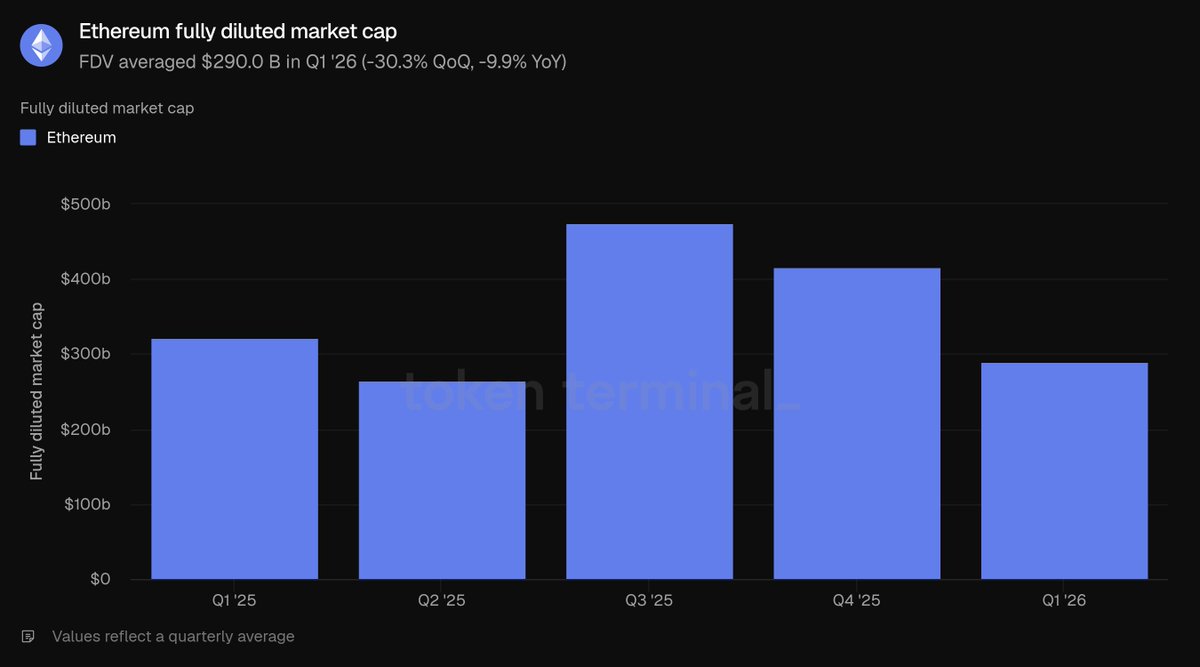
ETH Fully Diluted Market Capitalization: $290.0 billion (QoQ -30.3%, YoY -9.9%)

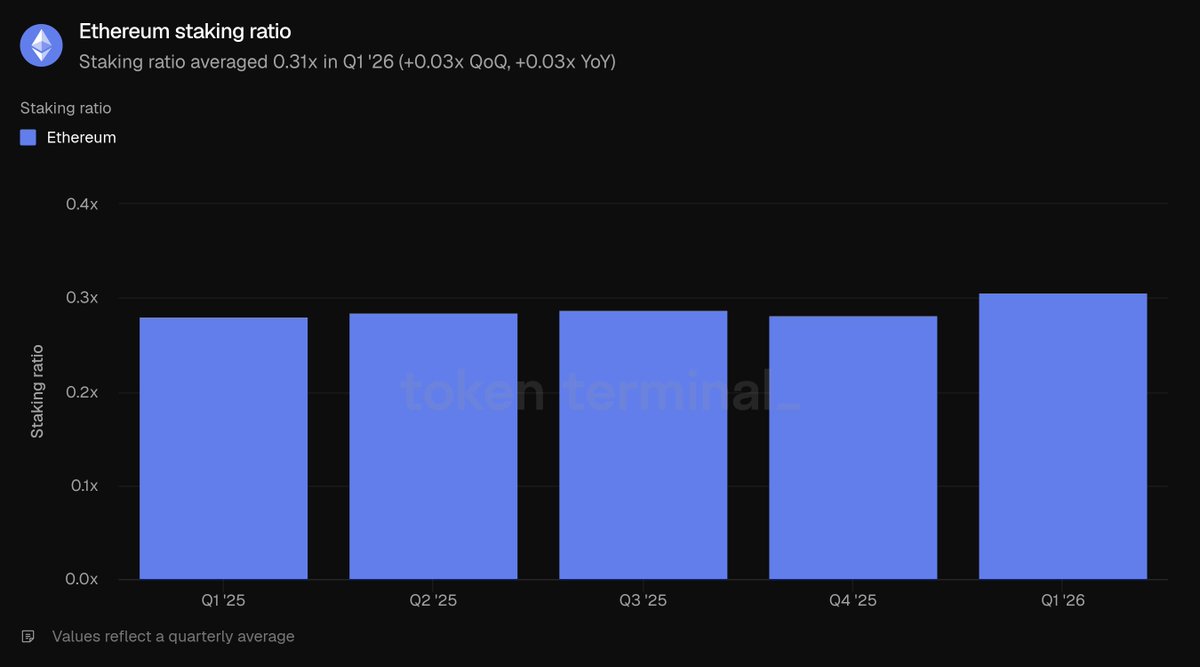
ETH Staking Ratio: 0.31 (both QoQ and YoY increased by 0.03)

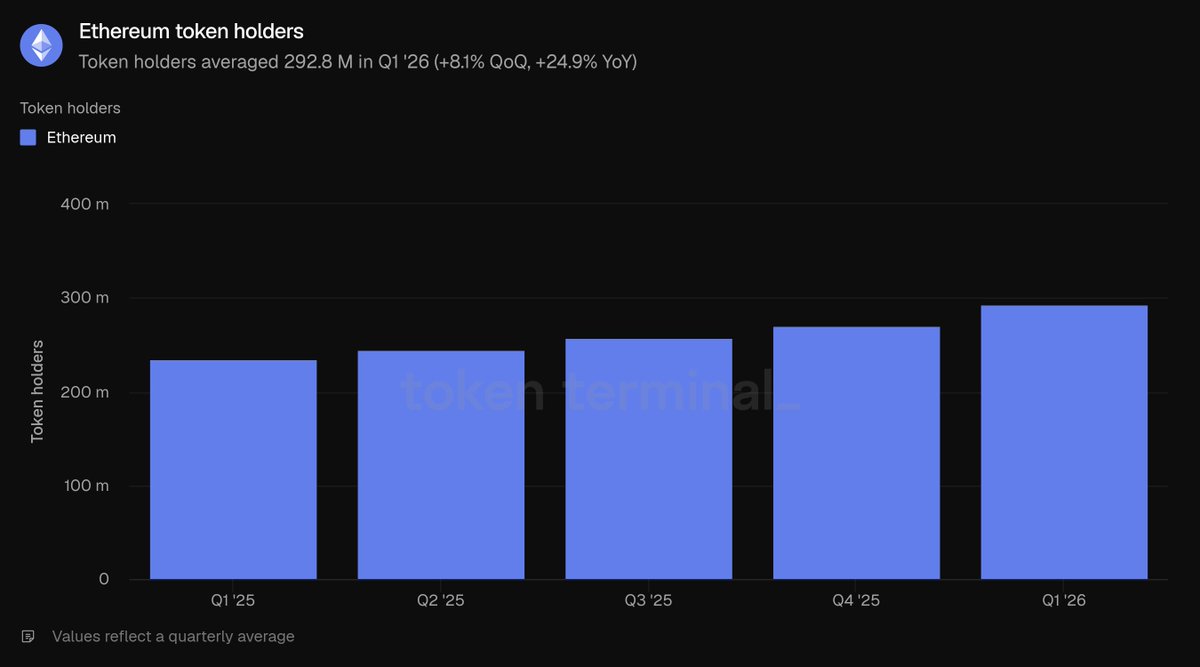
Total Number of ETH Holding Addresses: 292.8 million (QoQ +8.1%, YoY +24.9%)


Note: This report's statistical scope covers only the Ethereum Layer 1 mainnet. Layer 2 networks are considered independent blockchains, and their data is not included in Ethereum's statistics.


Overall Ecosystem Development


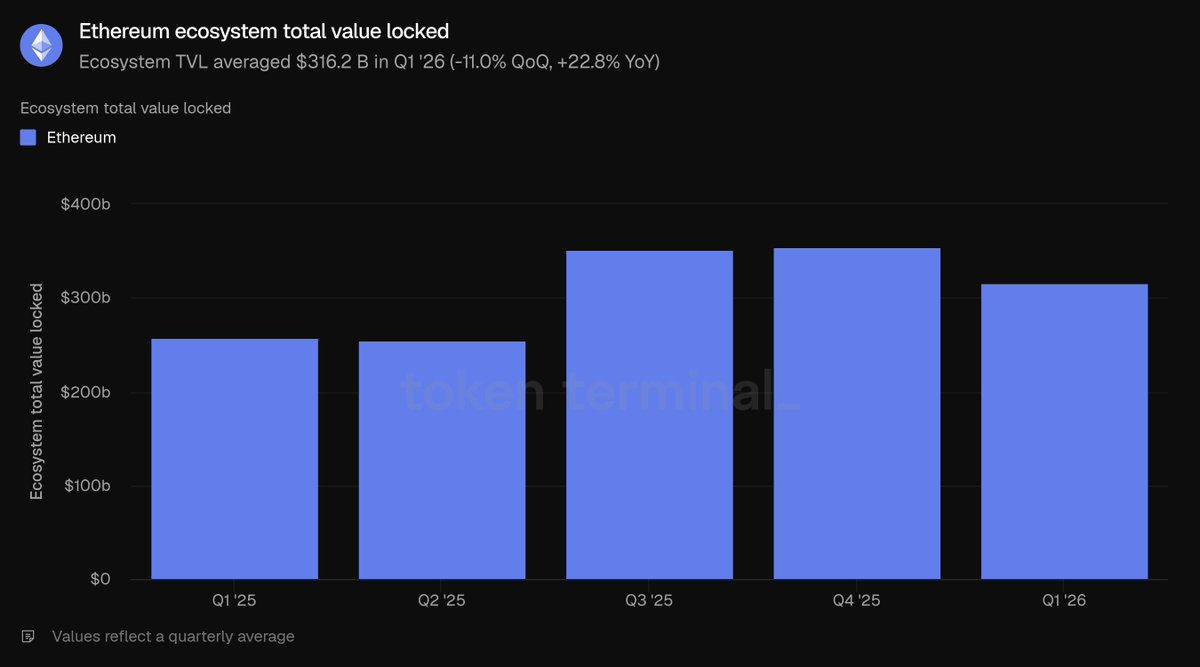
Total Value Locked (TVL) refers to the total US dollar value of assets deposited into various on-chain applications. It is a leading indicator for revenue-generating activities like lending, trading, and staking. This statistic measures the on-chain, withdrawable funds deposited by users across the entire Ethereum ecosystem. In Q1 2026, the average TVL for the Ethereum ecosystem reached $316.2 billion, down 11.0% quarter-over-quarter but up 22.8% year-over-year. The quarterly decline stemmed from a general price correction in crypto assets, while the significant year-over-year growth demonstrates substantial expansion in ecosystem scale compared to the same period last year.


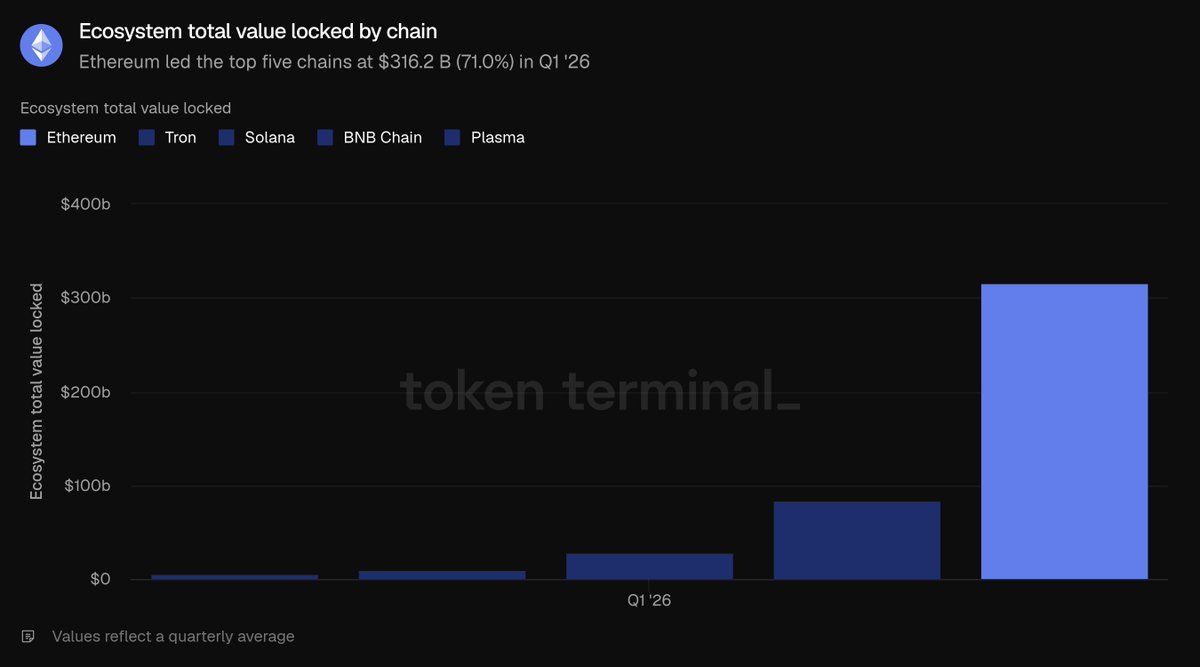
Among the top five public blockchains, Ethereum's locked value stands far ahead: $316.2 billion significantly surpasses the combined totals of Tron ($84.5B), Solana ($28.8B), BNB Chain ($10.3B), and Plasma ($5.7B), accounting for 71% of the total locked value across these five chains. Funds are primarily concentrated in two major sectors: the liquid staking sector led by Lido, and the lending sector centered around Aave; restaking protocols like EigenLayer and ether.fi, as well as synthetic dollar stablecoin platforms like Ethena and Sky, also hold substantial funds. High concentration of capital remains Ethereum's most prominent structural advantage.


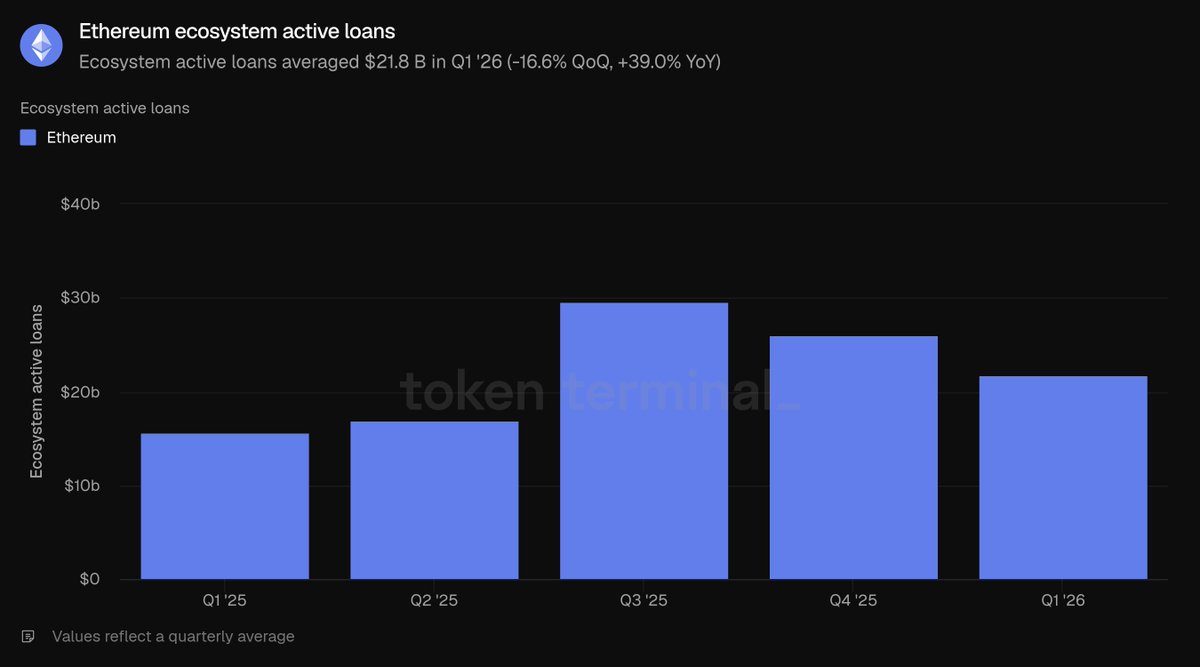
The Active Lending metric represents the scale of user deposits that are lent out and generate interest income, directly reflecting lending business revenue. This statistic measures the total outstanding loan amount across all lending applications on Ethereum. In Q1, the average active lending size in the ecosystem was $21.8 billion, down 16.6% QoQ but up 39.0% YoY. The contraction in lending balances in sync with TVL reflects a cooling of overall market risk appetite, but the scale remains far higher than the same period last year.


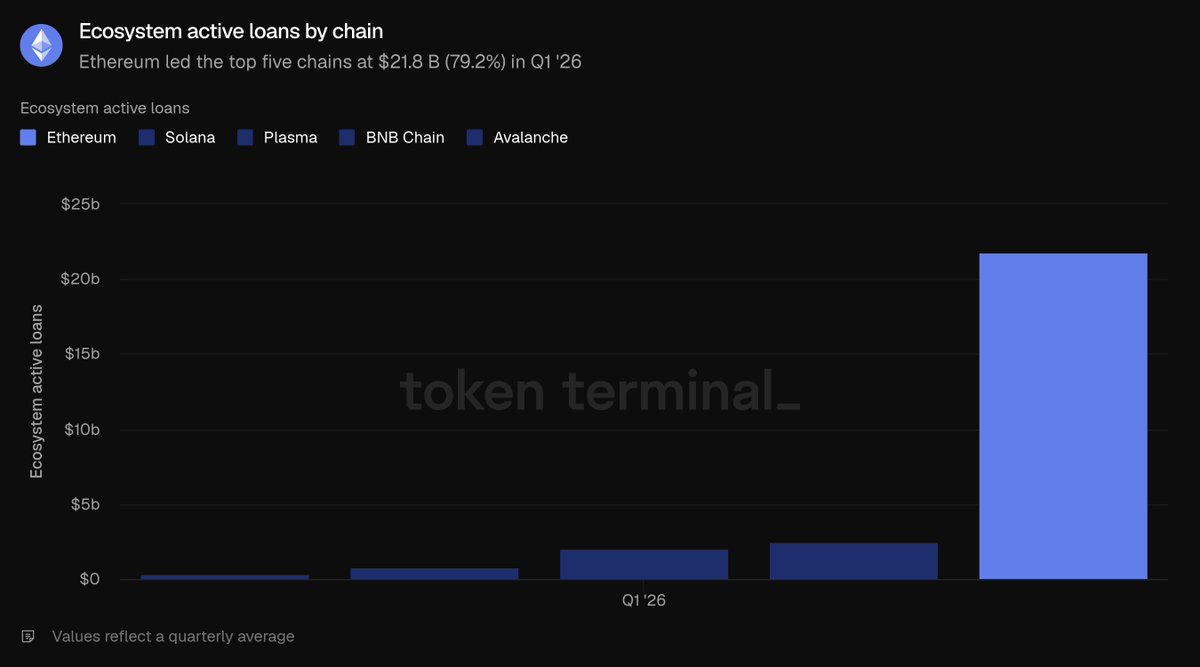
Ethereum's lending market is concentrated in a few liquidity pools, with Aave dominating: its outstanding active lending size at quarter-end was approximately $13.5 billion, capturing the vast majority of the ecosystem's share; followed by Morpho (~$1.9B), Spark under Sky (~$1.0B), and Maple (~$0.84B). The contraction in lending size this quarter was primarily driven by Aave, as declining crypto asset prices led to reduced borrowing demand, with its total loan volume shrinking by about 24%. Comparing across the five major chains, Ethereum's $21.8 billion in active lending far exceeds Solana ($2.5B), Plasma ($2.1B), BNB Chain ($0.7608B), and Avalanche ($0.3924B), accounting for 79.2% of the total lending volume across these five chains. This is the sector where Ethereum holds the highest percentage share among the top chains.


Decentralized Exchange (DEX) trading volume refers to the total transaction amount completed on on-chain spot exchanges. Traders pay fees when executing trades, making trading volume highly correlated with platform revenue. This data aggregates trading across all DEXs in the Ethereum ecosystem. In Q1, the ecosystem's total trading volume was $134.5 billion, down 24% QoQ and 31.2% YoY. The decline in trading volume was steeper than the contraction in TVL, confirming a significant reduction in market risk appetite during this quarter's asset downtrend cycle.
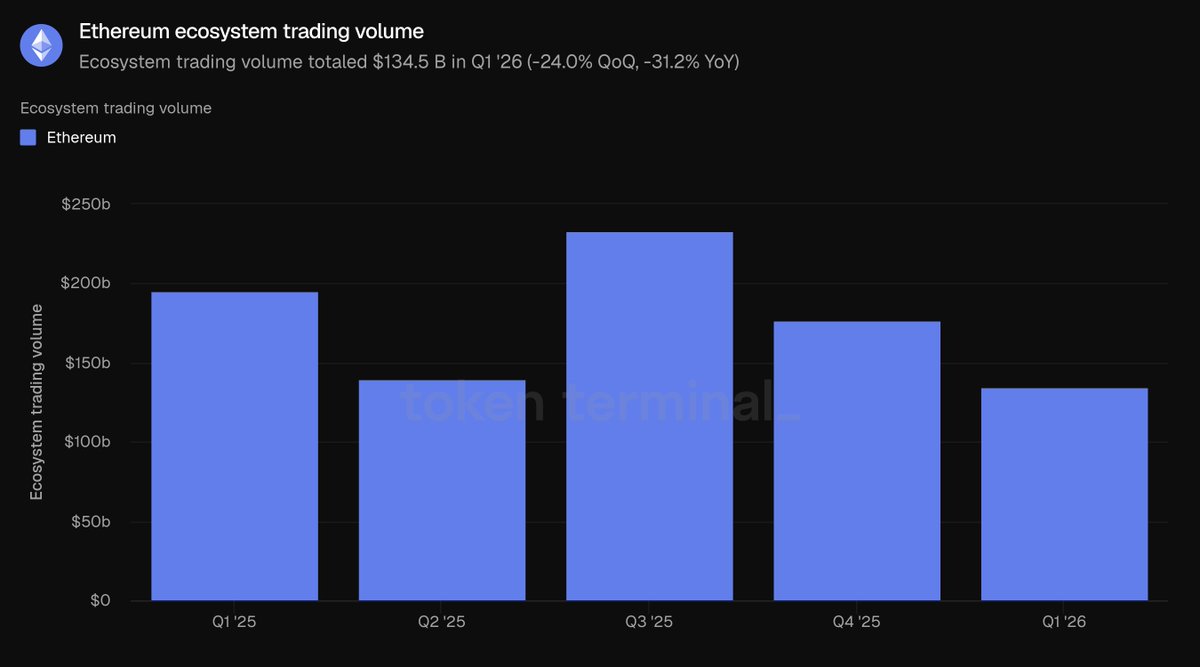


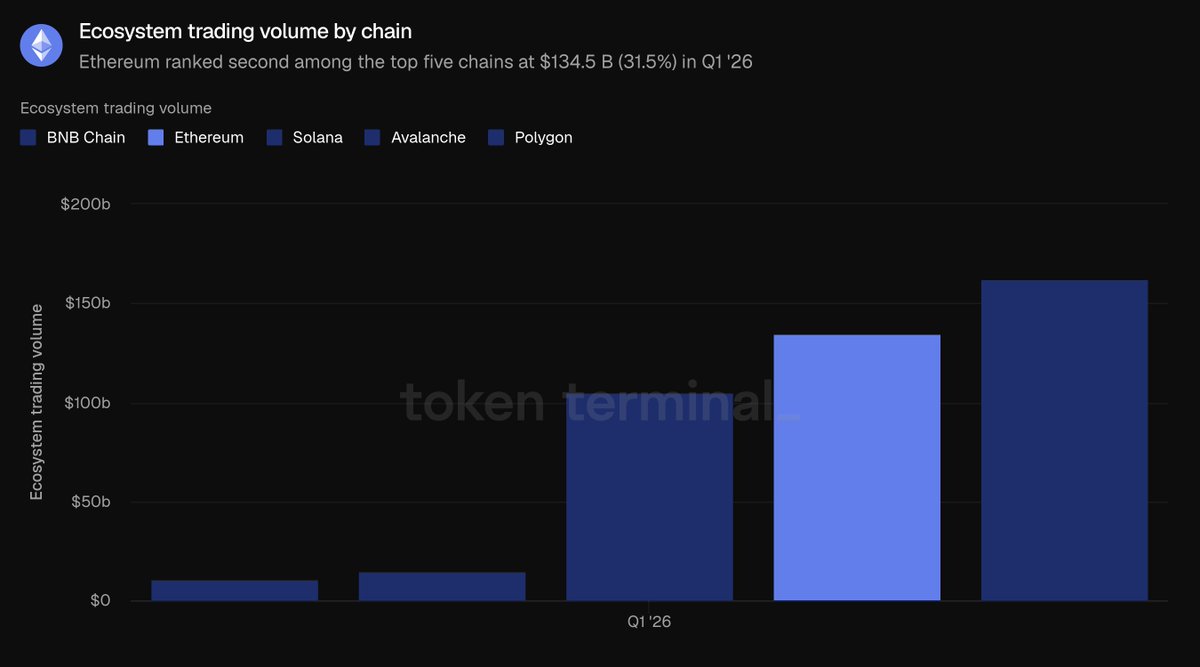
Ethereum's DEX trading flow is highly concentrated among top platforms: Uniswap's Q1 trading volume was approximately $85.5 billion, accounting for two-thirds of the ecosystem total; followed by Curve (~$22.1B) and CoW Swap (~$12.4B). Trading volume is the only metric where Ethereum did not top the five major chains: BNB Chain's total trading volume of $162.5 billion exceeded Ethereum's $134.5 billion, with Solana following closely ($104.9B), and Avalanche ($14.5B) and Polygon ($10.7B) ranking lower. Ethereum's trading volume constituted 31.5% of the combined total of the five chains, second to BNB Chain's 38%.


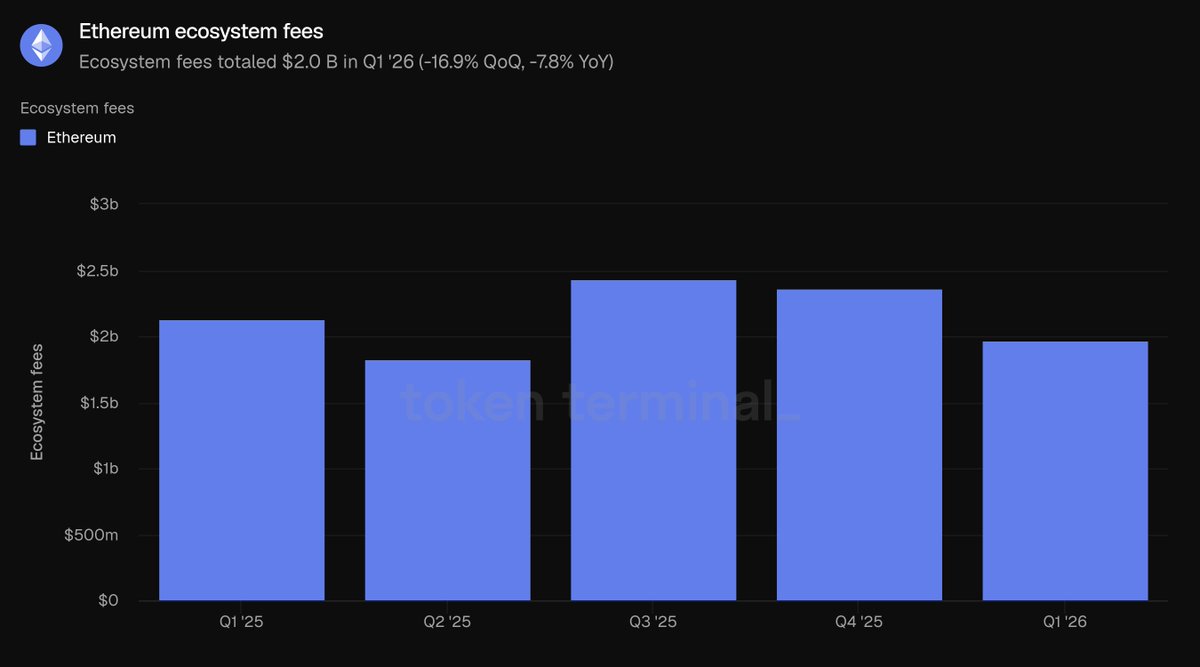
Ecosystem fees refer to all fees generated by users using various applications, including borrower interest and trader transaction fees. This directly reflects the economic value created by the ecosystem, aggregating total fees from all Ethereum applications. In Q1, total ecosystem fees amounted to $2.0 billion, down 16.9% QoQ and 7.8% YoY, declining in sync with lower trading and lending activity.


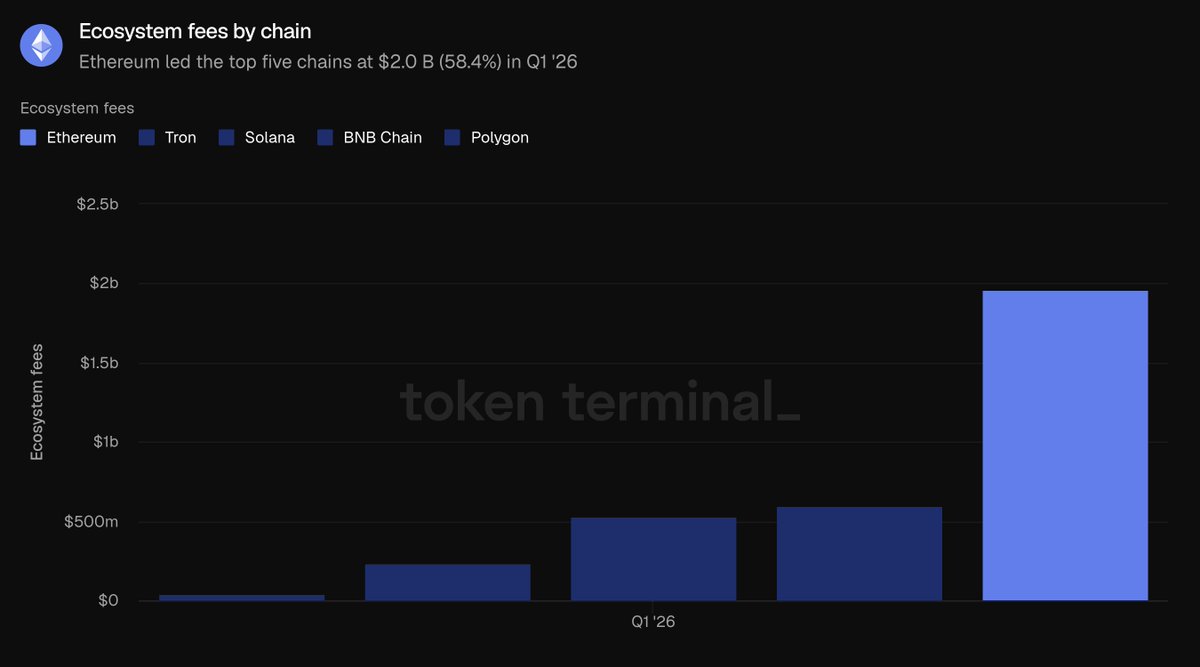
Ethereum's $2.0 billion in ecosystem fees far outpaces Tron ($599.3 million), Solana ($532.5 million), BNB Chain ($231.9 million), and Polygon ($38.8 million), accounting for 58.4% of the total fees across the five major chains. Even with this quarter's decline, Ethereum remains the industry's largest source of application fees. Summarizing all indicators in this section: Ethereum leads the industry in total locked value, lending size, and ecosystem fees, with only DEX trading volume falling short of BNB Chain.


Tokenized Assets Sector


Total Market Capitalization of Circulating Assets refers to the total value of on-chain tokenized assets, calculated as the circulating supply multiplied by the daily closing price. For stablecoins, it's the total circulating issuance; for tokenized funds, it's the on-chain asset under management; for tokenized stocks, it's the total value of on-chain issued shares. This section only counts assets issued on Ethereum.


In Q1, the average total market capitalization of tokenized assets on Ethereum was $203.4 billion, essentially flat QoQ (down only 0.7%) but up a significant 42.9% YoY. Stablecoins account for 87.9% of the total size, with the remaining share split among tokenized funds, commodities, and stocks.
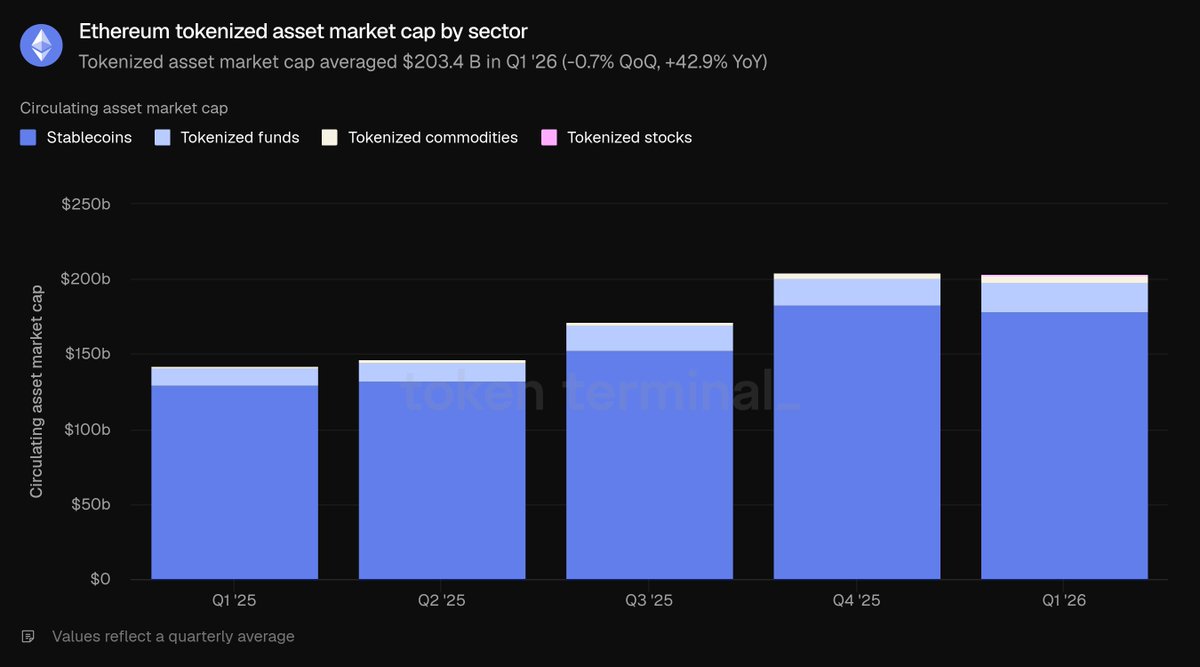


Stablecoins


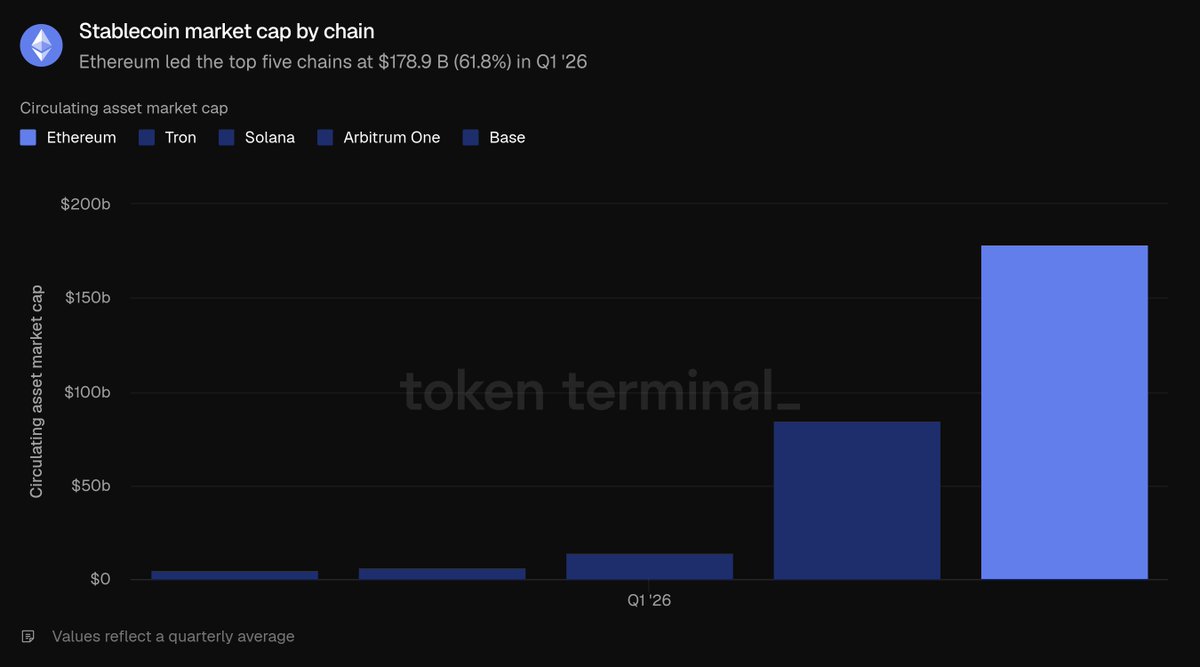
The average stablecoin size on Ethereum in Q1 was $178.9 billion, down slightly by 2.3% QoQ but up 37.6% YoY. It was the only tokenized sub-category to see a quarterly contraction. The market is dominated by two major issuers: at quarter-end, Tether's USDT ($94.1B) and Circle's USDC ($54.5B) together accounted for the vast majority of Ethereum's stablecoin market cap; other leading products include Sky USDS ($12.4B), Ethena USDe ($5.9B), and PayPal PYUSD ($2.9B); new compliant tokens like Ripple's RLUSD ($1.1B) have also launched. Comparing across the five major chains, Ethereum's $178.9 billion stablecoin scale leads Tron ($84.5B), Solana ($14.5B), Arbitrum One ($6.8B), and Base ($4.7B), accounting for 61.8% of the total stablecoin value across these five chains.


Tokenized Funds


The average size of tokenized funds on Ethereum in Q1 was $19.4 billion, up 4.9% QoQ and surging 73.1% YoY. The sector is divided into two main types:


Yield-bearing on-chain USD products (largest by size): Sky sUSDS (~$6.4B), Ethena sUSDe (~$3.5B);

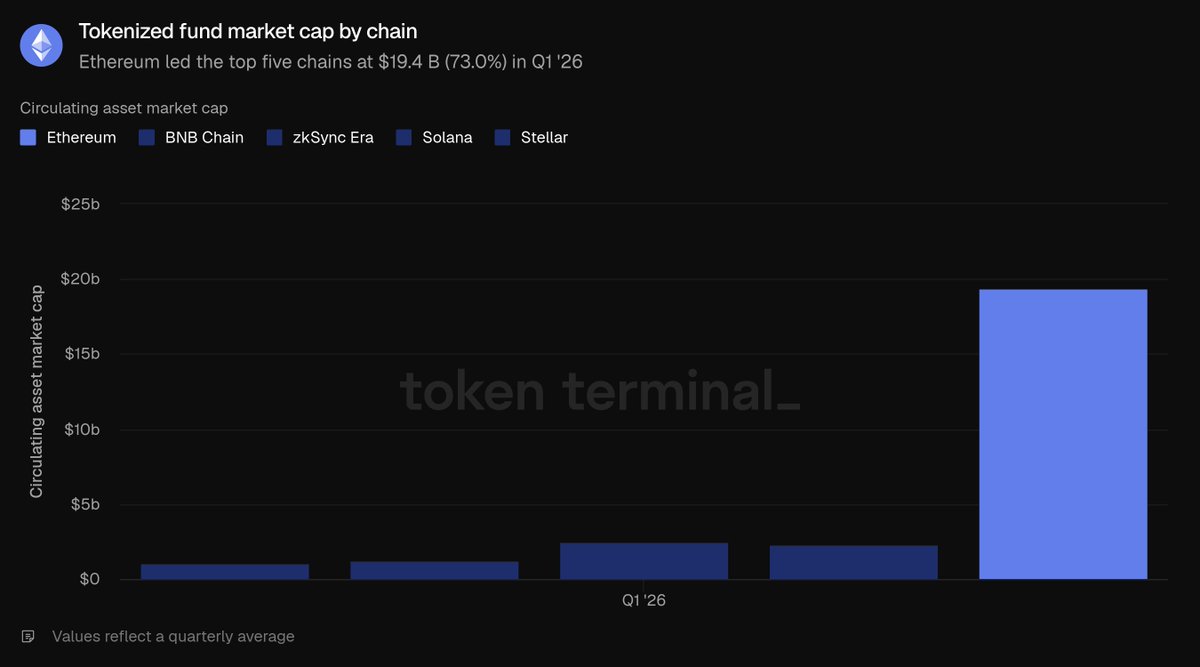
Traditional financial compliant funds (core vehicles for the institutional narrative): BlackRock BUIDL (issued via Securitize, ~$1.0B), WisdomTree Government Money Fund (~$0.815B), Superstate USTB (~$0.62B), with Ondo OUSG (~$0.32B) following closely. Comparing the five major chains, Ethereum's $19.4 billion in tokenized funds significantly leads ZKsync Era ($2.5B), BNB Chain ($2.3B), Solana ($1.3B), and Stellar ($1.1B), accounting for 73% of the total. This is the second most dominant tokenized asset sector for Ethereum.


Tokenized Commodities


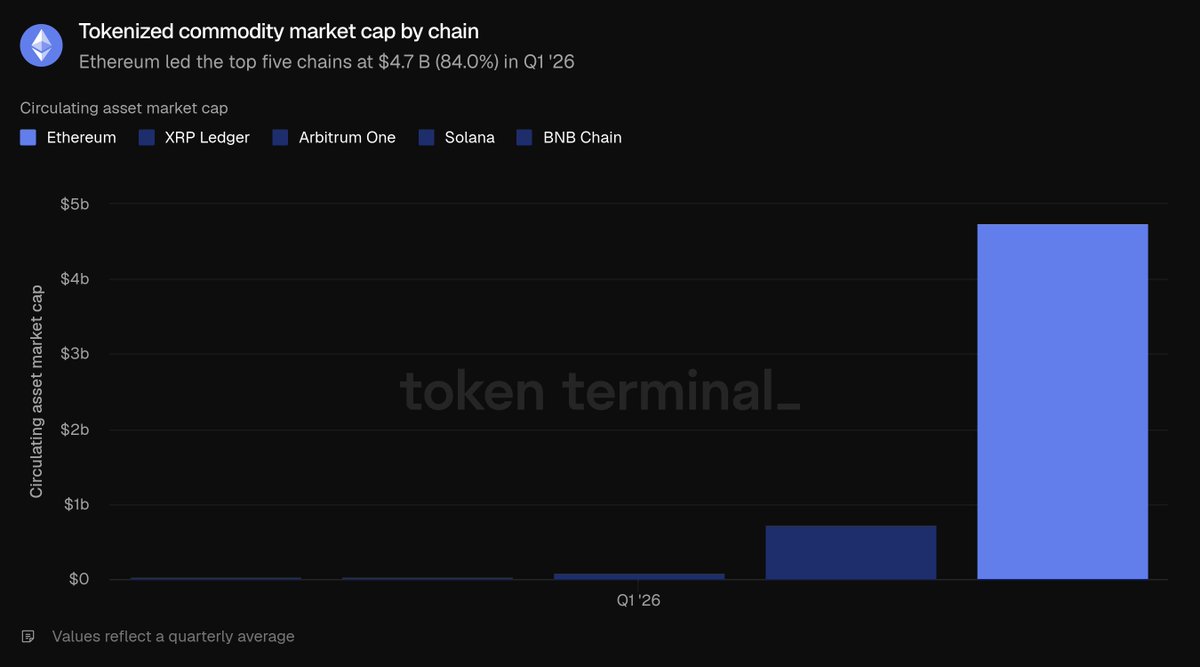
The average size of tokenized commodities on Ethereum in Q1 was $4.7 billion, up 60% QoQ and surging 325.9% YoY, making it the fastest-growing tokenized category. The sector consists almost entirely of on-chain gold: Tether Gold XAUT (~$2.6B) and Paxos Gold PAXG (~$2.4B) together account for the entire sector share. Comparing across the five relevant chains, Ethereum's $4.7 billion scale far exceeds Ripple ($736.6M), Arbitrum One ($95.9M), BNB Chain ($38.4M), and Solana ($29.8M), accounting for 84% of the total. This is the tokenized sub-sector where Ethereum exerts the strongest dominance.


Tokenized Stocks


Tokenized stocks are the smallest sub-category. The average size on Ethereum in Q1 was $365.1 million, virtually zero a year ago, and up 16.5% QoQ. The sector is almost exclusively dominated by Ondo Finance, which issues on-chain assets for broad-based indices like the S&P 500 and Nasdaq 100, as well as dozens of individual stocks, constituting the vast majority of Ethereum's tokenized stock market cap. Comparing across the five major chains, Ethereum's $365.1M slightly leads Solana ($249.0M), BNB Chain ($150.5M), Arbitrum One ($29.0M), and Stellar ($4.2M), accounting for only 45.8% of the total tokenized stock value across these five chains. This is the only tokenized asset sector where Ethereum does not hold an absolute majority share.
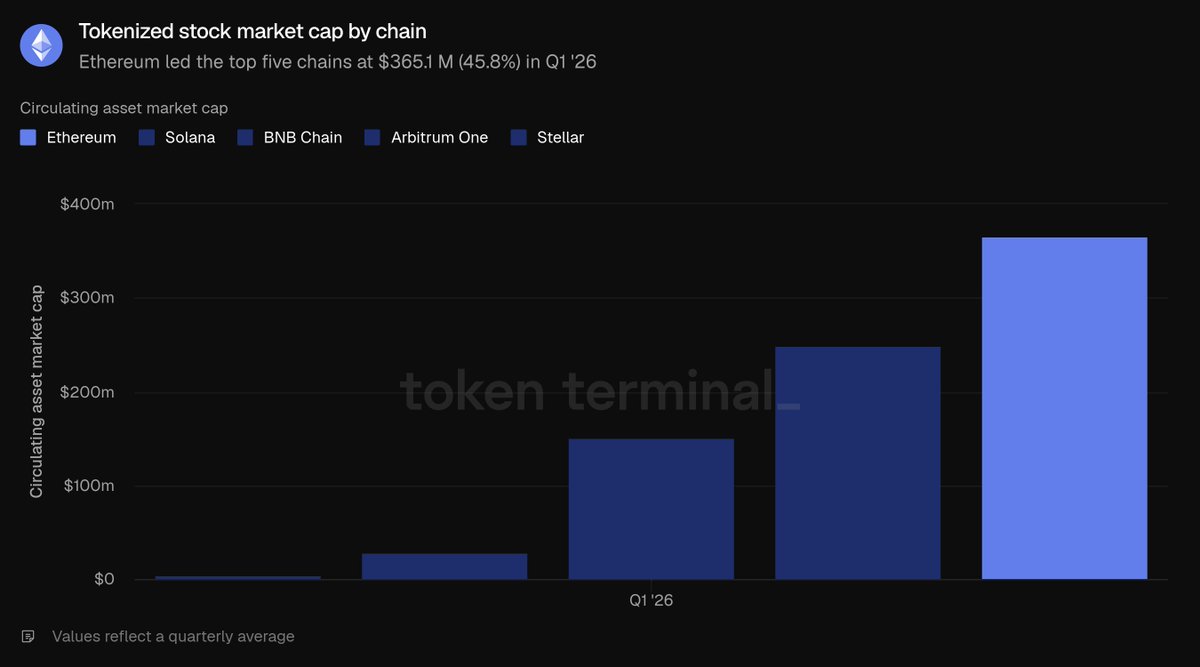


Summary of the Tokenized Assets Sector: Stablecoin stockpiles saw a slight decline in Q1, but Ethereum's dominant position in tokenized funds and commodities continues to solidify.


On-chain Usage Activity


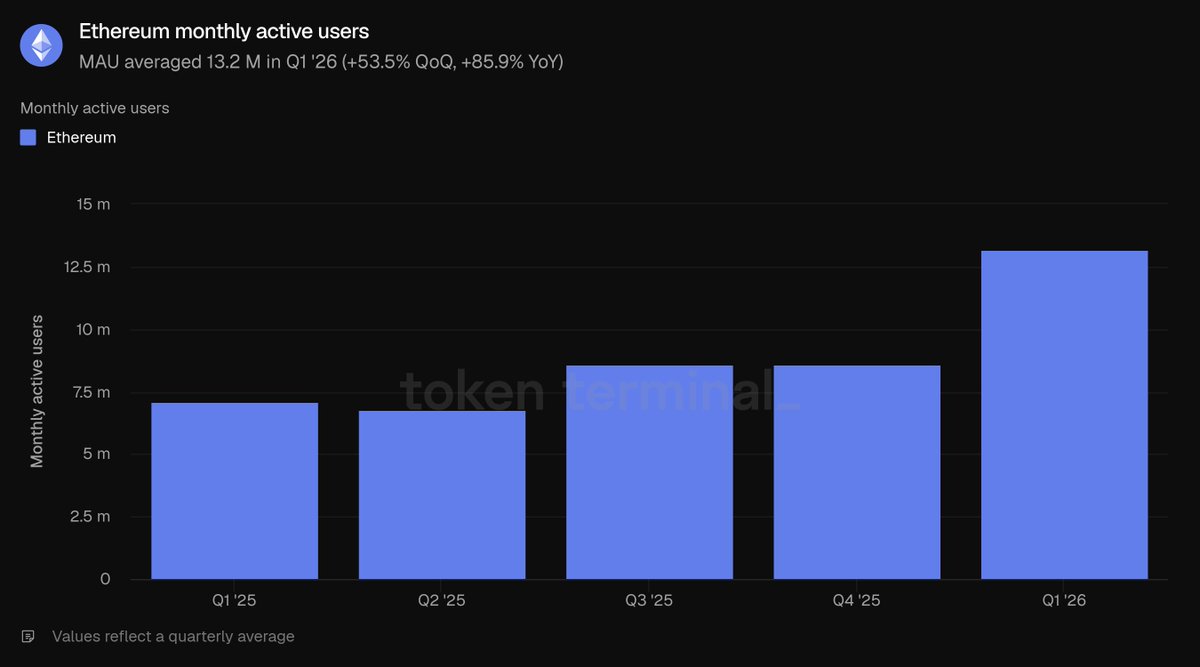
Monthly Active Users are defined as unique addresses that generate revenue-generating on-chain transactions each month. This metric only counts addresses interacting with the Ethereum Layer 1 mainnet. The average monthly active users in Q1 were 13.20 million, surging 53.5% QoQ and up 85.9% YoY, setting a new historical record and ending the slow growth trend of previous quarters, with user growth accelerating significantly.


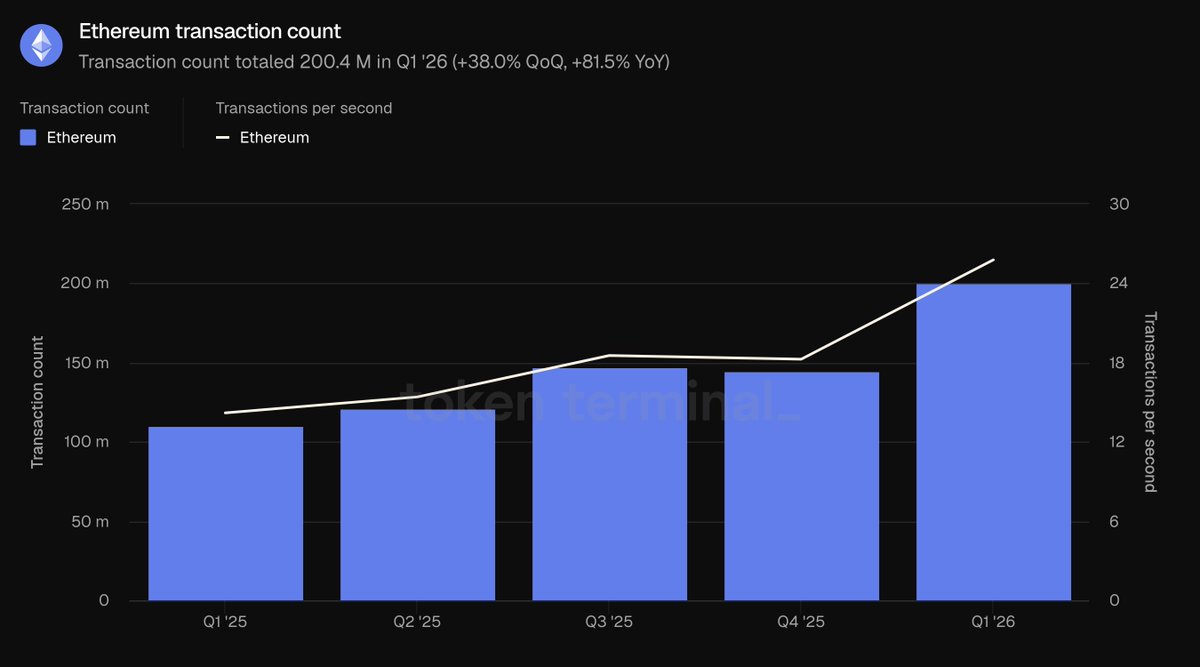
Total Transaction Count refers to the number of transactions written to the blockchain and confirmed, reflecting user on-chain interaction intensity. Transactions Processed per Second (TPS) is the average confirmation rate within the period, measuring the network's real-time carrying capacity. Both metrics are counted for the Ethereum Layer 1 mainnet only. In Q1, Layer 1 total transactions reached 200.4 million, up 38% QoQ and 81.5% YoY; average TPS increased to 25.78, up 41.2% QoQ. Both figures set new historical highs, proving that user growth has translated into real on-chain business volume increases.


Fees here specifically refer to the base network costs users pay for initiating transactions on Ethereum Layer 1, distinguished from the total ecosystem application fees in Part 2. In Q1, total Layer 1 transaction fees were $39.90 million, plummeting 47.9% QoQ and dropping sharply 81.9% YoY. The core data contrast this quarter is rising activity alongside sharply declining fees: while transaction volume increased 38%, total fees contracted by nearly half. The core reason is that Blob scaling significantly increased block storage capacity, ensuring ample block space supply and substantially reducing the cost per transaction.
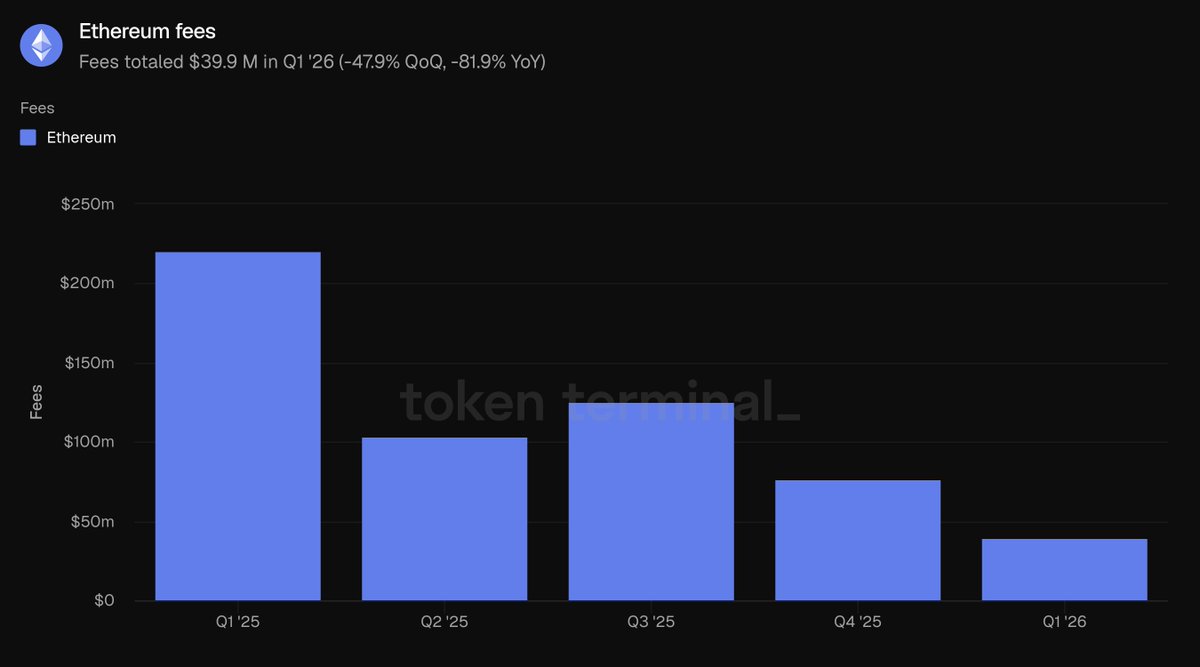


The core conclusion of this section is that scaling benefits have materialized: users and transaction counts have simultaneously reached new highs, while overall network usage costs have declined. When network throughput expansion outpaces the growth rate of market transaction demand, the characteristic "activity up, fees down" emerges.


Native Token ETH Fundamentals


Fully Diluted Market Capitalization calculation logic: ETH token price × the total potential supply under the current token economic model (including circulating, locked, unlocked, and yet-to-be-issued tokens). In Q1, ETH's average fully diluted market cap was $290.0 billion, down sharply 30.3% QoQ and 9.9% YoY. This is the indicator with the largest quarterly decline among all valuation metrics in the report and the core factor driving the contraction in the dollar-denominated asset scale across the entire ecosystem.


Staking Ratio: The ratio of the total value of ETH staked to secure the Proof-of-Stake network to the overall market capitalization of ETH; 0.31 indicates approximately 31% of ETH's market value is participating in staking. The average staking ratio in Q1 was 0.31, higher than the 0.28 from the previous quarter and the same period last year. Even as ETH's overall market cap significantly corrected, the proportion of tokens participating in network security staking continued to rise, indicating stable long-term staking意愿 among users during the price downtrend cycle.


Token Holder Metric: The total number of unique wallet addresses holding ETH. The average number of ETH holding addresses in Q1 was 292.8 million, up 8.1% QoQ and 24.9% YoY, marking five consecutive quarters of steady growth. Against the backdrop of a continuously declining fully diluted market cap, the expansion of holding addresses signifies further dispersion of the ETH-holding群体, with ordinary users'布局意愿 not cooling with short-term market trends.


Etherealize Team Commentary


The most core contradictory phenomenon this quarter: Ethereum Layer 1 mainnet on-chain usage scale hit historical highs, while network transaction fees simultaneously declined. Ethereum actively推进 network scaling, sacrificing short-term fee revenue for the long-term logic: cheaper block space will unleash massive potential market demand, ultimately driving long-term全网 revenue growth.


Data from Token Terminal's "Ethereum Report Q1 2026" proves this long-term logic正在兑现: on a year-over-year basis, monthly active users grew 85.9%, total transaction volume increased 81.5%, and network throughput rose 81.7%. This is a classic manifestation of Jevons Paradox. The team predicts that the long-term increase in全网 transaction demand will completely offset the short-term revenue loss caused by the decline in per-transaction fees. Drawing an analogy to the semiconductor industry: when Gordon Moore proposed Moore's Law in 1975, industry revenue规模 was limited; today, industry revenue has grown by several orders of magnitude. Scaling红利尚未完全释放: the planned Glamsterdam upgrade in Q3 aims to increase the Gas limit more than threefold; according to Ethereum's long-term roadmap规划, by 2029, it aims to achieve tens of thousands of TPS, creating a high-speed Layer 1 blockchain with second-level transaction finality.


The team agrees with BlackRock CEO Larry Fink's观点 from last December: the current stage of the tokenization industry is equivalent to the internet in 1996—when Amazon's online book sales were only $16 million. At the time, the market普遍 believed Amazon was merely an online bookstore surviving on the internet bubble and持续亏损; but Jeff Bezos预判 that the internet would彻底重塑 the retail industry,放弃短期盈利 to全力打造 network effects and scale advantages. Ethereum is now making the same取舍 to巩固 its position as the global financial底层 settlement layer.


Internet development offers another crucial启示: open, permissionless networks最终一定会战胜封闭私有 networks. In 1995, Bill Gates predicted in "The Road Ahead" that digital commerce would rely on enterprise proprietary private networks, "information highways," rather than the open internet. At the time, Microsoft created MSN, and America Online, CompuServe, Prodigy all operated封闭围墙花园, boasting millions of paying users; France's Minitel terminal system still had more users globally than the entire internet until late 1996. Yet all these封闭 systems ultimately failed. No正规大型 enterprise is willing to build its business on a network controlled by a competitor; more importantly, no single company can permanently keep up with the pace of innovation in a permissionless open ecosystem. History repeatedly confirms this规律: Linux surpassed proprietary Unix systems, the open web replaced enterprise封闭 intranets, Wikipedia replaced Encyclopædia Britannica. At the beginning of each transition, proprietary products gain first-mover advantages凭借更精准的功能,充足营销, and商务资源; but when the open ecosystem accumulates sufficient development tools, developers, and neutral, trustworthy attributes, first-mover advantages rapidly dissipate.


Now this industry规律 is replaying in financial infrastructure领域. All data in this report can佐证 that Ethereum has crossed the ecosystem critical mass threshold:它 holds绝对 market share in all core sectors. Institutions choosing Ethereum for deploying tokenized finance is not due to理念偏好, but because生态流动性, composability, and成熟机构落地案例 are already concentrated here. Report data shows: Ethereum holds 79.2% of DeFi active lending, 61.8% of stablecoins, 73% of tokenized funds, and 84% of tokenized commodities market share across the five major chains. Each new type of tokenized asset further thickens生态流动性,持续吸引更多机构入场; a neutral, non-biased底层 is the industry's only stable equilibrium solution—large financial institutions will绝不会统一选择竞品私有链 for asset settlement. Moreover, institutions are gradually realizing that private interactions, access restrictions, KYC compliance, and asset transfer controls can all be implemented through privacy computing environments and permissioned token standards on top of Ethereum, while fully tapping into the全网公共流动性. Conversely,封闭私有链 cannot嫁接 the massive liquidity and diverse applications of an open ecosystem.


After the quarter ended, institutional deployment accelerated further. In May alone, several significant implementations emerged: In asset management: BlackRock filed for two new tokenized funds; JPMorgan Chase issued its second on-chain货币基金 JLTXX on Ethereum; Fidelity International launched the Moody's AAA-rated dollar liquidity fund FILQ,上线 as an ERC-20 token. In the stablecoin sector: The Japanese Blockchain Foundation's yen stablecoin EJPY is即将部署 on Ethereum; a European alliance of 12 major banks (including BNP Paribas, ING, UniCredit, BBVA, etc.) is preparing a compliant euro stablecoin.


In 1990, the internet seemed遥不可及; by 2005, it had become a societal刚需. If Fink's assessment of the tokenization industry's development stage is accurate, the next few years may be the most opportune phase in Ethereum's development history. The team's previous "Efficient Money" report proposed the core观点: network fees构建 ETH's intrinsic value floor; the long-term optimistic logic is that依托更完善的货币属性, ETH有望吸纳 the combined超 $30 trillion monetary贮藏 value溢价 of gold and Bitcoin. Ethereum can establish industry leadership without relying on high fees.

Criptomoedas em alta

Perguntas relacionadas

QAccording to the article, what is the key contradiction observed in Ethereum's performance during Q1 2026?

AThe key contradiction was that while on-chain usage (monthly active users, total transactions, throughput) hit record highs, the network transaction fees collected on Layer 1 plummeted (down 47.9% QoQ).

QWhat are the three core protocol goals set by the Ethereum Foundation for 2026?

AThe three core protocol goals for 2026 are: scaling, optimizing user experience, and strengthening the underlying Layer 1 security.

QWhich on-chain activity metric saw the largest year-on-year percentage growth in Q1 2026?

AThe on-chain activity metric with the largest year-on-year percentage growth was Tokenized Commodities, which increased by 325.9% compared to Q1 2025.

QWhy does the Etherealize team believe open, permissionless networks like Ethereum will ultimately prevail over private, closed networks for financial infrastructure?

AThey believe that no large, formal enterprise will build critical business on a network controlled by a competitor, and crucially, no single company can keep pace with the innovation speed of a permissionless, open ecosystem over the long term, as historically seen with Linux and the open web.

QWhat does the article identify as the primary factor driving the significant drop in Layer 1 transaction fees despite increased usage in Q1 2026?

AThe primary factor was the successful implementation of the second Blob Parameter Fork (BPO#2) as part of the Fusaka upgrade cycle in January, which greatly increased data storage capacity (blob space), making block space more abundant and reducing the cost per transaction.

Leituras Relacionadas

WeChat AI Card Hands-On Guide: Has the AI Shopping Era Arrived?

**"WeChat AI Card" Practical Test Guide: Has the Era of AI Shopping Arrived?** WeChat has officially launched the "AI Exclusive Card," a feature integrated into its Workbuddy AI assistant. This card is designed to handle payments for AI-initiated purchases. Our hands-on test reveals it's not yet a tool for fully autonomous AI shopping, but rather a controlled payment layer for AI agents. The AI Card functions as an isolated sub-wallet within WeChat Pay. Users must bind the card and transfer funds into it from their main wallet. Crucially, every transaction requires explicit user confirmation via smartphone scan; AI cannot spend autonomously. Currently accessible through the Workbuddy agent, the card targets specific digital consumption scenarios: purchasing paid content (reports, data), calling paid APIs/tools, and subscribing to services. Its design prioritizes security and control by separating funds and mandating approval for each payment. We tested a real-world scenario: ordering bubble tea via Workbuddy using a "Meituan Life Assistant" skill. The process encountered multiple hurdles: high "skill" usage costs (exceeding daily free credits), and most importantly, while a payment was successfully initiated, the AI purchased an incorrect product (a mismatched group-buy coupon instead of the desired drink). This highlights the current limitation: the **AI Card only solves the payment step**. The broader challenge lies in the **AI agent's execution chain**—accurately understanding intent, navigating third-party platforms, selecting the right product, and ensuring proper fulfillment. The payment succeeded, but the purchase failed to meet the user's need. In conclusion, the WeChat AI Exclusive Card is a cautious, early-step experiment in AI commerce. It provides a secure, user-controlled payment method for agent interactions but is not yet capable of reliable, end-to-end complex purchases. For now, it's best used for low-value, low-risk digital services with careful user verification at each step. The vision of AI handling complete shopping tasks remains a work in progress.

marsbitHá 2h

WeChat AI Card Hands-On Guide: Has the AI Shopping Era Arrived?

marsbitHá 2h

Deconstructing Notion's Growth: From a Note-taking Tool to 100 Million Users—How Notion Built a Triple Growth Flywheel Through Product, Templates, and Community

Notion's growth from a niche note-taking tool to a platform with 100 million users is powered by three interconnected flywheels: Product-Led Growth (PLG), a Template Economy, and Community-Driven Growth. First, Notion's PLG strategy relies on a highly flexible, "plastic" product that users can adapt to countless personal and team workflows. Its freemium model lowers the barrier to entry, while features like page sharing and collaboration drive organic, usage-based viral growth as users naturally invite others. Second, the Template Economy solves the "blank page" problem. Templates, created by both Notion and its community, transform abstract product capabilities into concrete, copyable solutions for specific scenarios (e.g., project management, content calendars). This dramatically lowers activation costs for new users and fuels SEO-driven discovery. Third, a vibrant Community acts as a distributed growth engine. Users and official Ambassadors create tutorials, share use cases, and host local events. This community not only educates users but also fosters a sense of identity around pursuing "better ways of working," strengthening loyalty and enabling global, low-cost expansion. Together, these flywheels create a self-reinforcing ecosystem: a great product attracts users who create templates and community content, which in turn attracts more users and deepens engagement. This system allowed Notion to scale from individuals to teams and enterprises through a bottom-up adoption path. Looking ahead, AI integration promises to accelerate these flywheels further by making templates smarter and the platform a potential AI-native work operating system. Ultimately, Notion's defensible advantage is not just its features, but this deeply entrenched network of user assets, creators, and community trust.

marsbitHá 2h

Deconstructing Notion's Growth: From a Note-taking Tool to 100 Million Users—How Notion Built a Triple Growth Flywheel Through Product, Templates, and Community

marsbitHá 2h

$10 Billion, Qualcomm to Acquire Chip Legend Jim Keller's Company

Global mobile chip giant Qualcomm is in advanced talks to acquire AI chip startup Tenstorrent in a deal valued between $8-10 billion, according to media reports. This potential acquisition would be one of the largest in the AI chip sector in recent years. Tenstorrent, led by legendary chip architect Jim Keller, has gained prominence for its RISC-V architecture and AI accelerator designs. The move highlights Qualcomm's strategic push to diversify beyond its core smartphone chip business. As the smartphone market matures, Qualcomm is aggressively targeting growth in automotive, data center, and cloud AI. Acquiring Tenstorrent would allow Qualcomm to rapidly enter the high-end AI computing market, bypassing lengthy in-house development cycles. Tenstorrent's cost-effective system architecture, which avoids expensive HBM memory and relies on standard Ethernet for clustering, offers a potential alternative to Nvidia's costly solutions. Furthermore, Tenstorrent's high-performance RISC-V CPU technology and its focus on the automotive and edge computing segments align with Qualcomm's strategic goals, including its "Snapdragon Digital Chassis" platform. Despite the strategic rationale, the high valuation has sparked some investor caution. The successful integration of Tenstorrent's open-source culture and independent team into Qualcomm's organization, along with the commercialization of its technology, remains a key challenge.

marsbitHá 3h

$10 Billion, Qualcomm to Acquire Chip Legend Jim Keller's Company

marsbitHá 3h

Trading

Spot
Futuros

Artigos em Destaque

O que é ETH 2.0

ETH 2.0: Uma Nova Era para o Ethereum Introdução ETH 2.0, amplamente conhecido como Ethereum 2.0, marca uma atualização monumental à blockchain do Ethereum. Esta transição não é meramente uma mudança estética; visa melhorar fundamentalmente a escalabilidade, segurança e sustentabilidade da rede. Com uma mudança do mecanismo de consenso em Proof of Work (PoW), intensivo em energia, para um Proof of Stake (PoS) mais eficiente, o ETH 2.0 promete uma abordagem transformadora ao ecossistema blockchain. O que é ETH 2.0? ETH 2.0 é um conjunto de atualizações distintas e interconectadas focadas na otimização das capacidades e desempenho do Ethereum. Esta reformulação foi projetada para abordar desafios críticos que o mecanismo atual do Ethereum enfrentou, particularmente em relação à velocidade das transações e à congestão da rede. Objetivos do ETH 2.0 Os principais objetivos do ETH 2.0 giram em torno da melhoria de três aspectos centrais: Escalabilidade: Com o objetivo de melhorar significativamente o número de transações que a rede pode manejar por segundo, o ETH 2.0 procura ultrapassar a limitação atual de aproximadamente 15 transações por segundo, alcançando potencialmente milhares. Segurança: Medidas de segurança melhoradas são integrais ao ETH 2.0, especialmente através da resistência aprimorada contra ciberataques e da preservação do ethos descentralizado do Ethereum. Sustentabilidade: O novo mecanismo PoS foi projetado não apenas para melhorar a eficiência, mas também para reduzir drasticamente o consumo de energia, alinhando a estrutura operacional do Ethereum com considerações ambientais. Quem é o Criador do ETH 2.0? A criação do ETH 2.0 pode ser atribuída à Ethereum Foundation. Esta organização sem fins lucrativos, que desempenha um papel crucial no apoio ao desenvolvimento do Ethereum, é liderada pelo co-fundador notável Vitalik Buterin. A sua visão de um Ethereum mais escalável e sustentável tem sido a força motriz por trás desta atualização, envolvendo contribuições de uma comunidade global de desenvolvedores e entusiastas dedicados a melhorar o protocolo. Quem são os Investidores do ETH 2.0? Embora os detalhes sobre os investidores do ETH 2.0 não tenham sido tornados públicos, é sabido que a Ethereum Foundation recebe apoio de várias organizações e indivíduos no espaço da blockchain e tecnologia. Esses parceiros incluem firmas de capital de risco, empresas de tecnologia e organizações filantrópicas que compartilham um interesse mútuo em apoiar o desenvolvimento de tecnologias descentralizadas e infraestrutura de blockchain. Como Funciona o ETH 2.0? ETH 2.0 é notável por introduzir uma série de características chave que o diferenciam do seu predecessor. Proof of Stake (PoS) A transição para um mecanismo de consenso PoS é uma das mudanças de destaque do ETH 2.0. Ao contrário do PoW, que depende da mineração intensiva em energia para a verificação de transações, o PoS permite que os utilizadores validem transações e criem novos blocos de acordo com a quantidade de ETH que apostam na rede. Isso leva a uma maior eficiência energética, reduzindo o consumo em aproximadamente 99,95%, tornando o Ethereum 2.0 uma alternativa consideravelmente mais ecológica. Shard Chains As shard chains são outra inovação crítica do ETH 2.0. Estas cadeias menores operam em paralelo com a cadeia principal do Ethereum, permitindo que várias transações sejam processadas simultaneamente. Esta abordagem melhora a capacidade geral da rede, abordando preocupações de escalabilidade que têm atormentado o Ethereum. Beacon Chain No coração do ETH 2.0 está a Beacon Chain, que coordena a rede e gere o protocolo PoS. Ela atua como uma espécie de organizador: supervisiona os validadores, garante que as shards permaneçam conectadas à rede e monitora a saúde geral do ecossistema blockchain. Linha do Tempo do ETH 2.0 A jornada do ETH 2.0 tem sido marcada por vários marcos chave que traçam a evolução desta atualização significativa: Dezembro de 2020: O lançamento da Beacon Chain marcou a introdução do PoS, preparando o caminho para a migração para o ETH 2.0. Setembro de 2022: A conclusão de “The Merge” representa um momento crucial em que a rede Ethereum fez a transição com sucesso de um quadro PoW para um PoS, anunciando uma nova era para o Ethereum. 2023: O lançamento esperado das shard chains visa melhorar ainda mais a escalabilidade da rede Ethereum, solidificando o ETH 2.0 como uma plataforma robusta para aplicações e serviços descentralizados. Características Chave e Benefícios Escalabilidade Melhorada Uma das vantagens mais significativas do ETH 2.0 é a sua escalabilidade melhorada. A combinação de PoS e shard chains permite que a rede expanda a sua capacidade, permitindo que acomode um volume de transações muito maior em comparação com o sistema legado. Eficiência Energética A implementação do PoS representa um enorme passo em direção à eficiência energética na tecnologia blockchain. Ao reduzir drasticamente o consumo de energia, o ETH 2.0 não só reduz os custos operacionais, mas também se alinha mais estreitamente com os objetivos globais de sustentabilidade. Segurança Aprimorada Os mecanismos atualizados do ETH 2.0 contribuem para uma segurança melhorada em toda a rede. O uso do PoS, juntamente com medidas de controle inovadoras estabelecidas através das shard chains e da Beacon Chain, assegura um maior grau de proteção contra potenciais ameaças. Custos Mais Baixos para os Utilizadores À medida que a escalabilidade melhora, os efeitos sobre os custos de transação também serão evidentes. Aumentada a capacidade e reduzida a congestão, espera-se que isso se traduza em taxas mais baixas para os utilizadores, tornando o Ethereum mais acessível para transações do dia a dia. Conclusão ETH 2.0 marca uma evolução significativa no ecossistema da blockchain do Ethereum. Ao abordar questões fundamentais como a escalabilidade, o consumo de energia, a eficiência das transações e a segurança geral, a importância desta atualização não pode ser subestimada. A transição para o Proof of Stake, a introdução das shard chains e o trabalho fundamental da Beacon Chain são indicativos de um futuro em que o Ethereum pode atender à crescente demanda do mercado descentralizado. Em uma indústria movida pela inovação e progresso, o ETH 2.0 representa um testemunho das capacidades da tecnologia blockchain em pavimentar o caminho para uma economia digital mais sustentável e eficiente.

101 Visualizações TotaisPublicado em {updateTime}Atualizado em 2024.12.03

O que é ETH 2.0

O que é ETH 3.0

ETH3.0 e $eth 3.0: Uma Análise Profunda do Futuro do Ethereum Introdução No ambiente em rápida evolução da criptomoeda e da tecnologia blockchain, o ETH3.0, frequentemente denotado como $eth 3.0, emergiu como um tema de considerável interesse e especulação. O termo abrange dois conceitos principais que merecem esclarecimento: Ethereum 3.0: Esta representa uma potencial atualização futura destinada a aumentar as capacidades da atual blockchain do Ethereum, focando especialmente na melhoria da escalabilidade e desempenho. ETH3.0 Meme Token: Este distinto projeto de criptomoeda procura aproveitar a blockchain do Ethereum na criação de um ecossistema centrado em memes, promovendo o envolvimento na comunidade de criptomoedas. Compreender esses aspectos do ETH3.0 é essencial não apenas para entusiastas de criptomoedas, mas também para aqueles que observam as tendências tecnológicas mais amplas no espaço digital. O que é ETH3.0? Ethereum 3.0 Ethereum 3.0 é promovido como uma atualização proposta para a rede Ethereum já estabelecida, que tem sido a espinha dorsal de muitas aplicações descentralizadas (dApps) e contratos inteligentes desde a sua criação. As melhorias vislumbradas concentram-se principalmente na escalabilidade—integrando tecnologias avançadas como sharding e provas de conhecimento zero (zk-proofs). Essas inovações tecnológicas visam facilitar um número sem precedentes de transações por segundo (TPS), potencialmente alcançando milhões, abordando assim uma das limitações mais significativas enfrentadas pela tecnologia blockchain atual. A melhoria não é meramente técnica, mas também estratégica; visa preparar a rede Ethereum para uma adoção generalizada e utilidade em um futuro marcado por uma maior demanda por soluções descentralizadas. ETH3.0 Meme Token Em contraste com o Ethereum 3.0, o ETH3.0 Meme Token aventura-se por um domínio mais leve e divertido, combinando a cultura dos memes da internet com a dinâmica das criptomoedas. Este projeto permite que os usuários comprem, vendam e negociem memes na blockchain do Ethereum, proporcionando uma plataforma que fomenta o envolvimento da comunidade através da criatividade e interesses compartilhados. O ETH3.0 Meme Token visa demonstrar como a tecnologia blockchain pode interseccionar com a cultura digital, criando casos de uso que são tanto divertidos quanto financeiramente viáveis. Quem é o Criador do ETH3.0? Ethereum 3.0 A iniciativa em direção ao Ethereum 3.0 é impulsionada principalmente por um consórcio de desenvolvedores e pesquisadores dentro da comunidade Ethereum, notavelmente incluindo Justin Drake. Conhecido por suas percepções e contribuições para a evolução do Ethereum, Drake tem sido uma figura proeminente nas discussões sobre a transição do Ethereum para uma nova camada de consenso, referida como “Beam Chain”. Esta abordagem colaborativa ao desenvolvimento significa que o Ethereum 3.0 não é fruto de um único criador, mas sim uma manifestação da engenhosidade coletiva focada no avanço da tecnologia blockchain. ETH3.0 Meme Token Os detalhes sobre o criador do ETH3.0 Meme Token são atualmente indetectáveis. A natureza dos tokens de meme frequentemente leva a uma estrutura mais descentralizada e impulsionada pela comunidade, o que poderia explicar a falta de atribuição específica. Isso alinha-se com a ethos da comunidade de criptomoedas mais ampla, onde a inovação geralmente surge de esforços colaborativos em vez de esforços individuais. Quem são os Investidores do ETH3.0? Ethereum 3.0 O apoio ao Ethereum 3.0 provém principalmente da Fundação Ethereum, juntamente com uma comunidade entusiástica de desenvolvedores e investidores. Esta associação fundacional proporciona um grau significativo de legitimidade e melhora as perspectivas de uma implementação bem-sucedida, uma vez que aproveita a confiança e credibilidade construída ao longo de anos de operações de rede. Em um clima em rápida mudança no mundo das criptomoedas, o apoio da comunidade desempenha um papel crucial no impulso ao desenvolvimento e adoção, posicionando o Ethereum 3.0 como um sério candidato a futuros avanços na blockchain. ETH3.0 Meme Token Embora as fontes atualmente disponíveis não forneçam informações explícitas sobre as fundações ou organizações de investimento que apoiam o ETH3.0 Meme Token, é indicativo do modelo típico de financiamento para tokens de meme, que frequentemente depende de apoio base e engajamento da comunidade. Os investidores em tais projetos costumam consistir em indivíduos motivados pelo potencial de inovação impulsionada pela comunidade e pelo espírito de cooperação encontrado dentro da comunidade cripto. Como Funciona o ETH3.0? Ethereum 3.0 As características distintivas do Ethereum 3.0 residem em sua proposta de implementação de sharding e tecnologia zk-proof. Sharding é um método de partição da blockchain em partes menores e gerenciáveis ou “shards”, que podem processar transações simultaneamente em vez de sequencialmente. Esta descentralização do processamento ajuda a prevenir congestionamentos e garante que a rede permaneça responsiva mesmo sob carga pesada. A tecnologia de prova de conhecimento zero (zk-proof) contribui com outra camada de sofisticação ao permitir a validação de transações sem revelar os dados subjacentes envolvidos. Este aspecto não apenas melhora a privacidade, mas também aumenta a eficiência geral da rede. Há também conversas sobre a incorporação de uma Máquina Virtual Ethereum de conhecimento zero (zkEVM) nesta atualização, amplificando ainda mais as capacidades e utilidade da rede. ETH3.0 Meme Token O ETH3.0 Meme Token distingue-se ao capitalizar sobre a popularidade da cultura dos memes. Estabelece um mercado para que os usuários participem da negociação de memes, não apenas para entretenimento, mas também para potencial ganho econômico. Ao integrar recursos como staking, provisão de liquidez e mecanismos de governança, o projeto fomenta um ambiente que incentiva a interação e participação da comunidade. Ao oferecer uma mistura única de entretenimento e oportunidade econômica, o ETH3.0 Meme Token visa atrair um público diversificado, variando de entusiastas de criptomoedas a conhecedores casuais de memes. Cronologia do ETH3.0 Ethereum 3.0 11 de novembro de 2024: Justin Drake sugere a próxima atualização do ETH 3.0, centrada nas melhorias de escalabilidade. Este anúncio sinaliza o início de discussões formais sobre a futura arquitetura do Ethereum. 12 de novembro de 2024: A proposta antecipada para Ethereum 3.0 deve ser revelada no Devcon em Bangkok, preparando o cenário para um feedback mais amplo da comunidade e potenciais próximos passos no desenvolvimento. ETH3.0 Meme Token 21 de março de 2024: O ETH3.0 Meme Token é oficialmente listado no CoinMarketCap, marcando sua entrada no domínio público das criptomoedas e aumentando a visibilidade de seu ecossistema baseado em memes. Pontos Chave Em conclusão, Ethereum 3.0 representa uma evolução significativa dentro da rede Ethereum, focando em superar limitações quanto à escalabilidade e desempenho através de tecnologias avançadas. As atualizações propostas refletem uma abordagem proativa às futuras demandas e usabilidade. Por outro lado, o ETH3.0 Meme Token encapsula a essência da cultura impulsionada pela comunidade no espaço das criptomoedas, aproveitando a cultura dos memes para criar plataformas envolventes que incentivam a criatividade e participação dos usuários. Compreender os distintos propósitos e funcionalidades do ETH3.0 e $eth 3.0 é fundamental para qualquer pessoa interessada nos desenvolvimentos contínuos dentro do espaço cripto. Com ambas as iniciativas a pavimentar caminhos únicos, elas sublinham coletivamente a natureza dinâmica e multifacetada da inovação em blockchain.

105 Visualizações TotaisPublicado em {updateTime}Atualizado em 2024.12.03

O que é ETH 3.0

Como comprar ETH

Bem-vindo à HTX.com!Tornámos a compra de Ethereum (ETH) simples e conveniente.Segue o nosso guia passo a passo para iniciar a tua jornada no mundo das criptos.Passo 1: cria a tua conta HTXUtiliza o teu e-mail ou número de telefone para te inscreveres numa conta gratuita na HTX.Desfruta de um processo de inscrição sem complicações e desbloqueia todas as funcionalidades.Obter a minha contaPasso 2: vai para Comprar Cripto e escolhe o teu método de pagamentoCartão de crédito/débito: usa o teu visa ou mastercard para comprar Ethereum (ETH) instantaneamente.Saldo: usa os fundos da tua conta HTX para transacionar sem problemas.Terceiros: adicionamos métodos de pagamento populares, como Google Pay e Apple Pay, para aumentar a conveniência.P2P: transaciona diretamente com outros utilizadores na HTX.Mercado de balcão (OTC): oferecemos serviços personalizados e taxas de câmbio competitivas para os traders.Passo 3: armazena teu Ethereum (ETH)Depois de comprar o teu Ethereum (ETH), armazena-o na tua conta HTX.Alternativamente, podes enviá-lo para outro lugar através de transferência blockchain ou usá-lo para transacionar outras criptomoedas.Passo 4: transaciona Ethereum (ETH)Transaciona facilmente Ethereum (ETH) no mercado à vista da HTX.Acede simplesmente à tua conta, seleciona o teu par de trading, executa as tuas transações e monitoriza em tempo real.Oferecemos uma experiência de fácil utilização tanto para principiantes como para traders experientes.

3.2k Visualizações TotaisPublicado em {updateTime}Atualizado em 2026.06.02

Como comprar ETH

Discussões

Bem-vindo à Comunidade HTX. Aqui, pode manter-se informado sobre os mais recentes desenvolvimentos da plataforma e obter acesso a análises profissionais de mercado. As opiniões dos utilizadores sobre o preço de ETH (ETH) são apresentadas abaixo.

活动图片