Facing Competition from Fomo, Why is Pump.fun Spending Heavily to 'Poach' and Compete for Trading Volume?

marsbitPublicado em 2026-08-13Última atualização em 2026-08-13

Resumo

In the competitive meme coin market, Pump.fun and Fomo are battling for dominance in speculative trading. Fomo has seen rapid growth on Robinhood Chain by socializing trading—allowing users to follow traders, view portfolios, and copy trades. However, as Solana remains the core hub for such activity, Pump.fun, which provides much of the underlying infrastructure for platforms like Fomo, is now aggressively moving to capture the front-end user market directly. Pump.fun is employing tactics like offering lucrative contracts to poach top traders from Fomo and implementing a zero-fee front-end policy—subsidies possible due to its profitable bond curve and PumpSwap mechanisms. This creates a complex dynamic where the two are partners in infrastructure but direct competitors for users. The conflict highlights a trend of established crypto infrastructure projects vertically integrating to control consumer-facing applications, similar to Uniswap's moves on Robinhood Chain. The article suggests the ultimate winner may hinge on *trust*. While Fomo promotes transparency, the inherent risk in social trading is that traders can manipulate signals. Pump.fun's aggressive tactics, including the alleged poaching, have also impacted its reputation. The platform that best ensures the authenticity of trading signals and maintains user trust will likely prevail.

Written by: David Christopher

Compiled by: Saoirse, Foresight News

The meme coin battlefield is filled with smoke, as Pump.fun and Fomo vie for industry dominance.

Over the past few weeks, another titan clash has unfolded in the crypto industry: Pump versus Fomo. The arena for their competition is the most widespread product in the crypto market—speculative trading.

Fomo has proven well how quality consumer-facing experiences can shape a trading product. It has socialized, publicized, and trackable trading: users can follow traders, view their holdings, copy trades or take the opposite position, and observe the complete trading process in real-time.

This product design has driven rapid platform growth. Riding the wave of renewed market speculation, Fomo became a core battleground for the meme coin frenzy on Robinhood Chain, with weekly platform fees and trader numbers surging accordingly.
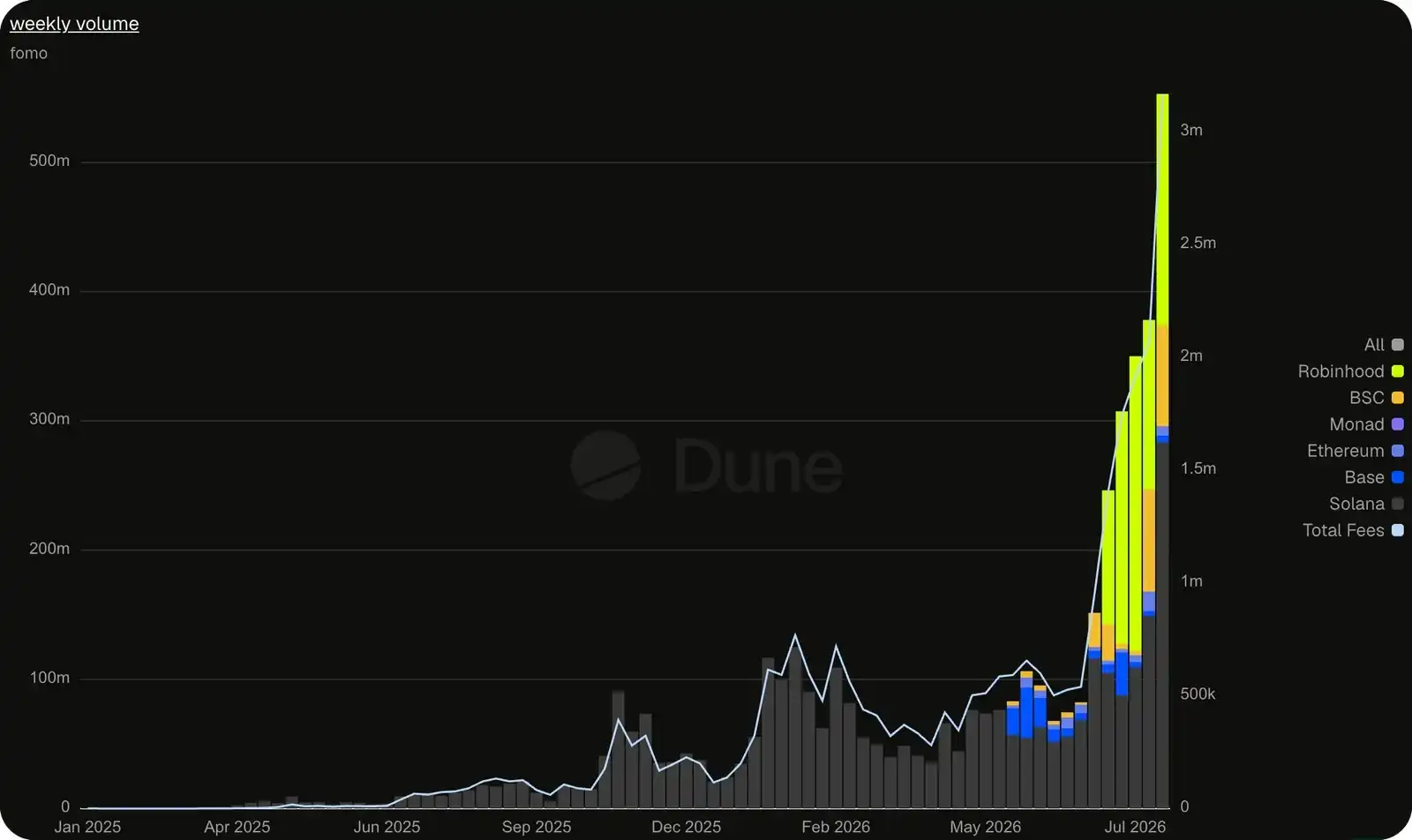
This Dune chart shows Fomo's weekly trading volume: starting with slow growth in early 2025, experiencing an explosive surge after May 2026, with Robinhood Chain being the core driver of volume growth, while total platform fees simultaneously hit record highs.

However, Solana remains the stronghold of speculative trading in the crypto market, and Pump.fun sits at the heart of this arena, unwilling to share the market pie.

Fomo relies on the underlying infrastructure from Pump.fun, achieving rapid growth with a superior front-end interface, essentially acting as a middleman between Solana's speculative infrastructure and the average speculative user. The term 'middleman' here is not derogatory. Fomo has built a product that meets user needs, and the platform's continuous generation of fees proves users are willing to pay for this experience.

But ultimately, most of the features built by Fomo could theoretically be replicated by Pump.fun. We are witnessing this now: Pump.fun is continuously adding numerous social features to its own application, striving to become the 'homepage' for speculative trading.

This creates a delicate dynamic between the two platforms: partners at the underlying infrastructure layer, yet direct competitors in the user-facing market. Fomo holds user traffic, while the infrastructure supporting trade execution mostly belongs to Pump.fun.

Now, Pump.fun wants to capture both the infrastructure and the consumer-facing market layers.

To achieve this goal, Pump.fun is going all out. It is reportedly offering conditions, with contracts worth tens of thousands of dollars per month, to poach top traders from Fomo and attract them to move their trading activities to Pump.fun. This action is not illegal, nor even an industry scandal. Essentially, it's a well-funded platform spending money to attract core users who bring their own traffic.

Beyond this, Pump.fun has also introduced a zero-fee policy for its front-end. It can afford this subsidy because the platform already profits from mechanisms like its bonding curve and PumpSwap; this front-end subsidy model is something Fomo cannot replicate.

Many market participants criticize Fomo for charging fees as a result, but this view misses the core question: what exactly are users paying for?

Users pay for the entire accompanying trading experience: finding traders worth following, viewing their holdings, tracking trade profits, receiving market alerts, and completing all operations through an interface that significantly lowers the barrier to cryptocurrency actions.

Transaction fees are Fomo's core revenue source; the entire user experience is its main business. Pump.fun can offer similar features for free because its underlying business already provides stable income.

In my view, there are two key points worth considering in this matter.

First, this is yet another classic case: mature crypto infrastructure projects are beginning vertical integration upward, competing for end-user traffic. A similar drama is unfolding with Uniswap on Robinhood Chain. After becoming the core on-chain trading infrastructure, Uniswap is promoting its own launchpad, no longer merely serving as an underlying tool for other platforms. Pump.fun is employing the same strategy on Solana: having already captured the underlying infrastructure for speculative trading, it now wants to further control the consumer-facing layer for ordinary users.

Second, I believe the key to the ultimate outcome between Pump.fun and Fomo lies in trust.

Due to its central position in the meme speculation arena, regardless of objectivity, Pump.fun's reputation within the crypto community is mixed. And the rumors of the platform heavily incentivizing trader poaching further damage its image.

In contrast, Fomo launched later, carries less historical baggage, and its product was designed from the outset to make trading behavior more transparent and traceable, focusing on social trading.

But the value of social trading depends entirely on the credibility of the signals traders provide. A trader can publicly buy with one wallet and quietly sell with another; build a position in advance, promote it publicly, and then dump the holdings on followers. While blockchain enables on-chain data transparency, it cannot guarantee that traders themselves are trustworthy.

Ultimately, where users choose to trade depends on which platform can maximize the authenticity of the information displayed. Once traders collude, use multiple hidden wallets to obscure transactions, and harvest their followers, users will lose trust in trading signals. After trust collapses, the value of the social trading layer that both platforms are fiercely competing for will also vanish.

It remains to be seen what measures both platforms will take to maintain user trust going forward.


Criptomoedas em alta

Perguntas relacionadas

QWhat are the main strategies that Pump.fun is using to compete with Fomo for trading traffic?

APump.fun is employing two main strategies to compete with Fomo. First, it is reportedly offering lucrative contracts, worth tens of thousands of dollars per month, to attract top traders from Fomo to migrate their trading activity to Pump.fun. Second, it has introduced a zero-fee policy for its front-end interface, a subsidy it can afford due to profits from its underlying infrastructure like bonding curves and PumpSwap, which Fomo cannot replicate as its core revenue comes from transaction fees.

QWhat is the fundamental difference in the business models of Pump.fun and Fomo that allows Pump.fun to offer a zero-fee front-end?

AThe fundamental difference lies in their primary revenue sources. Pump.fun's core business and profitability come from its underlying infrastructure, such as the bonding curve mechanism and PumpSwap, which facilitate token creation and trading. This allows it to subsidize its front-end by offering zero fees. In contrast, Fomo's main business and revenue stream is its user-facing platform and the associated trading experience; transaction fees are essential for its operation, as it does not have the same foundational infrastructure profits to offset such costs.

QAccording to the article, what broader trend in the crypto industry does the competition between Pump.fun and Fomo represent?

AThe competition represents a trend of vertical integration, where mature crypto infrastructure projects begin moving upstream to capture end-user traffic and control the consumer-facing layer. Similar dynamics are seen with Uniswap on Robinhood Chain, which, after becoming core on-chain trading infrastructure, started promoting its own launchpad instead of just serving as a backend tool for other platforms. Pump.fun is following the same playbook on Solana.

QWhat is identified as the ultimate deciding factor for which platform, Pump.fun or Fomo, will win in the long run?

AThe article identifies user trust as the ultimate deciding factor. The value of social trading, which Fomo emphasizes and Pump.fun is replicating, depends entirely on the credibility of the signals traders provide. If traders engage in manipulative practices (like wash trading or hidden wallets), user trust will erode. The platform that can best ensure the authenticity of the information and trading signals displayed will likely gain a decisive advantage.

QHow does Fomo's product design differentiate it in the meme coin trading space, and what is a potential vulnerability of this model?

AFomo differentiates itself by socializing, publicizing, and making trading trackable. Its product allows users to follow traders, view their portfolios, copy trades (or trade against them), and observe the entire trading process in real-time. This superior front-end experience drove its rapid growth. A potential vulnerability of this social trading model is its dependence on trader trustworthiness. The transparency of blockchain data does not prevent traders from acting dishonestly (e.g., using multiple wallets to hide true positions), which could lead to a collapse in user trust and devalue the platform's core offering.

Leituras Relacionadas

Wall Street Morning Report: CPI Lands Mildly, U.S. Stocks Stage Deep V-Shaped Reversal, AI Cloud, Storage, and Optical Communications Collectively Surge

Wall Street Morning Report: US stocks staged a deep V-shaped recovery following a mild CPI report, with AI cloud, storage, and optical communication sectors leading the rally. Major indexes were mixed: the Dow dipped slightly, while the S&P 500 and Nasdaq gained, nearing record highs. The July CPI data met expectations, with core inflation hitting its slowest pace since March 2021, further reducing expectations for a September Fed rate hike. Market focus shifted decisively towards AI infrastructure. The Philadelphia Semiconductor Index jumped 2.49%. AI cloud providers NEBIUS and CoreWeave surged 34% and 19% respectively on strong earnings and massive order backlogs. Optical communication stocks like Lumentum and Coherent also posted significant gains. The storage sector rallied broadly, with SK Hynix and Micron among the advancers. Meanwhile, major tech giants saw divergence. Nvidia rose over 3%, while Apple, Microsoft, Amazon, and Meta closed lower. In commodities, gold and silver remained strong, while oil prices retreated as markets awaited developments in the Strait of Hormuz. The US federal budget deficit widened significantly in July, raising long-term concerns. Key upcoming events include US PPI data, Sandisk's investor day, and the SEC's 13F filings deadline, which will reveal institutional holdings.

marsbitHá 11m

Wall Street Morning Report: CPI Lands Mildly, U.S. Stocks Stage Deep V-Shaped Reversal, AI Cloud, Storage, and Optical Communications Collectively Surge

marsbitHá 11m

A 22-Year-Old Mathematical Puzzle, Solved by a Union Hospital Intern?

In an astonishing development, a longstanding mathematical problem known as the Crouzeix conjecture, which had challenged experts in numerical linear algebra for 22 years, appears to have been solved by Shanmu Jin, a neurosurgery resident and postdoctoral researcher at Peking Union Medical College Hospital. With no formal advanced mathematical training—his background is in geology and medicine—Jin relied on self-study and, crucially, the AI model GPT-5.6. The conjecture, proposed by mathematician Michel Crouzeix in 2004, concerns a fundamental constant (speculated to be 2) bounding the relationship between matrix norms and polynomial values over numerical ranges. It is critical for applications in matrix function analysis and numerical methods. Despite dedicated efforts by leading mathematicians, the best proven constant had only been reduced to 2.414. Jin approached the problem using sophisticated prompt engineering with GPT-5.6. He adapted a known prompting strategy, isolating the AI from external resources to force original reasoning, employing multiple divergent "sub-agents" to explore different paths, and enforcing rigorous adversarial review of proposed proof steps. After about 16 hours of autonomous, unsupervised operation, the AI produced a novel and elegant proof. The key insight involved a clever "sampling strategy" that reduced the problem to a simple positivity condition—a solution described as elegant and unexpected by experts. The proof was verified by the conjecture's originator, Michel Crouzeix, and other specialists like Alex Townsend and Anne Greenbaum, who expressed astonishment at its validity. Jin has made the entire process open-source, including the prompt, drafts, and formal verification code. Remarkably, just eight days after Jin's preprint appeared, mathematicians Emiel Lorist and Felix Schwenninger published an independent, concise 5-page proof using a different approach, also developed with the aid of ChatGPT 5.6. Jin welcomed this complementary work. This event marks a potential turning point, demonstrating how AI can enable experts from non-traditional backgrounds to solve deep theoretical problems and dramatically accelerate scientific discovery, heralding what some are calling a new "golden age" for interdisciplinary research.

marsbitHá 25m

A 22-Year-Old Mathematical Puzzle, Solved by a Union Hospital Intern?

marsbitHá 25m

Trading

Spot

Artigos em Destaque

O que é MEME 2.0

Memecoin 2.0: A Ascensão do $MEME 2.0 no Mundo das Criptomoedas Introdução No panorama em constante evolução das criptomoedas, um novo concorrente surgiu. Memecoin 2.0, simbolizado como $MEME 2.0, eleva o conceito de moedas meme a um novo nível emocionante. Como um subproduto do Memecoin original, este projeto capturou a atenção da comunidade crypto ao mudar o foco de incentivos financeiros típicos para uma experiência envolvente e divertida. Operando na blockchain Ethereum, Memecoin 2.0 redefine audaciosamente o envolvimento da comunidade na esfera crypto. O que é Memecoin 2.0, $MEME 2.0? No seu cerne, Memecoin 2.0 é um projeto de criptomoeda que prioriza o espírito comunitário e a diversão associada à cultura meme. Ao contrário das criptomoedas convencionais, que se concentram em casos de uso práticos e benefícios tangíveis, Memecoin 2.0 distingue-se ao abraçar o lado mais leve da moeda digital. O projeto existe sem promessas de utilidade, um roteiro estruturado ou retornos financeiros, focando em vez disso em fomentar uma comunidade vibrante centrada em memes e no prazer partilhado. Ao fazer isso, aproveita a crescente tendência da cultura meme no espaço online, tornando-se num jogador único no mundo dos ativos digitais. Criador do Memecoin 2.0, $MEME 2.0 Apesar de extensa pesquisa sobre as origens do Memecoin 2.0, a identidade explícita do seu criador continua desconhecida. Esta anonimidade não é incomum na comunidade crypto, onde muitos projetos são liderados por indivíduos ou grupos que preferem ficar nos bastidores. A falta de informações publicamente disponíveis sobre o criador pode ser vista como um movimento estratégico, colocando os holofotes no envolvimento da comunidade em vez de na notoriedade individual dentro do espaço. Investidores do Memecoin 2.0, $MEME 2.0 As informações sobre os investidores ou o financiamento do Memecoin 2.0 são escassas. Esta ausência de detalhes pode sugerir que o projeto é autofinanciado ou que o seu foco na comunidade, em vez de estruturas de investimento tradicionais, atraiu um tipo diferente de apoiador. Como o mundo das moedas memes geralmente envolve mais envolvimento de base do que investimento institucional, esta abordagem alinha-se ao ethos de projetos orientados pela comunidade. Como Funciona o Memecoin 2.0, $MEME 2.0? O Memecoin 2.0 opera inteiramente na blockchain Ethereum, aproveitando as suas robustas características de segurança e escalabilidade. Ao aproveitar os pontos fortes da Ethereum, o Memecoin 2.0 pode oferecer um ambiente seguro para interações dos utilizadores enquanto assegura que as transações são eficientes e custo-efetivas. Uma das características únicas do Memecoin 2.0 reside na sua estrutura orientada pela comunidade. O valor e a popularidade do token $MEME 2.0 derivam da participação ativa dos seus utilizadores, em vez de uma utilidade inerente. Este design reforça o foco do projeto no aspecto de entretenimento das criptomoedas, implicando que o riso e o envolvimento da comunidade são as verdadeiras moedas que impulsionam o seu sucesso. Além disso, o projeto insere-se no ecossistema mais amplo das moedas meme, onde o valor de cada moeda meme oscila com base na cultura, nas tendências e no envolvimento da comunidade, em vez de nos princípios económicos tradicionais. Linhas do Tempo do Memecoin 2.0, $MEME 2.0 Para melhor entender a evolução e os marcos do Memecoin 2.0, aqui está uma linha do tempo que destaca eventos significativos na sua história: 2024: O início do Memecoin 2.0 é reconhecido como um desdobramento do Memecoin original, estabelecendo-se dentro do contexto próspero das moedas meme enquanto opera na blockchain Ethereum. 13 de Julho de 2024: O Memecoin 2.0 posiciona-se oficialmente como uma moeda meme centrada na comunidade na rede Ethereum, enfatizando a sua abordagem centrada no entretenimento que convida os utilizadores a participar e envolver-se no seu crescimento. Pontos Chave Sobre o Memecoin 2.0, $MEME 2.0 Várias características críticas definem o Memecoin 2.0: Abordagem Centrada na Comunidade: A missão primária do Memecoin 2.0 é criar uma experiência comunitária divertida e envolvente, capitalizando o prazer coletivo derivado da cultura meme. Construído na Ethereum: Operar na blockchain Ethereum fornece ao projeto uma infraestrutura essencial que garante segurança e escalabilidade. Falta de Utilidade ou Roteiro: Numa notável divergência das criptomoedas tradicionais, o Memecoin 2.0 não promete quaisquer características utilitárias ou retornos financeiros, reafirmando o seu compromisso com o envolvimento da comunidade e a participação social. Foco na Cultura Meme: Ao abraçar os aspectos humorísticos e culturais do fenómeno meme, o Memecoin 2.0 fornece uma plataforma para que os utilizadores se envolvam com a crypto offline e online. Contexto Adicional: A Importância das Moedas Meme As moedas meme emergiram como uma classe distinta de criptomoeda, frequentemente impulsionadas pelo humor e por uma abordagem leve ao comércio. Estas moedas geralmente carecem de utilidade significativa ou roteiros de desenvolvimento, atraindo os utilizadores com a promessa de diversão, interação comunitária e relevância cultural. No panorama do ecossistema crypto mais amplo, as moedas meme revive a importância do envolvimento da comunidade, resistindo contra abordagens exclusivamente orientadas para o lucro. Projetos como o Memecoin 2.0 inauguram uma era em que o entretenimento pode harmonizar-se com aspirações financeiras, transformando a blockchain numa plataforma para criatividade e interação social. Conclusão O Memecoin 2.0, ou $MEME 2.0, representa uma nova onda de criptomoeda que prioriza o envolvimento da comunidade em detrimento de estruturas financeiras rígidas. Com um foco no humor e na interação social, capitaliza a fascinação em torno da cultura meme. Ao operar na blockchain Ethereum, o Memecoin 2.0 aproveita as capacidades da tecnologia, enquanto mantém um compromisso firme com o valor de entretenimento da moeda digital. À medida que o espaço em torno das criptomoedas continua a evoluir, o Memecoin 2.0 serve como um testemunho da ideia de que o futuro dos ativos digitais pode muito bem depender de experiências partilhadas, risadas e conexões comunitárias sólidas. No mundo imprevisível da crypto, talvez a alegria possa ser tão valiosa quanto o ganho financeiro tradicional.

160 Visualizações TotaisPublicado em {updateTime}Atualizado em 2024.12.03

O que é MEME 2.0

Como comprar MEME

Bem-vindo à HTX.com!Tornámos a compra de Memeland (MEME) simples e conveniente.Segue o nosso guia passo a passo para iniciar a tua jornada no mundo das criptos.Passo 1: cria a tua conta HTXUtiliza o teu e-mail ou número de telefone para te inscreveres numa conta gratuita na HTX.Desfruta de um processo de inscrição sem complicações e desbloqueia todas as funcionalidades.Obter a minha contaPasso 2: vai para Comprar Cripto e escolhe o teu método de pagamentoCartão de crédito/débito: usa o teu visa ou mastercard para comprar Memeland (MEME) instantaneamente.Saldo: usa os fundos da tua conta HTX para transacionar sem problemas.Terceiros: adicionamos métodos de pagamento populares, como Google Pay e Apple Pay, para aumentar a conveniência.P2P: transaciona diretamente com outros utilizadores na HTX.Mercado de balcão (OTC): oferecemos serviços personalizados e taxas de câmbio competitivas para os traders.Passo 3: armazena teu Memeland (MEME)Depois de comprar o teu Memeland (MEME), armazena-o na tua conta HTX.Alternativamente, podes enviá-lo para outro lugar através de transferência blockchain ou usá-lo para transacionar outras criptomoedas.Passo 4: transaciona Memeland (MEME)Transaciona facilmente Memeland (MEME) no mercado à vista da HTX.Acede simplesmente à tua conta, seleciona o teu par de trading, executa as tuas transações e monitoriza em tempo real.Oferecemos uma experiência de fácil utilização tanto para principiantes como para traders experientes.

419 Visualizações TotaisPublicado em {updateTime}Atualizado em 2026.06.02

Como comprar MEME

Discussões

Bem-vindo à Comunidade HTX. Aqui, pode manter-se informado sobre os mais recentes desenvolvimentos da plataforma e obter acesso a análises profissionais de mercado. As opiniões dos utilizadores sobre o preço de MEME (MEME) são apresentadas abaixo.

活动图片