Bitcoin Shifts Towards Consolidation, Long-Term Holder Selling Pressure Significantly Eases

marsbitPublicado em 2026-07-17Última atualização em 2026-07-17

Resumo

Bitcoin's Bottoming Process Shows Signs of Shifting Dynamics Bitcoin's bottom formation is ongoing, but key characteristics are changing. The capitulation selling by long-term holders (LTHs), a primary source of selling pressure this cycle, has begun to cool from its recent peak. Buyers successfully absorbed the selling at the June lows, and price is now recovering to challenge overhead resistance. The market is testing higher resistance levels. Bitcoin reacted more strongly to soft inflation data than major equity indices, signaling sellers may be exhausted and buyers are waiting for a catalyst. Its correlation with stocks is weakening while its inverse relationship with the USD is deepening, suggesting liquidity dynamics are now more influential than risk sentiment. On-chain, price sits between the network's Realized Price (a historical bear market floor) and the Short-Term Holder (STH) cost basis near $69k, a key resistance level where recent buyers break even. LTH profit-taking has largely dried up, and losses now dominate realized on-chain volume—a typical late bear market signal. Crucially, the pace of LTH capitulation has started to decline. Derivatives markets show bearish positions are being unwound, with put/call ratios falling and crash protection costs moderating. However, this derisking hasn't been accompanied by significant spot buying, a missing link for sustained recovery. US spot ETF outflows have slowed but not reversed. In conclusion, foundational elem...

Author: Glassnode

Compiled by: AididiaoJP, Foresight News

Bitcoin's bottom is still being built, but its characteristics are quietly shifting. The capitulation selling by long-term holders is cooling off, buy-side demand has successfully absorbed the June lows, and the price is gradually recovering, challenging the zone that previously suppressed it.

Executive Summary

  • The market has begun testing resistance levels above.
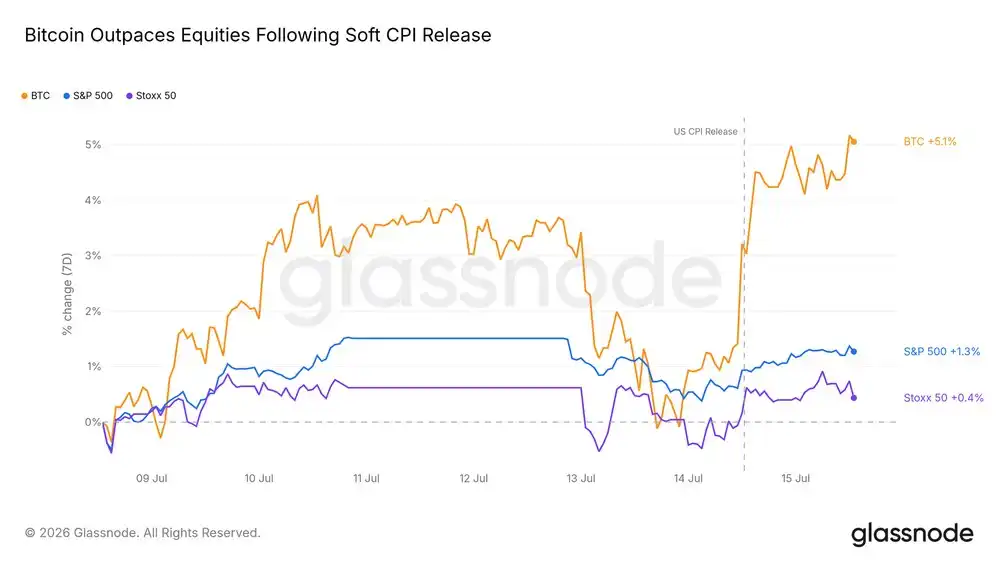
  • Bitcoin's reaction to weak inflation data was much stronger than that of any major stock index, marking the most positive response to good news in weeks.
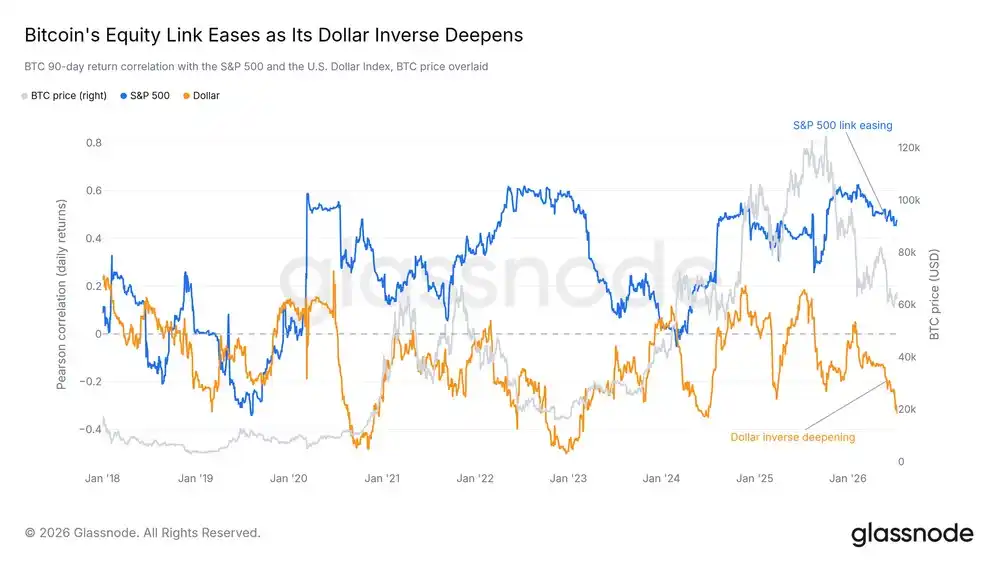
  • Correlations with equities are loosening, while the inverse linkage with the dollar is deepening further – the current driver is liquidity, not risk appetite.
  • Long-term holder selling – the primary source of selling pressure this year – has retreated from its peak.
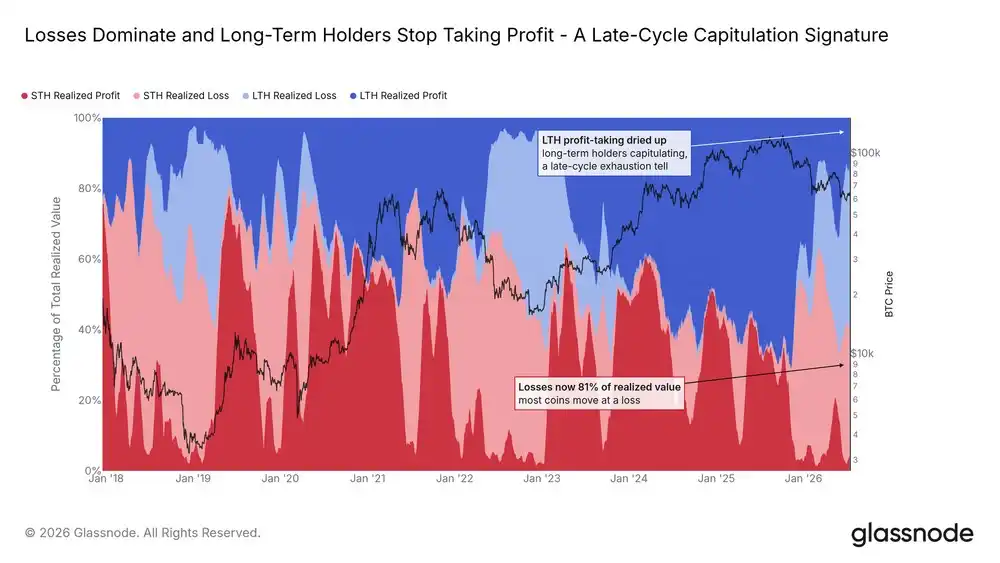
  • Profit-taking has drastically reduced. Buyers have fully absorbed the selling pressure at the June lows, diminishing the supply pressure faced on each subsequent rally.
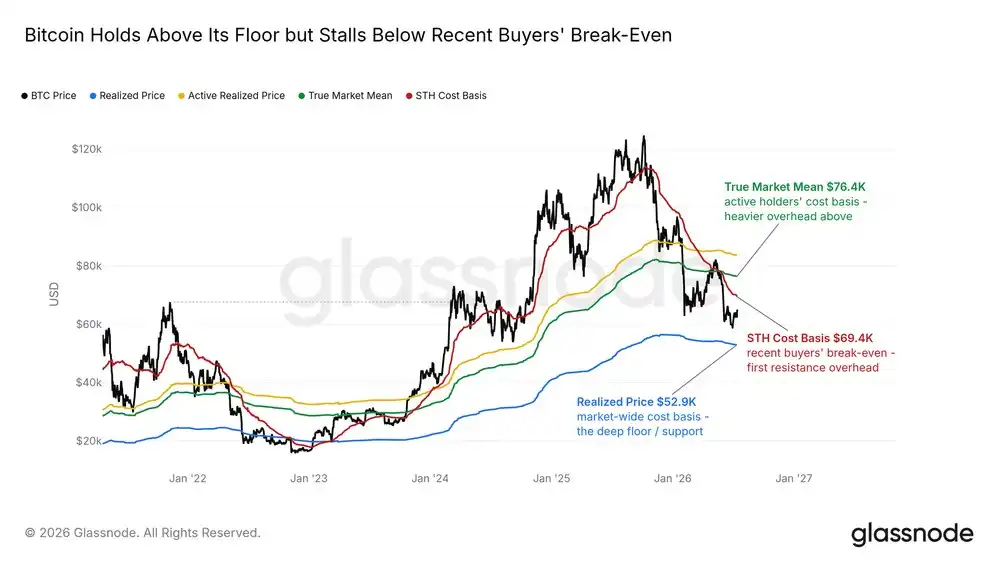
  • The Short-Term Holder cost basis is near $69,000, the break-even line for recent buyers, which will become the next significant resistance; a strong reaction is expected there.
  • Derivative traders are unwinding bearish positions, but spot buying has not yet followed, which is the missing link in the current recovery.

Macro Insights

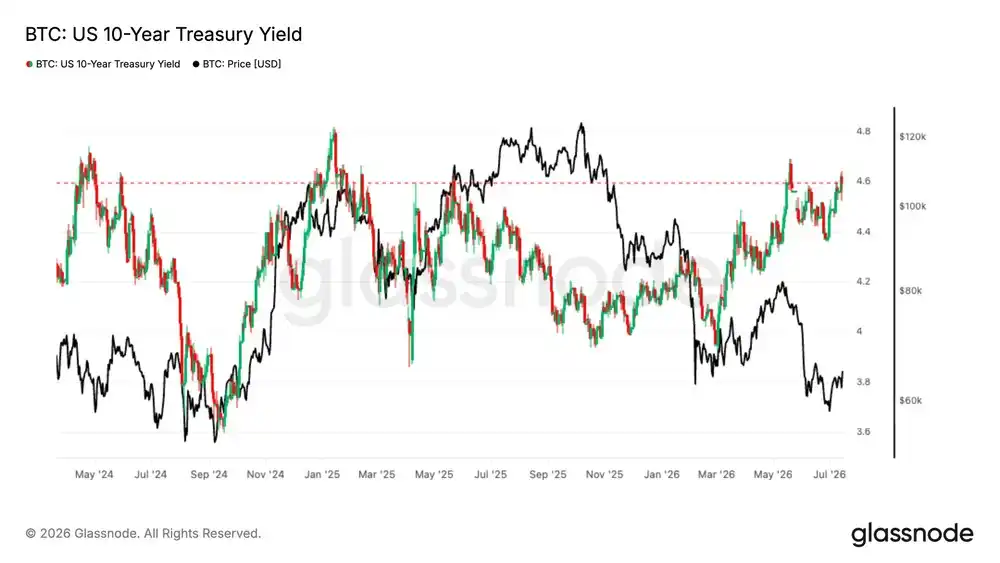
The pressure faced by Bitcoin this quarter is essentially a story of real rates, not risk-off. The 10-year real yield has climbed to around 2.4%, near the 2026 highs, and the dollar has held above its 200-day moving average since May. However, broader risk assets show no signs of strain: equities are near highs, credit spreads are low, and volatility remains moderate.
Bitcoin Leads the Rally

Following Tuesday's soft inflation data, Bitcoin posted larger gains than any other major asset. It jumped swiftly after the release, significantly outperforming US and European stocks for the week. After a month of sideways movement near lows, the market is once again reacting positively to good news.

This sensitivity is itself a signal: a market eager to rally on a single inflation report often indicates that sellers are exhausted, and buyers are just waiting for a reason.
Shift in Macro Drivers

Underneath the rally, Bitcoin's driving factors are changing. Its correlation with US stocks has been weakening since winter, while its inverse relationship with the dollar has deepened. Bitcoin is looking less like a proxy for stocks and more like an asset that strengthens when the dollar weakens.

It has not decoupled from the risk asset universe, but the dollar and liquidity channels now hold more sway than stock market sentiment. This is the channel most likely to transmit first if the macro environment loosens from here.
On-Chain Insights

Between Floor and Ceiling

The cost basis map precisely illustrates the current position. The Bitcoin price is above the network's average realized price – a natural floor in bear markets; yet it is below the Short-Term Holder cost basis (near $69,000) – the average entry price for buyers over the past five months. The current recovery is climbing towards this break-even resistance level, with a large number of trapped buyers waiting above.

The first touch of this level is likely to trigger a strong reaction, as those most inclined to sell are the ones about to break even. Successfully reclaiming it would open space for the recovery; rejection would reinforce the range-bound pattern.
Sellers Stop Taking Profits

The Long-Term/Short-Term Holder Realized Profit/Loss ratio indicator categorizes all on-chain selling into four types: veterans and newcomers, each selling at a profit or loss. For most of this cycle, selling by long-term holders at a profit dominated the selling flow. This flow has now nearly dried up completely; veterans are primarily selling at a loss.

Loss-selling by both cohorts now constitutes the main transactional signature on-chain, a typical late-bear signal. The crucial change is that the share of selling by long-term holders has stopped growing. The wave of selling pressure that has capped every rally this year is no longer expanding.
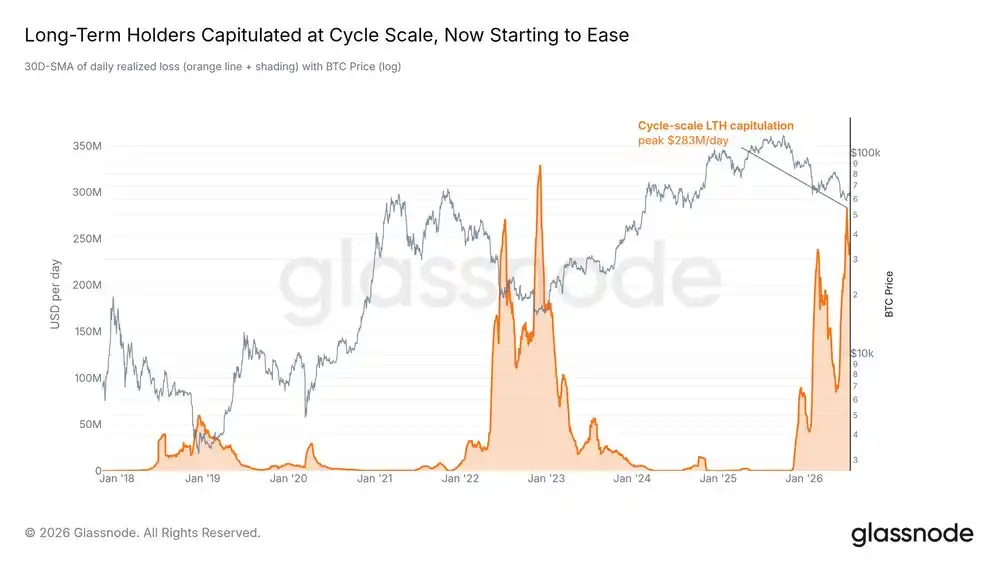
Capitulation Selling Begins to Cool

The rhythm of this capitulation is the most important current metric. The Entity-Adjusted Long-Term Holder Realized Loss metric filters out internal transfers, reflecting the actual volume that veterans are giving up each day. This metric hit a cycle peak two weeks ago; last week's report highlighted that its cooling was a prerequisite for any lasting recovery.

Now it has begun to recede. A single pullback doesn't prove exhaustion, and new shocks could restart selling. But in this cycle, it's the first time this core metric defining the bottoming process has shifted from rising to falling. The primary sellers driving this bear market are, at the margin, drying up.
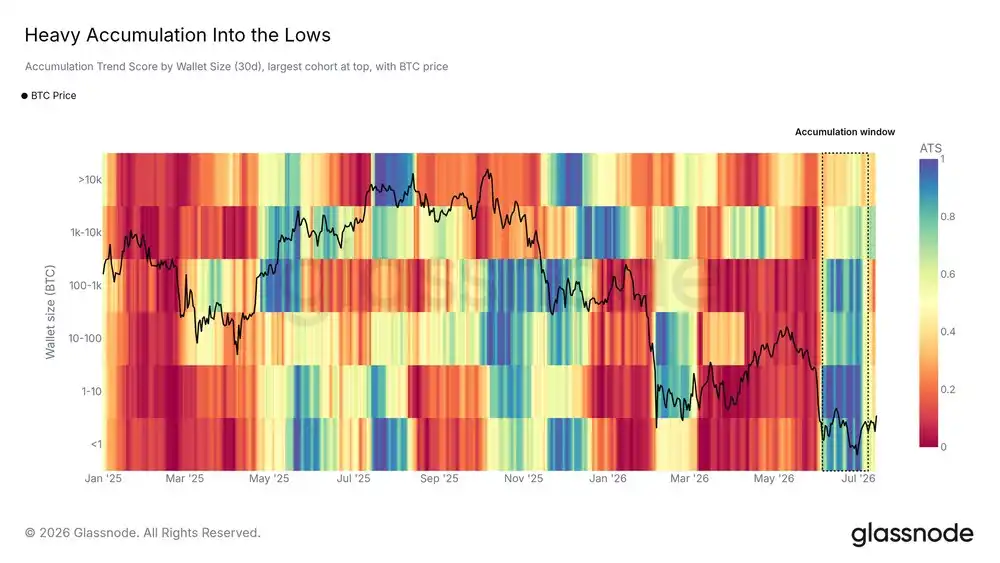
Demand Absorbs Lows Selling

As veterans capitulated, buyers stepped in promptly. The Accumulation Trend Score, segmented by wallet size, shows a broad and strong wave of buying during the June lows, covering wallets from small to large. After prices stabilized, this intensity weakened, and the market entered a waiting mode.

The coins sold at the lows found buyers. Whether these buyers return with similar force in the next move will determine whether this bottom holds.
Off-Chain / Derivatives Insights

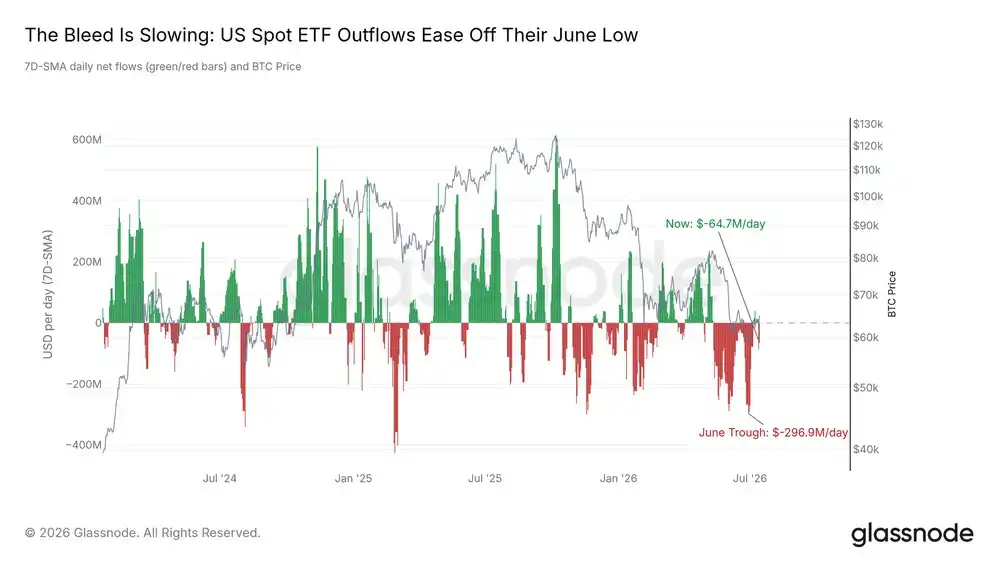
ETF Outflows Slow

US Spot ETFs tell a similar story of easing but unresolved pressure. Redemption pressure has significantly retreated from June's extreme levels, trending towards stabilization. However, the channel is not fully repaired: this week still saw one of the largest single-day outflows in several weeks, followed by a partial inflow the next day.

Until inflows truly return and hold steady, this remains a market where institutions have stopped fleeing but have not yet started buying.
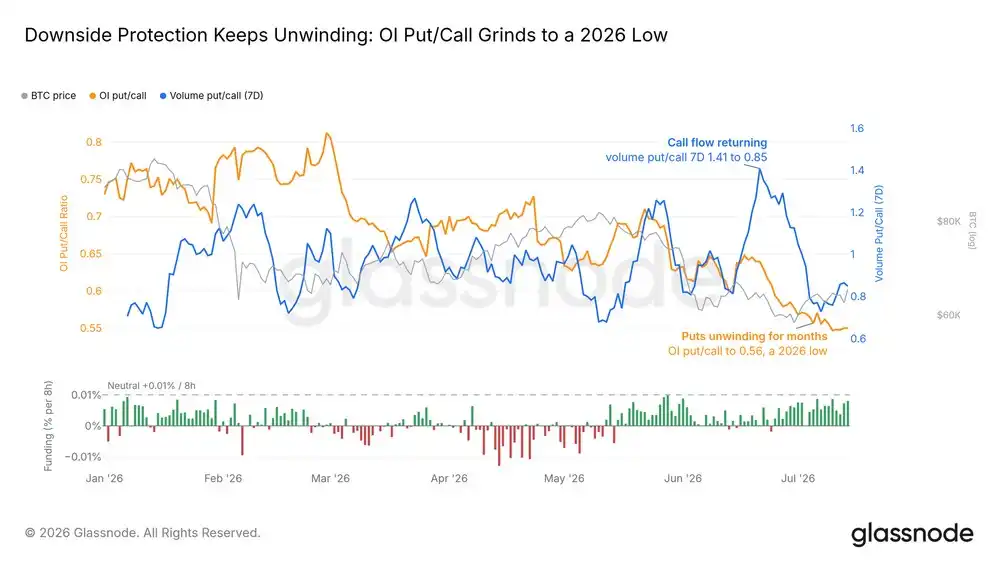
Bears Throw in the Towel

Derivative markets have been moving in the opposite direction for weeks. The options put/call ratio has fallen to its lowest level this year, with traders letting bearish protection expire; perpetual funding rates are only slightly above neutral, far from crowded long levels. Bearish bets are quietly and steadily unwinding.

But this unwinding hasn't translated into actual buying. Position adjustments by futures and options traders do not equate to capital entering the spot market, which is the clearest warning sign in the current recovery.
Panic Premium Eases

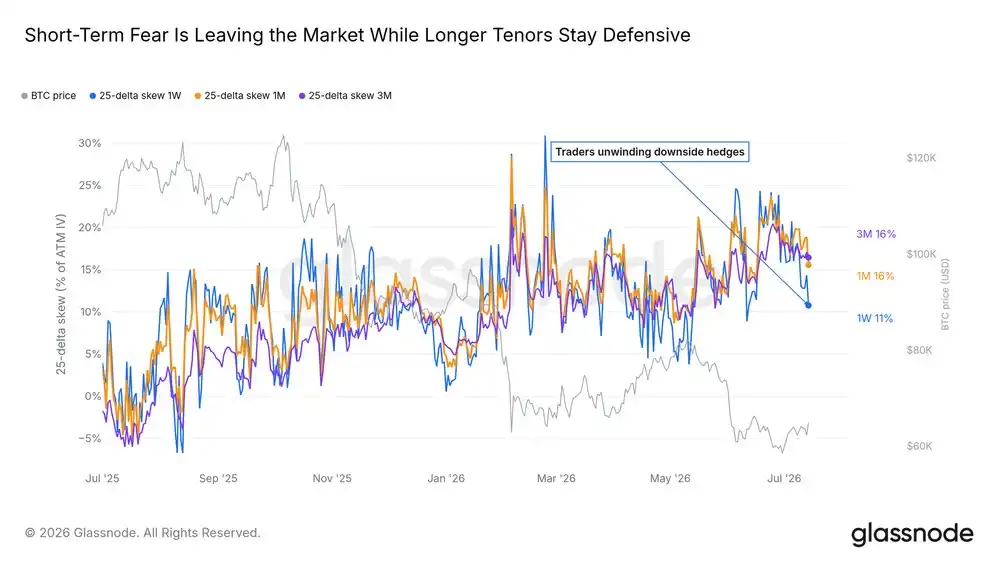
The premium for crash protection in the options market (measured via 25-Delta Skew) spiked during the June sell-off but has since consistently receded, now well below February's extreme levels. The cost of hedging each pullback is noticeably lower than a month ago.

Demand for protection still exists – as it should with unconfirmed lows – but the overall direction is normalizing.
Approaching Max Pain

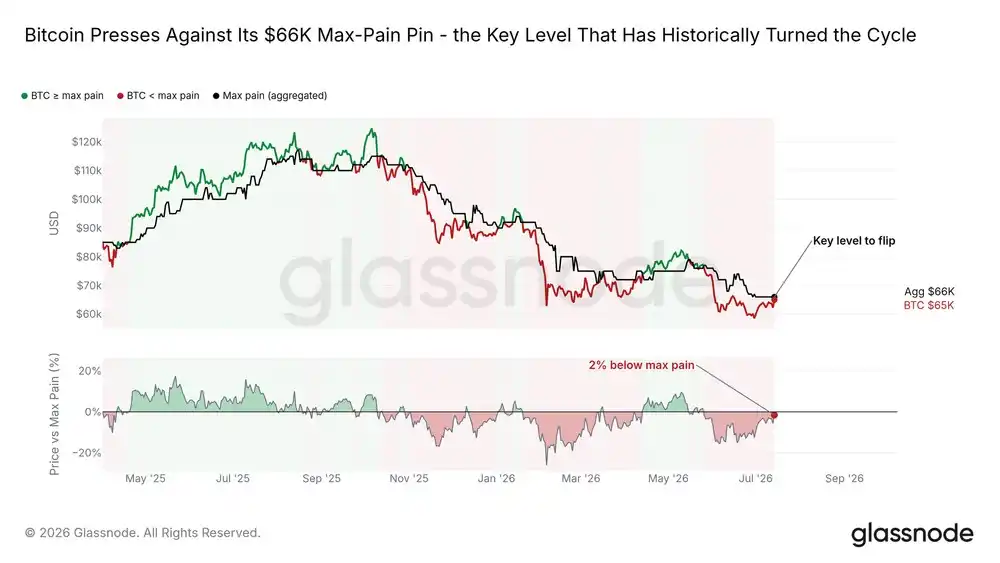
Max Pain is the price at which the largest volume of open options expires worthless, and spot price has oscillated around it this year. Bitcoin is currently just below this level and challenging it for the first time in weeks.

Historically, reclaiming Max Pain often coincides with a shift to a more market-friendly environment, though the transition takes time. A clean break above this level would be the first structural signal of an upside breakout from the range; rejection would confirm the cautious sentiment still priced into the options market.
Crash Protection Costs Decline

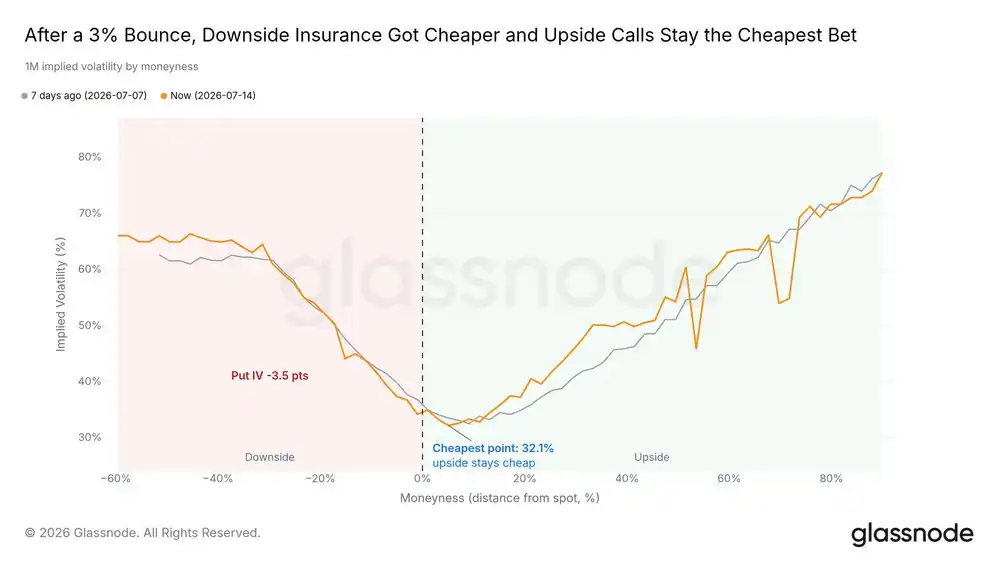
Absolute protection costs also confirm the easing trend. During the recovery, the price for one-month crash protection has steadily declined, indicating waning hedging demand. The market still pays a premium for downside protection, but significantly less than at the lows.
Volatility Enters a Calm Period

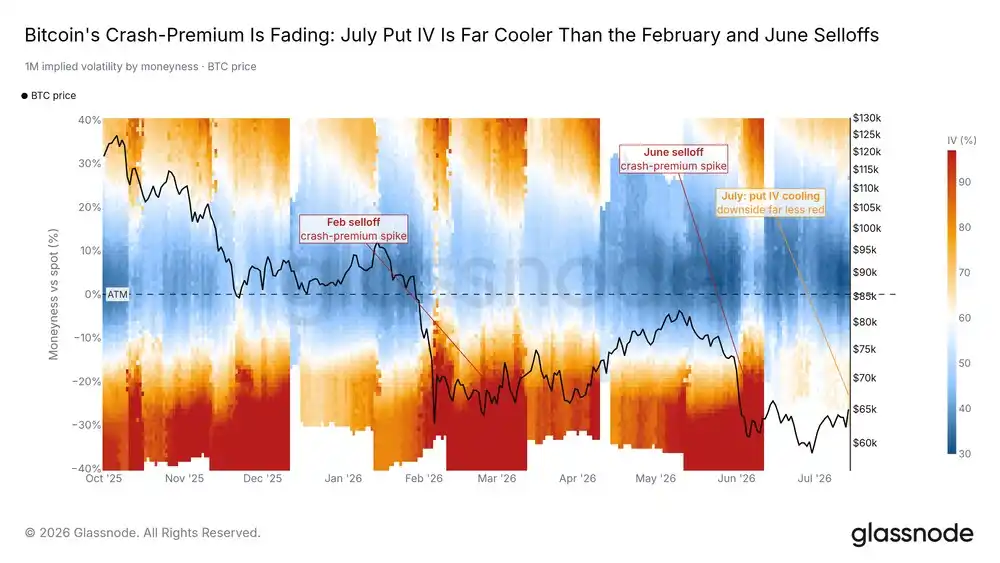
A longer-term view shows how calm the market has become. The Bitcoin Volatility Index (DVOL) is near one-year lows, and the deep put pressure that erupted in February and June has faded from the volatility surface. Such compression rarely lasts; it's often the backdrop before the next decisive move begins.
Conclusion

A bottom is still being built, and this week it began to respond. Long-term holder capitulation has retreated from its peak, profit-taking has dried up, and the June lows were absorbed by broad-based buying. Bitcoin reacted more strongly to macro-positive news than other assets, is approaching Max Pain from below, and nearing the Short-Term Holder cost basis above – where the recovery will face its first real test.

Confirmation signals are still absent: ETF outflows have slowed but not reversed, derivative unwinding lacks spot follow-through, and compressed volatility awaits a catalyst. The key signal to change the view would be spot-driven buying that pushes price to effectively break through and hold above the Short-Term Holder cost basis. If long-term holder losses accelerate again, or if price is pushed back near the Realized Price, the market will return to range-bound trading.

The foundation is laid, but the follow-through has not yet arrived.

Criptomoedas em alta

Perguntas relacionadas

QWhat is the key change in the behavior of long-term Bitcoin holders according to the article?

AThe key change is that the selling pressure from long-term holders, which was the primary source of sell pressure this year, has peaked and is now declining. Specifically, profit-taking sales by long-term holders have almost completely dried up, and their realized loss selling has started to cool off from its recent peak.

QWhat are the two key price levels that define Bitcoin's current trading range, as mentioned in the article?

AThe two key levels are the Realized Price (the network-wide average cost basis), which acts as a floor, and the Short-Term Holder Cost Basis (around $69,000), which acts as a ceiling. Bitcoin is currently trading between these two levels.

QHow did Bitcoin react to the soft inflation data mentioned in the article compared to other assets?

ABitcoin reacted more strongly to the soft inflation data than any other major asset class. It rallied immediately after the data release and significantly outperformed major stock indices (US and European) over the week, marking its most positive response to good news in weeks.

QWhat does the article identify as the missing element in the current Bitcoin market recovery?

AThe missing element is spot-driven buying. While derivatives traders are unwinding bearish bets (reducing shorts and letting puts expire), this adjustment in positions has not been accompanied by significant capital flowing into the spot market to buy Bitcoin directly.

QWhat is the 'Max Pain' price level, and what significance does the article attach to Bitcoin's price action relative to it?

AThe 'Max Pain' price is the strike price at which the largest number of open option contracts would expire worthless. The article states that Bitcoin's price has oscillated around this level all year and is now challenging it from below for the first time in weeks. A clean break and hold above Max Pain would be the first structural signal of an upward breakout from the range, while a rejection would confirm the cautious sentiment still priced in by options markets.

Leituras Relacionadas

Li Shanyou: The World Is Getting More Competitive, But We Can Choose to Be Slower, Go Deeper, and Turn Inward

**Title:** Li Shanyou: The World Is Moving Faster and More Chaotically; We Can Choose to Be Slower, Deeper, and More Inward **Summary:** In an era where AI evolves weekly and past experiences often fail, the article argues for returning to First Principles. It shifts focus from "cognition" (knowledge/content), which AI has disrupted, to "consciousness" or "the capacity to know"—the foundational ability that enables cognition and determines its scope and depth. The piece uses Zhang Yiming (founder of ByteDance) as a case study for the "second-order consciousness" of the mobile internet era: success through rational logic, modeling, and deduction, which allowed him to surpass earlier "first-order" entrepreneurs reliant on copying experiences. However, the author suggests that the AI era demands a further leap to "third-order consciousness"—operating from a place of inner inspiration, vision, or "ideas," beyond pure rationality. Figures like Elon Musk and Steve Jobs are cited as examples, with DeepSeek's Liang Wenfeng presented as a potential representative of this new, AI-native wave of entrepreneurs driven by curiosity and innovation rather than just commercial logic. For the majority who may not become such visionary leaders, the author proposes an alternative path: the "Path of Quality" or "Work as Art." This involves turning inward, focusing on the immediate task at hand, and imbuing one's work with care and dedication—creating a "quality" product not as a means to an end, but as an end in itself. This process refines both the work and the individual's own consciousness. In a hyper-competitive, fast-paced world, this path offers a counterpoint: to be slower, go deeper, and focus inward, finding meaning by creating quality in everyday endeavors, regardless of scale.

marsbitHá 1h

Li Shanyou: The World Is Getting More Competitive, But We Can Choose to Be Slower, Go Deeper, and Turn Inward

marsbitHá 1h

1inch Co-founder Anton Bukov Leaves, Launches New Project Second Tier

Anton Bukov, co-founder of the decentralized exchange aggregator protocol 1inch, has announced his departure from the company's daily operations. Bukov, who was instrumental in designing core 1inch architectures like the Router, Fusion, and cross-chain Swap, ceased involvement in November 2025 due to strategic and leadership disagreements, though he retains his co-founder title and 50% equity stake. Concurrently, Bukov unveiled his new venture, Second Tier (tier.xyz), describing it as infrastructure to "shorten the distance between economic intent and on-chain execution." He explicitly stated it is not a DEX or aggregator. The project's public-facing material is currently a manifesto criticizing systemic financial friction and advocating for building new architectural categories rather than competing within existing ones. No product details, team, or funding have been disclosed. The split highlights a strategic divergence within 1inch. While CEO Sergej Kunz has steered the company toward traditional finance integration—evidenced by a 2025 brand refresh and a major Coinbase partnership—Bukov emphasized a commitment to decentralized, permissionless DeFi principles. Bukov's exit coincides with a challenging period for 1inch. Q1 2026 data shows a 60.3% quarterly drop in its daily average trading volume to $97.1 million, underperforming the broader DEX aggregator market decline. Its market share fell from 25.2% to 17.0%, dropping it to fourth place among competitors. Key questions remain regarding Bukov's future role as a major 1inch shareholder, the timeline for Second Tier's product development, and whether 1inch's institutional-focused strategy can reverse its declining trading metrics.

Foresight NewsHá 1h

1inch Co-founder Anton Bukov Leaves, Launches New Project Second Tier

Foresight NewsHá 1h

Meituan Leads Investment, New Unicorn in Dexterous Hands Born

Xynova, a full-stack provider of dexterous hand solutions for embodied intelligence, has officially become a unicorn after securing a 500 million yuan Series A+ round led by Meituan. This marks the company's third major funding in 2024, bringing the total raised in four months to approximately 1.5 billion yuan. The investment lineup features a prominent group of industrial and internet giants, including repeat investors like Xiaomi and new backers such as NIO Capital and China Merchants Capital. With total market capitalization of its industrial shareholders exceeding 5 trillion yuan, the backing represents a strategic positioning across the new energy manufacturing, smart logistics, and last-mile delivery sectors. Founded in 2024 by CEO Xia Yuxuan, Xynova focuses on the critical "last centimeter" of robot interaction—the dexterous hand. Moving beyond traditional technical debates, the company adopts a full-stack, self-developed approach, integrating hardware and algorithms. Its flagship product, the Flex 2, is a hybrid tendon-and-direct-drive hand with 23 degrees of freedom, weighing under 400 grams and boasting a key component lifespan of over 1.5 million cycles. The industry narrative is shifting from robot mobility to practical utility, making reliable, mass-producible components crucial. Xynova has established a 5,400-square-meter factory in Hangzhou, with annual capacity expected to reach 10,000 units by year-end. The company believes embodied robots will see large-scale real-world adoption within three years, potentially as soon as 18 months.

marsbitHá 1h

Meituan Leads Investment, New Unicorn in Dexterous Hands Born

marsbitHá 1h

Trading

Spot

Artigos em Destaque

O que é BITCOIN

Compreender o HarryPotterObamaSonic10Inu (ERC-20) e a Sua Posição no Espaço Cripto Nos últimos anos, o mercado de criptomoedas assistiu a um aumento na popularidade das moedas meme, cativando não apenas os traders, mas também aqueles que procuram envolvimento comunitário e valor de entretenimento. Entre estes tokens únicos está o HarryPotterObamaSonic10Inu (ERC-20), um projeto intrigante que mistura referências culturais no tecido das criptomoedas. Este artigo explora os principais aspetos do HarryPotterObamaSonic10Inu, examinando os seus mecanismos, a sua ética orientada pela comunidade e o seu envolvimento com o vasto panorama cripto. O que é o HarryPotterObamaSonic10Inu (ERC-20)? Como o nome sugere, o HarryPotterObamaSonic10Inu é uma moeda meme construída na blockchain Ethereum, classificada sob o padrão ERC-20. Ao contrário das criptomoedas tradicionais, que podem enfatizar a utilidade prática ou o potencial de investimento, este token prospera no valor de entretenimento e na força da sua comunidade. O projeto visa promover um ambiente onde utilizadores envolvidos possam reunir-se, partilhar ideias e participar em atividades inspiradas por diversos fenómenos culturais. Uma característica notável do HarryPotterObamaSonic10Inu é a zero taxa sobre transações. Este elemento atraente visa encorajar a negociação e o envolvimento da comunidade, isento de encargos adicionais que podem desencorajar os traders de pequena escala. A oferta total da moeda está fixada em mil milhões de tokens, uma cifra que marca a sua intenção de manter uma circulação substancial dentro da comunidade. Criador do HarryPotterObamaSonic10Inu (ERC-20) As origens do HarryPotterObamaSonic10Inu estão um pouco envoltas em mistério; os detalhes sobre o criador permanecem desconhecidos. O desenvolvimento deste token carece de uma equipa identificável ou de um plano explícito, o que não é raro no setor das moedas meme. Em vez disso, o projeto surgiu de forma orgânica, com o seu progresso a depender fortemente do entusiasmo e da participação da sua comunidade. Investidores do HarryPotterObamaSonic10Inu (ERC-20) No que diz respeito a investimentos externos e apoios, o HarryPotterObamaSonic10Inu também permanece ambíguo. O token não lista quaisquer fundações de investimento conhecidas ou apoio organizacional significativo. Em vez disso, o “sangue vital” do projeto é a sua comunidade de base, que informa o seu crescimento e sustentabilidade através da ação coletiva e do envolvimento no espaço cripto. Como Funciona o HarryPotterObamaSonic10Inu (ERC-20)? Como uma moeda meme, o HarryPotterObamaSonic10Inu opera principalmente fora dos quadros tradicionais que muitas vezes governam o valor dos ativos. Existem vários aspetos distintivos que definem como o projeto funciona: Transações Sem Taxas: Sem taxas sobre transações, os utilizadores podem comprar e vender o token livremente, sem a preocupação de custos ocultos. Envolvimento da Comunidade: O projeto prospera na interação da comunidade, aproveitando plataformas de redes sociais para criar entusiasmo e facilitar a participação. Discussões, partilha de conteúdo e envolvimento são elementos cruciais que ajudam a expandir o seu alcance e a fomentar a lealdade entre os apoiantes. Sem Utilidade Prática: Deve ser notado que o HarryPotterObamaSonic10Inu não oferece utilidade concreta dentro do ecossistema financeiro. Em vez disso, é classificado como um token principalmente para entretenimento e atividades comunitárias. Referência Cultural: O token incorpora de forma inteligente elementos da cultura popular para atrair interesse, conectando-se tanto com entusiastas de memes como com seguidores de criptomoedas. HarryPotterObamaSonic10Inu exemplifica como as moedas meme operam de forma diferente de projetos de criptomoedas mais tradicionais, entrando no mercado como construções sociais inovadoras em vez de ativos utilitários. Linha do Tempo do HarryPotterObamaSonic10Inu (ERC-20) A história do HarryPotterObamaSonic10Inu é marcada por vários marcos notáveis: Criação: O token surgiu de um meme viral, capturando a imaginação de muitos entusiastas de criptomoedas. Datas específicas de criação não estão disponíveis, sublinhando a sua ascensão orgânica. Listagem em Exchanges: O HarryPotterObamaSonic10Inu conseguiu entrar em várias exchanges, permitindo um acesso e negociação mais fáceis pela comunidade. Iniciativas de Envolvimento da Comunidade: Atividades contínuas direcionadas a melhorar a interação comunitária, incluindo concursos, campanhas em redes sociais e geração de conteúdo por fãs e defensores. Planos de Expansão Futura: O roteiro do projeto inclui o lançamento de uma coleção de NFTs, mercadorias e um site de eCommerce relacionado aos seus temas culturais, envolvendo ainda mais a comunidade e tentando adicionar mais dimensões ao seu ecossistema. Pontos-Chave sobre o HarryPotterObamaSonic10Inu (ERC-20) Natureza Orientada pela Comunidade: O projeto prioriza a contribuição coletiva e a criatividade, assegurando que o envolvimento dos utilizadores está na vanguarda do seu desenvolvimento. Classificação como Moeda Meme: Representa o epítome da criptomoeda baseada em entretenimento, destacando-se dos veículos de investimento tradicionais. Sem Afiliação Direta com o Bitcoin: Apesar da semelhança no nome do ticker, o HarryPotterObamaSonic10Inu é distinto e não tem qualquer relação com o Bitcoin ou outras criptomoedas estabelecidas. Foco na Colaboração: O HarryPotterObamaSonic10Inu é projetado para criar um espaço de colaboração e partilha de histórias entre os seus detentores, proporcionando uma via para a criatividade e o fortalecimento da comunidade. Perspectivas Futuras: A ambição de expandir além da sua premissa inicial para NFTs e mercadorias delineia um caminho para o projeto potencialmente entrar em avenidas mais mainstream dentro da cultura digital. À medida que as moedas meme continuam a capturar a imaginação da comunidade cripto, HarryPotterObamaSonic10Inu (ERC-20) destaca-se devido aos seus laços culturais e abordagem centrada na comunidade. Embora possa não se encaixar no molde típico de um token orientado para utilidade, a sua essência reside na alegria e camaradagem fomentadas entre os seus apoiantes, destacando a natureza em evolução das criptomoedas em uma era cada vez mais digital. À medida que o projeto continua a desenvolver-se, será importante observar como as dinâmicas comunitárias influenciam a sua trajetória no panorama em constante mudança da tecnologia blockchain.

1.7k Visualizações TotaisPublicado em {updateTime}Atualizado em 2024.12.03

O que é BITCOIN

Como comprar BTC

Bem-vindo à HTX.com!Tornámos a compra de Bitcoin (BTC) simples e conveniente.Segue o nosso guia passo a passo para iniciar a tua jornada no mundo das criptos.Passo 1: cria a tua conta HTXUtiliza o teu e-mail ou número de telefone para te inscreveres numa conta gratuita na HTX.Desfruta de um processo de inscrição sem complicações e desbloqueia todas as funcionalidades.Obter a minha contaPasso 2: vai para Comprar Cripto e escolhe o teu método de pagamentoCartão de crédito/débito: usa o teu visa ou mastercard para comprar Bitcoin (BTC) instantaneamente.Saldo: usa os fundos da tua conta HTX para transacionar sem problemas.Terceiros: adicionamos métodos de pagamento populares, como Google Pay e Apple Pay, para aumentar a conveniência.P2P: transaciona diretamente com outros utilizadores na HTX.Mercado de balcão (OTC): oferecemos serviços personalizados e taxas de câmbio competitivas para os traders.Passo 3: armazena teu Bitcoin (BTC)Depois de comprar o teu Bitcoin (BTC), armazena-o na tua conta HTX.Alternativamente, podes enviá-lo para outro lugar através de transferência blockchain ou usá-lo para transacionar outras criptomoedas.Passo 4: transaciona Bitcoin (BTC)Transaciona facilmente Bitcoin (BTC) no mercado à vista da HTX.Acede simplesmente à tua conta, seleciona o teu par de trading, executa as tuas transações e monitoriza em tempo real.Oferecemos uma experiência de fácil utilização tanto para principiantes como para traders experientes.

4.3k Visualizações TotaisPublicado em {updateTime}Atualizado em 2026.06.02

Como comprar BTC

O que é $BITCOIN

OURO DIGITAL ($BITCOIN): Uma Análise Abrangente Introdução ao OURO DIGITAL ($BITCOIN) OURO DIGITAL ($BITCOIN) é um projeto baseado em blockchain que opera na rede Solana, com o objetivo de combinar as características dos metais preciosos tradicionais com a inovação das tecnologias descentralizadas. Embora partilhe um nome com o Bitcoin, frequentemente referido como “ouro digital” devido à sua percepção como uma reserva de valor, o OURO DIGITAL é um token separado projetado para criar um ecossistema único dentro da paisagem Web3. O seu objetivo é posicionar-se como um ativo digital alternativo viável, embora os detalhes sobre as suas aplicações e funcionalidades ainda estejam em desenvolvimento. O que é o OURO DIGITAL ($BITCOIN)? OURO DIGITAL ($BITCOIN) é um token de criptomoeda explicitamente projetado para uso na blockchain Solana. Em contraste com o Bitcoin, que fornece um papel amplamente reconhecido como armazenamento de valor, este token parece focar em aplicações e características mais amplas. Aspectos notáveis incluem: Infraestrutura Blockchain: O token é construído na blockchain Solana, conhecida pela sua capacidade de lidar com transações de alta velocidade e baixo custo. Dinâmicas de Oferta: O OURO DIGITAL tem um fornecimento máximo limitado a 100 quatrilhões de tokens (100P $BITCOIN), embora os detalhes sobre o seu fornecimento circulante ainda não tenham sido divulgados. Utilidade: Embora as funcionalidades precisas não estejam explicitamente delineadas, existem indicações de que o token poderia ser utilizado para várias aplicações, potencialmente envolvendo aplicações descentralizadas (dApps) ou estratégias de tokenização de ativos. Quem é o Criador do OURO DIGITAL ($BITCOIN)? Neste momento, a identidade dos criadores e da equipa de desenvolvimento por trás do OURO DIGITAL ($BITCOIN) permanece desconhecida. Esta situação é típica entre muitos projetos inovadores no espaço da blockchain, particularmente aqueles alinhados com finanças descentralizadas e fenómenos de moedas meme. Embora tal anonimato possa fomentar uma cultura orientada pela comunidade, intensifica as preocupações sobre governança e responsabilidade. Quem são os Investidores do OURO DIGITAL ($BITCOIN)? As informações disponíveis indicam que o OURO DIGITAL ($BITCOIN) não tem apoiantes institucionais conhecidos ou investimentos proeminentes de capital de risco. O projeto parece operar num modelo peer-to-peer focado no apoio e adoção da comunidade, em vez de rotas de financiamento tradicionais. A sua atividade e liquidez estão principalmente situadas em exchanges descentralizadas (DEXs), como a PumpSwap, em vez de plataformas de negociação centralizadas estabelecidas, destacando ainda mais a sua abordagem de base. Como Funciona o OURO DIGITAL ($BITCOIN) A mecânica operacional do OURO DIGITAL ($BITCOIN) pode ser elaborada com base no seu design de blockchain e nas características da rede: Mecanismo de Consenso: Ao aproveitar o exclusivo proof-of-history (PoH) da Solana combinado com um modelo de proof-of-stake (PoS), o projeto assegura uma validação eficiente das transações, contribuindo para o alto desempenho da rede. Tokenomics: Embora mecanismos deflacionários específicos não tenham sido extensivamente detalhados, o vasto fornecimento máximo de tokens implica que pode atender a microtransações ou casos de uso de nicho que ainda estão por definir. Interoperabilidade: Existe o potencial para integração com o ecossistema mais amplo da Solana, incluindo várias plataformas de finanças descentralizadas (DeFi). No entanto, os detalhes sobre integrações específicas permanecem não especificados. Cronologia de Eventos Chave Aqui está uma cronologia que destaca marcos significativos relacionados ao OURO DIGITAL ($BITCOIN): 2023: O lançamento inicial do token ocorre na blockchain Solana, marcado pelo seu endereço de contrato. 2024: O OURO DIGITAL ganha visibilidade ao tornar-se disponível para negociação em exchanges descentralizadas como a PumpSwap, permitindo que os utilizadores o negociem contra SOL. 2025: O projeto testemunha atividade de negociação esporádica e potencial interesse em envolvimentos liderados pela comunidade, embora não tenham sido documentadas parcerias ou avanços técnicos notáveis até ao momento. Análise Crítica Forças Escalabilidade: A infraestrutura subjacente da Solana suporta altos volumes de transações, o que pode aumentar a utilidade do $BITCOIN em vários cenários de transação. Acessibilidade: O potencial preço de negociação baixo por token pode atrair investidores de retalho, facilitando uma participação mais ampla devido a oportunidades de propriedade fracionada. Riscos Falta de Transparência: A ausência de apoiantes, desenvolvedores ou um processo de auditoria publicamente conhecidos pode gerar ceticismo em relação à sustentabilidade e confiabilidade do projeto. Volatilidade do Mercado: A atividade de negociação depende fortemente do comportamento especulativo, o que pode resultar em volatilidade significativa dos preços e incerteza para os investidores. Conclusão O OURO DIGITAL ($BITCOIN) surge como um projeto intrigante, mas ambíguo, dentro do ecossistema em rápida evolução da Solana. Embora tente aproveitar a narrativa do “ouro digital”, a sua divergência do papel estabelecido do Bitcoin como reserva de valor sublinha a necessidade de uma diferenciação mais clara da sua utilidade pretendida e estrutura de governança. A aceitação e adoção futuras dependerão provavelmente da abordagem da atual opacidade e da definição mais explícita das suas estratégias operacionais e económicas. Nota: Este relatório abrange informações sintetizadas disponíveis até outubro de 2023, e desenvolvimentos podem ter ocorrido além do período de pesquisa.

138 Visualizações TotaisPublicado em {updateTime}Atualizado em 2025.05.13

O que é $BITCOIN

Discussões

Bem-vindo à Comunidade HTX. Aqui, pode manter-se informado sobre os mais recentes desenvolvimentos da plataforma e obter acesso a análises profissionais de mercado. As opiniões dos utilizadores sobre o preço de BTC (BTC) são apresentadas abaixo.

活动图片