2026-08-16 Domingo

Notícias de cripto - Página 733

Mantenha-se a par do mercado de cripto. Notícias em tempo real, análises, preços, histórias em alta e análise de especialistas — tudo num só lugar.

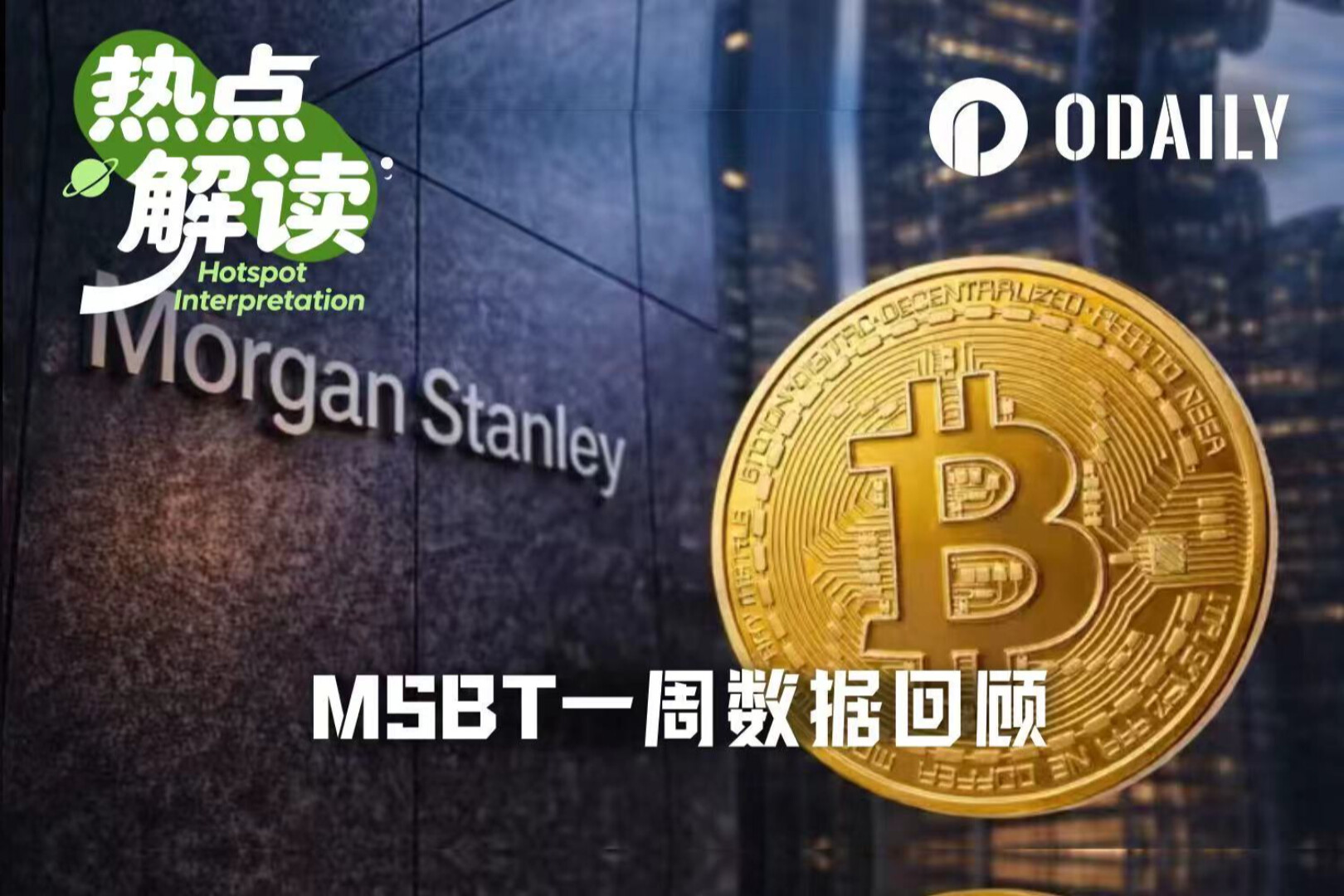
Morgan Stanley's First Bitcoin ETF One-Week Review: Defying the Trend to Attract Capital, a Signal of Institutional Accumulation

Morgan Stanley launched its first spot Bitcoin ETF, the Morgan Stanley Bitcoin Trust (MSBT), on April 8, becoming the first major U.S. bank to issue such a product. With the lowest annual fee among U.S. Bitcoin ETFs at 0.14%, it is custodied by Coinbase and administered by BNY Mellon. In its first week, MSBT saw consistent inflows despite overall market outflows. On its debut, it attracted $30.6 million while the broader Bitcoin ETF market bled $93.9 million. It continued to see inflows in subsequent days, even as major ETFs like Fidelity’s FBTC experienced significant outflows. By the end of the week, MSBT had accumulated $37.5 million in net inflows, with assets under management (AUM) around $64–70 million, holding roughly 960 BTC. The launch timing—amid a 44% Bitcoin price correction from its 2025 high—suggests institutional accumulation at lower levels. Morgan Stanley’s wealth advisors are reportedly recommending up to a 4% Bitcoin allocation to high-net-worth clients, signaling potential sustained inflows from its $7 trillion client assets. Shortly after, Goldman Sachs filed for its own Bitcoin ETF—a covered call strategy product aimed at generating income from option premiums, catering to yield-seeking institutional investors. Analysts see MSBT’s steady inflows as a sign of institutional confidence despite bearish sentiment, making it a key indicator of Wall Street’s growing engagement with Bitcoin.

Odaily星球日报04/16 08:56

Morgan Stanley's First Bitcoin ETF One-Week Review: Defying the Trend to Attract Capital, a Signal of Institutional Accumulation

Odaily星球日报04/16 08:56

Understanding the Key Issues of Tokenization in One Article

The core of tokenization lies in eliminating friction in financial infrastructure, not speculative digital assets. The true value is in near-instant settlement (T+0 vs. traditional T+2), 24/7 liquidity, fractional ownership, and the disintermediation of financial processes. Tokenization represents real-world assets (real estate, bonds, private equity) as digital tokens on a blockchain, functioning as programmable digital deeds that enable self-custody and automated ownership tracking. It addresses four key problems: 1) Settlement Speed: Atomic, near-instant settlement replaces multi-day processes. 2) Liquidity: Enables secondary markets for historically illiquid assets. 3) Fractional Ownership: Drastically lowers investment minimums by automating administrative overhead. 4) Disintermediation: Replaces trust-based functions of custodians and clearinghouses with self-executing smart contracts. This is not about cryptocurrency speculation. Major institutions like J.P. Morgan (Onyx), BlackRock (BUIDL), and Goldman Sachs are building the infrastructure, focusing on reliable asset management. Significant hurdles remain, including uncertain legal frameworks, lack of different blockchain platforms, and resistance from intermediaries protecting their revenue streams. Tokenization doesn't create a frictionless utopia but fundamentally reshapes the cost structure and efficiency of global financial infrastructure, representing its largest reorganization since the advent of electronic trading.

marsbit04/16 08:40

Understanding the Key Issues of Tokenization in One Article

marsbit04/16 08:40

Dialogue with a16z Co-founder: The Physical Laws of the Old World Are Dead, Crypto Becomes Key Infrastructure for AI

At a16z Fintech Connect, Ben Horowitz discusses how AI revolution is fundamentally rewriting the rules of software competition. He argues that traditional moats like data lock-in and UI familiarity are vanishing, as AI can easily replicate code, transfer data, and interact flexibly with software. CEOs of legacy companies must recognize these shifts and pivot towards delivering unique value beyond outdated advantages. Horowitz highlights that while some businesses face obsolescence, others with complex, entrenched operational networks (like travel platforms) may retain relevance. The conversation also covers critical infrastructure bottlenecks in the AI boom—from GPU shortages and power constraints to supply chain issues—emphasizing the need for massive investment in physical and digital infrastructure. Horowitz strongly links AI and blockchain, arguing that crypto is essential for solving AI-generated problems: identity verification, content authenticity, fraud prevention, universal basic income distribution, and enabling AI economic agency. Looking ahead, he speculates on VC’s evolving role—whether it scales up alongside mega-companies or adapts to a decentralized compute landscape—and strikes an optimistic note on AI’s long-term impact, foreseeing unprecedented improvements in global living standards despite transitional disruption.

marsbit04/16 08:13

Dialogue with a16z Co-founder: The Physical Laws of the Old World Are Dead, Crypto Becomes Key Infrastructure for AI

marsbit04/16 08:13

The Other Side of the Stock Market Rally: Energy Restructuring, Bitcoin Squeeze, and Market Mismatch

The article examines the complex and seemingly contradictory signals in global markets, where rising equities, falling oil prices, and cooling inflation expectations coexist with unresolved structural tensions. In digital assets, a major corporate strategy added nearly $1 billion in Bitcoin, increasing its holdings significantly, while Bitcoin's price action is seen as less important than the persistent negative funding rates, indicating a crowded short position that could lead to a sharp upward repricing. The global oil trade is rapidly rewiring, with the U.S. Gulf Coast becoming a key supplier to Europe and Asia amid Middle East disruptions. However, the article warns that such supply shocks can lead to permanent demand destruction as consumers and governments adapt. U.S. equities rose on optimism over potential geopolitical de-escalation and softer PPI data, led by tech stocks like NVIDIA. Meanwhile, the U.S. Federal Reserve maintains a wait-and-see stance on rates. Geopolitically, U.S.-Iran negotiations are ongoing alongside a maritime blockade, which has disrupted energy infrastructure and supply chains. Finally, the push for supply chain reshoring, particularly in critical minerals and defense, is accelerating but faces significant execution challenges related to permitting, financing, and labor, moving the issue from cost to one of strategic necessity.

marsbit04/16 07:53
The Other Side of the Stock Market Rally: Energy Restructuring, Bitcoin Squeeze, and Market Mismatch

marsbit04/16 07:53

US Stocks Hit Record Highs: Why Isn't the Market Afraid of the Flames of War?

U.S. stocks hit a record high on April 15, with the S&P 500 closing at 7,022.95, just 77 days after its previous peak. This rebound occurred in only 11 trading days—far faster than recoveries following past crises like the COVID-19 pandemic (103 days) or the 2011 debt crisis (106 days). The market's rapid recovery is attributed to "ceasefire expectations" rather than deteriorating economic fundamentals. During the sell-off triggered by the U.S.-Israel military action against Iran in late February, the S&P 500 fell nearly 10%. However, the market rallied twice on ceasefire rumors—first on March 24 and again on April 8—even before any permanent peace deal was signed. Notably, the VIX fear index fell below pre-war levels, indicating that the market had repriced the conflict from an uncertainty to a calculable risk. Major financial institutions like JPMorgan reported record trading revenues of $11.6 billion in Q1 2026, largely driven by volatility in commodities and emerging markets. Hedge funds turned net long for the first time since late 2025, while margin debt hit a record $1.28 trillion. This reflects a financial system that commercializes volatility, treating geopolitical shocks as tradable opportunities rather than systemic threats. However, the current optimism relies on assumptions of a sustained ceasefire and stable oil prices, leaving the market vulnerable if these conditions change.

marsbit04/16 07:13

US Stocks Hit Record Highs: Why Isn't the Market Afraid of the Flames of War?

marsbit04/16 07:13

Is the Rebound an Illusion? The Bond Market Has Already Given the Answer

Is the stock market's rapid rebound to pre-war levels a sign of recovery or a misleading rally driven by momentum rather than fundamentals? While the S&P 500 has fully recovered its losses from the U.S.-Iran conflict and nears all-time highs, bond and oil markets tell a different story. Key data reveals contradictions: 10-year Treasury yields have risen 30 basis points, signaling persistent inflation concerns and constrained Fed policy space. WTI crude is up 37%, indicating that geopolitical risks are not priced to resolve soon. The 2-year Treasury yield, a sensitive gauge of rate expectations, has increased nearly 40 bps, challenging the narrative of imminent Fed rate cuts. The equity market appears to be pricing in a "perfect scenario": subdued oil impact on consumption, Fed rate cuts despite hot inflation, stable corporate margins, and near-term conflict resolution. However, bonds and oil reflect a reality of sticky inflation, limited Fed flexibility, and ongoing geopolitical tension. This divergence suggests the rally may be momentum-driven rather than fundamentally justified. If upcoming CPI data exceeds expectations (e.g., above 3.5%), the 2026 rate-cut narrative could collapse. Investors chasing the rally are betting on an ideal outcome—swift conflict resolution, controlled inflation, Fed easing, and resilient earnings—while ignoring signals from more cautious asset classes. The gap will likely close either through a fundamental improvement validating stocks or a market correction aligning with bond and oil realities.

marsbit04/16 07:05

Is the Rebound an Illusion? The Bond Market Has Already Given the Answer

marsbit04/16 07:05

活动图片