Dragonfly Survey on Current State of Crypto Recruitment: Compliance Roles +340%, Data Science +74%, Crypto Enters the Era of On-Demand Hiring

marsbitPublicado em 2026-04-16Última atualização em 2026-04-16

Resumo

Dragonfly's 2026 crypto talent report reveals a fundamental shift in hiring: companies now recruit based on actual need rather than market hype. In 2025, the industry saw a net reduction of 472 roles, but compliance positions surged by 340% and data science roles grew by 74%. The second half of 2025 brought discipline and recovery, with hiring stabilizing. Candidates are now more cautious, prioritizing company durability, clear role definition, and tangible impact over broad narratives. Engineering, AI/ML, and security roles remain highly competitive. Founders are advised to hire based on milestones—not cycles—and provide clear value propositions to attract talent. Remote work remains common, but key hubs like New York and the Bay Area dominate. AI's influence is significant, but its unclear impact in crypto may slow hiring. The outlook for 2026 is flat to moderate growth, driven by execution-focused teams with credible stories.

Author: Zackary Skelly (Head of Talent at Dragonfly)

Compiled by: Deep Tide TechFlow

Deep Tide Introduction: Dragonfly releases the 2026 crypto industry insights report, revealing a fundamental shift in hiring logic. In 2025, the industry saw a net reduction of 472 people, but compliance roles surged by 340%, and data science roles grew by 74%. The most critical change: candidates are no longer impulsive about the bull market; they want clear value explanations and certainty. If you can't explain "why this role is important," the conversion rate will plummet.

1/

We are now in the first quarter of 2026, and the hiring situation in the cryptocurrency space is completely different from any previous cycle.

We have just released the latest "Talent Insights Report," detailing how we got here and what it means for founders and talent teams.

2/

TL;DR

2025 did not kill crypto hiring; it matured it.

Companies are no longer hiring based on price but on actual needs.

This shift has become the new benchmark heading into 2026.
3/

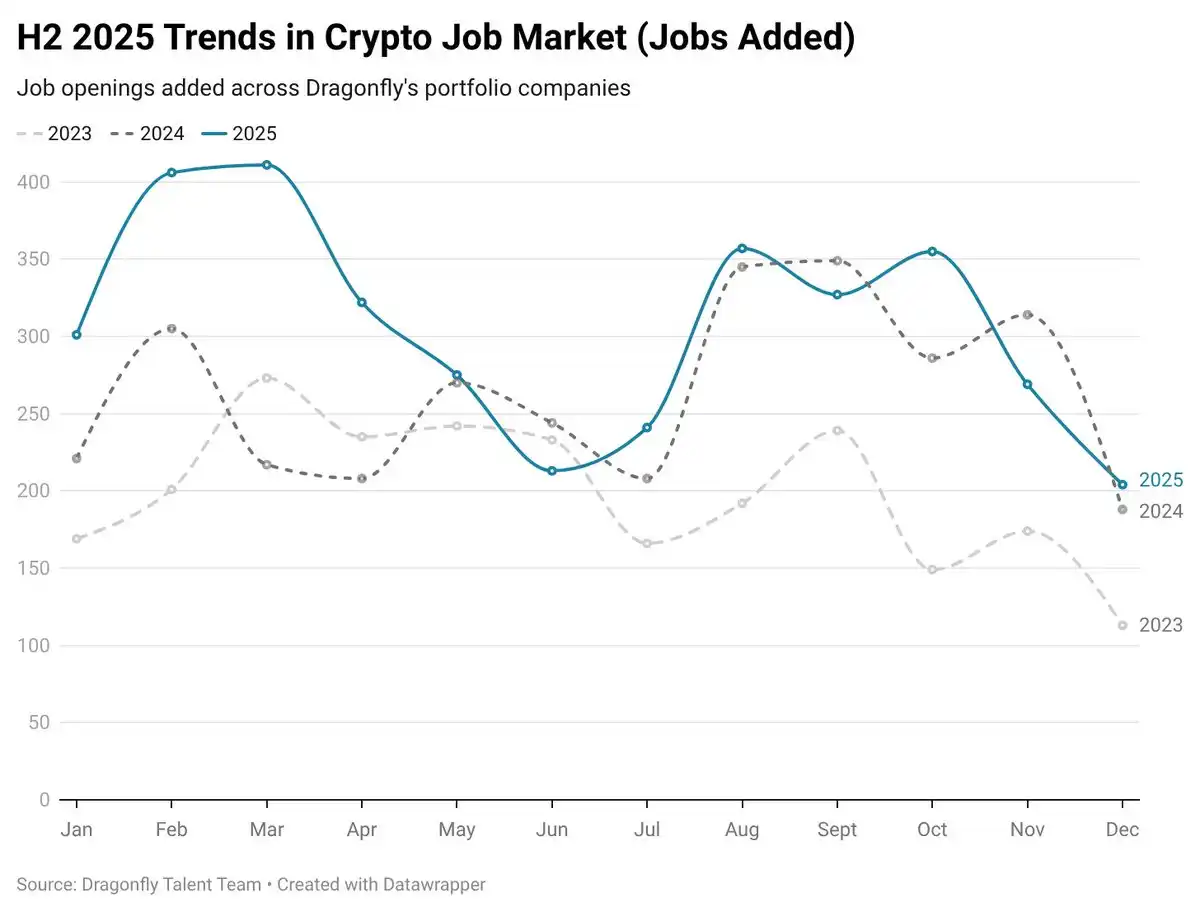
The year was clearly divided into two halves.

The first half of 2025 (25H1) was turbulent, with pro-crypto optimism quickly reversing amid macro shocks.

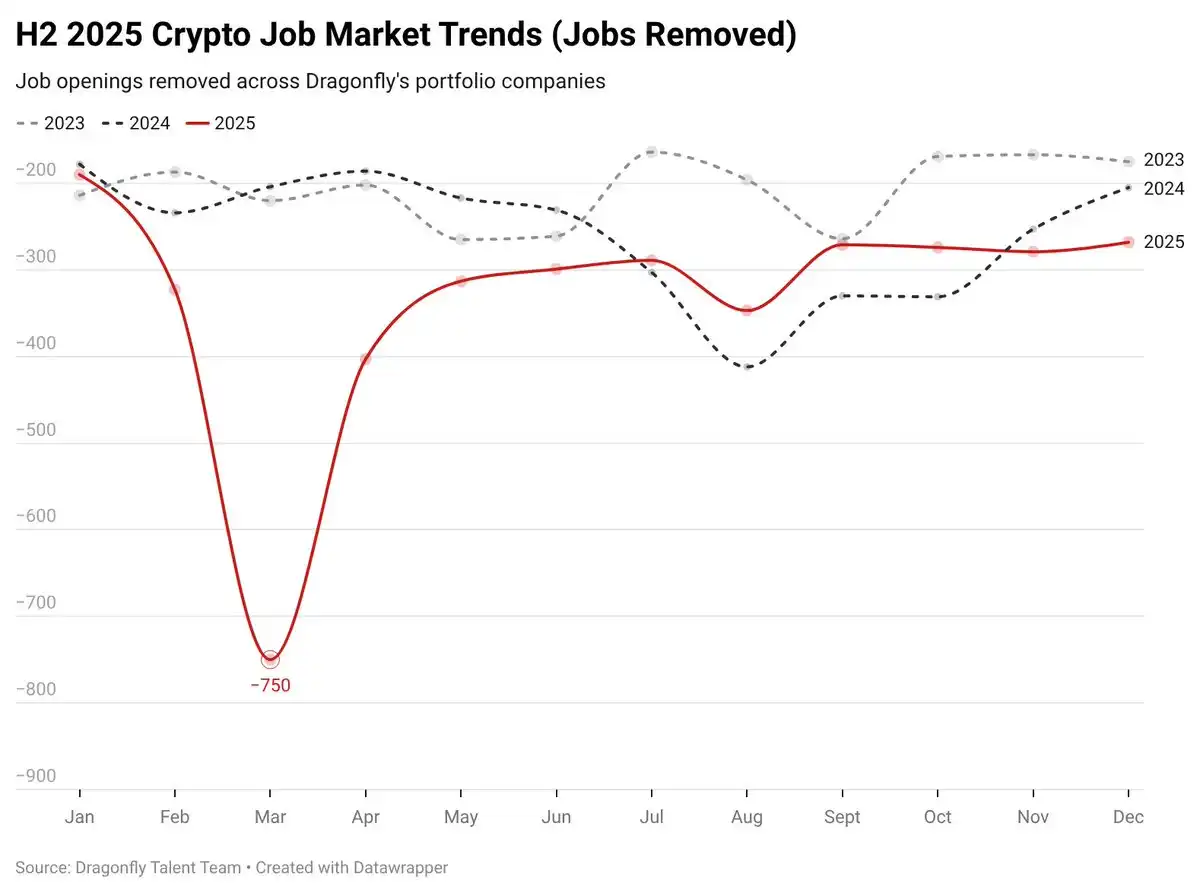
Job removals surged in March (750), with most losses concentrated in the first half.

Approximately 3,700 new jobs were added for the year, while about 4,100 were removed, resulting in a net reduction of -472.
4/

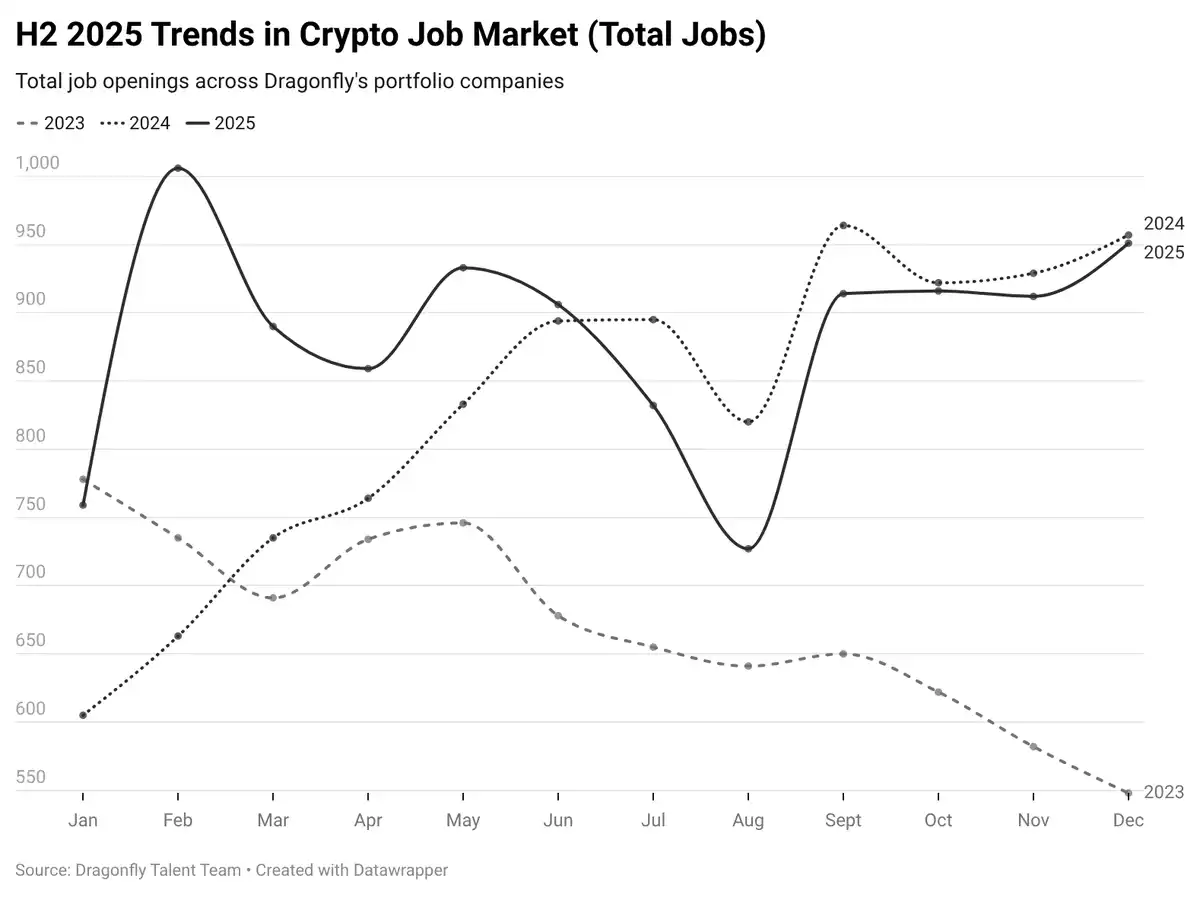
The second half (H2) brought discipline and recovery.

The overall job trend in H2 was largely consistent with 2024, just at a lower overall level.

July reset, August bottomed out, September reopened, and Q4 stabilized.

The more severe reset in spring was the main reason 2025 overall was lower than 2024.
5/

In our 25H1 report, we made some predictions. Let's score them now:

✓ Late Q3 rebound (September job openings +26%), Q4 slowdown, compliance hiring started early

✗ Underestimated the degree of divergence in traffic and applications; overestimated the resilience of legal roles relative to compliance roles

6/

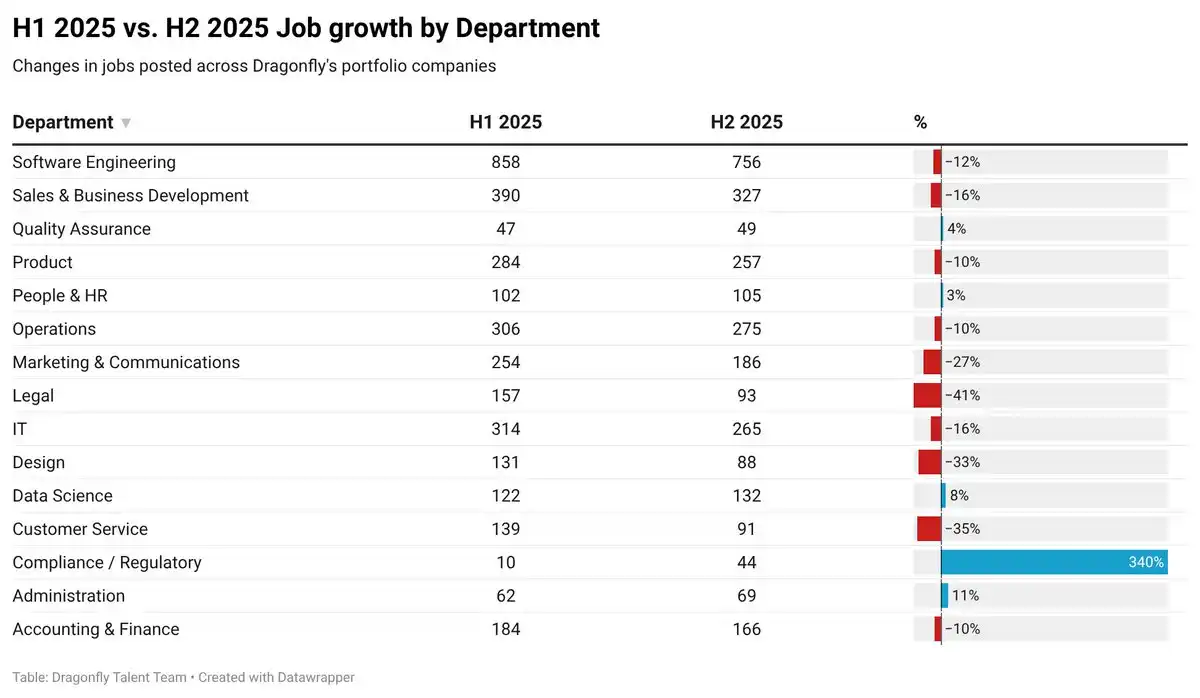
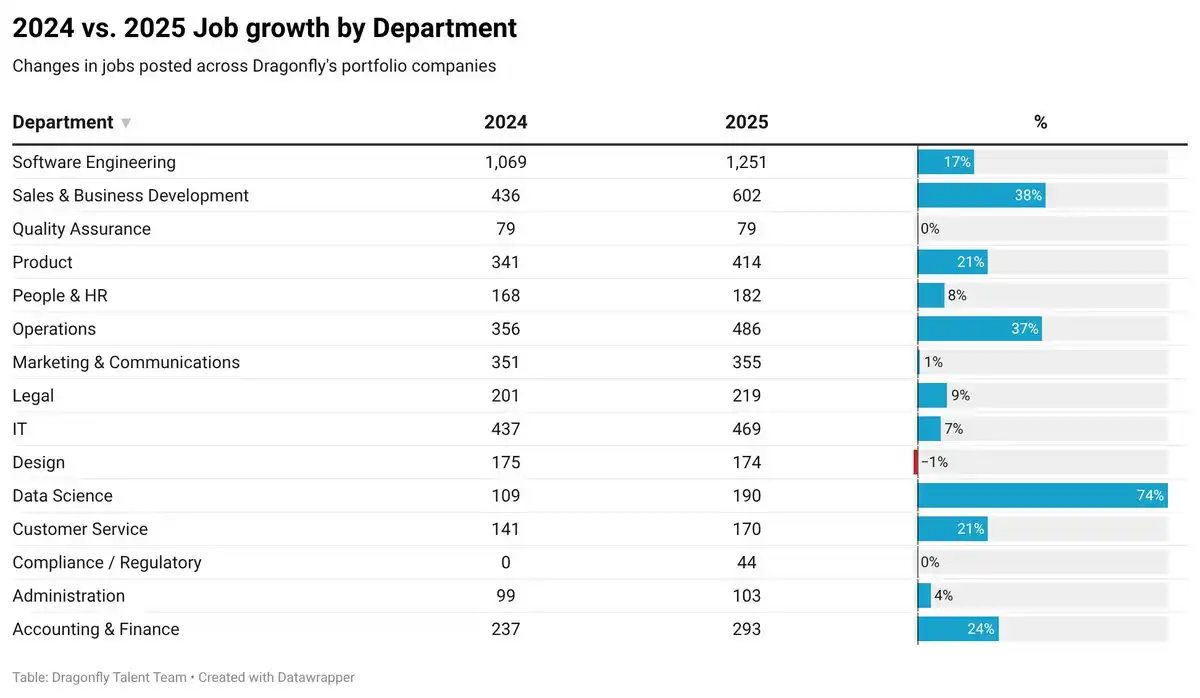
The real shift from 25H1 to H2 was not how many people companies hired, but what roles they hired for. Core first, earn the right to scale.

→ Engineering: -12%, still the anchor → Marketing: -27% → Design: -33% → Customer Service: -35% → Sales & BD: -16% → Legal: -41% → Compliance: +340%
7/

Data science was the clearest winner of the year, up +74% year-over-year. (Thanks to AI?)
8/

Interesting changes also happened on the candidate side.

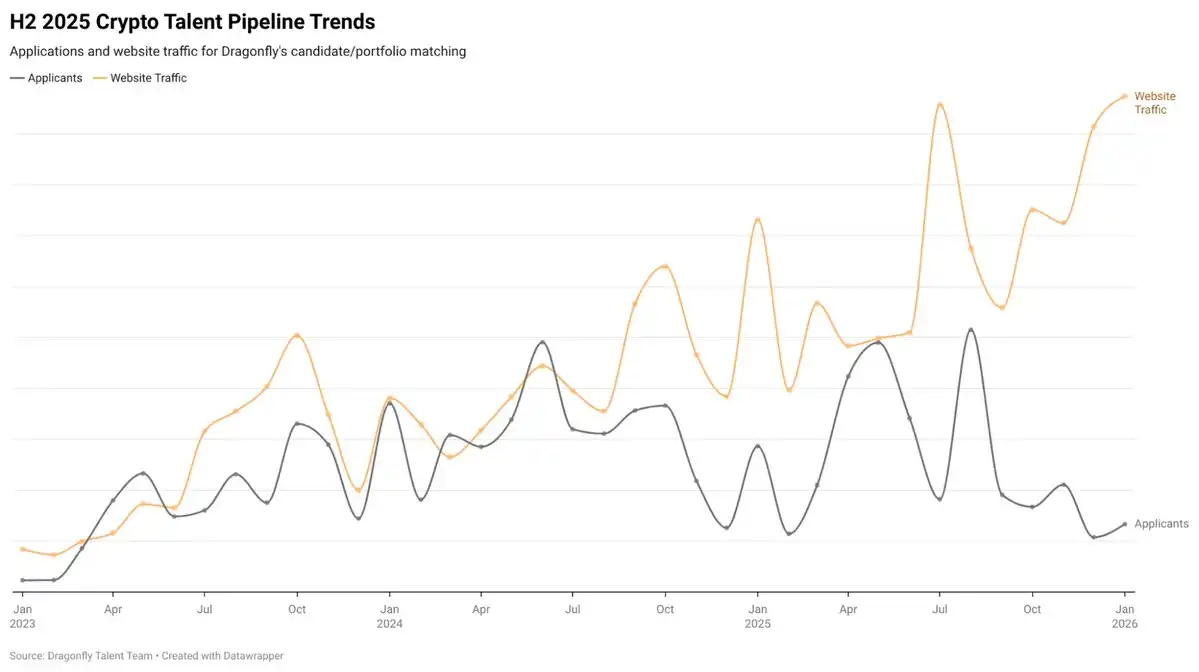
Traffic remained stable in the second half, while applications dropped by about 26%.

People are still browsing, just not submitting applications as easily.
9/

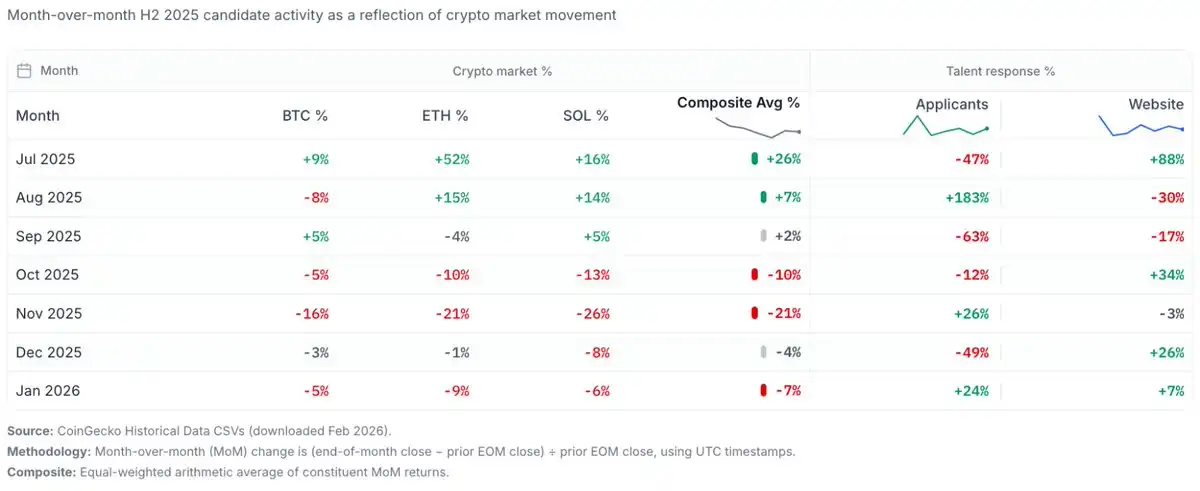
In early cycles, market excitement did most of the hiring work: rising salaries, influx of applications.

This mechanism is failing.

Stronger months still drive page views, but attention conversion rates are not what they used to be.
10/

Why? Partly because candidates have become more cautious.

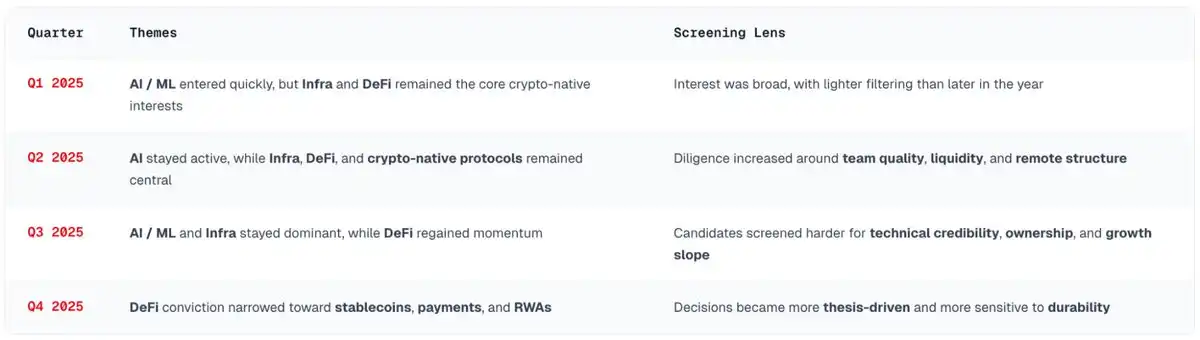
They are more rigorously screening companies for durability, ownership clarity, team quality, and technical credibility: open-source proof, product depth, hardcore problems, GTM roadmap.

Generic category narratives no longer work.
11/

Areas of concentrated belief: Infrastructure, DeFi, L1, and L2 remain core, but DeFi interest has narrowed to stablecoins, payments, and RWA.

Fintech-related and institutional use cases have gained significant attention. AI remains a key interest point.

12/

Stage preferences also tell an interesting story.

Seed and Series A stages are still the most attractive to candidates, with high demand for founder roles and first-employee roles. However, larger, more mature companies can still attract interest.

13/

The most common factor causing candidates to drop out is not compensation, stage, or size, but ambiguity.

If you cannot clearly explain why the company is important, what specific scope they will own, and why the opportunity has lasting power, the conversion rate will drop significantly.

14/

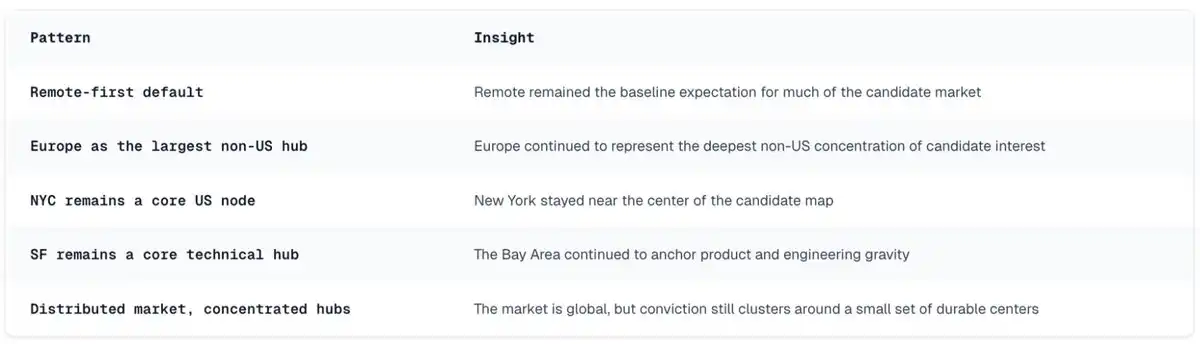
Geographically, remote work is still the norm, but the most active hiring teams are more concentrated in New York and lean towards in-person work.

Talent remains global, but New York + the Bay Area still dominate. Europe is the largest non-US hub.

(Note: Specific geographic hiring = smaller TAM, longer hiring cycles.)
15/

Another factor shaping the current landscape: Hiring is concentrating towards later-stage teams and significantly in the verticals candidates are most interested in.

We expect hiring for the remainder of 2026 to be driven more by acquisitions, pivots, and consolidation, rather than pure new growth.

16/

So what should founders do?

Hire based on milestones—product launches, revenue, partnerships, regulatory progress—not market cycles or calendar plans.

Companies that did well with hiring in H2 2025 could clearly articulate and stick to the reason for each role's existence.

17/

Know that teams are different, so sequence hires thoughtfully:

→ Core builders first (engineering, security, data/protocol) → BD explores fit → Product is flexible based on type (consumer earlier, infrastructure leaner) → Compliance, finance, risk → Marketing/support scales after leverage appears

18/

Keep pipelines always open for scarce talent.

Engineering, AI/ML, and security roles are severely supply-constrained and cannot be restarted from zero every cycle. Even if specific needs are closed, relationships should be kept warm.

19/

Recognize that the way roles are sold has changed.

Candidates want runway clarity, clear ownership for the first 30–60 days, and transparent upside mechanisms.

You must sell differentiation. You are not selling your category; you are selling why you will win and what specific role they can play.

20/

You also need a real AI story. Not "we are an AI company."

Candidates want to know:

→ How AI is used internally → How it changes the product → Whether it creates a real advantage

Vague answers lose talent.

21/

Specific advice for talent teams:

Put your strongest people at the front of the process (first impressions matter), keep interview loops tight, and provide clear feedback.

22/

An open question: AI makes 2026 harder to predict.

People can do more with fewer people. Better tools enable some to start their own. Some might go work directly on AI.

Meanwhile, higher output per employee means faster scaling, and crypto is positioned more broadly than ever.

23/

Our current view on AI's impact: Before clear AI × Crypto use cases solidify, deceleration signals are stronger than acceleration signals.

📎 Further reading: The Agentic Economy Will Be Massive, Agentic Commerce Won't

24/

Our baseline expectation for 2026: Flat to moderate growth, led by engineering, AI/data, and security. Consolidation will continue.

Whether bull, baseline, or bear market, this is a year focused on quality building.

25/

The teams that will win talent will be those with the most credible stories, not the loudest ones.

Execution discipline, durable business models, and good explanations of both are essential.

Criptomoedas em alta

Perguntas relacionadas

QWhat were the key changes in the crypto hiring landscape in 2025 according to Dragonfly's report?

AThe key changes were a shift from hiring based on market hype to hiring based on actual need, with a net reduction of 472 jobs. Compliance roles surged by 340% and data science roles grew by 74%, while roles in marketing, design, customer service, sales, BD, and legal declined significantly.

QWhich job function saw the highest percentage increase in hiring in 2025, and what was the speculated reason?

AData science saw the highest percentage increase at 74%, with the report speculating that this growth might be due to the influence of AI.

QHow did candidate behavior change in the second half of 2025 (H2)?

ACandidate traffic remained stable, but the number of applications submitted dropped by approximately 26%. Candidates became more cautious, browsing jobs but not applying as readily, and demanded greater clarity on a company's importance, role specifics, and long-term viability.

QWhat are the new priorities for founders when hiring in the current crypto environment?

AFounders should hire based on specific milestones (like launches, revenue, partnerships, regulatory progress) rather than market cycles. They must clearly articulate why each role is important, provide clear runways, define ownership for the first 30-60 days, and offer transparent upside mechanisms.

QWhat is the geographic concentration of the most active crypto hiring teams and the talent pool?

AThe most active hiring teams are concentrated in New York and favor in-person work. The talent pool remains global, but New York and the Bay Area dominate, with Europe being the largest non-US hub.

Leituras Relacionadas

Podcast Notes | Conversation with GSR Asset Management Head: To Determine if This Crypto Rally is Real, Just Watch the Lending Rates on Aave

Podcast Summary: Dialogue with GSR's Head of Asset Management: To Determine if This Crypto Rally is Real, Just Check Lending Rates on Aave Andy Baehr, Managing Director of Asset Management at GSR, discusses the current crypto market, characterizing it as stuck in a state of "ambivalence" with short-lived, unsustainable rallies. He outlines a simple framework: the market moves between "ambivalence" and "conviction" (sustained upward momentum). Currently, every rally resembles a single-stage rocket booster that quickly fizzles out. Baehr identifies three key signals to watch: 1) DeFi lending rates, 2) the potential passage of the CLARITY Act, and 3) the market forming a consensus on the "Fed hawkish peak." He emphasizes that the most immediate indicator for the sustainability of the recent CPI-triggered rally is the USDC borrowing rate on Aave, currently around 3.75%—close to U.S. Treasury yields. The absence of a credit spread indicates low leverage demand and a lack of market energy. He explains that a healthy, sustained rally requires layered buying pressure. Last year's rally progressed from an ETH short squeeze to crypto-native trader influx and finally to ETF inflows. Currently, this structure is missing. Other potential structural buyers like Digital Asset Treasury (DAT) companies are absent, and ETF flows have proven transient. Baehr notes that while small-cap crypto tokens outperformed large caps in Q2—a potential sign of capitation in major assets—capital is also flowing to more exciting opportunities like AI stocks and tech IPOs, leaving crypto sidelined. Regarding DeFi, he highlights that platforms like Aave provide a clear, real-time signal of leverage demand through their supply/demand-driven interest rates. A significant, sustained rate increase would signal genuine market conviction. He also observes the quiet emergence of fixed-income-like products and vaults in DeFi. On regulation, the probability of the CLARITY Act passing before the August 7th deadline has dropped linearly from 75% to below 40% on Polymarket. Baehr suggests its passage would be treated as a bullish surprise, a potent driver for price movement. However, political hurdles, including ethical clause debates and disclosures about the First Family's crypto profits, remain significant obstacles. Ultimately, the market awaits clarity on the Fed's terminal rate under Chair Warsh. Until the "Fed Solstice"—the point where the market collectively understands the peak of hawkish policy—sustained conviction will be difficult to achieve.

marsbitHá 3m

Podcast Notes | Conversation with GSR Asset Management Head: To Determine if This Crypto Rally is Real, Just Watch the Lending Rates on Aave

marsbitHá 3m

7 Months After the Collapse of Huiwang, Southeast Asia's Escrow Platforms Undergo a Major Reshuffle

Following the collapse of Huione Pay—dubbed the "Alipay of Southeast Asia"—seven months ago, the region's underground financial guarantee platform sector is undergoing a significant reshuffle. This power vacuum has been swiftly filled by emerging platforms such as XinBi, Tiger/Navigator, JinBei (renamed JinBo), Dali/Tiancheng, and FullyLight. These platforms, operating largely via Telegram and offering services like escrow for illicit transactions, have absorbed the vast user base and markets left behind by Huione. While positioning themselves as "trust intermediaries," their primary clientele consists of networks involved in online scams, money laundering, illegal gambling, and even human trafficking. For instance, the Tiger/Navigator platform explicitly provides "escrow" services for kidnapping-for-ransom operations ("强押车交易"). Data underscores the immense scale: Huione alone processed over $103 billion in cryptocurrency payments and facilitated over $31 billion through its escrow market before its downfall, linking it to Cambodia's notorious Prince Group. Since its collapse, competitors have seen explosive growth. For example, the XinBi platform has accumulated over $1.6 billion in total USDT revenue, while platforms like NewPay, OkPay (under Dali), and FullyLight Wallet collectively processed over $4.8 billion in USDT in a single year. This ecosystem thrives in regions like Cambodia and Myanmar, where regulatory gaps allow these platforms to act as critical financial infrastructure for sprawling cybercrime industries, from scam compounds to online casinos. The article concludes that the moniker "Southeast Asian Alipay" is a misnomer, obscuring the platforms' fundamental role in enabling serious criminal enterprises rather than representing legitimate financial innovation.

Odaily星球日报Há 1h

7 Months After the Collapse of Huiwang, Southeast Asia's Escrow Platforms Undergo a Major Reshuffle

Odaily星球日报Há 1h

The Changing Landscape: What Are Crypto VCs Experiencing?

Title: The Shifting Landscape of Crypto Venture Capital The era of dedicated crypto venture capital funds is undergoing a significant transformation. Once essential for navigating the sector's complexity and high risk, these specialized funds are now facing an identity crisis as the market matures. This shift mirrors historical patterns in other specialized investment classes like cleantech and SPACs, where initial information advantages dissipate as technologies become mainstream and integrated into existing industry frameworks. The article argues that crypto is reaching a critical inflection point, transitioning from a "building phase" to an "integration phase." Major players like Stripe, BlackRock, and Visa now engage with crypto not for its novel mechanics but as a foundational financial infrastructure. Their needs—regulatory compliance, banking partnerships, distribution channels—align with traditional fintech, a domain easily understood by large, generalist funds like Sequoia and Founders Fund. This evolution creates a "barbell effect" within the VC landscape. On one end are massive, diversified platforms that can incorporate crypto as one vertical among many. On the other are small, nimble funds focused on niche, experimental projects. The middle ground—medium-sized dedicated crypto funds—is being squeezed out. Their typical fund size makes it impossible to generate sufficient returns solely from early-stage crypto bets, yet they cannot compete with giants for later-stage deals. Consequently, leading crypto-native firms like Paradigm and Framework Ventures are expanding into AI, robotics, and other sectors, driven partly by LP pressure for better returns amid a broader VC DPI crisis. Others, like Dragonfly and a16z, have narrowed their crypto focus predominantly to financial infrastructure like stablecoins, reframing the sector's core narrative. For crypto entrepreneurs, this consolidation presents challenges. While generalist funds offer larger checks and broader resources, crypto projects now compete fiercely with AI for attention and capital within these firms. Furthermore, the long-term, non-commercial foundational work that built the ecosystem—funded by dedicated crypto VCs—is less likely to attract generalist capital focused on direct returns. The conclusion is that "crypto investor" as a standalone category is becoming obsolete, akin to "internet investor." Crypto is becoming a baseline infrastructure layer. The future will see a barbell structure: large-scale growth financing handled by generalist funds, while pioneering, speculative projects are funded by small, specialized vehicles. The dedicated crypto funds of the 2017-2021 boom, which incubated core infrastructure, are giving way to this new, bifurcated reality.

Foresight NewsHá 1h

The Changing Landscape: What Are Crypto VCs Experiencing?

Foresight NewsHá 1h

Trading

Spot

Artigos em Destaque

Como comprar ERA

Bem-vindo à HTX.com!Tornámos a compra de Caldera (ERA) simples e conveniente.Segue o nosso guia passo a passo para iniciar a tua jornada no mundo das criptos.Passo 1: cria a tua conta HTXUtiliza o teu e-mail ou número de telefone para te inscreveres numa conta gratuita na HTX.Desfruta de um processo de inscrição sem complicações e desbloqueia todas as funcionalidades.Obter a minha contaPasso 2: vai para Comprar Cripto e escolhe o teu método de pagamentoCartão de crédito/débito: usa o teu visa ou mastercard para comprar Caldera (ERA) instantaneamente.Saldo: usa os fundos da tua conta HTX para transacionar sem problemas.Terceiros: adicionamos métodos de pagamento populares, como Google Pay e Apple Pay, para aumentar a conveniência.P2P: transaciona diretamente com outros utilizadores na HTX.Mercado de balcão (OTC): oferecemos serviços personalizados e taxas de câmbio competitivas para os traders.Passo 3: armazena teu Caldera (ERA)Depois de comprar o teu Caldera (ERA), armazena-o na tua conta HTX.Alternativamente, podes enviá-lo para outro lugar através de transferência blockchain ou usá-lo para transacionar outras criptomoedas.Passo 4: transaciona Caldera (ERA)Transaciona facilmente Caldera (ERA) no mercado à vista da HTX.Acede simplesmente à tua conta, seleciona o teu par de trading, executa as tuas transações e monitoriza em tempo real.Oferecemos uma experiência de fácil utilização tanto para principiantes como para traders experientes.

515 Visualizações TotaisPublicado em {updateTime}Atualizado em 2026.06.02

Como comprar ERA

Discussões

Bem-vindo à Comunidade HTX. Aqui, pode manter-se informado sobre os mais recentes desenvolvimentos da plataforma e obter acesso a análises profissionais de mercado. As opiniões dos utilizadores sobre o preço de ERA (ERA) são apresentadas abaixo.

活动图片













