2026-08-07 Sexta

Notícias de cripto - Página 334

Mantenha-se a par do mercado de cripto. Notícias em tempo real, análises, preços, histórias em alta e análise de especialistas — tudo num só lugar.

Football Draw Harvests Whales: Extreme Profit-Loss Divergence on Polymarket's World Cup

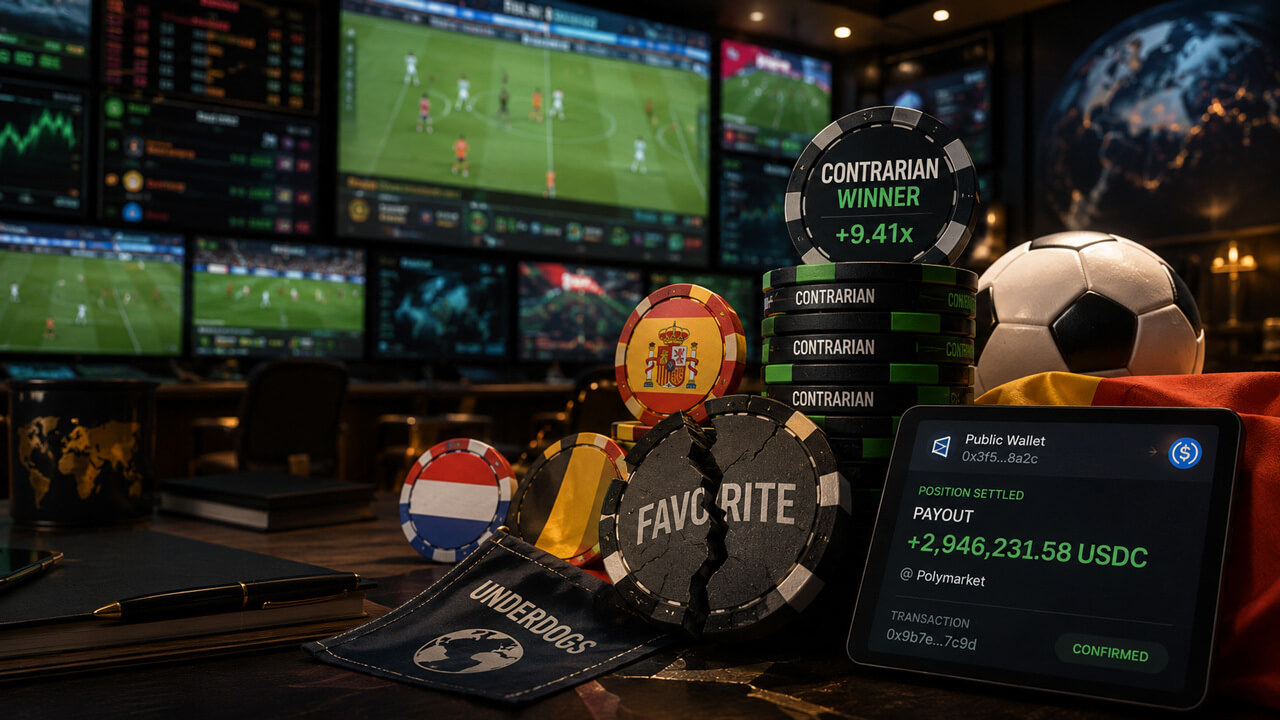
A bettor known as "fishalive" made a stunning profit of nearly $9 million on the Polymarket prediction platform by correctly wagering against favorites during the 2026 FIFA World Cup group stage. The account, registered just before the tournament, risked roughly $400,000 on two contracts for a Spain vs. Cape Verde match: one that Spain would *not* win, and another on a Cape Verde +2.5 goal handicap. The resulting 0-0 draw triggered both payouts. This single event, with a total market volume of $64 million, highlighted extreme profit-and-loss divergence. Other traders, like "betoor619" and "leeeeroyjenkins," lost millions by betting heavily on favorites Spain and Belgium to win outright—contracts that become worthless in a draw. The article explains that while markets heavily favored strong teams, the "team to win" contracts are binary and do not account for the common outcome of a draw. This creates high-risk, low-reward scenarios for favorite backers, while asymmetric profits flow to those betting on underdogs or against outright wins. The transparency of Polymarket's on-chain ledger publicly documents these massive wins and losses, driving mainstream media coverage. As the tournament progresses, the author suggests traders may shift towards hedging strategies that account for draws. The piece also notes growing regulatory scrutiny in the US and Europe, questioning whether such large-scale, anonymous sports prediction markets should be regulated as gambling or financial derivatives.

Foresight News06/18 06:02

Football Draw Harvests Whales: Extreme Profit-Loss Divergence on Polymarket's World Cup

Foresight News06/18 06:02

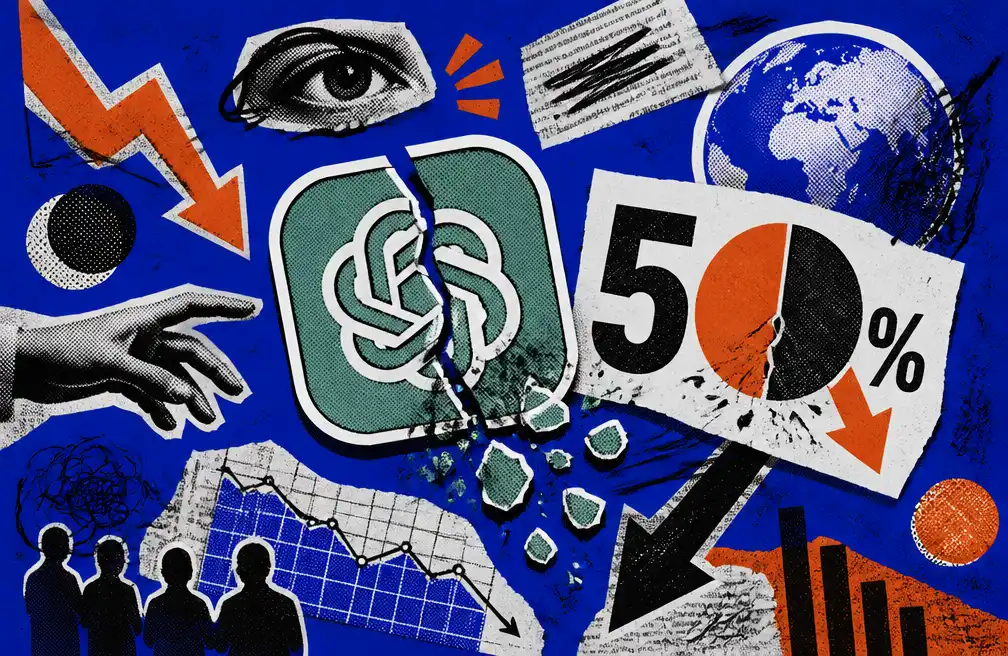
ChatGPT Loses Half Its Market: From Monopoly to Shared Market in Three and a Half Years

In a landmark shift three and a half years after its debut, ChatGPT's global market share in the AI assistant market has fallen below 50% for the first time, dropping to 46.4% as of May 2026. This signals the end of its initial dominance, with the market now diversifying among competitors like Gemini (27.7%) and Claude (10.3%). The report from Sensor Tower indicates the AI assistant landscape has matured from a phase of awe and experimentation into one of product comparison, ecosystem integration, and monetization. Users are increasingly pragmatic, readily switching between assistants based on specific use cases, brand trust, and value propositions. The industry is moving past the "free lunch" era, with users demonstrating a willingness to pay for premium features, driving significant in-app expenditure. Major players are adopting varied monetization strategies: Claude boasts a high subscription conversion rate, while ChatGPT is increasingly testing ads and shopping integrations to complement its subscription revenue. However, this growth comes with immense costs, as exemplified by OpenAI's soaring cash burn for model training and infrastructure. While ChatGPT remains the largest single player, its declining share symbolizes a broader normalization of AI. The technology is no longer a novelty but an integral, scrutinized part of daily digital life, judged on practical utility, price, and seamless integration. The battle has shifted from proving AI's potential to competing in a crowded field where no single product holds a permanent monopoly.

marsbit06/18 05:51

ChatGPT Loses Half Its Market: From Monopoly to Shared Market in Three and a Half Years

marsbit06/18 05:51

a16z: The Crypto Industry Enters the 'Show Me' Era

The crypto industry is entering a "show me" era, shifting from a focus on vision and promises to demanding hard evidence of execution and traction. This change is driven by heightened skepticism, regulatory scrutiny, and the serious entry of traditional finance institutions (like BlackRock, Fidelity, JPMorgan) with real, scaled products. Previously, a whitepaper and a token could capture attention. Now, credible projects must demonstrate a "proof stack": verifiable mainnet data (transactions, active users, revenue), real partnerships with tangible integrations, organic user adoption and retention metrics, and third-party validation (audits, independent analysis). Announcements alone are insufficient without underlying substance. For startups, this means narratives must be built from proven facts upwards—starting with concrete evidence points (e.g., "we reduced cross-border settlement from three days to four minutes with live corporate users") rather than leading with abstract vision. While vision remains important, the evidence-to-vision ratio has inverted; substance now must constitute the majority of the narrative. This higher bar presents an opportunity for projects with genuine product-market fit, as it filters out noise and allows their real progress to stand out. The core question for projects is whether their communication strategy is designed to showcase existing evidence or is still stuck in the phase of promising it.

marsbit06/18 04:43

a16z: The Crypto Industry Enters the 'Show Me' Era

marsbit06/18 04:43

Polymarket's Sixth Anniversary: Bathroom, Exile, and Homecoming

Polymarket, a prediction market platform, recently celebrated its sixth anniversary. Born during New York's COVID-19 lockdown, founder Shayne Coplan built the initial product from his bathroom. The platform allows users to trade on the outcomes of real-world events, aiming to aggregate information faster than traditional media or polls. Its early years involved navigating regulatory challenges, most notably a 2022 CFTC order and penalty for offering unregistered event contracts, which led to a ban on U.S. users. Despite this "exile," the platform persisted, gaining significant traction during major news events like the 2024 U.S. presidential election, where its markets often preceded mainstream narratives. A pivotal shift occurred in 2025. Following the conclusion of a DOJ/CFTC investigation, Polymarket strategically acquired a CFTC-regulated exchange (QCX) to re-enter the U.S. market legally. It secured a massive strategic investment from Intercontinental Exchange (ICE), NYSE's parent company, and formed high-profile partnerships with sports leagues like the NHL, UFC, and MLB, as well as media outlets including Google and the Wall Street Journal. Now valued in the tens of billions, Polymarket stands at the intersection of crypto, finance, media, and sports. Its journey reflects a constant tension between innovative information aggregation and regulatory scrutiny, evolving from a fringe crypto experiment into a mainstream, albeit still contested, financial and data infrastructure.

marsbit06/18 04:12
Polymarket's Sixth Anniversary: Bathroom, Exile, and Homecoming

marsbit06/18 04:12

The 'Side Hustle Survival' of DAT Companies: After the Accumulation Flywheel Stops, They Begin Self-Rescue

"Metaplanet's 'Side Hustle Survival': After the 'Crypto Hoarding Flywheel' Stops, They Begin Self-Rescue" The article discusses the strategic pivot of Digital Asset Treasury (DAT) companies as the once-lucrative model of hoarding cryptocurrencies, pioneered by MicroStrategy, faces challenges. With the crypto bear market and the rise of ETFs offering direct, low-premium exposure, many DAT firms are abandoning the passive treasury model. Prominent examples include ETHZilla, which sold ETH to repay debt and shifted to RWA tokenization, and others like Prenetics Global exiting completely. Facing stalled growth, remaining companies are pursuing two main survival paths. The first path is transforming into institutional crypto asset management platforms and yield funds. SharpLink Gaming exemplifies this by staking 100% of its ETH and partnering with Galaxy Digital to launch a yield fund. GameSquare is taking a more aggressive approach, using AI-driven algorithms across DeFi protocols to seek higher returns. The second path involves becoming blockchain infrastructure operators, particularly in the Solana ecosystem. Companies like DeFi Development and SOL Strategies are moving beyond holding SOL to operating validator networks and launching liquid staking tokens, building fee-based revenue models from ecosystem participation. The article notes these transitions reflect a broader industry maturation, shifting from financial engineering to building operational moats through technology, network effects, and deep ecosystem integration. However, risks remain, including DeFi protocol vulnerabilities and dependence on specific blockchain networks' health. Ultimately, this collective shift signals that in crypto, sustainable value comes not from capital games but from active participation, cash flow generation, and providing real utility—a necessary, if painful, step towards industry maturity.

marsbit06/18 04:11

The 'Side Hustle Survival' of DAT Companies: After the Accumulation Flywheel Stops, They Begin Self-Rescue

marsbit06/18 04:11

活动图片