Shiba Inu Burn Rate Jumps 706% as Holder Number Soars High Overnight

u.todayPublicado em 2022-12-16Última atualização em 2022-12-16

Resumo

As shared by Shibburn Twitter handle that represents a popular burn tracking service, during the period of the last 24 hours, the burn rate of SHIB has seen a substantial increase, rising by more than 700%.

Contents

  • SHIB army raises burn rate overnight
  • SHIB disappears from top 10 asset list

As shared by Shibburn Twitter handle that represents a popular burn tracking service, during the period of the last 24 hours, the burn rate of SHIB has seen a substantial increase, rising by more than 700%.
Meanwhile, the prominent meme coin SHIB has again gone off the top 10 list of the largest wallets on the Ethereum chain.
SHIB army raises burn rate overnight
According to the website of Shibburn, in the past 24 hours, the burn rate of Shiba Inu surged by a whopping 706%. This happened after 16,037,016 SHIB were sent to "inferno" wallets.
The biggest burn-transaction here contained 8,495,098 Shiba Inu made by an address ending in -ffdeaa.
On the whole, the total amount burned this week, per data that has been shared by the aforementioned tracker, will hardly exceed 100 million meme coins.
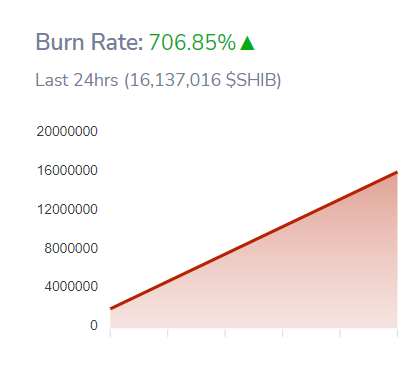
SHIB_burnrate_jumps00qrewe9089u2irhg923894u3SHIB

Image via Shibburn
SHIB disappears from top 10 asset list
WhaleStats tracker that aggregates data related to wallets on several leading blockchains, including Ethereum, BSC and several others, over the past 24 hours, Shiba Inu canine crypto has disappeared from the top 10 list of assets held by the largest 100 whales on Ethereum.
This is the second time it has happened this month, and now the whales have added MANA, stETH and ANT as their biggest holdings. Their comprised portfolio now contains 35.59% of MANA, 34.21% of stETH (both worth over $1,000,000 in fiat equivalent) and 12.45% of ANT ($370,000 in USD).
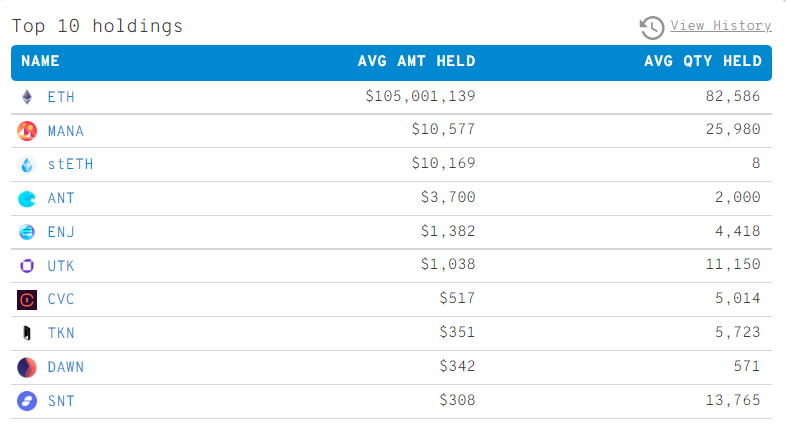
SHIB_topassetlist_gone00qwewre903u4i4

Image via WhaleStats Still, SHIB continues to add more users in the thousands. Over the past 24 hours, the total amount of SHIB holders rose by roughly 1,000, rising from 1,265,003 to 1,266,039 now. Earlier this week, the SHIB holder count also demonstrated big rises within one day, as covered by U.Today.
As for the SHIB price, at the time of this writing, it has dropped to $0.000008616, losing 3.37% in the past 24 hours, as per data provided by CoinMarketCap.


Criptomoedas em alta

Leituras Relacionadas

Chip Stocks Lead U.S. Market Decline: Is AI Trading Being Hit by Both Interest Rates and Returns?

Chip stocks led a broad decline in US markets, with the Nasdaq dropping 2.2% and the S&P 500 falling 1.4%. This selloff reflects a dual challenge for the once-high-flying AI hardware trade: rising interest rate expectations and growing investor impatience for clear returns from massive AI capital expenditures. The pressure was most acute on hardware leaders. Nvidia fell about 4%, dipping below a $5 trillion market cap, while Micron plunged 13.2% ahead of its earnings report. Declines across memory, storage, AI, and mobile chips indicated a sector-wide retreat. The selloff spread globally, with South Korea's KOSPI index dropping nearly 10% as key suppliers SK Hynix and Samsung recorded double-digit losses. Investors appeared to be taking profits from the most crowded trades first. Macro headwinds intensified as market expectations shifted toward a more aggressive Federal Reserve. Forecasts for multiple rate hikes in 2026 pressured high-valuation tech stocks, which rely on long-term growth projections that become less attractive as discount rates rise. Concurrently, investors are scrutinizing the profit potential of the immense AI spending by cloud giants like Alphabet, Amazon, and Meta. While these expenditures drive demand for chips and hardware, the market is now questioning whether AI services will generate sufficient returns to justify the ongoing costs. This adjustment is not necessarily a bubble burst but a recalibration. AI demand fundamentals remain, but the narrative of endless growth can no longer fully offset concerns over higher interest rates and a longer path to profitability. Near-term direction may hinge on Micron's upcoming earnings guidance and incoming inflation data, which will influence both the AI demand outlook and the Fed's policy path. The market is transitioning from blindly buying growth to demanding clearer visibility on returns.

marsbitHá 26m

Chip Stocks Lead U.S. Market Decline: Is AI Trading Being Hit by Both Interest Rates and Returns?

marsbitHá 26m

OpenAI's New Paper: How to Train an AI that "Doesn't Deteriorate Under Pressure"?

OpenAI's new paper "Reinforcement Learning Towards Broadly and Persistently Beneficial Models" explores training AI to maintain safe, helpful, and honest behavior even under pressure, in unseen scenarios, or after being fine-tuned for harmful purposes. Moving beyond simple rule-based "don'ts," the research focuses on cultivating "beneficial traits" like honesty, risk-awareness, corrigibility, and transparency. It investigates if reinforcement learning (RL), often prone to "reward hacking" where models exploit loopholes, can instead be used to instill robust, generalized positive behaviors. Researchers created a multi-domain synthetic dialogue dataset covering areas like healthcare and law. They trained a model by replacing 5% of standard RL data with "beneficial trait" data. This model outperformed the baseline in 83% of 53 evaluations, showing average gains of 9.1% in alignment, safety, and helpfulness. Crucially, improvements generalized: a model trained only on healthcare "good behavior" data also performed better in 17 out of 19 non-healthcare alignment tests. The paper also tests "alignment persistence." When subjected to adversarial prompts or harmful fine-tuning, the beneficial trait model showed greater resilience, with smaller performance drops and less "spillover" of bad behavior to unrelated tasks. While not a complete solution, this work suggests a shift from post-hoc correction to proactively shaping robust, principled AI behavior, a critical step for deploying models in high-stakes, complex decision-making scenarios.

marsbitHá 29m

OpenAI's New Paper: How to Train an AI that "Doesn't Deteriorate Under Pressure"?

marsbitHá 29m

Semiconductor Stock Rebound: Is the Technical Correction Over or a Trend Reversal?

The core of recent semiconductor stock volatility is not about daily price swings, but rather the market questioning whether AI-driven semiconductor pricing has entered a new phase. Following a sharp sell-off in Korean stocks on June 23rd, led by Samsung and SK Hynix, a subsequent rebound is seen more as a technical positioning adjustment rather than a confirmed trend reversal. The key variable is HBM (High Bandwidth Memory), essential for AI chips. Its supply-demand imbalance granted memory makers significant pricing power. The current market focus is on whether this dynamic remains strong enough to justify elevated valuations. All eyes are on Micron's upcoming earnings report. The critical factor is not whether results meet already high expectations, but whether the company's guidance confirms that AI memory pricing power, order visibility, and future margins are still expanding. Micron's outlook will serve as a crucial test for the broader AI semiconductor chain, including Samsung, SK Hynix, and other infrastructure players. The recent bounce appears to be a pre-earnings positioning repair. For it to evolve into a sustained uptrend, concrete evidence is needed that the AI infrastructure expansion cycle's fundamentals—particularly for high-end memory—remain robust and can continue to surpass elevated market expectations. The risk is that strong demand alone may not be sufficient if future guidance hints at peaking momentum or increasing supply-side pressures.

marsbitHá 1h

Semiconductor Stock Rebound: Is the Technical Correction Over or a Trend Reversal?

marsbitHá 1h

Trading

Spot
Futuros

Artigos em Destaque

Como comprar MANA

Bem-vindo à HTX.com!Tornámos a compra de Decentraland (MANA) simples e conveniente.Segue o nosso guia passo a passo para iniciar a tua jornada no mundo das criptos.Passo 1: cria a tua conta HTXUtiliza o teu e-mail ou número de telefone para te inscreveres numa conta gratuita na HTX.Desfruta de um processo de inscrição sem complicações e desbloqueia todas as funcionalidades.Obter a minha contaPasso 2: vai para Comprar Cripto e escolhe o teu método de pagamentoCartão de crédito/débito: usa o teu visa ou mastercard para comprar Decentraland (MANA) instantaneamente.Saldo: usa os fundos da tua conta HTX para transacionar sem problemas.Terceiros: adicionamos métodos de pagamento populares, como Google Pay e Apple Pay, para aumentar a conveniência.P2P: transaciona diretamente com outros utilizadores na HTX.Mercado de balcão (OTC): oferecemos serviços personalizados e taxas de câmbio competitivas para os traders.Passo 3: armazena teu Decentraland (MANA)Depois de comprar o teu Decentraland (MANA), armazena-o na tua conta HTX.Alternativamente, podes enviá-lo para outro lugar através de transferência blockchain ou usá-lo para transacionar outras criptomoedas.Passo 4: transaciona Decentraland (MANA)Transaciona facilmente Decentraland (MANA) no mercado à vista da HTX.Acede simplesmente à tua conta, seleciona o teu par de trading, executa as tuas transações e monitoriza em tempo real.Oferecemos uma experiência de fácil utilização tanto para principiantes como para traders experientes.

245 Visualizações TotaisPublicado em {updateTime}Atualizado em 2026.06.02

Como comprar MANA

Discussões

Bem-vindo à Comunidade HTX. Aqui, pode manter-se informado sobre os mais recentes desenvolvimentos da plataforma e obter acesso a análises profissionais de mercado. As opiniões dos utilizadores sobre o preço de MANA (MANA) são apresentadas abaixo.

活动图片