Bitcoin options data shows bulls aiming for $17K BTC price by Friday’s expiry

CointelegraphPublicado em 2022-12-08Última atualização em 2022-12-08

Resumo

BTC bulls could secure a $130 million profit in the Dec. 9 options expiry, but bears aim to balance the scales by keeping Bitcoin price below $17,000.

Bitcoin price crashed to $15,500 on Nov. 21, driving the price to its lowest level in two years. The 2-day-long correction totaled an 8% downtrend and wiped out $230 million worth of leverage long (buy) futures contracts.

The price move gave the false impression to bears that a sub-$15,500 expiry on the Dec. 9 options expiry was feasible, but those bets are unlikely to pay off as the deadline approaches.

Year-to-date, Bitcoin price is 65% down for 2022, but the leading cryptocurrency remains a top 30 global tradable asset class ahead of tech giants like Meta Platforms (META), Samsung (005930.KS), and Coca-Cola (KO).

Investors' main concern is still the possibility of a recession if the U.S. Federal Reserve raises rates for longer than expected. Proof of this comes from Dec. 2 data which showed that 263,000 jobs were created in November, signaling the Fed’s effort to slow the economy and bring down inflation remains a work in progress.

On Dec. 7, Wells Fargo director Azhar Iqbal wrote in a note to clients that "all told, financial indicators point to a recession on the horizon." Iqbal added, "taken together with the inverted yield curve, markets are clearly braced for a recession in 2023."

Bears were overly pessimistic and will suffer the consequences

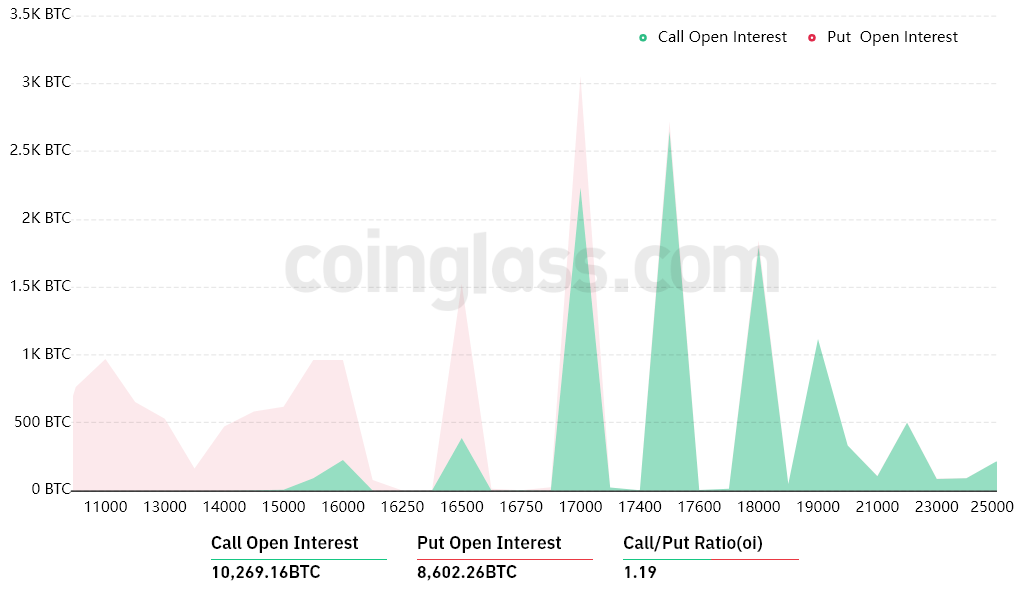
The open interest for the Dec. 9 options expiry is $320 million, but the actual figure will be lower since bears were expecting sub-$15,500 price levels. These traders became overconfident after Bitcoin traded below $16,000 on Nov. 22.

Bitcoin options aggregate open interest for Dec. 9. Source: CoinGlass

The 1.19 call-to-put ratio reflects the imbalance between the $175 million call (buy) open interest and the $145 million put (sell) options. Currently, Bitcoin stands at $16,900, meaning most bearish bets will likely become worthless.

If Bitcoin's price remains near $17,000 at 8:00 am UTC on Dec. 9, only $16 million worth of these put (sell) options will be available. This difference happens because the right to sell Bitcoin at $16,500 or $15,500 is useless if BTC trades above that level on expiry.

Bulls aim for $18k to secure a $130 million profit

Below are the four most likely scenarios based on the current price action. The number of options contracts available on Dec. 9 for call (bull) and put (bear) instruments varies, depending on the expiry price. The imbalance favoring each side constitutes the theoretical profit:

Between $15,500 and $16,500: 200 calls vs. 2,100 puts. The net result favors the put (bear) instruments by $30 million.

Between $16,500 and $17,000: 1,700 calls vs. 1,500 puts. The net result is balanced between bears and bulls.

Between $17,000 and $18,000: 5,500 calls vs. 100 puts. The net result favors the call (bull) instruments by $100 million.

Between $18,000 and $18,500: 7,300 calls vs. 0 puts. Bulls completely dominate the expiry by profiting $130 million.

This crude estimate considers the put options used in bearish bets and the call options exclusively in neutral-to-bullish trades. Even so, this oversimplification disregards more complex investment strategies.

For example, a trader could have sold a put option, effectively gaining positive exposure to Bitcoin above a specific price, but unfortunately, there's no easy way to estimate this effect.

Bulls probably have less margin to support the price

Bitcoin bulls need to push the price above $18,000 on Friday to secure a potential $130 million profit. On the other hand, the bears' best-case scenario requires a slight push below $16,500 to maximize their gains.

Bitcoin bulls just had $230 million leverage long positions liquidated in two days, so they might have less margin required to support the price.

Considering the negative pressure from traditional markets due to recession concerns and raising interest rates, bears will likely avoid a loss by keeping Bitcoin below $17,000 on Dec 9.


Leituras Relacionadas

Giants Wage the Context War, Reconstructing AI Moats

The article "Giants Launch the Context War, Reconstructing AI's Moat" discusses how leading AI companies—OpenAI, Anthropic, and Google—are shifting their competitive focus from model size to acquiring, managing, and utilizing user context (Context). Initially, Context referred to the length of text a model could process, leading to a "arms race" for longer context windows. However, the competition has evolved through three key phases: expanding text capacity (long context windows), enabling memory across sessions, and finally, integrating AI into real user environments like browsers and desktops to capture dynamic task states. Each company is pursuing a distinct strategy. OpenAI is building Context around the ChatGPT account, turning it into a central hub that accumulates user understanding across various integrated applications and tools. Anthropic, lacking a major user base, focuses on high-value verticals like coding, empowering its Claude model to actively gather Context through GUI interaction (Computer Use) and system connections (MCP protocol). Google, with vast existing user data from products like Search and Gmail, faces the challenge of restructuring this data into actionable, AI-understandable Context for its Gemini model within its ecosystem. The core argument is that the nature of competitive advantage in AI is changing. The internet era prized network effects—connecting more users. The AI era values "individual depth": the ability to build deep, task-specific understanding of a user. This creates a new moat through 1) the compounding value of accumulated Context, 2) deep integration with user tools and permissions, and 3) the establishment of trust for complex tasks. Therefore, the battle for Context is fundamentally about capturing "task entry points" and converting existing digital ecosystems into environments where AI can effectively understand and act, rather than merely scaling user numbers.

marsbitHá 17m

Giants Wage the Context War, Reconstructing AI Moats

marsbitHá 17m

Foundation Steps Back, Ethlabs Steps Forward: Ethereum Undergoes Its Largest Restructuring in History

On June 23rd, the Ethereum ecosystem witnessed two major shifts, signaling a significant governance realignment. First, former Ethereum Foundation researchers established Ethlabs, a new independent non-profit. Backed by major ETH holders like Bitmine and SharpLink, Ethlabs aims to address practical needs for institutional adoption, including faster settlement, native asset issuance, cross-chain transactions, and mainnet scaling. Secondly, the Ethereum Foundation announced a major restructuring, laying off 54 employees (20% of its staff) to become a leaner entity focused on protocol governance and maintenance rather than being the primary builder. This move represents a pivotal correction. Criticisms had mounted over the Foundation's perceived slowness, lack of clear strategy, and over-reliance on Vitalik Buterin's influence. Ethlabs emerges as a more execution-oriented, "industrialized" layer focused on market adoption—bridging the gap between research and real-world use. Notably, Vitalik Buterin is absent from its list of supporters, interpreted as an intentional step to avoid excessive personal endorsement and allow the organization to build independent credibility. The Ethereum Foundation's downsizing and redefinition mark a retreat from its former central coordinating role. It now aims to share the "privilege of stewarding Ethereum" with other emerging groups like Ethlabs, the Ethereum Applications Guild, and The Ethereum Economic Zone. Analysts frame this dual shift as the Foundation ensuring Ethereum remains "correct" (credibly neutral), while Ethlabs must prove it remains "effective" (competitive and attractive for capital and adoption). This addresses community "shareholder-like anxiety" about ETH's market performance. While risks exist—such as concerns over shifting from Foundation centrality to large-holder influence—the consensus is that the greater risk for Ethereum was inaction, caught between technical idealism and organizational inertia. These steps aim to create a more multi-stakeholder, execution-driven future for the network.

链捕手Há 7h

Foundation Steps Back, Ethlabs Steps Forward: Ethereum Undergoes Its Largest Restructuring in History

链捕手Há 7h

Second Half of U.S. Crypto Policy: The Clarity Act Aims for 60 Votes, CFTC's "One-Person Commission" Becomes Biggest Variable

In a pivotal year for US crypto policy, the "CLARITY Act" is advancing in the Senate but faces a high hurdle, needing 60 votes to pass. Key challenges include bridging partisan divides on ethics and swaying undecided Republican senators within a tight legislative calendar of only about 40 working days. The policy "second half" involves intense negotiations on a broader framework for Web3 and DeFi, including crypto tax reforms and the Blockchain Regulatory Certainty Act. A significant uncertainty is the understaffed CFTC, operating with four commissioner vacancies, which complicates regulatory clarity. Meanwhile, the departure of key "crypto champions"—SEC Commissioner Hester Peirce and Senator Cynthia Lummis—will impact ongoing policy efforts. Industry experts are cautiously optimistic but realistic. Sara K. Weed notes that while progress is being made, CLARITY is unlikely to pass this Congress, pushing agencies like the SEC and CFTC to provide more guidance. Sulolit Mukherjee suggests meaningful crypto tax legislation is more likely to be attached to larger must-pass bills. Rashan Colbert discusses the jurisdictional debate over prediction markets, emphasizing the need for a regulatory framework that fosters their development as financial tools rather than treating them broadly as gambling. The clock is ticking, but opportunities remain for substantive progress through continued bipartisan dialogue and pragmatic efforts.

marsbitHá 10h

Second Half of U.S. Crypto Policy: The Clarity Act Aims for 60 Votes, CFTC's "One-Person Commission" Becomes Biggest Variable

marsbitHá 10h

Dan Koe's New Essay: Escaping the Fate of the Wage Slave, How to Survive the AI Replacement Wave?

Dan Koe argues that the true threat in the AI era isn't technology itself, but a reliance on others for one's livelihood and happiness. The core problem is "wage slavery"—spending life on unfulfilling work. To survive and thrive, one must escape this by building their own enterprise. The key is developing five elements: Agency (initiative), Taste (discernment), Persuasion, Persistence, and Iteration. These boil down to problem-solving skills and experiential knowledge, which cannot be learned passively but only through doing your own projects. The solution is to become "unemployable" by shifting your identity. This requires: 1) Radically changing your environment to force growth, 2) Choosing a medium (like content creation) that provides real feedback through trial and error, and 3) Mastering either code or, preferably, media (content). Content creation is more valuable because its subjective nature and need for human perspective create a durable advantage over generic AI output. To start, define your life's work by answering foundational questions about your innate knowledge, unique abilities, and contrarian beliefs. Then, immediately act by publishing your first piece of content. The cycle of creating, receiving feedback, and iterating is the essential path to developing the skills needed for an independent, meaningful career and financial resilience.

marsbitHá 11h

Dan Koe's New Essay: Escaping the Fate of the Wage Slave, How to Survive the AI Replacement Wave?

marsbitHá 11h

Trading

Spot
Futuros
活动图片