Giants Wage the Context War, Reconstructing AI Moats

marsbitPublicado em 2026-06-23Última atualização em 2026-06-23

Resumo

The article "Giants Launch the Context War, Reconstructing AI's Moat" discusses how leading AI companies—OpenAI, Anthropic, and Google—are shifting their competitive focus from model size to acquiring, managing, and utilizing user context (Context). Initially, Context referred to the length of text a model could process, leading to a "arms race" for longer context windows. However, the competition has evolved through three key phases: expanding text capacity (long context windows), enabling memory across sessions, and finally, integrating AI into real user environments like browsers and desktops to capture dynamic task states. Each company is pursuing a distinct strategy. OpenAI is building Context around the ChatGPT account, turning it into a central hub that accumulates user understanding across various integrated applications and tools. Anthropic, lacking a major user base, focuses on high-value verticals like coding, empowering its Claude model to actively gather Context through GUI interaction (Computer Use) and system connections (MCP protocol). Google, with vast existing user data from products like Search and Gmail, faces the challenge of restructuring this data into actionable, AI-understandable Context for its Gemini model within its ecosystem. The core argument is that the nature of competitive advantage in AI is changing. The internet era prized network effects—connecting more users. The AI era values "individual depth": the ability to build deep, task-specific ...

This year, the three major US AI giants have been labeling their own model products with some "sci-fi" tags.

OpenAI says ChatGPT has learned to "dream"; Anthropic wants to give Claude a built-in "personal Wiki"; Google claims Gemini "natively comes with ten years of your memories".

These three statements seem unrelated, but they are actually competing for the same thing—Context.

Early on, Context was just an unremarkable technical parameter, measuring how many characters a model could process at once. Today, the meaning of Context is broadening: it is user assets, tool permissions, the real-time state of a task's progress, and ultimately, how well the AI understands you.

According to "Deep Flow Research Institute," since the beginning of this year, OpenAI, Anthropic, and Google have released over 40 important product and feature updates centered around Context—on average, a new capability hits the market every three to four days.

From long-context windows to cross-session Memory, to browser, desktop, and GUI capabilities, almost all the most significant changes in AI products over the past two years have revolved around Context.

A war over "Context" has already begun, which is quietly reconstructing the moats of the AI era.

1. From Long Windows to the Real Environment: Three Leaps in the Boundaries of Context

The earliest competition over Context happened in "text length."

In the Chatbot era, Context primarily meant how much information a model could ingest at one time. The longer the window, the more capable the model was at handling papers, codebases, even complete project documentation. Thus, OpenAI, Anthropic, and Google ignited an arms race in context window length.

In May 2023, Anthropic led the charge by extending Claude's context window from 9K to 100K, equivalent to about 75,000 words, making "uploading an entire book" a reality for the first time. In November 2023, OpenAI followed up with GPT-4 Turbo's 128K window. Three months later, Google pushed the window to the million-level with Gemini 1.5 Pro.

In less than a year, Context leaped from the hundred-thousand level to the million level.
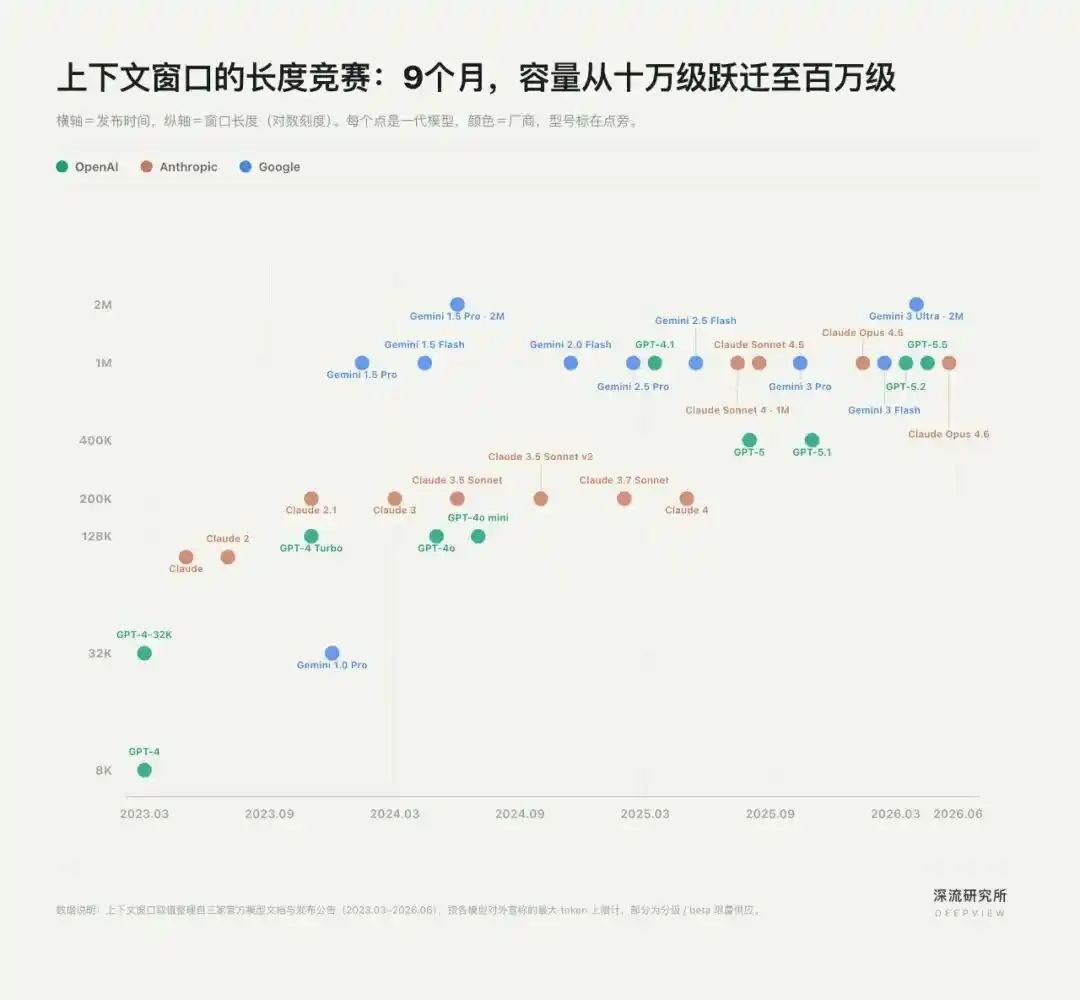
Long windows solved the AI's "throughput" problem, but this race quickly exposed its limitations: the model seeing more information doesn't necessarily mean it can better understand the task.

Especially as AI products evolved from Chatbot to Agent, the boundaries of Context began to change. It was no longer just the input text in a single conversation, but the continuously accumulating, dynamically updated state flow within the task loop.

The focus of competition shifted accordingly: from "how much the model can know at once" to "what the model can remember long-term." Memory became the typical product form of this stage.

In early 2024, OpenAI was the first to introduce cross-session memory for ChatGPT, allowing the model to remember user preferences, backgrounds, and long-term needs. Subsequently, Anthropic and Google also equipped Claude and Gemini with memory capabilities.

Context began to have a time dimension. AI no longer only processed the current input; it also started trying to establish continuity between a user's interactions today, last week, and last month. Only AI with long-term Context could string discrete interactions into an ongoing relationship.

However, Memory answers "what happened in the past," but hasn't yet touched upon an even more critical question: what is happening now?

The real watershed moment appeared in the second half of 2025.

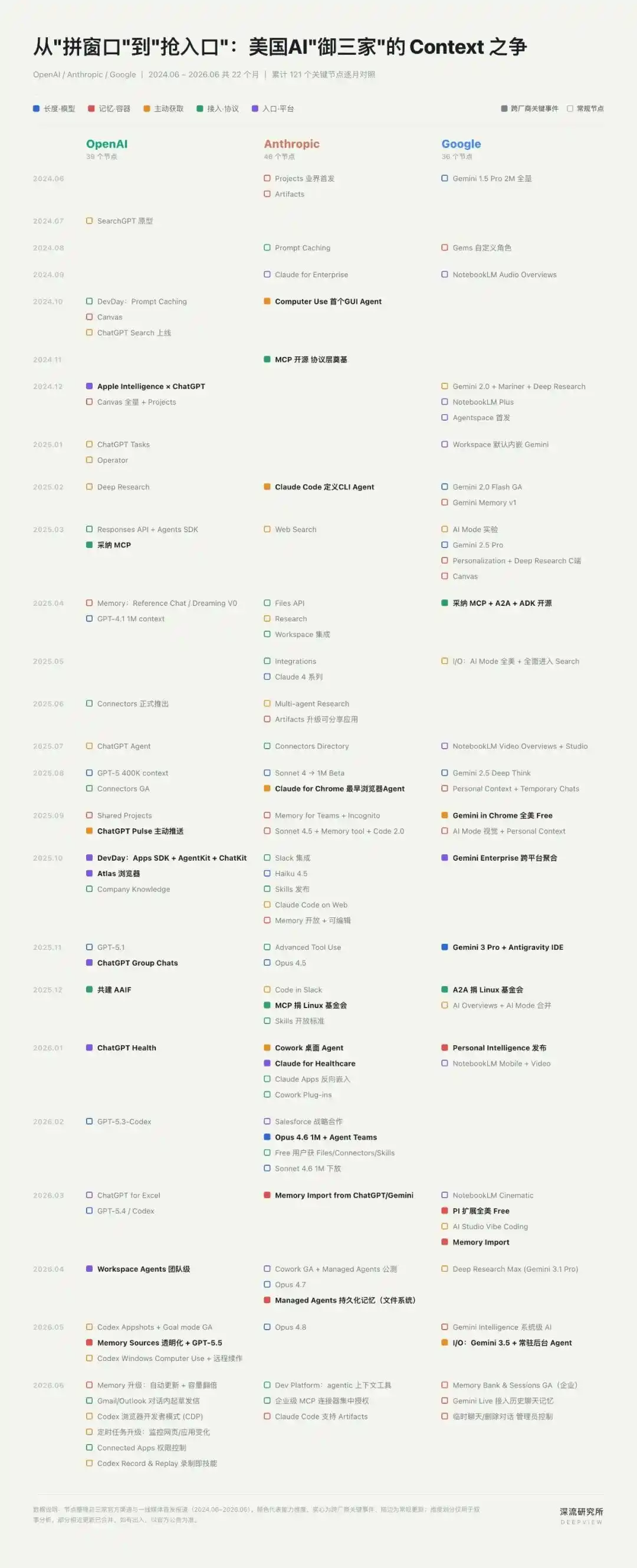
Starting in August of that year, the three companies almost simultaneously pushed the Context front to the browser: Anthropic released Claude for Chrome, Google embedded Gemini into Chrome, and OpenAI launched the standalone AI browser ChatGPT Atlas.

The browser is a natural Context goldmine. Web content, search intent, login status, forms, history, tabs, and the tasks the user is executing are all deposited within the browser. More importantly, the Context here is more real-time, continuous, and closer to the actual task site.

Previously, the way AI obtained Context was essentially still waiting for the user to deliver materials: uploading files, inputting instructions, authorizing memory, connecting data sources.

After entering the browser, the logic changed. AI began entering the user's work environment, observing page state, understanding task progress, capturing operational intent, and executing the next step within the real interface.

This was the third leap in Context boundaries: it transformed from static data input on the model side to the dynamic state captured by Agents in GUI, web pages, and system environments.

Long windows determine how much information the model can ingest at once; Memory determines whether the model can understand the user across time; browser, desktop products, and GUI capabilities determine whether the model can enter the real task site.

Together, these three constitute the main thread of AI product competition over the past two years: Context is no longer just a model capability issue; it is gradually becoming a product entry point issue, a user relationship issue, and an asset accumulation issue.

2. Context Becomes the New Battleground: Three Paths for the US AI "Big Three"

When Context evolves from a model parameter to a user asset, the core of competition becomes: who can more stably acquire, organize, and invoke Context.

Centered on this, OpenAI, Anthropic, and Google have taken three differentiated paths.
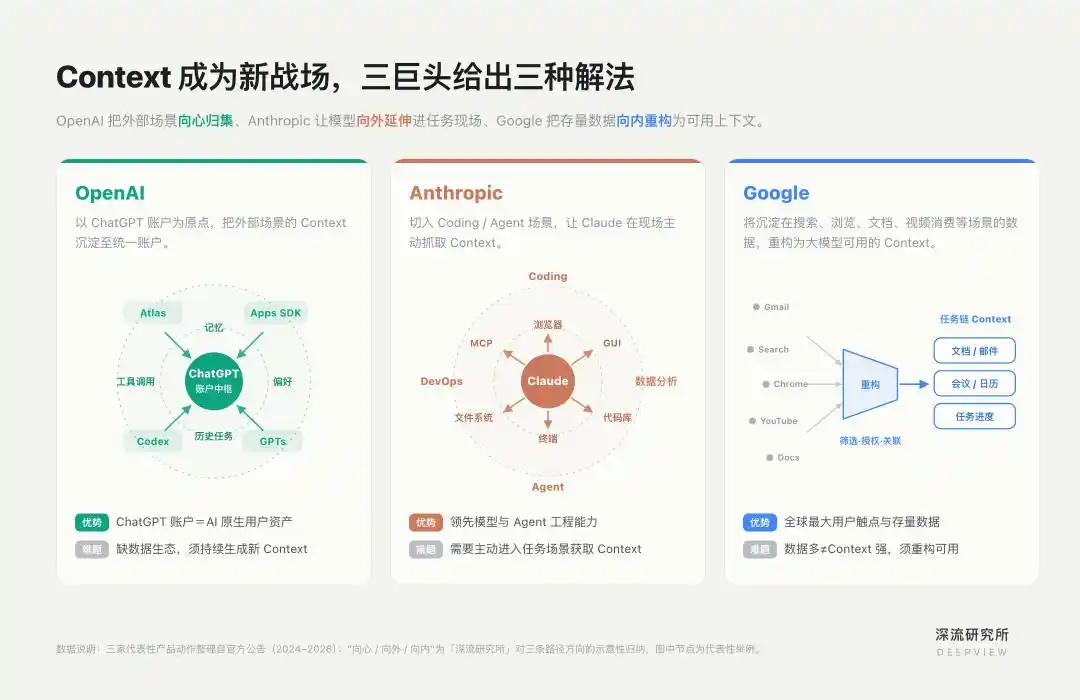
ChatGPT is OpenAI's most core source of Context.

Memories, preferences, historical tasks, and tool usage records left by users in countless conversations gradually accumulate under the same ChatGPT account.

This account differs from traditional internet accounts. Traditional accounts record login status, subscription relationships, and payment information; ChatGPT accounts record the user's "history understood by AI."

This is an AI-native user asset. Its value lies not only in more personalized answers but also in reducing cold-start costs, continuing task states, and reusing the same set of user understanding across different product scenarios.

For OpenAI, lacking Google's native data ecosystem, it must have users continuously generate new Context within the ChatGPT system.

Therefore, OpenAI's product moves over the past two years have consistently expanded the task radius that the ChatGPT account can cover—the Apps SDK brings third-party apps into ChatGPT, Atlas brings the browser into ChatGPT, and the newly integrated Codex brings programming tasks into the same workflow.

OpenAI's unique path lies in not first controlling the entry point and then plugging AI into it; rather, it takes ChatGPT as the origin point and pulls application, browser, programming, and other scenarios back into the same account system.

ChatGPT thus is no longer just a conversational entry point but a hub for converging, invoking, and updating Context.

In contrast, Anthropic lacks both C-end entry points and large-scale existing user data.

Its path is to cut into high-value vertical scenarios like Coding and Agent and strengthen Claude's ability to actively acquire Context within these scenarios.

For Claude, Context is not a piece of text input by the user but the dynamically changing environment within the task site: codebases, file systems, terminal output, browser pages, databases, project documentation, and feedback after each execution step.

Therefore, Anthropic emphasizes the proactivity of Context acquisition more. The model should not just wait for user input; it should also actively enter the environment, read the state, and obtain feedback during task execution.

In October 2024, Anthropic launched Computer Use, allowing Claude to move the mouse, click buttons, and input text based on screen captures.

According to the official statement, Claude 3.5 Sonnet is the first frontier AI model publicly offering computer use capabilities.

This means that when Context exists in web pages, forms, backend system interfaces, and local software UIs, rather than in structured APIs, Claude can still enter the environment via GUI, observe the state, and execute operations.

A month later, Anthropic released MCP. This open protocol connecting AI assistants with external tools and data sources is officially defined as connecting AI assistants to "systems where data resides," including content libraries, business tools, and development environments.

Its value lies in allowing Claude to no longer rely on users copy-pasting but to access external tools and data sources through standardized methods.

These two types of capabilities correspond to Anthropic's two paths for acquiring Context:

Computer Use enters interfaces via GUI; MCP connects systems via protocol. One enters the task site; the other connects to external tools, collectively enabling Claude to obtain dynamic Context.
Now, looking at Google. It's often said externally that Google is one of the companies with the most Context. It lacks neither entry points nor data. Products like Chrome, Gmail, YouTube, and Search constitute one of the largest collections of user touchpoints globally.

But from an AI perspective, more data does not equal stronger Context.

What Google accumulated in the past was search, browsing, email, documents, location, video consumption, and other data, primarily serving search ranking, ad delivery, content recommendation, and office collaboration. They are essentially behavioral signals needed for system operation.

What Agents need is task background that can be understood, reasoned about, and invoked by models.

Only when a model can judge which information is relevant to the current task, which is outdated, which can be invoked, and how these pieces of information are related, does data truly become Context.

The challenge Google faces is not simply "accessing data," but a data refactoring. It needs to re-screen, correlate, authorize, and transform old data scattered across different products, serving different system goals, into personal context usable by Gemini.

The difficulty of this engineering task is no less than OpenAI re-accumulating Context or Anthropic entering the task site.

Over the past two years, Google's product moves have not been starting from scratch but reforming inward along its existing strongholds. The core of this path is organizing fragmented data into task chains.

In May 2024, Gemini 1.5 Pro entered the Workspace sidebar, allowing the model to first invoke current context within work scenarios like Gmail, Docs, and Drive.

In July 2025, the Gemini app began connecting to tools like Gmail, Drive, and Calendar, extending Context from a single application to cross-application tasks.

In January 2026, Personal Intelligence launched a test version, further incorporating personal data like Gmail and Photos into Gemini's personalized background.

Google's Context strategy is not "we have more data, so we're naturally ahead."

What it truly needs to accomplish is a data usability engineering project: transforming historically accumulated behavioral data serving system goals like search, ads, and recommendation into understandable, authorizable, actionable Context for the AI era.

3. From "Network Scale" to "Individual Depth": AI Era Moats Are Changing

Over the past two years, OpenAI, Anthropic, and Google have all accelerated the accumulation and mining of Context, building capabilities around its acquisition, organization, and invocation, attempting to form new competitive barriers.

But a seemingly contradictory change is also happening simultaneously: since this year, the three companies have coincidentally made Memory more transparent, explainable, and even migratable.

In March 2026, Anthropic and Google successively launched Memory Import, supporting users in migrating memories between ChatGPT, Gemini, and Claude.

Subsequently, OpenAI, through Memory Sources, allowed users to see which memories, historical chats, or external data sources were invoked behind a personalized answer.

If Context is the most important asset in the AI era, why are platforms starting to open its permissions?

The answer lies in the fact that Memory Import truly only opens surface-level Context: user preferences, memory summaries, compressed versions of chat history.

This information is highly structured and easily described in natural language. Migrating it is not technically difficult.

What's truly hard to migrate is another type of Context: task states, tool permissions, enterprise system integrations, real-time feedback from execution sites.

This Context is deeply embedded within product and system environments and cannot be fully moved with a prompt.

This also indicates that the competitive logic of the AI era differs from that of the internet era.

The basic form of the internet is the network. It connects people, content, goods, services, and information into nodes. The more nodes and denser the connections, the more valuable the product. Therefore, the strongest moat in the internet era was network effects; value came from more people using it.

The basic form of AI is closer to a new kind of computer, or a new information processing system.

Its primary value is not connecting more people, but understanding information, processing tasks, invoking tools, and completing actions. An AI could create enormous value even serving just one user.

Therefore, the moats of the AI era are shifting from "network scale" to "individual depth." This "individual depth" barrier primarily comes from three layers:

First, the compounding effect of Context. Every time an AI completes a task, it understands the user's expression habits, judgment standards, data sources, and workflow better. The next time it executes, the cold-start cost is lower.

Second, the embedding of permissions and toolchains. When users authorize AI to access their email, documents, codebases, etc., AI is no longer just a replaceable Q&A tool; it enters the real task site.

Third, the formation of trust relationships. The more complex and high-value the task, the less likely users are to casually hand it to an unfamiliar AI. Only an AI that has long understood them, knows their boundaries, and can continue the context will likely be allowed to execute the next step.

If internet products compete for attention entry points, then AI products compete for task entry points.

Once an AI consistently enters a user's workflow, accumulates context, and gains execution permissions, the migration cost isn't just switching an app; it's re-establishing a whole set of task relationships of being understood, authorized, and trusted.

Changes in domestic products can also be understood within this logic.

Take Tencent as an example. It accumulated relationship chains, content, service ecosystems, and high-frequency entry points in the internet era; in the AI era, the value of these assets lies in whether they can be reorganized into Context that Agents can understand, invoke, and execute.

Whether it's WorkBuddy accessing work scenarios like documents, meetings, and WeCom, or WeChat's "Xiao Wei" attempting to invoke mini-programs and services within the WeChat ecosystem, the essence is transforming content, relationships, and processes originally serving humans into task environments AI can enter.

As Tencent's Chief AI Scientist Yao Shunyu judges: Context may appear as a data asset, but essentially it is a comprehensive reflection of product capabilities, engineering capabilities, and organizational coordination capabilities.

In the internet era, moats were about scale. In the AI era, moats should be more about conversion efficiency:

Who can transform their existing ecosystem into an AI work environment faster? Who can allow AI to accumulate deeper user understanding through each task? Whoever does this is more likely to build new barriers.

This is what truly deserves attention about the Context War.

This article is from WeChat public account "Deep Flow Research Institute," author: Jiang Feng

Criptomoedas em alta

Perguntas relacionadas

QAccording to the article, what are the three major evolutions of the meaning of 'Context' in AI, and what does each represent?

AThe article describes three major evolutions in the meaning of 'Context'. First, it started as a technical parameter for text length (long context windows), addressing the model's 'throughput'. Second, it evolved to include a time dimension through 'Memory', allowing AI to understand users across sessions. Third, it expanded to become dynamic state captured from real environments like browsers and GUIs, enabling AI to operate within real task contexts.

QHow do the strategies of OpenAI, Anthropic, and Google for acquiring and utilizing Context differ, as outlined in the article?

ATheir strategies differ significantly. OpenAI focuses on the ChatGPT account as a central hub to accumulate Context from diverse tasks (apps, browser, coding). Anthropic, lacking major data ecosystems, emphasizes proactive Context acquisition through capabilities like Computer Use (GUI interaction) and the MCP protocol (connecting to external tools and data). Google's strategy involves transforming its vast existing user data from products like Search, Gmail, and Chrome into actionable, task-relevant Context usable by its Gemini AI, a complex data restructuring effort.

QWhat key shift in the nature of AI-era competitive moats does the article identify, compared to the internet era?

AThe article identifies a shift from moats based on 'network scale' in the internet era to moats based on 'individual depth' in the AI era. Internet value came from connecting more people (network effects). AI value comes from deeply understanding and efficiently completing tasks for individuals or organizations. The new moat is built on Context compounding, embedded permissions/toolchains, and formed trust relationships within a user's workflow.

QWhat is the apparent contradiction the article notes regarding Memory in AI systems, and what is the explanation provided?

AThe contradiction is that while companies are heavily competing on Context/Memory as a core asset, they are also making Memory features like 'Memory Import' transparent and portable between platforms. The explanation is that what is made portable is only surface-level, structured Context (preferences, summaries). The truly valuable, hard-to-migrate Context is deeply embedded in task states, tool permissions, system integrations, and real-time environmental feedback, which remains locked within each platform's ecosystem.

QHow does the article interpret the value of a company like Tencent's existing internet-era assets in the new AI context-driven competition?

AThe article interprets that the value of Tencent's assets (social graphs, content, services, high-frequency apps) in the AI era lies not in their scale alone, but in their potential to be reorganized and converted into 'Context'—task environments that AI agents can understand, access, and operate within. Success depends on the efficiency of transforming these human-centric ecosystems into AI-actionable workflows, as seen in products like WorkBuddy and the 'Xiaowei' assistant within WeChat.

Leituras Relacionadas

Preferred Stock Is Not the Trigger for Corporate Bankruptcy, MicroStrategy's Dollar Reserves Can Cover Dividend and Interest Payments Until February 2027

Preferred Shares Are Not the Catalyst for Corporate Bankruptcy; MicroStrategy's Dollar Reserves Can Cover Dividend and Interest Payments Until February 2027. This article analyzes the nature of preferred shares used by MicroStrategy (MSTR). Legally equity but economically similar to debt, these shares, including its Bitcoin-linked STR convertible preferred notes (STRC), offer fixed or floating dividends. Crucially, MicroStrategy's preferred shares lack rigid redemption clauses, meaning they are not classified as traditional debt. This eliminates principal repayment pressure and means missed dividends do not constitute default or trigger bankruptcy, creating a "self-contradictory virtuous cycle." The article clarifies that if funds are short, MicroStrategy can defer or suspend preferred share dividends (except for non-cumulative types like STRD) without immediate risk. The real potential crisis point lies with its convertible bonds. If a prolonged bear market prevents conversion, MicroStrategy might need to sell Bitcoin to repay these bonds starting from the earliest maturity in September 2027, potentially creating a downward spiral. Preferred dividend suspensions would only exacerbate market panic in such a scenario. Recent financial activity shows MicroStrategy strengthened its position through four weeks of common stock (MSTR) issuances, raising over $851 million without issuing new preferred shares. It increased its dollar reserves to approximately $1.4 billion, which is sufficient to cover all preferred share dividends and interest until around March 2027. While Bitcoin purchases slowed recently, this prioritization of cash reserves enhances the company's near-term financial safety. The analysis concludes that if the Bitcoin bear market ends by early 2025 as anticipated, MicroStrategy can resume issuing MSTR stock in a rising market to replenish reserves and manage future dividend obligations, thereby reducing the long-term pressure from its preferred share structure.

marsbitHá 30m

Preferred Stock Is Not the Trigger for Corporate Bankruptcy, MicroStrategy's Dollar Reserves Can Cover Dividend and Interest Payments Until February 2027

marsbitHá 30m

Foundation Steps Back, Ethlabs Steps Forward: Ethereum Undergoes Its Largest Restructuring in History

On June 23rd, the Ethereum ecosystem witnessed two major shifts, signaling a significant governance realignment. First, former Ethereum Foundation researchers established Ethlabs, a new independent non-profit. Backed by major ETH holders like Bitmine and SharpLink, Ethlabs aims to address practical needs for institutional adoption, including faster settlement, native asset issuance, cross-chain transactions, and mainnet scaling. Secondly, the Ethereum Foundation announced a major restructuring, laying off 54 employees (20% of its staff) to become a leaner entity focused on protocol governance and maintenance rather than being the primary builder. This move represents a pivotal correction. Criticisms had mounted over the Foundation's perceived slowness, lack of clear strategy, and over-reliance on Vitalik Buterin's influence. Ethlabs emerges as a more execution-oriented, "industrialized" layer focused on market adoption—bridging the gap between research and real-world use. Notably, Vitalik Buterin is absent from its list of supporters, interpreted as an intentional step to avoid excessive personal endorsement and allow the organization to build independent credibility. The Ethereum Foundation's downsizing and redefinition mark a retreat from its former central coordinating role. It now aims to share the "privilege of stewarding Ethereum" with other emerging groups like Ethlabs, the Ethereum Applications Guild, and The Ethereum Economic Zone. Analysts frame this dual shift as the Foundation ensuring Ethereum remains "correct" (credibly neutral), while Ethlabs must prove it remains "effective" (competitive and attractive for capital and adoption). This addresses community "shareholder-like anxiety" about ETH's market performance. While risks exist—such as concerns over shifting from Foundation centrality to large-holder influence—the consensus is that the greater risk for Ethereum was inaction, caught between technical idealism and organizational inertia. These steps aim to create a more multi-stakeholder, execution-driven future for the network.

链捕手Há 8h

Foundation Steps Back, Ethlabs Steps Forward: Ethereum Undergoes Its Largest Restructuring in History

链捕手Há 8h

Second Half of U.S. Crypto Policy: The Clarity Act Aims for 60 Votes, CFTC's "One-Person Commission" Becomes Biggest Variable

In a pivotal year for US crypto policy, the "CLARITY Act" is advancing in the Senate but faces a high hurdle, needing 60 votes to pass. Key challenges include bridging partisan divides on ethics and swaying undecided Republican senators within a tight legislative calendar of only about 40 working days. The policy "second half" involves intense negotiations on a broader framework for Web3 and DeFi, including crypto tax reforms and the Blockchain Regulatory Certainty Act. A significant uncertainty is the understaffed CFTC, operating with four commissioner vacancies, which complicates regulatory clarity. Meanwhile, the departure of key "crypto champions"—SEC Commissioner Hester Peirce and Senator Cynthia Lummis—will impact ongoing policy efforts. Industry experts are cautiously optimistic but realistic. Sara K. Weed notes that while progress is being made, CLARITY is unlikely to pass this Congress, pushing agencies like the SEC and CFTC to provide more guidance. Sulolit Mukherjee suggests meaningful crypto tax legislation is more likely to be attached to larger must-pass bills. Rashan Colbert discusses the jurisdictional debate over prediction markets, emphasizing the need for a regulatory framework that fosters their development as financial tools rather than treating them broadly as gambling. The clock is ticking, but opportunities remain for substantive progress through continued bipartisan dialogue and pragmatic efforts.

marsbitHá 11h

Second Half of U.S. Crypto Policy: The Clarity Act Aims for 60 Votes, CFTC's "One-Person Commission" Becomes Biggest Variable

marsbitHá 11h

Dan Koe's New Essay: Escaping the Fate of the Wage Slave, How to Survive the AI Replacement Wave?

Dan Koe argues that the true threat in the AI era isn't technology itself, but a reliance on others for one's livelihood and happiness. The core problem is "wage slavery"—spending life on unfulfilling work. To survive and thrive, one must escape this by building their own enterprise. The key is developing five elements: Agency (initiative), Taste (discernment), Persuasion, Persistence, and Iteration. These boil down to problem-solving skills and experiential knowledge, which cannot be learned passively but only through doing your own projects. The solution is to become "unemployable" by shifting your identity. This requires: 1) Radically changing your environment to force growth, 2) Choosing a medium (like content creation) that provides real feedback through trial and error, and 3) Mastering either code or, preferably, media (content). Content creation is more valuable because its subjective nature and need for human perspective create a durable advantage over generic AI output. To start, define your life's work by answering foundational questions about your innate knowledge, unique abilities, and contrarian beliefs. Then, immediately act by publishing your first piece of content. The cycle of creating, receiving feedback, and iterating is the essential path to developing the skills needed for an independent, meaningful career and financial resilience.

marsbitHá 12h

Dan Koe's New Essay: Escaping the Fate of the Wage Slave, How to Survive the AI Replacement Wave?

marsbitHá 12h

Trading

Spot
Futuros

Artigos em Destaque

O que é GROK AI

Grok AI: Revolucionar a Tecnologia Conversacional na Era Web3 Introdução No panorama em rápida evolução da inteligência artificial, a Grok AI destaca-se como um projeto notável que liga os domínios da tecnologia avançada e da interação com o utilizador. Desenvolvida pela xAI, uma empresa liderada pelo renomado empreendedor Elon Musk, a Grok AI procura redefinir a forma como interagimos com a inteligência artificial. À medida que o movimento Web3 continua a florescer, a Grok AI visa aproveitar o poder da IA conversacional para responder a consultas complexas, proporcionando aos utilizadores uma experiência que é não apenas informativa, mas também divertida. O que é a Grok AI? A Grok AI é um sofisticado chatbot de IA conversacional projetado para interagir com os utilizadores de forma dinâmica. Ao contrário de muitos sistemas de IA tradicionais, a Grok AI abraça uma gama mais ampla de perguntas, incluindo aquelas tipicamente consideradas inadequadas ou fora das respostas padrão. Os principais objetivos do projeto incluem: Raciocínio Fiável: A Grok AI enfatiza o raciocínio de senso comum para fornecer respostas lógicas com base na compreensão contextual. Supervisão Escalável: A integração de assistência de ferramentas garante que as interações dos utilizadores sejam monitorizadas e otimizadas para qualidade. Verificação Formal: A segurança é primordial; a Grok AI incorpora métodos de verificação formal para aumentar a fiabilidade das suas saídas. Compreensão de Longo Contexto: O modelo de IA destaca-se na retenção e recordação de um extenso histórico de conversas, facilitando discussões significativas e contextualizadas. Robustez Adversarial: Ao focar na melhoria das suas defesas contra entradas manipuladas ou maliciosas, a Grok AI visa manter a integridade das interações dos utilizadores. Em essência, a Grok AI não é apenas um dispositivo de recuperação de informações; é um parceiro conversacional imersivo que incentiva um diálogo dinâmico. Criador da Grok AI A mente por trás da Grok AI não é outra senão Elon Musk, um indivíduo sinónimo de inovação em vários campos, incluindo automóvel, viagens espaciais e tecnologia. Sob a égide da xAI, uma empresa focada em avançar a tecnologia de IA de maneiras benéficas, a visão de Musk visa reformular a compreensão das interações com a IA. A liderança e a ética fundacional são profundamente influenciadas pelo compromisso de Musk em ultrapassar os limites tecnológicos. Investidores da Grok AI Embora os detalhes específicos sobre os investidores que apoiam a Grok AI permaneçam limitados, é reconhecido publicamente que a xAI, a incubadora do projeto, é fundada e apoiada principalmente pelo próprio Elon Musk. As anteriores empreitadas e participações de Musk fornecem um forte apoio, reforçando ainda mais a credibilidade e o potencial de crescimento da Grok AI. No entanto, até agora, informações sobre fundações ou organizações de investimento adicionais que apoiam a Grok AI não estão prontamente acessíveis, marcando uma área para exploração futura potencial. Como Funciona a Grok AI? A mecânica operacional da Grok AI é tão inovadora quanto a sua estrutura conceptual. O projeto integra várias tecnologias de ponta que facilitam as suas funcionalidades únicas: Infraestrutura Robusta: A Grok AI é construída utilizando Kubernetes para orquestração de contêineres, Rust para desempenho e segurança, e JAX para computação numérica de alto desempenho. Este trio assegura que o chatbot opere de forma eficiente, escale eficazmente e sirva os utilizadores prontamente. Acesso a Conhecimento em Tempo Real: Uma das características distintivas da Grok AI é a sua capacidade de aceder a dados em tempo real através da plataforma X—anteriormente conhecida como Twitter. Esta capacidade concede à IA acesso às informações mais recentes, permitindo-lhe fornecer respostas e recomendações oportunas que outros modelos de IA poderiam perder. Dois Modos de Interação: A Grok AI oferece aos utilizadores a escolha entre “Modo Divertido” e “Modo Regular”. O Modo Divertido permite um estilo de interação mais lúdico e humorístico, enquanto o Modo Regular foca em fornecer respostas precisas e exatas. Esta versatilidade assegura uma experiência adaptada que atende a várias preferências dos utilizadores. Em essência, a Grok AI combina desempenho com envolvimento, criando uma experiência que é tanto enriquecedora quanto divertida. Cronologia da Grok AI A jornada da Grok AI é marcada por marcos fundamentais que refletem as suas fases de desenvolvimento e implementação: Desenvolvimento Inicial: A fase fundamental da Grok AI ocorreu ao longo de aproximadamente dois meses, durante os quais o treinamento inicial e o ajuste do modelo foram realizados. Lançamento Beta do Grok-2: Numa evolução significativa, o beta do Grok-2 foi anunciado. Este lançamento introduziu duas versões do chatbot—Grok-2 e Grok-2 mini—cada uma equipada com capacidades para conversar, programar e raciocinar. Acesso Público: Após o seu desenvolvimento beta, a Grok AI tornou-se disponível para os utilizadores da plataforma X. Aqueles com contas verificadas por um número de telefone e ativas há pelo menos sete dias podem aceder a uma versão limitada, tornando a tecnologia disponível para um público mais amplo. Esta cronologia encapsula o crescimento sistemático da Grok AI desde a sua concepção até ao envolvimento público, enfatizando o seu compromisso com a melhoria contínua e a interação com o utilizador. Principais Características da Grok AI A Grok AI abrange várias características principais que contribuem para a sua identidade inovadora: Integração de Conhecimento em Tempo Real: O acesso a informações atuais e relevantes diferencia a Grok AI de muitos modelos estáticos, permitindo uma experiência de utilizador envolvente e precisa. Estilos de Interação Versáteis: Ao oferecer modos de interação distintos, a Grok AI atende a várias preferências dos utilizadores, convidando à criatividade e personalização na conversa com a IA. Base Tecnológica Avançada: A utilização de Kubernetes, Rust e JAX fornece ao projeto uma estrutura sólida para garantir fiabilidade e desempenho ótimo. Consideração de Discurso Ético: A inclusão de uma função de geração de imagens demonstra o espírito inovador do projeto. No entanto, também levanta considerações éticas em torno dos direitos autorais e da representação respeitosa de figuras reconhecíveis—uma discussão em curso dentro da comunidade de IA. Conclusão Como uma entidade pioneira no domínio da IA conversacional, a Grok AI encapsula o potencial para experiências transformadoras do utilizador na era digital. Desenvolvida pela xAI e impulsionada pela abordagem visionária de Elon Musk, a Grok AI integra conhecimento em tempo real com capacidades avançadas de interação. Esforça-se por ultrapassar os limites do que a inteligência artificial pode alcançar, mantendo um foco nas considerações éticas e na segurança do utilizador. A Grok AI não apenas incorpora o avanço tecnológico, mas também representa um novo paradigma de conversas no panorama Web3, prometendo envolver os utilizadores com conhecimento hábil e interação lúdica. À medida que o projeto continua a evoluir, ele permanece como um testemunho do que a interseção da tecnologia, criatividade e interação humana pode alcançar.

485 Visualizações TotaisPublicado em {updateTime}Atualizado em 2024.12.26

O que é GROK AI

O que é ERC AI

Euruka Tech: Uma Visão Geral do $erc ai e as suas Ambições no Web3 Introdução No panorama em rápida evolução da tecnologia blockchain e das aplicações descentralizadas, novos projetos surgem frequentemente, cada um com objetivos e metodologias únicas. Um desses projetos é a Euruka Tech, que opera no vasto domínio das criptomoedas e do Web3. O foco principal da Euruka Tech, particularmente do seu token $erc ai, é apresentar soluções inovadoras concebidas para aproveitar as capacidades crescentes da tecnologia descentralizada. Este artigo tem como objetivo fornecer uma visão abrangente da Euruka Tech, uma exploração das suas metas, funcionalidade, a identidade do seu criador, potenciais investidores e a sua importância no contexto mais amplo do Web3. O que é a Euruka Tech, $erc ai? A Euruka Tech é caracterizada como um projeto que aproveita as ferramentas e funcionalidades oferecidas pelo ambiente Web3, focando na integração da inteligência artificial nas suas operações. Embora os detalhes específicos sobre a estrutura do projeto sejam um tanto elusivos, ele é concebido para melhorar o envolvimento dos utilizadores e automatizar processos no espaço cripto. O projeto visa criar um ecossistema descentralizado que não só facilita transações, mas também incorpora funcionalidades preditivas através da inteligência artificial, daí a designação do seu token, $erc ai. O objetivo é fornecer uma plataforma intuitiva que facilite interações mais inteligentes e um processamento eficiente de transações dentro da crescente esfera do Web3. Quem é o Criador da Euruka Tech, $erc ai? Neste momento, a informação sobre o criador ou a equipa fundadora da Euruka Tech permanece não especificada e algo opaca. Esta ausência de dados levanta preocupações, uma vez que o conhecimento sobre o histórico da equipa é frequentemente essencial para estabelecer credibilidade no setor blockchain. Portanto, categorizamos esta informação como desconhecida até que detalhes concretos sejam disponibilizados no domínio público. Quem são os Investidores da Euruka Tech, $erc ai? De forma semelhante, a identificação de investidores ou organizações de apoio para o projeto Euruka Tech não é prontamente fornecida através da pesquisa disponível. Um aspeto que é crucial para potenciais partes interessadas ou utilizadores que consideram envolver-se com a Euruka Tech é a garantia que vem de parcerias financeiras estabelecidas ou apoio de empresas de investimento respeitáveis. Sem divulgações sobre afiliações de investimento, é difícil tirar conclusões abrangentes sobre a segurança financeira ou a longevidade do projeto. Em linha com a informação encontrada, esta seção também se encontra no estado de desconhecido. Como funciona a Euruka Tech, $erc ai? Apesar da falta de especificações técnicas detalhadas para a Euruka Tech, é essencial considerar as suas ambições inovadoras. O projeto procura aproveitar o poder computacional da inteligência artificial para automatizar e melhorar a experiência do utilizador no ambiente das criptomoedas. Ao integrar IA com tecnologia blockchain, a Euruka Tech visa fornecer funcionalidades como negociações automatizadas, avaliações de risco e interfaces de utilizador personalizadas. A essência inovadora da Euruka Tech reside no seu objetivo de criar uma conexão fluida entre os utilizadores e as vastas possibilidades apresentadas pelas redes descentralizadas. Através da utilização de algoritmos de aprendizagem automática e IA, visa minimizar os desafios enfrentados por utilizadores de primeira viagem e agilizar as experiências transacionais dentro do quadro do Web3. Esta simbiose entre IA e blockchain sublinha a importância do token $erc ai, que se apresenta como uma ponte entre interfaces de utilizador tradicionais e as capacidades avançadas das tecnologias descentralizadas. Cronologia da Euruka Tech, $erc ai Infelizmente, devido à informação limitada disponível sobre a Euruka Tech, não conseguimos apresentar uma cronologia detalhada dos principais desenvolvimentos ou marcos na jornada do projeto. Esta cronologia, tipicamente inestimável para traçar a evolução de um projeto e compreender a sua trajetória de crescimento, não está atualmente disponível. À medida que informações sobre eventos notáveis, parcerias ou adições funcionais se tornem evidentes, atualizações certamente aumentarão a visibilidade da Euruka Tech na esfera cripto. Esclarecimento sobre Outros Projetos “Eureka” É importante abordar que múltiplos projetos e empresas partilham uma nomenclatura semelhante com “Eureka.” A pesquisa identificou iniciativas como um agente de IA da NVIDIA Research, que se concentra em ensinar robôs a realizar tarefas complexas utilizando métodos generativos, bem como a Eureka Labs e a Eureka AI, que melhoram a experiência do utilizador na educação e na análise de serviços ao cliente, respetivamente. No entanto, estes projetos são distintos da Euruka Tech e não devem ser confundidos com os seus objetivos ou funcionalidades. Conclusão A Euruka Tech, juntamente com o seu token $erc ai, representa um jogador promissor, mas atualmente obscuro, dentro do panorama do Web3. Embora os detalhes sobre o seu criador e investidores permaneçam não divulgados, a ambição central de combinar inteligência artificial com tecnologia blockchain destaca-se como um ponto focal de interesse. As abordagens únicas do projeto em promover o envolvimento do utilizador através da automação avançada podem diferenciá-lo à medida que o ecossistema Web3 avança. À medida que o mercado cripto continua a evoluir, as partes interessadas devem manter um olhar atento sobre os avanços em torno da Euruka Tech, uma vez que o desenvolvimento de inovações documentadas, parcerias ou um roteiro definido pode apresentar oportunidades significativas no futuro próximo. Neste momento, aguardamos por insights mais substanciais que possam desvendar o potencial da Euruka Tech e a sua posição no competitivo panorama cripto.

527 Visualizações TotaisPublicado em {updateTime}Atualizado em 2025.01.02

O que é ERC AI

O que é DUOLINGO AI

DUOLINGO AI: Integrar a Aprendizagem de Línguas com Inovação Web3 e IA Numa era em que a tecnologia transforma a educação, a integração da inteligência artificial (IA) e das redes blockchain anuncia uma nova fronteira para a aprendizagem de línguas. Apresentamos DUOLINGO AI e a sua criptomoeda associada, $DUOLINGO AI. Este projeto aspira a unir o poder educativo das principais plataformas de aprendizagem de línguas com os benefícios da tecnologia descentralizada Web3. Este artigo explora os principais aspectos do DUOLINGO AI, analisando os seus objetivos, estrutura tecnológica, desenvolvimento histórico e potencial futuro, mantendo a clareza entre o recurso educativo original e esta iniciativa independente de criptomoeda. Visão Geral do DUOLINGO AI No seu cerne, DUOLINGO AI procura estabelecer um ambiente descentralizado onde os alunos podem ganhar recompensas criptográficas por alcançar marcos educativos em proficiência linguística. Ao aplicar contratos inteligentes, o projeto visa automatizar processos de verificação de habilidades e alocação de tokens, aderindo aos princípios do Web3 que enfatizam a transparência e a propriedade do utilizador. O modelo diverge das abordagens tradicionais de aquisição de línguas ao apoiar-se fortemente numa estrutura de governança orientada pela comunidade, permitindo que os detentores de tokens sugiram melhorias ao conteúdo dos cursos e à distribuição de recompensas. Alguns dos objetivos notáveis do DUOLINGO AI incluem: Aprendizagem Gamificada: O projeto integra conquistas em blockchain e tokens não fungíveis (NFTs) para representar níveis de proficiência linguística, promovendo a motivação através de recompensas digitais envolventes. Criação de Conteúdo Descentralizada: Abre caminhos para educadores e entusiastas de línguas contribuírem com os seus cursos, facilitando um modelo de partilha de receitas que beneficia todos os colaboradores. Personalização Através de IA: Ao empregar modelos avançados de aprendizagem de máquina, o DUOLINGO AI personaliza as lições para se adaptar ao progresso de aprendizagem individual, semelhante às características adaptativas encontradas em plataformas estabelecidas. Criadores do Projeto e Governança A partir de abril de 2025, a equipa por trás do $DUOLINGO AI permanece pseudónima, uma prática frequente no panorama descentralizado das criptomoedas. Esta anonimidade visa promover o crescimento coletivo e o envolvimento das partes interessadas, em vez de se concentrar em desenvolvedores individuais. O contrato inteligente implementado na blockchain Solana indica o endereço da carteira do desenvolvedor, o que significa o compromisso com a transparência em relação às transações, apesar da identidade dos criadores ser desconhecida. De acordo com o seu roteiro, o DUOLINGO AI pretende evoluir para uma Organização Autónoma Descentralizada (DAO). Esta estrutura de governança permite que os detentores de tokens votem em questões críticas, como implementações de funcionalidades e alocação de tesouraria. Este modelo alinha-se com a ética de empoderamento comunitário encontrada em várias aplicações descentralizadas, enfatizando a importância da tomada de decisão coletiva. Investidores e Parcerias Estratégicas Atualmente, não existem investidores institucionais ou capitalistas de risco publicamente identificáveis ligados ao $DUOLINGO AI. Em vez disso, a liquidez do projeto origina-se principalmente de trocas descentralizadas (DEXs), marcando um contraste acentuado com as estratégias de financiamento das empresas tradicionais de tecnologia educacional. Este modelo de base indica uma abordagem orientada pela comunidade, refletindo o compromisso do projeto com a descentralização. No seu whitepaper, o DUOLINGO AI menciona a formação de colaborações com “plataformas de educação blockchain” não especificadas, com o objetivo de enriquecer a sua oferta de cursos. Embora parcerias específicas ainda não tenham sido divulgadas, estes esforços colaborativos sugerem uma estratégia para misturar inovação em blockchain com iniciativas educativas, expandindo o acesso e o envolvimento dos utilizadores em diversas vias de aprendizagem. Arquitetura Tecnológica Integração de IA O DUOLINGO AI incorpora dois componentes principais impulsionados por IA para melhorar as suas ofertas educativas: Motor de Aprendizagem Adaptativa: Este motor sofisticado aprende a partir das interações dos utilizadores, semelhante a modelos proprietários de grandes plataformas educativas. Ele ajusta dinamicamente a dificuldade das lições para abordar desafios específicos dos alunos, reforçando áreas fracas através de exercícios direcionados. Agentes Conversacionais: Ao empregar chatbots alimentados por GPT-4, o DUOLINGO AI oferece uma plataforma para os utilizadores se envolverem em conversas simuladas, promovendo uma experiência de aprendizagem de línguas mais interativa e prática. Infraestrutura Blockchain Construído na blockchain Solana, o $DUOLINGO AI utiliza uma estrutura tecnológica abrangente que inclui: Contratos Inteligentes de Verificação de Habilidades: Esta funcionalidade atribui automaticamente tokens aos utilizadores que passam com sucesso em testes de proficiência, reforçando a estrutura de incentivos para resultados de aprendizagem genuínos. Emblemas NFT: Estes tokens digitais significam vários marcos que os alunos alcançam, como completar uma seção do seu curso ou dominar habilidades específicas, permitindo-lhes negociar ou exibir as suas conquistas digitalmente. Governança DAO: Membros da comunidade com tokens podem participar na governança votando em propostas-chave, facilitando uma cultura participativa que incentiva a inovação nas ofertas de cursos e funcionalidades da plataforma. Cronologia Histórica 2022–2023: Conceituação O trabalho preliminar para o DUOLINGO AI começa com a criação de um whitepaper, destacando a sinergia entre os avanços em IA na aprendizagem de línguas e o potencial descentralizado da tecnologia blockchain. 2024: Lançamento Beta Um lançamento beta limitado introduz ofertas em línguas populares, recompensando os primeiros utilizadores com incentivos em tokens como parte da estratégia de envolvimento comunitário do projeto. 2025: Transição para DAO Em abril, ocorre um lançamento completo da mainnet com a circulação de tokens, promovendo discussões comunitárias sobre possíveis expansões para línguas asiáticas e outros desenvolvimentos de cursos. Desafios e Direções Futuras Obstáculos Técnicos Apesar dos seus objetivos ambiciosos, o DUOLINGO AI enfrenta desafios significativos. A escalabilidade continua a ser uma preocupação constante, particularmente no equilíbrio dos custos associados ao processamento de IA e à manutenção de uma rede descentralizada responsiva. Além disso, garantir a criação e moderação de conteúdo de qualidade num ambiente descentralizado apresenta complexidades na manutenção dos padrões educativos. Oportunidades Estratégicas Olhando para o futuro, o DUOLINGO AI tem o potencial de aproveitar parcerias de micro-certificação com instituições académicas, proporcionando validações verificadas em blockchain das habilidades linguísticas. Além disso, a expansão cross-chain poderia permitir que o projeto acedesse a bases de utilizadores mais amplas e a ecossistemas de blockchain adicionais, melhorando a sua interoperabilidade e alcance. Conclusão DUOLINGO AI representa uma fusão inovadora de inteligência artificial e tecnologia blockchain, apresentando uma alternativa focada na comunidade aos sistemas tradicionais de aprendizagem de línguas. Embora o seu desenvolvimento pseudónimo e o modelo económico emergente tragam certos riscos, o compromisso do projeto com a aprendizagem gamificada, educação personalizada e governança descentralizada ilumina um caminho a seguir para a tecnologia educativa no domínio do Web3. À medida que a IA continua a avançar e o ecossistema blockchain evolui, iniciativas como o DUOLINGO AI poderão redefinir a forma como os utilizadores interagem com a educação linguística, empoderando comunidades e recompensando o envolvimento através de mecanismos de aprendizagem inovadores.

458 Visualizações TotaisPublicado em {updateTime}Atualizado em 2025.04.11

O que é DUOLINGO AI

Discussões

Bem-vindo à Comunidade HTX. Aqui, pode manter-se informado sobre os mais recentes desenvolvimentos da plataforma e obter acesso a análises profissionais de mercado. As opiniões dos utilizadores sobre o preço de AI (AI) são apresentadas abaixo.

活动图片