Ethereum Co-Founder Vitalik Buterin Weighs in on Sam Bankman-Fried’s FTX ‘Fraud’

DecryptPublicado em 2022-11-16Última atualização em 2022-11-16

Resumo

As a co-founder of Ethereum, Vitalik Buterin is one of the most prominent voices in crypto. He took to Twitter early Tuesday morning to urge his audience not to write off everything FTX’s departing CEO Sam Bankman-Fried did as a part of “the fraud.”

As a co-founder of Ethereum, Vitalik Buterin is one of the most prominent voices in crypto. He took to Twitter early Tuesday morning to urge his audience not to write off everything FTX’s departing CEO Sam Bankman-Fried did as a part of “the fraud.”

“Automatically downgrading every single thing SBF believed in is an error,” Buterin said. “It's important to actually think and figure out which things contributed to the fraud and which things didn't.”
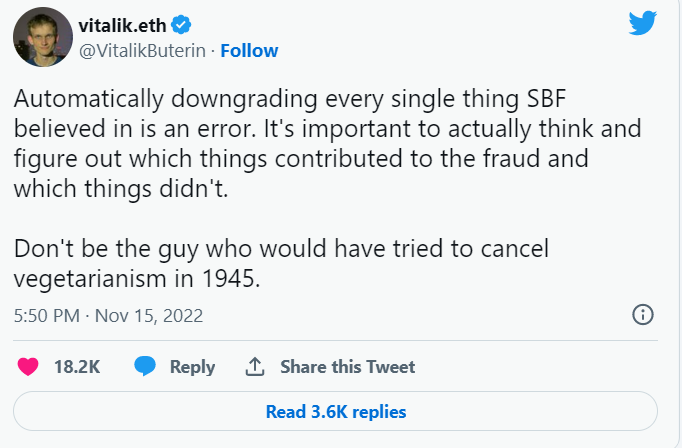
Buterin has publicly criticized Bankman-Fried since FTX’s bank run, plummeting token price, and subsequent bankruptcy filings sent shockwaves across the crypto industry. Five U.S. government agencies are investigating FTX and Bankman-Fried for alleged fraud, including the Securities and Exchange Commission, the Department of Justice, and the Commodity Futures Trading Commission.

At a conference in Argentina last week, Buterin likened Bankman-Fried to “a 1930s dictator” because of the cult of personality surrounding Bankman’s persona.

Harsh words aside, Buterin wants the public to think critically when evaluating Bankman-Fried’s life choices. SBF’s practices and beliefs, from veganism to playing video games, are not all worthy of scorn.

But what about “effective altruism,” the philosophical concept Bankman-Fried and his lackeys at Alameda Research touted, which revolves around improving the lives of others using evidence-based reasoning?

Ava Labs CEO Emin Gün Sirer believes that gig is up.

“Vitalik, if you're trying to save the Effective Altruism brand, it's dead,” Gün Sirer said. “It contributed to the fraud by providing cover (linear utility) for unchecked greed. SBF, and his shallow philosophy, isn't a hill worth fighting for.”

The co-founder of DeFi firm Gnosis shared a similar view.

“I think it is worth talking about the danger of using EA as a justification strategy,” Martin Köppelmann said of effective altruism. “You can abuse EA ideas to justify every shitty behaviour that earns you money as you can claim it is all for a greater good.”

To Köppelmann, Buterin offered a simple response.

“Oh I agree, that is one of the things that contributed to what happened,” he replied.

Notably, one of Bankman-Fried’s largest effective altruism proponents was Oxford philosopher Will MacAskill, who worked as an advisor at FTX’s now-defunct Future Fund. MacAskill has since published a lengthy statement addressing the issue and his ties to Bankman-Fried.

“If that goodwill laundered fraud, I am ashamed,” MacAskill said. “I know that others from inside and outside of the community have worried about the misuse of EA ideas in ways that could cause harm. I used to think these worries, though worth taking seriously, seemed speculative and unlikely. I was probably wrong.”


Leituras Relacionadas

Deep Insight: Decentralized Inference is Not Hype, but a Key Track for AI to Break Through Centralized Monopoly

Decentralized Reasoning: Beyond the Hype, a Key to Breaking AI's Centralized Monopoly A future scenario where a powerful AI model is banned by a major government illustrates the core value proposition of decentralized AI: resistance to censorship. The core bet of decentralized inference networks is mitigating this risk, with other benefits like cost being secondary. The path is extremely difficult, involving four key challenges: 1. **Running Massive Models:** Distributing a single model across a decentralized GPU swarm requires sophisticated techniques like pipeline and speculative decoding to overcome crippling network latency, aiming for usable speeds (e.g., 30-40 tokens/second). 2. **Proving Model Integrity:** Verifying that a node runs the correct model is critical. Solutions range from cryptographically secure but slow ZKML to faster, economically-secure methods like statistical fingerprints, deterministic re-execution, or live-weight proofs, each involving trade-offs between integrity, latency, and cost. 3. **Ensuring Prompt Privacy:** Simply sharding a model does not protect user inputs from nodes. Robust solutions currently require trusted hardware (TEEs) or advanced cryptography (FHE), which are not yet widely deployed in consumer swarms. 4. **Building a Real Market:** Identifying the ideal customer is tough. Beyond speculative AI agents, the viable market currently consists of startups embedding AI and projects needing batch processing (e.g., synthetic data generation), where decentralized aggregation can be an advantage over low-latency needs. The article analyzes several projects tackling these problems, such as Dolphin Network (live-weight proofs), Inference.net (statistical verification), Morpheus (TEE-based), and Darkbloom (Apple Secure Enclave). It provides a framework: decentralization is a "tax" for latency-sensitive applications (e.g., chat) but a potential supply-side advantage for throughput-oriented tasks (e.g., batch processing). The long-term vision is a closed data loop where decentralized inference generates valuable data (traces, preferences) to feed decentralized training networks, which in turn produce better open-weight models for the inference networks. A due diligence checklist advises focusing on projects that: are truly decentralized at specific layers; have a credible integrity method; offer real cost benefits; ensure genuine privacy; handle node reliability; have paying users; and are built by teams with deep AI expertise. The ultimate goal should be products that appeal beyond the crypto-native audience, using crypto mechanisms invisibly to deliver better cost, performance, or privacy.

Foresight NewsHá 11m

Deep Insight: Decentralized Inference is Not Hype, but a Key Track for AI to Break Through Centralized Monopoly

Foresight NewsHá 11m

The Final Piece of Franklin Templeton's Crypto Ambition

Franklin Templeton Completes Crypto Ambition with Acquisition of 250 Digital On June 22, Franklin Templeton announced the acquisition of 250 Digital and established Franklin Crypto, a new division focused on actively managed cryptocurrency strategies for institutional investors. The unit is led by Christopher Perkins and Seth Ginns. This acquisition marks a key piece in Franklin Templeton's multi-year crypto strategy, which began in 2018 with a digital assets team. The firm's crypto product suite now spans three layers: tokenized funds like the blockchain-based money market fund BENJI (~$831M AUM); a series of passive ETFs including Bitcoin (EZBC, ~$368M), Ethereum (EZET), XRP (XRPZ, ~$252M), Solana (SOEZ), and a multi-crypto index fund (EZPZ); and the newly added active management strategies from Franklin Crypto. The company has also expanded its crypto ecosystem through investments in projects like Ethena and Crossmint, and collaborations with blockchains such as Aptos and Sui. With approximately $18B in digital asset AUM and a total firm AUM of ~$1.78T, Franklin Templeton is positioning itself as a comprehensive crypto asset manager for pensions and sovereign wealth funds. In contrast, competitor Fidelity Investments has taken a different path, focusing early on building its own custody and trading infrastructure. Fidelity's Bitcoin ETF (FBTC) holds over $11B, significantly larger than Franklin Templeton's equivalent offering. Both giants' moves underscore the deepening trend of traditional finance entering the crypto space.

Foresight NewsHá 34m

The Final Piece of Franklin Templeton's Crypto Ambition

Foresight NewsHá 34m

Trading

Spot
Futuros
活动图片