Serum’s SRM Tokens Double in Price After Emergency Fork in Wake of FTX Hack

CoinDeskPublicado em 2022-11-16Última atualização em 2022-11-18

Resumo

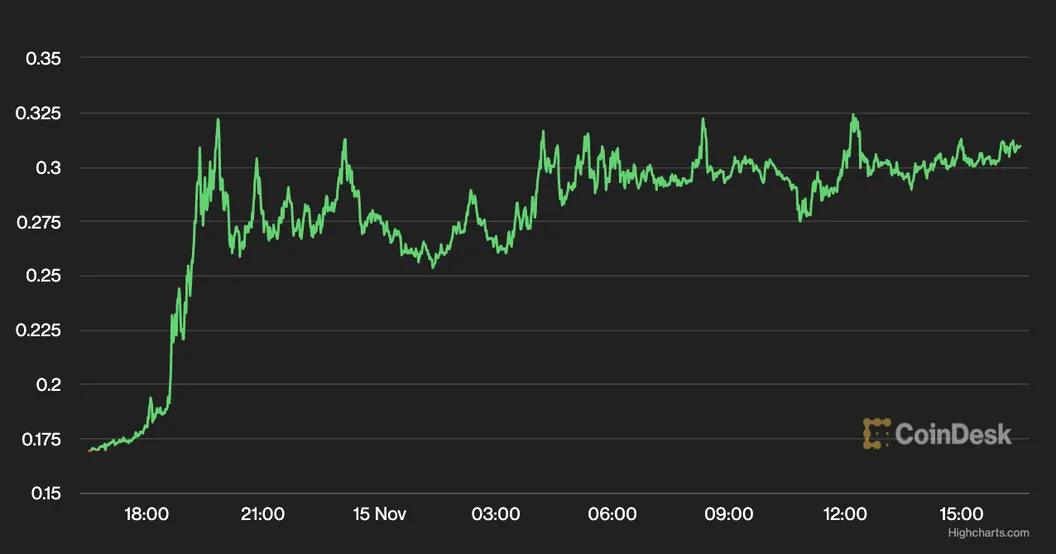
The Serum token price rose as high as 32 cents, from a low of 12 cents just two days ago, as community members of the decentralized exchange scrambled to implement an emergency fork in the wake of security concerns triggered by the hack of Sam Bankman-Fried's FTX exchange.

Serum, a decentralized exchange protocol on the Solana blockchain, saw its SRM tokens soar in digital-asset markets Tuesday, as key backers of the project rallied around an emergency fork in response to the recent hack of Sam Bankman-Fried’s ailing FTX exchange.

The community forked the project – blockchain–speak for essentially copying the underlying software code and starting afresh – after warnings that security may have been compromised by the Nov. 11 hack.

The alarms had sent the SRM price plummeting, ranking the token among the biggest losers in crypto markets. The rebound turned the token into one of the biggest winners overnight.

The serum (SRM) price started soaring around 23:30 UTC Monday, reaching a high of 32 cents Tuesday, up from a low of 12 cents on Sunday. As of press time, the token had settled back to 29 cents. It’s still down 95% in the past year.

Jupiter Aggregator, a key liquidity aggregator for Solana DeFi, which plugs into Serum, tweeted Tuesday that it was already testing an integration of the new version and “will announce it as soon as it’s ready.”

The price jump was likely due to the community “rallying behind a fork,” though it’s “unclear how the SRM token would fare if the fork gains traction,” Riyad Carey, an analyst with the crypto analysis firm Kaiko Research, told CoinDesk.

Kaiko had noted in a research report Monday that the SRM tokens had suffered a sharp drop in market depth on crypto exchanges last week triggered by the collapse of Bankman-Fried’s crypto empire, including the FTX exchange and trading firm Alameda Research.

That dynamic appeared to shift Tuesday: Based on the total number of SRM tokens on the Serum order book, SRM’s liquidity on Binance is now higher than pre-crash, according to Clara Medalie, director of research at Kaiko.

Medalie told CoinDesk that market makers have been “building up support on Binance for SRM since the crash.”
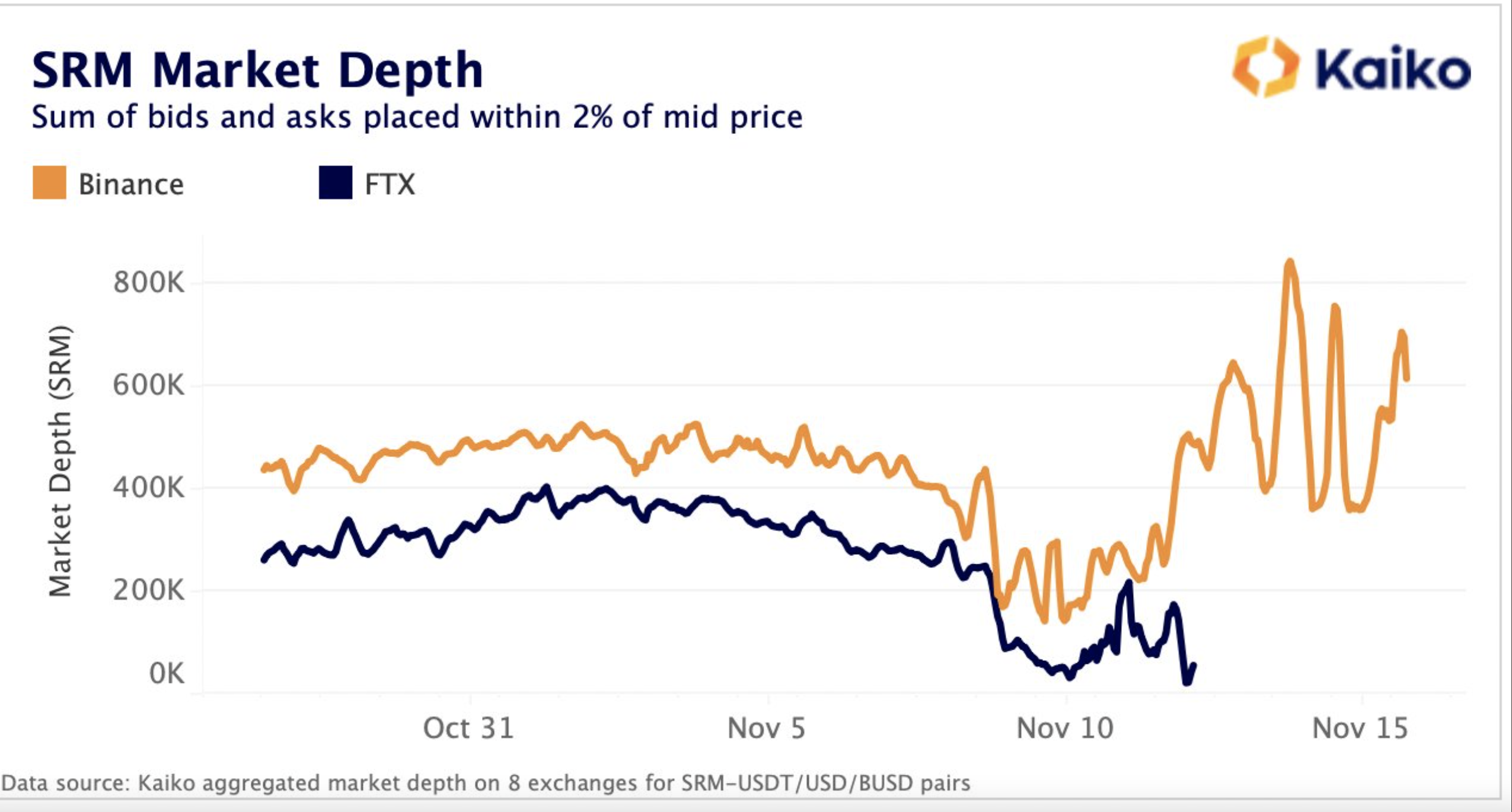
“Market makers are moving funds to Binance to support price,” she said. “Liquidity evaporated on nearly every other exchange.”

Solana co-founder Anatoly Yakovenko tweeted Nov. 12 that developers depending on Serum forked the program because “the upgrade key to the current one is compromised.” He said that “a ton of protocols depend on Serum markets for liquidity and liquidations.”

The effort to replace Serum with a community-led open-source version has renewed the market's interest, according to Brian Long, a prominent validator, in a tweet.

The FTX-Alameda fallout last week has pushed the Solana community to the edge. The Solana Foundation said Monday it held 134.54 million SRM tokens and 3.43 million FTT tokens on FTX when withdrawals went dark on Nov. 6.

Solana-based applications have also seen nearly $700 million in value wiped out, with a 70% drop from the $1 billion in total value locked (TVL) on Nov. 2 when CoinDesk first reported on Alameda’s troubling balance sheet.

Solana’s native token SOL saw a minor rebound on Tuesday, up 6% to around $14 Tuesday. The CoinDesk Market Index was up 2%.

Medalie said that a sudden price jump for SRM may not be a strong indicator in terms of future price movements because “there is still a large gap that Alameda left.”

Leituras Relacionadas

Quantum Computing "Manhattan Project" Unveiled: Is the Encryption Industry at a Critical Turning Point?

"Quantum Computing 'Manhattan Project' Launched: Is the Crypto Industry at a Critical Juncture?" On June 22, former U.S. President Donald Trump signed two executive orders. The first mandates all federal agencies upgrade their cryptographic systems to new, quantum-resistant standards by 2030. The second orders the Department of Energy to lead the development of a national quantum computer, signaling a shift from laboratory research to a state-enforced national agenda. This creates a hard deadline. A powerful quantum computer could break current encryption. The threat is compounded by "harvest now, decrypt later" attacks, where encrypted data is stored today for future decryption. Federal agencies must appoint migration officers and complete post-quantum cryptography (PQC) upgrades for key establishment by 2030 and digital signatures by 2031. Procurement rules will also be changed, forcing government contractors to comply. The crypto industry faces a direct threat. Bitcoin's ECDSA signatures are theoretically vulnerable. Research indicates millions of Bitcoin with exposed public keys are at risk if quantum computers advance. While projects like Bitcoin Quantum testnets and efforts by Ethereum, Solana, NEAR, and Zcash are exploring quantum-resistant solutions, achieving consensus in decentralized networks remains a major challenge. The centralized U.S. government has started a 5-year countdown. For decentralized crypto networks, the real test is whether they can complete this anti-quantum upgrade before the theoretical threat becomes a practical reality.

Foresight NewsHá 6m

Quantum Computing "Manhattan Project" Unveiled: Is the Encryption Industry at a Critical Turning Point?

Foresight NewsHá 6m

Coin Stock Barometer丨BitMine's Total Assets and Investment Reach $10.7 Billion, Exceeding ~$9.3 Billion Floating Loss; Strategy Buys Only 520 BTC, Strive Adds Positions Against the Trend (June 23)

This article provides a weekly market update on "coin-equity" trends, focusing on listed companies holding major cryptocurrencies. Key highlights include: **General Market Trends:** Global equities, particularly in the US, Japan, and South Korea, faced significant sell-offs, led by large tech and AI-related stocks. Analysts cite profit-taking and a shift from hype-driven to performance-driven valuation for AI companies. Market focus is on upcoming Micron Technology's earnings. **Cryptocurrency Treasury Updates:** * **Bitcoin (BTC):** Net weekly BTC purchases by listed companies (excluding miners) totaled approximately $86 million, down 13.97% from the prior week. Strategy (formerly MicroStrategy) purchased only 520 BTC for ~$34.9 million, while Strive Asset Management increased its holdings by 759 BTC for ~$50 million. Other notable actions include Mara Holdings adding 1,000 BTC and Capital B shareholders approving a massive financing plan (up to ~$1.2 trillion) to potentially expand its Bitcoin reserves. * **Ethereum (ETH):** BitMine emerged as the largest corporate ETH treasury, holding 5.67 million ETH (4.7% of supply). It purchased an additional 52,203 ETH ($92 million) in the past week. Sharplink completed a $75 million private placement to fund further ETH accumulation and stock buybacks. * **Solana (SOL):** The top five listed companies hold over 15.7 million SOL combined. However, Solmate Infrastructure, a SOL treasury firm, faces a lawsuit from its largest external shareholder alleging board misconduct and self-dealing. * **Other:** Updates include Canton Strategic's $50 million stock buyback plan and Lite Strategy's $1 million strategic investment in LitVM, a Layer-2 network for Litecoin. The article notes that while crypto treasury firms continue fundraising and accumulation, their stocks may struggle to rise against the broader market downturn until Q4.

marsbitHá 20m

Coin Stock Barometer丨BitMine's Total Assets and Investment Reach $10.7 Billion, Exceeding ~$9.3 Billion Floating Loss; Strategy Buys Only 520 BTC, Strive Adds Positions Against the Trend (June 23)

marsbitHá 20m

OpenAI Partners with PE Firms, Investing $4 Billion. Let's Talk About Silicon Valley's Hottest New Role: FDE.

The hottest new role in Silicon Valley is the Forward Deployment Engineer (FDE), a hybrid of engineer and business consultant whose core mission is to transform AI demos into native, practical workflows within client organizations. The recent surge in demand is driven by a strategic shift from leading AI companies. OpenAI, partnering with 19 private equity firms in a $4 billion investment, formed a Deployment Company and acquired Tomoro along with its 150 FDEs. Anthropic also announced a $1.5 billion joint venture with financial institutions like Blackstone. The article, based on interviews with industry experts Jove (FDE lead at Cresta) and Oliver (VP at Invisible Technologies, ex-McKinsey), explores the FDE role and the rise of deployment-focused companies. Key insights include: **The FDE Role:** Jove describes an FDE as a "Forward Deployed CTO"—a technically strong engineer who works intimately with clients to implement AI solutions, learn from the process, and feed those insights back to improve the core product. They require expertise in AI agents, client-facing experience, resilience, and the ability to handle complex, imperfect systems. While AI tools enhance their efficiency, the role's complexity makes full automation a distant prospect. **Industry Shift:** Model companies are moving beyond selling tools to ensuring real-world adoption. This blurs the line between model and application companies. Collaborations with private equity (PE) firms are key, providing access to large portfolios of traditional businesses needing AI transformation. For PE firms, these partnerships offer signal value to LPs, create tangible value in portfolio companies, and provide exposure to high-growth AI assets. **Consulting & Transformation:** AI deployment involves deep, customized workflow redesign, moving beyond simple tool augmentation. Companies like Invisible Technologies build modular platforms to create bespoke, AI-native workflows for clients. While traditional consulting will see growth in helping businesses rethink their models for AI, the real value is captured by firms that leave behind transformed, operational systems. Critical success factors include building robust data foundations and strategically deciding which workflow steps should be deterministic versus AI-driven. The ultimate goal shifts from pure cost-cutting to unlocking new revenue opportunities previously impossible without AI-scale capabilities.

marsbitHá 33m

OpenAI Partners with PE Firms, Investing $4 Billion. Let's Talk About Silicon Valley's Hottest New Role: FDE.

marsbitHá 33m

Trading

Spot
Futuros
活动图片