Bitcoin Price Plunges 15%, Can Buyers Save The Key $15K Support?

newsbtcPublicado em 2022-11-10Última atualização em 2022-11-10

Resumo

Bitcoin price declined over 15% and even traded below $16,000. BTC remains at a risk of more losses if it breaks the $15,000 support zone. Bitcoin remained in a bearish...

Bitcoin price declined over 15% and even traded below $16,000. BTC remains at a risk of more losses if it breaks the $15,000 support zone.

”“

  • Bitcoin remained in a bearish zone after the FTX collapse and declined below $16,000.
  • The price is trading below $17,500 and the 100 hourly simple moving average.
  • There is a major bearish trend line forming with resistance near $16,500 on the hourly chart of the BTC/USD pair (data feed from Kraken).
  • The pair could continue to move down if it stays below the $16,500 and $17,000 levels.

”“

Bitcoin Price Tumbles
“”

Bitcoin price remained in a bearish zone after it settled below the $20,000 support zone. Binance opted out to bail FTX, resulting in an increase in selling pressure. BTC declined below the $18,500 and $17,000 levels.
“”

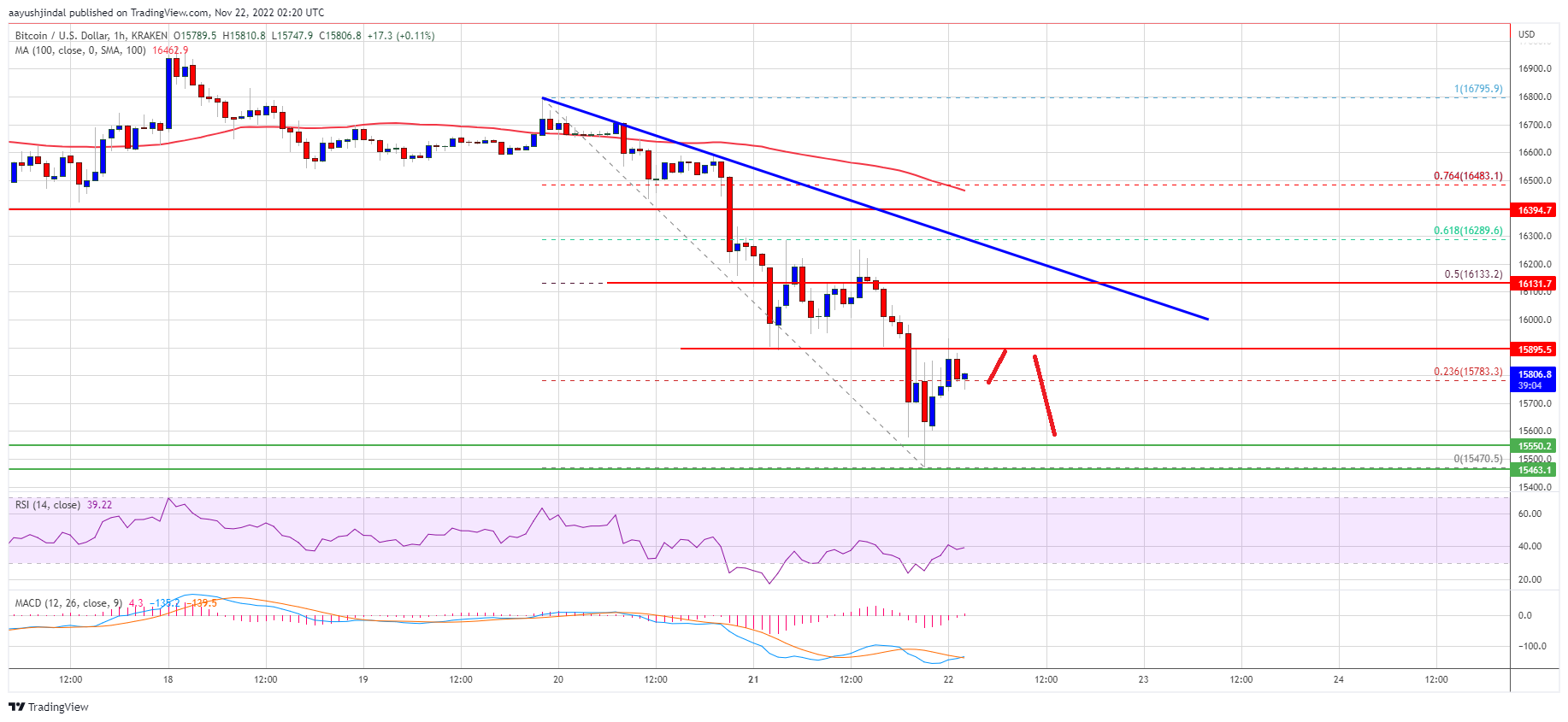
The crypto market is bleeding and many altcoins such as ethereum, bnb, ripple are down over 15%. Bitcoin price also gained bearish momentum and traded below the $16,000 support level. The price traded as low as $15,555 and is currently consolidating losses.
“”

It is trading below $17,500 and the 100 hourly simple moving average. There is also a major bearish trend line forming with resistance near $16,500 on the hourly chart of the BTC/USD pair.
“”

On the upside, an immediate resistance is near the $16,400 level. The first major resistance is near the $16,650 level. It is near the 23.6% Fib retracement level of the recent decline from the $20,671 swing high to $15,555 low.
Bitcoin Price

Source: BTCUSD on TradingView.com
“”

A clear move above the trend line resistance and $16,675 might start a decent recovery wave. The next major resistance is near $18,000 or the 50% Fib retracement level of the recent decline from the $20,671 swing high to $15,555 low, above which the price could test the $20,000 zone.
“”

More Losses in BTC?
“”

If bitcoin fails to start a recovery wave above the $16,500 resistance zone, it could continue to move down. An immediate support on the downside is near the $15,800 level.
“”

The next major support is near the $15,500 zone. A clear move below the $15,500 support might push the price further lower. In this case, the price may perhaps decline below the $15,000 support zone.
“”

Technical indicators:
“”

Hourly MACD – The MACD is now gaining pace in the bearish zone.
Hourly RSI (Relative Strength Index) – The RSI for BTC/USD is now below the 30 level.
Major Support Levels – $15,800, followed by $15,500.
Major Resistance Levels – $16,500, $16,675 and $18,000.
Leituras Relacionadas

From Corning to Ciena: The 10X Stock Opportunities in the AI Optical Communication Chain

From Copper to Light: The AI-Driven Optical Communication Supply Chain and Investment Opportunities The exponential data demands of AI are pushing data centers beyond the physical limits of copper cables, forcing a critical transition to optical communication. This shift from electrical to photonic signals over distances greater than ~3 feet solves heat, power, and bandwidth constraints. The real investment opportunity lies not just in headline chipmakers, but across the entire essential photonics supply chain. **Key Investment Layers & Companies:** * **Glass & Fiber:** **Corning** is a dominant, irreplaceable supplier of advanced fiber to all major cloud/AI players (Meta, Amazon, Google, MSFT, OpenAI, NVIDIA), with multi-billion-dollar, multi-year contracts locked in years ahead of delivery. Its profit growth (93%) far outpaces revenue growth (36%), showing pricing power. * **Interconnects:** **Amphenol**, a consolidating giant in high-speed connectors (both copper and optical), shows robust growth (>80% in AI data centers) and expanding margins post-acquisition. **Credo Technology** bridges old and new worlds, extending copper's life in racks while moving into optics. It has hyper-growth but carries high customer concentration risk. * **Systems:** **Ciena** is a leader in coherent optics, enabling massive data capacity upgrades on existing fiber. It has a massive, growing order backlog ($~7B) and strong ties with cloud providers. * **Upstream & Enablers:** **AXT** produces mission-critical indium phosphide wafers for lasers, creating a supply bottleneck, but faces significant geopolitical/export license risk from its China-based manufacturing. **VEO Solutions** is the essential "picks and shovels" play, providing test equipment needed by every component in the optical chain, regardless of the eventual winner. A new pure-play photonics ETF (**FOTO**) offers a consolidated investment vehicle for this theme, though it is new and small. The core thesis is clear: the move from copper to light is inevitable and accelerating, with wealth creation spreading across this critical, multi-layered supply chain.

marsbitHá 1m

From Corning to Ciena: The 10X Stock Opportunities in the AI Optical Communication Chain

marsbitHá 1m

A Chip Company Releases AIDC Energy Storage Certification Standards. Why NVIDIA? Computing Power Reshapes Power Supply Logic. Who's in the Lead and Who's Left Out?

NVIDIA has released a "Battery Energy Storage System Self-Certification Guide," setting strict technical standards for energy storage systems specifically for AI data centers (AIDC). The guide focuses solely on certifying the Power Conversion System (PCS), not the batteries, with 10 mandatory performance metrics and 12 validation tests requiring real-world and simulation comparisons. Key requirements include rapid dynamic response to AI workloads, high-frequency system telemetry, and detailed electromagnetic transient models. The move is driven by the extreme and fluctuating power demands of next-generation AI hardware. Modern AIDCs require energy storage systems to act as intelligent, controllable grid assets, not just passive backup, to manage instantaneous, massive power load shifts that traditional UPS systems cannot handle. This redefines the competitive landscape for energy storage providers, shifting focus from capacity and cost to advanced control capabilities and system integration. While the market potential is significant—with forecasts of hundreds of GWh in new demand by 2030—the certification creates a high barrier to entry. It requires proven PCS delivery volumes and credible plans for rapid capacity scaling, favoring established, well-resourced players. Early movers like Fluence (partnering with Siemens) and several Chinese companies have secured projects ahead of the standard, but new entrants must now navigate this rigorous, costly, and time-intensive certification process to compete in the AIDC energy storage market.

marsbitHá 48m

A Chip Company Releases AIDC Energy Storage Certification Standards. Why NVIDIA? Computing Power Reshapes Power Supply Logic. Who's in the Lead and Who's Left Out?

marsbitHá 48m

Trading

Spot
Futuros
活动图片