Micron Q2 Earnings Preview: Citi Raises Price Target

marsbitPublicado em 2026-06-23Última atualização em 2026-06-23

Resumo

TL;DR: Ahead of Micron's Q2 FY26 earnings report on June 24, Citi raised its price target from $840 to $1,200, citing stronger-than-expected 2026 memory prices and high gross margins. The stock price had already neared $1,211, shifting focus to whether the aggressive earnings assumptions will hold. The $1,200 target is based on significantly higher FY27 EPS estimates ($114.73), driven by projections of DRAM ASPs rising 200% and NAND ASPs rising 186% in 2026. The bullish outlook hinges on the ongoing transition of spot price increases (DRAM up 52% YTD) to contract prices, with server demand being a key driver. Supply remains tight, with a projected 5% DRAM shortage in 2026, exacerbated by HBM production consuming capacity. Long-Term Agreements (LTAs) could provide stability but their specific terms are crucial. Risks include HBM yield/ramp challenges, potential industry overcapacity, and AI/data center capex fluctuations. With the stock near the target, future moves depend on the continuation of strong pricing, tight supply, and high margins.

TL;DR

Micron is scheduled to release its fiscal year 2026 third-quarter earnings on June 24, with the earnings call set for 4:30 PM ET on the same day. Ahead of the report, Citi has raised its price target for Micron from $840 to $1,200, maintaining a Buy rating, citing stronger-than-expected memory prices in 2026 and high gross margins.

The highlight of this target hike is not the $1,200 figure itself. Based on the stock price of approximately $1,020.76 at the time of the report's release, this target implies an upside of about 18%. However, as of June 23, market data shows Micron's stock price hovering around $1,211, slightly above Citi's target. In other words, the stock has already approached the target price, and the market's focus now shifts to whether Citi's earnings assumptions can materialize.

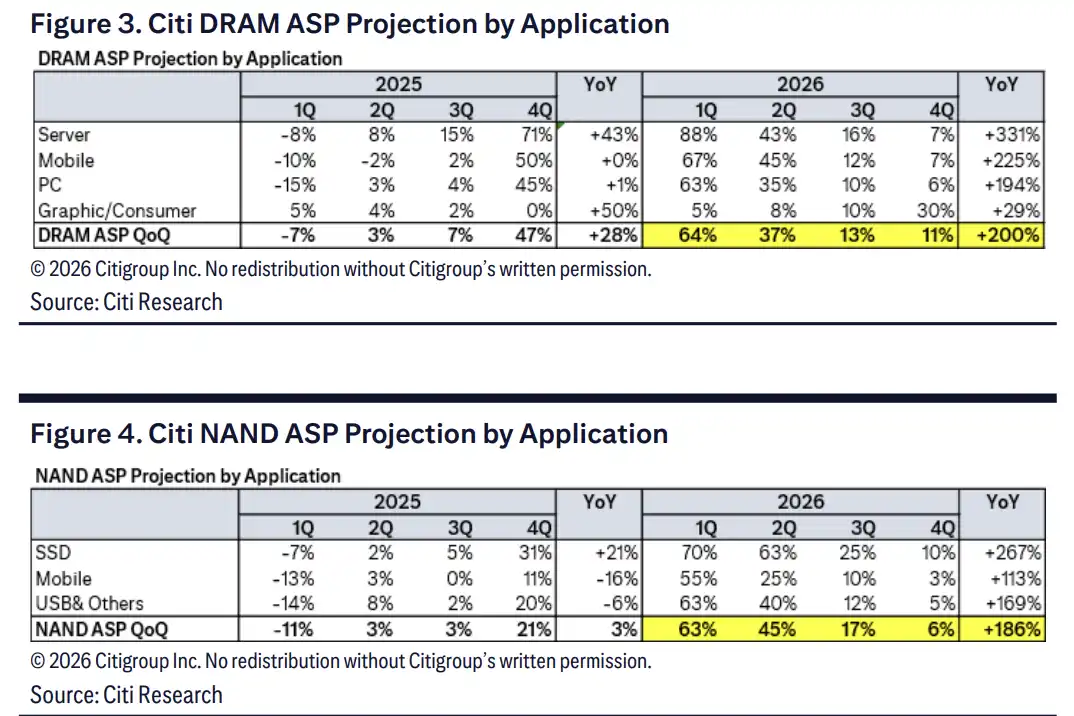
The most aggressive assumptions come from pricing. Public reports citing Citi's view indicate that DRAM average selling prices (ASP) are projected to rise by 200% in 2026, while NAND ASP is expected to increase by 186%. If this wave of price hikes continues to transmit from spot prices to contract prices, there remains room for further upward revisions to Micron's fiscal year 2027 earnings expectations.

Behind the $1,200 Target: Further Upside for FY27 Earnings

According to reports from TipRanks/The Fly, Citi has raised Micron's price target to $1,200 while maintaining a Buy rating. Yahoo Finance and Investing.com, citing related reports, noted that Citi has increased its FY2027 EPS estimate for Micron to $114.73.

Such revisions typically stem from two directions: higher pricing on the revenue side and sustained high gross margins. Memory industry profits are extremely sensitive to price. When DRAM and NAND prices enter an upward cycle, minor quarterly revenue changes can be magnified into larger full-year earnings expectations.

The assumptions in Citi's original report are even more aggressive. The report shows expectations for Micron's F3Q26 revenue at $35.6 billion and EPS at $19.98. F4Q26 revenue is forecast at $42.0 billion with EPS of $24.27. On an annual basis, FY26 revenue is estimated at $115.0 billion, while FY27 revenue is projected to rise further to $197.5 billion, with FY27 EPS revised up to $114.73.
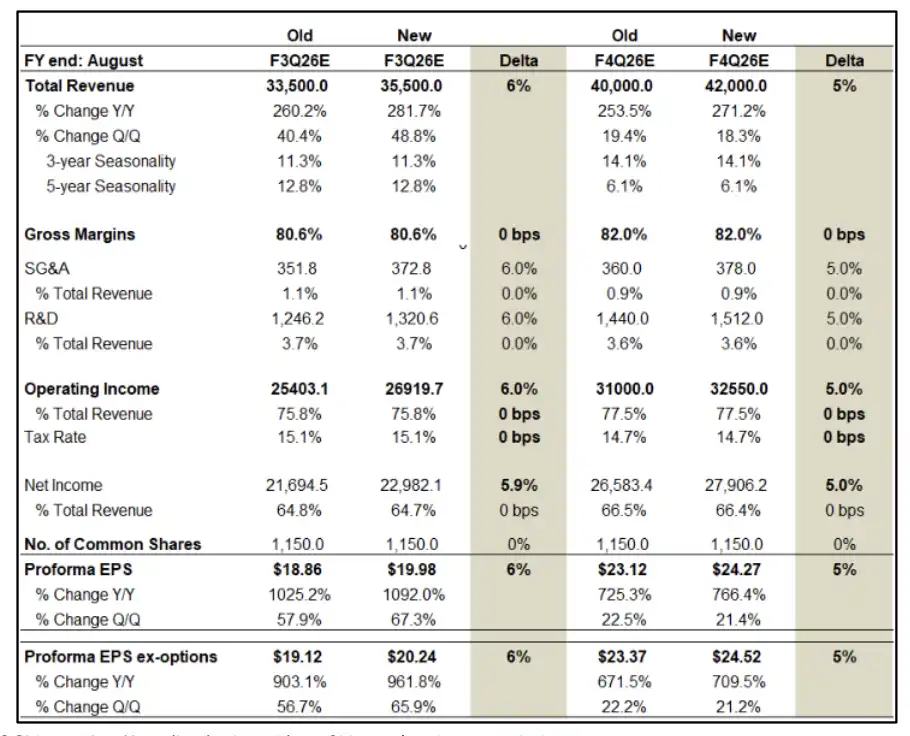
The $1,200 price target reflects high confidence in 2027 earnings rather than being a tactical trade around a single quarter's report. If FY2027 EPS approaches $115, Micron's current valuation may still find support. Conversely, if memory prices peak earlier, and with the stock already near the target price, the margin for error would significantly shrink.

Spot Prices Lead Contract Prices, Hikes Still Propagating to Customers

The direct driver for the upward revisions to Micron's earnings expectations is memory pricing.

Public reports citing Citi data note that DRAM spot prices have risen 52% cumulatively since the beginning of 2026 and are currently about 21% higher than contract prices. In the memory industry, spot prices typically react faster than contract prices. When spot prices are significantly higher than contract prices, contract prices may still be adjusted upward upon customer re-negotiations.

This is also the basis for the substantial upward revision of the 2026 ASP assumptions. Citi expects DRAM ASP to rise 200% for the full year 2026. NAND ASP is projected to increase by 186% for the year, with Q2, Q3, and Q4 expected to see sequential increases of 45%, 17%, and 6%, respectively.

The server segment is the most concentrated direction for price increases. Citi's original report assumes server DRAM ASP will rise 331% for the full year 2026, while NAND SSD will increase by 267%. This indicates that the price hikes are not solely due to PC and smartphone restocking; procurement from data centers, AI servers, and enterprise SSDs represents a stronger source of demand.
HBM Strains Capacity; Supply Discipline Determines Cycle Length

Whether prices can continue to rise depends largely on whether supply remains tight.

Citi's report assumes a global DRAM supply shortage of about 5% in 2026. For the memory industry, such a deficit is sufficient to drive significant price volatility, especially as High Bandwidth Memory (HBM) consumes wafer, equipment, and advanced packaging resources, further squeezing supply for conventional DRAM.

HBM also acts as an amplifier in this cycle. AI training and inference continue to drive demand for high-bandwidth memory, while HBM capacity ramp-up consumes more advanced production capacity. If HBM prices remain strong, Micron's product mix and gross margins may continue to benefit.

The risk lies in the supply side not remaining disciplined indefinitely. TipRanks, citing TrendForce data, notes that global DRAM bit supply is expected to grow by about 30% in 2026, with Micron's growth projected at 42%. If competitors accelerate capacity expansion in 2027, or if new capacity is released faster than AI and data center demand can absorb it, the current assumptions of shortage and high gross margins will be challenged.

Long-Term Agreements Can Smooth Cycles, But Terms Are Key

Beyond price increases, Long-Term Agreements (LTAs) are another part of Citi's optimistic scenario.

Historically, memory companies have been most heavily discounted by the market for their highly cyclical earnings. Profits rapidly expand during price hikes but decline once oversupply emerges, dragging down prices and margins. If customers are willing to lock in longer-term procurement arrangements, the volatility of Micron's revenue and profits over the next few years could be partially smoothed.

Citi's original report mentions that Dell has signed relevant LTAs and suggests such agreements may drive the adoption of complementary NAND solutions like KV cache offload, further opening up SSD and NAND demand. Expectations and reality still need to be separated here: LTAs can improve earnings visibility, but they do not yet constitute a fully validated new business model.

What truly impacts valuation are the detailed terms, including the volume covered, the design of the pricing mechanism, whether there are minimum purchase commitments, and whether customers can adjust orders in response to price changes. If LTAs are merely framework agreements without strong, binding purchase arrangements, their support for Micron's valuation would be significantly weaker.

Stock Price Nears Target; Bear Case Reminds of Cyclical Risks

Citi's base case target price is $1,200. The original report outlines a bull case target of $1,400 and a bear case target of $400. This range itself indicates that market divergence regarding Micron is not about the direction but rather about how long the cycle can last.
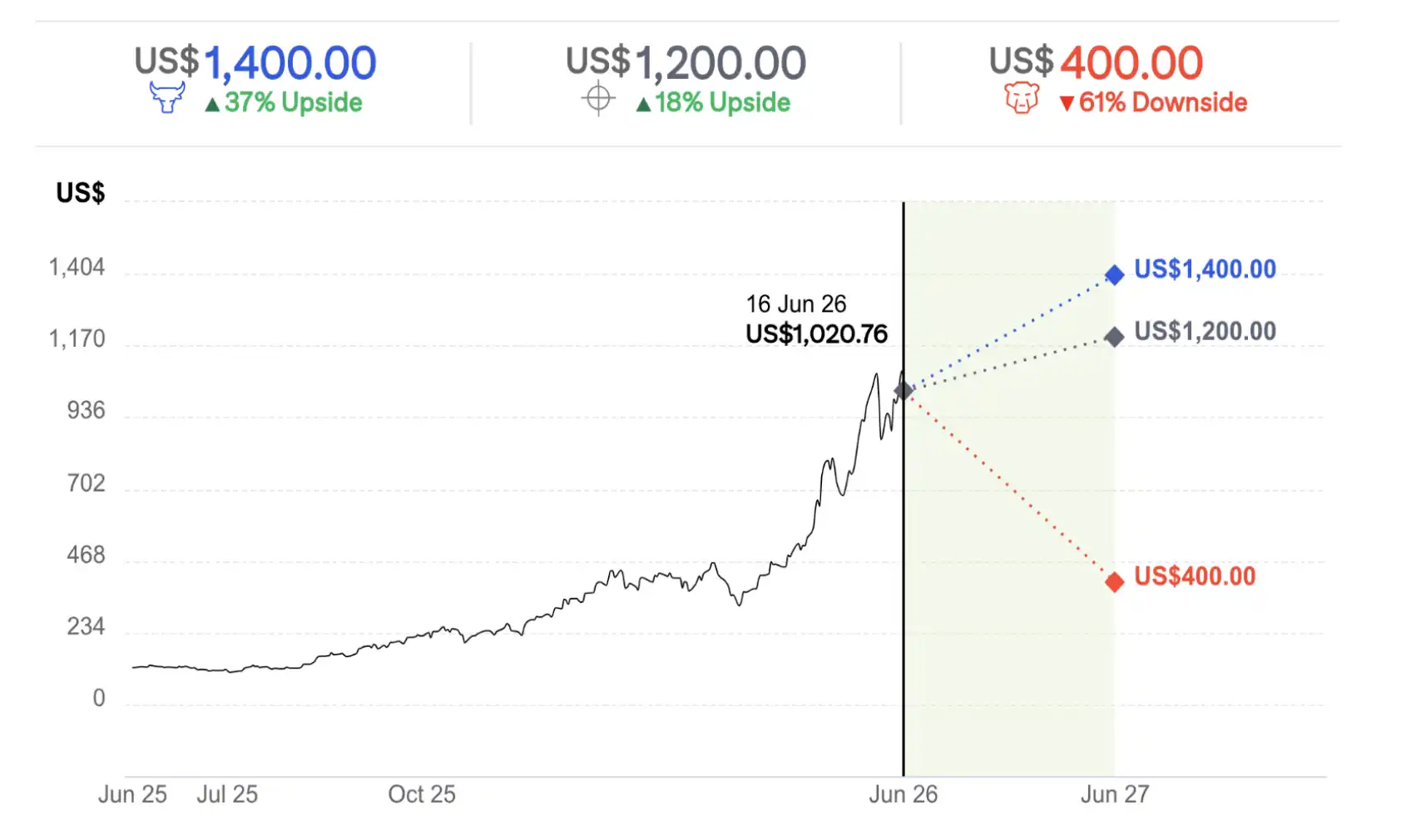
Risks are mainly concentrated in three areas.

First, HBM yield and capacity ramp. Slow release of high-end memory supply may intensify price hikes in the short term but could also affect Micron's deliverable volumes and customer qualification progress.

Second, industry capacity expansion. The memory industry has repeatedly seen cycles where high prices stimulate expansion, which in turn depresses prices. It's difficult to completely escape this pattern this time around.

Third, AI and data center capital expenditures. The current price forecasts imply continued expansion in AI server, inference demand, and enterprise SSD procurement. If cloud providers slow spending, or if storage demand growth falls short of expectations, the pace of ASP increases may decelerate.

For Micron's upcoming earnings report, the most crucial aspect is not just whether F3Q26 exceeds expectations, but also how management discusses supply and demand for 2026 and 2027, HBM pricing, LTA progress, and gross margin guidance. The $1,200 target price is built on a combination of continued memory price increases, tight supply, and sustained high margins. If any one of these links weakens, with the stock already near the target price, the market's patience for this uptrend cycle will be even shorter.


Perguntas relacionadas

QWhat is Citigroup's new price target for Micron, and what is their rating?

ACitigroup has raised its price target for Micron from $840 to $1200 and maintains a 'Buy' rating.

QWhat are the key assumptions behind Citigroup's raised EPS forecast for Micron's FY2027?

AThe key assumptions are a stronger-than-expected 200% rise in DRAM average selling prices (ASP) and a 186% rise in NAND ASP for 2026, coupled with high gross margins.

QAccording to the article, what is a primary factor currently pushing up memory prices?

AA primary factor is tight supply, partly because High Bandwidth Memory (HBM) production for AI is consuming advanced wafer, equipment, and packaging capacity, thereby squeezing the supply of conventional DRAM.

QWhat potential risk could challenge the assumptions of continued price strength and high margins for Micron?

AA key risk is the industry's tendency to increase production capacity in response to high prices, which could later lead to oversupply and price declines, breaking the cycle of high margins.

QWhat does the article suggest is more important than Micron's upcoming quarterly earnings for the market's focus?

AThe market is more focused on whether Citigroup's aggressive profit assumptions for 2026 and 2027 will materialize, including management's commentary on future supply/demand, HBM pricing, Long-Term Agreement (LTA) progress, and gross margin guidance.

Leituras Relacionadas

SK Hynix Market Cap Exceeds Samsung for First Time in 26 Years, Korean Broker Calls for 50% More Upside

SK Hynix's market capitalization surpassed Samsung Electronics for the first time in 26 years on June 22, reaching 208.1 trillion won. The shift reflects a market trend where companies directly benefiting from AI infrastructure, like SK Hynix, are receiving higher valuation premiums than diversified giants. The surge is driven by AI-driven demand for High Bandwidth Memory (HBM), where SK Hynix holds a dominant 70-80% market share. Its Q1 2026 revenue exceeded 50 trillion won for the first time, with an operating profit margin of 72%. Hanwha Investment & Securities significantly raised its price target for SK Hynix to 430,000 won, the highest among Korean brokerages. The key rationale is that Long-Term Supply Agreements (LTAs) and robust HBM demand have fundamentally reduced the company's historical profit volatility. Several other brokers have also raised targets, arguing the valuation framework for memory semiconductors is being rewritten, moving away from a cyclical model. Despite the bullish outlook, the stock experienced a pullback of over 5% in regular trading on June 23 after briefly surpassing 3 million won pre-market, amid broader tech sector weakness. Some analysts caution that the市值 overtaking Samsung, whose profit scale and growth forecasts remain higher, could signal short-term overheating. However, high-return investors viewed the dip as a buying opportunity.

marsbitHá 4m

SK Hynix Market Cap Exceeds Samsung for First Time in 26 Years, Korean Broker Calls for 50% More Upside

marsbitHá 4m

GPU Rental Prices Drop 30% in Three Weeks: AI Value Chain Migrating from Nvidia to Memory Chips

GPU rental prices for Nvidia's flagship B200 chip have fallen by approximately 30% over three weeks, dropping from a high of $6.11/hour to $4.22/hour. This decline signals a potential easing of the "compute scarcity" narrative that has long supported AI hardware valuations. Concurrently, the semiconductor market is witnessing a significant divergence: while the VanEck Semiconductor ETF (SMH) has risen 15% in the past month, with memory giants Micron and SanDisk each surging nearly 60%, Nvidia's stock has declined about 3% over the same period. Analysts suggest this shift indicates that the AI value chain's bottleneck and profits are migrating from compute (GPUs) to memory. Demand for high-bandwidth memory (HBM) remains intensely strong, with contract prices soaring over 100% in H1 2026, granting memory manufacturers significant pricing power. In contrast, increased B200 supply from improved manufacturing yields and competitive pressure from new cloud providers are softening GPU rental rates. While long-term contracts, like SpaceX's $30 billion deal with Google, show sustained large-scale demand for Nvidia hardware, the softening spot prices pressure the margins of cloud providers and could eventually impact Nvidia's order flow if chip prices don't adjust. The key takeaway for investors is not a weakening AI thesis, but a recalibration within the sector: pricing power appears to be strengthening for memory chipmakers while showing signs of strain for leading GPU suppliers.

marsbitHá 14m

GPU Rental Prices Drop 30% in Three Weeks: AI Value Chain Migrating from Nvidia to Memory Chips

marsbitHá 14m

From Corning to Ciena: The 10X Stock Opportunities in the AI Optical Communication Chain

From Copper to Light: The AI-Driven Optical Communication Supply Chain and Investment Opportunities The exponential data demands of AI are pushing data centers beyond the physical limits of copper cables, forcing a critical transition to optical communication. This shift from electrical to photonic signals over distances greater than ~3 feet solves heat, power, and bandwidth constraints. The real investment opportunity lies not just in headline chipmakers, but across the entire essential photonics supply chain. **Key Investment Layers & Companies:** * **Glass & Fiber:** **Corning** is a dominant, irreplaceable supplier of advanced fiber to all major cloud/AI players (Meta, Amazon, Google, MSFT, OpenAI, NVIDIA), with multi-billion-dollar, multi-year contracts locked in years ahead of delivery. Its profit growth (93%) far outpaces revenue growth (36%), showing pricing power. * **Interconnects:** **Amphenol**, a consolidating giant in high-speed connectors (both copper and optical), shows robust growth (>80% in AI data centers) and expanding margins post-acquisition. **Credo Technology** bridges old and new worlds, extending copper's life in racks while moving into optics. It has hyper-growth but carries high customer concentration risk. * **Systems:** **Ciena** is a leader in coherent optics, enabling massive data capacity upgrades on existing fiber. It has a massive, growing order backlog ($~7B) and strong ties with cloud providers. * **Upstream & Enablers:** **AXT** produces mission-critical indium phosphide wafers for lasers, creating a supply bottleneck, but faces significant geopolitical/export license risk from its China-based manufacturing. **VEO Solutions** is the essential "picks and shovels" play, providing test equipment needed by every component in the optical chain, regardless of the eventual winner. A new pure-play photonics ETF (**FOTO**) offers a consolidated investment vehicle for this theme, though it is new and small. The core thesis is clear: the move from copper to light is inevitable and accelerating, with wealth creation spreading across this critical, multi-layered supply chain.

marsbitHá 33m

From Corning to Ciena: The 10X Stock Opportunities in the AI Optical Communication Chain

marsbitHá 33m

A Chip Company Releases AIDC Energy Storage Certification Standards. Why NVIDIA? Computing Power Reshapes Power Supply Logic. Who's in the Lead and Who's Left Out?

NVIDIA has released a "Battery Energy Storage System Self-Certification Guide," setting strict technical standards for energy storage systems specifically for AI data centers (AIDC). The guide focuses solely on certifying the Power Conversion System (PCS), not the batteries, with 10 mandatory performance metrics and 12 validation tests requiring real-world and simulation comparisons. Key requirements include rapid dynamic response to AI workloads, high-frequency system telemetry, and detailed electromagnetic transient models. The move is driven by the extreme and fluctuating power demands of next-generation AI hardware. Modern AIDCs require energy storage systems to act as intelligent, controllable grid assets, not just passive backup, to manage instantaneous, massive power load shifts that traditional UPS systems cannot handle. This redefines the competitive landscape for energy storage providers, shifting focus from capacity and cost to advanced control capabilities and system integration. While the market potential is significant—with forecasts of hundreds of GWh in new demand by 2030—the certification creates a high barrier to entry. It requires proven PCS delivery volumes and credible plans for rapid capacity scaling, favoring established, well-resourced players. Early movers like Fluence (partnering with Siemens) and several Chinese companies have secured projects ahead of the standard, but new entrants must now navigate this rigorous, costly, and time-intensive certification process to compete in the AIDC energy storage market.

marsbitHá 1h

A Chip Company Releases AIDC Energy Storage Certification Standards. Why NVIDIA? Computing Power Reshapes Power Supply Logic. Who's in the Lead and Who's Left Out?

marsbitHá 1h

Trading

Spot
Futuros
活动图片