Стоит ли ждать рост Биткойна к Новому году?

VC.ruPublicado em 2022-11-02Última atualização em 2022-11-02

Resumo

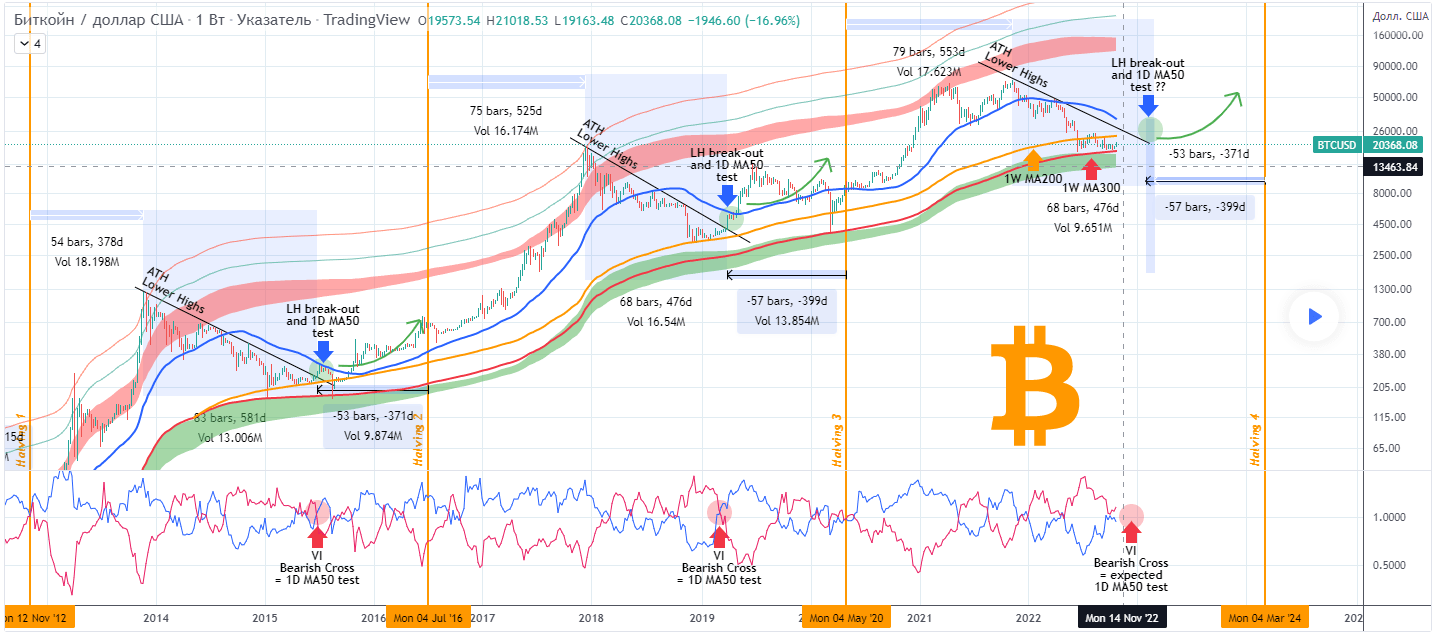
Согласно анализа, проведенного одним из ведущих аналитиков TradingView, рост BTC исходя из имеющихся факторов, стоит ждать не ранее начала 2023 года.

Согласно анализа, проведенного одним из ведущих аналитиков TradingView, рост BTC исходя из имеющихся факторов, стоит ждать не ранее начала 2023 года.

На недельном графике видно, что курс BTC, продолжая торговаться боком, все отчетливее обозначает "нижнюю фазу тренда в районе MA300". При этом, первый серьезный прорыв в предыдущих циклах произошел тогда, когда курс пробил линию нисходящих минимумов (ATH).

В своем анализе TradingShot помимо ключевых линий сопротивления (MA200 и MA50), которые еще только предстоит пробить, линии тренда понижающихся минимумов и фактора халвинга в 2024 году, после которого "рост происходит по определению", так же использует индикатор Vortex.

«Синяя и красная линии индикатора Vortex разошлись, сформировав крест, что исторически всегда происходит перед ралли.»

Значение индикатора Vortex выступает в качестве раннего сигнала роста. Вместе с тем, автор исследования отмечает, что на преодоление сопротивления каждой из трендовых линий в предыдущих двух циклах ушло несколько недель. При этом, прорыв выше линии тренда нисходящих минимумов случался примерно за 55 недель до халвинга:

«Следующий халвинг произойдёт в начале марта 2024 года. Прогнозируемый диапазон пробоя ATH и теста 1D MA50 можно ожидать в пределах недельных свечей от 30 января 2023 года до 27 февраля 2023 года [~$20-21k]. Отклонение Vortex от [медвежьего] креста пока подтверждает такой сценарий.»

CryptoNews для vc.ru.

Leituras Relacionadas

Former SpaceX Engineer Reconstructs Financial Execution System Using First Principles

Former SpaceX engineer Lex Li applies "First Principles Thinking" to financial infrastructure with Plan Execution Lab, recently raising angel funding at a $50M post-money valuation. The team argues that the core function of finance is capital allocation, and the critical gap is not in trading but in execution, which remains highly manual and fragmented. While assets, liquidity, and settlement have migrated on-chain, execution workflows (monitoring, risk management, liquidity coordination) are still human-native. In an era of accelerating AI agents, strategy decay is rapid, shifting the competitive edge from having the best strategy to having the most robust execution network. Plan Execution Lab introduces two core components: 1. **PlanX**: A Financial Execution Protocol designed as infrastructure for the migration from CEX to DEX, providing on-chain execution capabilities, liquidity access, risk management, and capital orchestration. 2. **Xgent**: An Autonomous Financial Runtime. Users define investment intents, risk preferences, and constraints; Xgent automatically constructs an execution graph, verifies it, and handles ongoing execution and optimization—streamlining the process from Intent to Autonomous Execution. The long-term vision is to create the "Bloomberg Terminal for Autonomous Finance"—a shared operating environment and execution network built collectively by participants like execution nodes, liquidity providers, and autonomous agents. The future of finance, they contend, belongs not to isolated algorithms but to open, collaborative execution networks.

marsbitHá 14m

Former SpaceX Engineer Reconstructs Financial Execution System Using First Principles

marsbitHá 14m

Former SpaceX Engineer Reconstructs Financial Execution System from First Principles

Plan Execution Lab, a financial infrastructure project founded by former SpaceX engineer Lex Li, has raised angel funding at a $50M post-money valuation. The startup is applying "first principles thinking" from Li's SpaceX experience to rethink financial market execution. Their analysis posits that while assets, liquidity, and settlement have moved on-chain, the execution layer remains fundamentally human-dependent and fragmented. In the era of AI Agents, strategy advantages decay rapidly, shifting the competitive edge from isolated algorithms to robust **execution networks**. Plan Execution Lab's solution is a two-part system: **PlanX**, a Financial Execution Protocol designed to facilitate the migration from centralized exchanges (CEX) to on-chain markets by providing core on-chain execution capabilities; and **Xgent**, an Autonomous Financial Runtime. Xgent allows users to define investment goals and constraints, then autonomously constructs and manages the execution logic—moving from **Intent to Execution Graph to Verification to Autonomous Execution**. The long-term vision is to create the "Bloomberg Terminal for Autonomous Finance"—an operating environment not for humans, but for agents and execution nodes. The future financial system, they argue, will be a collaborative network built by diverse participants contributing execution capabilities, not secret strategies. The core competition will shift to who builds the most powerful and adaptive execution network.

链捕手Há 15m

Former SpaceX Engineer Reconstructs Financial Execution System from First Principles

链捕手Há 15m

First Long-Horizon Doc2Repo Training Dataset: Code Agents Move Beyond Bug Fixing and Begin Creating Repositories

With the advancement of LLM Code Agents, the research focus is shifting towards long-horizon, real-world tasks, moving beyond simple bug fixes to full repository generation. To address this, researchers from Renmin University of China introduced the DeNovoSWE dataset. This dataset focuses on long-term software engineering tasks, specifically the "document-to-repository" challenge—generating an entire, executable code repository from a task description. The DeNovoSWE construction method employs a Divide & Conquer approach. It breaks down target repositories into core capabilities and uses a multi-agent Draft-Critic-Repair workflow to automatically generate high-quality, evaluation-aligned task documents. The dataset also implements difficulty-aware filtering to balance quality and diversity. The result is a high-quality, anti-leakage dataset of 4,818 instances. Experiments show that models trained on DeNovoSWE achieve significant improvements in long-horizon repository generation. For instance, Qwen3-30B-A3B-Instruct's performance on the BeyondSWE-Doc2Repo benchmark increased from 5.8% to 47.2%, and on NL2RepoBench from 4.3% to 23.0%. Similar gains were observed with stronger backbones, demonstrating that dedicated long-horizon training data is crucial for advancing Code Agents from maintainers to architects capable of planning and building complete software projects from scratch.

marsbitHá 30m

First Long-Horizon Doc2Repo Training Dataset: Code Agents Move Beyond Bug Fixing and Begin Creating Repositories

marsbitHá 30m

Even CZ Praised Hyperliquid as 'Awesome', But Its Biggest Moat Might Also Be Its Biggest Risk

In an episode of Galaxy Brains, Binance founder CZ praised Hyperliquid as "awesome" but clarified that while its product is strong, Binance cannot compete in its specific niche due to Hyperliquid's no-KYC, decentralized model. CZ noted he would not personally operate such a model, highlighting the inherent legal and compliance risks tied to its access advantage. The discussion underscores a core market structure conflict: on-chain perp platforms like Hyperliquid thrive on open, low-barrier access, which regulated exchanges like Binance cannot replicate without abandoning their global compliance posture. However, this very advantage makes Hyperliquid a clear target for regulatory scrutiny. The UK FCA has already issued a warning against Hyperliquid for potentially offering unauthorized services to UK users, framing it as a financial services provider rather than neutral infrastructure. Historical cases like the CFTC's action against bZeroX and Ooki DAO further illustrate that regulators may pursue decentralized structures if they facilitate leveraged trading for retail users without proper controls. Meanwhile, regulated venues like Cboe are developing US-compliant "continuous futures" that mimic perpetual exposure, narrowing the product gap. Hyperliquid's long-term edge may increasingly hinge on its access model—the very feature most exposed to regulatory pressure. The key question is whether its "access premium" can withstand escalating legal challenges as on-chain perps gain mainstream attention.

marsbitHá 48m

Even CZ Praised Hyperliquid as 'Awesome', But Its Biggest Moat Might Also Be Its Biggest Risk

marsbitHá 48m

Trading

Spot
Futuros
活动图片