Former SpaceX Engineer Reconstructs Financial Execution System from First Principles

链捕手Publicado em 2026-06-25Última atualização em 2026-06-25

Resumo

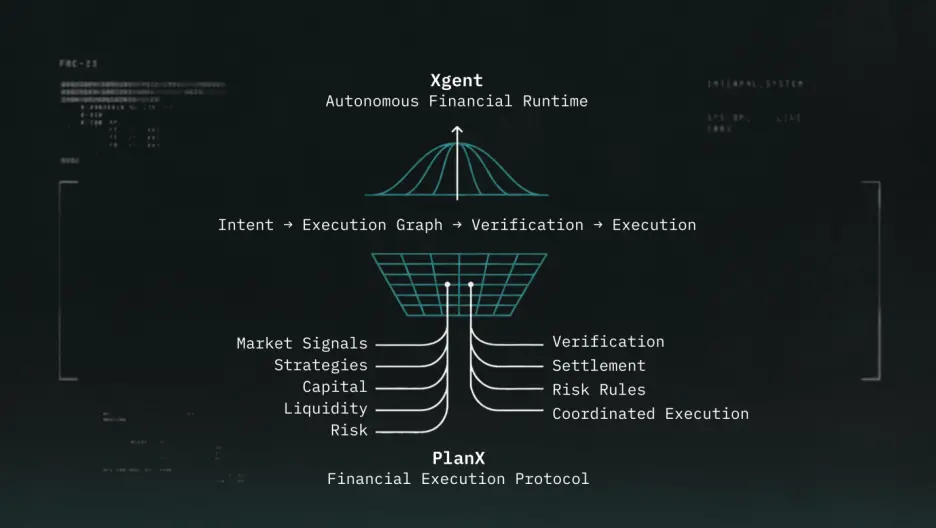
Plan Execution Lab, a financial infrastructure project founded by former SpaceX engineer Lex Li, has raised angel funding at a $50M post-money valuation. The startup is applying "first principles thinking" from Li's SpaceX experience to rethink financial market execution. Their analysis posits that while assets, liquidity, and settlement have moved on-chain, the execution layer remains fundamentally human-dependent and fragmented. In the era of AI Agents, strategy advantages decay rapidly, shifting the competitive edge from isolated algorithms to robust **execution networks**. Plan Execution Lab's solution is a two-part system: **PlanX**, a Financial Execution Protocol designed to facilitate the migration from centralized exchanges (CEX) to on-chain markets by providing core on-chain execution capabilities; and **Xgent**, an Autonomous Financial Runtime. Xgent allows users to define investment goals and constraints, then autonomously constructs and manages the execution logic—moving from **Intent to Execution Graph to Verification to Autonomous Execution**. The long-term vision is to create the "Bloomberg Terminal for Autonomous Finance"—an operating environment not for humans, but for agents and execution nodes. The future financial system, they argue, will be a collaborative network built by diverse participants contributing execution capabilities, not secret strategies. The core competition will shift to who builds the most powerful and adaptive execution network.

The financial infrastructure project Plan Execution Lab recently announced the completion of an angel round of funding led by a prominent family office in Singapore, with the company's post-investment valuation reaching $50 million. This round of funding will primarily be used to accelerate the research and development and ecosystem building of the PlanX Financial Execution Protocol and the Xgent Autonomous Financial Runtime.
Unlike most trading platforms, Plan Execution Lab does not attempt to build a "faster exchange" or a "smarter trading bot." They aim to answer a more fundamental question: What is truly missing from the future financial markets?

From SpaceX to Financial Infrastructure

The career starting point for Plan Execution Lab founder Lex Li was not Wall Street, but SpaceX. As an engineer who joined SpaceX as a campus recruit, Lex worked there for thirteen months. In that experience, what influenced him most was not any specific technology, but the core methodology advocated by SpaceX: First Principles Thinking.

At SpaceX, engineers are required to constantly question: Why must rockets be built this way? Why must costs be so high? Why must the industry's default practices be correct? Many rules taken for granted ultimately prove to be mere historical legacies. This mode of thinking also became Lex's most important methodology when he later entered the financial industry.

"After entering the financial industry, I found everyone discussing faster trading speeds, more complex product designs, and greater liquidity," Lex said. "But few stop to think about a more fundamental question: What is the fundamental purpose of financial markets?"

Looking at Financial Markets from First Principles

In Lex's view, the core function of financial markets is not trading, but Capital Allocation. Trading is merely one expression of capital allocation, and the process that truly transforms decisions into action is Execution.

Over the past decade, financial infrastructure has undergone tremendous change: assets have migrated on-chain, liquidity has migrated on-chain, and settlement has migrated on-chain. However, the execution layer has hardly seen fundamental change. Today's market is still built upon a vast array of fragmented human workflows:

  • Human monitoring of markets

  • Human scheduling of funds

  • Human risk management

  • Human coordination of liquidity

  • Human execution of trades

Even on the most advanced trading platforms, financial execution remains Human-Native.

The Agent Era is Accelerating Strategy Decay

With the development of large language models, AI Agents, and automated systems, the market is entering a new stage. The speed of information dissemination is increasing, market reaction speeds are accelerating, and strategy decay is also speeding up.

An advantage that could last for years in the past may now only last a few months. An Alpha that lasted months may now last only weeks in the future. For independent traders and even small-to-medium institutions, it is becoming increasingly difficult to sustain effective strategies.

"The biggest challenge in the future is no longer acquiring information, but how to execute consistently and efficiently," said Lex.

The Strategy is Not the Smallest Unit

Most people think of a strategy as an independent algorithm. But from first principles, a strategy is actually just a combination of multiple execution capabilities. For example:

  • Risk management

  • Capital allocation

  • Liquidity acquisition

  • Hedging logic

  • Execution timing

  • Portfolio construction

These capabilities are more like independent Nodes, which together form a larger Execution Graph. Therefore, the true object of competition for future financial systems will no longer be a single strategy, but the Execution Network. The most powerful financial system of the future will not be a single mysterious algorithm, but a collaborative network built and continuously evolving through a multitude of execution nodes.

PlanX: Facilitating the Migration from CEX to DEX

Based on this judgment, the team built PlanX. PlanX is not positioned as another DEX, but as a Financial Execution Protocol.

The team believes that one of the biggest financial migrations of the next decade will be the shift of global trading volume from centralized exchanges (CEX) to on-chain markets. But what will migrate is not just assets, but financial behavior itself. The goal of PlanX is to become the execution infrastructure for this migration process, providing the market with:

  • On-chain execution capability

  • Liquidity access

  • Risk management

  • Settlement coordination

  • Capital scheduling

Thereby constructing an open financial execution network.

Xgent: The Runtime for the Autonomous Finance Era

If PlanX is the execution infrastructure, then Xgent is the autonomous financial runtime built on top of it. Users no longer need to manually manage multiple platforms and complex workflows; they only need to define:

  • Investment objectives

  • Risk preferences

  • Constraints

  • Capital allocation rules

Xgent will automatically complete:

  • Execution logic construction

  • Risk validation

  • Liquidity coordination

  • Strategy operation

  • Autonomous optimization

The team defines this process as: Intent → Execution Graph → Verification → Autonomous Execution.

Building the Bloomberg Terminal for the Autonomous Finance Era

Lex often uses an analogy to describe the long-term vision of Xgent. In the past few decades, Bloomberg Terminal became the core operating environment for global financial markets. It not only provides data but, more importantly, provides the entire financial industry with unified workflows, a unified context, and a unified collaborative environment.

Bloomberg is the operating system for the human finance world. In the autonomous finance era, a new operating system is similarly needed. But the user is no longer humans, but Agents.

"If Bloomberg Terminal defined the Operating Environment for Human Finance, then the combination of PlanX + Xgent aims to become the Operating Environment for Autonomous Finance."

Financial Infrastructure Built by Nodes Collectively

Unlike traditional financial systems, Plan Execution Lab does not attempt to control the entire network through a single institution. The team believes that the next generation of financial infrastructure must be built collectively by participants. The future ecosystem will be jointly formed by the following participants:

  • Execution Nodes

  • Liquidity Providers

  • Strategy Contributors

  • Infrastructure Operators

  • Autonomous Financial Agents

What each participant contributes is not a single strategy, but execution capability itself. These execution capabilities will continuously combine, evolve, and ultimately form the execution network for the autonomous finance era.

The Core of Next-Generation Financial Competition

For Lex, the core competitiveness of future finance is not who has the best trading strategy, but who has the most powerful execution network.

The past decade changed the location of asset storage. The next decade will change the way financial decisions are executed. And the combination of PlanX + Xgent hopes to become the infrastructure for this transformation. The future does not belong to isolated strategies; the future will belong to autonomous execution networks.


Perguntas relacionadas

QWhat is the core problem that Plan Execution Lab aims to solve in the financial markets, according to founder Lex Li's 'first principles' approach?

AThe core problem is the lack of a fundamental rethinking of the financial execution layer. Lex Li argues that while assets, liquidity, and settlement have moved on-chain, the execution of financial actions remains 'Human-Native,' relying on fragmented, manual workflows. The future market lacks a robust, automated execution network that moves beyond simply speeding up transactions or creating smarter trading bots.

QWhat are the two core components developed by Plan Execution Lab and what are their respective functions?

APlan Execution Lab has developed two core components: PlanX and Xgent. PlanX is a Financial Execution Protocol designed to be the execution infrastructure for migrating financial activity from centralized exchanges (CEX) to on-chain markets. It provides capabilities like on-chain execution, liquidity access, risk management, and capital orchestration. Xgent is an Autonomous Financial Runtime built on PlanX. It allows users to define goals and constraints, and then automatically constructs execution logic, validates risk, coordinates liquidity, and runs strategies, functioning as the operating environment for the autonomous finance era.

QHow does the article describe the impact of AI and automation on trading strategies, and what does this shift the future competition towards?

AThe article states that the AI and Agent era is accelerating strategy decay, making effective strategies harder to maintain for individuals and small institutions as alpha advantages last for shorter periods. Consequently, future financial competition will not be about who has the best single trading strategy. Instead, the core competitive advantage will be 'who has the most powerful execution network' – a network of interoperable execution capabilities that can be combined and evolved continuously.

QWhat analogy does Lex Li use to describe the long-term vision for the Xgent platform?

ALex Li uses the analogy of the Bloomberg Terminal. He states that Bloomberg Terminal defined the operating environment for 'Human Finance.' Similarly, the combination of PlanX and Xgent aims to become the operating environment for 'Autonomous Finance,' serving not humans but AI Agents and automated systems.

QHow is the proposed future financial infrastructure of Plan Execution Lab different from traditional systems in terms of construction and governance?

AUnlike traditional financial systems often controlled by a single institution, Plan Execution Lab envisions a next-generation infrastructure co-built by participants. The ecosystem will consist of various contributors like Execution Nodes, Liquidity Providers, Strategy Contributors, Infrastructure Operators, and Autonomous Financial Agents. Each contributes execution capabilities rather than just strategies, which then combine and evolve to form a decentralized, collaborative execution network.

Leituras Relacionadas

Grayscale: These 15 Profitable Crypto Protocols Are Severely Undervalued

Grayscale Research identifies 15 top-revenue crypto protocols trading at significant valuation discounts, with many at single-digit or even 1x revenue multiples. Protocols like Pump.fun, PancakeSwap, and Meteora have market capitalizations roughly equal to their annual revenue. The report argues these financially-focused protocols (DEXs, lending, staking) are fundamentally undervalued and could benefit from the potential passage of the CLARITY Act, expected as soon as next month. This legislation aims to clarify digital asset regulation, potentially reducing institutional barriers and driving on-chain activity. The analysis breaks down the protocols into three groups: the "1x Club" (market cap ≈ revenue), mid-tier protocols with 3-9x multiples (e.g., Aave, Lido, Jupiter), and high-multiple protocols like Hyperliquid (15x) and Uniswap (37x), where valuation reflects future potential rather than current cash flows. Grayscale applies a traditional DCF model to Aave, suggesting a one-year price target of ~$175, representing ~130% upside from current levels. The report notes a risk-off macro environment since the Iran conflict has further compressed valuations, creating a potential entry window. The conclusion highlights that while the valuation data presents an intriguing opportunity, the investment thesis is contingent on the CLARITY Act's passage and subsequent institutional capital flows. Investors are cautioned to consider Grayscale's inherent conflict of interest as a crypto asset manager with products tied to these assets.

marsbitHá 17m

Grayscale: These 15 Profitable Crypto Protocols Are Severely Undervalued

marsbitHá 17m

Sam Altman's Personal Alchemy of Wealth: Investing in 400 Companies, Over 10 Deeply Tied to OpenAI

The article investigates Sam Altman's personal wealth strategy, centered around his investments in approximately 400 companies while serving as OpenAI's CEO. Despite not holding direct equity in OpenAI, Altman has built a vast portfolio, with at least 10 of his investments having commercial ties or ongoing negotiations with OpenAI. This creates a complex network of potential conflicts of interest, drawing scrutiny from U.S. congressional committees and state attorneys general. Key investments highlighted include the anti-aging startup Retro Biosciences (valued at $258 million for his stake as of late last year) and the chipmaker Cerebras, whose value soared following an OpenAI procurement deal. His most significant financial gain is linked to the nuclear fusion company Helion, where a recent funding round reportedly increased his stake's value to at least $4.1 billion. The article details a decade-long relationship between Altman, Helion, and OpenAI, including a controversial non-binding power purchase agreement and Altman's efforts to secure investments from OpenAI and its backer SoftBank for Helion. Other points include internal investigations at Tools for Humanity (developer of Worldcoin) and OpenAI's massive contracts with tech giants like Nvidia. According to Forbes, Altman's net worth is around $3.4 billion, ranking him 1251st globally—a rise of over 1400 places since 2024. OpenAI's board states that Altman's external dealings are transparent and potential conflicts are carefully managed.

Odaily星球日报Há 38m

Sam Altman's Personal Alchemy of Wealth: Investing in 400 Companies, Over 10 Deeply Tied to OpenAI

Odaily星球日报Há 38m

Former SpaceX Engineer Reconstructs Financial Execution System Using First Principles

Former SpaceX engineer Lex Li applies "First Principles Thinking" to financial infrastructure with Plan Execution Lab, recently raising angel funding at a $50M post-money valuation. The team argues that the core function of finance is capital allocation, and the critical gap is not in trading but in execution, which remains highly manual and fragmented. While assets, liquidity, and settlement have migrated on-chain, execution workflows (monitoring, risk management, liquidity coordination) are still human-native. In an era of accelerating AI agents, strategy decay is rapid, shifting the competitive edge from having the best strategy to having the most robust execution network. Plan Execution Lab introduces two core components: 1. **PlanX**: A Financial Execution Protocol designed as infrastructure for the migration from CEX to DEX, providing on-chain execution capabilities, liquidity access, risk management, and capital orchestration. 2. **Xgent**: An Autonomous Financial Runtime. Users define investment intents, risk preferences, and constraints; Xgent automatically constructs an execution graph, verifies it, and handles ongoing execution and optimization—streamlining the process from Intent to Autonomous Execution. The long-term vision is to create the "Bloomberg Terminal for Autonomous Finance"—a shared operating environment and execution network built collectively by participants like execution nodes, liquidity providers, and autonomous agents. The future of finance, they contend, belongs not to isolated algorithms but to open, collaborative execution networks.

marsbitHá 1h

Former SpaceX Engineer Reconstructs Financial Execution System Using First Principles

marsbitHá 1h

Trading

Spot
Futuros
活动图片