$8 Billion Valuation, 2x Growth in 8 Months! What Makes Crypto-Friendly Bank Erebor Bank So Special?

链捕手Publicado em 2026-07-04Última atualização em 2026-07-04

Resumo

Erebor Bank, a crypto-friendly U.S. bank founded by Palmer Luckey, is reportedly in talks for a new funding round targeting a valuation of at least $8 billion, double its $4.35 billion valuation from December. Despite being operational for only a few months, its rapid growth—deposits surged from $1.1 billion in March to approximately $4.05 billion within a quarter, adding nearly 400 clients—has attracted investor interest. The bank aims to fill the void left by Silicon Valley Bank's collapse, targeting startups and businesses with non-traditional assets like defense contracts and digital tokens. Its strategy involves holding its own banking license to offer services like stablecoin deposits, payments, and 24/7 on-chain settlement. While digital assets are a core long-term focus, recent growth has been driven more by financing for U.S. manufacturing and defense sectors. Erebor's leadership combines Luckey's tech/defense background with a seasoned financial team. It received a national bank charter from the OCC in early 2026, benefiting from a favorable regulatory climate for digital assets. However, the bank faces significant risks, including reliance on a concentrated client base, exposure to crypto market volatility, potential regulatory shifts, and the unproven demand for its integrated banking model. Investors are betting on its future potential to monetize deposits through lending and crypto services, despite current losses typical for a new bank.

Author: Chloe, ChainCatcher

According to a Bloomberg report, digital bank Erebor, initiated by Anduril founder Palmer Luckey and backed by billionaire investor Peter Thiel, is in talks with investors for a new round of financing, targeting a valuation of at least $8 billion, roughly double its December 2025 round ($350 million raised, $4.35 billion valuation). The financing is still in early stages, with the valuation not yet finalized. An Erebor spokesperson declined to comment on the negotiations.

A bank that has only been operating for a few months, doubling its valuation, stands as one of the highest valuation increases among newly licensed U.S. banks in recent years. What likely makes investors willing to reprice it is the expansion speed revealed in its financial reports.

What Potential Do Investors See in the Financials?

According to sources familiar with the matter, Erebor's deposit base surged from $1.1 billion disclosed to regulators at the end of March to approximately $4.05 billion within three months, nearly quadrupling in a single quarter. It also added nearly 400 new clients, with the bank expecting to become profitable by the end of 2026.
This growth rate has also sparked external skepticism—whether Erebor's ties to Silicon Valley tech circles and government/defense circles are too close, raising suspicions of a "friends and family" game.

Luckey responded directly, emphasizing that none of the quarterly growth came from his own companies, and new clients independently chose Erebor. He added that a significant portion of the recent expansion focused on companies rebuilding U.S. manufacturing capacity, and the bank has correspondingly expanded equipment financing, venture debt, and credit businesses supporting industrial and defense enterprises.

Looking back at the Q1 financials, Erebor's total assets were $1.703 billion, deposits $1.098 billion, and bank equity $600.6 million. There were no loans, leases, or borrowings other than deposits (items like federal funds purchased, repurchase agreements, other borrowed money, subordinated debt were all zero). The asset structure was extremely liquid: approximately $1.411 billion in cash and due from banks, and about $275 million in available-for-sale debt and equity securities (of which bonds $116 million, equity securities $159 million).

Additionally, quarterly net interest income was only $3.36 million, non-interest expenses were $10.56 million, resulting in a net loss of $6.01 million. However, for a newly launched bank still amortizing technology, compliance, and operational costs, such losses are considered necessary expenditures.

In other words, investors are willing to pay an $8 billion valuation not for Erebor's current monetization potential, but for its growth speed—deposits surging from $1.1 billion to $4.05 billion—and the expectation that it will eventually lend out these deposits and develop stablecoin business.

Founder Unfamiliar with Wall Street, Yet Comes with Considerable Pedigree

To understand Erebor, one must first understand the recurring product-building pattern behind it.

Founder Palmer Luckey's trajectory spans Oculus VR and Anduril, consistently focusing on capital-intensive industries at the intersection of hardware, regulatory moats, and government-adjacent ecosystems. In 2012, he entered the not-yet-formed VR market, solving long-standing industry issues like latency and spatial tracking, selling Oculus to Facebook for $2 billion in 2014. His second venture, Anduril, applied the same playbook to the defense industry: using private venture capital to build defense systems first, then selling them to the government as "products" rather than through traditional "cost-plus" contracts, thereby building deep relationships with the Department of Defense and intelligence agencies. Luckey explicitly stated that Erebor would "work with the intelligence community from day one" to prevent fraud, adopting a proactive compliance posture.

However, Luckey himself is an outsider to banking. Erebor's brand partly relies on his and Thiel's reputations, but prestige ultimately cannot replace regulatory and operational track records. Once entering Wall Street, the bank will ultimately be judged by the standards of a regulated institution.

Therefore, the real operators are a team with deep financial backgrounds: President Michael Hagedorn from Wells Fargo's regional banking; CEO Owen Rapaport with crypto compliance experience through Aer Compliance; Chief Strategy Officer Jacob Hirshman, who worked on Circle's stablecoin business and practiced at Sullivan & Cromwell; Growth VP Noah Pompan with a background at MoonPay. The investor lineup includes Joe Lonsdale's 8VC, Thiel's Founders Fund, Lux Capital, and a fund associated with a16z.
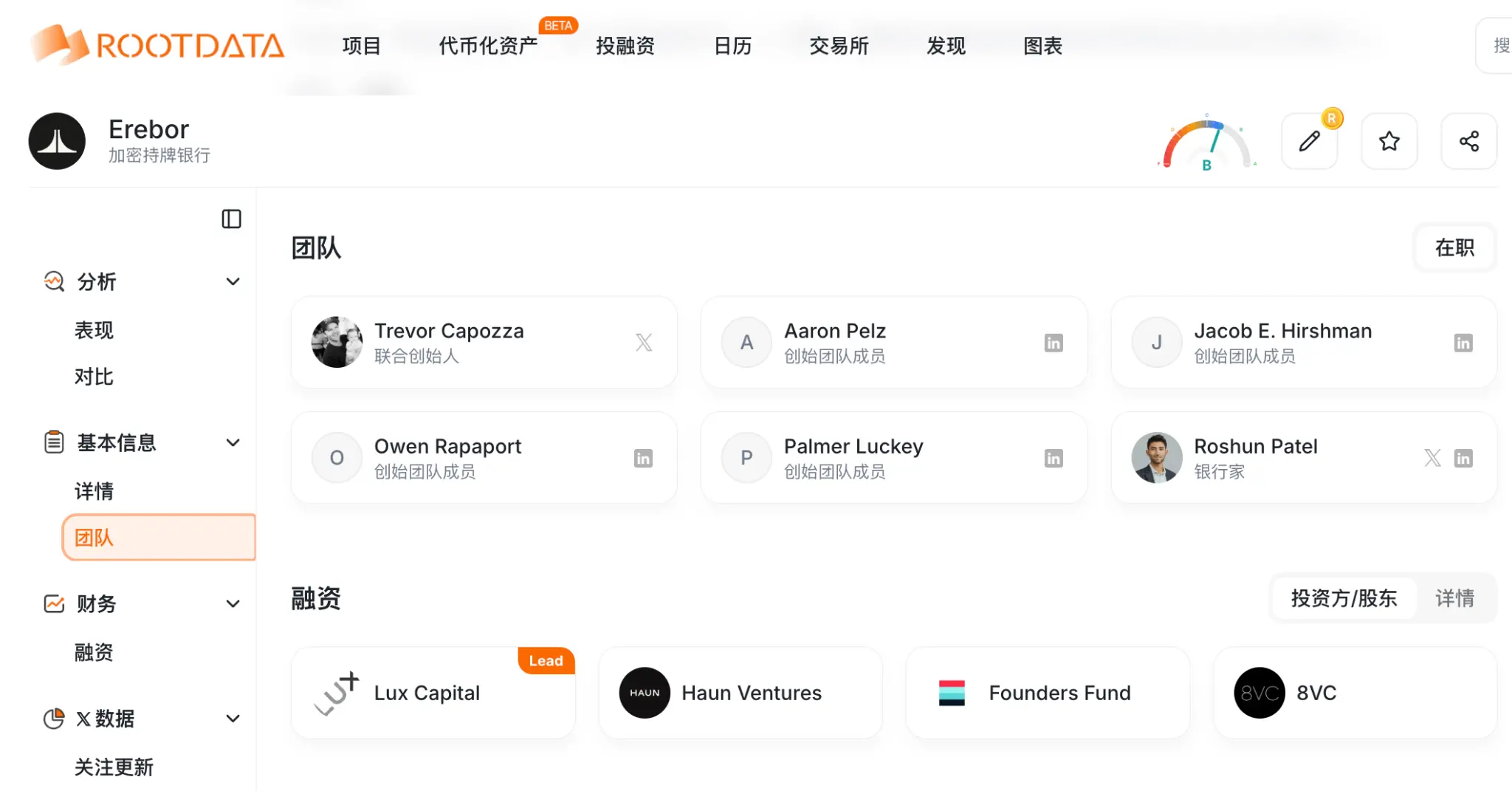
Image Source:RootData

Furthermore, a key strategic choice for Erebor is: insisting on obtaining its own license and being responsible for its financials, unlike Mercury or Brex which rely on partner banks. Luckey's argument is that relying on third-party infrastructure exposes one to risks of "de-platforming," policy pressure, and product limitations; only by holding the license and ledger can it fulfill promises of on-chain settlement, stablecoin minting, and redemption.

Looking back at Erebor's origin, it is almost entirely tied to the collapse of Silicon Valley Bank (SVB) in 2023. That failure left a large number of startups and venture capitalists suddenly without banking partners and deposit protection. Luckey and investors believed this left a "structural vacuum"—the disappearance of banks specializing in serving startups, while traditional banks were too conservative or slow for startups holding non-standard assets (defense contracts, AI hardware, digital tokens).

Erebor claims to address roughly four pain points: First, providing credit for physical assets—traditional banks are good at lending against real estate or receivables but not at valuing "GPUs" or "aerospace research." Second, bridging the on-chain/off-chain divide, bringing fiat banking and stablecoin settlement onto the same regulated balance sheet. Third, meeting 24/7 settlement needs, replacing SWIFT and ACH still operating on decades-old schedules. Fourth, providing USD access for high-growth international companies, combating the "de-banking" friction they often face.

Of course, how much of this operational potential is real versus marketing remains debatable. Venture-backed companies now have alternatives like non-bank lenders and DeFi lending, and some incumbent banks had already started targeting tech niches before SVB's collapse. Erebor's founders clearly believe existing institutions are insufficient, and the fact that it obtained a full banking license suggests regulators might also see some merit in this assessment?

Additionally, digital assets are core to Erebor's long-term strategy. It plans to handle deposits and payments for dollar stablecoins, provide instant fiat/stablecoin conversion, 24/7 settlement rails, and gradually support stablecoin minting and redemption within a regulated framework. Its OCC license even explicitly allows it to hold small amounts of crypto assets on its own books to pay for on-chain transaction fees, with supervisory letters defining such holdings as "incidental" to banking business—a noteworthy precedent in compliance.

On April 2nd, the Sui Foundation announced that Erebor now supports the Sui network, allowing clients to deposit and withdraw stablecoins. This is one of the first public pieces of evidence of it connecting regulated bank infrastructure to on-chain payments.

However, reality also presents gaps. Sources indicate demand for crypto-collateralized loans has been lower than the bank initially expected. This aligns with the earlier financials: the recent growth has actually been driven by companies rebuilding U.S. manufacturing capacity and their equipment financing and venture debt needs. In other words, Erebor currently resembles more of a "defense + advanced manufacturing + crypto" hybrid than a purely native crypto bank.

Perfect Timing—Even Its License Application Timing Was Fortuitous?

Breaking down the licensing: Erebor received preliminary conditional approval from the OCC on October 15, 2025, FDIC deposit insurance approval on December 16, final license in early February 2026, and officially launched on February 8 with approximately $625 million in initial capital (significantly increased from about $275 million during the preliminary approval phase). It is the first newly issued (de novo) national bank charter under the current U.S. administration.
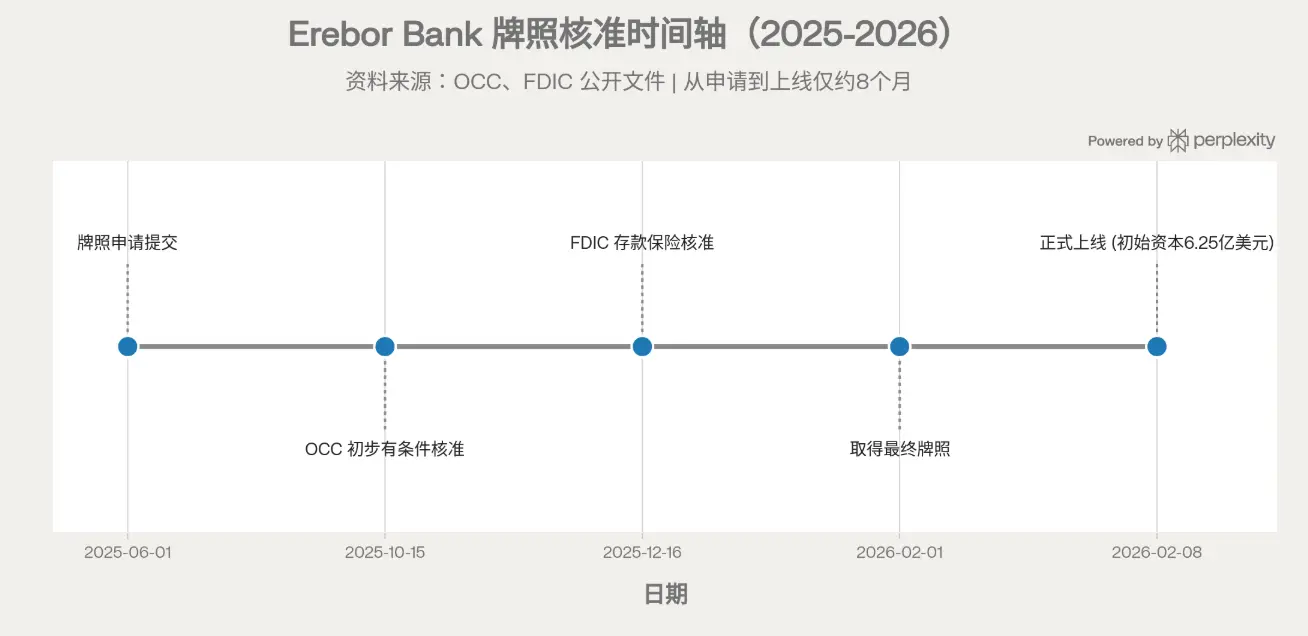
All this occurred against the backdrop of a clear shift in U.S. banking policy: Under the leadership of Acting Comptroller Jonathan Gould, the OCC has adopted an explicitly open regulatory stance toward digital asset banks, with Gould himself hailing this license as an example of a "dynamic and diverse financial system"; coupled with the advancement of federal-level stablecoin framework (GENIUS Act), once-fuzzy legal territories have been clarified considerably.

Notably, regulators did not grant approval without conditions. In exchange for approval, the OCC and FDIC imposed strict requirements: maintaining a Tier 1 leverage ratio of at least 12% for the first three years (roughly double the "well-capitalized" threshold) and a capital maintenance commitment. It could be said that Erebor's feasibility is partly tied to the current political cycle. If future regulatory stances shift, or stablecoin and anti-money laundering rules tighten, its entire narrative built on "token-friendly rules" could face headwinds.

Finally, synthesizing external media judgments, Erebor's model replicates almost every risk that contributed to SVB's downfall.

It serves early-stage, tech-heavy companies with non-traditional collateral. It caters to a small number of large accounts (startups, founders, investment funds) rather than thousands of retail customers; any single client's failure or withdrawal (crypto market volatility, venture capital pullback) could significantly impact liquidity. Regulators have long pointed out that SVB's "monoculture" client structure was a key driver of its run.

Crypto correlation makes the issue more tricky. If a supported stablecoin de-pegs or crypto prices crash, the deposit base and loan collateral could shrink simultaneously. Further down are policy reversal risks (its entire narrative bets on lenient token rules), execution risks of building core systems and on-chain settlement from scratch, and the unverified premise of "whether stablecoins will be widely adopted by clients." Finally, reputational and political risks—Luckey's highly controversial political affiliations plus the novelty of a "crypto bank" itself could amplify market confidence loss if the bank ever faces trouble.

It could be said Erebor is a high-profile experiment happening at the intersection of banking, crypto, and industrial policy.

The market need it advocates emerged from the financing gap left by SVB's collapse and friction in crypto payments. Now, regulators have given paper endorsement, the team combines tech prestige with Wall Street backgrounds. The execution of this new model, the continuity of regulatory stances, and the genuine market demand for its integrated services are precisely the points under rigorous market scrutiny.


Criptomoedas em alta

Perguntas relacionadas

QWhat are the key factors driving Erebor Bank's rapid valuation increase to $8 billion?

AThe rapid valuation increase to $8 billion is primarily driven by the bank's exceptional deposit growth, which surged from $1.1 billion to approximately $4.05 billion in a single quarter. Investors are betting on its future potential to deploy these deposits into profitable lending and stablecoin operations, its strategic positioning to fill the void left by Silicon Valley Bank's collapse, and its unique combination of founder reputation (Palmer Luckey, Peter Thiel) and a seasoned financial and crypto-compliance team.

QHow does Erebor Bank's business model differ from that of traditional banks and other fintech companies like Mercury?

AErebor Bank's business model differs from traditional banks by focusing on niche, capital-intensive clients like defense, advanced manufacturing, and crypto-native businesses, offering services like equipment financing for non-traditional assets (e.g., GPUs) and crypto integration. Unlike fintechs like Mercury or Brex that operate on third-party bank infrastructure, Erebor holds its own national bank charter, giving it direct control over its ledger, compliance, and the ability to offer regulated stablecoin minting/redemption and 24/7 on-chain settlement services.

QWhat are the main risks associated with Erebor Bank's strategy as outlined in the article?

AThe main risks include: 1) Concentrated client risk similar to SVB, relying on a small number of large depositors from volatile sectors (tech startups, crypto). 2) Execution risk in building core banking and on-chain settlement systems from scratch. 3) Regulatory and policy risk, as its model depends on a favorable crypto regulatory environment which could reverse. 4) Market adoption risk for its core crypto/stablecoin services, which currently have lower-than-expected demand. 5) Reputational and political risk tied to its founders' controversial profiles and the novel nature of a 'crypto bank'.

QWhat role does digital asset integration play in Erebor Bank's long-term strategy?

ADigital asset integration is central to Erebor's long-term strategy. It plans to offer deposit and payment services for US dollar stablecoins, provide instant fiat-to-stablecoin conversions, enable 24/7 settlement rails, and support the minting and redemption of stablecoins within a regulated framework. Its OCC charter even allows it to hold small amounts of crypto assets on its balance sheet for operational purposes. The bank has already taken steps like integrating with the Sui network for stablecoin transactions.

QWhy was the timing of Erebor Bank's regulatory approval considered favorable?

AThe timing was favorable due to a significant shift in U.S. banking policy under the current administration. The OCC, led by Acting Comptroller Jonathan Gould, adopted an explicitly open stance toward digital asset banks. This coincided with legislative progress on a federal stablecoin framework (the GENIUS Act), which helped clarify the legal landscape. Erebor's charter is the first *de novo* national bank charter issued under this administration, making it a beneficiary of this specific regulatory and political moment.

Leituras Relacionadas

Valuation of $8 Billion, Up 200% in 8 Months! What's Behind Crypto-Friendly Bank Erebor Bank's Rise?

Erebor Bank, a digital bank founded by Palmer Luckey and backed by Peter Thiel, is in talks for new funding at a target valuation of $8 billion, double its $4.35 billion valuation from December. This surge is driven by explosive deposit growth, which soared from $1.1 billion in March to approximately $4.05 billion within a quarter, alongside adding nearly 400 new clients. The bank, launched in February 2026, holds a full national bank charter from the OCC, a strategic choice to avoid reliance on partner banks. It aims to serve tech startups, defense contractors, and crypto-native businesses, addressing gaps left by Silicon Valley Bank's collapse. Core promises include lending against non-traditional assets like hardware, offering 24/7 settlement, and integrating stablecoin services with traditional banking. It has already enabled stablecoin deposits and withdrawals on the Sui network. However, its current financials show minimal lending activity and a net loss, with high liquidity in cash and securities. The valuation hinges on future potential to monetize deposits through lending and crypto services. The bank's experienced management team includes veterans from Wells Fargo and crypto compliance firms. Risks are significant. Its concentrated customer base and exposure to volatile sectors like crypto and venture capital echo SVB's vulnerabilities. Its entire model depends on continued regulatory favor towards digital assets, which could shift. Erebor represents a high-profile experiment at the intersection of banking, crypto, and industrial policy, with its execution and market demand yet to be fully proven.

marsbitHá 1h

Valuation of $8 Billion, Up 200% in 8 Months! What's Behind Crypto-Friendly Bank Erebor Bank's Rise?

marsbitHá 1h

Trading

Spot

Artigos em Destaque

O que é $BANK

Bank AI: Um Passo Revolucionário no Futuro da Banca Introdução Em uma era marcada por avanços rápidos na tecnologia, o Bank AI está na interseção da inteligência artificial (IA) e dos serviços bancários. Este projeto inovador visa redefinir o panorama financeiro, melhorando a eficiência operacional, as medidas de segurança e as experiências dos clientes através do poder da IA. Ao embarcarmos nesta exploração do Bank AI, iremos aprofundar no que o projeto implica, suas dinâmicas operacionais, seu contexto histórico e marcos significativos. O que é o Bank AI? No seu cerne, o Bank AI representa uma iniciativa transformadora com o objetivo de integrar a inteligência artificial em várias operações bancárias. Este projeto aproveita as capacidades da IA para automatizar processos, melhorar os protocolos de gestão de risco e melhorar a interação com os clientes através de serviços personalizados. Os principais objetivos do Bank AI incluem: Automatização das Funções Bancárias: Ao aproveitar as tecnologias de IA, o Bank AI visa automatizar tarefas rotineiras, reduzindo o peso sobre os recursos humanos e aumentando a eficiência. Gestão de Risco Melhorada: O projeto utiliza algoritmos de IA para prever e identificar riscos, fortalecendo assim as medidas de segurança contra fraudes e outras ameaças. Personalização dos Serviços Bancários: O Bank AI foca em oferecer produtos e serviços financeiros ajustados, analisando dados e comportamentos dos clientes. Melhoria da Experiência do Cliente: A implementação de soluções impulsionadas por IA, como chatbots e assistentes virtuais, visa proporcionar aos usuários interações mais humanizadas, revolucionando a forma como os clientes se envolvem com os bancos. Com esses objetivos, o Bank AI posiciona-se como um ator crucial para tornar a banca mais eficiente, segura e centrada no usuário. Quem é o Criador do Bank AI? Os detalhes sobre o criador do Bank AI permanecem desconhecidos. Assim, nenhuma pessoa ou organização específica foi identificada nas informações disponíveis. O anonimato que cerca a origem do projeto levanta questões, mas não diminui a sua ambiciosa visão e objetivos. Quem são os Investidores do Bank AI? Semelhante ao criador do projeto, informações específicas sobre os investidores ou organizações que apoiam o Bank AI não foram divulgadas. Sem essas informações, é difícil delinear o apoio financeiro e institucional que pode estar impulsionando o projeto para frente. No entanto, a importância de ter uma sólida base de investimento é fundamental para sustentar o desenvolvimento em um campo tão inovador. Como Funciona o Bank AI? O Bank AI opera em várias frentes inovadoras, focando em fatores únicos que o diferenciam das estruturas bancárias tradicionais. Abaixo estão as principais características operacionais: Automatização: Ao aplicar algoritmos de aprendizado de máquina, o Bank AI automatiza vários processos manuais dentro dos bancos. Isso resulta na redução dos custos operacionais e permite que os trabalhadores humanos redirecionem os seus esforços para atividades mais estratégicas. Gestão de Risco Avançada: A integração da IA nas práticas de gestão de risco equipa os bancos com ferramentas para prever com precisão potenciais ameaças, como fraudes, garantindo que as informações e ativos dos clientes permaneçam seguros. Recomendações Financeiras Personalizadas: Através do aprendizado contínuo a partir das interações com os clientes, os sistemas de IA desenvolvem uma compreensão sutil das necessidades dos usuários, permitindo oferecer conselhos adaptados sobre decisões financeiras. Interações Melhoradas com os Clientes: Utilizando chatbots e assistentes virtuais alimentados por IA, o Bank AI permite uma experiência de cliente mais envolvente, permitindo que os usuários tenham suas dúvidas resolvidas rapidamente, reduzindo assim os tempos de espera e melhorando os níveis de satisfação. Juntas, estas características operacionais posicionam o Bank AI como um pioneiro no setor bancário, estabelecendo novos padrões para a prestação de serviços e a excelência operacional. Cronologia do Bank AI Compreender a trajetória do Bank AI requer uma análise do seu contexto histórico. Abaixo está uma cronologia que destaca marcos e desenvolvimentos importantes: Início de 2010: A conceituação da integração da IA nos serviços bancários começou a ganhar atenção à medida que instituições bancárias reconheciam os potenciais benefícios. 2018: Ocorreu um aumento significativo na implementação de tecnologias de IA, quando os bancos começaram a usar ferramentas de IA como chatbots para atendimento ao cliente básico e sistemas de gestão de risco para melhorar o tratamento de segurança. 2023: A sofisticação da IA continuou a avançar, com a introdução de IA generativa para tarefas mais complexas, como processamento de documentos e análise de investimentos em tempo real. Este ano marcou um salto significativo nas capacidades proporcionadas aos bancos pela tecnologia de IA. 2024-Estado Atual: Neste ano, o Bank AI está em uma trajetória ascendente, com pesquisas e desenvolvimentos em andamento prontos para aprimorar ainda mais as capacidades nas operações bancárias. A exploração contínua das aplicações de IA sugere desenvolvimentos emocionantes por vir. Pontos Chave Sobre o Bank AI Integração da IA na Banca: O Bank AI foca na adoção da inteligência artificial para simplificar os processos bancários e melhorar as experiências dos usuários. Automatização e Foco em Gestão de Risco: O projeto enfatiza fortemente essas áreas, visando transferir o peso das tarefas rotineiras enquanto melhora as estruturas de segurança através de análises preditivas. Soluções Bancárias Personalizadas: Ao aproveitar os dados dos clientes, o Bank AI possibilita serviços bancários ajustados que atendem às necessidades individuais dos usuários. Compromisso com o Desenvolvimento: O Bank AI permanece comprometido com contínuas pesquisas e esforços de desenvolvimento, garantindo a sua adaptabilidade e relevância contínua à medida que a tecnologia continua a evoluir. Conclusão Em resumo, o Bank AI exemplifica um passo crucial em frente na indústria bancária, aproveitando a inteligência artificial para remodelar paradigmas operacionais, melhorar a segurança e promover a satisfação do cliente. Apesar das lacunas de informação em torno do criador e dos investidores, os objetivos claros e os mecanismos funcionais do Bank AI fornecem uma base sólida para sua evolução contínua. À medida que a tecnologia de IA continua a avançar e se fundir com o setor bancário, o Bank AI está bem posicionado para impactar significativamente o futuro dos serviços financeiros, aprimorando a maneira como entendemos e interagimos com a banca.

65 Visualizações TotaisPublicado em {updateTime}Atualizado em 2024.12.03

O que é $BANK

Como comprar BANK

Bem-vindo à HTX.com!Tornámos a compra de Lorenzo Protocol (BANK) simples e conveniente.Segue o nosso guia passo a passo para iniciar a tua jornada no mundo das criptos.Passo 1: cria a tua conta HTXUtiliza o teu e-mail ou número de telefone para te inscreveres numa conta gratuita na HTX.Desfruta de um processo de inscrição sem complicações e desbloqueia todas as funcionalidades.Obter a minha contaPasso 2: vai para Comprar Cripto e escolhe o teu método de pagamentoCartão de crédito/débito: usa o teu visa ou mastercard para comprar Lorenzo Protocol (BANK) instantaneamente.Saldo: usa os fundos da tua conta HTX para transacionar sem problemas.Terceiros: adicionamos métodos de pagamento populares, como Google Pay e Apple Pay, para aumentar a conveniência.P2P: transaciona diretamente com outros utilizadores na HTX.Mercado de balcão (OTC): oferecemos serviços personalizados e taxas de câmbio competitivas para os traders.Passo 3: armazena teu Lorenzo Protocol (BANK)Depois de comprar o teu Lorenzo Protocol (BANK), armazena-o na tua conta HTX.Alternativamente, podes enviá-lo para outro lugar através de transferência blockchain ou usá-lo para transacionar outras criptomoedas.Passo 4: transaciona Lorenzo Protocol (BANK)Transaciona facilmente Lorenzo Protocol (BANK) no mercado à vista da HTX.Acede simplesmente à tua conta, seleciona o teu par de trading, executa as tuas transações e monitoriza em tempo real.Oferecemos uma experiência de fácil utilização tanto para principiantes como para traders experientes.

410 Visualizações TotaisPublicado em {updateTime}Atualizado em 2026.06.02

Como comprar BANK

Discussões

Bem-vindo à Comunidade HTX. Aqui, pode manter-se informado sobre os mais recentes desenvolvimentos da plataforma e obter acesso a análises profissionais de mercado. As opiniões dos utilizadores sobre o preço de BANK (BANK) são apresentadas abaixo.

活动图片