Blockchain’s Maiden First-Person Shooter Game is Ready to Fire

newsbtcPublicado em 2022-03-13Última atualização em 2022-03-13

Resumo

The next time a skeptic questions the momentum of the blockchain gaming market, kindly inform them that the industry had...

The next time a skeptic questions the momentum of the blockchain gaming market, kindly inform them that the industry had attracted over 1.5 million users by the end of 2021, with daily trade volume from gaming dApps climbing as high as half a billion dollars. Then cackle with satisfaction.
The breathless rush by gamers, developers and investors into the gamefi (gaming finance) space was triggered by the potential for profit via play-to-earn (P2E) mechanics, but also by the opportunities for rich gameplay thanks to the deployment of blockchain and NFTs (non-fungible tokens).
To date, most blockchain games have offered up simple 2D worlds based around turn-based mechanics, focusing on earning potential rather than fast-paced gameplay. But thankfully, that is starting to change…
Epic War, Entrancing Gameplay
Epic War is the first blockchain-based FPS (first-person shooter) that provides Triple-A graphics and gameplay in delivery of its virtual reality (VR), free-play-to-earn (F2P2E) metaverse.
Interestingly, the fully 3D blockchain shooter is just one part of the envisaged Epic War universe, which will expand to include a series of comic books and films. The gaming narrative sees players take part in battle royales where they must contend with other gamers as well as hostile NPC creatures on a treacherous foreign planet. Other notable elements include team battles featuring up to 16 players (8v8) in a single session. Boss battles test players’ abilities even further, and come in three different difficulty levels: normal, hard, and super hardcore.
The native token of Epic War ($EWAR) is used to create new in-game characters, weapons, gears, battle maps and purchase NFT items. It can also be used for governance purposes, giving holders decision-making privileges on the future of the project. EWAR tokens are awarded to players and teams who triumph in battles, and these tokens can subsequently be used to improve the attributes of player-characters or sold to the highest bidder on exchanges.
Both winning and losing players will have the ability to earn unique NFTs after each session, with tokens representing in-game items like weapons, gears and maps. Such artefacts can be sold, traded or rented to other players for profit, and they are also dispensed upon the completion of challenging in-game quests.
Epic War’s game engine was built from the ground up using C++ code, and leverages the acclaimed Unity Engine as the technical foundation of its gameworld. The Unity Engine is employed by many mainstream, Triple-A game publishers, and has been used in such releases as Escape From Tarkov, Cuphead, Wasteland 3, Subnautica, and many more.
Future Milestones
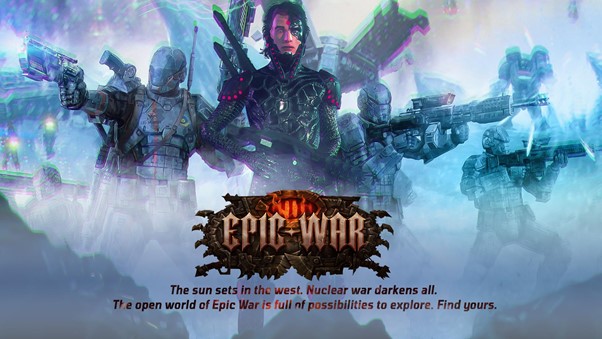
The team behind Epic War hails from Vietnam, where they have years of collective experience in game design, blockchain development and full-stack coding. They also partner with Japanese studios to develop Open World gameplay and VR metaverse phase. By mid Q2 2022, the team aims to release a beta version of the PvE and PvP game modes, alongside its DAO governance system, where players will be able to have a say in future development decisions. The IGO (initial game offering) for the native EWAR token will also take place before the end of Q2. Ongoing roadmap milestones portend a full game release and multi-chain integration by the end of Q3.
Multiple blockchain ecosystems will play host to Epic War when it is complete, including Binance Smart Chain, Solana, Polygon, and NEAR, in an effort to give players the maximum number of benefits offered up by various networks (speed, low fees, access to native stablecoins, etc). Gamers can also look forward to Epic War’s Beta Test launch coming this March.
The long-term goals of Epic War include integrating VR support and building out an expansive metaverse world where players can interact with the game in a virtual 3D space. Epic War builds on the promise of gamefi by extending blockchain gaming to the level mainstream gamers expect, while integrating crypto and NFT rewards for the benefit of successful players.


Leituras Relacionadas

How to Do Research Well: Deliberately Practice the Real Skills That Matter

No one truly teaches you how to do research. You're often given a desk, a pre-selected problem, and vague instructions to "create something new." Consequently, many people reverse-engineer the job based on visible outputs—papers, posts, announcements—learning only how to *appear* like a researcher rather than how to *become* one. True research capability is built from stacking small, trainable skills, nearly all of which can be developed through deliberate practice. **Pick Your Own Problem:** Most researchers absorb problems from advisors or trends, lacking the underlying reasoning. Choosing a problem you genuinely care about, as John Schulman advises, leads to original work. Develop "taste" like a muscle: predict experiment outcomes, guess paper results from methods, and track which findings remain important over time. **Upgrade Your Inputs:** Relying on shared reading lists (arXiv hot lists, filtered group chats) leads to unoriginal conclusions. Undervalued old literature often holds crucial insights (e.g., MoE, LSTM, backpropagation). Richard Sutton's "The Bitter Lesson" or Claude Shannon's 1952 talk on creative thinking are more predictive than lengthy modern surveys. Breadth matters as much as depth: draw from neuroscience, mechanism design, hardware knowledge, and honest statistics. Read papers directly, especially appendices and limitations sections. **Write Everything Down:** As Paul Graham noted, writing exposes flaws in seemingly mature ideas. Writing is the cheapest defense against self-deception. Following Feynman's principle, Darwin programmatically wrote down facts contradicting his theory to combat memory bias. Maintain a detailed log of hypotheses, setups, predictions, results, and updated understandings. Reviewing past logs fosters essential humility.

marsbitHá 12m

How to Do Research Well: Deliberately Practice the Real Skills That Matter

marsbitHá 12m

Following US Ban on Fable 5, Zhipu AI's Stock Soars 47%

On June 15th, shares of Zhipu AI surged dramatically on the Hong Kong stock market, peaking at a 47.6% gain before closing 32.82% higher. This sharp increase was directly triggered by two recent industry events. On June 12th, Anthropic announced it was suspending global access to its latest flagship models, Claude Fable 5 and Claude Mythos 5, to comply with a U.S. government export control order. The next day, Zhipu AI announced it would open access to its latest open-source flagship model, GLM-5.2, under the permissive MIT license. The Anthropic incident highlighted a critical issue beyond raw model capability: the risk of sudden, unpredictable loss of access to advanced AI models, especially for developers and enterprises deeply integrated with them. This has shifted industry and market focus toward factors like stability, sustainable access, and controllability. Zhipu's move, promoting "frontier intelligence for all," positions its openly available model as a reliable and accessible alternative. The GLM-5.2 model emphasizes "Long Horizon Task" capabilities with a 1M context window, targeting complex, multi-step coding and engineering workflows where maintaining context is crucial. Analysts note this event exposes the risk of dependency on closed-source models subject to single jurisdictional controls, potentially accelerating a shift toward domestic base models and localized deployments. The market's reaction signals a new valuation dimension in AI: providers who can offer stable, long-term, and sustainably accessible AI capabilities are gaining strategic importance.

marsbitHá 36m

Following US Ban on Fable 5, Zhipu AI's Stock Soars 47%

marsbitHá 36m

Fully Entering the AI Era: Alipay Bets on Conversation, WeChat Holds Fast to Social

In May 2026, Alipay announced over 300 million AI payment transactions. Shortly after, WeChat opened its mini-programs for AI integration, sparking controversy by requiring developer source code access. This highlights their diverging approaches to AI integration. Alipay is testing "Project Treasure," an optional AI-native interface replacing traditional app grids with a conversational window. Users can command complex tasks (e.g., "book a ride and order coffee") handled end-to-end by AI. This shift follows an abandoned standalone AI app, focusing instead on enhancing its existing user base. For unmodified mini-programs, Alipay's AI uses "screen-reading" to simulate user interactions, bypassing the need for developer overhaul. It also introduced "Token Pay" for micro-transactions and "AI Wallets" for autonomous agent spending. WeChat, prioritizing its core social function, is taking an embedded approach. Its AI agent will operate within existing contexts like group chats and official accounts, assisting without a separate interface. To enable this, WeChat offers developers two paths: granting source code access for direct AI control ("Automatic Mode") or manually encapsulating services into standardized "Skills." Both place significant burden on developers. Key differences emerge in handling legacy services: WeChat demands developer cooperation (code or labor), while Alipay's screen-reading offers immediate, if potentially less stable, compatibility. Alipay's 3 billion AI transactions demonstrate user acceptance of AI-driven commercial actions. The divergent strategies may reshape mini-program ecosystems—Alipay passively "AI-fying" services, WeChat potentially favoring resource-rich developers—and set competing technical standards. Ultimately, the competition centers on where users entrust the command to "help me get things done."

marsbitHá 36m

Fully Entering the AI Era: Alipay Bets on Conversation, WeChat Holds Fast to Social

marsbitHá 36m

Trading

Spot
Futuros

Artigos em Destaque

Como comprar WAR

Bem-vindo à HTX.com!Tornámos a compra de WAR (WAR) simples e conveniente.Segue o nosso guia passo a passo para iniciar a tua jornada no mundo das criptos.Passo 1: cria a tua conta HTXUtiliza o teu e-mail ou número de telefone para te inscreveres numa conta gratuita na HTX.Desfruta de um processo de inscrição sem complicações e desbloqueia todas as funcionalidades.Obter a minha contaPasso 2: vai para Comprar Cripto e escolhe o teu método de pagamentoCartão de crédito/débito: usa o teu visa ou mastercard para comprar WAR (WAR) instantaneamente.Saldo: usa os fundos da tua conta HTX para transacionar sem problemas.Terceiros: adicionamos métodos de pagamento populares, como Google Pay e Apple Pay, para aumentar a conveniência.P2P: transaciona diretamente com outros utilizadores na HTX.Mercado de balcão (OTC): oferecemos serviços personalizados e taxas de câmbio competitivas para os traders.Passo 3: armazena teu WAR (WAR)Depois de comprar o teu WAR (WAR), armazena-o na tua conta HTX.Alternativamente, podes enviá-lo para outro lugar através de transferência blockchain ou usá-lo para transacionar outras criptomoedas.Passo 4: transaciona WAR (WAR)Transaciona facilmente WAR (WAR) no mercado à vista da HTX.Acede simplesmente à tua conta, seleciona o teu par de trading, executa as tuas transações e monitoriza em tempo real.Oferecemos uma experiência de fácil utilização tanto para principiantes como para traders experientes.

141 Visualizações TotaisPublicado em {updateTime}Atualizado em 2026.06.02

Como comprar WAR

Discussões

Bem-vindo à Comunidade HTX. Aqui, pode manter-se informado sobre os mais recentes desenvolvimentos da plataforma e obter acesso a análises profissionais de mercado. As opiniões dos utilizadores sobre o preço de WAR (WAR) são apresentadas abaixo.

活动图片