When 34% of ETH is Staked: In the Era of Native Compounding, How Should You Choose Staking?

marsbitPublicado em 2026-08-28Última atualização em 2026-08-28

Resumo

As Ethereum staking reaches a record 34.7% of the total supply, it is evolving from a niche technical activity into a standardized asset management practice. This article analyzes four primary staking methods for ETH holders, highlighting their core trade-offs between control, convenience, and risk. The foundational method is solo staking, which requires 32 ETH and running one's own validator node. It offers full control and native rewards but demands significant technical expertise and constant maintenance. Non-custodial native staking, like services offered by imToken, provides a middle ground. Users control their withdrawal keys and assets while outsourcing node operation to professional providers. This maintains self-custody but transfers operational risk. For users without 32 ETH or those prioritizing liquidity, liquid staking protocols like Lido are key. Users deposit ETH to receive a liquid staking token (e.g., stETH), enabling continued participation in DeFi. This introduces additional smart contract and protocol risks but solves liquidity constraints. Exchange-based staking offers the lowest barrier to entry, handling all technical complexities and custody. However, it requires full trust in the platform's management of assets, node operations, and reward distribution. The choice depends on individual priorities: control (solo staking), balanced custody (non-custodial native), liquidity (liquid staking), or simplicity (exchange). With developments like Pectra en...

Recently, two very interesting numbers have emerged in Ethereum Staking.

One is 34.7%.

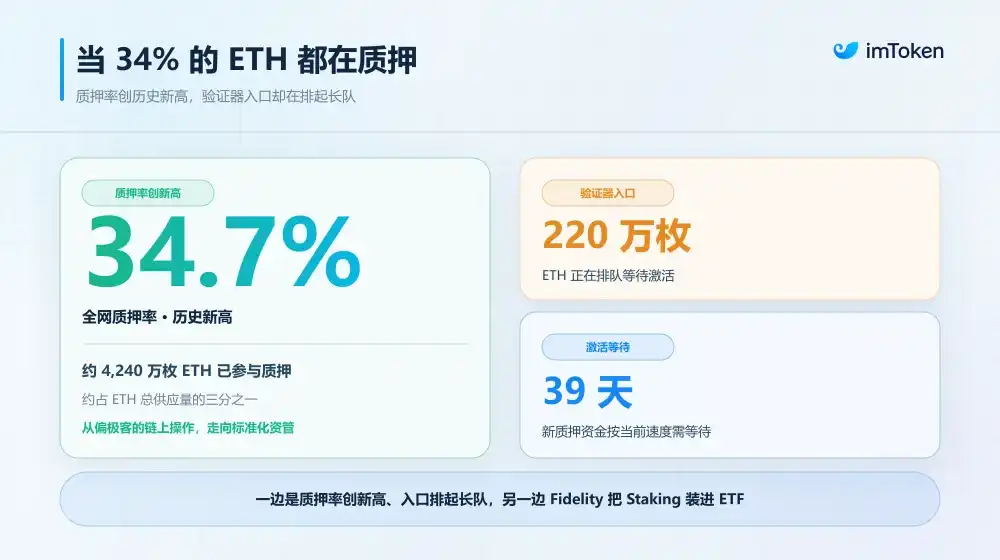
As of late August, approximately 42.4 million ETH have been staked across the Ethereum network, accounting for about 34.7% of the total supply, reaching a record high. Even more striking is that there are still over 2.2 million ETH queued at the validator entry point. At the current rate, new staking funds need to wait nearly 39 days to be formally activated.

Another change comes from traditional finance.

In August, Fidelity further advanced the Staking arrangements for its Ethereum fund, FETH. It has not only signed relevant custody agreements with Anchorage Digital and BitGo but also clearly designed a staking reward distribution mechanism.

These two seemingly unrelated changes are actually a microcosm of a larger trend: in the past six months, Ethereum staking has accelerated its shift from a niche on-chain operation favored by geeks to an increasingly standardized asset management method.

For ordinary ETH holders, a more practical question than "whether to stake" is now emerging:

If you decide to stake, should you run your own node, choose Native Staking, Lido, or simply stake on an exchange?
1. Staking Is No Longer Just About 'Locking Up Assets to Earn Yield'

Let's start with the basics.

After Ethereum completed The Merge, the network no longer relies on miners using computing power to maintain the network. Instead, validator nodes maintain consensus and validate blocks by staking ETH.

The most basic threshold to become an independent validator node is 32 ETH.

Validators receive consensus layer rewards from the Ethereum protocol for staying online, correctly submitting attestations, and participating in block proposals. Conversely, being offline for extended periods incurs penalties, and serious violations like double-signing may lead to Slashing.

From this perspective, staking rewards are not "interest" magically generated out of thin air, but protocol rewards users earn by using their ETH to provide economic security for the Ethereum network.

But over the past few years, there has been a somewhat counterintuitive issue with Staking: rewards don't naturally compound.

In traditional 0x01 validators, even if they earn an extra 0.5 ETH or 1 ETH in consensus layer rewards, any amount exceeding 32 ETH is periodically and automatically withdrawn by the network to the withdrawal address, and does not continue to participate in the next round of staking.

To make this ETH generate rewards again, one would need to gather enough for a new staking amount and deploy it again.

Pectra changes this.

The new 0x02 validator has its maximum effective balance increased to 2048 ETH. Moreover, after exceeding 32 ETH, the balance can continue to gradually increase the effective staking amount according to protocol rules. For long-term stakers, the previous process of "earning rewards -> withdrawing them -> redeploying" can now, for the first time, be automated within the native Ethereum protocol (Extended reading: When 8 Million ETH Starts 'Moving': In the Post-Pectra Era, Staking Undergoes a Structural Transformation?).

If we look at the timeline over the past six months, we find that ETH staking is evolving from a relatively crude early-stage "lock 32 ETH for yield" model into a more sophisticated asset management mechanism.

Fidelity adding staking yield to its ETF addresses the question of "who stakes for me" for traditional finance users; Pectra addresses capital efficiency at the validator level; liquid staking protocols like Lido address liquidity; and professional node operators are beginning to separate operational maintenance from asset control.

Therefore, when comparing staking options today, the focus should no longer be solely on APR, but on comprehensive trade-offs.

2. They're All Staking, But What's the Difference?

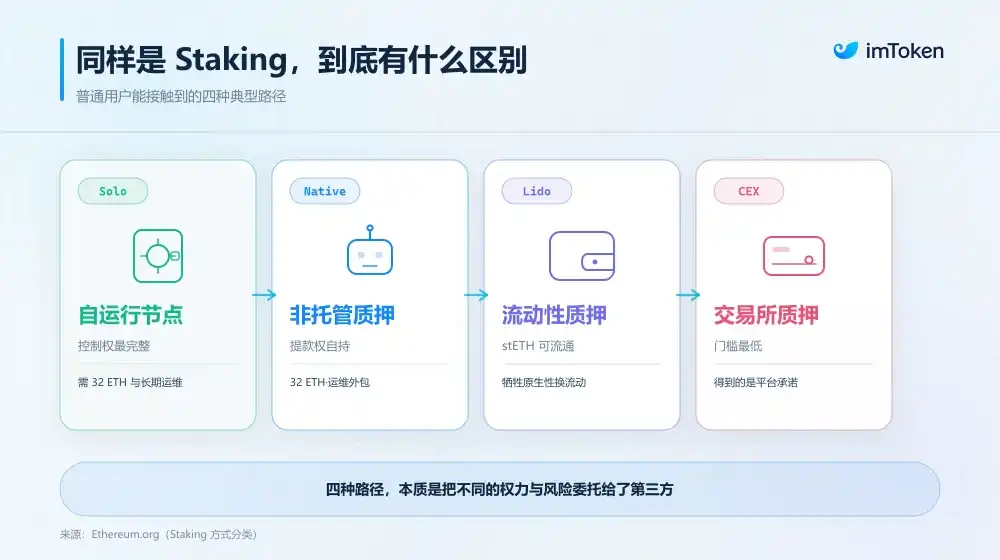
Overall, the typical ETH staking paths accessible to ordinary users today can be broadly categorized into four types.

On the surface, they might seem like just four methods to earn the same yield, but the core difference between these paths lies in which part of the power and risk the user chooses to delegate to a third party.
1. Running Your Own Node: The Most 'Native' Yield, and the Most Complete Control

The purest form of ETH staking is preparing 32 ETH yourself, running execution and consensus layer clients, and maintaining your own validator node.

In this method, everything—from how the node is deployed, which clients are run, to when to exit—is decided by you. The protocol-generated rewards also don't need to be shared with a liquid staking protocol or exchange.

However, the barriers are higher because you need at least 32 ETH, a stably running device, good network conditions, and must continuously maintain client versions, node status, and key security.

Ultimately, running your own node trades the highest level of control and more complete rewards for higher technical and operational costs.

2. Native Staking: Control Your Assets, Outsource the 'Operations'

The second method can be understood as a middle ground between Solo Staking and fully custodial solutions.

The user still uses their own 32 ETH to create an independent validator. The ETH ultimately still enters the native Ethereum staking system and is not exchanged for another token, but the node operation is handled by a professional service provider.

The most important distinction is the separation between withdrawal rights and node operation rights.

The validator itself uses different keys. The Signing Key, used for daily node signatures and block validation, can be managed by a professional node service provider. However, the Withdrawal Credential, which ultimately determines the destination of the principal and rewards, can remain in the hands of the user.

This is also a crucial dividing line between non-custodial Native Staking and custodial exchange staking. For example, imToken's current non-custodial ETH staking service is designed with this concept in mind (Extended reading: What is imToken's Non-Custodial ETH Staking Service?):

Users holding 32 ETH or more can create independent validators. The withdrawal keys are controlled by the user, node operation is handled by professional infrastructure, and different choices like compound validator and auto-withdrawal validator are already available.

This is suitable for users who have at least 32 ETH, want to earn native staking rewards, value self-custody, but don't want to maintain a validator themselves daily.

Of course, "non-custodial" does not mean "no third-party risk." Node operators can still experience downtime, configuration errors, or even Slashing. Therefore, what's transferred here is not asset ownership, but node operational risk.

3. Lido: Sacrifice a Bit of 'Nativity' for Liquidity

If you don't have 32 ETH, or simply don't want your ETH stuck in a validator exit queue for a long time, then liquid staking represents a completely different route.

Lido is the most typical example. Users deposit ETH into Lido, and the protocol allocates the funds to node operators to participate in Ethereum staking, while issuing stETH to the user.

Thus, ETH that was originally staked and couldn't be directly transferred is wrapped into a chain asset that remains liquid. Users can still transfer, trade, and use stETH, or further participate in DeFi scenarios like lending and liquidity provision.

To exit, users can either follow Lido's protocol redemption process to swap back to ETH, or directly sell stETH for ETH on a DEX. The latter doesn't even require waiting for the validator to actually exit, but the trade-off is bearing the current market price and potential slippage.

Simultaneously, stETH continuously reflects the staking rewards earned by the user through mechanisms like Rebase. Therefore, for ordinary users, there's basically no need to handle the issue of "claiming rewards and then re-staking" themselves.

The flip side of convenience is an additional layer of risk. Lido currently charges a protocol fee, distributed among node operators, the DAO Treasury, etc., with users receiving the remainder. More importantly, it introduces additional risks such as Lido's smart contracts, protocol governance, node operator risk, and stETH secondary market liquidity.

It's important to note that there is no forced "1:1 peg" between stETH and ETH like with fiat-backed stablecoins. If the market is eager to sell stETH in the short term, it could very well trade at a discount to ETH. If you then use that stETH to participate in more DeFi protocols, you further layer on new smart contract and liquidation risks.

Currently, imToken's ETH staking portal has also integrated Lido, allowing users to directly participate in liquid staking and hold stETH without needing 32 ETH.

4. Exchange Staking: The Lowest Barrier, But What You Own is a 'Platform Promise'

The last method might be the most familiar for many new users: depositing ETH on an exchange and clicking "Staking."

In terms of user experience, this is undoubtedly the simplest.

No need to have 32 ETH, no need to understand validator nodes, no need to manage Signing Keys or Withdrawal Keys, and no worries about server uptime.

The exchange aggregates ETH from many users to run validators, then credits a portion of the rewards to user accounts according to its own rules.

But precisely because of this, this method requires the most trust. What a user sees as "1 ETH staked" is often first and foremost a record in the exchange's internal accounting system. How validators are deployed at the underlying level, how much asset is actually staked, how rewards are reinvested, what percentage the platform takes, and how liquidity is managed when users request redemption—all depend on the specific platform's product design.

More importantly, the assets themselves are primarily under the custody of a centralized platform. This doesn't necessarily mean exchange staking is "bad." For newcomers who already keep their ETH on an exchange long-term and don't plan to manage an on-chain wallet themselves, it might still be the method with the lowest operational barrier.

It's just that the convenience you gain essentially comes from handing over asset custody, node operation, reward distribution, and even the exit process to the platform.
3. There's No 'Highest Yield' Staking, Only the Right Combination of Risks for You

Placing all four methods side by side reveals an interesting phenomenon.

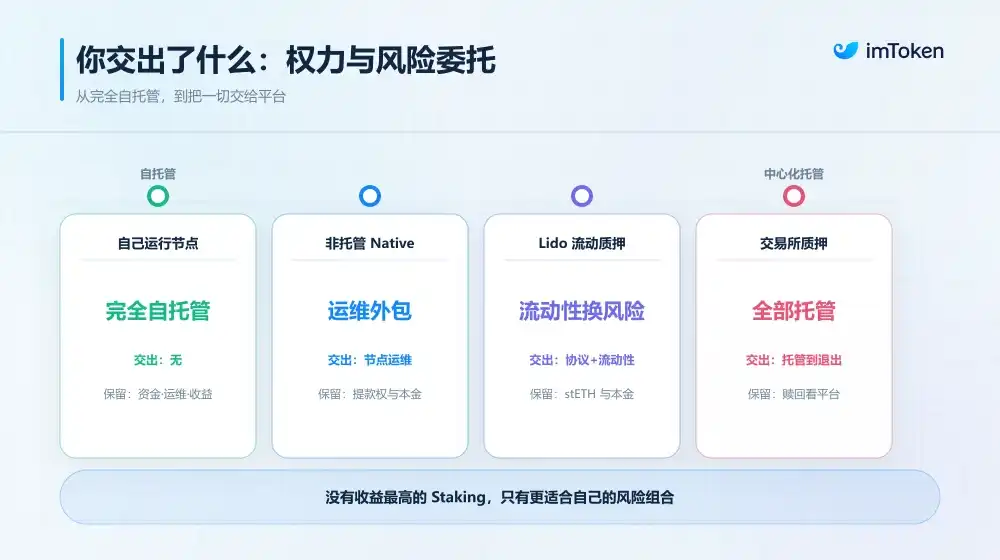
The evolution of Ethereum staking products isn't all solutions converging towards the same endpoint, but rather a continuous process of differentiating the capabilities that different users actually need.

  • Running your own node maximizes control;
  • Native Staking separates "fund ownership" and "node operations";
  • Lido recombines "staking yield" and "fund liquidity";
  • Exchanges further hide complexity, trading centralized custody for the lowest usage barrier;

And Fidelity planning to package Staking into an ETF takes yet another step forward—investors don't even need to hold on-chain ETH or understand how validators work; traditional financial products can handle custody, node operation, yield acquisition, and even final distribution for them.

From this viewpoint, Staking is increasingly resembling a mature financial infrastructure service.

So how should ordinary users choose?

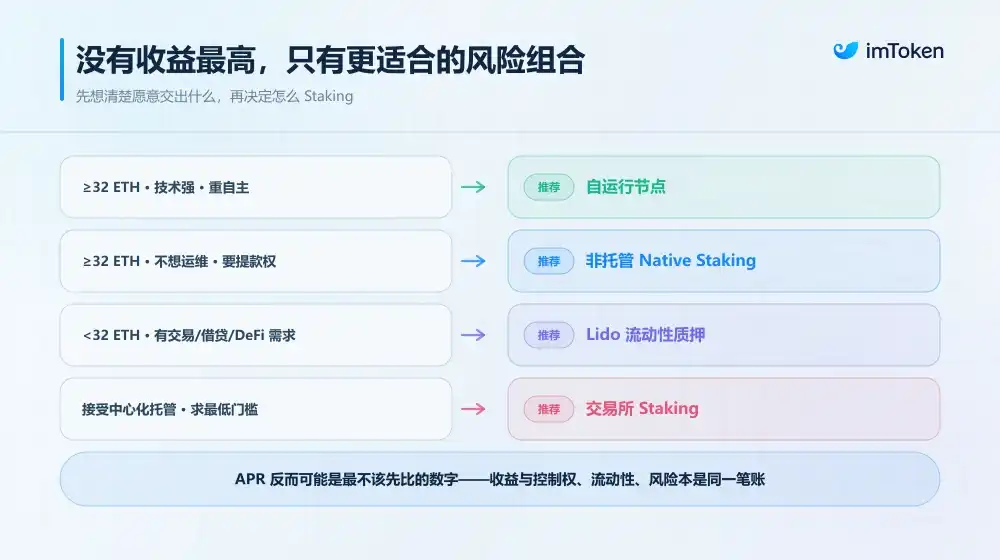
If you have at least 32 ETH, possess some technical skills, highly value self-sovereignty, and wish to directly participate in the Ethereum network, running your own validator is still the choice with the most complete control.

If you also have 32 ETH but don't want to bear the long-term burden of node operation, while still wanting to firmly control withdrawal permissions, non-custodial Native Staking is a natural compromise.

If you hold less than 32 ETH, or have ongoing needs for trading, lending, and other DeFi activities, then Liquid Staking, as represented by Lido, trades an additional layer of protocol risk for significantly greater capital flexibility.

As for exchange Staking, it's more suitable for users who already accept centralized custody and wish to minimize operational barriers, provided they understand that platform risk doesn't disappear just because there's a "Staking" button.
Therefore, looking at Ethereum staking today, APR might actually be the least important number to compare first.

If two products differ by only a few tenths of a percentage point in annualized yield, but one requires handing over assets completely to a third party while the other lets you control withdrawal rights; one requires waiting in the validator exit queue to withdraw, while the other allows selling the LST on the market anytime; one enables native compounding directly, while the other depends on how the platform handles rewards—these differences are often far more significant than the surface-level APR.

After all, staking rewards never exist in isolation.

How much yield you earn, and how much liquidity, control, and additional risk you give up for that yield, are ultimately all part of the same calculation.

Criptomoedas em alta

Perguntas relacionadas

QAccording to the article, what are the two key numbers recently observed in Ethereum Staking, and what do they signify?

AThe first number is 34.7%, indicating that approximately 42.4 million ETH is currently staked, a historical high. The second is that there are over 2.2 million ETH in the validator entry queue, with a waiting period of about 39 days. These numbers signify that Ethereum staking is accelerating from a niche on-chain operation towards becoming a standardized asset management method.

QWhat is the fundamental difference in reward mechanisms between traditional 0x01 validators and the new 0x02 validators introduced with Pectra?

AFor traditional 0x01 validators, any consensus rewards earned above the 32 ETH stake are automatically and periodically withdrawn to the withdrawal address and do not automatically re-stake. With the new 0x02 validators introduced with Pectra, the maximum effective balance is raised to 2048 ETH, and any rewards above 32 ETH can automatically increase the validator's effective staking balance, enabling native compounding within the protocol.

QWhat are the four typical paths for ordinary users to engage in ETH Staking as outlined in the article, and what is the core trade-off they represent?

AThe four paths are: 1) Running your own node (full control, high technical cost). 2) Native Staking with a service provider (self-custody of assets, outsourced node operation). 3) Using a liquid staking protocol like Lido (trades some native protocol purity for liquidity via LSTs). 4) Staking through an exchange (lowest barrier, full custody and operational reliance on the platform). The core trade-off for all paths is the degree of control, liquidity, and risk that users delegate to a third party in exchange for convenience and rewards.

QIn the context of Non-Custodial Native Staking, how is the separation of keys a critical distinction from exchange-based staking?

AIn Non-Custodial Native Staking, the user's withdrawal credential (Withdrawal Key) which controls the principal and final rewards remains in the user's self-custody. The node operational key (Signing Key) can be managed by a professional node operator. This separation creates a crucial boundary, ensuring asset ownership is not surrendered, unlike exchange-based staking where the user entrusts both asset custody and all operational control to the platform.

QAccording to the article's conclusion, why is comparing APR (Annual Percentage Rate) alone insufficient for choosing a Staking method?

AComparing only APR is insufficient because the critical differences lie in other factors such as the level of asset control (self-custody vs. platform custody), liquidity (e.g., via Liquid Staking Tokens), exit flexibility (waiting for validator queue vs. selling on the market), and the specific risks introduced (smart contract, protocol, node operator, or platform risk). The article emphasizes that the trade-offs between the rewards earned and the liquidity, control, and additional risks undertaken are integral parts of the overall staking decision.

Leituras Relacionadas

Podcast Notes | After Watching 141 YouTube Investment Guru Videos, I Found Everyone's Bullish on These 5 Stocks

Podcast Summary: After analyzing 141 YouTube investment videos from 21 creators, five stocks were consistently highlighted: Alphabet (Google), Nvidia, Micron, CoreWeave, and Uber. However, the analysis reveals a key concentration: four of these (Google, Nvidia, Micron, CoreWeave) represent essentially the same AI-focused bet, with only Uber standing as an independent pick. The podcaster, Brian, provides his specific views and entry strategies for each. **Key Stocks & Brian's Stance:** - **Alphabet (Google):** Viewed as cheap based on profits but expensive based on sales. Brian is only buying a half-position via monthly investments at ~$362. - **Nvidia:** Models suggest it is undervalued (~$221 vs. a ~$290-330 fair value range), but significant client debt ($500B) raises risk. Brian holds a 12% position (his cap) and would not buy below $148. - **Micron:** Brian's model fair value is ~$1450, but it's a cyclical stock. He is buying only on schedule after it broke below its 50-day moving average (~$961), with a "story broken" line at $434. - **CoreWeave:** Has large contracts but faces scrutiny over demand sustainability, with Nvidia backing unsold capacity. Brian holds zero position due to limited history and structural concerns. - **Uber:** The only non-AI pick, valued cheaply on strong cash flow (~$100B annually). Brian's fair value is ~$109 (current price ~$67), and he is buying a full position. **Core Insight:** Most discussed topics (76/141 videos) were chips, cloud, and AI models. A portfolio built from such consensus may appear diversified but often constitutes a single, concentrated bet on AI. Brian concludes with a disciplined framework for any investment: compare to its own history, understand what the current price assumes, separate a good company from a good price, and pre-define your exit conditions.

marsbitHá 35m

Podcast Notes | After Watching 141 YouTube Investment Guru Videos, I Found Everyone's Bullish on These 5 Stocks

marsbitHá 35m

From 'Interest Rate Trading' to 'Dollar Debasement Trade', the Logic Behind Gold's Rise Has Changed

From "Rate Trade" to "Debasement Trade": The Logic Behind Gold's Rally Has Shifted Gold surged by 17% in August. According to UBS, the key development was a fundamental shift in the driving narrative mid-rally—from the traditional "rate trade" to a "debasement trade" focused on fiscal and dollar concerns. The bank breaks the summer rebound into two acts. The first was a technically-driven bounce from a solid base, supported by light positioning, resilient physical demand (especially from central banks like China's), and softening US economic data. The second act, triggered by the US Treasury's announcement to double long-term bond buybacks, marked a shift in gold's pricing logic. The market began viewing higher long-term yields as a sign of fiscal sustainability risks rather than economic strength, weakening gold's traditional inverse correlation with real rates. Gold's role evolved from an "opportunity cost" asset to a hedge against "fiscal credibility" and currency debasement, further aided by a weakening US dollar. UBS maintains a bullish outlook, noting rising upside risks to its long-term forecasts. While it lowered its 2026 year-end target to $4,675/oz, its 2027+ forecasts are unchanged, with an upside scenario target as high as $6,500/oz. The primary near-term risk is a hawkish Fed pivot, which could trigger a correction. However, UBS views any such dip as a buying opportunity, not a trend reversal, unless AI-driven growth allows for significantly higher rates. The report concludes that as gold is increasingly seen as a hedge against fiscal and currency risks, its strategic role in portfolios is changing. With overall gold allocations still low, there is significant room for further price appreciation if debt sustainability concerns drive sustained strategic buying.

marsbitHá 36m

From 'Interest Rate Trading' to 'Dollar Debasement Trade', the Logic Behind Gold's Rise Has Changed

marsbitHá 36m

Not Just Trading and Meme: These 5 Projects on Base Are Exploring New On-Chain Use Cases

Beyond Trading and Memes: 5 Projects Exploring New On-Chain Use Cases on Base While much of the crypto space is dominated by speculation, Base—Coinbase's Ethereum Layer 2 with over $5B TVL—is fostering innovative projects beyond the usual categories. Here are five notable examples: 1. **Hydrex**: A MetaDEX/AMM aggregator that pools native and external liquidity (e.g., from Uniswap, Morpho) to offer optimal swap rates. It features a ve(3,3)-style incentive model and single-signature transactions. 2. **SwapRoyale**: A fantasy trading competition app where users pay a fixed entry fee to trade with a virtual $100k portfolio in real-time contests. It gamifies trading with various tournament formats and has already distributed over $100k in prizes. 3. **BlockRun**: A permissionless AI gateway and payment layer for the on-chain agent economy. It allows autonomous systems to discover, pay for, and execute services using USDC on Base via the x402 micropayment standard, enabling pay-per-use AI. 4. **PixieChess**: A play-to-earn digital chess game where each piece is a collectible NFT with unique abilities that alter classic rules. Value is kept within the ecosystem, with a treasury funding real ETH prizes for winners. 5. **Tokensto**: A platform that lets users sell their unused AI API credits (e.g., from OpenRouter) for cash. It automatically prices credits and facilitates direct payouts to crypto wallets. These projects demonstrate that builders on Base are actively experimenting with consumer experiences, the agent economy, and novel gaming mechanics, suggesting the surface area for meaningful on-chain activity is broader than current narratives imply.

marsbitHá 1h

Not Just Trading and Meme: These 5 Projects on Base Are Exploring New On-Chain Use Cases

marsbitHá 1h

Trading

Spot

Artigos em Destaque

O que é ETH 2.0

ETH 2.0: Uma Nova Era para o Ethereum Introdução ETH 2.0, amplamente conhecido como Ethereum 2.0, marca uma atualização monumental à blockchain do Ethereum. Esta transição não é meramente uma mudança estética; visa melhorar fundamentalmente a escalabilidade, segurança e sustentabilidade da rede. Com uma mudança do mecanismo de consenso em Proof of Work (PoW), intensivo em energia, para um Proof of Stake (PoS) mais eficiente, o ETH 2.0 promete uma abordagem transformadora ao ecossistema blockchain. O que é ETH 2.0? ETH 2.0 é um conjunto de atualizações distintas e interconectadas focadas na otimização das capacidades e desempenho do Ethereum. Esta reformulação foi projetada para abordar desafios críticos que o mecanismo atual do Ethereum enfrentou, particularmente em relação à velocidade das transações e à congestão da rede. Objetivos do ETH 2.0 Os principais objetivos do ETH 2.0 giram em torno da melhoria de três aspectos centrais: Escalabilidade: Com o objetivo de melhorar significativamente o número de transações que a rede pode manejar por segundo, o ETH 2.0 procura ultrapassar a limitação atual de aproximadamente 15 transações por segundo, alcançando potencialmente milhares. Segurança: Medidas de segurança melhoradas são integrais ao ETH 2.0, especialmente através da resistência aprimorada contra ciberataques e da preservação do ethos descentralizado do Ethereum. Sustentabilidade: O novo mecanismo PoS foi projetado não apenas para melhorar a eficiência, mas também para reduzir drasticamente o consumo de energia, alinhando a estrutura operacional do Ethereum com considerações ambientais. Quem é o Criador do ETH 2.0? A criação do ETH 2.0 pode ser atribuída à Ethereum Foundation. Esta organização sem fins lucrativos, que desempenha um papel crucial no apoio ao desenvolvimento do Ethereum, é liderada pelo co-fundador notável Vitalik Buterin. A sua visão de um Ethereum mais escalável e sustentável tem sido a força motriz por trás desta atualização, envolvendo contribuições de uma comunidade global de desenvolvedores e entusiastas dedicados a melhorar o protocolo. Quem são os Investidores do ETH 2.0? Embora os detalhes sobre os investidores do ETH 2.0 não tenham sido tornados públicos, é sabido que a Ethereum Foundation recebe apoio de várias organizações e indivíduos no espaço da blockchain e tecnologia. Esses parceiros incluem firmas de capital de risco, empresas de tecnologia e organizações filantrópicas que compartilham um interesse mútuo em apoiar o desenvolvimento de tecnologias descentralizadas e infraestrutura de blockchain. Como Funciona o ETH 2.0? ETH 2.0 é notável por introduzir uma série de características chave que o diferenciam do seu predecessor. Proof of Stake (PoS) A transição para um mecanismo de consenso PoS é uma das mudanças de destaque do ETH 2.0. Ao contrário do PoW, que depende da mineração intensiva em energia para a verificação de transações, o PoS permite que os utilizadores validem transações e criem novos blocos de acordo com a quantidade de ETH que apostam na rede. Isso leva a uma maior eficiência energética, reduzindo o consumo em aproximadamente 99,95%, tornando o Ethereum 2.0 uma alternativa consideravelmente mais ecológica. Shard Chains As shard chains são outra inovação crítica do ETH 2.0. Estas cadeias menores operam em paralelo com a cadeia principal do Ethereum, permitindo que várias transações sejam processadas simultaneamente. Esta abordagem melhora a capacidade geral da rede, abordando preocupações de escalabilidade que têm atormentado o Ethereum. Beacon Chain No coração do ETH 2.0 está a Beacon Chain, que coordena a rede e gere o protocolo PoS. Ela atua como uma espécie de organizador: supervisiona os validadores, garante que as shards permaneçam conectadas à rede e monitora a saúde geral do ecossistema blockchain. Linha do Tempo do ETH 2.0 A jornada do ETH 2.0 tem sido marcada por vários marcos chave que traçam a evolução desta atualização significativa: Dezembro de 2020: O lançamento da Beacon Chain marcou a introdução do PoS, preparando o caminho para a migração para o ETH 2.0. Setembro de 2022: A conclusão de “The Merge” representa um momento crucial em que a rede Ethereum fez a transição com sucesso de um quadro PoW para um PoS, anunciando uma nova era para o Ethereum. 2023: O lançamento esperado das shard chains visa melhorar ainda mais a escalabilidade da rede Ethereum, solidificando o ETH 2.0 como uma plataforma robusta para aplicações e serviços descentralizados. Características Chave e Benefícios Escalabilidade Melhorada Uma das vantagens mais significativas do ETH 2.0 é a sua escalabilidade melhorada. A combinação de PoS e shard chains permite que a rede expanda a sua capacidade, permitindo que acomode um volume de transações muito maior em comparação com o sistema legado. Eficiência Energética A implementação do PoS representa um enorme passo em direção à eficiência energética na tecnologia blockchain. Ao reduzir drasticamente o consumo de energia, o ETH 2.0 não só reduz os custos operacionais, mas também se alinha mais estreitamente com os objetivos globais de sustentabilidade. Segurança Aprimorada Os mecanismos atualizados do ETH 2.0 contribuem para uma segurança melhorada em toda a rede. O uso do PoS, juntamente com medidas de controle inovadoras estabelecidas através das shard chains e da Beacon Chain, assegura um maior grau de proteção contra potenciais ameaças. Custos Mais Baixos para os Utilizadores À medida que a escalabilidade melhora, os efeitos sobre os custos de transação também serão evidentes. Aumentada a capacidade e reduzida a congestão, espera-se que isso se traduza em taxas mais baixas para os utilizadores, tornando o Ethereum mais acessível para transações do dia a dia. Conclusão ETH 2.0 marca uma evolução significativa no ecossistema da blockchain do Ethereum. Ao abordar questões fundamentais como a escalabilidade, o consumo de energia, a eficiência das transações e a segurança geral, a importância desta atualização não pode ser subestimada. A transição para o Proof of Stake, a introdução das shard chains e o trabalho fundamental da Beacon Chain são indicativos de um futuro em que o Ethereum pode atender à crescente demanda do mercado descentralizado. Em uma indústria movida pela inovação e progresso, o ETH 2.0 representa um testemunho das capacidades da tecnologia blockchain em pavimentar o caminho para uma economia digital mais sustentável e eficiente.

298 Visualizações TotaisPublicado em {updateTime}Atualizado em 2024.12.03

O que é ETH 2.0

O que é ETH 3.0

ETH3.0 e $eth 3.0: Uma Análise Profunda do Futuro do Ethereum Introdução No ambiente em rápida evolução da criptomoeda e da tecnologia blockchain, o ETH3.0, frequentemente denotado como $eth 3.0, emergiu como um tema de considerável interesse e especulação. O termo abrange dois conceitos principais que merecem esclarecimento: Ethereum 3.0: Esta representa uma potencial atualização futura destinada a aumentar as capacidades da atual blockchain do Ethereum, focando especialmente na melhoria da escalabilidade e desempenho. ETH3.0 Meme Token: Este distinto projeto de criptomoeda procura aproveitar a blockchain do Ethereum na criação de um ecossistema centrado em memes, promovendo o envolvimento na comunidade de criptomoedas. Compreender esses aspectos do ETH3.0 é essencial não apenas para entusiastas de criptomoedas, mas também para aqueles que observam as tendências tecnológicas mais amplas no espaço digital. O que é ETH3.0? Ethereum 3.0 Ethereum 3.0 é promovido como uma atualização proposta para a rede Ethereum já estabelecida, que tem sido a espinha dorsal de muitas aplicações descentralizadas (dApps) e contratos inteligentes desde a sua criação. As melhorias vislumbradas concentram-se principalmente na escalabilidade—integrando tecnologias avançadas como sharding e provas de conhecimento zero (zk-proofs). Essas inovações tecnológicas visam facilitar um número sem precedentes de transações por segundo (TPS), potencialmente alcançando milhões, abordando assim uma das limitações mais significativas enfrentadas pela tecnologia blockchain atual. A melhoria não é meramente técnica, mas também estratégica; visa preparar a rede Ethereum para uma adoção generalizada e utilidade em um futuro marcado por uma maior demanda por soluções descentralizadas. ETH3.0 Meme Token Em contraste com o Ethereum 3.0, o ETH3.0 Meme Token aventura-se por um domínio mais leve e divertido, combinando a cultura dos memes da internet com a dinâmica das criptomoedas. Este projeto permite que os usuários comprem, vendam e negociem memes na blockchain do Ethereum, proporcionando uma plataforma que fomenta o envolvimento da comunidade através da criatividade e interesses compartilhados. O ETH3.0 Meme Token visa demonstrar como a tecnologia blockchain pode interseccionar com a cultura digital, criando casos de uso que são tanto divertidos quanto financeiramente viáveis. Quem é o Criador do ETH3.0? Ethereum 3.0 A iniciativa em direção ao Ethereum 3.0 é impulsionada principalmente por um consórcio de desenvolvedores e pesquisadores dentro da comunidade Ethereum, notavelmente incluindo Justin Drake. Conhecido por suas percepções e contribuições para a evolução do Ethereum, Drake tem sido uma figura proeminente nas discussões sobre a transição do Ethereum para uma nova camada de consenso, referida como “Beam Chain”. Esta abordagem colaborativa ao desenvolvimento significa que o Ethereum 3.0 não é fruto de um único criador, mas sim uma manifestação da engenhosidade coletiva focada no avanço da tecnologia blockchain. ETH3.0 Meme Token Os detalhes sobre o criador do ETH3.0 Meme Token são atualmente indetectáveis. A natureza dos tokens de meme frequentemente leva a uma estrutura mais descentralizada e impulsionada pela comunidade, o que poderia explicar a falta de atribuição específica. Isso alinha-se com a ethos da comunidade de criptomoedas mais ampla, onde a inovação geralmente surge de esforços colaborativos em vez de esforços individuais. Quem são os Investidores do ETH3.0? Ethereum 3.0 O apoio ao Ethereum 3.0 provém principalmente da Fundação Ethereum, juntamente com uma comunidade entusiástica de desenvolvedores e investidores. Esta associação fundacional proporciona um grau significativo de legitimidade e melhora as perspectivas de uma implementação bem-sucedida, uma vez que aproveita a confiança e credibilidade construída ao longo de anos de operações de rede. Em um clima em rápida mudança no mundo das criptomoedas, o apoio da comunidade desempenha um papel crucial no impulso ao desenvolvimento e adoção, posicionando o Ethereum 3.0 como um sério candidato a futuros avanços na blockchain. ETH3.0 Meme Token Embora as fontes atualmente disponíveis não forneçam informações explícitas sobre as fundações ou organizações de investimento que apoiam o ETH3.0 Meme Token, é indicativo do modelo típico de financiamento para tokens de meme, que frequentemente depende de apoio base e engajamento da comunidade. Os investidores em tais projetos costumam consistir em indivíduos motivados pelo potencial de inovação impulsionada pela comunidade e pelo espírito de cooperação encontrado dentro da comunidade cripto. Como Funciona o ETH3.0? Ethereum 3.0 As características distintivas do Ethereum 3.0 residem em sua proposta de implementação de sharding e tecnologia zk-proof. Sharding é um método de partição da blockchain em partes menores e gerenciáveis ou “shards”, que podem processar transações simultaneamente em vez de sequencialmente. Esta descentralização do processamento ajuda a prevenir congestionamentos e garante que a rede permaneça responsiva mesmo sob carga pesada. A tecnologia de prova de conhecimento zero (zk-proof) contribui com outra camada de sofisticação ao permitir a validação de transações sem revelar os dados subjacentes envolvidos. Este aspecto não apenas melhora a privacidade, mas também aumenta a eficiência geral da rede. Há também conversas sobre a incorporação de uma Máquina Virtual Ethereum de conhecimento zero (zkEVM) nesta atualização, amplificando ainda mais as capacidades e utilidade da rede. ETH3.0 Meme Token O ETH3.0 Meme Token distingue-se ao capitalizar sobre a popularidade da cultura dos memes. Estabelece um mercado para que os usuários participem da negociação de memes, não apenas para entretenimento, mas também para potencial ganho econômico. Ao integrar recursos como staking, provisão de liquidez e mecanismos de governança, o projeto fomenta um ambiente que incentiva a interação e participação da comunidade. Ao oferecer uma mistura única de entretenimento e oportunidade econômica, o ETH3.0 Meme Token visa atrair um público diversificado, variando de entusiastas de criptomoedas a conhecedores casuais de memes. Cronologia do ETH3.0 Ethereum 3.0 11 de novembro de 2024: Justin Drake sugere a próxima atualização do ETH 3.0, centrada nas melhorias de escalabilidade. Este anúncio sinaliza o início de discussões formais sobre a futura arquitetura do Ethereum. 12 de novembro de 2024: A proposta antecipada para Ethereum 3.0 deve ser revelada no Devcon em Bangkok, preparando o cenário para um feedback mais amplo da comunidade e potenciais próximos passos no desenvolvimento. ETH3.0 Meme Token 21 de março de 2024: O ETH3.0 Meme Token é oficialmente listado no CoinMarketCap, marcando sua entrada no domínio público das criptomoedas e aumentando a visibilidade de seu ecossistema baseado em memes. Pontos Chave Em conclusão, Ethereum 3.0 representa uma evolução significativa dentro da rede Ethereum, focando em superar limitações quanto à escalabilidade e desempenho através de tecnologias avançadas. As atualizações propostas refletem uma abordagem proativa às futuras demandas e usabilidade. Por outro lado, o ETH3.0 Meme Token encapsula a essência da cultura impulsionada pela comunidade no espaço das criptomoedas, aproveitando a cultura dos memes para criar plataformas envolventes que incentivam a criatividade e participação dos usuários. Compreender os distintos propósitos e funcionalidades do ETH3.0 e $eth 3.0 é fundamental para qualquer pessoa interessada nos desenvolvimentos contínuos dentro do espaço cripto. Com ambas as iniciativas a pavimentar caminhos únicos, elas sublinham coletivamente a natureza dinâmica e multifacetada da inovação em blockchain.

306 Visualizações TotaisPublicado em {updateTime}Atualizado em 2024.12.03

O que é ETH 3.0

Como comprar ETH

Bem-vindo à HTX.com!Tornámos a compra de Ethereum (ETH) simples e conveniente.Segue o nosso guia passo a passo para iniciar a tua jornada no mundo das criptos.Passo 1: cria a tua conta HTXUtiliza o teu e-mail ou número de telefone para te inscreveres numa conta gratuita na HTX.Desfruta de um processo de inscrição sem complicações e desbloqueia todas as funcionalidades.Obter a minha contaPasso 2: vai para Comprar Cripto e escolhe o teu método de pagamentoCartão de crédito/débito: usa o teu visa ou mastercard para comprar Ethereum (ETH) instantaneamente.Saldo: usa os fundos da tua conta HTX para transacionar sem problemas.Terceiros: adicionamos métodos de pagamento populares, como Google Pay e Apple Pay, para aumentar a conveniência.P2P: transaciona diretamente com outros utilizadores na HTX.Mercado de balcão (OTC): oferecemos serviços personalizados e taxas de câmbio competitivas para os traders.Passo 3: armazena teu Ethereum (ETH)Depois de comprar o teu Ethereum (ETH), armazena-o na tua conta HTX.Alternativamente, podes enviá-lo para outro lugar através de transferência blockchain ou usá-lo para transacionar outras criptomoedas.Passo 4: transaciona Ethereum (ETH)Transaciona facilmente Ethereum (ETH) no mercado à vista da HTX.Acede simplesmente à tua conta, seleciona o teu par de trading, executa as tuas transações e monitoriza em tempo real.Oferecemos uma experiência de fácil utilização tanto para principiantes como para traders experientes.

3.9k Visualizações TotaisPublicado em {updateTime}Atualizado em 2026.06.02

Como comprar ETH

Discussões

Bem-vindo à Comunidade HTX. Aqui, pode manter-se informado sobre os mais recentes desenvolvimentos da plataforma e obter acesso a análises profissionais de mercado. As opiniões dos utilizadores sobre o preço de ETH (ETH) são apresentadas abaixo.

活动图片