Tokyo Stock Exchange Urges 270 Companies to Lower Entry for Retail Investors

cryptonews.ruPublicado em 2026-07-28Última atualização em 2026-07-28

Resumo

On July 28th, the Tokyo Stock Exchange (TSE) urged 270 listed companies to consider conducting stock splits. This initiative aims to lower the high minimum investment cost, which was at least 500,000 yen (about $3,050) per lot of 100 shares as of late June, thereby making it easier for retail investors to participate. The TSE's call responds to investor demand for more affordable lots around 100,000 yen, as highlighted by the exchange in April. To further this goal, the TSE has established a working group focused on promoting small-lot investments, with meetings starting in October. Recent data shows progress: of the 276 companies that split their stocks in the 12 months to June 30, about 70% targeted post-split prices in the hundreds of thousands of yen. Before the splits, 45% of these companies had lots priced at 500,000 yen or more; after the splits, that figure dropped to just 2%. Overall, 762 companies have executed stock splits since the TSE's previous request in October 2022. Notable examples include Tokyo Electron and Organo, which plan significant splits effective October 1st.

On July 28th, the Tokyo Stock Exchange sent a written request to 270 listed companies to consider stock splits. At the end of June, purchasing shares in any of these companies cost at least 500,000 yen (approximately $3050), as stocks on the exchange trade exclusively in blocks of 100 shares.

Individual investors want this number reduced. In April 2025, the exchange's administration stated that investors are seeking lots priced around 100,000 yen, significantly lower than the 500,000 yen cap set by the trading platform.

In response, the Tokyo Stock Exchange established a Working Group for Promoting Small-Sized Investments. The group will "consider specific measures and other initiatives aimed at further facilitating small-sized investments," with its meetings set to begin in October.

According to materials attached to the letter, of the 276 companies that decided to split their shares in the 12 months prior to June 30th, about 70% targeted a share price in the hundreds of thousands of yen range.

Before the splits, 45% of the companies in this group had lots priced at 500,000 yen or more. After the splits, according to the exchange's own calculations, that figure was 2%. The sample excluded foreign stocks, REITs, and companies listed on the TOKYO PRO Market.

Across the entire market, 762 companies have decided to split their shares since the Tokyo Stock Exchange's previous request in October 2022.

Some companies are already conducting stock splits. On October 1st, Tokyo Electron, with a lot size of 7.72 million yen, will undergo a five-for-one split, and Organo plans a similar ratio.


Criptomoedas em alta

Perguntas relacionadas

QWhat did the Tokyo Stock Exchange request from 270 listed companies on July 28?

AThe Tokyo Stock Exchange requested that 270 listed companies consider implementing stock splits.

QWhat is the minimum cost to purchase shares in one of these companies, and why?

AAt the end of June, purchasing shares in any of these companies cost at least 500,000 yen (about $3050) because shares on the exchange are traded exclusively in lots of 100 units.

QWhat price level are individual investors seeking for share lots according to the exchange's April 2025 announcement?

AAccording to the April 2025 announcement, individual investors are seeking share lots priced around 100,000 yen.

QWhat was the purpose of creating the 'Working Group for Promoting Small-Size Investment'?

AThe purpose was to consider specific measures and other initiatives aimed at further facilitating small-size investments.

QAccording to the article, what was the impact of stock splits on the percentage of companies with lots priced at 500,000 yen or more?

ABefore the splits, 45% of the organizations in the relevant group had lots priced at 500,000 yen or more. After the splits, this percentage dropped to 2% according to the exchange's own calculations.

Leituras Relacionadas

a16z: From Companies to DAOs, DUNA May Become the Next Generation Organizational Form

This article, "From Companies to DAOs: How DUNA Could Become the Next Organizational Form," traces the 500-year evolution of business collaboration. It begins with medieval structures like the *commenda* and Florentine *compagnia*, which exposed partners to personal risk. The modern corporation, exemplified by the Dutch East India Company (VOC), was a revolutionary leap, enabling large-scale, capital-intensive ventures by offering limited liability and reducing coordination costs. However, corporations introduced new challenges like principal-agent problems and bureaucratic overhead. The piece argues that software and internet-native protocols are now reducing these traditional overheads. Decentralized Autonomous Organizations (DAOs) emerged as a new model for coordination without centralized management. Yet, DAOs face a significant legal vacuum: they lack legal recognition, leaving members exposed to unlimited personal liability, and their tokens are vulnerable to being classified as securities under unclear regulations (e.g., the Howey Test). This has forced projects into suboptimal workarounds like offshore foundations. The article identifies the Decentralized Unincorporated Nonprofit Association (DUNA) as a potential solution. Recently legalized in states like Wyoming, the DUNA provides a legal wrapper for decentralized networks. It grants key protections—legal personality, limited liability, and perpetual existence—to a group without imposing a traditional hierarchical management structure. This allows token-holder communities to govern, hold assets, and contract as a single legal entity, aligning with their decentralized nature. While DUNA doesn't solve all governance challenges or magically resolve securities law questions, it represents a crucial step. It fills the legal recognition gap, offering a native legal form for internet-scale, decentralized collaboration and extending the separation of personal risk from organizational venture into a new domain.

marsbitHá 31m

a16z: From Companies to DAOs, DUNA May Become the Next Generation Organizational Form

marsbitHá 31m

2026 Mid-Year Report On-Chain RWA: Tokenized Stock Market Cap Doubles in a Year, But 90% of Rights Are Hollow Shells

The 2026 Mid-Year Report on On-Chain RWA highlights a significant growth in tokenized stock market capitalization, which nearly doubled from $951 million in March to $1.89 billion by July. However, the report reveals a fundamental contradiction in this "layer 2.5" ecosystem: products with the strongest legal foundation (like regulated U.S. infrastructure) lack liquidity and distribution, while freely tradable offshored wrapper products often lack substantive ownership rights. The increase is driven largely by a few products (SECZ, FGRS, STRCx) and platforms (Ondo, xStocks, Securitize collectively hold over 85% share). While distributed value across networks like Ethereum, Solana, and BNB Chain has grown, the market remains fragmented. Products referencing the same underlying asset (e.g., Apple stock) are distinct legal liabilities with different intermediaries and jurisdictional rules, offering varying degrees of legal claim. The report cautions that headline numbers are misleading, as they reflect changes in distributed token value—driven by issuance, conversions, and price movements—not pure investor inflows. True "canonical shares" with legal ownership, wide wallet distribution, institutional liquidity, and independent on-chain price discovery do not yet exist at scale. Tokenized treasuries show stronger product-market fit, and ETFs may be easier to scale than single stocks. The core takeaway is a trade-off: legal certainty versus liquidity and composability.

marsbitHá 1h

2026 Mid-Year Report On-Chain RWA: Tokenized Stock Market Cap Doubles in a Year, But 90% of Rights Are Hollow Shells

marsbitHá 1h

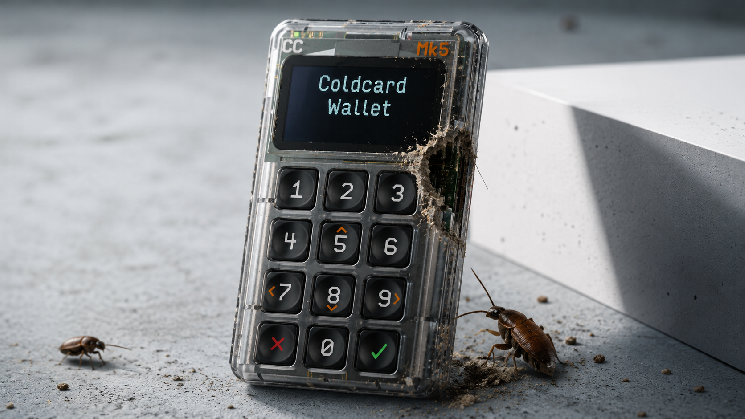
Coldcard Hardware Wallet Hacked: 594 Bitcoin Withdrawn in 25 Minutes

The Coldcard hardware wallet has been compromised, with hackers stealing approximately 594.5 Bitcoin (~$40 million) from 500 addresses in just 25 minutes. The root cause was a critical software bug, undetected for five years, which disabled the device's secure chip for generating true random numbers. This led to the creation of private keys based on predictable data like the processor's serial number, drastically reducing cryptographic security. The attackers exploited this offline by brute-forcing possible seed phrases, finding active addresses on the public ledger, and signing transactions. Initially, Coinkite (Coldcard's maker) claimed only older models were at risk but later admitted all devices running the compromised firmware were vulnerable. CEO Rodolphe Novak (NVK) apologized but ruled out financial compensation for affected users. To secure funds, owners must urgently update their firmware to specific safe versions, generate a completely new seed phrase on the updated device, and transfer all assets to new addresses created with that new seed. While a BIP-39 passphrase can help, it does not replace this migration process. Other Coinkite products like TAPSIGNER were not affected. This incident underscores that even specialized hardware requires rigorous, independent code audits, especially for cryptographic functions. It parallels past failures, like a 2006 OpenSSL bug in Debian, and raises questions about whether automated code analysis can ever fully replace human scrutiny in critical security areas.

cryptonews.ruHá 3h

Coldcard Hardware Wallet Hacked: 594 Bitcoin Withdrawn in 25 Minutes

cryptonews.ruHá 3h

Trading

Spot

Artigos em Destaque

Como comprar COMP

Bem-vindo à HTX.com!Tornámos a compra de Compound (COMP) simples e conveniente.Segue o nosso guia passo a passo para iniciar a tua jornada no mundo das criptos.Passo 1: cria a tua conta HTXUtiliza o teu e-mail ou número de telefone para te inscreveres numa conta gratuita na HTX.Desfruta de um processo de inscrição sem complicações e desbloqueia todas as funcionalidades.Obter a minha contaPasso 2: vai para Comprar Cripto e escolhe o teu método de pagamentoCartão de crédito/débito: usa o teu visa ou mastercard para comprar Compound (COMP) instantaneamente.Saldo: usa os fundos da tua conta HTX para transacionar sem problemas.Terceiros: adicionamos métodos de pagamento populares, como Google Pay e Apple Pay, para aumentar a conveniência.P2P: transaciona diretamente com outros utilizadores na HTX.Mercado de balcão (OTC): oferecemos serviços personalizados e taxas de câmbio competitivas para os traders.Passo 3: armazena teu Compound (COMP)Depois de comprar o teu Compound (COMP), armazena-o na tua conta HTX.Alternativamente, podes enviá-lo para outro lugar através de transferência blockchain ou usá-lo para transacionar outras criptomoedas.Passo 4: transaciona Compound (COMP)Transaciona facilmente Compound (COMP) no mercado à vista da HTX.Acede simplesmente à tua conta, seleciona o teu par de trading, executa as tuas transações e monitoriza em tempo real.Oferecemos uma experiência de fácil utilização tanto para principiantes como para traders experientes.

310 Visualizações TotaisPublicado em {updateTime}Atualizado em 2026.06.02

Como comprar COMP

Discussões

Bem-vindo à Comunidade HTX. Aqui, pode manter-se informado sobre os mais recentes desenvolvimentos da plataforma e obter acesso a análises profissionais de mercado. As opiniões dos utilizadores sobre o preço de COMP (COMP) são apresentadas abaixo.

活动图片