Crypto Shockwave: Circle Sued As $280 Million Drift Hack Unravels

bitcoinistPublicado em 2026-04-17Última atualização em 2026-04-17

Resumo

A class action lawsuit has been filed in a Massachusetts federal court against Circle Internet Financial, alleging the stablecoin issuer was negligent and aided in the theft of $280 million from the Drift Protocol. The plaintiffs, representing over 100 investors, argue Circle had the means to stop the stolen USDC from being moved across blockchains using its Cross-Chain Transfer Protocol but failed to act. They point to Circle's prior action of freezing wallets in a separate civil case as proof it could have intervened. The April 1st hack is attributed to North Korean state-backed actors who moved the funds to Ethereum and laundered them through Tornado Cash. The case raises significant questions about the responsibility of centralized entities in the decentralized crypto ecosystem.

North Korean hackers likely pocketed hundreds of millions in stolen crypto — and now a US court is being asked to decide whether a stablecoin giant should have stopped them.

Circle’s Own Track Record Becomes A Key Weapon

A class action lawsuit filed in a Massachusetts federal court this week names Circle Internet Group as the defendant, with plaintiffs arguing the company had both the means and the opportunity to stop roughly $280 million in stolen USDC from moving across blockchains — and did nothing.

The case was brought by Drift Protocol investor Joshua McCollum, representing more than 100 affected members. Their attorneys put it plainly: Circle allowed criminal use of its own technology.
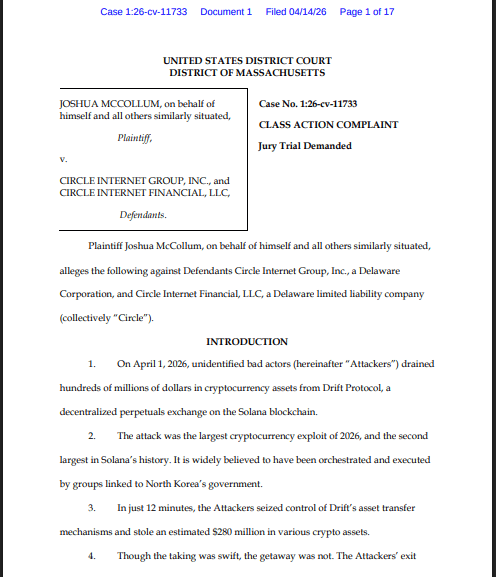
The complaint was filed Wednesday in a Massachusetts US district court by Drift investor Joshua McCollum, representing more than 100 members.

The April 1 attack on Drift Protocol saw attackers drain funds and route them from Solana to Ethereum using Circle’s Cross-Chain Transfer Protocol, a bridging tool the company operates. The transfers happened over several hours, according to reports. The window was wide open.

What makes the lawsuit particularly pointed is what happened just days before the hack. About a week prior, Circle froze 16 USDC wallets tied to a sealed US civil case. Plaintiffs seized on that detail. If Circle could move fast for a court-adjacent matter, they argue, it could have acted here too. That single fact sits at the center of the legal fight.

Accusations Range From Negligence To Aiding The Crime

The suit carries two main charges: negligence and aiding and abetting conversion — a legal term for helping someone unlawfully take another person’s property. The law firm Mira Gibb is handling the case for McCollum and the other Drift investors. Damages have not yet been set and will be determined at trial.

BTCUSD trading at $75,081 on the 24-hour chart: TradingView

Circle has not responded to requests for comment.

Crypto analytics firm Elliptic flagged the attack as the work of North Korean state-backed operatives. Based on Elliptic’s analysis, the hackers executed more than 100 transactions through Circle’s bridging infrastructure during regular US business hours. After moving the funds to Ethereum, the stolen assets were converted and pushed through Tornado Cash, a privacy protocol used to obscure transaction trails.
Image: SOPA Images/Getty Images

ARK Invest Defends Circle, But The Moral Stakes Remain High

Not everyone is pointing fingers at Circle. Lorenzo Valente, ARK Invest’s director of digital asset research, argued that Circle made the right call by not acting without a legal order.

His concern: give a company like Circle the power to freeze funds on judgment alone, and every decision becomes political. He questioned aloud where the line would be drawn — between a North Korean hacker and a suspicious wallet elsewhere in the world.

Featured image from B&G Lawyers, chart from TradingView

Criptomoedas em alta

Perguntas relacionadas

QWhat is the main allegation against Circle Internet Group in the class action lawsuit?

AThe plaintiffs allege that Circle had both the means and the opportunity to stop roughly $280 million in stolen USDC from moving across blockchains but did nothing, thereby allowing criminal use of its technology.

QWhich hacking group is suspected to be behind the $280 million attack on Drift Protocol?

ACrypto analytics firm Elliptic flagged the attack as the work of North Korean state-backed operatives.

QWhat key precedent from just days before the hack do the plaintiffs use to strengthen their case against Circle?

AThe plaintiffs point out that about a week prior to the hack, Circle froze 16 USDC wallets tied to a sealed US civil case, arguing that if Circle could act quickly in that instance, it could have acted to stop the stolen funds.

QWhat are the two main legal charges brought against Circle in the lawsuit?

AThe two main charges are negligence and aiding and abetting conversion, which is a legal term for helping someone unlawfully take another person's property.

QWhat was the primary method the hackers used to obscure the trail of the stolen funds after the attack?

AAfter moving the funds to Ethereum, the stolen assets were converted and pushed through Tornado Cash, a privacy protocol used to obscure transaction trails.

Leituras Relacionadas

a16z: From Companies to DAOs, DUNA May Become the Next Generation Organizational Form

This article, "From Companies to DAOs: How DUNA Could Become the Next Organizational Form," traces the 500-year evolution of business collaboration. It begins with medieval structures like the *commenda* and Florentine *compagnia*, which exposed partners to personal risk. The modern corporation, exemplified by the Dutch East India Company (VOC), was a revolutionary leap, enabling large-scale, capital-intensive ventures by offering limited liability and reducing coordination costs. However, corporations introduced new challenges like principal-agent problems and bureaucratic overhead. The piece argues that software and internet-native protocols are now reducing these traditional overheads. Decentralized Autonomous Organizations (DAOs) emerged as a new model for coordination without centralized management. Yet, DAOs face a significant legal vacuum: they lack legal recognition, leaving members exposed to unlimited personal liability, and their tokens are vulnerable to being classified as securities under unclear regulations (e.g., the Howey Test). This has forced projects into suboptimal workarounds like offshore foundations. The article identifies the Decentralized Unincorporated Nonprofit Association (DUNA) as a potential solution. Recently legalized in states like Wyoming, the DUNA provides a legal wrapper for decentralized networks. It grants key protections—legal personality, limited liability, and perpetual existence—to a group without imposing a traditional hierarchical management structure. This allows token-holder communities to govern, hold assets, and contract as a single legal entity, aligning with their decentralized nature. While DUNA doesn't solve all governance challenges or magically resolve securities law questions, it represents a crucial step. It fills the legal recognition gap, offering a native legal form for internet-scale, decentralized collaboration and extending the separation of personal risk from organizational venture into a new domain.

marsbitHá 16m

a16z: From Companies to DAOs, DUNA May Become the Next Generation Organizational Form

marsbitHá 16m

2026 Mid-Year Report On-Chain RWA: Tokenized Stock Market Cap Doubles in a Year, But 90% of Rights Are Hollow Shells

The 2026 Mid-Year Report on On-Chain RWA highlights a significant growth in tokenized stock market capitalization, which nearly doubled from $951 million in March to $1.89 billion by July. However, the report reveals a fundamental contradiction in this "layer 2.5" ecosystem: products with the strongest legal foundation (like regulated U.S. infrastructure) lack liquidity and distribution, while freely tradable offshored wrapper products often lack substantive ownership rights. The increase is driven largely by a few products (SECZ, FGRS, STRCx) and platforms (Ondo, xStocks, Securitize collectively hold over 85% share). While distributed value across networks like Ethereum, Solana, and BNB Chain has grown, the market remains fragmented. Products referencing the same underlying asset (e.g., Apple stock) are distinct legal liabilities with different intermediaries and jurisdictional rules, offering varying degrees of legal claim. The report cautions that headline numbers are misleading, as they reflect changes in distributed token value—driven by issuance, conversions, and price movements—not pure investor inflows. True "canonical shares" with legal ownership, wide wallet distribution, institutional liquidity, and independent on-chain price discovery do not yet exist at scale. Tokenized treasuries show stronger product-market fit, and ETFs may be easier to scale than single stocks. The core takeaway is a trade-off: legal certainty versus liquidity and composability.

marsbitHá 1h

2026 Mid-Year Report On-Chain RWA: Tokenized Stock Market Cap Doubles in a Year, But 90% of Rights Are Hollow Shells

marsbitHá 1h

Coldcard Hardware Wallet Hacked: 594 Bitcoin Withdrawn in 25 Minutes

The Coldcard hardware wallet has been compromised, with hackers stealing approximately 594.5 Bitcoin (~$40 million) from 500 addresses in just 25 minutes. The root cause was a critical software bug, undetected for five years, which disabled the device's secure chip for generating true random numbers. This led to the creation of private keys based on predictable data like the processor's serial number, drastically reducing cryptographic security. The attackers exploited this offline by brute-forcing possible seed phrases, finding active addresses on the public ledger, and signing transactions. Initially, Coinkite (Coldcard's maker) claimed only older models were at risk but later admitted all devices running the compromised firmware were vulnerable. CEO Rodolphe Novak (NVK) apologized but ruled out financial compensation for affected users. To secure funds, owners must urgently update their firmware to specific safe versions, generate a completely new seed phrase on the updated device, and transfer all assets to new addresses created with that new seed. While a BIP-39 passphrase can help, it does not replace this migration process. Other Coinkite products like TAPSIGNER were not affected. This incident underscores that even specialized hardware requires rigorous, independent code audits, especially for cryptographic functions. It parallels past failures, like a 2006 OpenSSL bug in Debian, and raises questions about whether automated code analysis can ever fully replace human scrutiny in critical security areas.

cryptonews.ruHá 3h

Coldcard Hardware Wallet Hacked: 594 Bitcoin Withdrawn in 25 Minutes

cryptonews.ruHá 3h

Trading

Spot

Artigos em Destaque

Como comprar DRIFT

Bem-vindo à HTX.com!Tornámos a compra de Drift Protocol (DRIFT) simples e conveniente.Segue o nosso guia passo a passo para iniciar a tua jornada no mundo das criptos.Passo 1: cria a tua conta HTXUtiliza o teu e-mail ou número de telefone para te inscreveres numa conta gratuita na HTX.Desfruta de um processo de inscrição sem complicações e desbloqueia todas as funcionalidades.Obter a minha contaPasso 2: vai para Comprar Cripto e escolhe o teu método de pagamentoCartão de crédito/débito: usa o teu visa ou mastercard para comprar Drift Protocol (DRIFT) instantaneamente.Saldo: usa os fundos da tua conta HTX para transacionar sem problemas.Terceiros: adicionamos métodos de pagamento populares, como Google Pay e Apple Pay, para aumentar a conveniência.P2P: transaciona diretamente com outros utilizadores na HTX.Mercado de balcão (OTC): oferecemos serviços personalizados e taxas de câmbio competitivas para os traders.Passo 3: armazena teu Drift Protocol (DRIFT)Depois de comprar o teu Drift Protocol (DRIFT), armazena-o na tua conta HTX.Alternativamente, podes enviá-lo para outro lugar através de transferência blockchain ou usá-lo para transacionar outras criptomoedas.Passo 4: transaciona Drift Protocol (DRIFT)Transaciona facilmente Drift Protocol (DRIFT) no mercado à vista da HTX.Acede simplesmente à tua conta, seleciona o teu par de trading, executa as tuas transações e monitoriza em tempo real.Oferecemos uma experiência de fácil utilização tanto para principiantes como para traders experientes.

326 Visualizações TotaisPublicado em {updateTime}Atualizado em 2026.06.02

Como comprar DRIFT

Discussões

Bem-vindo à Comunidade HTX. Aqui, pode manter-se informado sobre os mais recentes desenvolvimentos da plataforma e obter acesso a análises profissionais de mercado. As opiniões dos utilizadores sobre o preço de DRIFT (DRIFT) são apresentadas abaixo.

活动图片