Crypto market’s weekly winners and losers – PIPPIN, ZEC, MYX, APT

ambcryptoPublicado em 2026-02-15Última atualização em 2026-02-15

Resumo

Following weeks of significant losses, the cryptocurrency market showed signs of recovery, buoyed by a U.S. inflation report indicating a slowdown in price increases to 2.4% and a strong labor market, raising expectations of potential Federal Reserve interest rate cuts. While major cryptocurrencies like Bitcoin and Ethereum remained relatively stable, several smaller tokens experienced substantial price movements. Key weekly winners included PIPPIN, which surged over 280% from its accumulation zone to above $0.72, driven by strong buying activity and positive technical indicators. ZCash (ZEC) rallied 33% after Digital Currency Group CEO Barry Silbert suggested privacy coins could attract significant Bitcoin investment and praised ZEC's potential. Humanity Protocol (H) gained nearly 90%, reaching approximately $0.23, supported by its integration with Fireblocks, which provides access to over 2,000 financial institutions. Other notable gainers included Dogecoin (18%), Shiba Inu (12%), and Pi (30%). On the losing side, MYX Finance (MYX) fell nearly 70%, dropping from around $6.30 to below $2.00 due to sell pressure and negative capital flow. Memecore (M) declined over 10% to approximately $1.27 after failing to maintain earlier highs, reflecting weakened buyer confidence. Aptos (APT) slipped from about $1.10 to below $1.00, struggling to recover amid low buying volume. Other decliners included Story (IP, down 6%), Bitget Token (BGB, down 7%), and DoubleZero (2Z, down 13%). Th...

After weeks of heavy losses, the crypto market finally saw some light.

Bitcoin [BTC] and Ethereum [ETH] put up weak shows, but the overall mood was vastly improved. This came after a U.S. inflation report showed prices rising more slowly, with inflation falling to 2.4%.

The labor market also stayed strong, raising hopes that the Fed may cut interest rates soon. That often helps crypto.

While the biggest coins stayed quiet, several smaller tokens saw major gains… and losses. So, grab your coffees and teas! Here’s a quick look at this week’s biggest movers.

Weekly winners

Strong buying pushes pippin [PIPPIN] into a mammoth breakout

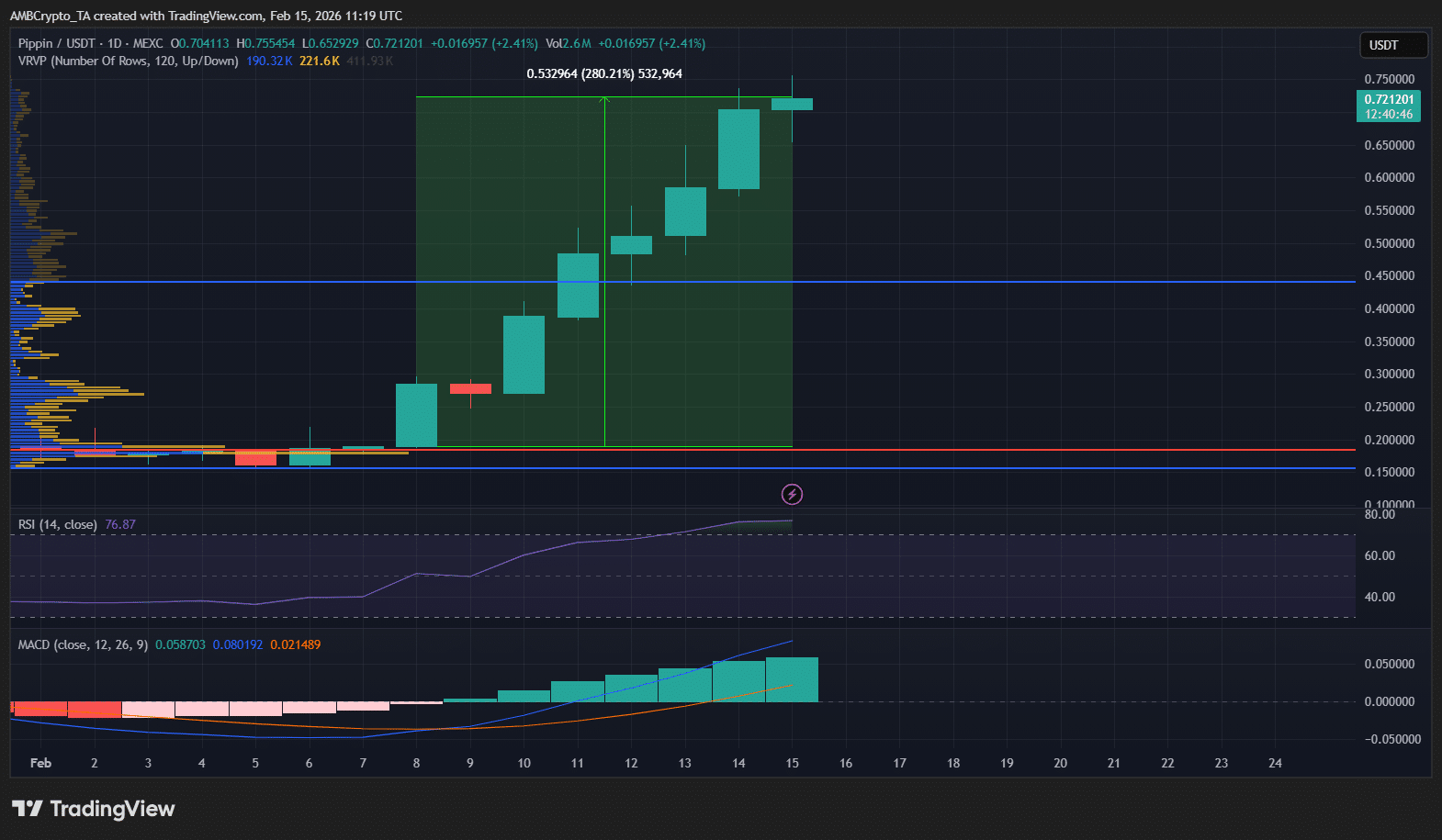
pippin [PIPPIN] has surged from the $0.16-$0.20 accumulation zone to above $0.72, a gain of over 280% in just over a week!

Most trading activity was concentrated near the lower range, which meant that buyers built strong positions before the breakout.

Once price moved above this high-volume area, resistance thinned, and upside movement happened quicker.

RSI showed demand but didn’t show any signs of a reversal. MACD was bullish as well.
Source: TradingView

With rising wallet counts and active incentives, PIPPIN’s rally was pushed by gradual buying. The trend may still have room to continue.

ZCash [ZEC] energized by DCG CEO claims

Zcash [ZEC] rallied 33% this week after Digital Currency Group CEO Barry Silbert said 5% to 10% of Bitcoin [BTC] investments could go into privacy coins in the coming years.

He also called Zcash a project capable of delivering 500x returns!

ZEC surged from around $230 to above $330 before settling at $307. This came after days of consolidation, so investors were buying before the move. RSI was at 51, recovering from weak levels.

Humanity Protocol [H] hits new highs

Humanity Protocol [H] traded near $0.23 after gaining nearly 90% from its recent base around $0.12. The steady series of higher highs and higher lows proves that the spike was supported by buying.

The RSI held above 70, while the MACD stayed bullish.

This growth came alongside Humanity Protocol’s integration with Fireblocks. This development opens access to more than 2,000 financial institutions, allowing professional investors to custody and interact with H.

At the same time, its privacy-focused mainnet and decentralized identity infrastructure are attracting interest.

Other notable winners

Dogecoin [DOGE] went up 18% at the time of writing. Shiba Inu [SHIB] followed with a 12% rise, supported by retail activity. Meanwhile, Pi [PI] led the group with a 30% rally!

Weekly losers

MYX Finance [MYX] drops with sell pressure

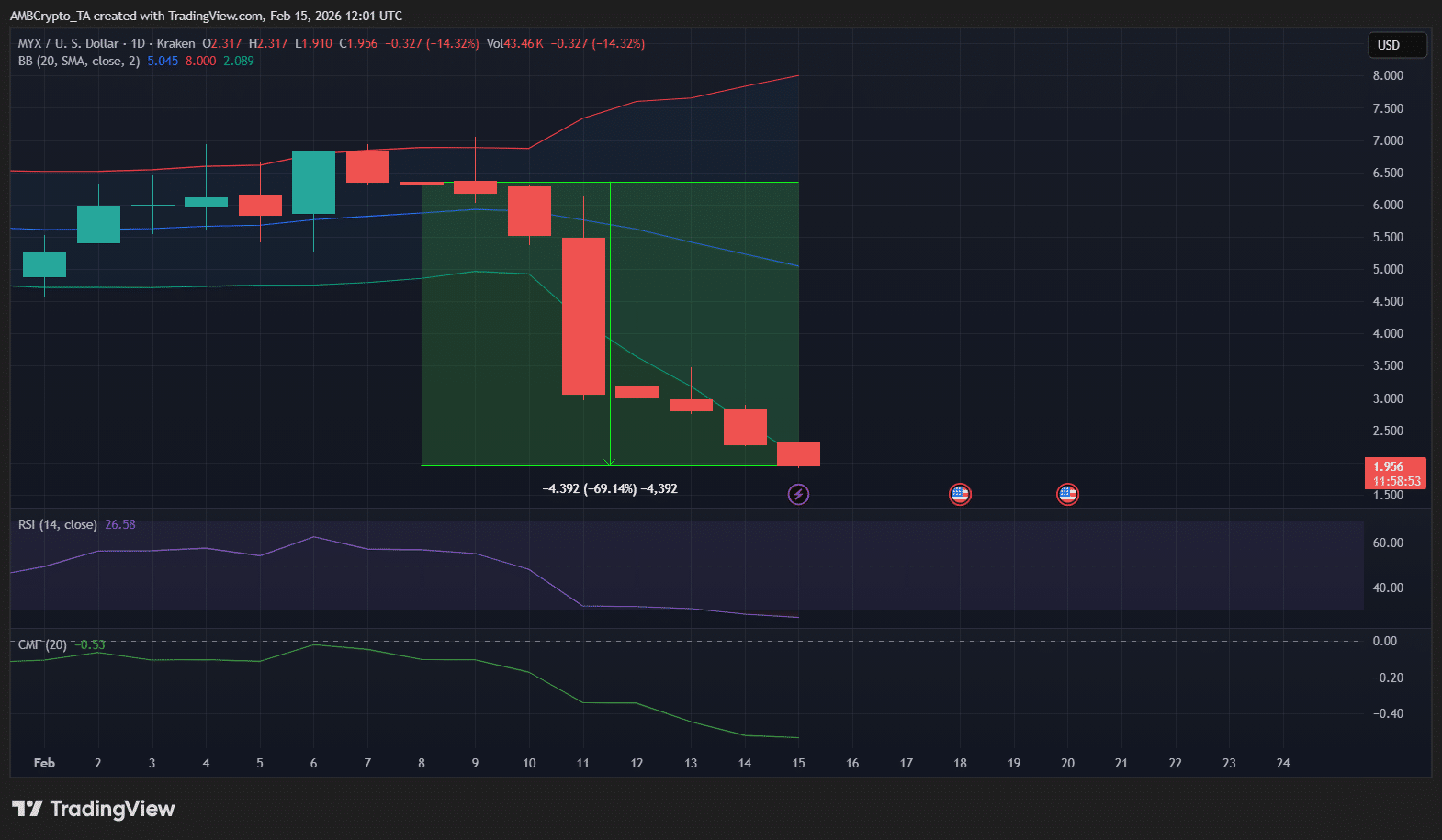
MYX Finance [MYX] fell nearly 70% from around $6.30 to below $2.00, according to the daily chart.

The decline followed a period of consolidation near the upper Bollinger Band, after which price broke down and continued forming lower lows.
Source: TradingView

The RSI dropped to 26, putting MYX deep in oversold territory. At the same time, the CMF was negative, so capital has been exiting.

Unless buyers step in to defend current levels, MYX may continue facing downward pressure in the near term.

Memecore [M] weakens with fading pace

Memecore [M] has come under pressure after failing to hold its early February highs near $1.85. There was a rejection followed by a steady decline, with the price at around $1.27 at press time.

That’s a drop of over 10% in recent sessions.

The token attempted to stabilize between $1.30 and $1.45, but repeated lower highs proved the lack of buyer confidence. RSI slipped to 41.

The earlier rally was met with strong selling at higher levels, forcing M into a consolidation phase.

Aptos [APT] loses its footing

Aptos [APT] slipped from around $1.10 to below $1.00, a steady downtrend before finding weak support near $0.90. While there’s been a small bounce since then, the recovery hasn’t been strong enough to flip the board.

RSI was close to oversold territory at 29. Meanwhile, the OBV was low, so buyers hadn’t returned in full force.

APT is trying to stabilize, but confidence still looks shaky. Unless it can reclaim the $1.00-$1.10 range convincingly, the token may be stuck in a fragile recovery phase.

Other notable losers

Story [IP] fell 6%, while Bitget Token [BGB] dropped 7% with a fading pace. Meanwhile, DoubleZero [2Z] saw the worst decline among the group, sliding 13% as sellers took control.

And that’s the week in crypto!

If there’s always one takeaway, it’s this. Things can flip fast; today’s top gainer can easily become next week’s biggest loser. So, stay curious, stay cautious, and always DYOR before chasing the hype.

We’ll be watching the charts, and we’ll see you next week!


Final Summary

  • PIPPIN jumped 280%, Humanity Protocol rose 90%, and Zcash gained 33%.
  • Market momentum is way beyond major coins.
Next: BONK jumps 11% after channel breakout: Reversal or short squeeze setup?
Share
  • Share
  • Tweet

Criptomoedas em alta

Perguntas relacionadas

QWhat was the main reason for the improved mood in the crypto market this week?

AThe improved mood was due to a U.S. inflation report showing prices rising more slowly, with inflation falling to 2.4%, and a strong labor market raising hopes that the Fed may cut interest rates soon.

QWhich token had the largest percentage gain this week and what was the gain?

APIPPIN had the largest percentage gain, surging over 280% from the $0.16-$0.20 accumulation zone to above $0.72.

QWhat news event catalyzed the 33% rally for ZCash (ZEC)?

AZCash rallied after Digital Currency Group CEO Barry Silbert said 5% to 10% of Bitcoin investments could go into privacy coins in the coming years and called Zcash a project capable of delivering 500x returns.

QWhich token was the biggest loser this week and what was its percentage decline?

AMYX Finance (MYX) was the biggest loser, falling nearly 70% from around $6.30 to below $2.00.

QWhat development contributed to the growth of Humanity Protocol (H) alongside its price increase?

AIts growth came alongside Humanity Protocol's integration with Fireblocks, which opens access to over 2,000 financial institutions, allowing professional investors to custody and interact with H.

Leituras Relacionadas

UNI Doubles in Two Months Against the Trend: A 5-Year-Overdue Value Realization

Amidst a generally stagnant crypto market in June and July, UNI, the governance token of Uniswap, saw a significant surge, nearly doubling in price from around $2.3 to $4.6. This rally represents a delayed but significant value reassessment, triggered by the practical implementation of its long-debated "fee switch" mechanism. The key turning point was the on-chain execution of the UNIfication proposal in December 2025. It activated a protocol fee on select pools, directed Unichain sequencer revenue (net of costs) to a communal treasury, executed a one-time burn of 100 million UNI, and established a system where all protocol revenue flows into a "TokenJar" contract. This treasury has a single exit: purchasing and permanently burning UNI via a "Firepit" contract. Initially, the market reacted tepidly as the generated revenue and corresponding burn rate were modest. The narrative shifted dramatically in July 2025 with two major developments. First, the launch of Robinhood Chain, tailored for tokenized stocks, rapidly became a primary source of volume and fees for Uniswap, at one point contributing nearly half of its weekly fees. Second, governance votes successfully expanded the fee mechanism to v4 pools and initiated a temperature check for fees on Robinhood Chain. The activation of v4 fees caused the protocol's daily revenue earmarked for UNI burns to nearly triple. The core of UNI's recent price action is the transition from a pure governance token to a cash-flow asset with a permanent, protocol-funded buyer. Its effectiveness is amplified by UNI's mature and widely distributed supply, with no major impending unlocks to dilute the impact of the buybacks. The sustainability of this rally now hinges on whether the transaction volume, particularly on Robinhood Chain, persists after its initial gas subsidies expire, determining if this is a genuine value realization or a subsidy-fueled spike.

marsbitHá 1h

UNI Doubles in Two Months Against the Trend: A 5-Year-Overdue Value Realization

marsbitHá 1h

Breaking: Google Earth Urgently Pulls Back Nano Banana 2 Image Generation Feature!

Google Earth's newly launched "Create image" feature, powered by the Nano Banana 2 AI image generation model, was abruptly withdrawn shortly after its release due to being "played" by users. The feature allowed users to generate and overlay AI-created visuals directly onto real-world satellite and 3D maps in Google Earth. The tool enabled creative applications like historical recreations (e.g., visualizing ancient Pompeii), generating informational graphics for landmarks, and envisioning architectural projects or futuristic cityscapes on real terrain. It operated under "geospatial grounding," meaning the AI respected the underlying geography, topography, and perspective of the chosen map view. The model also integrated with Gemini to retrieve relevant factual information. However, upon release, users quickly tested its limits. A prominent example involved reimagining Philadelphia's historic Independence Hall as a post-apocalyptic ruin overrun by "happy" zombies, evil clowns, and giant alien mechs. This highlighted both the feature's playful potential and its risks regarding the generation of inappropriate or misleading content on realistic maps, leading to its swift temporary removal. Google stated it would re-release the feature after implementing "enhanced guardrails." Analysts note this move strategically leverages Google's vast proprietary geospatial data, positioning its AI not just for artistic generation but for spatially accurate world visualization—a unique advantage in the competitive AI image generation landscape.

marsbitHá 3h

Breaking: Google Earth Urgently Pulls Back Nano Banana 2 Image Generation Feature!

marsbitHá 3h

Altman Admits: Overestimated AI Snatching Jobs! Huang Renxun: The Unemployment Narrative Is Completely Backwards

Sam Altman has revised his earlier predictions about AI rapidly replacing jobs, admitting he overestimated the speed at which AI would eliminate entry-level white-collar roles. Speaking on the "Invest Like the Best" podcast, he stated that people do not truly want an AI CEO, as accountability and human connection remain critical. He found that individuals prefer interacting with people who can be held responsible for decisions. Similarly, NVIDIA's Jensen Huang argued that the narrative of AI destroying jobs is misguided. He distinguishes between tasks and jobs, noting that while AI can automate specific tasks, entire jobs—encompassing communication, judgment, coordination, and accountability—are not eliminated. He cited examples like radiologists and software engineers, where demand for these roles has increased as AI handles repetitive tasks, allowing for business expansion and the creation of more positions. Data from a University of Maryland and LinkUp study supports this, showing that U.S. job postings for new graduates have actually risen, countering the fear of vanishing entry-level roles. However, a significant shift is occurring: the traditional entry-level tasks that help newcomers gain experience are being automated, making initial career access more challenging. The key insight is that as AI takes over standardized tasks, the enduring value of human work shifts toward areas of responsibility, trust-building, and final decision-making—aspects that AI cannot replicate. The real "moat" for professionals lies in these irreplaceable human elements.

marsbitHá 3h

Altman Admits: Overestimated AI Snatching Jobs! Huang Renxun: The Unemployment Narrative Is Completely Backwards

marsbitHá 3h

Trading

Spot

Artigos em Destaque

Como comprar ZEC

Bem-vindo à HTX.com!Tornámos a compra de Zcash (ZEC) simples e conveniente.Segue o nosso guia passo a passo para iniciar a tua jornada no mundo das criptos.Passo 1: cria a tua conta HTXUtiliza o teu e-mail ou número de telefone para te inscreveres numa conta gratuita na HTX.Desfruta de um processo de inscrição sem complicações e desbloqueia todas as funcionalidades.Obter a minha contaPasso 2: vai para Comprar Cripto e escolhe o teu método de pagamentoCartão de crédito/débito: usa o teu visa ou mastercard para comprar Zcash (ZEC) instantaneamente.Saldo: usa os fundos da tua conta HTX para transacionar sem problemas.Terceiros: adicionamos métodos de pagamento populares, como Google Pay e Apple Pay, para aumentar a conveniência.P2P: transaciona diretamente com outros utilizadores na HTX.Mercado de balcão (OTC): oferecemos serviços personalizados e taxas de câmbio competitivas para os traders.Passo 3: armazena teu Zcash (ZEC)Depois de comprar o teu Zcash (ZEC), armazena-o na tua conta HTX.Alternativamente, podes enviá-lo para outro lugar através de transferência blockchain ou usá-lo para transacionar outras criptomoedas.Passo 4: transaciona Zcash (ZEC)Transaciona facilmente Zcash (ZEC) no mercado à vista da HTX.Acede simplesmente à tua conta, seleciona o teu par de trading, executa as tuas transações e monitoriza em tempo real.Oferecemos uma experiência de fácil utilização tanto para principiantes como para traders experientes.

374 Visualizações TotaisPublicado em {updateTime}Atualizado em 2026.06.02

Como comprar ZEC

Discussões

Bem-vindo à Comunidade HTX. Aqui, pode manter-se informado sobre os mais recentes desenvolvimentos da plataforma e obter acesso a análises profissionais de mercado. As opiniões dos utilizadores sobre o preço de ZEC (ZEC) são apresentadas abaixo.

活动图片