
Top 100 Apecoin Holders Control Over 51% of the Supply, APE Lost 81% in 2 Months

newsbtcPublicado em 2022-07-11Última atualização em 2022-07-11

Resumo

Back in mid-March 2022, Bored Ape Yacht Club’s (BAYC) Apecoin DAO launched and airdropped millions of apecoin tokens to specific NFT holders.

Top 100 Apecoin Holders Control Over 51% of the Supply, APE Lost 81% in 2 Months

Back in mid-March 2022, Bored Ape Yacht Club’s (BAYC) Apecoin DAO launched and airdropped millions of apecoin tokens to specific NFT holders. The crypto asset dedicated to the BAYC ecosystem tapped an all-time high two months ago reaching $26.70 per unit on April 28. However, apecoin is down more than 81% since that day and despite the fact that 80,744 unique addresses own APE, the top 100 addresses control 51.21% of the circulating supply.

While Apecoin’s Price Slips Lower, Concentration of Large APE Holders Remains the Same

Just over two months ago, the crypto asset apecoin (APE) made headlines after the Apecoin DAO distributed millions of apecoin (APE) to NFT owners. APE was airdropped to BAYC, Mutant Ape Yacht Club (MAYC), and Bored Ape Kennel Club (BAKC) holders.

On March 17, APE was exchanging hands for $10.36 per unit or 53% higher than the price today ($4.81 per APE). After the launch, APE continued to rise in USD value and by April 28, apecoin reached an all-time high (ATH) of $26.70 per unit.

At that time on April 28, APE had a circulating supply of around 284,843,750 tokens and it held the 22nd largest market valuation out of 13,000+ crypto assets. During the ATH, APE’s market cap had a dominance rating of around 0.40% as well. Moreover, at the time APE’s concentration of whale entities was quite large in comparison to most of the top coins.

Today, is an entirely different story, at least for APE’s crypto market performance. During the past month, apecoin has shed ​​14.5% against the U.S. dollar but did see an 8.2% rise during the past seven days. To date, APE is down 81% since the crypto asset’s ATH but what hasn’t changed much is the whale concentration.

Top 100 Apecoin Holders Control Over 51% of the Supply, APE Lost 81% in 2 Months

Apecoin metrics from intotheblock.com on July 10, 2022.

Bitcoin.com News reported on April 23, that 52% of the APE in circulation was held by 100 addresses. APE distribution has not changed much since the crypto winter started and the crypto economy’s value continues to slide. Statistics from coincarp.com’s APE rich list indicate that the top 100 wallets own 51.21% of the circulating supply.

Metrics from intotheblock.com shows that apecoin (APE) has a Concentration of Large Holders rating of around 91% today. That’s a whole lot more concentrated than bitcoin’s (BTC) rating today which is around 10%.

APE Transfers Decline, Apecoin Search Query Interest Drops 95%

Today, the top ten APE holders command 8.01% of the supply, the top 20 addresses hold 13.01% and the top 50 APE addresses hold 28.01% on July 10. While APE has seen 1,009,507 transactions total, it’s been averaging around 2K to under 1K per day in transfers.
Top 100 Apecoin Holders Control Over 51% of the Supply, APE Lost 81% in 2 Months

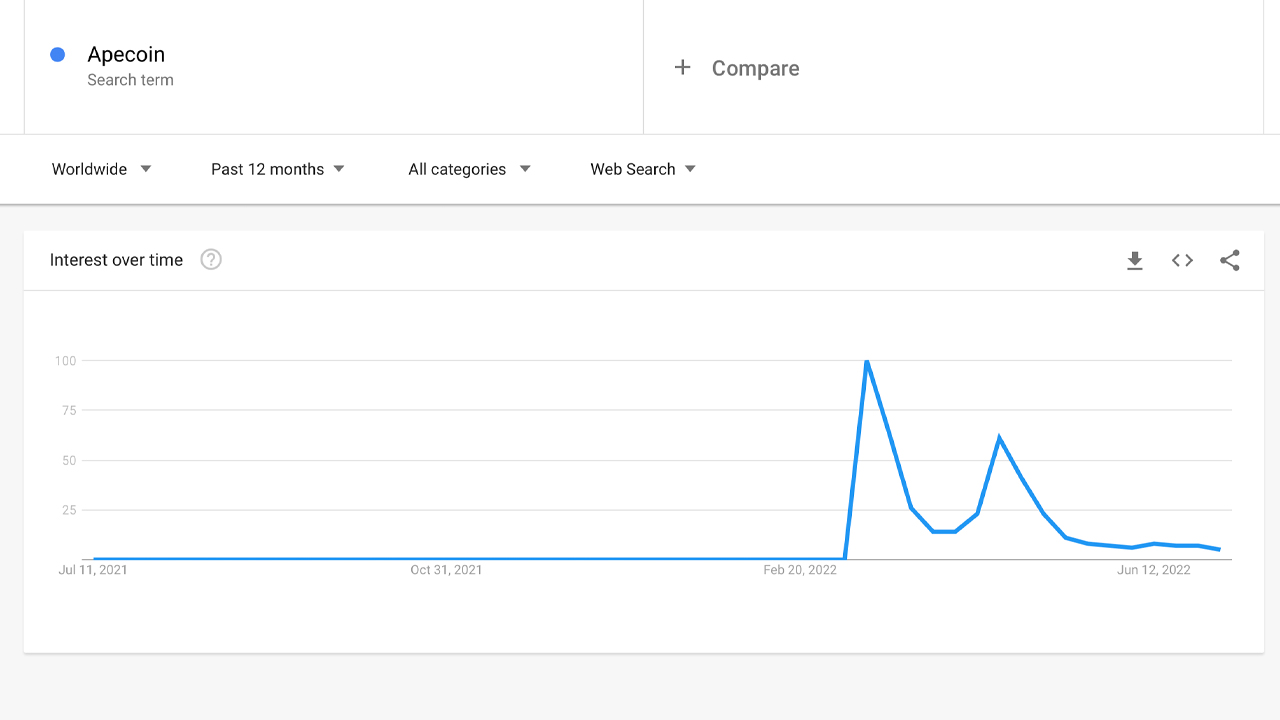
Google Trends search queries for the term “apecoin” declined by 95% since the second week of March 2022.

On July 9, 2022, 819 APE transfers were recorded and during the last week, $71.24 million worth of APE was transactions tied to transfers greater than $100K per transaction. Search data further shows that interest in apecoin (APE) has slid a great deal in the last two monts.

Google Trends (GT) data indicates that on the week of March 13th through the 19th, the search term “apecoin” tapped the highest score of 100. This week, the search query “apecoin” has a score of 5, according to worldwide GT metrics on July 10, 2022.


Leituras Relacionadas

The Value Distribution of Stablecoins

**Summary: The Value Distribution of Stablecoins** The article argues that stablecoins are evolving from mere trading tools into broader channels for dollar access. It divides the stablecoin ecosystem into four layers to analyze how value is distributed: 1. **Issuance Layer:** Mints stablecoins, holds reserve assets, and captures the spread between reserve yield and user costs (e.g., Tether, Circle). This layer currently earns the largest profit margin. 2. **Infrastructure Layer:** Connects stablecoins to the traditional financial system, handling fiat on/off-ramps, banking integration, compliance (KYC/AML), and asset management (e.g., Bridge, BVNK). This is the "unglamorous" but critical work, building the essential bridges between crypto and real-world finance. 3. **Acquiring/Distribution Layer:** Integrates stablecoins into merchant systems, manages payment flows, and provides enterprise financial software (e.g., Stripe, Coinbase). They act as the access point for businesses. 4. **Application Layer:** The end-users and businesses that ultimately use stablecoins for payments, settlements, or as a store of value. They benefit from convenience but have little pricing power. The core thesis is that while the issuance layer currently dominates profits, the often-overlooked **infrastructure layer holds significant long-term potential**. The real challenge and barrier to mass adoption is not the on-chain transfer of stablecoins (which is simple), but the complex "last mile" integration into existing business workflows, banking systems, and regulatory frameworks across different countries. Companies in this layer are currently in a "land grab" phase, investing heavily to build networks, secure bank partnerships, and establish compliance pathways. While their position is currently pressured by the profitable issuers above and distribution platforms below, the article suggests that if stablecoins become a default financial rail for businesses, the infrastructure providers who have done the hard work of integration will ultimately gain strong pricing power and become entrenched, essential players.

marsbitHá 19m

The Value Distribution of Stablecoins

marsbitHá 19m

The Value Distribution of Stablecoins

The Value Distribution of Stablecoins The article argues that stablecoins are evolving from a mere trading tool into a broad "dollar channel." It analyzes the industry's value chain through four layers: 1. **Issuance Layer (e.g., Tether, Circle):** The top layer that mints stablecoins, holds reserve assets, and captures the thickest interest rate spread. 2. **Infrastructure Layer (e.g., Bridge, BVNK):** Connects stablecoins to the traditional financial system, handling critical but complex "dirty work" like fiat on/off-ramps, banking integration, compliance (KYC/AML), and cross-border settlement. 3. **Acquiring/Distribution Layer (e.g., Stripe, Coinbase):** Embeds stablecoins into merchant systems, manages payment flows, and integrates with enterprise software. 4. **Application Layer:** End-users and businesses that ultimately use stablecoins for payments, settlement, or storing value. The author posits that while the issuance layer currently captures the most profit, the most overlooked and potentially critical layer is infrastructure. The core challenge for stablecoin adoption isn't the on-chain transfer (which is simple), but bridging the gap between blockchain and the real-world financial system. This involves solving practical problems for businesses: fiat conversion, reconciliation, tax handling, and user onboarding. Infrastructure companies are currently in a difficult "land-grab" phase—building networks, securing banking relationships, and achieving compliance country-by-country. They face pressure from both the profitable issuance layer above and distribution platforms below. However, the author suggests this layer is building a crucial moat. Once stablecoins become a default business rail, the infrastructure players who have done the hard work of integration may gain significant, durable value and pricing power.

链捕手Há 23m

The Value Distribution of Stablecoins

链捕手Há 23m

How to Do Research Well: Deliberately Practice the Real Skills That Matter

No one truly teaches you how to do research. You're often given a desk, a pre-selected problem, and vague instructions to "create something new." Consequently, many people reverse-engineer the job based on visible outputs—papers, posts, announcements—learning only how to *appear* like a researcher rather than how to *become* one. True research capability is built from stacking small, trainable skills, nearly all of which can be developed through deliberate practice. **Pick Your Own Problem:** Most researchers absorb problems from advisors or trends, lacking the underlying reasoning. Choosing a problem you genuinely care about, as John Schulman advises, leads to original work. Develop "taste" like a muscle: predict experiment outcomes, guess paper results from methods, and track which findings remain important over time. **Upgrade Your Inputs:** Relying on shared reading lists (arXiv hot lists, filtered group chats) leads to unoriginal conclusions. Undervalued old literature often holds crucial insights (e.g., MoE, LSTM, backpropagation). Richard Sutton's "The Bitter Lesson" or Claude Shannon's 1952 talk on creative thinking are more predictive than lengthy modern surveys. Breadth matters as much as depth: draw from neuroscience, mechanism design, hardware knowledge, and honest statistics. Read papers directly, especially appendices and limitations sections. **Write Everything Down:** As Paul Graham noted, writing exposes flaws in seemingly mature ideas. Writing is the cheapest defense against self-deception. Following Feynman's principle, Darwin programmatically wrote down facts contradicting his theory to combat memory bias. Maintain a detailed log of hypotheses, setups, predictions, results, and updated understandings. Reviewing past logs fosters essential humility.

marsbitHá 2h

How to Do Research Well: Deliberately Practice the Real Skills That Matter

marsbitHá 2h

Trading

Spot
Futuros

Artigos em Destaque

O que é APECOIN

Compreender a Moeda Eletrónica da Ásia-Pacífico ($APECoin) Num era em que a interseção entre tecnologia e ambientalismo se torna cada vez mais crítica, as criptomoedas estão a deixar a sua marca como potenciais catalisadores para a mudança. Entre estas inovações, a Moeda Eletrónica da Ásia-Pacífico ($APECoin) destaca-se como um projeto distinto concebido para apoiar iniciativas ambientais em toda a região da Ásia-Pacífico. Este artigo explora a fundação, características únicas e impacto do $APECoin no panorama mais amplo da blockchain. O que é a Moeda Eletrónica da Ásia-Pacífico ($APECoin)? A Moeda Eletrónica da Ásia-Pacífico ($APECoin) é um token ERC20 e TRC20, realizado em abril de 2020 após a sua concepção em dezembro de 2019. Esta inovação nasceu do desejo de promover práticas ecológicas e apoiar um conjunto de projetos ambientais visando a sustentabilidade e iniciativas verdes. Objetivos e Finalidades $APECoin não é apenas uma moeda digital; é concebida como um meio de troca que permite aos utilizadores realizarem transações que beneficiam diretamente causas ambientais. O seu ecossistema é projetado para facilitar diversas atividades financeiras enquanto promove a adoção de práticas ecológicas. A moeda tem como objetivo principal: Apoiar Iniciativas Ambientais: Através de cada transação, uma parte é alocada para financiar projetos sustentáveis direcionados à conservação e energia renovável. Promover Inovações Ecológicas: Incentivar startups e projetos que se alinhem com a sustentabilidade ambiental através do uso do seu token como meio de valor. Criar um Mercado Sustentável: A plataforma inclui um e-mercado onde transações financeiras podem ocorrer dentro de um quadro dedicado à promoção de práticas ecológicas. Criador da Moeda Eletrónica da Ásia-Pacífico ($APECoin) Embora os detalhes sobre o criador individual do $APECoin não sejam divulgados ao público, o projeto é significativamente apoiado pelo Grupo APEC, um consórcio focado na defesa de iniciativas ambientais. Este apoio acrescenta credibilidade e relevância ao projeto, ligando-o a uma rede mais ampla comprometida com a sustentabilidade e práticas ecológicas. Investidores da Moeda Eletrónica da Ásia-Pacífico ($APECoin) O panorama de investimento em torno do $APECoin permanece em grande parte não divulgado. Nomes específicos de fundações ou organizações de investimento que apoiam esta criptomoeda ainda não foram revelados. Contudo, o que é evidente é um crescente interesse entre investidores ansiosos por apoiar projetos sustentáveis que demonstram potencial de impacto no espaço cripto. Como funciona a Moeda Eletrónica da Ásia-Pacífico ($APECoin)? O $APECoin destaca-se devido ao seu modelo operacional inovador, que utiliza a tecnologia blockchain e contratos inteligentes. Esta combinação não só garante eficiência nas transações, mas também assegura a conformidade com estruturas regulatórias, aumentando a segurança e transparência das transações. Características Únicas do $APECoin Operações Baseadas em Blockchain: Ao estabelecer as suas operações numa plataforma de blockchain, o $APECoin garante que todas as transações são imutáveis e seguras através de técnicas criptográficas avançadas. Esta descentralização sublinha a integridade do token dentro do seu ecossistema. Contratos Inteligentes: O $APECoin emprega contratos inteligentes que facilitam transações sem costura enquanto asseguram conformidade com as regulações aplicáveis. Estes acordos automatizados minimizam a possibilidade de disputas, simplificam processos e contribuem para um quadro de transação fiável. E-Mercado: Uma das características principais do $APECoin é o seu e-mercado dedicado. Este ambiente digital serve como um centro para serviços que promovem práticas ecológicas, proporcionando uma plataforma para trocas que reforçam a visão verde do projeto. Através destas características, o $APECoin carve um nicho para si mesmo dentro da vasta extensão do mercado de criptomoedas, casando efetivamente os princípios da blockchain com a gestão ambiental. Cronologia da Moeda Eletrónica da Ásia-Pacífico ($APECoin) Compreender a trajetória do $APECoin fornece uma visão sobre os seus marcos de desenvolvimento e aspirações futuras. Aqui está uma cronologia que destaca eventos significativos na história do projeto: Dezembro de 2019: Conceção da Moeda Eletrónica da Ásia-Pacífico, iniciada com a ambição de promover a sustentabilidade através da criptomoeda. Abril de 2020: Lançamento oficial do $APECoin, assinalando a sua entrada no mercado como um token dedicado a projetos ambientais. 2020-2021: Realização da Oferta Inicial de Troca (IEO), permitindo aos utilizadores adquirir $APECoin, juntamente com o registro em várias plataformas de troca eletrónica para aumentar a acessibilidade. Na sua jornada relativamente curta, o $APECoin fez progressos significativos na construção das bases para uma criptomoeda segura e impactante, impulsionada por objetivos ambientais. Conclusão A Moeda Eletrónica da Ásia-Pacífico ($APECoin) corporifica a união entre tecnologia e responsabilidade ambiental, promovendo o crescimento no ecossistema cripto enquanto defende a sustentabilidade. Com a sua estrutura única, apoio de entidades respeitáveis e visão para um futuro mais verde, o $APECoin é mais do que apenas uma criptomoeda; é um projeto pioneiro destinado a nutrir a inovação responsável na região da Ásia-Pacífico. Através do seu compromisso com a inclusão financeira e seu suporte a iniciativas ambientais, destaca-se como um exemplo formidável de como as moedas digitais podem ser aproveitadas para um impacto societal positivo. À medida que o projeto continua a evoluir, os intervenientes na comunidade cripto e além estarão ansiosos para ver como o $APECoin moldará a conversa em torno de práticas sustentáveis no mundo em crescimento das criptomoedas.

84 Visualizações TotaisPublicado em {updateTime}Atualizado em 2024.12.03

O que é APECOIN

Como comprar APE

Bem-vindo à HTX.com!Tornámos a compra de ApeCoin (APE) simples e conveniente.Segue o nosso guia passo a passo para iniciar a tua jornada no mundo das criptos.Passo 1: cria a tua conta HTXUtiliza o teu e-mail ou número de telefone para te inscreveres numa conta gratuita na HTX.Desfruta de um processo de inscrição sem complicações e desbloqueia todas as funcionalidades.Obter a minha contaPasso 2: vai para Comprar Cripto e escolhe o teu método de pagamentoCartão de crédito/débito: usa o teu visa ou mastercard para comprar ApeCoin (APE) instantaneamente.Saldo: usa os fundos da tua conta HTX para transacionar sem problemas.Terceiros: adicionamos métodos de pagamento populares, como Google Pay e Apple Pay, para aumentar a conveniência.P2P: transaciona diretamente com outros utilizadores na HTX.Mercado de balcão (OTC): oferecemos serviços personalizados e taxas de câmbio competitivas para os traders.Passo 3: armazena teu ApeCoin (APE)Depois de comprar o teu ApeCoin (APE), armazena-o na tua conta HTX.Alternativamente, podes enviá-lo para outro lugar através de transferência blockchain ou usá-lo para transacionar outras criptomoedas.Passo 4: transaciona ApeCoin (APE)Transaciona facilmente ApeCoin (APE) no mercado à vista da HTX.Acede simplesmente à tua conta, seleciona o teu par de trading, executa as tuas transações e monitoriza em tempo real.Oferecemos uma experiência de fácil utilização tanto para principiantes como para traders experientes.

125 Visualizações TotaisPublicado em {updateTime}Atualizado em 2026.06.02

Como comprar APE

Discussões

Bem-vindo à Comunidade HTX. Aqui, pode manter-se informado sobre os mais recentes desenvolvimentos da plataforma e obter acesso a análises profissionais de mercado. As opiniões dos utilizadores sobre o preço de APE (APE) são apresentadas abaixo.

活动图片