В Bloomberg Intelligence допустили биткоин по $50 000

cryptonews.ruPublicado em 2025-11-26Última atualização em 2025-11-26

Старший стратег Bloomberg Intelligence по сырьевым товарам Майк Макглоун ожидает, что в 2026 году первая криптовалюта упадет примерно на 60% от исторического максимума выше $126 000.
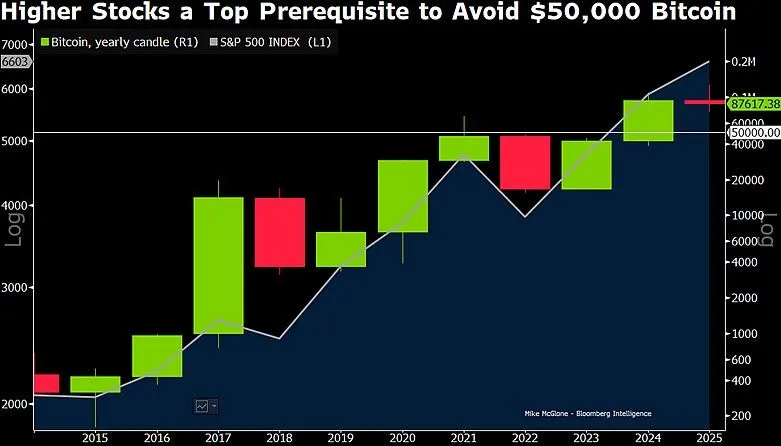
Источник: LinkedIn.

«Биткоин будет стоить $50 000 или $150 000 в 2026 году? Я склоняюсь к $50 000. Особенно если индекс S&P 500 упадет третий год подряд с 2008», — написал эксперт.

По мнению Макглоуна, сочетание стремительного роста цены на золото и падения цен на нефть с волатильностью на фондовом рынке побудит инвесторов к отказу от рискованных продуктов вроде криптовалют. Эти факторы способны привести к распродаже с «неограниченным предложением», подчеркнул он.

21 ноября, в пятницу, биткоин обвалился к отметкам в районе $82 000 — минимального уровня с апреля. В результате последующего отскока цена на пике достигла ~$87 900. На момент написания актив торгуется вблизи $86 400.

Биткоин может закрыть год новым падением

Сооснователь BitMEX Артур Хэйес полагает, что первую криптовалюту в ближайшее время ждет новая просадка к $80 000. Однако этот уровень котировки удержат, уточнил он.

minor improvements in $ liq:
— fed qt stops dec 1, this wed will prob be last fall in b/s
— us banks increased lending in nov

we chop below $90k, maybe one more stab down into low $80k's but i think $80k holds. might start nibbling, but leave the bazooka until the new year

— Arthur Hayes (@CryptoHayes) November 24, 2025

Позитивными факторами для цены цифрового золота Хэйес считает прекращение Федеральной резервной системой США (ФРС) политики количественного ужесточения с 1 декабря и увеличение объемов кредитования американскими банками в ноябре. Но этот приток ликвидности на рынок скажется только к концу года, уточнил он.

В Citigroup отметили, что после октябрьского обвала криптовалют у инвесторов резко упал аппетит к риску, сообщает CoinDesk.

Долгосрочные держатели монет испытывают все большее беспокойство в отношении второго слабого года для актива после последнего халвинга, что противоречит историческим циклам.

В базовом сценарии аналитики банка ожидали, что приток средств в BTC-ETF до конца года составит $7,5 млрд. Инвестиционные биткоин-продукты только с начала ноября потеряли $4,92 млрд.

По оценке экспертов Citigroup, реализуется их медвежий прогноз в $82 000 к началу 2026 года. Ключевым уровнем для инвесторов в ETF выступает $80 000.

Позитивные факторы вроде восстановления притока капитала в биржевые фонды и прорыв в регулировании индустрии в США могут поднять цену биткоина до $181 000 в течение следующих 12 месяцев .

Ранее CIO Bitwise Мэтт Хоуган констатировал, что биткоин скорее всего достиг дна в предыдущем откате, однако признал новую просадку ближе к $70 000 еще возможной.

Глава европейского отдела исследований компании Андре Драгош подтвердил мнение инвестиционного директора.

«В краткосрочной перспективе биткоин может торговаться ниже, пока не появится явный бычий катализатор. Но это будут “бросовые” оценки и очень привлекательные точки входа для увеличения доли в активе», — заявил он в интервью DL News.

Драгош ожидает сильную поддержку курсу криптовалюты в диапазоне от $81 000 до $73 000 — базовой стоимости монет в ETF от BlackRock и казначействе Strategy. Ниже этих отметок биткоин будет интенсивно выкупаться, уверен аналитик.

Он отметил, что текущая коррекция «соответствует предыдущим бычьим рынкам как по глубине, так и по продолжительности». Разворот тренда может произойти в любой момент при появлении явного катализатора вроде продолжения ФРС количественного смягчения или волатильности на рынке облигаций, которая вынудит регулятора к интервенциям.

«Мы по-прежнему ожидаем продолжения бычьего цикла биткоина в 2026 году из-за ослабления денежно-кредитной политики по всему миру, что, как правило, с существенным отставанием влияет на условия мирового роста и склонность к риску», — заключил Драгош.

Влияет неопределенность

Аналитик GSR Карлос Гусман выделил три фактора, негативно сказывающихся на текущих рыночных позициях цифрового золота.

Ожидания, что ФРС снизит ключевую ставку по итогам заседания 10 декабря, подскочили до 77%, хотя неделю назад показатель составлял 42%. При этом сохраняется неопределенность касательно решения регулятора, поскольку из-за затянувшегося шатдауна правительства не был опубликован ряд важнейших экономических данных.

Нарастают опасения в отношении пузыря в сегменте ИИ. После публикации Nvidia позитивного квартального отчета котировки одного из флагманов отрасли подскочили на 5%, но затем скорректировались на 3,1%.

«Эта волатильность отразилась на крипторынке, который, как правило, движется в тандеме с акциями технологических компаний», — заявил Гусман.

Третьим фактором, оказывающим давление на цифровые активы, он назвал «сохраняющиеся слабость и пессимизм, а также снижение ликвидности» в результате октябрьского обвала.

Напомним, закрепление цены биткоина ниже $80 000 существенно повысит риск более глубокого падения, к такому выводу пришел аналитик под ником Crypto Dan.

Leituras Relacionadas

NVIDIA CPU Advances, China's RISC-V Responds: Semiconductor Deep Dive - Part Four

NVIDIA is set to launch its new Vera AI data center CPU in China as early as August, with high pricing. While this move offers a new option, it highlights China's continued dependence on foreign-controlled Arm architecture. In response, the Chinese semiconductor industry is increasingly turning to RISC-V as a strategic alternative for achieving high-performance computing autonomy. The article explores the concept of the "impossible triangle" in CPU development—balancing prosperity, control, and autonomy—and posits that RISC-V's open-source, modular nature offers a unique path to achieving all three. While RISC-V is already dominant in embedded systems, the focus is now shifting to data centers and AI workloads. China has become a global hotspot for RISC-V development, driven by AI-driven compute demand, supply chain concerns from export controls, cost benefits of open-source, and strong policy support. Multiple Chinese companies have reportedly crossed the key performance threshold of 15 SPECint per GHz, a benchmark for entering the high-performance CPU club. Progress extends beyond single-core benchmarks. Companies are developing complete computing subsystems, including commercial-grade coherent network-on-chip (NoC) technology and server processors with up to 40 cores that strictly adhere to the RVA23 standard to ensure software compatibility. Real-world applications are emerging in areas like video transcoding and edge AI. However, significant challenges remain. The RISC-V ecosystem faces fragmentation, immature toolchains and verification processes, and gaps in single-core performance and energy efficiency compared to mature x86 and Arm architectures. The formidable software moat, epitomized by NVIDIA's CUDA, is a long-term hurdle. In conclusion, while RISC-V cannot immediately replace offerings like NVIDIA's Vera, it represents a viable long-term path for China to develop a self-sufficient, high-performance CPU ecosystem. The journey is acknowledged to be long and arduous, requiring sustained effort to overcome technical and ecosystem challenges.

marsbitHá 3h

NVIDIA CPU Advances, China's RISC-V Responds: Semiconductor Deep Dive - Part Four

marsbitHá 3h

My Coding Betting Dashboard is Profiting, but Polymarket is Truly Not a Good Place for 'Arbitrage'

The author built a custom monitoring dashboard for Polymarket, a prediction market platform, and tested it with $1,600, achieving over 30% returns. However, the core argument is that Polymarket is not a good venue for traditional arbitrage. The dashboard has two main sections: a "Portfolio Dashboard" for tracking active positions with key metrics like total capital, P&L, and a risk-control module using a tier system (T1, T2, T3), and an "Opportunity Watchlist" for monitoring markets. The article details a critical structural trap in binary markets: a bet with a high perceived probability of success still carries a 100% loss risk if wrong. The author's T1/T2/T3 system is designed to manage this by limiting position sizes based on conviction and time horizon, emphasizing that high confidence should not equal high concentration. A key insight is the danger of "pseudo-diversification"—betting on different markets driven by the same underlying variable. The author concludes that Polymarket offers few true low-risk, arbitrage opportunities. It is instead a high-risk environment where wins can create a false sense of mastery, leading to large losses. The platform is better viewed as a training ground for honing judgment through disciplined, framework-driven betting rather than a reliable income source. The tools help transform intuition into structured, rule-based decisions to mitigate the risk of catastrophic errors.

marsbitHá 7h

My Coding Betting Dashboard is Profiting, but Polymarket is Truly Not a Good Place for 'Arbitrage'

marsbitHá 7h

WeChat AI Card Hands-On Guide: Has the AI Shopping Era Arrived?

**"WeChat AI Card" Practical Test Guide: Has the Era of AI Shopping Arrived?** WeChat has officially launched the "AI Exclusive Card," a feature integrated into its Workbuddy AI assistant. This card is designed to handle payments for AI-initiated purchases. Our hands-on test reveals it's not yet a tool for fully autonomous AI shopping, but rather a controlled payment layer for AI agents. The AI Card functions as an isolated sub-wallet within WeChat Pay. Users must bind the card and transfer funds into it from their main wallet. Crucially, every transaction requires explicit user confirmation via smartphone scan; AI cannot spend autonomously. Currently accessible through the Workbuddy agent, the card targets specific digital consumption scenarios: purchasing paid content (reports, data), calling paid APIs/tools, and subscribing to services. Its design prioritizes security and control by separating funds and mandating approval for each payment. We tested a real-world scenario: ordering bubble tea via Workbuddy using a "Meituan Life Assistant" skill. The process encountered multiple hurdles: high "skill" usage costs (exceeding daily free credits), and most importantly, while a payment was successfully initiated, the AI purchased an incorrect product (a mismatched group-buy coupon instead of the desired drink). This highlights the current limitation: the **AI Card only solves the payment step**. The broader challenge lies in the **AI agent's execution chain**—accurately understanding intent, navigating third-party platforms, selecting the right product, and ensuring proper fulfillment. The payment succeeded, but the purchase failed to meet the user's need. In conclusion, the WeChat AI Exclusive Card is a cautious, early-step experiment in AI commerce. It provides a secure, user-controlled payment method for agent interactions but is not yet capable of reliable, end-to-end complex purchases. For now, it's best used for low-value, low-risk digital services with careful user verification at each step. The vision of AI handling complete shopping tasks remains a work in progress.

marsbitHá 9h

WeChat AI Card Hands-On Guide: Has the AI Shopping Era Arrived?

marsbitHá 9h

Trading

Spot
Futuros
活动图片