Analyst Says XRP Has 2 Options Right Now, Reveals Why Investors Win Either Way

bitcoinistPublicado em 2025-11-17Última atualização em 2025-11-17

Resumo

Crypto analyst Chad has revealed two scenarios that could unfold for XRP amid the recent crypto market downtrend. The analyst...

Trusted Editorial content, reviewed by leading industry experts and seasoned editors. Ad Disclosure

Crypto analyst Chad has revealed two scenarios that could unfold for XRP amid the recent crypto market downtrend. The analyst also stated that XRP investors would win, regardless of which scenario played out. 

Two Scenarios That Could Play Out For XRP At The Moment

In an X post, Chad stated that there are two options, with the first being that the XRP price stays the same as today, and then the ETFs buy the entire circulation supply in exactly one year. Meanwhile, the second option is that the XRP price rises dramatically, and the acquisition of XRP declines because the altcoin becomes more expensive to buy. 

The crypto analyst declared that XRP holders will win either way. He indicated that the XRP price would surge drastically if ETFs were to accumulate significantly. Notably, the first ‘33 Act XRP ETF just launched last week and has recorded significant net inflows. SoSo Value data shows that the Canary XRP fund took in $245 million on the first day and $243 million on the second day of trading. 

Meanwhile, other pending XRP ETFs are expected to launch soon. The first among them is Franklin Templeton, which is likely to launch this week after earlier filing an updated S-1, which removed the delay amendment. Bitwise and 21Shares could also launch this week, following a similar move. 

As Chad suggested, these XRP ETFs are bullish for the XRP price, considering the amount of fresh capital that could flow into the altcoin’s ecosystem through these funds. Institutional investors have already shown huge interest in XRP, as evidenced by the fact that Canary’s fund has had the best launch this year in terms of trading volume and inflows. 

Analyst Shares ETFs Impact Launch Model

In another X post, Chad shared the XRP ETFs launch impact model, showing how high the XRP price could reach thanks to these funds. The model showed that 20 ETFs seeded at $45 million each, with a total inflow of $900 million, would absorb 1.5% of the altcoin’s supply and could spark an XRP price surge to between $10 and $17 within 30 days. Meanwhile, the price could rally to between $13 and $24 within 60 days based on the model. 
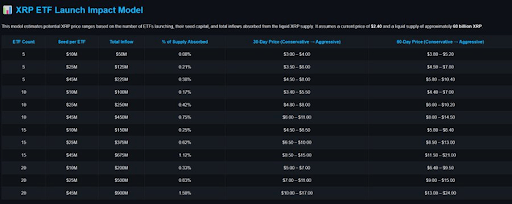
XRP
Source: Chart from Chad from X

Chad also revealed how the XRP ETFs could spark a supply shock for XRP. He noted that the OTC desks will initially run cover for the ETFs, but they will inevitably have to buy on public exchanges at some point. The analyst revealed that the XRP supply on exchanges is 2.8 billion, an amount that he expects the ETFs should be able to buy up. 

At the time of writing, the XRP price is trading at around $2.25, up in the last 24 hours, according to data from CoinMarketCap.

XRP
XRP trading at $2.26 on the 1D chart | Source: XRPUSDT on Tradingview.com
Featured image from Pxfuel, chart from Tradingview.com
Editorial Process for bitcoinist is centered on delivering thoroughly researched, accurate, and unbiased content. We uphold strict sourcing standards, and each page undergoes diligent review by our team of top technology experts and seasoned editors. This process ensures the integrity, relevance, and value of our content for our readers.

Scott Matherson is a leading crypto writer at Bitcoinist, who possesses a sharp analytical mind and a deep understanding of the digital currency landscape. Scott has earned a reputation for delivering thought-provoking and well-researched articles that resonate with both newcomers and seasoned crypto enthusiasts. Outside of his writing, Scott is passionate about promoting crypto literacy and often works to educate the public on the potential of blockchain.

Leituras Relacionadas

Harvard University May Have Lost $150 Million in Cryptocurrency Trading! Has Liquidated Ethereum and Significantly Reduced Bitcoin ETF Holdings

Harvard University's endowment fund, Harvard Management Company (HMC), significantly reduced its cryptocurrency holdings in Q1 2026, reportedly incurring substantial losses. According to its latest 13F filing, HMC completely sold off its position in the BlackRock Ethereum ETF (ETHA) and cut its BlackRock Bitcoin ETF (IBIT) holdings by 43%, leaving a position worth approximately $117 million. This marks a sharp decline from a peak public crypto allocation of $443 million just two quarters prior. Analysis suggests these trades resulted in estimated losses exceeding $150 million, with Bitcoin positions sold at an average loss of around 28% and Ethereum positions at roughly 35%. The moves have sparked debate on whether HMC engaged in counterproductive "buy high, sell low" behavior. The article contextualizes HMC's crypto journey, beginning with its initial disclosed investment in IBIT and gold ETF GLD in Q2 2025 as an "inflation hedge." Aggressive buying in Q3 2025 made IBIT its largest single public holding at 20% of the portfolio, coinciding with Bitcoin nearing all-time highs. Subsequent trimming began in Q4 2025, with an initial foray into ETHA. Explanations for the recent drastic cuts extend beyond market timing. Harvard faces significant financial pressure, including an annual operating deficit and a major increase in endowment tax rates. With illiquid assets like private equity dominating the portfolio, the highly liquid crypto ETFs became the most practical source for necessary portfolio rebalancing and liquidity. Furthermore, the impending retirement of HMC's CEO adds a layer of reputational risk to holding volatile assets. The article contrasts Harvard's retreat with other institutions, such as Mubadala's continued accumulation of Bitcoin ETFs and Dartmouth's expansion into staking-oriented crypto products. It concludes that HMC's actions reflect a complex interplay of fiscal needs, risk management, and institutional constraints rather than simple speculative trading, highlighting how traditional finance logic applies to crypto within large endowment portfolios.

链捕手Há 5m

Harvard University May Have Lost $150 Million in Cryptocurrency Trading! Has Liquidated Ethereum and Significantly Reduced Bitcoin ETF Holdings

链捕手Há 5m

WSJ: Unveiling the Secret Jury That Controls Disputes on Polymarket

Last month, Garrick Wilhelm lost a $567 bet on the Polymarket prediction platform about whether a ceasefire would be reached with Hezbollah. When a truce was announced, some traders argued it counted, but Wilhelm disagreed. The dispute was settled not by Polymarket, but by a decentralized group of UMA token holders who vote on such disagreements. As trading surges, resolving ambiguous outcomes is a growing challenge for prediction markets. Unlike competitors like Kalshi that decide internally, Polymarket outsources dispute resolution to UMA. Its token holders, mostly anonymous and with voting power weighted by holdings, arbitrate cases. Critics argue this system is prone to manipulation, as voters can also bet on the same markets they judge. A Wall Street Journal analysis found that over the past year, at least 60% of active UMA voters had corresponding Polymarket accounts and held positions in disputes they voted on. Voting power is also concentrated among a few large holders. Polymarket says only 0.2% of bets go to UMA and that the system disperses authority. Its founder has acknowledged flaws and promised fixes. UMA's backers deny any proven manipulation, dismissing critics as sore losers. The platform penalizes voters in the minority to incentivize "correct" outcomes. Disputes are rising, covering topics from a streamer's pregnancy announcement to Iran. This model also helps Polymarket argue it's an offshore platform outside U.S. regulation, a shift made after a 2022 settlement with the CFTC. Some losing traders have formed groups to protest, targeting entities like UMA.rocks, which aggregates votes. Its founder says traders often blame UMA for their own mistakes. A recently ousted committee member, Scout, admitted to both betting and voting but argued involved voters research more thoroughly. He highlighted the dilemma: "Either you have conflicted traders deciding, or you have uninformed outsiders voting. There is no perfect answer right now."

marsbitHá 42m

WSJ: Unveiling the Secret Jury That Controls Disputes on Polymarket

marsbitHá 42m

China's AI Circle Has Just Established a Pecking Order, and Capital Is Already Changing the Rules Again

The article describes how the valuation logic for major Chinese AI model companies has undergone three dramatic shifts between 2022 and 2026, driven by capital's changing priorities. The first phase (around 2022) was **technology-driven valuation**, where funding was based on model performance and benchmark scores. This logic was disrupted when DeepSeek's R1 model demonstrated that comparable capabilities could be achieved at a fraction of the cost, challenging the notion of technical superiority as an unassailable moat. The second phase shifted to **IPO window-driven valuation**. Following favorable listing conditions in Hong Kong, capital flowed to companies like Zhipu and MiniMax with the clearest path to a public listing. However, this focus on liquidity over fundamentals became apparent as their Annual Recurring Revenue (ARR) lagged far behind international peers like Anthropic. The third and current phase is **national strategy-driven valuation**. This shift was marked by the state-backed "Big Fund" leading a major investment in DeepSeek, signaling that leading domestic AI models are now viewed as strategic national assets comparable to semiconductor manufacturing. This new logic, combined with soaring US valuation benchmarks (e.g., OpenAI at $850B), propelled the combined valuation of China's top AI firms ("The Four Dragons"/"Five Strong") past 1 trillion RMB. The article presents a "pricing leap model": each shift is triggered by a key event that invalidates the old logic, leading to rapid capital reallocation under a new narrative before its flaws (particularly the gap in fundamental ARR metrics) become evident. It concludes that the next major test for these valuations will be a return to scrutinizing core business fundamentals, specifically ARR growth, suggesting a fourth pricing shift is imminent.

marsbitHá 1h

China's AI Circle Has Just Established a Pecking Order, and Capital Is Already Changing the Rules Again

marsbitHá 1h

'Stock God' Trump's 3,642 Trades Disclosed: The 'Perfect Closed Loop' of Policy and Portfolio

Summary: Donald Trump's First Quarter stock trades, totaling 3,642 transactions, have been disclosed. While the White House maintains the trades were managed by an advisor and complied with disclosure laws, they reveal a portfolio heavily aligned with his policy agenda. The trades show a rotation away from major tech stocks like Microsoft, Amazon, and Meta, and into semiconductor and AI hardware companies such as NVIDIA, AMD, Broadcom, Dell, and Intel. Notably, Trump's account purchased Dell stock before he publicly praised the company, after which its stock rose. The Dell family also pledged funds to a Trump-affiliated policy project. A critical case is Intel. The Trump administration converted $8.9 billion in CHIPS Act subsidies into a 9.9% equity stake, making the U.S. government Intel's largest shareholder. Months later, Trump's personal account also bought Intel stock. This intertwines national industrial policy with potential personal financial interest. Unlike typical insider trading concerns, this situation creates a "closed loop": policy decisions (e.g., subsidies, tariffs, crypto regulation) can boost the value of his holdings, and those holdings may, in turn, influence future policy directions. This blending of presidential power and personal portfolio, while legally disclosed, raises profound questions about conflicts of interest that current rules do not address.

marsbitHá 1h

'Stock God' Trump's 3,642 Trades Disclosed: The 'Perfect Closed Loop' of Policy and Portfolio

marsbitHá 1h

Trading

Spot
Futuros

Artigos em Destaque

Como comprar WIN

Bem-vindo à HTX.com!Tornámos a compra de WINkLink (WIN) simples e conveniente.Segue o nosso guia passo a passo para iniciar a tua jornada no mundo das criptos.Passo 1: cria a tua conta HTXUtiliza o teu e-mail ou número de telefone para te inscreveres numa conta gratuita na HTX.Desfruta de um processo de inscrição sem complicações e desbloqueia todas as funcionalidades.Obter a minha contaPasso 2: vai para Comprar Cripto e escolhe o teu método de pagamentoCartão de crédito/débito: usa o teu visa ou mastercard para comprar WINkLink (WIN) instantaneamente.Saldo: usa os fundos da tua conta HTX para transacionar sem problemas.Terceiros: adicionamos métodos de pagamento populares, como Google Pay e Apple Pay, para aumentar a conveniência.P2P: transaciona diretamente com outros utilizadores na HTX.Mercado de balcão (OTC): oferecemos serviços personalizados e taxas de câmbio competitivas para os traders.Passo 3: armazena teu WINkLink (WIN)Depois de comprar o teu WINkLink (WIN), armazena-o na tua conta HTX.Alternativamente, podes enviá-lo para outro lugar através de transferência blockchain ou usá-lo para transacionar outras criptomoedas.Passo 4: transaciona WINkLink (WIN)Transaciona facilmente WINkLink (WIN) no mercado à vista da HTX.Acede simplesmente à tua conta, seleciona o teu par de trading, executa as tuas transações e monitoriza em tempo real.Oferecemos uma experiência de fácil utilização tanto para principiantes como para traders experientes.

354 Visualizações TotaisPublicado em {updateTime}Atualizado em 2025.03.21

Como comprar WIN

Discussões

Bem-vindo à Comunidade HTX. Aqui, pode manter-se informado sobre os mais recentes desenvolvimentos da plataforma e obter acesso a análises profissionais de mercado. As opiniões dos utilizadores sobre o preço de WIN (WIN) são apresentadas abaixo.

活动图片