Monero Jumps Over 20% This Week as Privacy Narrative Reignites; Why Best Wallet Token Is Riding the Wave

bitcoinistPublicado em 2025-11-10Última atualização em 2025-11-10

Resumo

Quick Facts: ➡️ Monero surges around 20%, reigniting the privacy narrative, as shorts are squeezed and an upgrade pipeline adds...

Trusted Editorial content, reviewed by leading industry experts and seasoned editors. Ad Disclosure

Quick Facts:

  • ➡️ Monero surges around 20%, reigniting the privacy narrative, as shorts are squeezed and an upgrade pipeline adds fundamental support.
  • ➡️ The recent Fluorine Fermi update and the upcoming Full-Chain Membership Proofs are driving $XMR’s next phase of growth.
  • ➡️ Best Wallet ($BEST) has raised $19.6M+ in presale with a token price of $0.025925 and a potential 2,291% ROI by late-2026.
  • ➡️ Best Wallet integrates Fireblocks’ MPC-CMP and a Rubic-powered DEX aggregator, aligning with self-custody demand amid privacy-coin strength.

Privacy just reclaimed the spotlight.

Monero ($XMR) ripped higher this week, roughly a 20% seven-day surge, as traders rotated out of Zcash and into $XMR, aided by a clean technical breakout and an anticipated network upgrade.

The pump retained its momentum, positioning $XMR above the $412 threshold at the time of writing.

This performance stemmed from a sector rotation with $12M in shorts squeezed along the way, which is exactly the kind of flow that revives the entire privacy trade. Coinalyze’s long-short ratio is quite telling in this sense.

$XMR’s long-short ratio.

That shift matters because rotations rarely stop at one ticker; they tend to spill across the stack, from coins to the wallets and rails that service them.

The pump was somewhat expected, given that $XMR’s developers have been busy: their recent Fluorine Fermi update hardened peer selection against spy nodes, and the next big milestone – Full-Chain Membership Proofs – aims to boost privacy and throughput.

That cocktail of technical progress plus fresh momentum is why privacy names are back on your screen.

For traders watching risk rotations, this narrative typically involves demand for tools that simplify private, cross-chain trading.

That’s the bridge to Best Wallet Token ($BEST), the utility token for a mobile-first, non-custodial wallet that bakes strong security and a DEX aggregator into one app. When privacy coins are in use, the wallets that route liquidity – especially across chains – often capture the second-order bid.

Best Wallet Puts MPC Security and Cross-Chain Routing in Your Pocket

The Best Wallet app specs read like a checklist for a privacy-leaning, self-custody cycle: Fireblocks’ MPC-CMP technology under the hood, a built-in DEX aggregator powered by Rubic for both same-chain and cross-chain swaps, and a native token, $BEST, that actually does things.

These include reduced fees, governance, staking boosts, and early access to vetted presales via an ‘Upcoming Tokens’ portal.

The four-phase roadmap details multiple milestones, including a fiat offramp, airdrop launches, a dApps gaming hub, and extensive market intel analytics to keep you connected to the market’s pulse.
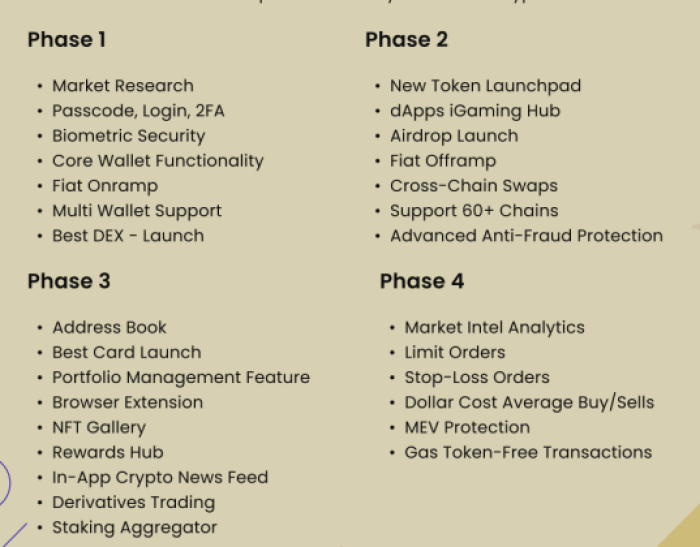
Best Wallet’s four-phase roadmap detailing multiple milestones.

The positioning hits the moment. Privacy assets are rallying, but liquidity and UX remain fragmented. A wallet that routes across 200+ DEXs and dozens of bridges while keeping keys split via MPC reduces the frictions that push you back to centralized venues.

The core app plans support for 60+ chains and is built around mobile UX – arguably the default for retail flow in 2025.
For traders who want to keep activity close to self-custody while chasing momentum across ecosystems, that’s the right blend of convenience and control.

$BEST Momentum: ~$16.9M Raised as the Presale Draws to a Close

Narrative is one thing; presale traction is another – and Best Wallet ($BEST) shows plenty of it.

The presale has reached over $16.9M so far. For a wallet token tied to an active product, that scale of commitment suggests buyers are paying for utility, not promises.

$BEST is currently sitting at $0.025925. Staking, meanwhile, is designed to bootstrap participation rather than offer fantasy yields, with a 77% yearly APY and a 343M-strong pool.
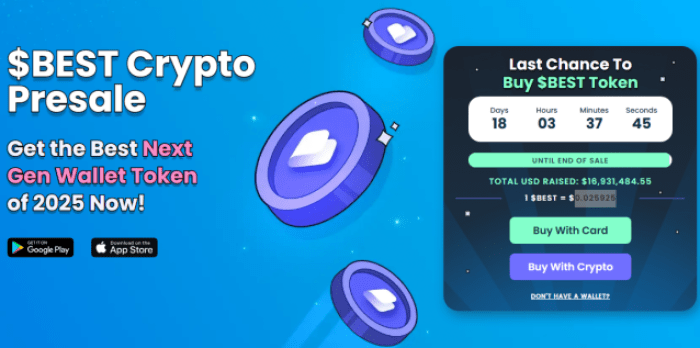
Best Wallet’s amount raised and token price.

Read that as a structured incentive to get in-app behavior moving, not a permanent income machine. High APYs hint at early-stage incentive design; the tell to watch is how quickly rates normalize as TVL grows and whether usage (fee reductions, presale access) keeps holders sticky.

Long-term, Best Wallet aims to capture 40% of the crypto wallet market share by the end of 2026. For this reason, the project has allocated 35% of its 10B total token supply to marketing, and 25% to product development.

Based on the project’s utility and scope, our price prediction for $BEST puts the coin at a potential $0.62 by the end of 2026. This represents a 2,291% one-year ROI if you buy your $BEST tokens at today’s price.

This type of potential recommends Best Wallet Token ($BEST) as one of the best crypto presales of 2025 and beyond. However, the $BEST presale is coming to an end, with just 18 days to go. With plans for a DEX listing at a price of $0.026035, there’s no better time to buy $BEST at its current early-bird price.

🚀 Ready to jump in? Join the $BEST presale while you still can.

Disclaimer: This isn’t financial advice. Always do your own research before making any investment decision.

Authored by Bogdan Patru for Bitcoinist – https://bitcoinist.com/monero-privacy-rally-best-wallet-token-presale-16-9m

Editorial Process for bitcoinist is centered on delivering thoroughly researched, accurate, and unbiased content. We uphold strict sourcing standards, and each page undergoes diligent review by our team of top technology experts and seasoned editors. This process ensures the integrity, relevance, and value of our content for our readers.

As a crypto writer, Bogdan’s responsibilities are split between researching and writing articles and entertaining the team with his humor bordering on the politically incorrect, an aspiring Bill Burr, if you will. Thanks to his 12+ years of writing experience in just as many fields, including tech, cybersecurity, modelling, fitness, crypto, and other topics-that-shall-not-be-named, he's become a genuine asset to the team. While his position as a senior writer at PrivacyAffairs thought him valuable lessons about the power of self-management, his entire writing career was and is an exercise in self-improvement. Now, he's ready to sink his teeth into crypto and teach people how to take control of their own money on the blockchain. With fiat as an eternally devaluing currency, Bitcoin and altcoins seem like the best-fitting alternative for Bogdan. Bogdan’s biggest professional accomplishment, aside from securing a position as a main writer for Bitcoinist, was his 5-year run as a writing manager at Blackwood Productions, where he coordinated a team of four writers. During that time, he learned the value of teamwork and that of creating a working environment that breeds efficiency, positivity, and friendship.

Leituras Relacionadas

The Tokenization of Gold: A Financial Revolution Driven by Regulation

The Tokenization of Gold: A Regulation-Driven Financial Revolution In early 2025, anticipation of US tariffs triggered a rush to withdraw physical gold from the Bank of England, exposing the friction in London's $1.2 trillion gold market. While daily trading of $737 billion occurs via ownership certificates without moving bullion, demand for physical metal revealed a pricing split based on deliverability. This article explores why the UK's Financial Conduct Authority (FCA) is developing rules for tokenized gold, focusing regulation squarely on the ledger system. London's gold market, cleared by four major banks, performs four key functions: physical storage, quality verification, ownership registration, and credit provision. Tokenization excels at the third—offering cheap, precise ownership records—but fundamentally challenges the fourth by potentially rendering banks' credit intermediation obsolete. Currently, most gold is held in "unallocated" accounts, where investors are unsecured creditors of banks, trading speed for credit risk. Tokenized gold combines the instant transfer of unallocated accounts with the direct ownership claim of allocated bullion, eliminating bank risk. The FCA is prioritizing its use as collateral, where speed is critical, unlocking this vast pool of currently illiquid assets for margin calls. This shift is partly driven by post-2008 banking regulations like Basel III's Net Stable Funding Ratio, which penalized banks for holding unallocated gold. The push now comes from the清算 banks themselves, like HSBC, which have launched proprietary tokenization systems. The crucial regulatory decision will be whether these tokens are allowed to circulate outside their creators' closed ecosystems. True adoption will be visible in LBMA data: high overall trading volume paired with a decline in settlements through the traditional central ledger, as transactions move to instant blockchain transfers. Ultimately, tokenization doesn't replace the physical vaults, security, and assayers but could elevate their importance, shifting their revenue to standardized service fees. The revolution lies not in moving the gold, but in reinventing how its ownership is recorded and transferred.

marsbitHá 7m

The Tokenization of Gold: A Financial Revolution Driven by Regulation

marsbitHá 7m

Yield Leverage and Liquidity Leverage: The STONKBROKER Mechanism is Very Suitable for the RWA Scenario

The article argues that the STONKBROKER mechanism is highly suitable for Real-World Asset (RWA) tokenization scenarios due to its two key leverages: **Profit Leverage** and **Liquidity Leverage**. **Profit Leverage:** Traditional RWA models simply tie tokens to real-world asset yields. STONKBROKER's model is more engaging by allowing NFT holders to earn not only the underlying real-world cash flows but also additional yields generated from the on-chain system's own operations and transaction activity (like fees and slippage). This creates a dual income stream. **Liquidity Leverage:** Standard RWA asset bundles often suffer from poor liquidity. STONKBROKER's mechanism, which allows fixed-ratio swapping between NFTs and a platform's fungible token (and vice versa), solves this. It provides real-time market pricing and flexible exit options for each "RWA asset" NFT by unifying NFT liquidity with ERC-20 token liquidity via an AMM pool. This enhances capital efficiency and attracts more trading activity. The article further speculates on applying this model to broader RWAs (e.g., real estate, bonds). The core idea is to create a more dynamic, liquid, and profitable ecosystem where ordinary users can participate, combining real-world yields with the speculative and transactional energy of a crypto-native system. The author mentions being inspired by the launch of a project called @TheCardWall, which tokenizes high-grade physical trading cards.

marsbitHá 28m

Yield Leverage and Liquidity Leverage: The STONKBROKER Mechanism is Very Suitable for the RWA Scenario

marsbitHá 28m

Deciphering TapeOut: A Child Built a CPU On-Chain

**Title: Understanding TapeOut: A Kid Built a CPU On-Chain** **Summary:** The article explores a remarkable experiment where a young developer named Blonskr has used blockchain technology to build a functional, on-chain CPU. Named "Behemoth," this CPU is based on the 1971 Intel 4004 processor specification. It runs on the BNB Chain, uses block production as its clock (running at a glacial 2.22 Hz), and is perhaps the slowest CPU in existence, yet it represents a novel and intriguing concept in the on-chain space. The core concept is the TapeOut protocol, named after the final "tape out" stage in semiconductor manufacturing. It treats the blockchain as a silicon wafer, with tokens representing fundamental logic components. The protocol's atomic unit is an ERC-1155 token representing a single NAND gate, the fundamental building block of digital logic. Users can visually design circuits on a "canvas," connecting these logic tokens. Once a design is finalized, the underlying tokens are burned, and an ERC-721 NFT representing the permanent, immutable circuit is minted. Blonskr used 2,300 such tokenized NAND gates to construct the Behemoth CPU. Key features of this and any TapeOut circuit include **permanent operation** (running as long as the chain exists), **free, permissionless evaluation** (anyone can query it without gas), and **safe composability** (circuits cannot call external contracts or modify state, making them inherently safe to use). This enables a new form of open, collaborative hardware design, where anyone can build upon and integrate components created by others. While highly niche, TapeOut reimagines the foundations of computation using blockchain's properties of permanence and openness. It pushes the boundaries of what can be built on-chain, potentially enabling future applications like custom mining circuits or decentralized, specialized processors. The experiment demonstrates an exciting combination of extreme technical vision and creative curiosity.

marsbitHá 1h

Deciphering TapeOut: A Child Built a CPU On-Chain

marsbitHá 1h

Novig Sues Wisconsin as Sports Prediction Market Dispute Heats Up

Novig, a sports event prediction market operator, has filed a lawsuit against Wisconsin's attorney general. The legal dispute centers on whether prediction markets fall under federal derivatives regulations or state gambling laws. The lawsuit, filed in a U.S. district court, seeks a declaratory judgment after Novig began offering event contracts to Wisconsin residents. This case is part of a broader conflict. In April, Wisconsin sued other prediction market platforms like Kalshi and Polymarket, alleging their sports-related contracts violate state gambling laws. Novig argues its contracts are "swaps" regulated exclusively by the federal Commodity Futures Trading Commission (CFTC), under the Commodity Exchange Act. Wisconsin contends they are sports betting. Federal courts have issued conflicting rulings on similar cases, creating legal uncertainty. The outcome is significant as prediction markets are a fast-growing sector, with trading volume reaching $9.5 billion on a single day in August. These markets are also increasingly intertwined with cryptocurrency infrastructure. Simultaneously, Novig is pursuing a nationwide legal strategy, having filed similar lawsuits in four other states. The company also recently secured a marketing partnership with the New York Mets, marking the first such deal with an MLB team. The Wisconsin case's resolution will influence whether prediction markets can operate as national financial products or remain constrained by individual state laws.

cryptonews.ruHá 1h

Novig Sues Wisconsin as Sports Prediction Market Dispute Heats Up

cryptonews.ruHá 1h

Trading

Spot
活动图片