A $50 Million Funding Round Ignites Airdrop Expectations, Making Variational the New Focus in Perp DEX

marsbitPublicado em 2026-05-21Última atualização em 2026-05-21

Resumo

Perp DEX Variational has become a focal point in the airdrop community following its announcement of a $50 million Series A funding round led by Dragonfly Capital, with participation from Bain Capital Crypto and CoinBase Ventures. The news caused a significant pre-market price surge. Variational is a zero-fee perpetual decentralized exchange built on Arbitrum, notable for its "brokerage-style" model that aggregates liquidity from various sources. It currently ranks fourth in open interest among Perp DEXs and is the only top-five platform yet to issue a token. The primary way for users to participate is through its "Trade to Earn" points program, designed to reward organic trading activity. The system includes benefits for early users, a tiered rewards structure based on trading volume, and a referral program. The platform has committed to allocating approximately 50% of its token supply to the community. While an exact Token Generation Event (TGE) date has not been announced, official documentation indicates the points program will run at least until the end of Q3 2026. Prediction markets currently suggest a TGE is more likely in Q4 2026.

Author | Asher(@Asher_ 0210)
A funding announcement has made the Perp DEX Variational the hottest topic in the airdrop hunting community.

Last night, Variational announced the completion of a $50 million Series A funding round, led by Dragonfly Capital, with participation from Bain Capital Crypto and Coinbase Ventures. Following the news, Variational's pre-market price surged over 36% in a short period, once touching $6.9 (corresponding to an FDV of $690 million), and has since retraced, currently quoted at $6.1 (corresponding to an FDV of $610 million).
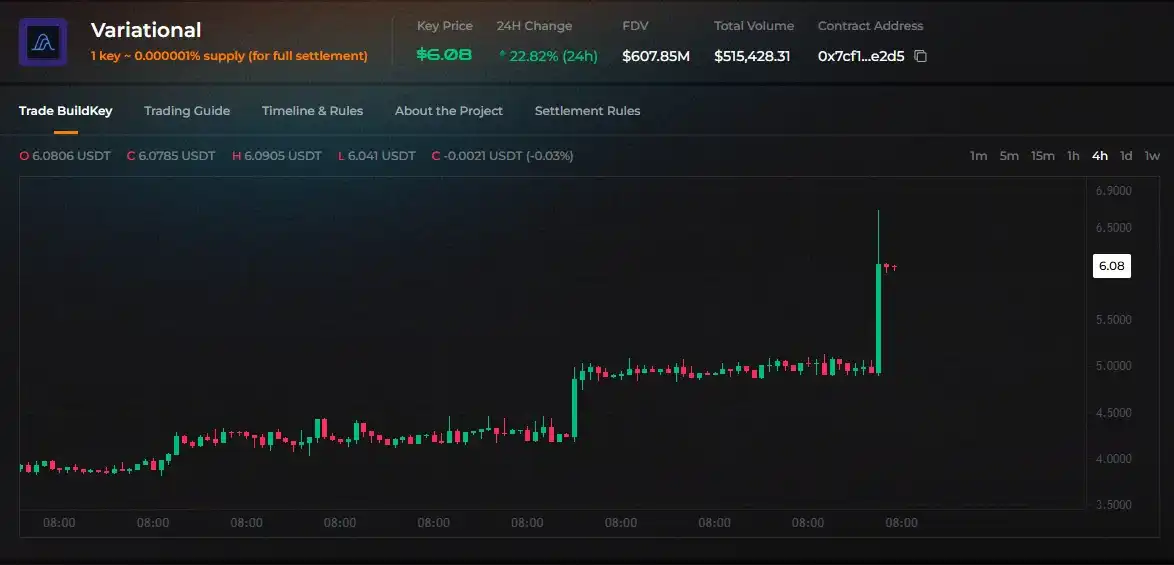
Variational Pre-market Price Movement

Furthermore, the probability of the event "Variational's FDV exceeds $500 million one day after listing" on the prediction platform predict.fun has risen to 57%; the probability for "Variational's FDV exceeds $1 billion one day after listing" has risen to 27%.
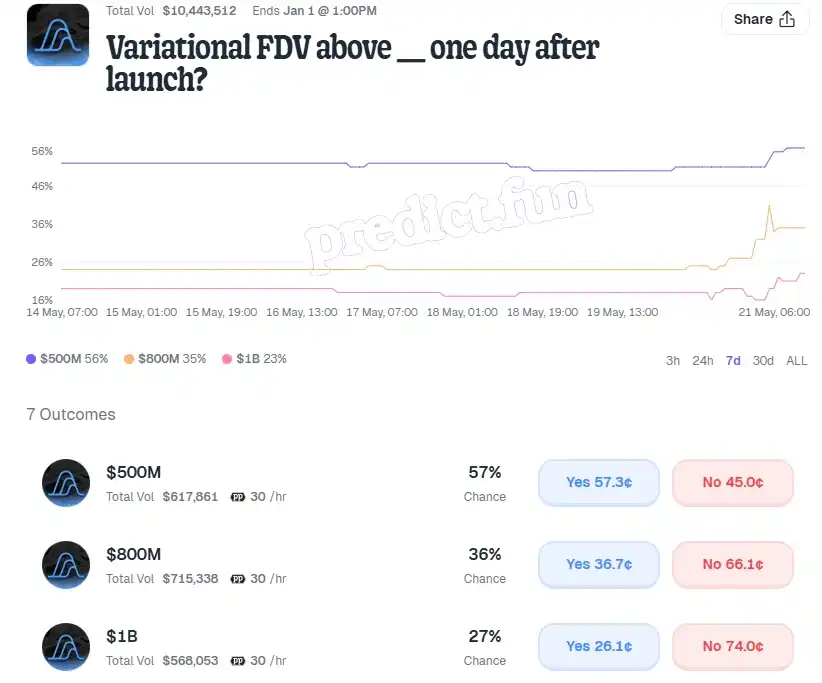
"Variational FDV After One Day of Listing" Prediction Event on predict.fun

Next, Odaily Planet Daily takes you to understand Variational, the rules for trading to earn points, and when the TGE will occur.

Variational: A Zero-Fee Perp DEX Deployed on Arbitrum
Variational is a Perp DEX platform deployed on Arbitrum, with its company headquartered in the Cayman Islands. Its core product is Omni. Simply put, users can trade perpetual contracts for mainstream crypto assets like BTC, ETH, and SOL on Variational, as well as long-tail assets, stocks, commodities, volatility indices, and more types of markets.

Compared to most Perp DEXs, the most intuitive feature of Variational is its zero trading fees. When trading on Omni, the platform does not charge regular transaction fees; the main costs come from spreads, slippage, funding rates, and deposit/withdrawal fees.

Additionally, the underlying design of Variational differs from traditional Perp DEXs. It does not rely solely on internal platform matching or a single liquidity pool to handle trades. Instead, it operates on a "brokerage-like" model connecting to multi-source liquidity, including traditional financial market makers, crypto-native market makers, and major trading platforms, aiming to solve the "cold start liquidity" problem in on-chain markets.

According to DefiLlama data, Variational's trading volume over the past month has exceeded $16 billion, with current open interest exceeding $800 million, ranking fourth in the Perp DEX sector. Notably, among the top five Perp DEXs by open interest, Variational is the only one that has not yet issued a token.
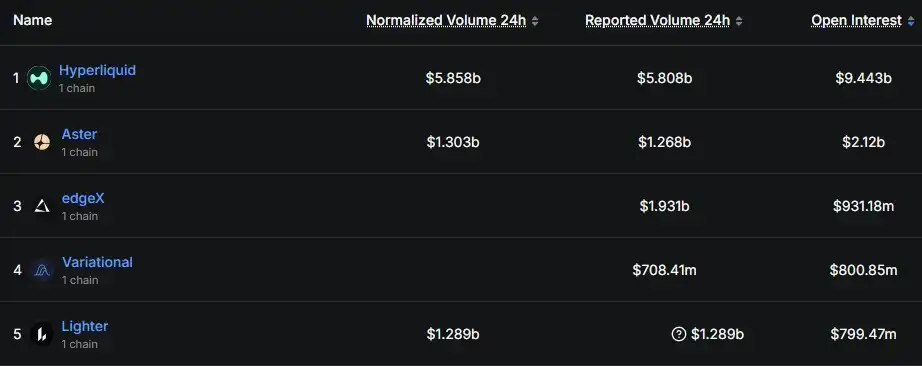
Open Interest Ranking for Perp DEXs

Trading to Earn Points: Detailed Rules for Variational

For regular users, the most direct way to participate in Variational currently is still trading to earn points.

Variational officially launched the Omni Points Program on December 17, 2025, and issued a one-time retrospective airdrop of 3 million points to historical trading users at launch, covering activity up to December 11, 2025. Since then, points are distributed every Friday at 00:00 UTC, counting platform activity from the previous cycle ending at 00:00 UTC on Thursday.

Furthermore, according to the documentation, the project promises that approximately 50% of the token supply will be allocated to the community (through various mechanisms like points, revenue sharing, not just a single airdrop), with plans to use at least 30% of protocol revenue for VAR token buybacks and burns.

The core of Variational's points system is not complex: the more active the trading, the more opportunities to earn points. However, Variational does not simply distribute based on trading volume; it incorporates designs that favor trading quality, specifically including:

  • Points are directly related to user trading activity: The platform rewards page indicates that the points program is designed to reward protocol users, who can earn points through platform activity. The official team reserves the right to adjust points and handle inorganic behavior, meaning that obvious meaningless volume trading or arbitrage-like point farming may be penalized or excluded later;
  • Extra bonus for early users: Accounts that traded before the points program launch enjoy a 10% points boost for points earned subsequently;
  • Introduction of the Reward Tiers system: A user's total trading volume over the past 30 days affects their tier, calculated as personal volume plus 0.2 times the volume from invited users. Different tiers correspond to different point multipliers: Iron at 0%, Bronze at 0.5%, Silver at 1%, Gold at 2%, Platinum at 3%, Diamond at 4%, Infinity at 5%. Among them, Bronze requires a past 30-day Total Volume of $1 million, Silver $5 million, Gold $25 million, Platinum $100 million, Diamond $750 million, Infinity $2.5 billion;
  • Inviting others also brings points and USDC rewards: Inviters receive 5% of the spreads paid by their invitees as USDC rewards. Additionally, every time an invitee earns 10 points, the inviter receives 1 point.

Judging from the rules, Variational's points design leans more towards organic trading rather than pure volume farming. For airdrop hunters, the focus isn't just on completing a single trade, but also on considering whether their trading frequency, capital efficiency, position risk, and point acquisition costs are well-matched.

When Will Variational Conduct Its TGE?

Currently, Variational has not announced a specific TGE date for VAR. However, based on information disclosed in the official documentation, points distribution will continue at least until the end of Q3 2026. Therefore, the community generally expects the TGE to occur in Q3 to Q4 of this year.

Data Source: Variational Official Documentation

Additionally, prediction market pricing leans more towards Q4. Polymarket data shows the probability of the event "Variational will launch its token before September 30th this year" is only 26%, while the probability for "Variational will launch its token before December 31st this year" is 78%.
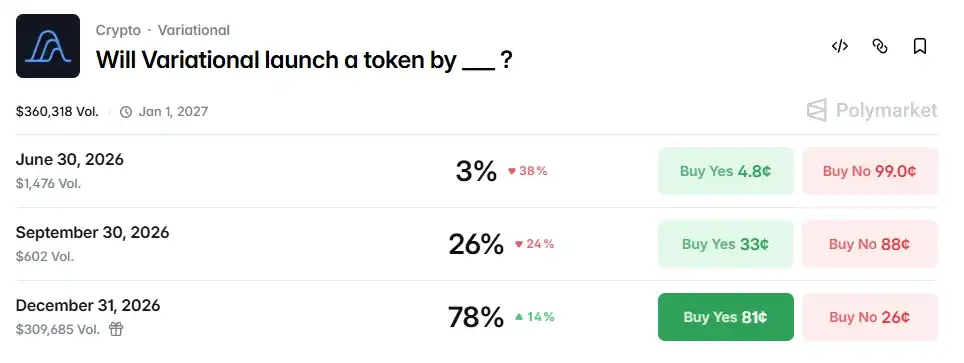
"When Will Variational TGE" Prediction Event on Polymarket


Perguntas relacionadas

QWhat is the key news about the Perp DEX platform Variational discussed in the article?

AThe article discusses that Variational announced the completion of a $50 million Series A funding round, led by Dragonfly Capital, with participation from Bain Capital Crypto and CoinBase Ventures.

QWhat is the most direct way for ordinary users to participate in Variational according to the article?

AAccording to the article, the most direct way for ordinary users to participate in Variational is through its 'Trade-to-Earn' points program.

QWhat is a distinctive feature of Variational's Omni platform compared to most other Perp DEXs?

AA distinctive feature of Variational's Omni platform is zero trading fees for users. The main costs come from the bid-ask spread, slippage, funding rates, and deposit/withdrawal fees.

QWhat is the community's general expectation for Variational's TGE (Token Generation Event) date based on the article?

ABased on the article, the community generally expects the TGE to occur in Q3 to Q4 of this year, as points distribution is scheduled to last until at least the end of Q3 2026. Prediction markets also lean towards a Q4 date.

QHow does Variational's points system differ from a simple volume-based reward model?

AVariational's points system incorporates elements that reward trading quality, not just volume. It includes a Reward Tiers system based on 30-day trading volume (with referral volume factored in), which grants bonus multipliers. It also penalizes inorganic behavior like meaningless wash trading and offers a 10% bonus for early users who traded before the points program launch.

Leituras Relacionadas

RWA Weekly: EU Proposes Revision of MiCA to Cover Tokenization and Non-EU Stablecoins; Swift and 17 Banks to Pilot Tokenized Cross-Border Payments

RWA Weekly: EU Proposes MiCA Revision for Tokenization and Non-EU Stablecoins; Swift to Pilot Tokenized Cross-Border Payments with 17 Banks During the statistical period of July 3-10, 2026, the RWA sector showed signs of recovery. The total on-chain market capitalization of RWAs rebounded to $33.12 billion, ending a prolonged decline. The stablecoin market cap also returned above $300 billion, with active addresses and holders increasing, indicating restored market vitality. Key regulatory developments include China promoting the use of digital yuan in consumption vouchers, the EU considering revisions to its MiCA framework to cover tokenization and non-EU stablecoins, and Kazakhstan authorizing stablecoin use for cross-border corporate and government payments. In Hong Kong, HSBC issued its first "digitally native" structured product. Major project updates feature Swift announcing readiness of its blockchain ledger for a 24/7 tokenized cross-border payment pilot involving 17 global banks. Ondo launched a perpetuals platform allowing tokenized stocks as collateral. Sony received conditional U.S. OCC approval to launch a stablecoin-focused trust bank in 2027. Tether plans to natively issue USDT on Bitcoin via the RGB protocol. Significant funding rounds saw Securitize planning to deploy over $400 million for acquisitions to expand its institutional tokenization business, while Tether invested $20 million in Brazil's Mercado Bitcoin to support its growth in on-chain financial services. Analysis highlights that stablecoins are evolving into global financial infrastructure with regional specializations and that institutions should consider international expansion to gain practical experience in the RWA tokenization space amidst evolving regulations.

marsbitHá 21m

RWA Weekly: EU Proposes Revision of MiCA to Cover Tokenization and Non-EU Stablecoins; Swift and 17 Banks to Pilot Tokenized Cross-Border Payments

marsbitHá 21m

The first to catch the wave of the Robinhood Chain hype is Arbitrum, up nearly 20%

"ARB, the native token of Arbitrum, surged nearly 20% recently, emerging as a top-performing L2 token. This rally is attributed to the launch of 'Robinhood Chain,' a Real-World Asset (RWA) Layer 2 built using Arbitrum's technology. The launch has brought renewed attention to the 'Arbitrum Expansion Plan' (AEP), a year-and-a-half-old program. AEP allows external projects to build their own chains using Arbitrum's Orbit technology. In return, these 'tenant' chains that do not settle on Arbitrum's main networks must share 10% of their net protocol revenue with the Arbitrum ecosystem—8% to the DAO treasury and 2% to the developer guild. While smaller chains like Degen Chain previously triggered AEP, Robinhood Chain is the first major, high-profile tenant, making the revenue-sharing model economically significant for the first time. Initial data from Robinhood Chain is impressive, with over 35 million transactions, 350,000 addresses, $2.5 billion in TVL, and over $1 billion in DEX volume shortly after launch. However, its current protocol revenue, at roughly $146,000 net, translates to only a minimal payout to Arbitrum DAO. The ARB price surge thus reflects the market's anticipation of future revenue as Robinhood's vast $324 billion platform assets potentially migrate on-chain. This 'landlord' model mirrors Optimism's approach with its OP Stack and Superchain. However, Optimism's model faces pressure as its largest tenant, Base, announced plans to depart, causing a significant drop in OP's price. Similarly, analysts question Robinhood Chain's long-term dependence on Arbitrum, noting its daily sequencer revenue already nears three times that of Arbitrum itself. There is speculation that, like Base, it may eventually seek independence, with ETH potentially being its primary economic token rather than ARB."

Foresight NewsHá 49m

The first to catch the wave of the Robinhood Chain hype is Arbitrum, up nearly 20%

Foresight NewsHá 49m

The Ethereum Foundation is Dead, The Era of Ethereum's Pluralistic Organizations Has Dawned

The Ethereum Foundation (EF) has announced the dissolution of its Protocol Support Team, marking a significant organizational shift. This move, described as the largest layoff in EF's history with a 20% staff reduction, follows a major internal restructuring announced in late June. The restructuring, which EF framed as necessary to streamline for future challenges, has drawn criticism for its perceived cold execution. Concurrently, several new independent non-profit organizations have emerged, founded by former EF members. These include Ethlabs, a research and development lab, and Ethereum Institutional, which focuses on promoting institutional adoption of Ethereum. Their rise is seen as both filling roles vacated by EF's downsizing and signaling a fragmentation of the Ethereum ecosystem's leadership. Amidst these changes, EF is also integrating advanced AI tools into its security operations. The security team has begun using AI agents to conduct red-team testing, which has already uncovered vulnerabilities in Ethereum's code. While EF states that AI complements rather than replaces human researchers, this technological shift hints at potential future reductions in human-centric roles within the organization. The article posits that these developments—massive layoffs, the exodus of key personnel like former Executive Director Xiaowei Wang, the rise of rival organizations, and AI integration—collectively point to a decline in EF's central authority. Once the undisputed leader of the Ethereum ecosystem, EF now faces questions about its future role, with speculation that it may evolve into more of a symbolic "ecosystem mascot" rather than a driving force for growth and adoption. This organizational turmoil unfolds against a backdrop of ongoing market pressure and community debate over Ethereum's value proposition.

marsbitHá 54m

The Ethereum Foundation is Dead, The Era of Ethereum's Pluralistic Organizations Has Dawned

marsbitHá 54m

Trading

Spot
活动图片