Hong Kong approves first-ever Solana ETF: Why it’s a ‘sweet zone’ for SOL

ambcryptoPublicado em 2025-10-22Última atualização em 2025-10-23

Key Takeaways

When will the Solana ETF be listed?

The ETF is set to be listed on the 27th of October, with 100 units per lot and a minimum entry of around $100.

How is the Solana market reacting to this approval?

Solana is trading near $186.24, down slightly by 0.25%, but analysts remain bullish, predicting potential targets between $300 and $400.


In a landmark development for Asia’s crypto market, Hong Kong has given the green light to the region’s first-ever Solana [SOL] exchange-traded fund (ETF). 

Scheduled for listing on the 27th of October, the ETF will offer investors regulated exposure to Solana’s market performance without requiring direct ownership of the token, with 100 units per lot and a minimum entry of around $100.

Needless to say, the approval already stirred optimism across the market, with some analysts predicting SOL could soar to $400. 

Details of the Hong Kong-approved Solana ETF

That said, the product now joins ChinaAMC’s suite of spot Bitcoin [BTC] and Ethereum [ETH] ETFs, reinforcing Hong Kong’s growing position as a hub for digital asset innovation.

Additionally, as per the filing, the newly approved Solana ETF will carry a management fee of 0.99%, with additional custody and administrative costs potentially bringing the total annual expense ratio to around 1.99%.

This happened at a time when Solana was trading at $186.24, marking a slight 0.25% dip in the past 24 hours, according to CoinMarketCap.

Yet, despite the minor pullback, analysts remain bullish.

For instance, one crypto strategist described SOL as being in its “sweet zone,” identifying ideal entry levels below $200 and forecasting potential price targets between $300 and $400, citing an attractive risk-to-reward setup for traders.

He said, 

“Price is still sitting in the sweet zone, but not for long — this week is your window before the next explosive move.”

What’s more in the ETF space?

This further coincided with VanEck filing its fifth amendment for a Spot SOL ETF.

Now, as VanEck awaits regulatory clearance for its Spot Solana ETF, broader market activity around digital asset funds continues to accelerate.

Like, spot Bitcoin ETFs saw inflows totaling $477.2 million, with BlackRock’s IBIT leading the charge.

While spot Ethereum ETFs attracted $141.7 million, driven primarily by Fidelity’s FETH, according to data from Farside Investors.

These robust inflows highlight sustained institutional interest in crypto-linked investment vehicles despite ongoing regulatory delays.

If approved, VanEck’s Solana ETF could become another key addition to this growing ecosystem. 

Share

Criptomoedas em alta

Leituras Relacionadas

Jameson Lopp's BIP-110 Postmortem: Bitcoin Is Driven by Game Theory, Not Morality

Jameson Lopp's analysis concludes that BIP-110, a proposal to restrict arbitrary data (like inscriptions) on Bitcoin, failed due to economic and technical realities, not moral arguments. The proposal, championed by Luke Dashjr and others, aimed to "cleanse" the chain but never reached its 55% miner activation threshold. Upon its forced signaling deadline in August, only the OCEAN pool (with ~1% hash rate) supported it, creating a short-lived fork that quickly died as miners faced unredeemable block rewards. Lopp's earlier predictions about its economic infeasibility were proven correct. Technically, BIP-110 was flawed; workarounds to embed data compliant with its rules were demonstrated almost immediately, proving it couldn't achieve its stated goal. The debate often devolved into moralistic rhetoric, with supporters accusing opponents of supporting child exploitation material—a tactic Lopp criticizes as ineffective for building consensus. Lopp argues Bitcoin is driven by incentives and game theory, not morality. Past forks like Bitcoin Cash promised economic benefits, while BIP-110 offered only restrictions and reduced miner fees, gaining no substantial support from major economic players. He predicts the "puritans" behind the failed fork will continue complaining but their new chain will remain insignificant. The episode reaffirms that attempting to censor data on a permissionless, anti-censorship network like Bitcoin is a futile battle.

marsbitHá 18m

Jameson Lopp's BIP-110 Postmortem: Bitcoin Is Driven by Game Theory, Not Morality

marsbitHá 18m

Tokenization Scale Soars to $4.3 Billion, But Why Did Securitize Incur a $5.5 Million Loss?

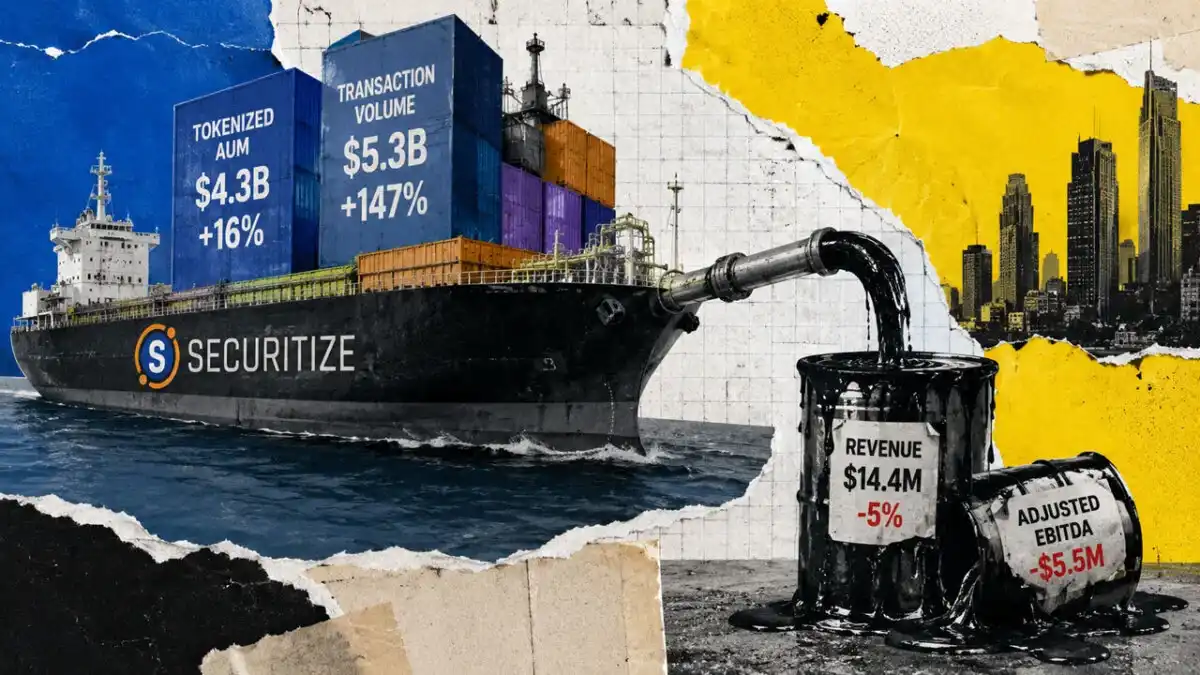
Securitize's first quarterly report post-IPO reveals a paradox: while its tokenized assets under management hit a record $4.3 billion (up 16% YoY) and platform trading volume surged 147% to $5.3 billion, total revenue fell 5% to $14.4 million. Tokenization revenue specifically dropped ~12% to $7.8 million, leading to an adjusted EBITDA loss of $5.5 million. CFO Francisco Flores explained that most trading volume is not yet monetized, with the majority of tokenization revenue still coming from one-time projects like new protocol integrations. In contrast, asset servicing revenue, a more recurring stream, grew slightly to $6.6 million. The company has lowered its full-year revenue guidance to $70-$80 million from an initial projection of $110 million. Industry experts note this highlights a structural challenge for the tokenization sector. Scaling assets on-chain doesn't automatically scale a profitable business model. Current implementations often rely on costly, customized projects for each new asset or jurisdiction. The future, they argue, lies in building standardized infrastructure that generates recurring "infrastructure revenue" from post-issuance activities like compliance, distributions, and secondary trading—similar to enterprise software. Analysts caution against misinterpreting high trading volumes as indicative of a mature fee-based model, as Securitize's broad volume metric includes many non-monetized actions. The key test for the industry is whether adding billions in new assets can generate sustainable revenue without constant new custom projects.

marsbitHá 21m

Tokenization Scale Soars to $4.3 Billion, But Why Did Securitize Incur a $5.5 Million Loss?

marsbitHá 21m

The Five Paradoxes of Artificial Intelligence

**Five Paradoxes of Artificial Intelligence** Artificial intelligence (AI) is an era filled with paradoxes, which we navigate as we advance. **1. The Prediction Paradox** AI experts, from pioneers like Marvin Minsky to contemporary figures like Geoffrey Hinton and Demis Hassabis, have a history of inaccurate forecasts regarding AI's capabilities and timelines, such as achieving human-level machine intelligence or surpassing radiologists. Predictions about Artificial General Intelligence (AGI) vary wildly between optimistic entrepreneurs and skeptical academics, highlighting the inherent unpredictability of technological futures. **2. The Employment Quantification Paradox** Despite numerous studies from institutions like the OECD, IMF, and McKinsey attempting to quantify AI's impact on jobs, estimates of affected employment range from 0.4% to 67%, revealing vast inconsistencies. This paradox arises because isolating AI's effect from other economic, social, and technological factors is virtually impossible, and forecasts depend on static assumptions about a dynamically evolving technology. **3. The Productivity Paradox** While AI is a transformative General Purpose Technology, significant productivity growth has not yet materialized in major economies like the EU and has only matched historical averages in the US. This disconnect between rapid innovation and slow productivity gains, reminiscent of the "Solow Paradox" from the computer age, is often explained by time lags. History shows it takes decades for such technologies to diffuse and trigger complementary innovations that boost productivity. **4. The Data Value Paradox** Data is hailed as the "new oil" and critical for AI, yet its economic value is paradoxical. Its worth is realized only in use, not in straightforward trade. Despite policy emphasis and initiatives for data asset recognition on corporate balance sheets in China, the monetized value remains negligible—accounting for only about 0.06% of major telecom operators' total assets—highlighting the gap between perceived utility and financial valuation. **5. The Industrial Revolution Paradox** For decades, nearly every major new technology, from the internet and nanotechnology to blockchain and now AI, has been proclaimed as the driver of a "Fourth Industrial Revolution." This constant reassignment suggests prior labels were premature. True industrial revolutions are typically identified in hindsight, not in real-time. Furthermore, the coexistence of such a proclaimed transformative revolution with ongoing economic crises would be historically anomalous. Whether AI truly defines a new industrial revolution remains a narrative for the future to decide.

marsbitHá 23m

The Five Paradoxes of Artificial Intelligence

marsbitHá 23m

Trading

Spot

Artigos em Destaque

O que é OUST

A Ouster, Inc. dedica-se à produção e venda de kits de sensores lidar para as indústrias automóvel, industrial, robótica e de infraestruturas inteligentes nas Américas, na Ásia-Pacífico, na Europa, no Médio Oriente e em África. A empresa oferece a linha de produtos Outer Sensor (OS), incluindo o OSDome que proporciona um campo de visão hemisférico; OS0 para visão ampla; OS1, para visão de médio alcance; e OS2 para visão de longo alcance. Também fornece a série DF, um conjunto de sensores lidar digitais de estado sólido de curto, médio e longo alcance para sistemas avançados de assistência ao condutor (ADAS) e sistemas de condução autónoma.

88 Visualizações TotaisPublicado em {updateTime}Atualizado em 2026.08.18

O que é OUST

Como comprar OUST

Bem-vindo à HTX.com!Tornámos a compra de OUST (OUST) simples e conveniente.Segue o nosso guia passo a passo para iniciar a tua jornada no mundo das criptos.Passo 1: cria a tua conta HTXUtiliza o teu e-mail ou número de telefone para te inscreveres numa conta gratuita na HTX.Desfruta de um processo de inscrição sem complicações e desbloqueia todas as funcionalidades.Obter a minha contaPasso 2: vai para Comprar Cripto e escolhe o teu método de pagamentoCartão de crédito/débito: usa o teu visa ou mastercard para comprar OUST (OUST) instantaneamente.Saldo: usa os fundos da tua conta HTX para transacionar sem problemas.Terceiros: adicionamos métodos de pagamento populares, como Google Pay e Apple Pay, para aumentar a conveniência.P2P: transaciona diretamente com outros utilizadores na HTX.Mercado de balcão (OTC): oferecemos serviços personalizados e taxas de câmbio competitivas para os traders.Passo 3: armazena teu OUST (OUST)Depois de comprar o teu OUST (OUST), armazena-o na tua conta HTX.Alternativamente, podes enviá-lo para outro lugar através de transferência blockchain ou usá-lo para transacionar outras criptomoedas.Passo 4: transaciona OUST (OUST)Transaciona facilmente OUST (OUST) no mercado à vista da HTX.Acede simplesmente à tua conta, seleciona o teu par de trading, executa as tuas transações e monitoriza em tempo real.Oferecemos uma experiência de fácil utilização tanto para principiantes como para traders experientes.

35 Visualizações TotaisPublicado em {updateTime}Atualizado em 2026.08.18

Como comprar OUST

O que é KR200

O KOSPI 200 é o índice de referência de blue-chips da Coreia do Sul, que acompanha as 200 principais ações de grande capitalização e alta liquidez listadas na Bolsa de Valores da Coreia (KRX). Abrange líderes de setor como a Samsung e a SK Hynix, e serve como o principal subjacente para derivados de ações coreanas e para a comparação institucional global.

12 Visualizações TotaisPublicado em {updateTime}Atualizado em 2026.08.19

O que é KR200

Discussões

Bem-vindo à Comunidade HTX. Aqui, pode manter-se informado sobre os mais recentes desenvolvimentos da plataforma e obter acesso a análises profissionais de mercado. As opiniões dos utilizadores sobre o preço de A (A) são apresentadas abaixo.

活动图片