Прибыльность майнинга биткоина сократилась на 7%

cryptonews.ruPublicado em 2025-12-19Última atualização em 2025-12-19

В сентябре рентабельность добычи первой криптовалюты упала более чем на 7% а суточный доход на 1 EH/s хешрейта сократился с $56 000 до $52 000. Об этом пишет CoinDesk со ссылкой на отчет Jefferies.

Специалисты инвестиционного банка обозначили в числе главных причин обвала прибыльности майнинга просадку цены биткоина на 2% за месяц и совокупных рост вычислительных мощностей сети примерно на 9%.

В начале IV квартала хешрейт немного сократился, снижая конкуренцию, но резкая коррекция актива усилила давление на экономику его добычи, подчеркнули эксперты.

Их оценку подтверждают данные Hashrate Index. После масштабной коррекции крипторынка 11 октября хешпрайс стабильно находится ниже отметки $49 за PH/s в сутки. Более низкие значения метрики в это году фиксировались в апреле, когда курс биткоина обвалился ниже $90 000.
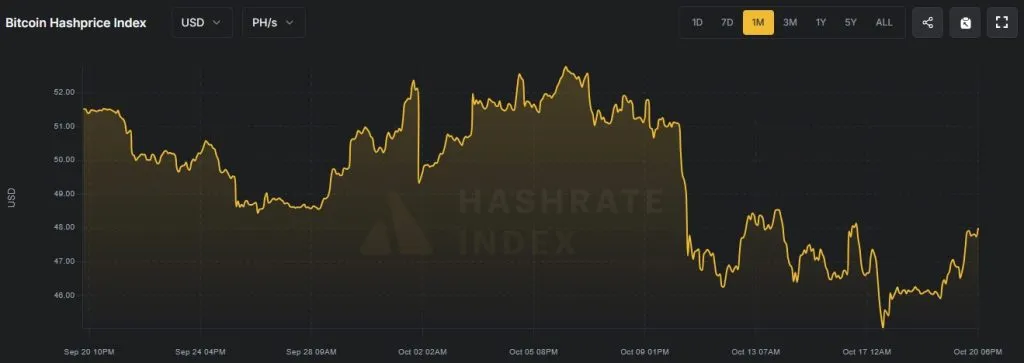
Источник: Hashrate Index.

Базирующиеся в США публичные майнинговые компании за сентябрь сгенерировали 3401 BTC против 3576 месяцем ранее.

Лидером выступила MARA Holdings, намайнившая 736 BTC, на втором месте оказалась CleanSpark с 629 BTC. У этих же фирм наиболее высокий развернутый хешрейт — 60,4 EH/s и 50 EH/s соответственно.

Однако, несмотря на снижение прибыльности добычи, акции майнеров стремительно растут. Согласно отчету TheMinerMag, капитализация 15 крупнейших американских компаний индустрии к середине октября достигла $90 млрд. С 15 сентября котировки Bitfarms выросли на 162%, стоимость Canaan прибавила 149%, а CleanSpark — 125%. За этот период биткоин упал на 3,7%.

Основным фактором такого резкого расхождения трендов эксперты назвали «ИИ-разворот» добытчиков криптовалюты. Преимуществом добытчиков криптовалюты на фоне бума сферы высокопроизводительных вычислений стал уже имеющийся доступ к энергоресурсам и готовая инфраструктура.

Майнеры расширяют диверсификацию в ИИ-вычисления

Одной из крупнейших сделок в этом направлении стала покупка в июле ИИ-гиперскейлером CoreWeave оператора майнинг-центров Core Scientific за $9 млрд.

В августе Google увеличила долю в TeraWulf до 14% через расширение финансовых гарантий до $3,2 млрд для сделки между майнером и облачной ИИ-платформой Fluidstack. В сентябре майнинговая компания анонсировала привлечение примерно $3 млрд на строительство дата-центров через поддерживаемую технологической корпорацией структуру.

В том же месяце Google помогла Fluidstack заключить арендное соглашение с еще одним добытчиком криптовалюты — Cipher Mining. Корпорация гарантировала выполнение английским стартапом обязательств на сумму $1,4 млрд в обмен на 5,4% акций майнера.

О расширении подразделения облачных вычислений AI Cloud в августе объявила IREN, инвестировав около $193 млн в графические процессоры NVIDIA Blackwell B200. На тот момент компания входила в четверку майнинговых компаний с хешрейтом не менее 50 EH/s наряду с MARA, CleanSpark и Cango. В TheMinerMag отметили, что из этого квартета только IREN начала экспансию в ИИ.

20 октября в CleanSpark заявили о переходе от «чистого майнинга» к высокопроизводительным вычислениям (HPC).

Monetize every megawatt. https://t.co/5JGWnrSACd

— Harry Sudock (@harry_sudock) October 20, 2025

Компания наняла на должность вице-президента по центрам обработки данных на базе ИИ ветерана индустрии Джеффри Томаса.

Bitdeer в отчете об операционной деятельности за сентябрь анонсировала планы по перепрофилированию майнингового объекта в Норвегии для оказания услуг в сегменте HPC. С этой же целью фирма расширит уже имеющиеся ИИ-мощности в Юго-Восточной Азии и США.

Напомним, в августе эксперты GoMining спрогнозировали волну институциональных инвестиций в биткоин-майнинг на фоне бума ИИ-вычислений.
Leituras Relacionadas

NVIDIA CPU Advances, China's RISC-V Responds: Semiconductor Deep Dive - Part Four

NVIDIA is set to launch its new Vera AI data center CPU in China as early as August, with high pricing. While this move offers a new option, it highlights China's continued dependence on foreign-controlled Arm architecture. In response, the Chinese semiconductor industry is increasingly turning to RISC-V as a strategic alternative for achieving high-performance computing autonomy. The article explores the concept of the "impossible triangle" in CPU development—balancing prosperity, control, and autonomy—and posits that RISC-V's open-source, modular nature offers a unique path to achieving all three. While RISC-V is already dominant in embedded systems, the focus is now shifting to data centers and AI workloads. China has become a global hotspot for RISC-V development, driven by AI-driven compute demand, supply chain concerns from export controls, cost benefits of open-source, and strong policy support. Multiple Chinese companies have reportedly crossed the key performance threshold of 15 SPECint per GHz, a benchmark for entering the high-performance CPU club. Progress extends beyond single-core benchmarks. Companies are developing complete computing subsystems, including commercial-grade coherent network-on-chip (NoC) technology and server processors with up to 40 cores that strictly adhere to the RVA23 standard to ensure software compatibility. Real-world applications are emerging in areas like video transcoding and edge AI. However, significant challenges remain. The RISC-V ecosystem faces fragmentation, immature toolchains and verification processes, and gaps in single-core performance and energy efficiency compared to mature x86 and Arm architectures. The formidable software moat, epitomized by NVIDIA's CUDA, is a long-term hurdle. In conclusion, while RISC-V cannot immediately replace offerings like NVIDIA's Vera, it represents a viable long-term path for China to develop a self-sufficient, high-performance CPU ecosystem. The journey is acknowledged to be long and arduous, requiring sustained effort to overcome technical and ecosystem challenges.

marsbitHá 1h

NVIDIA CPU Advances, China's RISC-V Responds: Semiconductor Deep Dive - Part Four

marsbitHá 1h

My Coding Betting Dashboard is Profiting, but Polymarket is Truly Not a Good Place for 'Arbitrage'

The author built a custom monitoring dashboard for Polymarket, a prediction market platform, and tested it with $1,600, achieving over 30% returns. However, the core argument is that Polymarket is not a good venue for traditional arbitrage. The dashboard has two main sections: a "Portfolio Dashboard" for tracking active positions with key metrics like total capital, P&L, and a risk-control module using a tier system (T1, T2, T3), and an "Opportunity Watchlist" for monitoring markets. The article details a critical structural trap in binary markets: a bet with a high perceived probability of success still carries a 100% loss risk if wrong. The author's T1/T2/T3 system is designed to manage this by limiting position sizes based on conviction and time horizon, emphasizing that high confidence should not equal high concentration. A key insight is the danger of "pseudo-diversification"—betting on different markets driven by the same underlying variable. The author concludes that Polymarket offers few true low-risk, arbitrage opportunities. It is instead a high-risk environment where wins can create a false sense of mastery, leading to large losses. The platform is better viewed as a training ground for honing judgment through disciplined, framework-driven betting rather than a reliable income source. The tools help transform intuition into structured, rule-based decisions to mitigate the risk of catastrophic errors.

marsbitHá 4h

My Coding Betting Dashboard is Profiting, but Polymarket is Truly Not a Good Place for 'Arbitrage'

marsbitHá 4h

WeChat AI Card Hands-On Guide: Has the AI Shopping Era Arrived?

**"WeChat AI Card" Practical Test Guide: Has the Era of AI Shopping Arrived?** WeChat has officially launched the "AI Exclusive Card," a feature integrated into its Workbuddy AI assistant. This card is designed to handle payments for AI-initiated purchases. Our hands-on test reveals it's not yet a tool for fully autonomous AI shopping, but rather a controlled payment layer for AI agents. The AI Card functions as an isolated sub-wallet within WeChat Pay. Users must bind the card and transfer funds into it from their main wallet. Crucially, every transaction requires explicit user confirmation via smartphone scan; AI cannot spend autonomously. Currently accessible through the Workbuddy agent, the card targets specific digital consumption scenarios: purchasing paid content (reports, data), calling paid APIs/tools, and subscribing to services. Its design prioritizes security and control by separating funds and mandating approval for each payment. We tested a real-world scenario: ordering bubble tea via Workbuddy using a "Meituan Life Assistant" skill. The process encountered multiple hurdles: high "skill" usage costs (exceeding daily free credits), and most importantly, while a payment was successfully initiated, the AI purchased an incorrect product (a mismatched group-buy coupon instead of the desired drink). This highlights the current limitation: the **AI Card only solves the payment step**. The broader challenge lies in the **AI agent's execution chain**—accurately understanding intent, navigating third-party platforms, selecting the right product, and ensuring proper fulfillment. The payment succeeded, but the purchase failed to meet the user's need. In conclusion, the WeChat AI Exclusive Card is a cautious, early-step experiment in AI commerce. It provides a secure, user-controlled payment method for agent interactions but is not yet capable of reliable, end-to-end complex purchases. For now, it's best used for low-value, low-risk digital services with careful user verification at each step. The vision of AI handling complete shopping tasks remains a work in progress.

marsbitHá 6h

WeChat AI Card Hands-On Guide: Has the AI Shopping Era Arrived?

marsbitHá 6h

Trading

Spot
Futuros
活动图片