Best Crypto to Buy Now Before Tether Goes Public in Potential $500B Raise

bitcoinistPublicado em 2025-09-24Última atualização em 2025-09-24

Resumo

Crypto heavyweight Tether is reportedly in early-stage discussions to raise between $15-20B in a private equity round, offering about 3%...

Trusted Editorial content, reviewed by leading industry experts and seasoned editors. Ad Disclosure

Crypto heavyweight Tether is reportedly in early-stage discussions to raise between $15-20B in a private equity round, offering about 3% of its equity.

If successful, the deal could peg the company’s valuation at nearly $500B, placing it among the world’s most valuable private firms alongside names like OpenAI and SpaceX, and joining elite company at a stroke.

This would likely raise crypto adoption and investor interest in the industry, creating hype.

It should be high time you paid attention to the best cryptos to buy (like Bitcoin Hyper) if you don’t want to miss this speeding train.

Fundraise Reveals the Scale of Tether’s Ambition

Tether’s deal would involve new equity issuance, rather than existing shareholders selling down their stakes, according to the source.

Cantor Fitzgerald is reported to be the lead advisor; the company owns roughly a 5% stake in Tether already, a share worth $25B if Tether’s IPO achieved the upper range of its valuation.

That’s speculative, of course – the final terms and valuation of the IPO may differ substantially.

Still, the proposed terms indicate just how ambitious Tether’s plans are. Tether issues the $USDT stablecoin, the largest such crypto, with a circulating supply of $173B. That supply has increased steadily over the past year, as demand for stablecoins has grown.
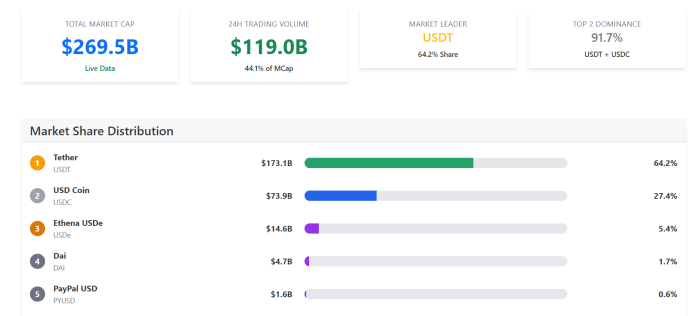
Stablecoin market overview.


More growth means more profits in Tether’s case; the company reported exceptionally strong profitability of $4.9B in Q2 2025 alone. That financial strength gives Tether a powerful base for any IPO plans.

U.S. Push and Regulatory Context

Part of those plans include a move into the U.S. market. Tether appointed Bo Hines, a former U.S. crypto policy official, as strategic adviser, and plans to launch a U.S.-oriented $USAT stablecoin.

USAT presentation page.

Why now? Regulatory headwinds that historically restrained its U.S. operations largely vanished earlier this year with the passing of the GENIUS stablecoin act.

That has created an opportunity for Tether – currently headquartered in South America – to expand and cater its operations to the US market.

Despite the hype, there are several uncertainties. The deal is still preliminary, so the valuation, stake dilution, and raise amount could all shift materially.

There’s also a bigger question; with Tether already highly profitable, why go public at all? Possible reasons include accelerating U.S. expansion, regulatory compliance, product diversification, or building reserves, but investors will want transparency over how the funds are deployed.

Regardless of how this plays out, even rumors of Tether’s move are enough to surge investors’ interest. Here are three of the best cryptos under $1 that could explode soon.

1. Bitcoin Hyper ($HYPER) – Faster, Cheaper, Better Bitcoin Layer 2

Bitcoin’s big, bad, and beautiful, with a $2.2T+ market cap and constant predictions of $150K, $200K, or even $1.5M.

But it’s also slow, with an average of 7 TPS, and has a low throughput; add a lot of traffic, and congestion can cause transaction speeds to drop and fees to jump. That’s where Bitcoin Hyper ($HYPER) comes in.

Leveraging a Canonical Bridge on the Solana Virtual Machine, Bitcoin Hyper introduces a Layer 2 that allows investors to bridge Bitcoin and create wrapped Bitcoin.

On the Hyper Layer 2, that wrapped Bitcoin can be swapped, traded, and deployed across the full range of decentralised finance in a way Bitcoin couldn’t be before now.

dApps, smart contracts, DAOs, NFT marketplaces, even GameFi applications: they could all come alive on Bitcoin through Bitcoin Hyper’s L2.
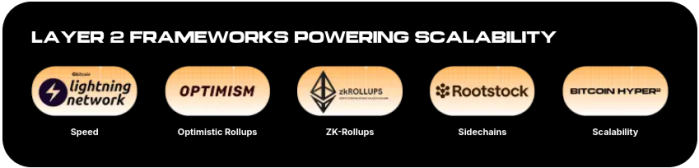
Bitcoin Hyper framework scalability and comparison.

The Bitcoin Hyper presale just passed $18M raised in the presale and shows no sign of slowing down.The token price is now set at $0.012975 but it won’t stay this cheap for too long. Our Bitcoin Hyper price prediction estimates a 2,366% increase by the end of the year.

Learn how to buy $HYPER, and check out our complete guide on what Bitcoin Hyper is and how it works.

Visit the $HYPER presale page to join before the next price increase.

2. Snorter Token ($SNORT) – Buy. Sell. Snipe. Win.

The best meme coins never see the light of day. They trade underground, rising and fading away again, but not before savvy investors make millions. The hardest part of trading them is finding them, and that’s where the Snorter Bot changes the game.

Snorter Bot and the Snorter Token ($SNORT) provide a cutting-edge meme coin trading tool.
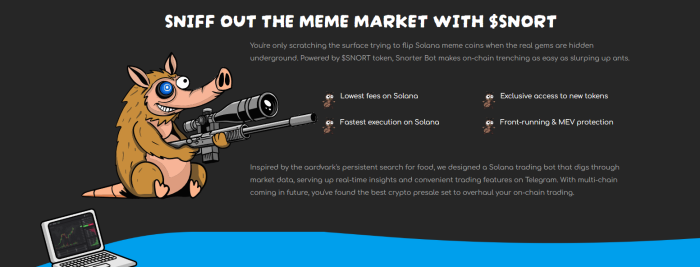
Snorter Token utility as shown on the presale page.

Native to Telegram and focused on Solana meme coins, Snorter sniffs out the best small-cap gems and gives traders all the tools they need to make winning plays. Those include:

  • Automated sniping
  • Rugpull protection
  • Copy trading
  • Honeypot detection
  • Limit orders

What is Snorter Token? It’s the tool that powers the best crypto trading bot. With over $4M raised, the presale continues to power forward towards the TGE.

Buy $SNORt at just $0.1053 before the presale ends in less than 26 days.

3. Aster ($ASTER) – 2,500% Gains for Up-and-Coming DeFi Platform

Back by CZ and benefiting from a wave of incoming TVL, Aster (the platform) has been on a roll recently. But $ASTER, the native utility token, has done even better.

In a single month since launch, $ASTER’s price increased over 2,500%.
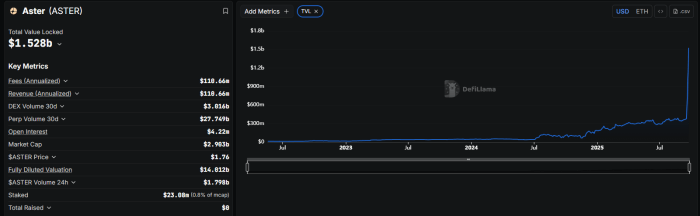
Aster TVL growth showing an abrupt climb recently.

That makes $ASTER one of the best plays of the resurgent DeFi scene. The platform, a decentralized perpetual contracts tool, has even drawn interest away from longstanding competitors in the field like Hyperliquid.

While $ASTER isn’t likely to grow at this rate forever, it’s already a proven contender.

Tether’s influence extends beyond its crypto business, holding tens of billions in U.S. Treasury bills, making it one of the largest non-sovereign purchasers of U.S. Treasuries.

Tether’s move might prompt re-assessments of how stablecoin issuers are valued compared to more traditional financial firms – and open the door for projects like $HYPER and $SNORT to skyrocket.

Recap: Bitcoin Hyper ($HYPER) is a utility-heavy altcoin focused on upscaling Bitcoin to modern demands, while Snorter Token ($SNORT) gives you the fastest and cheapest trading bot on Solana. And Aster ($ASTER) is a top DeFi buy right now.

Authored by Bogdan Patru, Bitcoinist – https://bitcoinist.com/best-crypto-to-buy-now-before-tether-goes-public

Editorial Process for bitcoinist is centered on delivering thoroughly researched, accurate, and unbiased content. We uphold strict sourcing standards, and each page undergoes diligent review by our team of top technology experts and seasoned editors. This process ensures the integrity, relevance, and value of our content for our readers.

As a crypto writer, Bogdan’s responsibilities are split between researching and writing articles and entertaining the team with his humor bordering on the politically incorrect, an aspiring Bill Burr, if you will. Thanks to his 12+ years of writing experience in just as many fields, including tech, cybersecurity, modelling, fitness, crypto, and other topics-that-shall-not-be-named, he's become a genuine asset to the team. While his position as a senior writer at PrivacyAffairs thought him valuable lessons about the power of self-management, his entire writing career was and is an exercise in self-improvement. Now, he's ready to sink his teeth into crypto and teach people how to take control of their own money on the blockchain. With fiat as an eternally devaluing currency, Bitcoin and altcoins seem like the best-fitting alternative for Bogdan. Bogdan’s biggest professional accomplishment, aside from securing a position as a main writer for Bitcoinist, was his 5-year run as a writing manager at Blackwood Productions, where he coordinated a team of four writers. During that time, he learned the value of teamwork and that of creating a working environment that breeds efficiency, positivity, and friendship.

Leituras Relacionadas

Semiconductor Stock Rebound: Is the Technical Correction Over or a Trend Reversal?

The core of recent semiconductor stock volatility is not about daily price swings, but rather the market questioning whether AI-driven semiconductor pricing has entered a new phase. Following a sharp sell-off in Korean stocks on June 23rd, led by Samsung and SK Hynix, a subsequent rebound is seen more as a technical positioning adjustment rather than a confirmed trend reversal. The key variable is HBM (High Bandwidth Memory), essential for AI chips. Its supply-demand imbalance granted memory makers significant pricing power. The current market focus is on whether this dynamic remains strong enough to justify elevated valuations. All eyes are on Micron's upcoming earnings report. The critical factor is not whether results meet already high expectations, but whether the company's guidance confirms that AI memory pricing power, order visibility, and future margins are still expanding. Micron's outlook will serve as a crucial test for the broader AI semiconductor chain, including Samsung, SK Hynix, and other infrastructure players. The recent bounce appears to be a pre-earnings positioning repair. For it to evolve into a sustained uptrend, concrete evidence is needed that the AI infrastructure expansion cycle's fundamentals—particularly for high-end memory—remain robust and can continue to surpass elevated market expectations. The risk is that strong demand alone may not be sufficient if future guidance hints at peaking momentum or increasing supply-side pressures.

marsbitHá 28m

Semiconductor Stock Rebound: Is the Technical Correction Over or a Trend Reversal?

marsbitHá 28m

Global Tech Stocks Plunge: Another Stress Test for the AI Bull Market

Global tech stocks plummeted in a sharp selloff on June 23, with South Korea's KOSPI index crashing nearly 10%, triggering a trading halt. The plunge was led by semiconductor giants Samsung and SK Hynix, dragging down major Asian and US tech indexes and levered ETFs. The immediate trigger was a confluence of three signals within 24 hours: 1) reports that SK Hynix was slowing HBM4 expansion, raising doubts about a key AI chip bottleneck; 2) profit-taking ahead of Micron's earnings report after its massive year-to-date rally; and 3) a warning from Korean regulators about the risks of single-stock leveraged ETFs. The selloff's severity was amplified by Korea's uniquely leveraged market structure: record-high retail margin debt, over $30 billion in volatile single-stock leveraged ETFs requiring daily rebalancing (which creates selling pressure during declines), and the surprising shift of the National Pension Service from a net buyer to a net seller. The event reignited debates about an AI bubble. Analysts differed on timing—some warned of imminent rupture, others saw a temporary liquidity-driven correction—but agreed that sky-high valuations, a shift to retail/leveraged buying, and rising rates created a fragile setup. The parallel steep drop in SpaceX's stock, alongside its massive debt raise for AI infrastructure, underscored a broader market shift from narrative-driven "infinite imagination" to a "return on investment" calculation phase. All eyes are now on Micron's upcoming earnings report, seen as a key test for the AI hardware trade's fundamental logic. A strong report could stabilize markets, while a miss could validate deeper fears. The episode serves as a stark warning: when a bull run becomes dependent on leveraged bets on a single narrative, a violent and rapid correction should not be a surprise. The core question for investors is how much drawdown they are willing to tolerate to stay invested.

marsbitHá 30m

Global Tech Stocks Plunge: Another Stress Test for the AI Bull Market

marsbitHá 30m

Ethereum Foundation Cuts 20% of Staff, 54 Depart: The Survival Logic Behind the Restructuring

The Ethereum Foundation (EF) has announced a major restructuring, resulting in the departure of 54 staff members, representing approximately 20% of its workforce. This reorganization is not merely a cost-cutting measure but a strategic refocusing. The EF will now concentrate its resources on what it deems critical and unique tasks, structured around five new operational clusters. The new structure comprises clusters dedicated to: the Protocol Layer (ensuring Ethereum's core properties like censorship resistance and security); the Access Layer (enabling trusted, non-intermediated user interactions); the User Layer (grounding decisions in real user needs and constraints); the Community Layer (representing EF's stance and building alliances); and the Institutional Layer (engaging with enterprises, governments, and academia to promote principled adoption). The foundation stated that the layoffs were a difficult but necessary step to align its organization and spending with its long-term mandate, insulating its core work from short-term market fluctuations. Affected employees were offered a severance package and transition support. The restructured EF emerges as a leaner and more focused organization, poised to prioritize the development and preservation of Ethereum's foundational promise of self-sovereignty. Further details on the new operational model are expected in the coming weeks.

marsbitHá 32m

Ethereum Foundation Cuts 20% of Staff, 54 Depart: The Survival Logic Behind the Restructuring

marsbitHá 32m

Talking About Returns But Not Collection? Goldfinch's Liquidation Sounds the Alarm for RWA Credit

Goldfinch, a crypto lending platform connecting investors with real-world borrowers, has proposed a full wind-down via governance proposal GIP-87. The plan would halt all new development, shut down its flagship Goldfinch Prime product, and allocate 150,000 USDC to manage the collection of outstanding loans. While the proposal is under community vote, it highlights a critical shift for the RWA (Real World Asset) lending sector: the transition from a growth phase focused on yields to a difficult recovery phase focused on collections. The proposal reveals that while the protocol's on-chain TVL is low, it still holds tens of millions in active, non-performing loans off-chain. This gap underscores that tokenizing debt makes tracking exposure transparent but does not simplify the offline, labor-intensive, and legally complex process of loan recovery. The case of the Lend East pool, where only an estimated 42% of a $10.15 million loan may be recovered, exemplifies the potential for significant investor losses. The wind-down plan forces token holders to govern not expansion but the maintenance of a debt collection system, including funding legal trust structures and preserving user access for repayments. This move starkly contrasts with the sector's typical narrative of rapid, AI-powered underwriting and high yields, exposing the often-overlooked necessity for robust borrower vetting, standardized disclosure, and sustainable collection mechanisms. Ultimately, Goldfinch's situation serves as a crucial stress test for the entire RWA lending space. It demonstrates that a platform's true resilience is tested not during capital deployment but during the protracted, costly, and uncertain process of recovering defaulted loans from real-world borrowers, a challenge blockchain transparency alone cannot solve.

Foresight NewsHá 37m

Talking About Returns But Not Collection? Goldfinch's Liquidation Sounds the Alarm for RWA Credit

Foresight NewsHá 37m

Meta Launches Prediction Market, Code-Named "Arena": Not Using Real Money, 3.56 Billion Daily Active Users Are Its Biggest Bargaining Chip

Meta, under the codename "Arena," is developing a standalone prediction market application, according to a June 23 report by The New York Times. Initially, the app will operate on a points-based system rather than real-money betting, though future integration of financial transactions is not ruled out. Meta plans to leverage its vast ecosystem of apps, boasting 3.56 billion daily active users, to distribute the product. The strategy aims to lower user acquisition costs and navigate regulatory complexities associated with real-money prediction markets, which are overseen by bodies like the CFTC. News of Meta's entry caused stock dips for established players like DraftKings and Robinhood, reflecting market concerns over Meta's potential to disrupt incumbents like Polymarket and Kalshi with its massive scale. The prediction market sector has seen explosive growth, with monthly trading volume on major platforms surging to approximately $24 billion as of April 2026. This marks Meta's second foray into the space, having launched and later shut down a similar virtual-points app called Forecast in 2020. While Arena poses a competitive threat to crypto-based platforms like Polymarket, its mainstream reach could also significantly expand the overall user base and awareness for prediction markets. The project remains in development with no public launch timeline, but its announcement has already impacted market sentiment.

marsbitHá 42m

Meta Launches Prediction Market, Code-Named "Arena": Not Using Real Money, 3.56 Billion Daily Active Users Are Its Biggest Bargaining Chip

marsbitHá 42m

Trading

Spot
Futuros
活动图片