Original Source: Wall Street News
June 23, Seoul, South Korea.
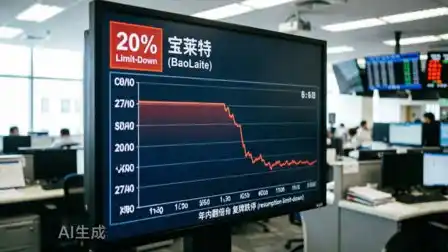
At 2 p.m., a trading halt was triggered on the Korea Exchange. The KOSPI index plunged 8% before trading was suspended for 20 minutes. After resumption, it continued to slide, ultimately closing down 9.99% at 8,203.84 points.
A few numbers sketch the severity of this sell-off—
Samsung Electronics fell 12.31%, SK Hynix fell 12.47%. Just these two companies contributed to about 71% of the KOSPI's decline for the day. The Nikkei 225 fell 3.55%, falling below the 70,000-point mark. Nasdaq 100 futures fell 3.01%, and the Philadelphia Semiconductor Index closed down 7.7%. TSMC pre-market trading dropped over 5%, Micron Technology fell over 8%, while AMD, Intel, Applied Materials, ARM, and ASML all saw declines exceeding 7%.
The collapse of leveraged ETFs was even more startling: the 3x Long Korea ETF plunged 32% in a single day, and the 3x Long Semiconductor ETF plummeted 17%.
The KOSPI's single-day decline ranks among the top five largest drops in the history of the South Korean stock market. The last comparable crash occurred in October 2008.
But 2008 was a clear and visible Great Recession. In 2026, the global economy is growing, the AI revolution is in full swing, and the KOSPI's year-to-date gain still ranks among the top of major global indices—until this crash.
class="ql-align-justify">So the real questions are: What happened, and why.Trigger Point: The Resonance of Three Signals
Looking back at the timeline, the direct trigger for the crash was the resonance of three signals within 24 hours.
First Signal: SK Hynix Slows HBM4 Capacity Expansion.
On the morning of June 23, South Korean media reported that SK Hynix was slowing down HBM4 capacity expansion, shifting its focus to general-purpose DRAM. HBM (High-Bandwidth Memory) is a core supporting component for AI chips. SK Hynix and Samsung are the only two mass-production suppliers globally. The market consensus on HBM4 supply and demand was almost overwhelmingly pointing towards "insufficient supply."
HBM4 is one of the most certain bottlenecks in the global AI infrastructure race. At any time, once the market begins to question the tightness of this bottleneck, the result is often a repricing of belief.
Second Signal: Profit-Taking Ahead of Micron's Earnings.
Micron Technology is scheduled to release its quarterly earnings on Wednesday (June 25). Following the news of the comprehensive Micron-Anthropic partnership, Micron's stock price had already hit a record high, with a year-to-date cumulative gain of over 300%. Goldman Sachs' trading desk noted, "Investor expectations have been stretched extremely high, creating conditions for preemptive profit-taking before the earnings report."
In a market driven by "expectations," position adjustments ahead of earnings reports can be more damaging than the reports themselves.
Third Signal: South Korean Regulators Issue Warning on Leveraged ETFs.
On June 22 (the day before the crash), Lee Chan-jin, Governor of the Financial Supervisory Service of South Korea, publicly stated that he "regretted" not stopping the issuance of single-stock leveraged ETFs tracking Samsung Electronics and SK Hynix, saying they "serve little purpose other than allowing brokerages to profit at the expense of retail investors."
The timing was almost cruelly precise. When a regulator publicly acknowledges structural problems in the market, it directly triggers panic-driven stampeding.
Amplifiers: The 'Three Levers' of the Korean Market
The reason the combined force of the three triggers above was so devastating is because it struck a market structure deeply intertwined with leverage.
This round of the AI bull market in South Korea has had three amplifiers operating simultaneously.
Amplifier One: Retail Margin Buying Hits Record High.
Korean retail investors have long been known for their "dare-to-gamble" approach. But the leverage ratio in this round reached unprecedented heights. South Korean retail margin balances had climbed to record levels before the crash. Goldman Sachs bluntly stated in its post-crash analysis report: "The rise of the Korean stock market has become increasingly reliant on retail investors as marginal buyers."
In a buy-more-as-it-rises leverage cycle, once the marginal buyers turn, it triggers a reverse, sell-more-as-it-falls stampede.
Amplifier Two: Single-Stock Leveraged ETFs Swell to $30 Billion.
This is the most unique problem in the Korean market. The asset size of 16 onshore single-stock leveraged ETFs is about $9.1 billion. The combined size of the 2x Long SK Hynix and Samsung ETFs issued by CSOP on the Hong Kong Exchange is about $21 billion — totaling over $30 billion. Among onshore products, 92% of the holdings come from retail investors.
Single-stock leveraged ETFs have a fatal structural characteristic: they require daily rebalancing. When the underlying stock price falls, the ETF needs to sell more shares to maintain its leverage multiple, creating a self-reinforcing selling pressure during declines. And when regulators hint at possibly restricting such products, the first to be sold are precisely these products themselves—and their underlying holdings.
The South Korean Financial Supervisory Service estimates that the trading commission scale for single-leveraged products is between $3 billion and $6.4 billion. Measures it is considering include: raising the investment threshold for retail investors, strengthening trader education tests, imposing size caps on single-stock ETFs, restricting new product launches, and enhancing suspension mechanisms when price-NAV deviations occur.
Whether these measures are implemented or not, the signal they send is clear enough: regulators believe a significant portion of this rally has detached from rational fundamental pricing.
Amplifier Three: National Pension Service Unexpectedly Becomes a Seller.
South Korea's National Pension Service (NPS) — the country's largest pension fund — net sold approximately $1 billion in KOSPI stocks in the six days before the crash. So far in June, it has net sold a cumulative $1.5 billion, marking the largest monthly net selling record since April 2021.
The NPS's operations are essentially rebalancing: the sustained rise of the KOSPI had previously pushed its domestic equity allocation above 30%, exceeding the target ceiling of around 28.8%.
But the key point is, in a market already heavily reliant on retail marginal funds, when the NPS, which originally served as a core stabilizing buyer, suddenly shifts from buyer to seller, it means there is no longer anyone in the market to "catch" the selling pressure.
As Goldman Sachs analysts put it: "The so-called theoretical constraint has become an observable liquidity reality."
The Bubble Debate: When Will It Come, How Deep Will It Fall?
Following the crash, a debate about the "AI bubble" naturally surfaced.
Chris Cha, Goldman Sachs Korea High-Touch Trading Head, provided a clear qualitative assessment in his client report on the day of the crash — liquidity exhaustion: "I remain constructive on the memory cycle and continue to believe KOSPI is undervalued. But this rally has increasingly relied on technically sensitive buyers, making it more susceptible to disruptions in liquidity momentum."
In other words: The long-term logic hasn't changed, but the short-term market structure has become fragile to a critical point.
Bank of America's Quantitative Signal: Nasdaq Approaching Bubble Territory.
A few days before the crash, Bank of America strategists released a report stating: Their bubble risk indicator shows the Nasdaq 100 Index has approached the 0.8 level, which "typically indicates heightened short-term tail risk at both ends." Tech and semiconductor stocks have already "displayed extreme bubble-like price action."
But Bank of America also offered an interesting judgment: "An AI bubble could take years to fully form. History suggests this indicator helps flag episodic pullbacks, not trend endings."
Li Bei's Warning: Trigger Conditions Have Appeared.
Prominent private equity figure Li Bei also expressed caution about the AI sector in a letter to investors. In her view, the "conditions for the AI bubble to burst have already appeared."
Three voices, pointing to three timeframes: Li Bei speaks of "now," Goldman Sachs says "don't panic," and Bank of America says "it will rise more but first must fall."
Notably: In a market deeply bound by leveraged ETFs, retail margin buying, and momentum trading, an "episodic pullback" and a "bubble burst" might be difficult to distinguish based on price action alone. A 10% single-day drop has already triggered a trading halt. What would happen with another 10%?
Mirror Image: SpaceX Tells the Same Story
Shifting focus from Seoul to New York reveals a mirror image.
SpaceX plunged for three consecutive days after its IPO — down over 16% on June 19, another ~5% on June 22, and continued losses on June 23 — wiping out about $600 billion in market capitalization over three days. Its stock price has fallen below its IPO opening price of $150, dropping to around $147.
More intriguing: While its stock price plummeted, SpaceX announced its first-ever bond issuance — raising $20 billion for AI infrastructure construction. Typically, a company issues bonds when facing financial difficulties. But SpaceX's situation is the opposite: Its AI capital expenditure story requires a steady stream of ammunition, and the falling stock price is closing the window for equity financing — debt is its last option to keep the narrative alive.
The resonance between SpaceX and South Korean semiconductors reveals a common problem: The capital market narrative around the AI theme is shifting from "unlimited imagination" to the "calculating returns" phase.
When investors start doing the math — how much slower is HBM4 expansion? How much have GPU rental prices dropped? When will AI revenue cover capital expenditures? — the market's pricing logic changes.
Outlook: Micron's Judgment Day
After the crash, all eyes turn to one date: June 25.
Micron's earnings report — the most immediate "judgment day" facing tech stocks after this round of selling.
Bloomberg quoted Pepperstone strategist Dilin Wu's comment: "Micron's earnings this week are the real test. A strong report has direct positive implications for Samsung and Hynix — this number will tell you whether the underlying logic of the AI hardware trade still holds."
Logically, there are two possibilities:
Scenario One: Micron Exceeds Expectations. If Micron delivers a strong earnings report and provides optimistic guidance, the current round of selling could be quickly corrected — positions that exited due to uncertainty may re-enter once certainty lands.
Scenario Two: Micron Falls Short of Expectations. If Micron's guidance disappoints, the current round of selling will receive validation at the fundamental level — the characterization of a liquidity issue will be overturned, shifting to a collapse of faith.
In Scenario One, the KOSPI trading halt will be marked as "a technical stampede." In Scenario Two, it will be marked as "a turning point in the AI bull market."
The answer the market gives on Wednesday night will determine the opening direction of Asian markets on Thursday morning.
Conclusion
The crash on June 23 can be explained on a technical level as the result of four factors resonating within 24 hours: the single news item about SK Hynix's HBM4 + the structural fragility of leveraged ETFs + the unexpected selling from NPS rebalancing + risk-off positioning ahead of Micron's earnings.
But this is only a technical explanation.
The deeper question is: When the AI bull market has reached this stage — valuations at historical extremes, the driving force shifting from institutions to retail, the trading structure deeply bound by leveraged products, while at the same time inflation and rate hike expectations are pushing up the risk-free rate — then a structural rupture is almost inevitable, sooner or later.
The KOSPI trading halt is a mirror.
The mirror reflects this: When all market participants are using leverage to bet on the same narrative, a reversal in this narrative — however swift or deep — should not be seen as a surprise.
For investors, after Micron's earnings, there's only one question: How much drawdown are you willing to accept to answer 'continue holding'?