Laos Eyes Bitcoin Mining To Tackle Mounting Debt

bitcoinistPublicado em 2025-09-18Última atualização em 2025-09-18

Resumo

Laos is exploring a new way to service the debts from its decades-long hydropower build-out: turning excess electricity into Bitcoin....

Trusted Editorial content, reviewed by leading industry experts and seasoned editors. Ad Disclosure

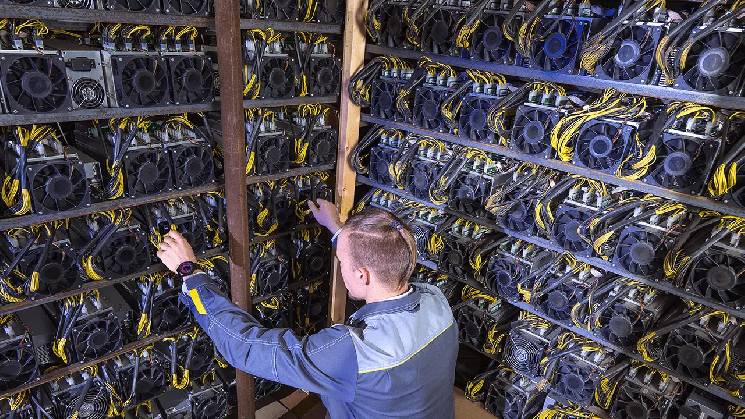
Laos is exploring a new way to service the debts from its decades-long hydropower build-out: turning excess electricity into Bitcoin. In a report published on September 17, the South China Morning Post framed the pivot bluntly: “Saddled with debt and surplus electricity, the ‘battery of Southeast Asia’ is eyeing energy-intensive crypto mining to turn a profit.” The article situates the move within a dam-driven development model that has left Laos with power it cannot always sell and a mounting repayment schedule.

Why Laos Eyes Bitcoin Mining

The policy logic is straightforward. Bitcoin mining converts electrons into a globally liquid asset and can be sited directly at hydropower plants, mitigating transmission bottlenecks and absorbing seasonal surpluses. Laos has promoted electricity exports for years—SCMP notes power accounted for roughly a quarter of the country’s exports last year—yet export deals and grids do not always line up with generation, exacerbating revenue-timing mismatches against hard-currency debt obligations from dam construction.

According to SCMP “environmental campaigners view the turn to crypto as symptomatic of a flawed energy policy that has left Laos indebted and unable to offload its surplus power.” The Chinese news report cites Witoon Permpongsacharoen, director of the Mekong Energy and Ecology Network: “Laos allowing electricity to be used for cryptocurrency mining is clearly not something driven by internal conditions. It stems from the fact that Laos is heavily indebted and unable to pay off its debts.”

If implemented, this would not be Laos’s first embrace of digital-asset mining. In September 2021, the government launched a pilot program authorizing six firms to mine and trade Bitcoin and cryptocurrencies under regulated power-purchase terms, a move widely read as an attempt to capture miners displaced by China’s crackdown.

However, the stance has seesawed amid hydrological stress and grid constraints: in August 2023, the state utility Électricité du Laos (EDL) halted electricity supply to Bitcoin miners citing drought and power shortages; by May 2024, Reuters reported crypto data centers made up “over a third of the country’s power” consumption and contributed to outages, prompting authorities to stop approving new operations even as they weighed proposals to stabilize supply.

The fiscal backdrop helps explain the renewed interest. External public debt service is projected by the World Bank to average about $1.3 billion per year over 2025–2028—around 9% of GDP annually—keeping gross financing needs elevated as key hydropower assets are still ramping. Separate reporting this year underscored the strain: a Chinese dam operator initiated a $555 million arbitration against EDL for alleged unpaid dues, highlighting the financial pressures on the state power sector.

Yet the “surplus power” narrative is not uniform. Hydropower output is volatile, impacted by erratic rainfall and a warming climate, while export pipelines remain politically and commercially complex. Laos produces surplus electricity in the wet season but must import power from neighboring countries during the dry months. These structural frictions are precisely the niches where mobile, interruptible loads like Bitcoin mines can monetize stranded energy—until the water runs low.

Analysts who champion “wasted renewables” see a broader pattern. “Bhutan, Ethiopia, and now Laos use Bitcoin mining to monetize wasted renewable energy,” Bitcoin climate activist Daniel Batten wrote via X as coverage of the SCMP story circulated, casting the strategy as part of a 2025 “vibe shift.”

Bhutan has openly leaned into hydro-powered mining this year, calling bitcoin “a strategic battery” to arbitrage seasonal surpluses and fund development; Ethiopia’s power utility has said it generated about $55 million over 10 months by selling surplus hydro to miners. Laos’s plan would slot into that template, albeit with more fragile hydrology and balance-sheet constraints.

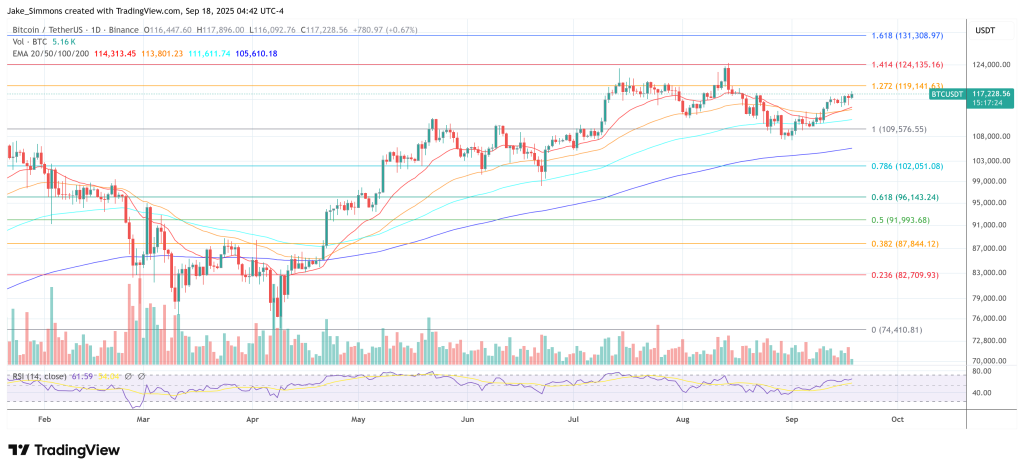
At press time, BTC traded at $117,228.
Bitcoin price
BTC is back above $117,000, 1-day chart | Source: BTCUSDT on TradingView.com
Featured image created with DALL.E, chart from TradingView.com
Editorial Process for bitcoinist is centered on delivering thoroughly researched, accurate, and unbiased content. We uphold strict sourcing standards, and each page undergoes diligent review by our team of top technology experts and seasoned editors. This process ensures the integrity, relevance, and value of our content for our readers.

Jake Simmons has been a Bitcoin enthusiast since 2016. Ever since he heard about Bitcoin, he has been studying the topic every day and trying to share his knowledge with others. His goal is to contribute to Bitcoin's financial revolution, which will replace the fiat money system. Besides BTC and crypto, Jake studied Business Informatics at a university. After graduation in 2017, he has been working in the blockchain and crypto sector. You can follow Jake on Twitter at @realJakeSimmons.

Leituras Relacionadas

Sam Altman's Personal Alchemy of Wealth: Investing in 400 Companies, Over 10 Deeply Tied to OpenAI

The article investigates Sam Altman's personal wealth strategy, centered around his investments in approximately 400 companies while serving as OpenAI's CEO. Despite not holding direct equity in OpenAI, Altman has built a vast portfolio, with at least 10 of his investments having commercial ties or ongoing negotiations with OpenAI. This creates a complex network of potential conflicts of interest, drawing scrutiny from U.S. congressional committees and state attorneys general. Key investments highlighted include the anti-aging startup Retro Biosciences (valued at $258 million for his stake as of late last year) and the chipmaker Cerebras, whose value soared following an OpenAI procurement deal. His most significant financial gain is linked to the nuclear fusion company Helion, where a recent funding round reportedly increased his stake's value to at least $4.1 billion. The article details a decade-long relationship between Altman, Helion, and OpenAI, including a controversial non-binding power purchase agreement and Altman's efforts to secure investments from OpenAI and its backer SoftBank for Helion. Other points include internal investigations at Tools for Humanity (developer of Worldcoin) and OpenAI's massive contracts with tech giants like Nvidia. According to Forbes, Altman's net worth is around $3.4 billion, ranking him 1251st globally—a rise of over 1400 places since 2024. OpenAI's board states that Altman's external dealings are transparent and potential conflicts are carefully managed.

Odaily星球日报Há 16m

Sam Altman's Personal Alchemy of Wealth: Investing in 400 Companies, Over 10 Deeply Tied to OpenAI

Odaily星球日报Há 16m

Former SpaceX Engineer Reconstructs Financial Execution System Using First Principles

Former SpaceX engineer Lex Li applies "First Principles Thinking" to financial infrastructure with Plan Execution Lab, recently raising angel funding at a $50M post-money valuation. The team argues that the core function of finance is capital allocation, and the critical gap is not in trading but in execution, which remains highly manual and fragmented. While assets, liquidity, and settlement have migrated on-chain, execution workflows (monitoring, risk management, liquidity coordination) are still human-native. In an era of accelerating AI agents, strategy decay is rapid, shifting the competitive edge from having the best strategy to having the most robust execution network. Plan Execution Lab introduces two core components: 1. **PlanX**: A Financial Execution Protocol designed as infrastructure for the migration from CEX to DEX, providing on-chain execution capabilities, liquidity access, risk management, and capital orchestration. 2. **Xgent**: An Autonomous Financial Runtime. Users define investment intents, risk preferences, and constraints; Xgent automatically constructs an execution graph, verifies it, and handles ongoing execution and optimization—streamlining the process from Intent to Autonomous Execution. The long-term vision is to create the "Bloomberg Terminal for Autonomous Finance"—a shared operating environment and execution network built collectively by participants like execution nodes, liquidity providers, and autonomous agents. The future of finance, they contend, belongs not to isolated algorithms but to open, collaborative execution networks.

marsbitHá 50m

Former SpaceX Engineer Reconstructs Financial Execution System Using First Principles

marsbitHá 50m

Former SpaceX Engineer Reconstructs Financial Execution System from First Principles

Plan Execution Lab, a financial infrastructure project founded by former SpaceX engineer Lex Li, has raised angel funding at a $50M post-money valuation. The startup is applying "first principles thinking" from Li's SpaceX experience to rethink financial market execution. Their analysis posits that while assets, liquidity, and settlement have moved on-chain, the execution layer remains fundamentally human-dependent and fragmented. In the era of AI Agents, strategy advantages decay rapidly, shifting the competitive edge from isolated algorithms to robust **execution networks**. Plan Execution Lab's solution is a two-part system: **PlanX**, a Financial Execution Protocol designed to facilitate the migration from centralized exchanges (CEX) to on-chain markets by providing core on-chain execution capabilities; and **Xgent**, an Autonomous Financial Runtime. Xgent allows users to define investment goals and constraints, then autonomously constructs and manages the execution logic—moving from **Intent to Execution Graph to Verification to Autonomous Execution**. The long-term vision is to create the "Bloomberg Terminal for Autonomous Finance"—an operating environment not for humans, but for agents and execution nodes. The future financial system, they argue, will be a collaborative network built by diverse participants contributing execution capabilities, not secret strategies. The core competition will shift to who builds the most powerful and adaptive execution network.

链捕手Há 51m

Former SpaceX Engineer Reconstructs Financial Execution System from First Principles

链捕手Há 51m

First Long-Horizon Doc2Repo Training Dataset: Code Agents Move Beyond Bug Fixing and Begin Creating Repositories

With the advancement of LLM Code Agents, the research focus is shifting towards long-horizon, real-world tasks, moving beyond simple bug fixes to full repository generation. To address this, researchers from Renmin University of China introduced the DeNovoSWE dataset. This dataset focuses on long-term software engineering tasks, specifically the "document-to-repository" challenge—generating an entire, executable code repository from a task description. The DeNovoSWE construction method employs a Divide & Conquer approach. It breaks down target repositories into core capabilities and uses a multi-agent Draft-Critic-Repair workflow to automatically generate high-quality, evaluation-aligned task documents. The dataset also implements difficulty-aware filtering to balance quality and diversity. The result is a high-quality, anti-leakage dataset of 4,818 instances. Experiments show that models trained on DeNovoSWE achieve significant improvements in long-horizon repository generation. For instance, Qwen3-30B-A3B-Instruct's performance on the BeyondSWE-Doc2Repo benchmark increased from 5.8% to 47.2%, and on NL2RepoBench from 4.3% to 23.0%. Similar gains were observed with stronger backbones, demonstrating that dedicated long-horizon training data is crucial for advancing Code Agents from maintainers to architects capable of planning and building complete software projects from scratch.

marsbitHá 1h

First Long-Horizon Doc2Repo Training Dataset: Code Agents Move Beyond Bug Fixing and Begin Creating Repositories

marsbitHá 1h

Trading

Spot
Futuros
活动图片