Understanding Stablecoin Peg Deviations: What Actually Happens When a Digital Dollar Loses Its Link to the US Dollar

cryptonews.ruPublicado em 2026-08-23Última atualização em 2026-08-23

Resumo

Stablecoin peg breakdowns occur because the code doesn't enforce a $1 value; it's an economic promise. Arbitrage by large traders (buying at a discount, redeeming for $1) maintains the peg. However, direct redemption is limited to large, verified clients, making general market confidence the true first line of defense. Four historical cases show different causes: USDT's 2018 drop was a trust issue; USDC's 2023 dip was a bank failure; xUSD's 2025 crash was due to risky yield strategies and a counterparty loss; and TerraUSD's 2022 collapse resulted from a flawed algorithmic design that triggered a death spiral. In 2026, a market-wide decline (total supply dropped ~$14.6B) is driven by new US regulations banning yield, reducing the arbitrage capital cushion that absorbs shocks. Market concentration remains high, with USDT and USDC comprising ~83% of the market, meaning any issue with either poses systemic risk. To interpret future de-pegs: identify the cause (reserve-backed coins tend to recover; algorithmic or yield-based models may not); monitor redemption processing, not just price; and watch for contagion to other protocols and assets, as seen with DAI during the USDC incident.

Nothing in a stablecoin's code keeps its price fixed at $1, meaning the peg is simply an economic promise where the issuer states each token can be exchanged for one real dollar, and arbitrage does the rest. If $USDT trades at $0.99, professional traders buy it at a discount and redeem it with Tether for $1.00, pocketing the difference and pushing the market price up.

Conversely, if it trades above $1, they mint new tokens for exactly $1 and sell them. The market price remains pegged only because this "redemption machine" is believed to work.

In practice, access to this "redemption machine" is limited. For instance, Tether requires clients to pass verification and have a minimum of $100,000 for direct redemptions, while Circle (the issuer of $USDC) operates through institutional accounts. Everyone else (be it a retail holder, a DeFi protocol, or an offshore exchange) relies on a chain of arbitrageurs who have both the access and the courage to keep buying tokens at a discount during panic.

It is this structure that causes a peg deviation to appear on exchange screens even in cases where the issuer never misses a redemption, i.e., the first line of defense for the peg is the trust of other people, not the reserves themselves.
Four Cases of Peg Deviation, Four Different Reasons

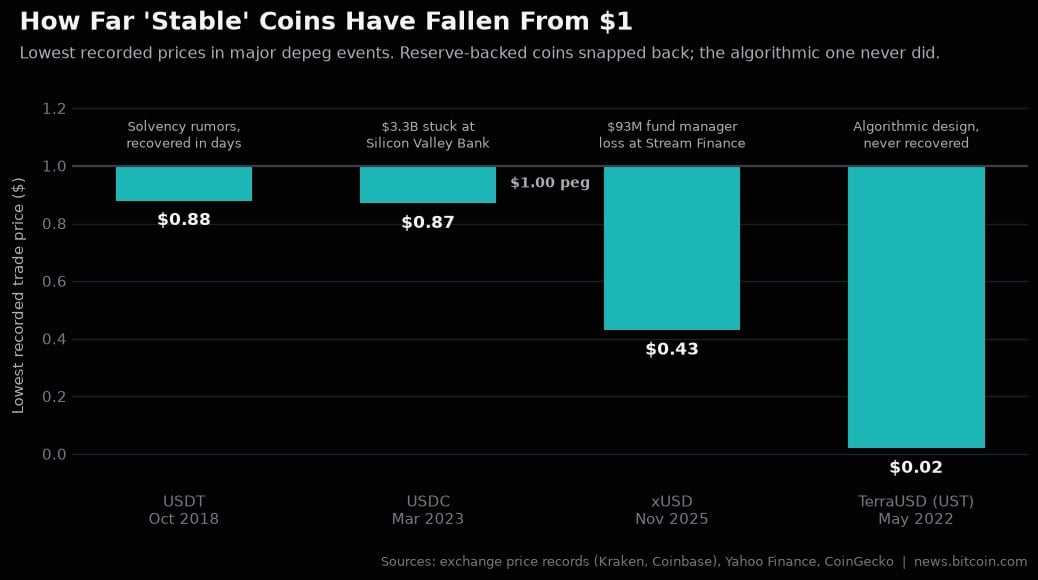
The panic around $USDT in October 2018 was a trust issue: rumors about the solvency of Tether and its associated exchange Bitfinex led to $USDT dropping to around $0.88 on some platforms. Ultimately, the reserves covered the redemptions, and the peg was restored within days.

The deviation of $USDC in March 2023 was more of a banking issue, as Circle disclosed that $3.3 billion of its reserves were held in the failed Silicon Valley Bank, causing the token's price to fall to $0.87 before US regulators guaranteed the bank's deposits. It is worth noting that this incident led to a broader market decline in decentralized finance (DeFi): $DAI, largely backed by $USDC, dropped to around $0.89.

The collapse of xUSD in November 2025 was a counterparty issue and serves as the most recent reminder that yield-bearing stablecoins carry risks not present with the giants. xUSD from Stream Finance was not backed dollar-for-dollar in a bank account, as the company employed leveraged strategies through third-party fund managers to generate yield for holders.

When one of these managers reported a $93 million loss, Stream froze withdrawals, and the price of xUSD plummeted from $1 to a low of $0.24 within hours (with $160 million in user deposits frozen at the same time).

Last but not least, the collapse of terraUSD (UST) in May 2022 was caused by a structural issue, and this token has never recovered. UST maintained its peg not through reserves but via an algorithmic "seesaw" mechanism relative to its "sister" token $LUNA (burning $1 of $LUNA to mint one UST and vice versa).

When mass withdrawals knocked UST off its $1 peg, holders rushed to convert it to $LUNA and sell, leading to hyperinflation of $LUNA's supply and the disappearance of the very asset meant to back the peg. UST fell below $0.10 within a week and trades around $0.02 today. The combined value of both tokens evaporated by roughly $40 billion, and the crash dragged down hedge funds, lenders, and ultimately, the fragile empire of the FTX exchange.

2026: A Decline, Then Stabilization at a Certain Level

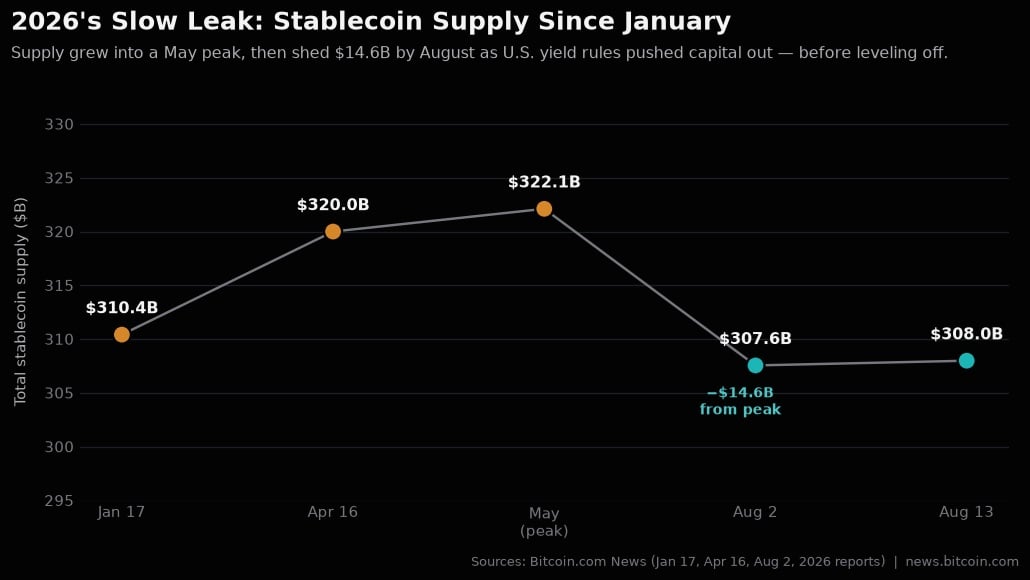
Tensions this year so far do not resemble an "instant crash" but rather a slow leak driven by regulatory measures. After new US federal stablecoin rules deprived digital dollars of the ability to pay interest, yield-seeking capital began to exit. The stablecoin market volume was $310 billion at the start of 2026, grew to about $320 billion by mid-April, and peaked at $322.1 billion in mid-May.

After that, the trend reversed sharply: by early August, the total stablecoin supply had contracted by $14.56 billion—the sharpest contraction since the Terra crash. Over the same period, the volume of $USDT shrank from about $189 billion to $183.2 billion (it had increased by $5 billion earlier this year while competitors saw a $4.2 billion contraction). The volume of $USDC, meanwhile, fell from a March peak near $80 billion to about $72.1 billion.
The decline was not limited to these two giants: in early July, the market volume contracted by $1.9 billion, with Sky Dollar's USDS showing the sharpest weekly drop, although PayPal's PYUSD and Ripple's RLUSD continued to grow.

A supply contraction does not directly cause a peg deviation, but it reduces the buffer of arbitrage capital that absorbs shocks, and it is this buffer that gets tested when the next crisis hits.

Why Concentration Raises the Stakes

Furthermore, this buffer is unevenly distributed, as $USDT and $USDC still account for roughly 83% of the entire $307.6 billion stablecoin market, meaning the redemption mechanism that keeps this entire category at $1 runs through the balance sheets and banking relationships of two companies.
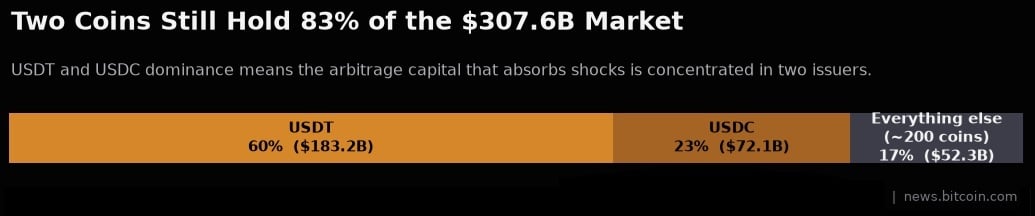
This concentration means that while these two coins dominate trading, which is generally a stabilizing factor, it also leads to disruptions for either issuer (such as a bank failure like the one Circle experienced in 2023, regulatory action, or a dispute over reserves) causing massive, unpredictable damage.

How to Interpret the Next Peg Deviation

First, it is crucial to identify the underlying cause, as reserve-backed coins (knocked off peg due to panic or bank failures) almost always restore their peg quickly once enough tokens are redeemed. However, models based on a native token (like TerraUSD) or an opaque yield strategy are incapable of this.

Second, investors should monitor redemption dynamics, not just price, as a coin trading at $0.97 (with the issuer processing withdrawal requests normally) is simply selling at a discount, not entering a "death spiral."

Third, it is critical to watch where "contagion" spreads: after all, fluctuations in $USDC led to a revaluation of $DAI within hours, the Terra crash affected companies that never dealt with UST, and the xUSD collapse triggered a chain reaction among DeFi lenders holding it as collateral.

end-content

Criptomoedas em alta

Perguntas relacionadas

QWhat is the primary mechanism that keeps a stablecoin's price at $1, according to the article?

AThe primary mechanism is an economic promise where the issuer states that each token can be redeemed for one real dollar, with arbitrage doing the rest to keep the market price near $1.

QWhat were the four main causes of de-pegging events mentioned for USDT (2018), USDC (2023), xUSD (2025), and TerraUSD (2022)?

AUSDT (2018): A confidence/trust issue. USDC (2023): A banking issue (exposure to a failing bank). xUSD (2025): A counterparty/yield-related issue. TerraUSD (2022): A structural/algorithmic issue with its 'seesaw' mechanism.

QWhat is the current trend in the stablecoin market in 2026 according to the article, and what is cited as the main driver?

AIn 2026, the market is experiencing a slow decline/contraction, not a sudden crash. The main driver cited is new U.S. federal regulations that prevent stablecoins from paying interest, causing yield-seeking capital to leave.

QWhy does market concentration in USDT and USDC increase systemic risk, even though it generally stabilizes trading?

ABecause it means the redemption mechanism that maintains the $1 peg for the entire category depends on the balance sheets and banking relationships of just two companies. A shock to one (like a bank failure, regulatory action, or reserve dispute) can cause widespread, unpredictable damage.

QWhat are three key factors an investor should monitor when a stablecoin de-pegs, based on the article's conclusion?

A1. The root cause (e.g., reserve-backed vs. algorithmic). 2. The dynamics of redemptions (not just the price). 3. The spread of 'contagion' to other platforms, tokens, or DeFi protocols.

Leituras Relacionadas

Hardware Wallet Owners Lose Money: The Nuances of Cold Bitcoin Storage in 2026

The article discusses a wave of distrust towards hardware wallets by the summer of 2026, primarily triggered by security incidents. The most significant involved Coldcard wallets from Coinkite, where a firmware bug dating back to 2021 drastically reduced the cryptographic entropy for seed phrase generation. This allowed attackers to brute-force private keys, leading to losses estimated between $115-$153 million in Bitcoin. While Coldcard issued a fixed firmware, the incident damaged the reputation of all hardware wallets. Other manufacturers like Trezor and Ledger issued statements assuring their devices' security, citing their use of secure hardware elements for true random number generation. However, separate data breaches affected SafePal (exposing personal data of ~40,000 users) and Trezor (via a logistics partner, compromising data for ~14,000 users), though no private keys or crypto assets were stolen in these cases. The article clarifies that hardware wallets themselves don't "hold" crypto but store the keys to access it on the blockchain. It argues against abandoning hardware wallets entirely, pointing out that alternatives like paper, memory, or custodial exchange storage have their own significant risks. It concludes that these incidents should be viewed as specific failures, not a condemnation of the entire category. A key underlying challenge highlighted is the dual role of advancing AI, which empowers both defenders to enhance security and attackers to find vulnerabilities more efficiently.

cryptonews.ruHá 23m

Hardware Wallet Owners Lose Money: The Nuances of Cold Bitcoin Storage in 2026

cryptonews.ruHá 23m

Trading

Spot

Artigos em Destaque

Como comprar LINK

Bem-vindo à HTX.com!Tornámos a compra de ChainLink (LINK) simples e conveniente.Segue o nosso guia passo a passo para iniciar a tua jornada no mundo das criptos.Passo 1: cria a tua conta HTXUtiliza o teu e-mail ou número de telefone para te inscreveres numa conta gratuita na HTX.Desfruta de um processo de inscrição sem complicações e desbloqueia todas as funcionalidades.Obter a minha contaPasso 2: vai para Comprar Cripto e escolhe o teu método de pagamentoCartão de crédito/débito: usa o teu visa ou mastercard para comprar ChainLink (LINK) instantaneamente.Saldo: usa os fundos da tua conta HTX para transacionar sem problemas.Terceiros: adicionamos métodos de pagamento populares, como Google Pay e Apple Pay, para aumentar a conveniência.P2P: transaciona diretamente com outros utilizadores na HTX.Mercado de balcão (OTC): oferecemos serviços personalizados e taxas de câmbio competitivas para os traders.Passo 3: armazena teu ChainLink (LINK)Depois de comprar o teu ChainLink (LINK), armazena-o na tua conta HTX.Alternativamente, podes enviá-lo para outro lugar através de transferência blockchain ou usá-lo para transacionar outras criptomoedas.Passo 4: transaciona ChainLink (LINK)Transaciona facilmente ChainLink (LINK) no mercado à vista da HTX.Acede simplesmente à tua conta, seleciona o teu par de trading, executa as tuas transações e monitoriza em tempo real.Oferecemos uma experiência de fácil utilização tanto para principiantes como para traders experientes.

1.2k Visualizações TotaisPublicado em {updateTime}Atualizado em 2026.06.02

Como comprar LINK

Discussões

Bem-vindo à Comunidade HTX. Aqui, pode manter-se informado sobre os mais recentes desenvolvimentos da plataforma e obter acesso a análises profissionais de mercado. As opiniões dos utilizadores sobre o preço de LINK (LINK) são apresentadas abaixo.

活动图片