Shiba Inu Team Issues Explosive Update On Shibarium Bridge Exploit

bitcoinistPublicado em 2025-09-18Última atualização em 2025-09-18

Resumo

Shiba Inu’s core team has issued a sweeping post-mortem update on the Shibarium bridge breach, detailing a multi-step attack that...

Trusted Editorial content, reviewed by leading industry experts and seasoned editors. Ad Disclosure

Shiba Inu’s core team has issued a sweeping post-mortem update on the Shibarium bridge breach, detailing a multi-step attack that combined a flash-loan powered governance capture with compromised validator keys—followed by emergency protocol changes and a split bounty offer aimed at recovering user funds.

Shiba Inu Devs Speak Out On Shibarium Bridge Exploit

In an X post published on September 17, 2025, the official Shiba Inu account said the exploiter “executed a flash loan swap to acquire 4.6M BONE from ShibaSwap” and delegated them to “Ryoshi Validator 1,” which pushed their voting power “> 2/3 majority” across Shibarium validators. Using “compromised internal validators” to co-sign a malicious state, the attacker then drained assets from the L2’s canonical bridge. The team now pegs direct losses at $4.1 million.

The disclosure adds granular color on what left the bridge exposed and how responders moved. The Shiba Inu team says the “leading possibility for the root cause” was a compromise of internal validator keys—“either from the developer machine or the server’s KMS”—not a CCIP predicate path that “was unrelated.”

The team further says it suspended bridge operations, began forensic analysis, and initiated a hardening campaign: revoking root chain manager access on the PoS bridge, lengthening the half-exit time on the Plasma path, and removing a predicate burn-only entry from the Plasma registry to prevent withdrawals. “We have suspended bridge operations… there is a significant loss of user funds on Shibarium,” the update states.

According to the team’s accounting, 17 tokens were taken from the bridge, including roughly $1.0M in ETH, $1.3M in SHIB, $717K in KNINE, $680K in LEASH, and $260K in ROAR, alongside smaller balances of TREAT, USDC, USDT, BAD, SHIFU, FUND, DAI, LTD, xFUND, WBTC and OSCAR. The exploiter has so far sold only USDT and USDC into ETH; they attempted seven times to sell KNINE before the K9 Finance DAO blacklisted the attacker’s wallet. The rest of the assets remain under the attacker’s control and “at risk,” the team warned.

SHIB Team Ups Bounty To 50 ETH

The remediation push now includes two distinct bounty tracks. First, the bounty chronology began with K9 Finance DAO—the Shibarium-aligned liquid-staking project—publishing an on-chain 5 ETH offer to the attacker for the return of KNINE, structured to decay after seven days and expire after 30 days.

K9’s accompanying X posts stressed the “accept()” finality and “code-is-law” terms embedded in the escrow contract. The exploiter then replied publicly: “I can’t accept 5 ETH. The bounty I can accept is 50 ETH and I will not return KNINE for less.”

After that refusal did the Shiba Inu team transmit a separate, on-chain 50 ETH bounty message via its Deployer 2 address covering the non-KNINE assets, conditioned on full restitution and a whitehat disclosure, with a promise of a legal-action waiver upon verified return.

The Shiba Inu team’s on-chain message reads in part: “Offer: 50 ETH bounty via a new bounty smart contract escrow,” adding that the attacker must return WETH, SHIB, LEASH, ROAR, TREAT, USDC, USDT, BAD, SHIFU, FUND, DAI, LTD, xFUND, WBTC, and OSCAR, and submit a full technical disclosure; “upon complete restitution and accepted disclosure, we will issue a waiver of legal action (subject to applicable law).” Transaction records show the message was sent from shiba-swap.eth (Deployer 2) to the address labeled ShibaSwap Exploiter on September 17.

For now, bridge operations remain disabled, and users are cautioned that assets listed as “under attacker control” remain exposed until recovery or further containment.

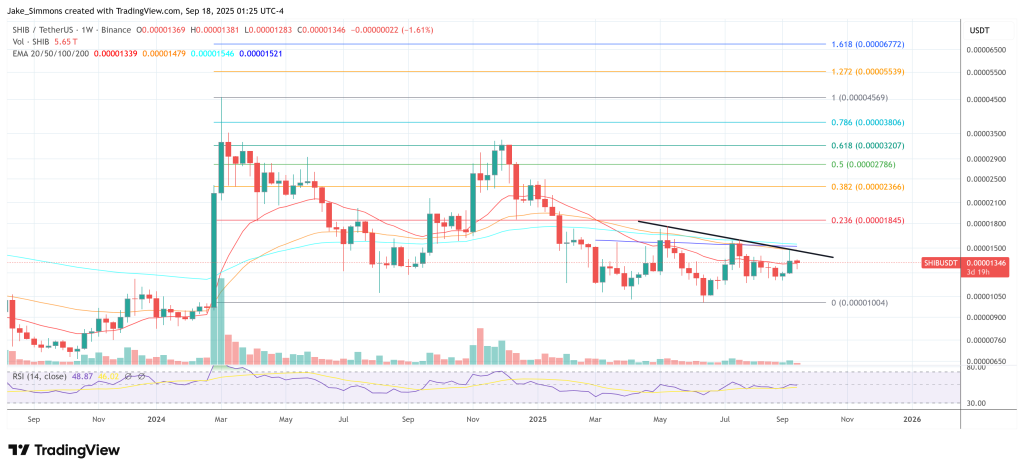
At press time, SHIB traded at $0.00001346.
Shiba Inu price
Shiba Inu continues its downtrend, 1-week chart | Source: SHIBUSDT on TradingView.com
Featured image created with DALL.E, chart from TradingView.com
Editorial Process for bitcoinist is centered on delivering thoroughly researched, accurate, and unbiased content. We uphold strict sourcing standards, and each page undergoes diligent review by our team of top technology experts and seasoned editors. This process ensures the integrity, relevance, and value of our content for our readers.

Jake Simmons has been a Bitcoin enthusiast since 2016. Ever since he heard about Bitcoin, he has been studying the topic every day and trying to share his knowledge with others. His goal is to contribute to Bitcoin's financial revolution, which will replace the fiat money system. Besides BTC and crypto, Jake studied Business Informatics at a university. After graduation in 2017, he has been working in the blockchain and crypto sector. You can follow Jake on Twitter at @realJakeSimmons.

Leituras Relacionadas

Sam Altman's Personal Alchemy of Wealth: Investing in 400 Companies, Over 10 Deeply Tied to OpenAI

The article investigates Sam Altman's personal wealth strategy, centered around his investments in approximately 400 companies while serving as OpenAI's CEO. Despite not holding direct equity in OpenAI, Altman has built a vast portfolio, with at least 10 of his investments having commercial ties or ongoing negotiations with OpenAI. This creates a complex network of potential conflicts of interest, drawing scrutiny from U.S. congressional committees and state attorneys general. Key investments highlighted include the anti-aging startup Retro Biosciences (valued at $258 million for his stake as of late last year) and the chipmaker Cerebras, whose value soared following an OpenAI procurement deal. His most significant financial gain is linked to the nuclear fusion company Helion, where a recent funding round reportedly increased his stake's value to at least $4.1 billion. The article details a decade-long relationship between Altman, Helion, and OpenAI, including a controversial non-binding power purchase agreement and Altman's efforts to secure investments from OpenAI and its backer SoftBank for Helion. Other points include internal investigations at Tools for Humanity (developer of Worldcoin) and OpenAI's massive contracts with tech giants like Nvidia. According to Forbes, Altman's net worth is around $3.4 billion, ranking him 1251st globally—a rise of over 1400 places since 2024. OpenAI's board states that Altman's external dealings are transparent and potential conflicts are carefully managed.

Odaily星球日报Há 17m

Sam Altman's Personal Alchemy of Wealth: Investing in 400 Companies, Over 10 Deeply Tied to OpenAI

Odaily星球日报Há 17m

Former SpaceX Engineer Reconstructs Financial Execution System Using First Principles

Former SpaceX engineer Lex Li applies "First Principles Thinking" to financial infrastructure with Plan Execution Lab, recently raising angel funding at a $50M post-money valuation. The team argues that the core function of finance is capital allocation, and the critical gap is not in trading but in execution, which remains highly manual and fragmented. While assets, liquidity, and settlement have migrated on-chain, execution workflows (monitoring, risk management, liquidity coordination) are still human-native. In an era of accelerating AI agents, strategy decay is rapid, shifting the competitive edge from having the best strategy to having the most robust execution network. Plan Execution Lab introduces two core components: 1. **PlanX**: A Financial Execution Protocol designed as infrastructure for the migration from CEX to DEX, providing on-chain execution capabilities, liquidity access, risk management, and capital orchestration. 2. **Xgent**: An Autonomous Financial Runtime. Users define investment intents, risk preferences, and constraints; Xgent automatically constructs an execution graph, verifies it, and handles ongoing execution and optimization—streamlining the process from Intent to Autonomous Execution. The long-term vision is to create the "Bloomberg Terminal for Autonomous Finance"—a shared operating environment and execution network built collectively by participants like execution nodes, liquidity providers, and autonomous agents. The future of finance, they contend, belongs not to isolated algorithms but to open, collaborative execution networks.

marsbitHá 51m

Former SpaceX Engineer Reconstructs Financial Execution System Using First Principles

marsbitHá 51m

Former SpaceX Engineer Reconstructs Financial Execution System from First Principles

Plan Execution Lab, a financial infrastructure project founded by former SpaceX engineer Lex Li, has raised angel funding at a $50M post-money valuation. The startup is applying "first principles thinking" from Li's SpaceX experience to rethink financial market execution. Their analysis posits that while assets, liquidity, and settlement have moved on-chain, the execution layer remains fundamentally human-dependent and fragmented. In the era of AI Agents, strategy advantages decay rapidly, shifting the competitive edge from isolated algorithms to robust **execution networks**. Plan Execution Lab's solution is a two-part system: **PlanX**, a Financial Execution Protocol designed to facilitate the migration from centralized exchanges (CEX) to on-chain markets by providing core on-chain execution capabilities; and **Xgent**, an Autonomous Financial Runtime. Xgent allows users to define investment goals and constraints, then autonomously constructs and manages the execution logic—moving from **Intent to Execution Graph to Verification to Autonomous Execution**. The long-term vision is to create the "Bloomberg Terminal for Autonomous Finance"—an operating environment not for humans, but for agents and execution nodes. The future financial system, they argue, will be a collaborative network built by diverse participants contributing execution capabilities, not secret strategies. The core competition will shift to who builds the most powerful and adaptive execution network.

链捕手Há 52m

Former SpaceX Engineer Reconstructs Financial Execution System from First Principles

链捕手Há 52m

First Long-Horizon Doc2Repo Training Dataset: Code Agents Move Beyond Bug Fixing and Begin Creating Repositories

With the advancement of LLM Code Agents, the research focus is shifting towards long-horizon, real-world tasks, moving beyond simple bug fixes to full repository generation. To address this, researchers from Renmin University of China introduced the DeNovoSWE dataset. This dataset focuses on long-term software engineering tasks, specifically the "document-to-repository" challenge—generating an entire, executable code repository from a task description. The DeNovoSWE construction method employs a Divide & Conquer approach. It breaks down target repositories into core capabilities and uses a multi-agent Draft-Critic-Repair workflow to automatically generate high-quality, evaluation-aligned task documents. The dataset also implements difficulty-aware filtering to balance quality and diversity. The result is a high-quality, anti-leakage dataset of 4,818 instances. Experiments show that models trained on DeNovoSWE achieve significant improvements in long-horizon repository generation. For instance, Qwen3-30B-A3B-Instruct's performance on the BeyondSWE-Doc2Repo benchmark increased from 5.8% to 47.2%, and on NL2RepoBench from 4.3% to 23.0%. Similar gains were observed with stronger backbones, demonstrating that dedicated long-horizon training data is crucial for advancing Code Agents from maintainers to architects capable of planning and building complete software projects from scratch.

marsbitHá 1h

First Long-Horizon Doc2Repo Training Dataset: Code Agents Move Beyond Bug Fixing and Begin Creating Repositories

marsbitHá 1h

Trading

Spot
Futuros
活动图片